• Skip to primary navigation
  • Skip to main content
  • Skip to primary sidebar

Carnegie Museum of Natural History

One of the Four Carnegie Museums of Pittsburgh

  • Visit
    • Buy Tickets
    • Visitor Information
    • Exhibitions
    • Events
    • Dining at the Museum
    • Celebrate at the Museum
    • Powdermill Nature Reserve
    • Event Venue Rental
    • Gift Cards
  • Learn
    • Field Trips
    • Educator Information
    • Programs at the Museum
    • Bring the Museum to You
    • Guided Programs FAQ
    • Programs Online
    • Climate and Rural Systems Partnership
  • Research
    • Scientific Sections
    • Science Stories
    • Science Videos
    • Senior Science & Research Staff
    • Museum Library
    • Science Seminars
    • Scientific Publications
    • Specimen and Artifact Identification
  • About
    • Mission & Commitments
    • Directors Team
    • Museum History
  • Tickets
  • Give
  • Shop

January 13, 2023 by

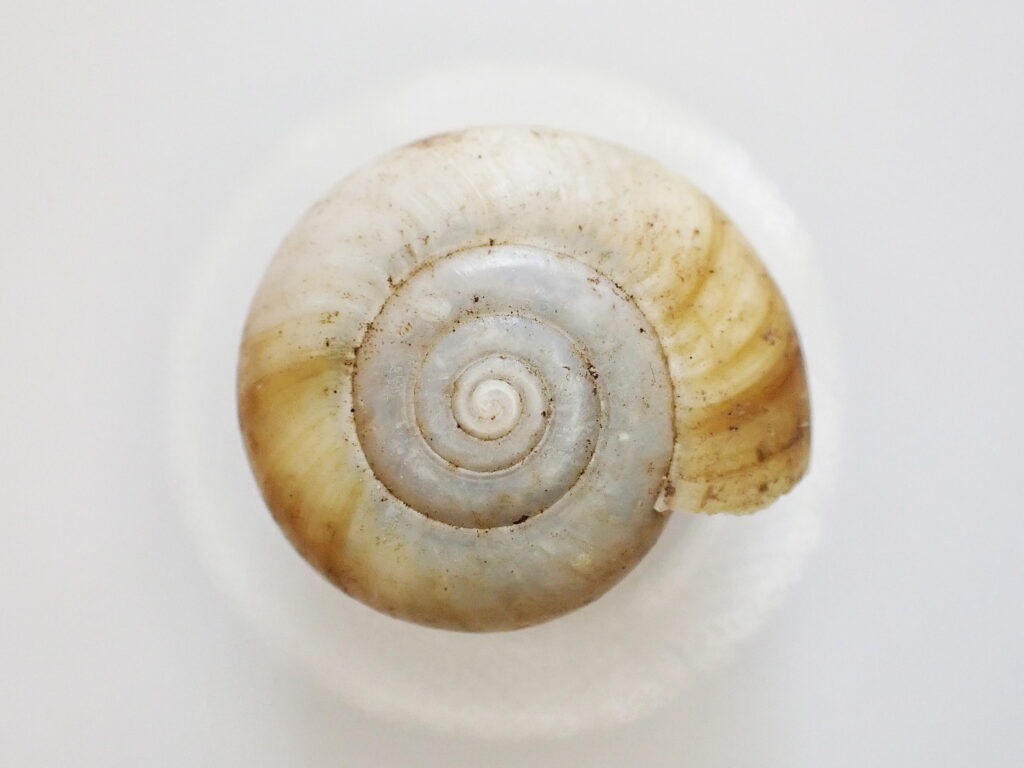
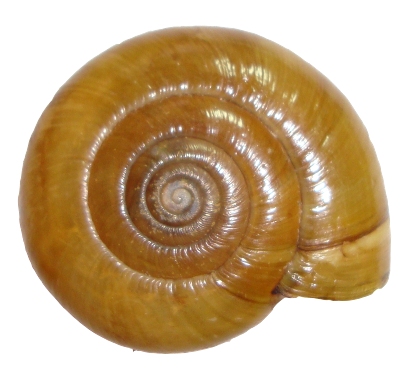
Perpolita binneyana

Image Usage Information

  • Lois and Mark Ports
  • CC BY-NC 4.0 DEED
  • Additional information about this specimen

Family: Gastrodontidae

Common name: Blue Glass

Discovery: E.S. Morse, 1864

Identification

Width: 3.5-4.3 mm
Height: 1.75 mm
Whorls: 3.5-4

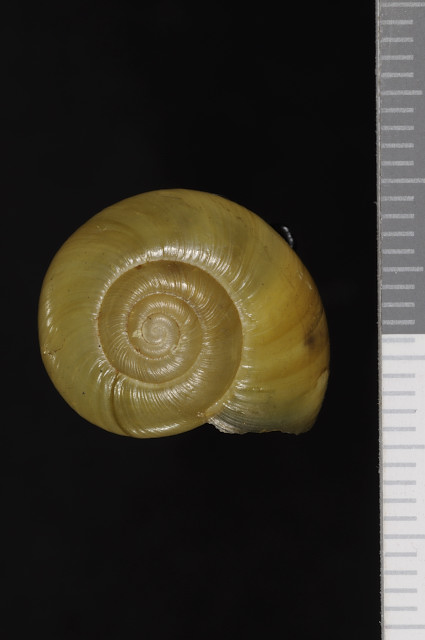
The shell of Perpolita binneyana is heliciform with a simple peristome and no teeth. Closely spaced, transverse striae are present but weakly developed and absent from the base. The spire is slightly elevated, the aperture is well-rounded and the umbilicus shows all its volutions. No spiral striae are present. The glossy, translucent shell is nearly clear, with a slight greenish tinge.

Ecology

P. binneyana is a species of upland mixed hardwood forests of the Northeastern United States where it dwells in leaf litter. In Maine it occurs in a wide variety of habitats, including white cedar-ash wetlands (Nekola, 2008).

Taxonomy

Synonyms for P. binneyana include Nesovitrea binneyana, Hyalina binneyana, Zonites binneyana, Helix morsei, and Retinella binneyana.

Distribution

Records of P. binneyana in the northeastern United States range from Pennsylvania and delware north, and it is also known from Michigan and Wisconsin. Specimens widely reported from West Virginia are likely N. electrina (Dourson, 2015).

Conservation

NatureServe Global Rank: G5, Apparently Secure.
This species is widespread in the northern states of the Northeast region.
January 13, 2023 by

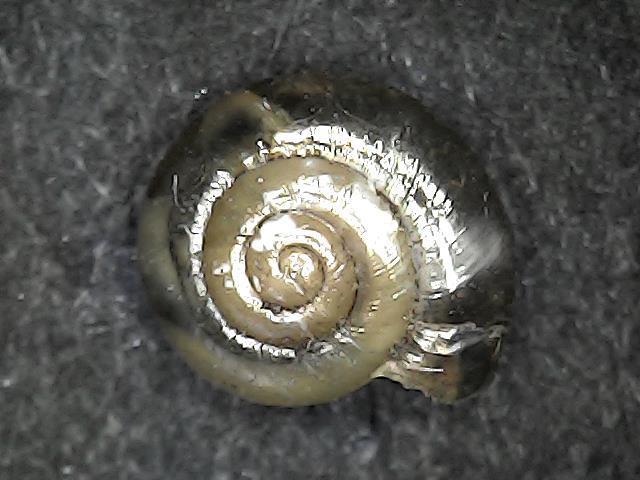
Mesomphix subplanus

Image Usage Information

  • Dan Dourson
  • CC BY-NC 4.0 DEED

Family: Gastrodontidae

Common name: Flat Button

Discovery: A. Binney, 1842

Identification

Width: 16.0–22.3 mm
Height: 6.0–10.6 mm
Whorls: 5.5+

The shell of Mesomphix subplanus is similar in overall plan to many other Mesomphix, but looks as if it has been squeezed in a press. The umbilicus is tiny and is only somewhat indented from the base, which is quite flat, and the apex is also flattened. The shell is thin, and the lip of the aperture is simple and thin. The glossy shell may vary in color, being olive or brown, and it is has radial striations.

Ecology

This species is found at higher altitudes, 2,000 feet or above, in moist leaf litter and around logs (Hubricht, 1985).

Taxonomy

Synonyms for M. subplanus are: Helix sub-plana, Mesomphix subplana, M. subplanus planus, Omphalina subplana, and Zonites subplanus.

Distribution

Mesomphix subplanus has a range similar to that of M. rugeli, though even more limited. It is found mostly along the North Carolina/Tennessee line. It appears in scattered western Virginia counties.

Conservation

NatureServe Global Rank: G3/G4, Vulnerable to Apparently Secure
NatureServe State Rank: Virginia, S2, Imperiled
Virginia’s wildlife action plan: Tier III

January 13, 2023 by

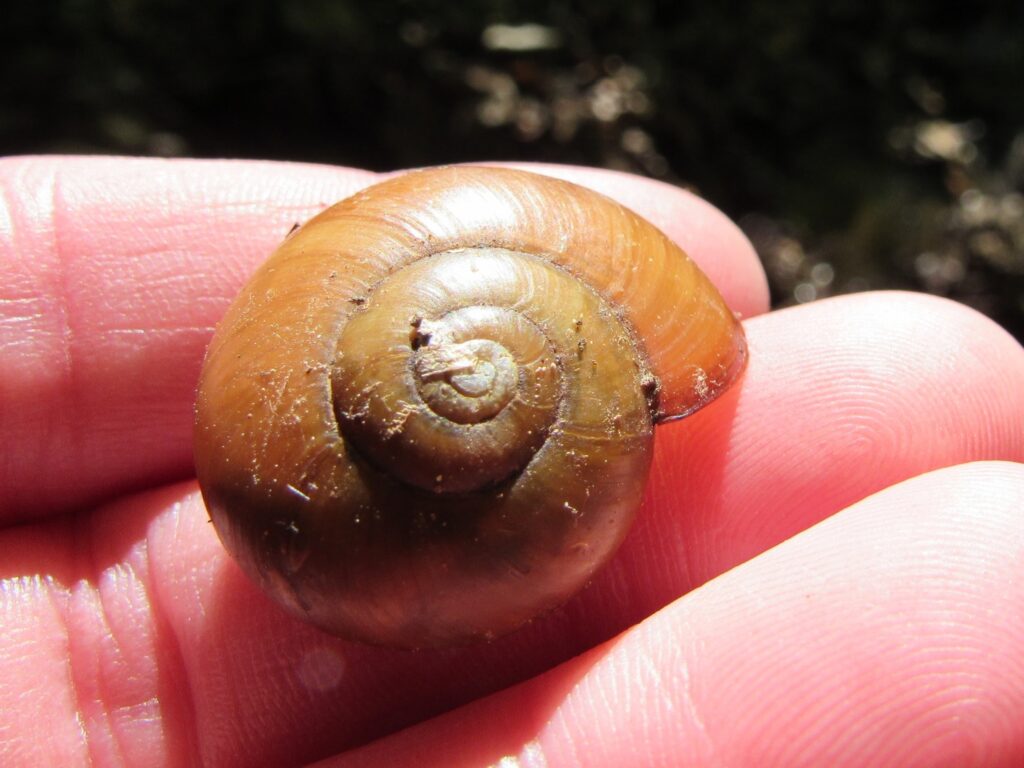
Mesomphix rugeli

Image Usage Information

  • Margarita Lankford
  • CC BY-NC 4.0 DEED
  • Additional information about this specimen

Family: Gastrodontidae

Common name: Wrinkled Button

Discovery: W. G. Binney, 1879

Identification

Width: 16.0–22.1 mm
Height: 9.0–12.6 mm
Whorls: 5+

Mesomphix rugeli has a relatively stout shell with a slightly elevated apex – not as depressed as in M. subplanus, and the last whorl is bigger. Otherwise its shell has a design similar to others in its family, with rounded whorls and a thin lip. As for its shell sculpture, the initial whorl is smooth, after which the sculpture becomes a series of radial ridges, and finally irregular riblets on the later whorls. There are no spiral striae. West Virginia representatives are of the subspecies M. r. oxycoccus, which has a more papillose, duller shell texture (Dourson, 2015).

Ecology

This animal is found under leaf litter on wooded hillsides or mountains (Hubricht, 1985).

Taxonomy

Synonyms for M. rugeli are Mesomphix rugeli oxycoccus, Zonites inornatus, and Z. rugeli.

Distribution

Mesomphix rugeli has a limited range, from northern Alabama, being found mostly along the North Carolina-Tennessee border, and then north into western Virginia.

Conservation

NatureServe Global Rank: G4, Apparently Secure
NatureServe State Rank: Virginia, S3, Vulnerable; West Virginia, not ranked
Virginia’s wildlife action plan: Tier IV

January 13, 2023 by

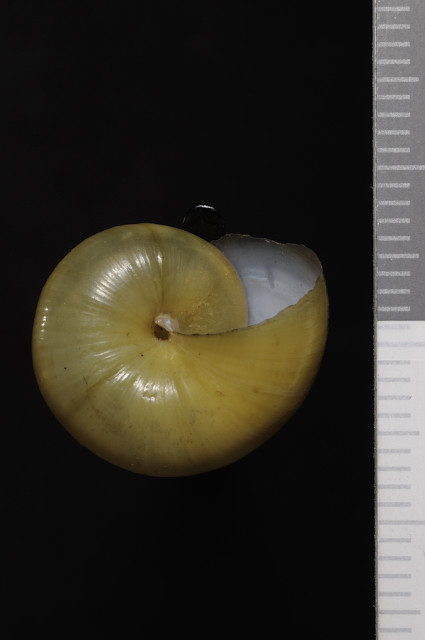
Mesomphix perlaevis

Image Usage Information

  • The Academy of Natural Sciences of Philadelphia
  • CC BY-NC 4.0 DEED
  • For additional information about this specimen: Gary Rosenberg (rosenberg.ansp@drexel.edu)

Family: Gastrodontidae

Common name: Smooth Button

Discovery: Pilsbry, 1900

Identification

Width: 17.6–20.7 mm
Height: 9.7–12.2 mm
Whorls: 4.5

Mesomphix perlaevis has a shell with a low apex, a large outer whorl, and a small umbilicus. The aperture is thin with a white callus lining inside. The somewhat glossy shell has a brown to olive color that fades toward the base. Some specimens may look almost green. The shell has irregular radial ridges, which are “cut” across the top by spiral striae, a useful characteristic for distinguishing it from similar-sized relatives. It may have tiny papillae upon its final whorl, but not extensively as on M. inornatus.

Ecology

This species can usually be found under leaf litter on wooded hillsides.  In Tennessee it is found in limestone areas and oak-pine forests at high elevation (Coney et al, 1982).

Taxonomy

Synonyms for M. perlaevis are Mesomphix laevigata perlaevis and Omphalina laevigata perlaevis.

Distribution

Mesomphix perlaevis occurs from northern Alabama, north to Ohio and southwestern Pennsylvania.

Conservation

NatureServe Global Rank: G5, Secure

January 13, 2023 by

Mesomphix inornatus

Image Usage Information

  • David Lang
  • CC BY-NC 4.0 DEED
  • Additional information about this specimen

Family: Gastrodontidae

Common name: Plain Button

Discovery: Say, 1821

Identification

Width: 16.6 – 21 mm
Height: 8.4 – 11 mm
Whorls: 4+

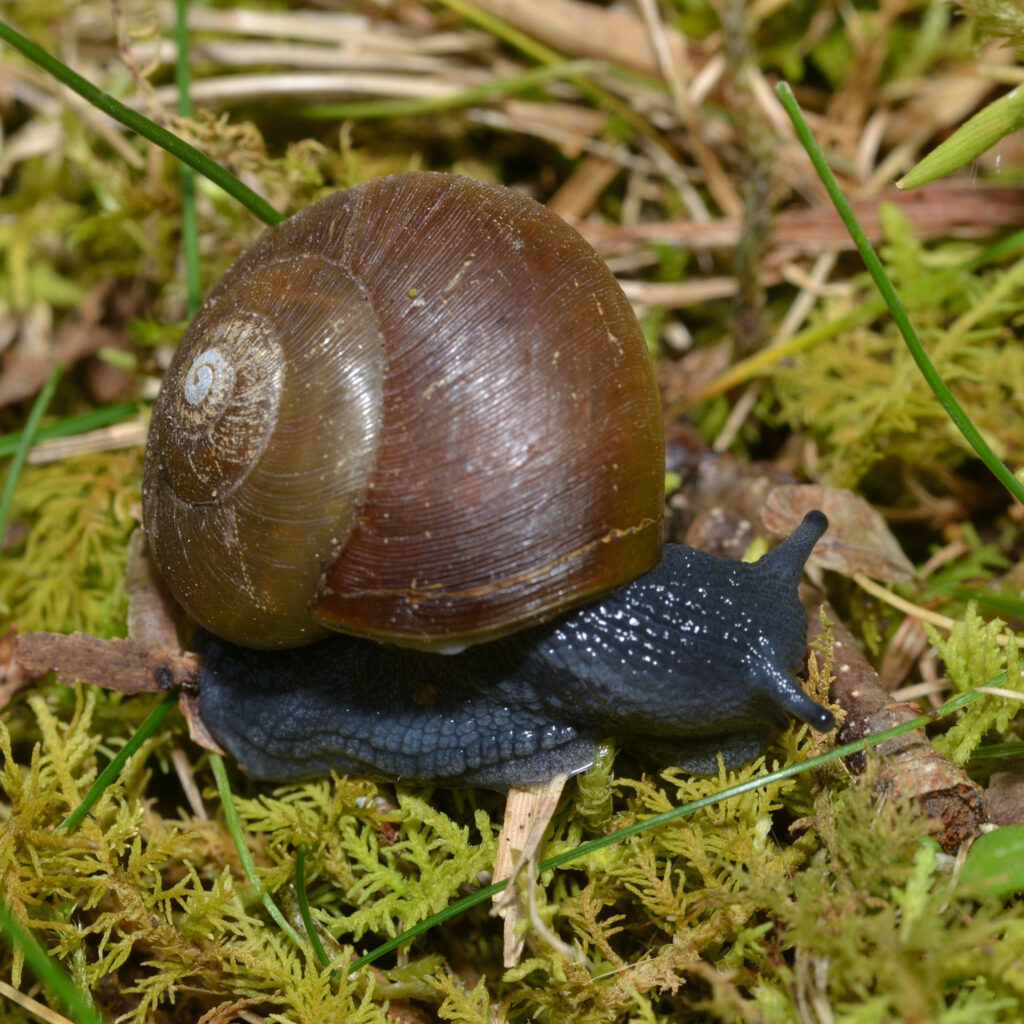
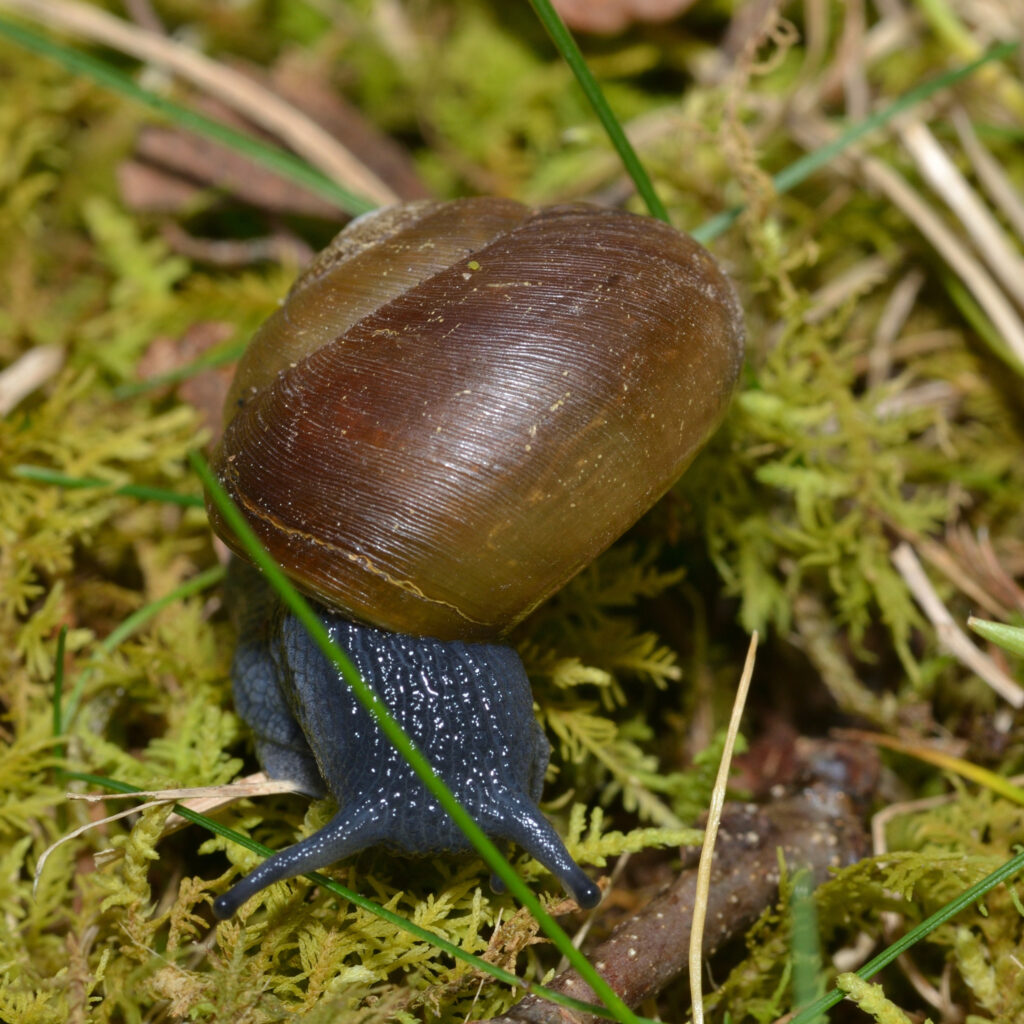
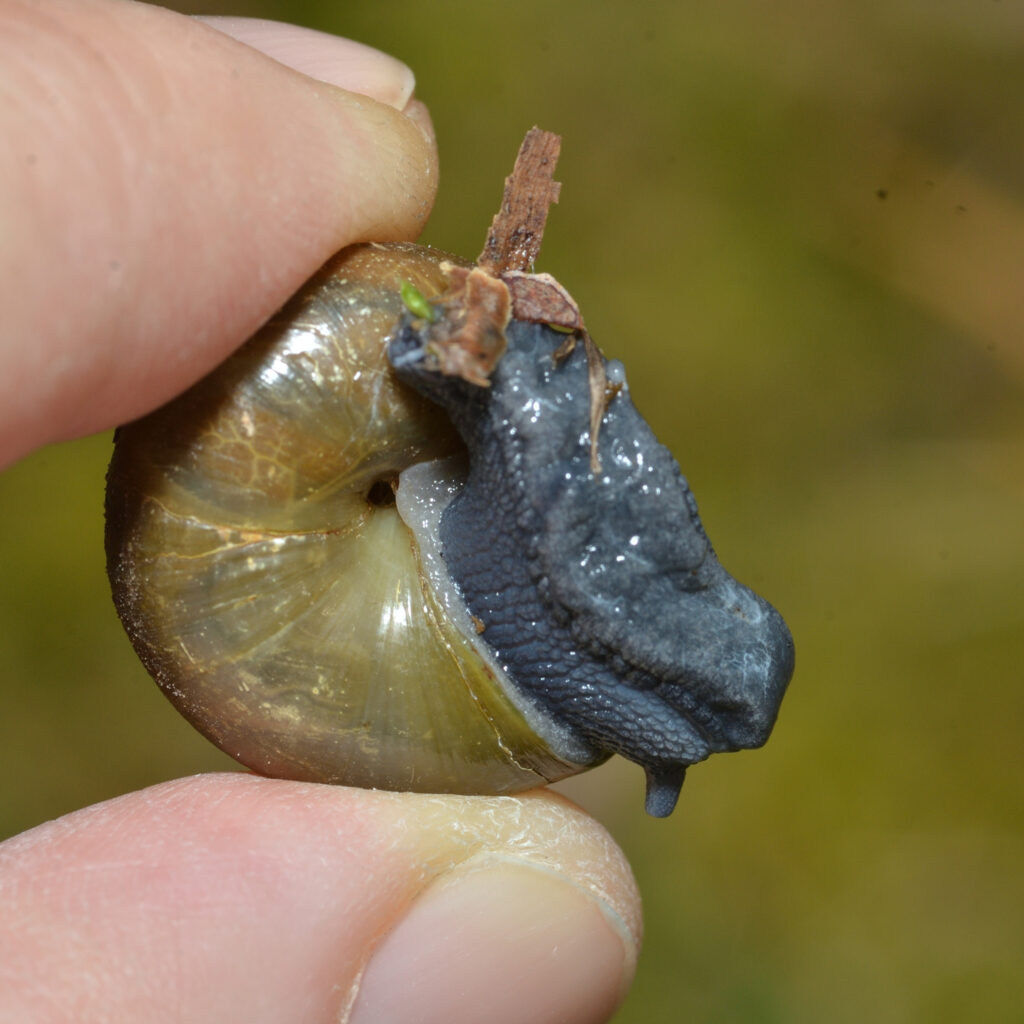
The shell of Mesomphix inornatus is slightly glossy with a golden brownish or almost tan color and little obvious sculpture. However, magnification reveals minute papillae in neat rows and columns. The shell is somewhat flattened and has a thin lip and a very small umbilicus. The last whorl is very large, about double the size of the one before it, making the aperture relatively large. The animal is gray, darker on the back.

Ecology

This animal lives in upland forests under leaves and dead wood (e.g. Hubricht, 1985).

Taxonomy

Synonyms for M. inornatus are Helix inornata, Mesomphix inornata, Omphalina inornata, and Zonites inornatus.

Distribution

The range of M. inornatus is inland from western Tennessee north to New York and central Vermont.  It eschews the coast.

Conservation

NatureServe Global Rank: G5, Secure

January 13, 2023 by

Mesomphix cupreus

Image Usage Information

  • Carrie S. Holt
  • CC BY-NC 4.0 DEED
  • Additional information about this specimen

Family: Gastrodontidae

Common name: Copper Button

Discovery: Rafinesque, 1831

Identification

Width: 22 -25 mm
Height: 12 – 15 mm
Whorls: 4+

The shell of Mesomphix cupreus is large, glossy, and robust. Its color is golden-brown to deep brown, and it typically has a very dark aperture edge. The shell microsculpture lacks papillae and instead may have a fine sandpaper texture, sometimes with spiral grooves (striae). The umbilicus is relatively large for its genus. Similar shells of large immature polygyrids are more transparent (in live animals), have fine radial ridges, and lack the dark lip edge.  Virginia specimens tend to be larger than those from farther north.

Ecology

This species is a denizen of damp forest leaf litter, sometimes near logs, in mature upland forests. Walton (in Pilsbry, 1948) reports it feeding upon other land snails.

Taxonomy

Synonyms for M. cupreus are: Helix fuliginosa, Mesomphix cupreus politus, Omphalina cuprea, O. fuliginosa, Zonites cupreus form sinistrorsus, and Zonites fuliginosus.

Distribution

The range of M. cupreus extends from western New England, New York, and Michigan, south to Tennessee and North Carolina. In the Mid-Atlantic it is not found near the coast. In Virginia it is found in the western mountains and hills.

Conservation

NatureServe Global Rank: G5, Secure

  • « Go to Previous Page
  • Page 1
  • Interim pages omitted …
  • Page 18
  • Page 19
  • Page 20
  • Page 21
  • Page 22
  • Interim pages omitted …
  • Page 53
  • Go to Next Page »

sidebar

About

  • Mission & Commitments
  • Directors Team
  • Museum History

Get Involved

  • Volunteer
  • Membership
  • Carnegie Discoverers
  • Donate
  • Employment
  • Events

Bring a Group

  • Groups of 10 or More
  • Birthday Parties at the Museum
  • Field Trips

Powdermill

  • Powdermill Nature Reserve
  • Powdermill Field Trips
  • Powdermill Staff
  • Research at Powdermill

More Information

  • Image Permission Requests
  • Science Stories
  • Accessibility
  • Shopping Cart
  • Contact
  • Visitor Policies
One of the Four Carnegie Museums | © Carnegie Institute | Privacy Policy | Terms of Use | Accessibility
Rad works here logo