• Skip to primary navigation
  • Skip to main content
  • Skip to primary sidebar

Carnegie Museum of Natural History

One of the Four Carnegie Museums of Pittsburgh

  • Visit
    • Buy Tickets
    • Visitor Information
    • Exhibitions
    • Events
    • Dining at the Museum
    • Celebrate at the Museum
    • Powdermill Nature Reserve
    • Event Venue Rental
    • Gift Cards
  • Learn
    • Field Trips
    • Educator Information
    • Programs at the Museum
    • Bring the Museum to You
    • Guided Programs FAQ
    • Programs Online
    • Climate and Rural Systems Partnership
  • Research
    • Scientific Sections
    • Science Stories
    • Science Videos
    • Senior Science & Research Staff
    • Museum Library
    • Science Seminars
    • Scientific Publications
    • Specimen and Artifact Identification
  • About
    • Mission & Commitments
    • Directors Team
    • Museum History
  • Tickets
  • Give
  • Shop

January 13, 2023 by

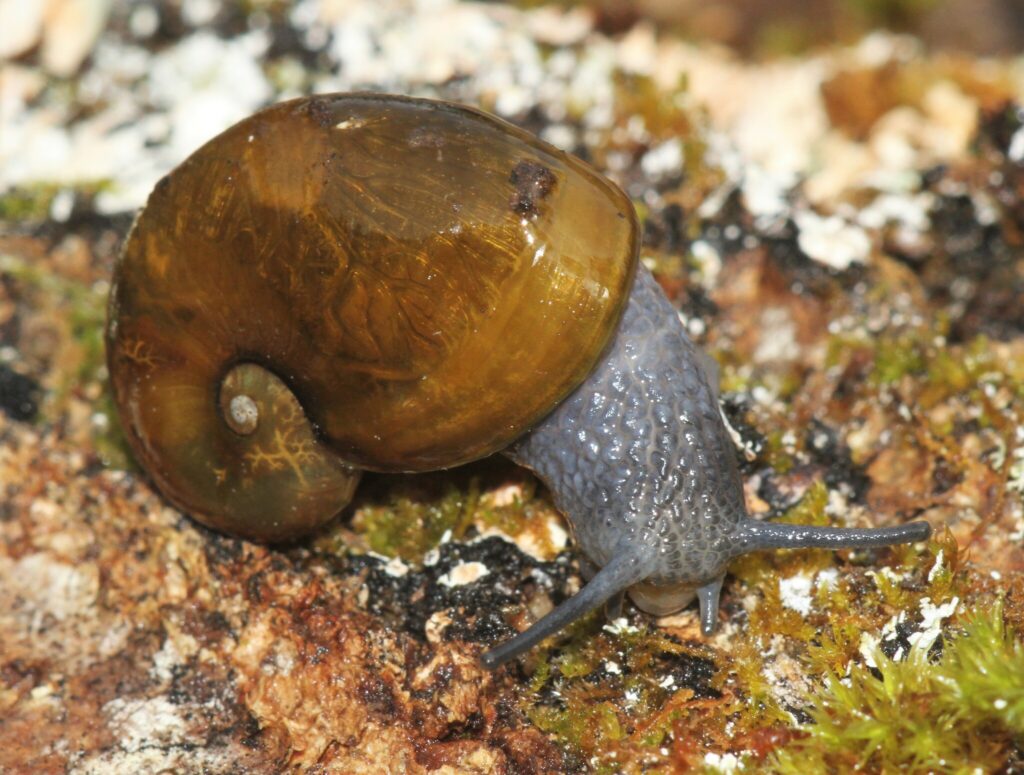
Vitrina angelicae

Image Usage Information

  • Matt Keevi
  • CC BY-NC 4.0 DEED
  • Additional information about this specimen

Family: Vitrinidae

Common name: Eastern glass-snail

Discovery: Beck, 1837

Identification

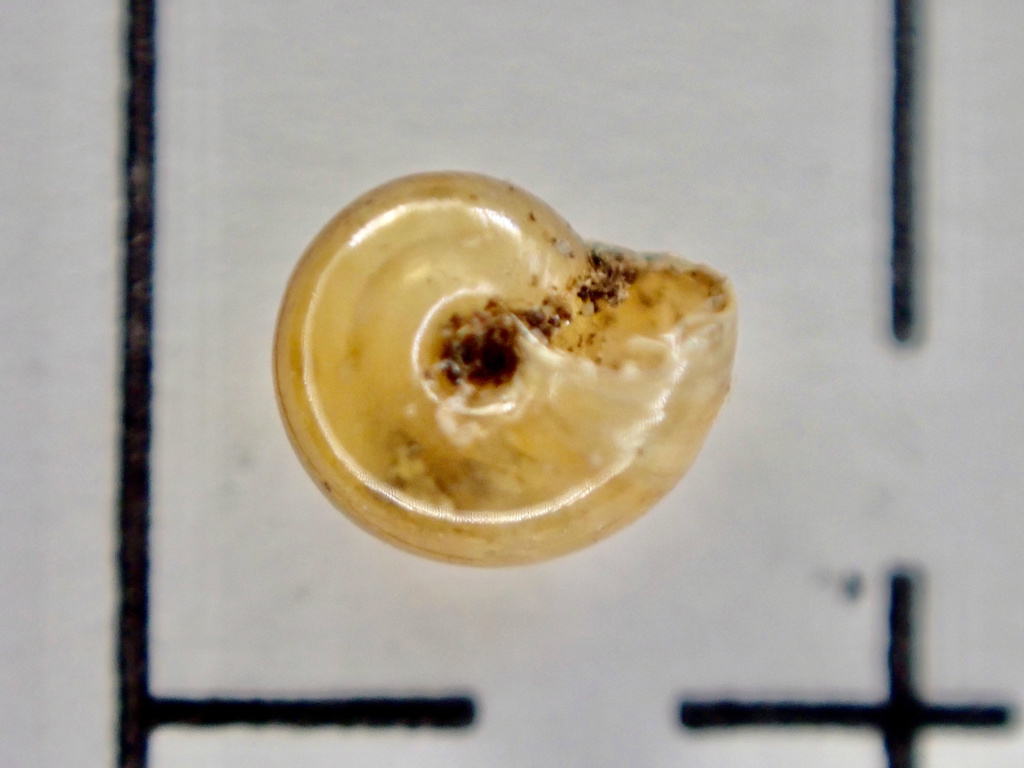
Small and fragile, the eastern glass-snail is unusual in its shape and habits. A nearly transparent shell, whose body whorl opens widely, seems barely large enough to cover the snail’s soft body as it withdraws. This snail is often found in damp grassy habitats near wetlands, streams and rivers, sometimes beneath wood, or among rocks. They may be found in apparently dry habitats that are wet during other parts of the year.

The shell of the eastern glass-snail is 6mm wide and 4.5mm tall, described by Gould (in Pilsbry, 1946) as “globose-discoid” with the last whorl “much expanded.” The shell is shiny, thin and fragile, and is clear or pale green. The umbilicus is tiny.

Ecology

The eastern glass-snail seems contrary in its habits—it is a northern species that is only active and breeding late in the year, rather than in the warmer months as most land snails. It is apparently an annual, not found alive in spring and summer. George Clapp reported that this species was among river drift along the Ohio River near Pittsburgh, and large numbers were seen in October and November when the temperature was between 1.7º and 7.2ºC (35º and 45 ºF; (in Pilsbry, 1946). Clapp observed them laying eggs in bunches of six or eight beneath wood debris.

Taxonomy

This species has no known synonyms.

Distribution

This animal is distributed in Europe, Canada, and the northern United States to the Midwest. In Pennsylvania it is found in the north and west (Hubricht, 1985).
Conservation

January 13, 2023 by

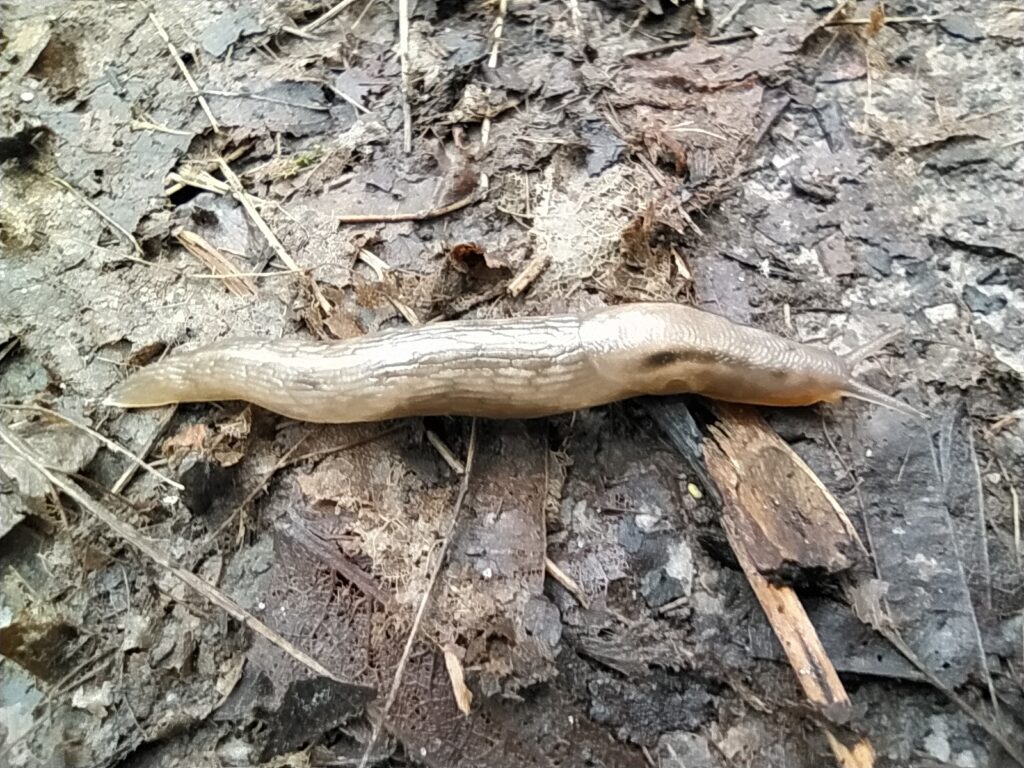
Limax maximus

Image Usage Information

  • maryrebeccau
  • CC BY-NC 4.0 DEED
  • Additional information about this specimen

Image Usage Information

  •  Nadja Baumgartner
  • CC BY-NC 4.0 DEED
  • Additional information about this specimen

Family: Limacidae

Common name: Giant Gardenslug

Discovery: Linnaeus, 1758

Non-native

Identification

Length: 100 – 200 mm

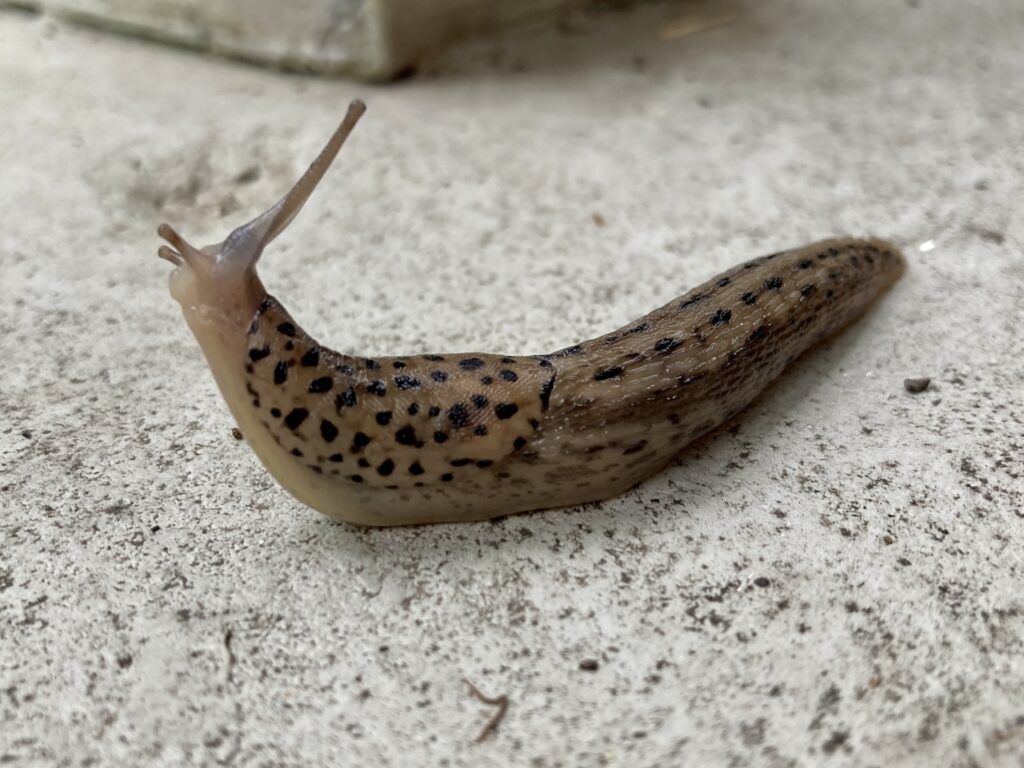
The introduced Limax maximus has a mantle covering the anterior portion of its dorsum (back). In this slug the mantle actually encloses a small vestigial shell. While the mantle is darkly spotted or marbled, the slug’s posterior has two or three dark longitudinal stripes (Kerney & Cameron, 1979). Its upper color varies from brownish green to gray, and its sole (underside) is whitish. The posterior has a “keel,” or ridge. Its slime is sticky and colorless, and its penis, which might be observed during mating, is pale blue. It is native to Europe.

Ecology

This giant non-native slug prowls gardens, yards, sidewalks, or old homesites in the woods, typically at night. It is omnivorous, generally eating plant material but also feeding upon other slugs. It conducts aerial mating, in which a pair of slugs mates while suspending themselves from a mucus strand attached to a tree branch or other object.

Up to several dozen eggs are laid under rocks or logs in the fall (Chichester & Getz, 1973). Eggs in the laboratory hatched in three to four weeks. Individuals may live four years.

Taxonomy

Distribution

Conservation

NatureServe Global Rank: G5
NatureServe State Rank: SNA

January 13, 2023 by

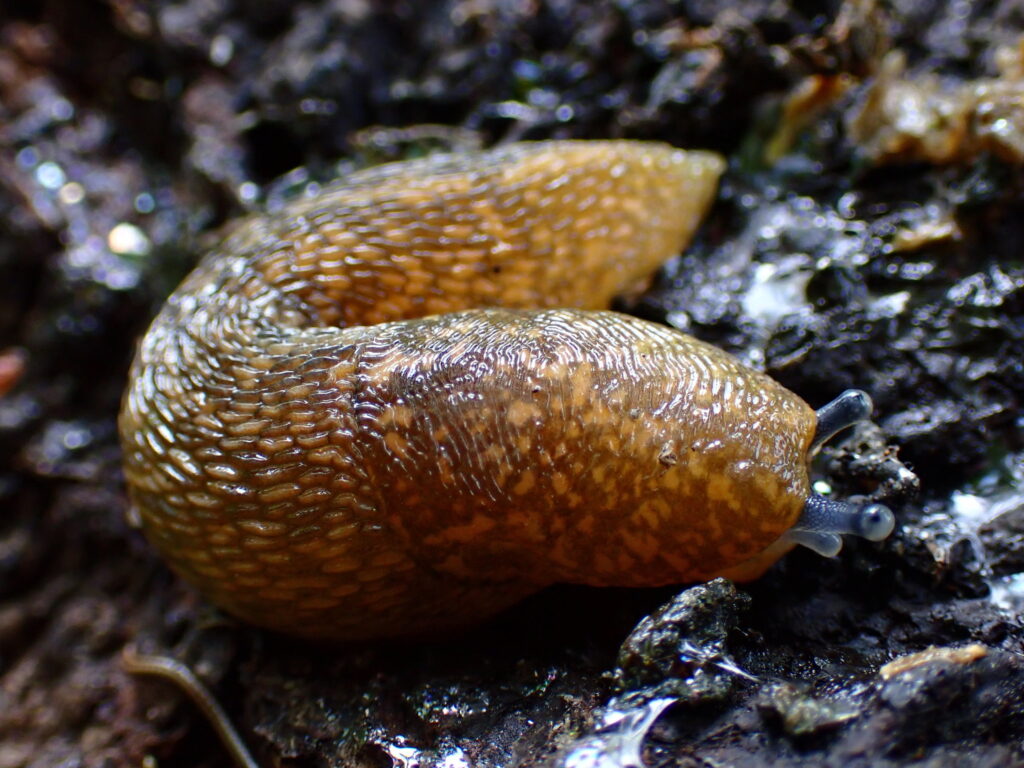
Limacus flavus

Image Usage Information

  • Richard Hasegawa
  • CC BY-NC 4.0 DEED
  • Additional information about this specimen

Family: Limacidae

Common name: Yellow Gardenslug, Yellow Cellar Slug

Discovery: Linnaeus, 1758

Non-native

Identification

Length: 75-100 mm

The body of L. flavus is yellowish to orange-pink with gray-green mottling, and its tail has a short keel. The tentacles are light blue-gray. Its sole is yellow-white with clear mucus, and the body mucus is yellow (Herbert, 1997; Kerney & Cameron, 1979).

Limacus flavus is similar to L. pseudoflavus and L. maculatus.  However, L. pseudoflavus is grayer and has darker markings, coarser tubercles, and gray tentacles (Kerney & Cameron ,1979), and L. maculatus is darker in color, and internally, its spermatheca connects to its penis (Wiktor et al., 2000).

Ecology

Limacus flavus is a synanthropic slug that was probably native to the forests of the Mediterranean region (Wiktor et al., 2000; Heller 2009). Internationally, it occupies disturbed habitats, gardens, waste piles, and buildings, and it takes shelter under logs and discarded waste (Herbert, 2010). Slugs are omnivorous, consuming dead and living plants (especially roots and fruit), algae, lichens, fungi, and domestic waste (Graham, 1955; Wiktor et al., 2000; Herbert, 2010).

In Britain, L. flavus mates in late summer to February, and it lays eggs in September and February (Quick, 1960).

Taxonomy

Synonyms include Limax flavus, L. variegatus, L. megalodontes, Limacus breckworthianus, and Deroceras (Agriolimax) melasma.

Distribution

Limacus flavus is a Mediterranean species that has been introduced to some of the southern, midwestern, and Northeastern US, as well as to southeastern Canada and Washington. In the Northeast, L. flavus has been found in mostly urban areas of New Jersey (Hudson Co.), New York (Bronx, Albany, and Columbia Counties), Pennsylvania (Allegheny, Philadelphia, and Chester Counties), and Maryland (Kent Co.).

Conservation

NatureServe Global Rank: G5, Apparently secure.

January 13, 2023 by

Lehmannia marginata

Image Usage Information

  • ahmedm 
  • CC BY-NC 4.0 DEED
  • Additional information about this specimen

Image Usage Information

  • Andrii Churilov
  • CC BY-NC 4.0 DEED
  • Additional information about this specimen

Family: Limacidae

Common name: Tree Slug

Discovery: Müller, 1774

Non-native

Identification

Length: 50-80 mm

The body of L. marginata is translucent pale gray to yellow, with two dark longitudinal bands (maybe broken into spots) on the dorsum. Two dark lines on the mantle form a lyre shape, and an indistinct dark line lies in between them. There is a short, pale keel toward the tail tip. The sole is gray-white. The slug produces clear body mucus, and when a potential predator perturbs it, the slug releases plentiful watery mucus (Quick, 1960; Kerney & Cameron, 1979; Abbes et al., 2010).

Lehmannia marginata and Ambigolimax valentiana are externally very similar-looking, but A. valentianus is yellowish and paler, has dorsal bands that are closer together, and possesses different genitalia. L. marginata may be confused with young Limax maximus, but L. marginata has a striped mantle and is translucent (Kerney & Cameron, 1979).

Ecology

Slugs may be found in forests and on open ground. They rest under the bark of dead trees, under damp rocks on clay soil (Kerney & Cameron, 1979; Abbes et al., 2010), and when available, on vertical rocks or live tree trunks, especially beech and hornbeam (Cameron, 1978; Wiktor, 1996). They tend to climb tree trunks in wet weather (Quick, 1960). Foods include live plants, wood (Jennings & Barkham, 1975), and especially lichen (Grimm et al., 2009).

The lifespan is three years, with slugs reaching maturity during their second year (Wiktor, 1996). These slugs can rappel down a mucus thread, particularly when they are young (Quick, 1960).

Taxonomy

The many synonyms of this species include Limax marginatus, L. scopulorum, L. salicium, L. limbatus, L. arborum, L. livonicus, L. scandens, L. arboreus, L. glaucus, L. arboretum, L. helveticus, L. altilis, and Lehmannia bielzi.

Distribution

Lehmannia marginata is a European species that has localities scattered across the southern and northeastern US and southwestern-most Canada. Museum site records for the northeast US include Delaware and West Virginia (Cabell and Wood Counties). (Note that L. marginata was often used incorrectly as the name of Ambigolimax valentiana in older North American literature [Grimm et al., 2009].)

Conservation

NatureServe Global Rank: G5, Apparently secure.

January 13, 2023 by

Vitrinizonites latissimus

Image Usage Information

  • Waynevand
  • CC BY-NC 4.0 DEED
  • Additional information about this specimen

Family: Gastrodontidae

Common name: Glassy Grapeskin

Discovery: J. Lewis, 1875

Identification

Width: 16.2-19.5 mm
Height: 6.0-9.2 mm
Whorls: 3

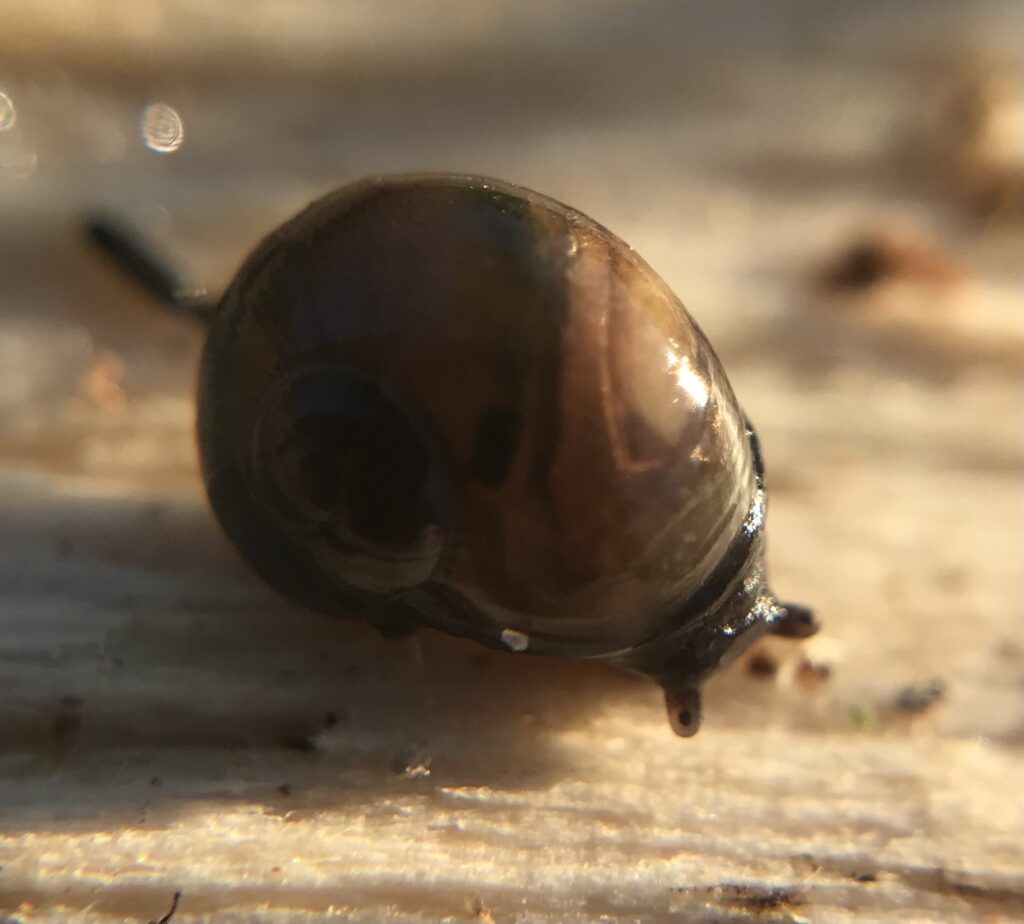
This is the only snail in Virginia that might be called a semi-slug. Its shell is thin and fragile, with few whorls, and the animal cannot completely withdraw its body. The shell color is brownish to greenish. The animal is gray with lighter flecks, palest along the foot edge.

Ecology

Vitrinizonites latissimus is a southern Appalachian Mountain endemic, occurring in mesic forests above 300 meters (Pilsbry, 1946). It is widespread at higher elevations in the Great Smoky Mountains. It is found in mixed hardwood forests but also upon more acid soils in rhododendron thickets (Dourson, 2010).

Taxonomy

A synonym for V. latissimus is Vitrina latissima.

Distribution

This species occurs from eastern Kentucky and western Virginia to northern Georgia and Alabama (Hubricht, 1985). Specimens are reported in Virginia only from four southwestern counties.

Conservation

NatureServe Global Rank: G4
NatureServe State Rank: S2?
Virginia’s wildlife action plan: Tier IV

January 13, 2023 by

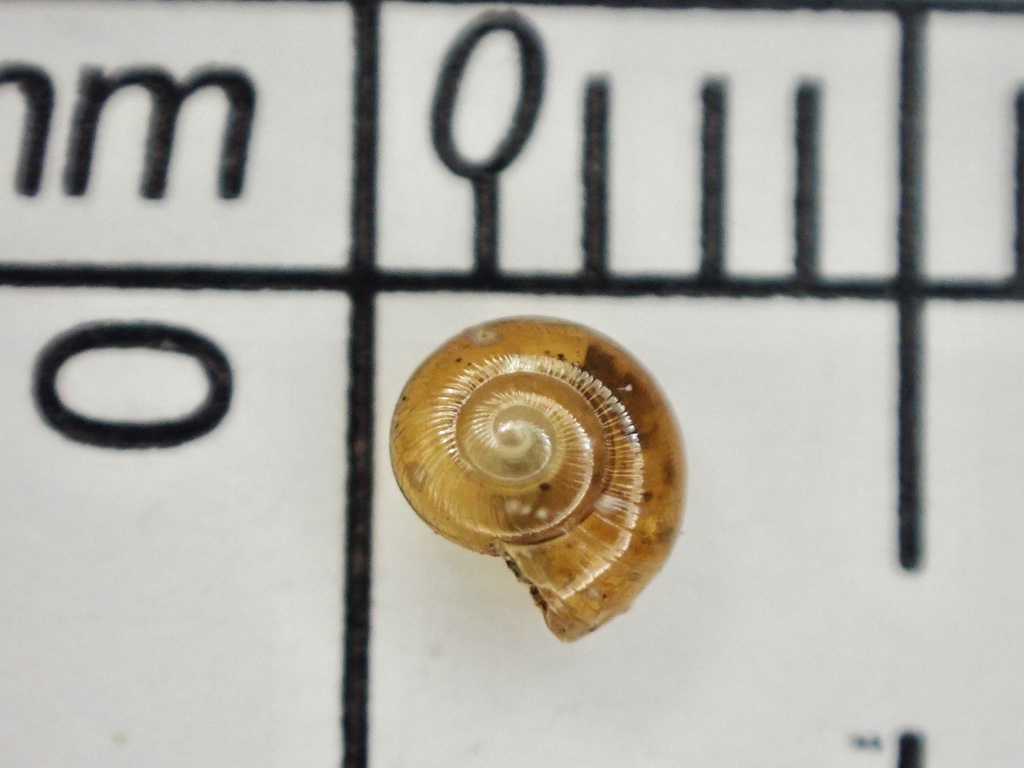
Perpolita electrina

Image Usage Information

  • Eli T.
  • CC BY 4.0 DEED
  • Additional information about this specimen

Family: Gastrodontidae

Common name: Amber Glass

Discovery: Gould, 1841

Identification

Width: 4.5-5.2 mm
Height: 2.5-2.8 mm
Whorls: 4.2-4.5

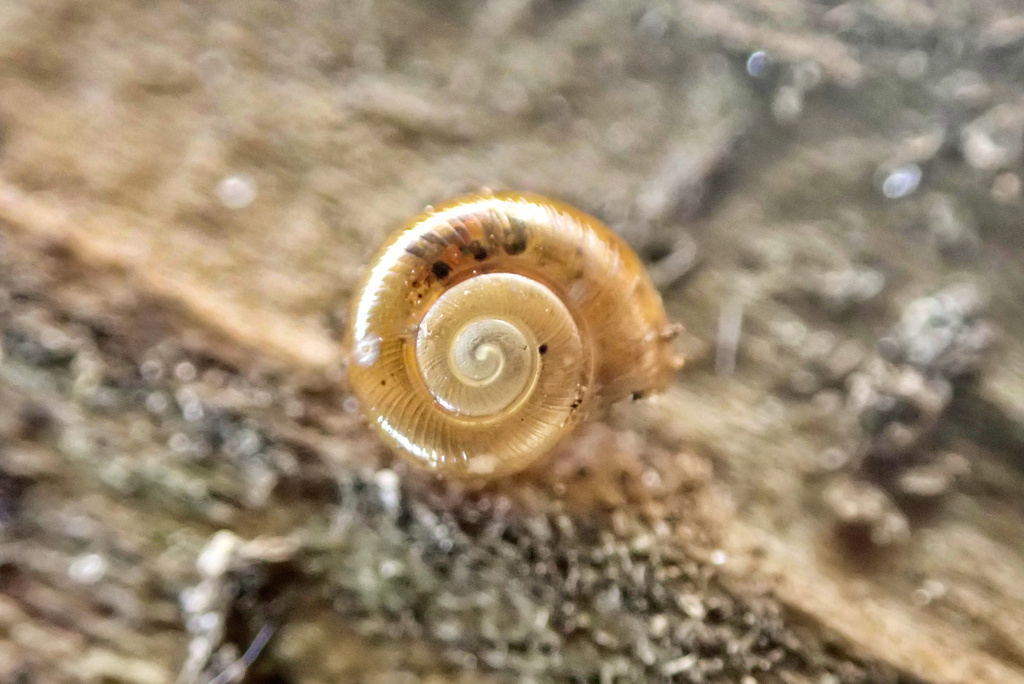
Perpolita electrina is average sized, having a depressed shell with a slightly rounded apex and whorls that increase relatively rapidly but gradually in size. The final whorl does not increase more rapidly than previous whorls. The umbilicus is about on quarter to one fifth the shell width. The shiny and translucent shell is sculptured with closely and irregularly spaced narrow indentations that run parallel to the indistinct growth lines. These grooves extend from the apical surface becoming progressively weaker and less numerous towards the umbilicus. In addition, there is sometimes microscopic sculpture of very weak incised spiral lines. The shell is uniformly translucent amber-brown. The dorsal surface of the body is nearly black fading to dark gray on the sole of the foot.  Internally, the apex of the penis has circular pilasters.

Ecology

This animal is found in a wide variety of wet habitats including wet prairies, freshwater marshes, lake margins, and wet forests. It is tolerant of a wide range of soil pH and is found on acidic, neutral and basic soils (Nekola, 2010).

Taxonomy

There are many synonyms for P. electrina including Nesovitrea electrina, Helix electrina, H. janus, Zonites radiatulus, Z. viridulus, Hylania pellucida, H. radiatula Electrina, Vitrea radiatula, Vitrea hammonis, Retinella hammonis, and R. electrina.

Distribution

Nesovitrea electrina has a remarkably wide native range in North America – from the Arctic Ocean south to Virginia. In Virginia in the east, and from Alaska to New Mexico in the west.

Conservation

NatureServe Global Rank: G5, Secure

  • « Go to Previous Page
  • Page 1
  • Interim pages omitted …
  • Page 17
  • Page 18
  • Page 19
  • Page 20
  • Page 21
  • Interim pages omitted …
  • Page 53
  • Go to Next Page »

sidebar

About

  • Mission & Commitments
  • Directors Team
  • Museum History

Get Involved

  • Volunteer
  • Membership
  • Carnegie Discoverers
  • Donate
  • Employment
  • Events

Bring a Group

  • Groups of 10 or More
  • Birthday Parties at the Museum
  • Field Trips

Powdermill

  • Powdermill Nature Reserve
  • Powdermill Field Trips
  • Powdermill Staff
  • Research at Powdermill

More Information

  • Image Permission Requests
  • Science Stories
  • Accessibility
  • Shopping Cart
  • Contact
  • Visitor Policies
One of the Four Carnegie Museums | © Carnegie Institute | Privacy Policy | Terms of Use | Accessibility
Rad works here logo