• Skip to primary navigation
  • Skip to main content
  • Skip to primary sidebar

Carnegie Museum of Natural History

One of the Four Carnegie Museums of Pittsburgh

  • Visit
    • Buy Tickets
    • Visitor Information
    • Exhibitions
    • Events
    • Dining at the Museum
    • Celebrate at the Museum
    • Powdermill Nature Reserve
    • Event Venue Rental
    • Gift Cards
  • Learn
    • Field Trips
    • Educator Information
    • Programs at the Museum
    • Bring the Museum to You
    • Guided Programs FAQ
    • Programs Online
    • Climate and Rural Systems Partnership
  • Research
    • Scientific Sections
    • Science Stories
    • Science Videos
    • Senior Science & Research Staff
    • Museum Library
    • Science Seminars
    • Scientific Publications
    • Specimen and Artifact Identification
  • About
    • Mission & Commitments
    • Directors Team
    • Museum History
  • Tickets
  • Give
  • Shop

January 13, 2023 by

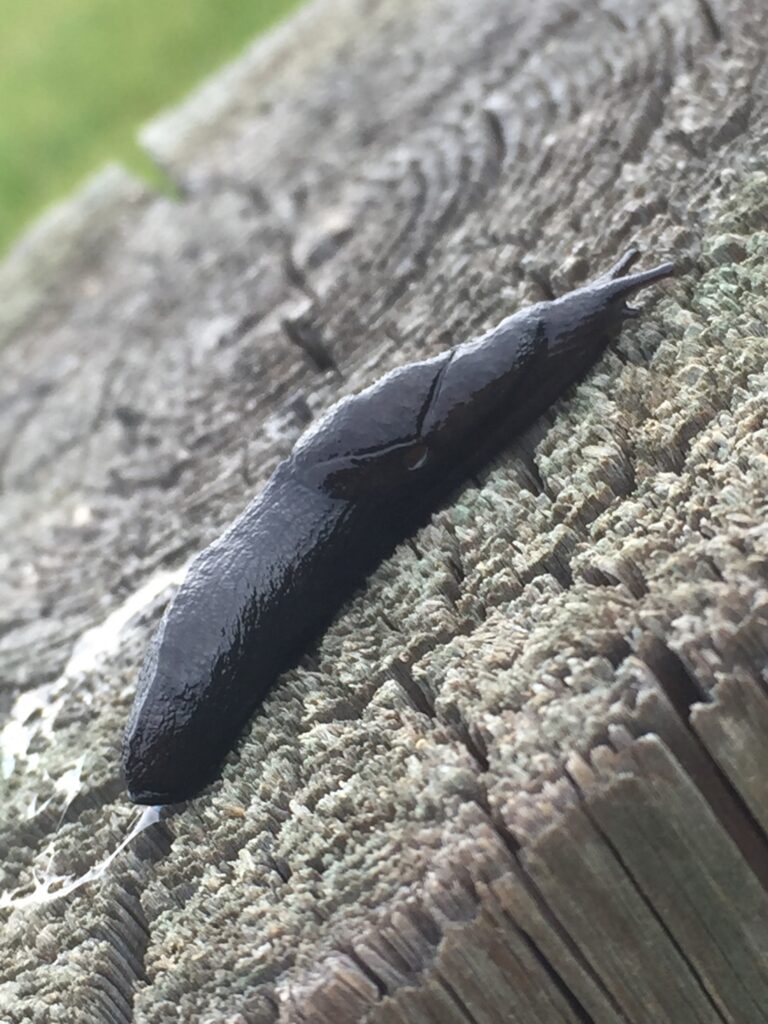
Milax gagates

Image Usage Information

  • John Martin
  • CC BY-NC 4.0 DEED
  • Additional information about this specimen

Family: Milacidae

Common name: Greenhouse Slug

Discovery: Draparnaud, 1801

Identification

Length: 50-60 mm

The slug Milax gagates is medium-sized, with a prominent dorsal keel from the mantle to the tail. It is gray-colored above, lighter on the sides, and whitish underneath. The keel is sometimes lighter. Its mucus is white or colorless. Pilsbry (1948) noted that Norfolk, Virginia, specimens have a very black dorsal surface.

Ecology

Milax gagates is found in a variety of habitats in western Europe and the Mediterranean – most commonly along coasts in gardens, farms, grassy seashore, hedges, and woods (Kerney & Cameron, 1979). In Argentina this animal is a pest of soybeans, sunflowers, and oilseed rape (Clemente et al., 2010). There, eggs hatched at 23 days. In Canada this slug is vulnerable to frost and overwinters in the egg stage (Grimm et al., 2009).

Taxonomy

Synonyms for Milax gagates include Limax gagates, L. hewstoni, Amalia gagates, and M. hewstoni.

Distribution

This slug has been introduced to both North American coasts. In Virginia specimens have reportedly been collected from Pittsylvania and Northampton Counties, as well as Norfolk.

Conservation

NatureServe Global Rank: G5, Secure

January 13, 2023 by

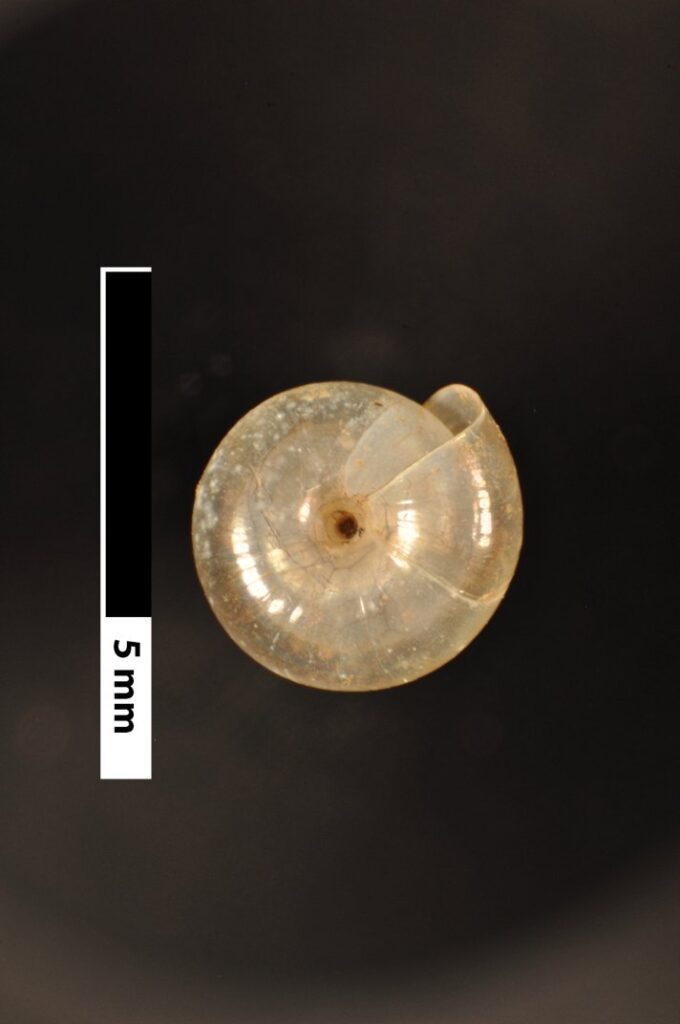
Paravitrea tridens

Image Usage Information

  • The Academy of Natural Sciences of Philadelphia
  • CC BY-NC 4.0 DEED
  • For additional information about this specimen: Gary Rosenberg (rosenberg.ansp@drexel.edu)

Family: Pristilomatidae

Common name:  White-foot Supercoil

Discovery: Pilsbry, 1946

Identification

Width: 5.5-6.5 mm
Height: 2.5-3.5 mm
Whorls: 6+

The spire of Paravitrea tridens is low but distinctively dome-shaped and somewhat pointed. The shell is lined with radial growth wrinkles and the periphery appears a bit oblong. The aperture is larger than in other Paravitrea species. As a juvenile, the shell may have between one and three sets of three teeth each, radially-aligned inside the final whorl. These disappear with age, however, and the adult shell is toothless.

Ecology

This animal may be found in moist leaf litter on mountain hillsides (Hubricht, 1985).

Taxonomy

Paravitrea tridens has also been known as Paravitrea capsella tridens.

Distribution

Paravitrea tridens is only known from a few counties in the easternmost Appalachian Mountains of Tennessee (Hubricht, 1985). It might be found in nearby western Virginia, perhaps Washington, Grayson, or Smyth Counties. The species is not yet reported.

Conservation

NatureServe Global Rank: G2
NatureServe State Rank: SNR

January 13, 2023 by

Paravitrea subtilis

  • Field Museum of Natural History
  • CC BY-NC 3.0 DEED
  • Field Museum Copyright Information
  • For additional information about this specimen, please contact: Rüdiger Bieler, Curator (rbieler@fieldmuseum.org)

Family: Pristilomatidae

Common name: Slender Supercoil

Discovery: Hubricht, 1978

Identification

Width: 2.5-3 mm
Height: 1.5 mm
Whorls: 6+

The tightly coiled whorls of Paravitrea subtilis are marked with widely and irregularly-spaced radial growth lines. On the center whorls and the base of the shell, these lines are less distinct. The shell has a relatively tall aperture. Inside the final whorl, one or two sets of teeth are arranged in radial rows. Each row may contain between four and six teeth, and in some individuals, laminae replace the teeth.

Ecology

Paravitrea subtilis may be found in leaf litter on hardwood slopes (Hubricht, 1985; Dourson, 2010).

Taxonomy

There are no synonyms.

Distribution

Paravitrea subtilis is scattered through a small number of counties in Virginia, Kentucky, and Tennessee (Hubricht, 1985). In Virginia it is known only from Wise County.

Conservation

NaureServe Global Rank: G2
NaureServe State Rank: S1S2
Virginia’s wildlife action plan: Tier II

January 13, 2023 by

Paravitrea seradens

  • Field Museum of Natural History
  • CC BY-NC 3.0 DEED
  • Field Museum Copyright Information
  • For additional information about this specimen, please contact: Rüdiger Bieler, Curator (rbieler@fieldmuseum.org)

Family: Pristilomatidae

Common name: Barred Supercoil

Discovery: Hubricht, 1972

Identification

Width: 5-6 mm
Height: 2.5-3 mm
Whorls: 6+

The glossy, amber-colored shell of Paravitrea seradens may appear somewhat angular when juvenile, due to a flattened base and a square-shaped periphery. The periphery becomes more rounded with age. The final whorl expands abruptly and slopes downward as it approaches the aperture. A deep umbilicus provides a view of all the whorls. The outer and basal walls of the outer whorls have one or more pairs of large teeth, which are present at all stages of growth.

Ecology

This animal may be found in moist leaf litter on wooded slopes (Hubricht, 1985).

Taxonomy

There are no synonyms.

Distribution

Paravitrea seradensis reported from a handful of counties across the Appalachian Mountains in Virginia, Kentucky, and West Virginia. In Virginia it is found only in two far western counties on the West Virginia border – Bland and Giles (Hubricht, 1985).

Conservation

NatureServe Global Rank: G3
NatureServe State Rank: S1S3
Virginia’s wildlife action plan: Tier II

January 13, 2023 by

Mesomphix capnodes

placeholder

Family: Zonitidae

Common name:  Dusky Button

Discovery: W. G. Binney, 1857

Identification

Width: 28-35 mm
Height: 17.5–26.0 mm
Whorls: 5

Mesomphix capnodes is large, and has a shell shaped like many other species in its family, with a low apex, thin lip, rounded whorls and a large outer whorl. It has a small umbilicus, and a big downward-tilting aperture, two features that are more pronounced here than in the similar shell of M. cupreus. Its most important distinguishing feature is its shell microsculpture – fine spiral threads that are cross-hatched to create rows of small bumps or papillae.  The shell may have a greenish tint, darkening toward the lip. The height of the apex may vary within a population (Dourson, 2015).

Ecology

This species is a calciphile and can be found under leaf litter in upland forests (Hubricht, 1985).

Taxonomy

Synonyms for M. capnodes are:  Helix kopnodes, Mesomphix cupreus ozarkensis, M. c. miktus, Omphalina kopnodes, and Zonites capnodes.

Distribution

Mesomphix capnodes is mainly an animal of southern hill lands, concentrated most heavily in and around the Arkansas-Oklahoma border and in Alabama and Tennessee.  In Virginia its reports are scattered in the west, and some are suspect due to this species’ similarity to its relatives.

Conservation

NatureServe Global Rank: G5, Secure
NatureServe State Rank: Virginia, S3, Vulnerable; West Virginia, SH, Historic

January 13, 2023 by

Paravitrea septadens

  • Field Museum of Natural History
  • CC BY-NC 3.0 DEED
  • Field Museum Copyright Information
  • For additional information about this specimen, please contact: Rüdiger Bieler, Curator (rbieler@fieldmuseum.org)

Family: Pristilomatidae

Common name: Brown Supercoil

Discovery: Hubricht, 1978

Identification

Width: 3-4 mm
Height: 1.5-2 mm
Whorls: 6+

The spire of Paravitrea septadens is very low, causing the shell to appear nearly disk-shaped. Irregularly-spaced radial growth lines mark the later whorls; lines are less distinct on the base of the shell, and the nuclear whorl is smooth. The umbilicus is narrow, deep and well-like. The whorls slowly increase in size, expanding somewhat abruptly near the aperture in older shells. The final whorl usually contains a radial lamella, sometimes two, visible through the translucent base of the shell.

Ecology

Paravitrea septadens is found on steep forested slopes and in ravines, often among woody debris, rocks, or deeper leaf litter. It is found in mixed eastern hemlock-hardwood forest, and also in richer hardwood stands (Hotopp, per obs). It is frequently found together with P. multidentata (Hubricht, 1985).

Taxonomy

There are no synonyms.

Distribution

Paravitrea septadens is known only from Dickenson and Buchanan Counties, Virginia (Hubricht, 1985), and adjacent Pike County, Kentucky (Dourson, 2010).

Conservation

NatureServe Global Rank: G1
NatureServe State Rank: S1
State Status: Threatened
Virginia’s wildlife action plan: Tier I

  • « Go to Previous Page
  • Page 1
  • Interim pages omitted …
  • Page 19
  • Page 20
  • Page 21
  • Page 22
  • Page 23
  • Interim pages omitted …
  • Page 53
  • Go to Next Page »

sidebar

About

  • Mission & Commitments
  • Directors Team
  • Museum History

Get Involved

  • Volunteer
  • Membership
  • Carnegie Discoverers
  • Donate
  • Employment
  • Events

Bring a Group

  • Groups of 10 or More
  • Birthday Parties at the Museum
  • Field Trips

Powdermill

  • Powdermill Nature Reserve
  • Powdermill Field Trips
  • Powdermill Staff
  • Research at Powdermill

More Information

  • Image Permission Requests
  • Science Stories
  • Accessibility
  • Shopping Cart
  • Contact
  • Visitor Policies
One of the Four Carnegie Museums | © Carnegie Institute | Privacy Policy | Terms of Use | Accessibility
Rad works here logo