• Skip to primary navigation
  • Skip to main content
  • Skip to primary sidebar

Carnegie Museum of Natural History

One of the Four Carnegie Museums of Pittsburgh

  • Visit
    • Buy Tickets
    • Visitor Information
    • Exhibitions
    • Events
    • Dining at the Museum
    • Celebrate at the Museum
    • Powdermill Nature Reserve
    • Event Venue Rental
  • Learn
    • Field Trips
    • Educator Information
    • Programs at the Museum
    • Bring the Museum to You
    • Guided Programs FAQ
    • Programs Online
    • Climate and Rural Systems Partnership
  • Research
    • Scientific Sections
    • Science Stories
    • Science Videos
    • Senior Science & Research Staff
    • Museum Library
    • Science Seminars
    • Scientific Publications
    • Specimen and Artifact Identification
  • About
    • Mission & Commitments
    • Directors Team
    • Museum History
  • Tickets
  • Give
  • Shop

amphibians and reptiles

July 15, 2022 by Erin Southerland

A Deep Look Inside Reptiles and Amphibians

by Ian N. Roa

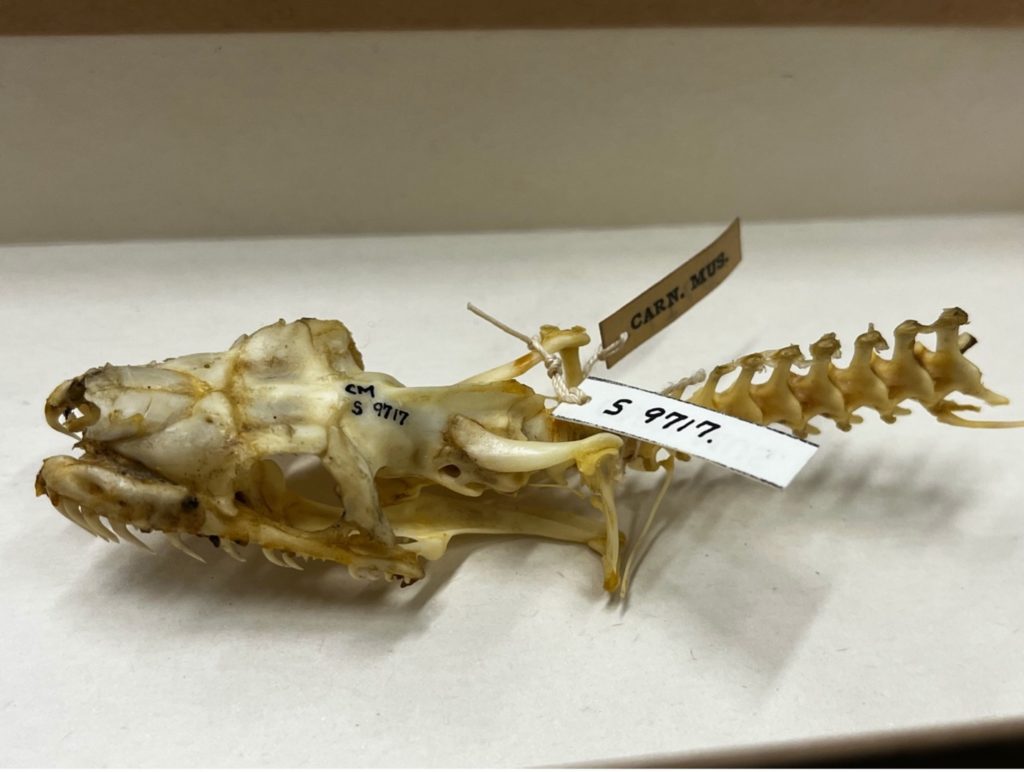
Fig. 1 – Head and neck portions of a Boa sp. skeleton.

Museums are integral to our communities because they are institutions that provide public education and outreach to better understand the world we live in. Visitors often think of museums in terms of displays, animal taxidermy mounts in dioramas, or jars of preserved amphibians, for example, but much of the important work of museums occurs behind the scenes. I developed a clear understanding of this situation through two different interactions with the Section of Amphibians and Reptiles at Carnegie Museum of Natural History.

I am an archaeology graduate student at the University of Pittsburgh (Pitt), and I met Stevie Kennedy-Gold, the Collection Manager for the Section of Amphibians and Reptiles, in 2019 when her assistance helped me answer a research question. I specialize in zooarchaeology, that is the of study animals in archeological contexts, in the Maya lowlands of western Belize. Unfortunately, due to the wet, humid climate of the jungle, preservation of bone is not always the greatest. There exists, however, a necklace made of vertebrae that was found still clutched in the hand of an ancient Maya elite. Based upon several characteristics of each vertebra, I knew the necklace was made up of reptile but could not deduce anything more specific. When I reached out to Stevie, she helped me figure out that the necklace was made of bones from numerous snakes! The significance of finding out what kind of animal the necklace was made from helps us to understand the ways humans interacted with their environment, in this case animals who share the same landscape. Even more exciting is the cosmological importance of the serpent to the Maya culture where the creatures primarily symbolize rebirth and renewal.

This positive experience of having my doctoral research aided by a museum collection convinced me of how important it is to make sure such resources are well managed for generations to come. When I reached out to Stevie for a second time, it was to offer my time in the Section of Amphibians and Reptiles for any project I could assist. When we got started, I was asked to help catalog the osteological inventory of reptiles and amphibians, which is fitting as Stevie has nicknamed me “the bone guy” for my specialty as a zooarchaeologist. The work involves locating each specimen, identifying which components of the skeleton are present, and noting any articulation or soft tissue (such as skin) that may be present. Any necessary steps for later upkeep to maintain preservation is also recorded, procedures such as cleaning skeletal pieces, removing dead dermestid beetles, and transferring specimens to new storage boxes. This experience has allowed me to further familiarize myself with diverse taxonomic groups and even inflammatory and autoimmune pathologies (Fig. 2)! 
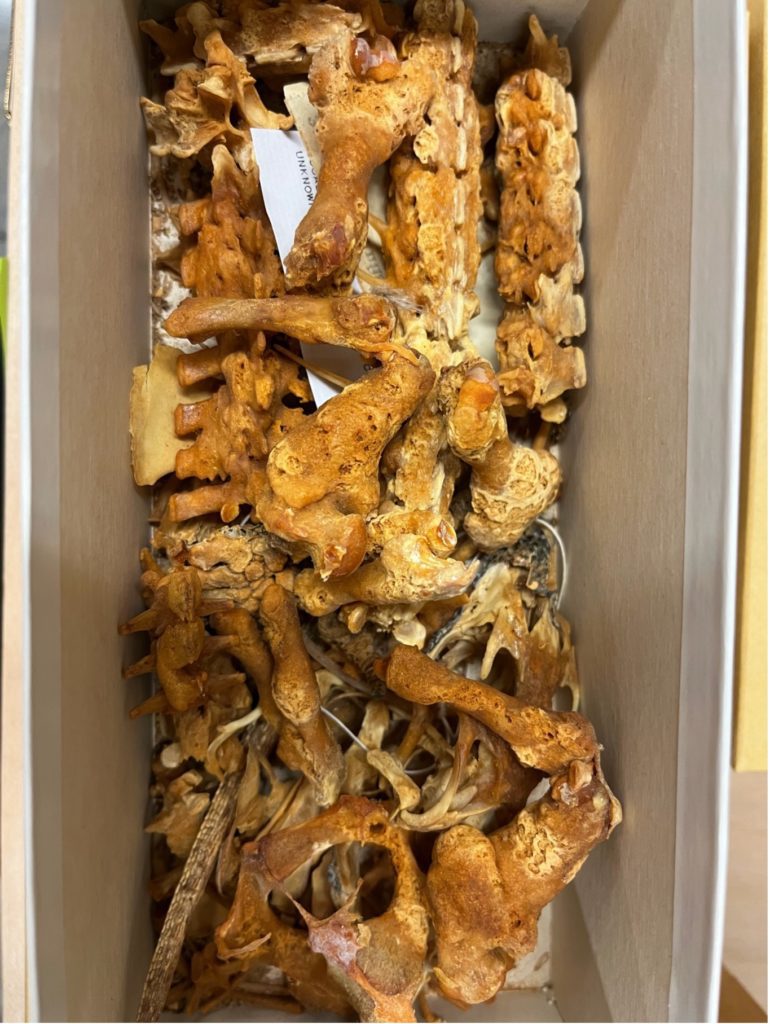
Fig. 2 – Osteological inflammatory growth along the axial and appendicular parts of this squamate skeleton due to disease.

Though it is an arduous task to organize and record the entire osteological collection between Stevie, a couple of section work-studies, and myself, it is also a load of fun (or perhaps torturous levels of organization is my crazy idea of fun). No, really! As we go through each cabinet, drawer, and box we stumble across some really fantastic skeletons of lizards, snakes, crocodiles, turtles, and more (Fig. 3). One of my favorites was of an Asian water monitor (Varanus salvator), because it is the oldest specimen in the entire herpetology collection at CMNH, and even includes a beautiful hand-written record of this original skeleton.
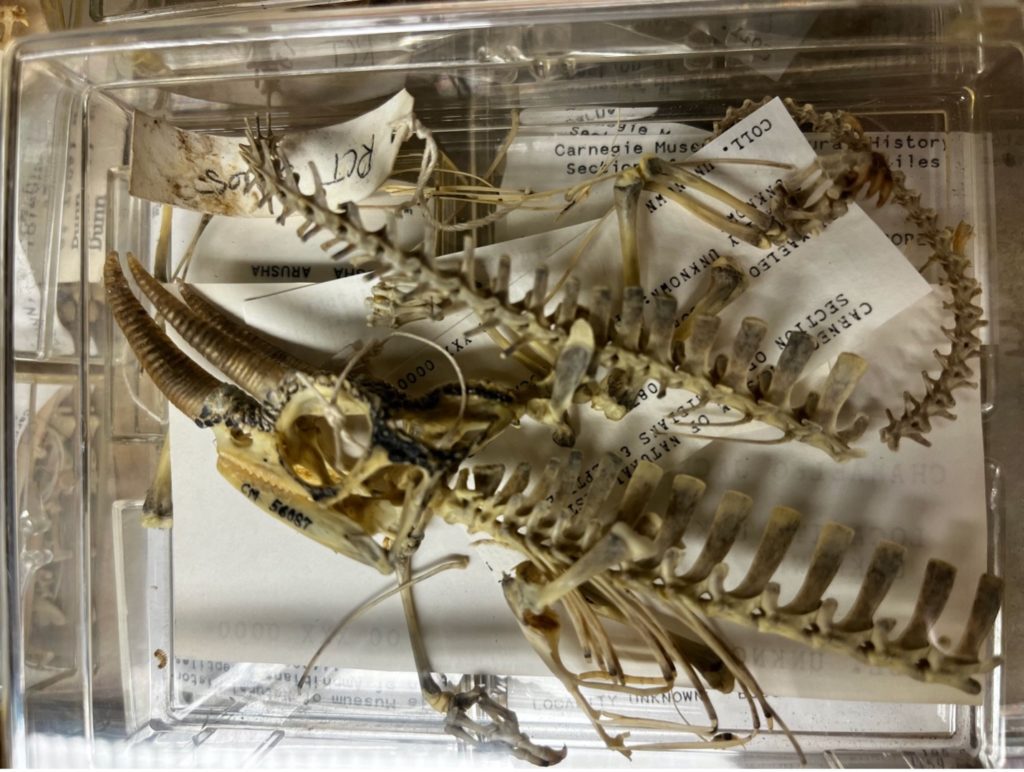
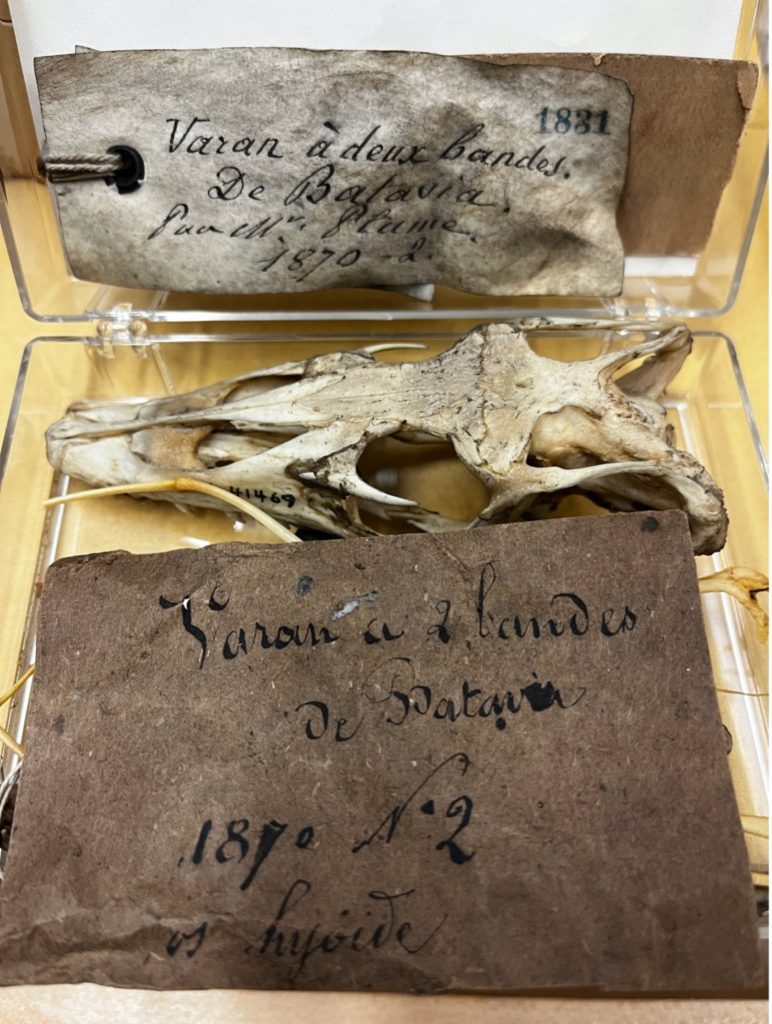
Fig. 3 – Trioceros jacksonii, commonly known as the Jackson’s chameleon. The males are easily identified by the three large horns protruding from their faces.
Fig. 4 – Commonly known as the Asian water monitor (Varan salvator), this skeleton was collected in 1870 and is actually the oldest specimen in the collection, wet or dry.

Ian N. Roa is an archaeology graduate student at the University of Pittsburgh.

Related Content

A Head Above the Rest: Unearthing the Story of Our Leatherback Sea Turtle

Meet the Fossil Detectives in the Basement

Do Snakes Believe in the Tooth Fairy?

Carnegie Museum of Natural History Blog Citation Information

Blog author: Roa, Ian N.
Publication date: July 15, 2022
Share this post!

  • Share on Twitter Share on Twitter
  • Share on Facebook Share on Facebook
  • Share on Pinterest Share on Pinterest
  • Share on LinkedIn Share on LinkedIn
  • Share on Reddit Share on Reddit
  • Share via Email Share via Email

Filed Under: Blog Tagged With: amphibians and reptiles, Ian Roa, Science News

April 28, 2022 by Erin Southerland

Sharing a City Park With a Resident Reptile

by Patrick McShea

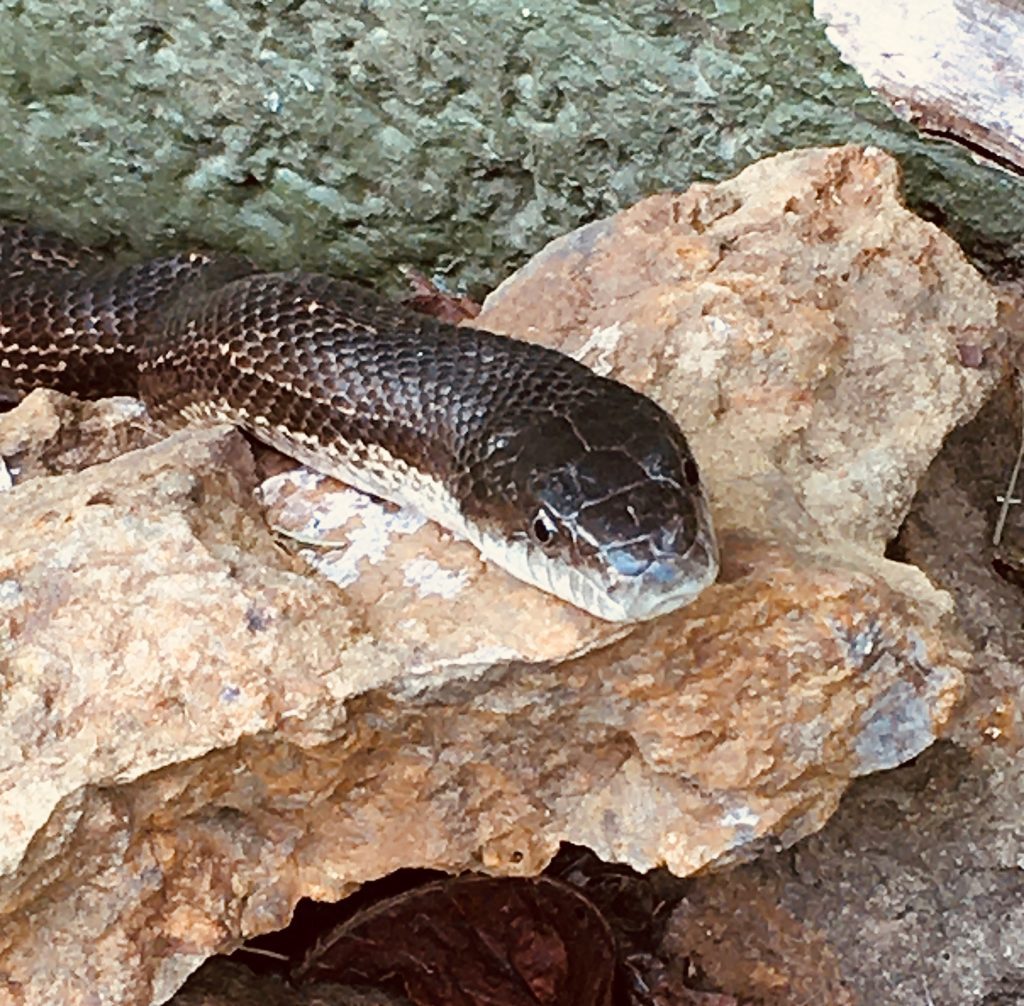
Last April, when reports of a large unidentified snake in Frick Park briefly captured the attention of Pittsburgh news media, Park Ranger Erica Heide was not alarmed. As she explained nearly a year later, “I knew it had to be a black rat snake, and I knew who to check with.” One of the city park’s longtime maintenance staff had earlier told Erica about a large snake he had encountered enough times to merit the bestowing of a name. “That’s Charlie,” he reassured her, “I get reports about him every spring.”

Early rumors, which included speculation that someone had released a large python into the park, were dispelled within hours by a widely shared photograph depicting what was clearly a black rat snake fully exposed in a still leafless trailside sapling. Erica, who has worked in her position for the City of Pittsburgh since 2017, now focuses on the benefits of the publicity. “Overall, the event had positive impact. For some weeks afterward I’d be stopped along the trails by park visitors asking how they could be sure to avoid an encounter with the snake, and by just as many others who wanted to know where they could go to see it. For both groups, and for everyone else whose interest level fell somewhere between those positions, the knowledge that this city park can support and sustain a wide variety of wildlife has certainly been a good thing.”

Black rat snake on a rock.

At Carnegie Museum of Natural History, it’s well understood that whenever snakes are the topic of a public presentation, a similar audience stratification comes into play. During such circumstances fearful and fascinated people occupy widely separated edge positions. Within the Section of Amphibians and Reptiles, Assistant Curator Jen Sheridan and Collection Manager Stevie Kennedy-Gold frequently use their positions to diminish the fear of snakes by increasing background knowledge about the creatures’ life cycles, physical adaptations, behaviors, and ecosystem roles. Stevie has recently created a full alphabet-referenced set of 26 TikTok videos that introduce viewers to preserved amphibian and reptile specimens, including many snakes, in the museum’s scientific collection. In early February Jen and Stevie welcomed NEXTPittsburgh’s Boaz Frankel on a tour of their section’s alcohol-preserved specimens for an episode of the weekly YouTube series, Yinzer Backstage Pass.

One highlight of the 30-minute program features Jen holding a large glass jar containing the preserved remains of a type of snake she has frequently encountered during fieldwork in Borneo, the venomous species known to science as Tropidolaemus subannulatus. “What’s really cool about these guys in the field is that they often will sit in the same place for days, and you can go back and take pictures of them, and I can bring students to look at them and admire their beautiful green color.”

Jen’s excitement in relating first-hand experiences as a scientist visiting an exotic environment will undoubtedly move some viewers closer to acceptance of snakes as valued biodiversity markers in a distant land. For a broader acceptance of black rat snakes as neighborhood wildlife, however, the advice Robin Wall Kimmerer, a botanist who is a member of the Citizen Potawatomi Nation, offered to museum staff earlier this month might be even more important. “Native names are important,” the author of Braiding Sweetgrass, reminded us during an informal talk that was part of her appearance as a Pittsburgh Arts and Lectures’ Ten Evenings speaker. “Their use says, ‘We’re not the first ones here.’” 

The comments prompted me to retrieve a year-old email message from Deborah Harding, the recently retired Collection Manager for the museum’s Section of Anthropology, and someone who has developed close personal and professional relations with Cherokee artists through her knowledge of traditional weaving practices. As media panic subsided when the snake in the Frick Park tree had been identified, Deb sent a one-line message that explained the creature’s predictable behavior:

The Cherokee word for blacksnake is “ulisdi” = “the one who climbs”. 

Patrick McShea is an Educator at Carnegie Museum of Natural History. Museum employees blog about their unique experiences and knowledge gained from working at the museum.

Related Content

The Enduring Appeal of Snakes

Do Snakes Believe in the Tooth Fairy?

Collected On This Day in 1906: Flowering Dogwood in Frick Park

Carnegie Museum of Natural History Blog Citation Information

Blog author: McShea, Patrick
Publication date: April 28, 2022

Share this post!

  • Share on Twitter Share on Twitter
  • Share on Facebook Share on Facebook
  • Share on Pinterest Share on Pinterest
  • Share on LinkedIn Share on LinkedIn
  • Share on Reddit Share on Reddit
  • Share via Email Share via Email

Filed Under: Blog Tagged With: amphibians and reptiles, Carnegie Museum of Natural History, Pat McShea

March 8, 2022 by Erin Southerland

Reptiles, and Amphibians, and Bones? Oh My!

by Anais Haftman

I am a fourth year biology student at Duquesne University who has had the pleasure to work in the Section of Amphibians and Reptiles since 2021. Most of my time working in the section has been dedicated to cleaning the bones of specimens in the collection to ensure proper long-term preservation. With over 7,000 osteology (skeletal) specimens in the section, bone cleaning can be a tedious task. With the help of the museum’s Conservator Gretchen Anderson, and Collection Manager of Amphibians and Reptiles Stevie Kennedy-Gold, the long process of conserving and improving the quality of the osteologic specimens has been a breeze.

Why is a clean osteology collection important? 

Conservation of specimens (wet and dry) in research collections is of the of the utmost importance because each specimen is a time and place record of species occurrence that can be re-examined as necessary. Some specimens are notable for having informed past research, and all specimens are held in public trust for their potential to inform current and future research. Because our specimens are routinely loaned out to researchers for use in studies, we work to ensure that their work is not diminished by ensuring the highest quality specimens possible. As the quality of a specimen decreases, the quality of information received from it also decreases. 

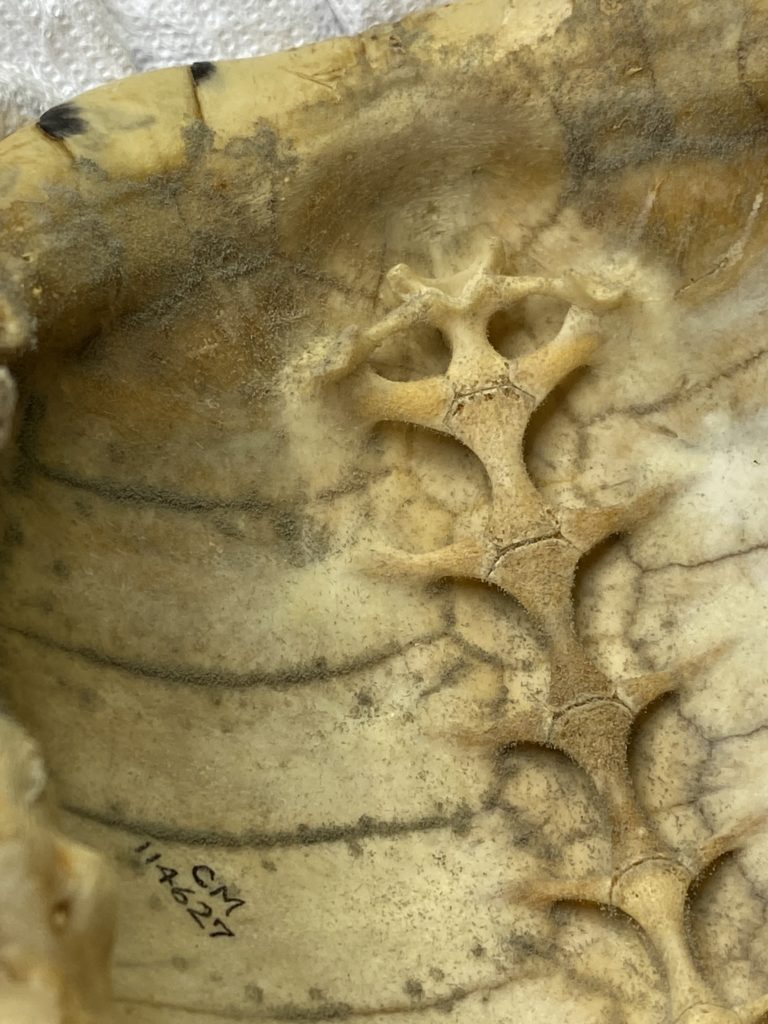
Close up of a turtle shell with the specimen number CM 114627 on it.
There’s no separating a turtle’s backbone from its shell, even for cleaning purposes. Photo by Stevie Kennedy-Gold.

What makes the osteology specimens unclean?

One of the most common culprits behind our need to clean bones are dermestid beetle larvae. But wait, why in the world would there be beetles in the bone boxes? Dermestid beetle larvae are commonly used to eat flesh and cartilage off specimens before they are added to the collection. During this process sometimes a larva or two wiggle themselves into small holes in the bones and are not seen when the bugs are cleaned off prior to storage. In these cases, we simply remove any long dead hitch-hiker larvae we find.

Sometimes natural oils and fats also remain on bones after the initial dermestid cleaning. In these cases, the cleaning process becomes more complicated. The most common circumstance that creates a need for cleaning, however, is the presence of inactive mold on specimens. Most of the time this issue can be easily solved by using a simple paint brush or Q-tip. But other times, particularly on large sturdy bones, I needed to put in a good amount of elbow grease!

How is the bone cleaning done?

Gretchen taught Stevie and I all we needed to know to properly clean bone specimens. The first step is always to visually inspect the specimen and record its condition. We make sure to write down its identifying collection number, what species it is, whether it’s a whole skeleton or only parts, if there were dermestid larvae still present on the specimen, and much more.

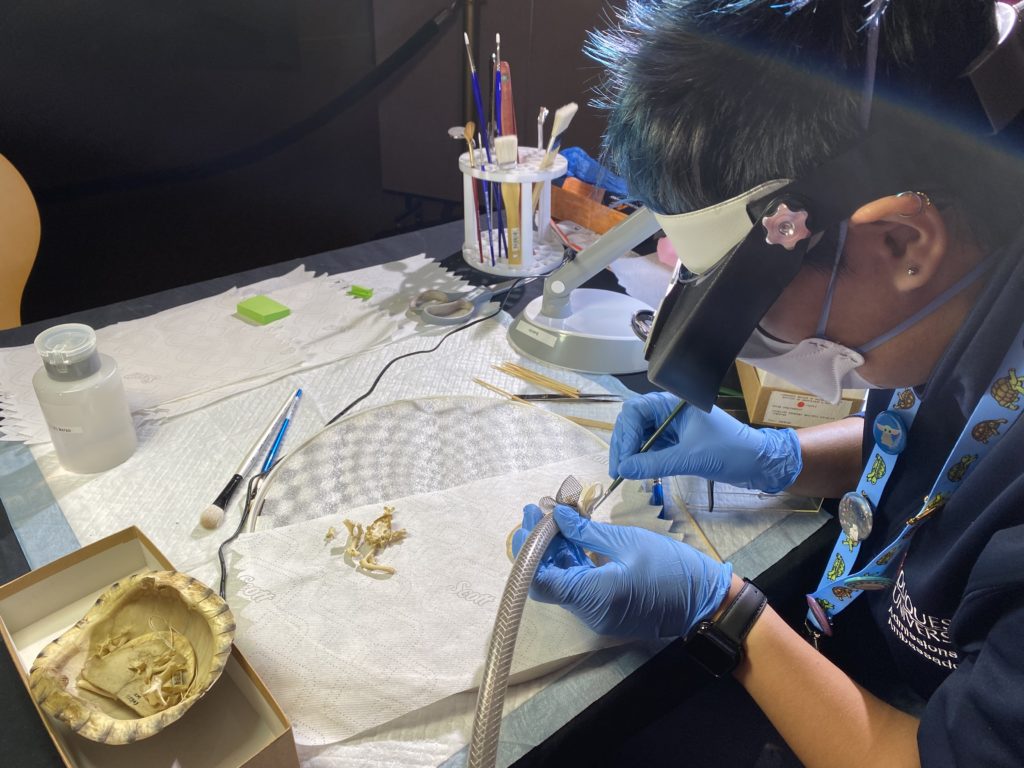
Person cleaning bones with a vacuum.
The author using the vacuum tube to clean bones. Photo by Stevie Kennedy-Gold.

Once the data collection on the initial quality is complete, the cleaning can begin. We initially use a Nilfisk HEPA vacuum tube (a device we named R2-D2) to clean any inactive mold from the bones. Wearing protective masks, we manually loosen the mold and push it into the vacuum using paint brushes. Once the mold is removed, we are able to inspect the bones for presence of larvae or secreted oils. If there are larvae present, we carefully remove them with tweezers and put them in our “bug box.” If there are oils present, a Q-tip is used to clean it off. For smaller bones, such as individual vertebrae, a soak in 70% ethanol is often part of the cleaning process. 

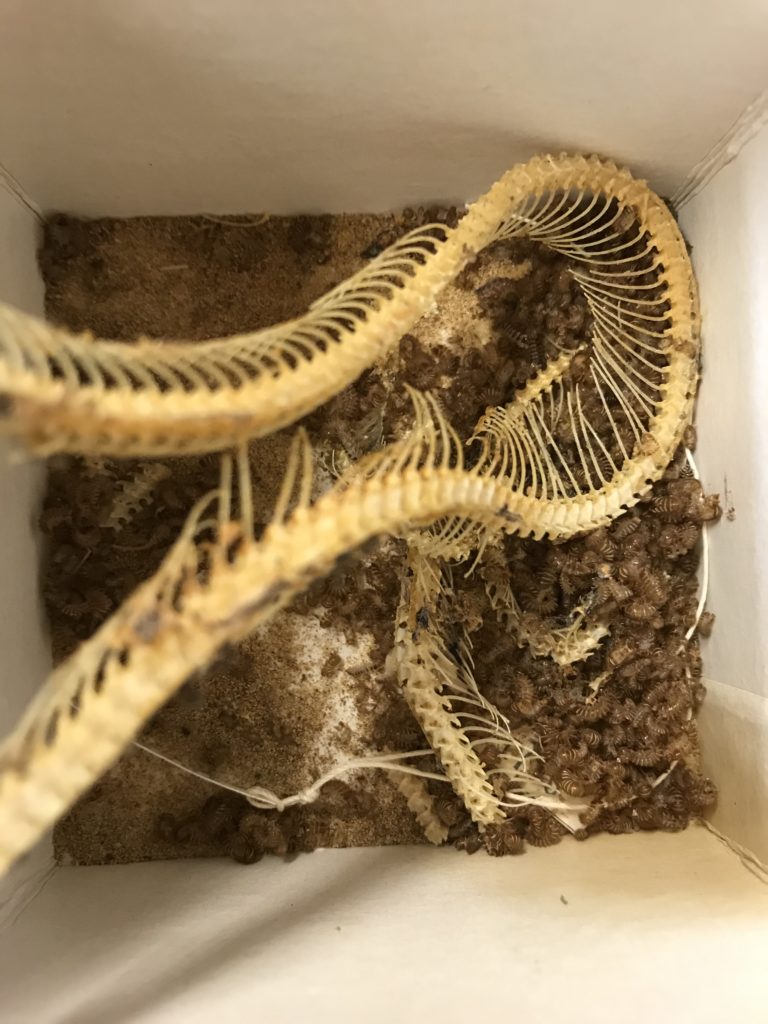
Snake vertebrae in a container from above
The delicate ribs and vertebrae of a snake require a delicate cleaning touch. Photo by Stevie Kennedy-Gold.

Depending on the quality and size of the osteological specimen, it can take anywhere from fifteen minutes to an hour to clean completely. Overall, much of the work to preserve osteologic specimens happens behind the scenes. This vital work is an example of the never-ending important tasks performed by both staff and volunteers that make the museum an important resource for scientific research.

Anais Haftman is a biology student at Duquesne University and works in the Section of Amphibians and Reptiles at the museum. Museum staff, volunteers, and interns blog about their unique experiences and knowledge gained from working at the museum. 

Related Content

Digital Developments: Why Archiving and Herpetology Go Hand-in-Hand

Photos of Fluid-Preserved Specimens: A Different Kind of Portrait

Saddle Cleaning

Carnegie Museum of Natural History Blog Citation Information

Blog author: Haftman, Anais
Publication date: March 8, 2022

Share this post!

  • Share on Twitter Share on Twitter
  • Share on Facebook Share on Facebook
  • Share on Pinterest Share on Pinterest
  • Share on LinkedIn Share on LinkedIn
  • Share on Reddit Share on Reddit
  • Share via Email Share via Email

Filed Under: Blog Tagged With: amphibians and reptiles, Anais Haftman, Science News

October 1, 2021 by wpengine

Sharing Shipping Space with Amphibians and Reptiles

by Stevie Kennedy-Gold

Your online orders of clothes and household goods might well have shared shipping space alongside preserved toads and snakes from the Carnegie Museum of Natural History. Don’t worry though – museum specimens are shipped following long-established rules and regulations, and the movement of herpetological freight is all in the service of science.

Wait, what?! Well, at a relatively low, but steady rate, natural history museums loan out specimens, and these materials are generally shipped, outgoing and incoming, via regular commercial carriers.

Why loan out a specimen?! Why, to ask and answer awesome scientific questions, to enhance an exhibit, or to use as artistic references! Just as every human has a story unique to their own life and experiences, etched in their wrinkles, freckles, and scars, the same is true for every specimen in the collection. Each frog and lizard, snake and turtle has experienced different environmental impacts, endured famine, parasites, pollution, or predation. Each specimen has its own story. Instead of being written down within the pages of a book, the animals’ stories are recorded within their muscles, organs, bones, and DNA. As such, an eastern fence lizard collected from Pennsylvania in 1893 will likely have a different body size, diet, or parasite load compared to the same species of lizard collected from the same town in 2005.

Scientists request loans from museum collections so that they can examine the specimens, unlock the stories hidden in each body, and answer their scientific questions. Alternatively, we receive requests from artists needing reference materials for their newest works of art, or to more accurately render images of a species they would otherwise not be able to see up close (I’m looking at you, venomous snakes, highly toxic frogs, or now extinct species!). And, of course, museums themselves loan from collections to use in displays as representatives of the far larger number of specimens housed behind-the-scenes. Walk through Dinosaurs in their Time towards Cenozoic – those bones can be considered as an inter-building loan from our Vertebrate Paleontology collection. Head up to the Foster Overlook and check out our hellbender who choked on a marshmallow – that specimen is certainly an inter-building loan from the collection I manage.

But how exactly are specimen loans arranged? The process varies from institution to institution and from section to section, so this description is the process specific to the Section of Amphibians and Reptiles at this museum. Overall, though, the process is a great deal easier than it would seem. Assuming a borrower knows what species to work with, a search of the Section’s online presence at iDigBio or VertNet will determine the specific specimens to request. After that, a formal request letter is required. This document must include details of borrower affiliation, the species and specimens requested, and the reason behind the request along with any planned examination techniques. The next step in the procedure is an email directed to me through the museum website (here), again providing a brief description of the borrower’s intent.

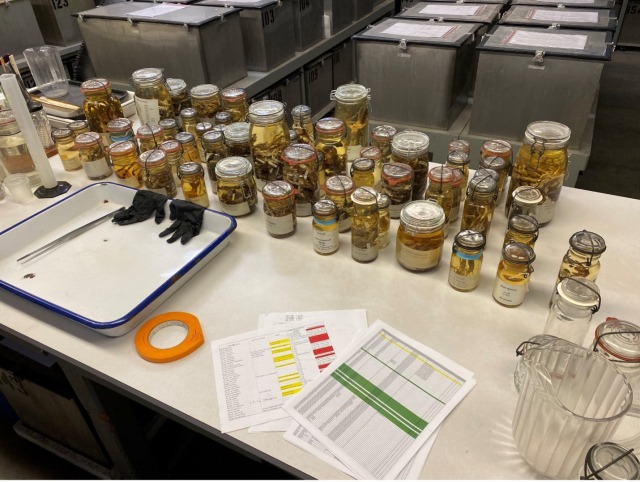
Table with specimen jars, paper, a metal tray, gloves, and other tools for herpetology work.
Image 1: Prepping a loan of anoles for a researcher. In the foreground are lists of specimen preferences from the researcher and specimens in the collection which fit the criteria.

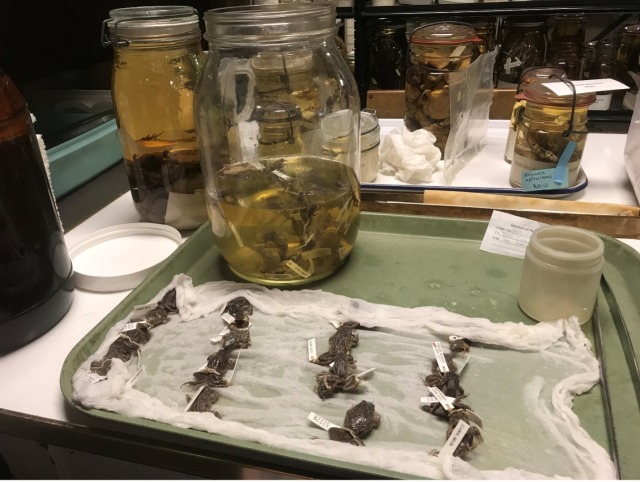
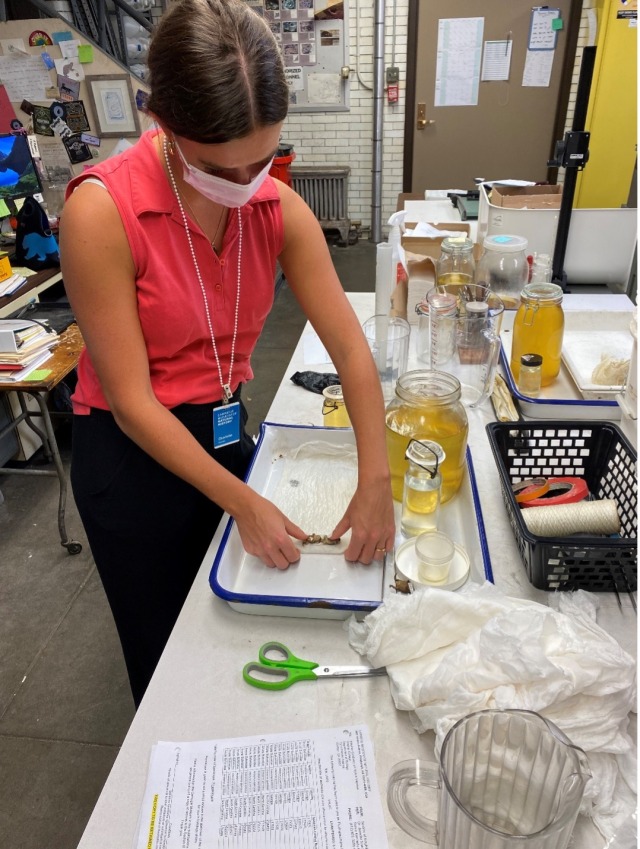
Assuming a request is reasonable (i.e., doesn’t involve the complete destruction of the specimen!), I then begin pulling the requested specimens from the collection, placing tiny loan slips in each jar as I go as place holders signifying the specimen’s loaned status (Image 1). The slip has the specimen’s catalog number, the loan number, and the requester. Paper trails are vital in loaning specimens. I also make a notation in my fancy new Loan database, as well as in the general Herp Section Specimen database. Finally, I draft up the loan contract which will be sent out with the specimens. I then wrap the specimens in cheesecloth (Images 2 and 3), give them a good soaking in alcohol, triple bag and heat seal them in, and slap the appropriate documentation on and in the box. The package then goes off to the mailroom!

Specimen jar and herpetology specimens laid on cheesecloth.
Image 2: Laying out the specimens on cheesecloth in preparation for shipping. A loan slip can be seen behind the cup on the right side of the image.
Woman wrapping a specimen in cheesecloth
Image 3: Charlotte, a recent intern in the section, helps package up a loan of toads.

Once someone has completed their work with the specimens, they normally notify me and ship the specimens back as soon as possible. Assuming all the specimens are returned in good order, the loan is closed, the specimens are returned to the collection, the slips of paper are pulled from the jars, and the specimens once again become available for other people to use.

Unfortunately, some specimen loans, like library books, become overdue. A typical loan duration is 6 months, at the end of which the borrower can request a loan extension (much like requesting an extension on a library book) or they can send the specimens back. If the loan period elapses without any communication, I don my imaginary “Lizard Librarian” hat and kindly request their return as soon as possible.

Due to the size of this collection, the responsibilities of a collection manager, the number of loans we send out annually (some years over 40!), and the recent (with respect to the general age of the collection) technological adoptions within the Section (i.e., creating digital databases), it is not surprising that the retrieval of some loans lapsed, and even the documentation of some specimen locations is unclear. As a result, I recently took it upon myself, with the aid of my fearless and tireless group of interns, work study students, and volunteers, to determine the “active status” for all loans sent out since 1925 (the earliest recorded loan in the section). We have nearly 2000 loan records to look through, but fortunately my predecessors did a decent job tracking when a loan was returned or when contact was made to request the specimens be returned.

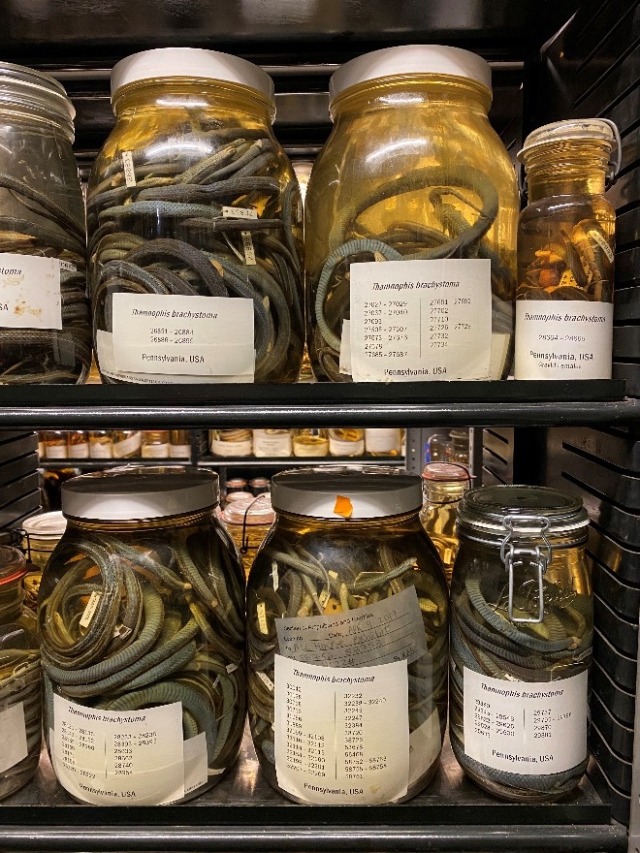
It’s a long arduous process making sure that all the specimens are back. Initially, our search to verify if the specimen was returned begins with the jars containing species from the location where the borrowed specimen was collected. This process takes time, and the pace is contingent upon how many specimens were requested per loan and how many specimens (and jars!) of a specific species from a specific place we have in the collection. For example, tracking the whereabouts of a loan of 50 eastern newts from Pennsylvania has taken us a few weeks because we have nearly 20 jars of newts from the state, each containing at least 100 specimens.

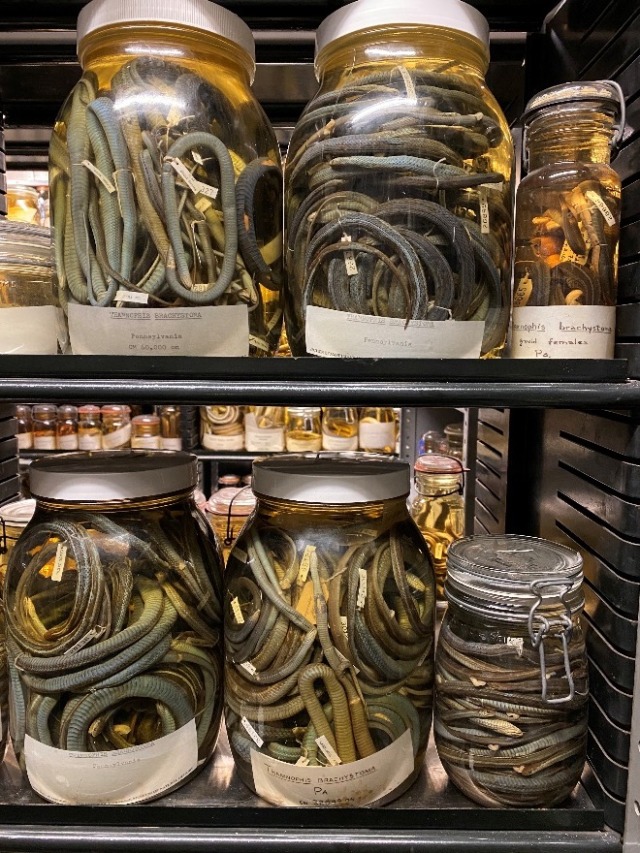
Jars of amphibians and reptiles preserved in fluid
Image 4: Before (top) and after (bottom) images of a selection of jars which we looked through to confirm the specimens were loaned out and for which we updated the jar labels. You can see in the bottom middle jar in the image on the right the loan slip and piece of orange tape which denotes specimens were loaned out from that jar.

If we emerge empty handed after examining all the jars of a specific species from a specific place, we then look in jars containing the same species collected from other locations. This process has resulted in finding almost 10 specimens previously deemed “missing” – some since the 1960s! On top of this process, we also record the catalogue number of every specimen in every jar we examine so we can update the jar labels with the specimen numbers (Image 4). This expedites finding specific specimens in the future and ensures that all specimens are placed in their correct jars. It’s a true labor of love and the process is a museum collection equivalent of an (ultra-ULTRA) marathon, not a sprint. When it all boils down though, I am just a librarian making sure that all my books (or specimens!) are where they ought to be.

Stevie Kennedy-Gold is the Collection Manager for the Section of Amphibians and Reptiles at Carnegie Museum of Natural History. Museum employees are encouraged to blog about their unique experiences and knowledge gained from working at the museum.

Related Content

Digital Developments: Why Archiving and Herpetology Go Hand-in-Hand

Do Snakes Believe in the Tooth Fairy?

A Head Above the Rest: Unearthing the Story of Our Leatherback Sea Turtle

Share this post!

  • Share on Twitter Share on Twitter
  • Share on Facebook Share on Facebook
  • Share on Pinterest Share on Pinterest
  • Share on LinkedIn Share on LinkedIn
  • Share on Reddit Share on Reddit
  • Share via Email Share via Email

Filed Under: Blog Tagged With: amphibians and reptiles, Science News, Stevie Kennedy-Gold

September 3, 2021 by wpengine

Pitfall Traps: Fieldwork Surprises

by Amanda K. Martin

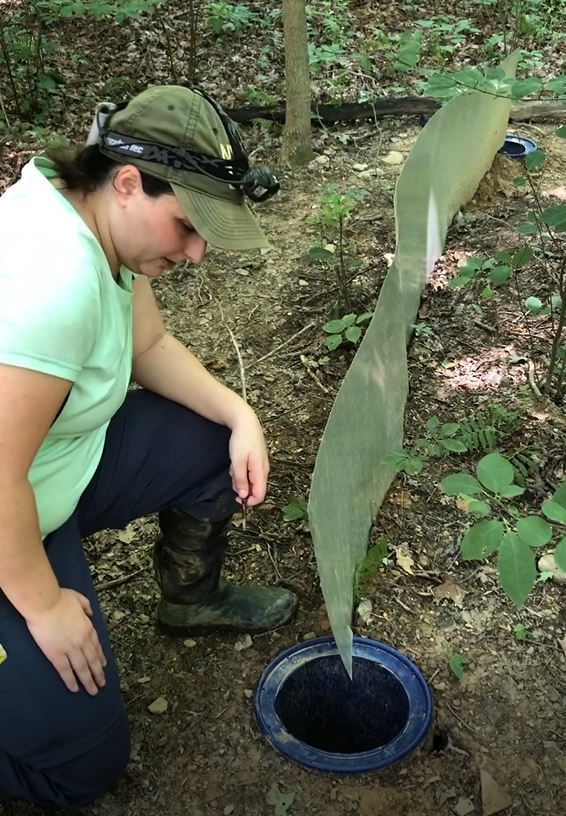
Powdermill Nature Reserve is home to a wide variety of creatures whose presence remains undetected by most human visitors. One way that scientists can explore the animal diversity of an area is by a method called pitfall trapping (Fig. 1A). For research into the Reserve’s amphibian diversity, I was part of a small team who placed pairs of 5-gallon buckets in the ground 8 feet apart, with their rims at surface level. We then set up a low metal fence between each pair of buckets (Fig 1A). Animals moving along the forest floor who encountered the fence would generally follow the barrier, to the left or to the right, and fall into one of our traps.

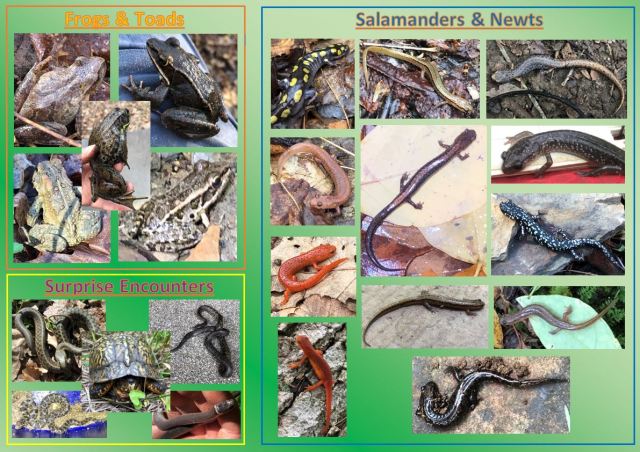
We checked our pitfall traps every morning during the study period, noting which species we had captured, along with their size and weight, before releasing them unharmed. As an amphibian study our trapping targets were frogs, toads, salamanders, and newts, and we were successful in documenting their presence. Across ten sample periods of ten days each, we captured 1,962 individual amphibians representing 17 different species! (Fig. 1B)

Woman looking into a pitfall trap in the woods.
Fig 1A: Dr. Martin inspecting a pitfall trap array for captured amphibians. Photo by P. DeQueiroz.
College of reptile and amphibian photos.
Fig. 1B: Species diversity from captures in traps along with a few surprise reptilian encounters.

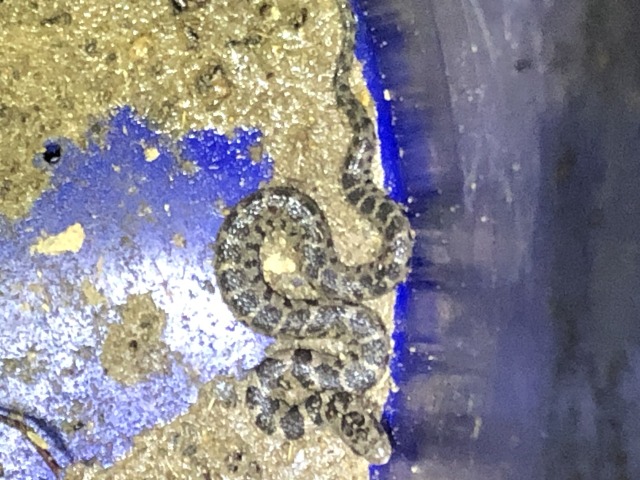
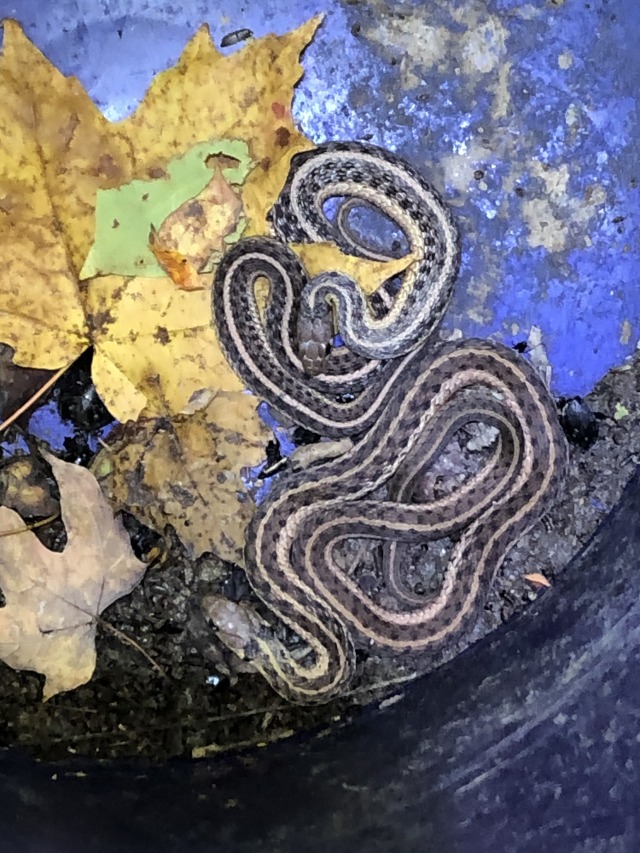
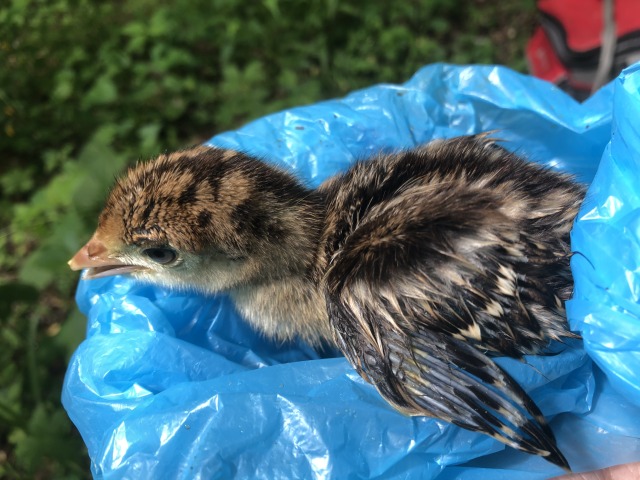
Pitfall traps also capture non-target species, called by-catch, a term that give little indication of the surprising encounters some of these creatures create. Normally I see a wide variety of invertebrate species when I check my traps, including millipedes, large beetles, spiders, crayfish, and even moths. Additionally, this year we captured a Northern water snake (Nerodia sipedon; Fig. 2A) and four eastern garter snakes (Thamnophis sirtalis; Fig. 2B). More surprisingly, one trap briefly detained a fledging Wild Turkey (Meleagris gallopavo, Fig. 2C)!

Northern water snake in a pitfall trap.
Eastern garter snake in a pitfall trap.
Fledgling turkey.
Fig. 2: Captured snakes and a surprise avian, Northern Water (A), Eastern Garter (B), and a fledgling turkey (C).

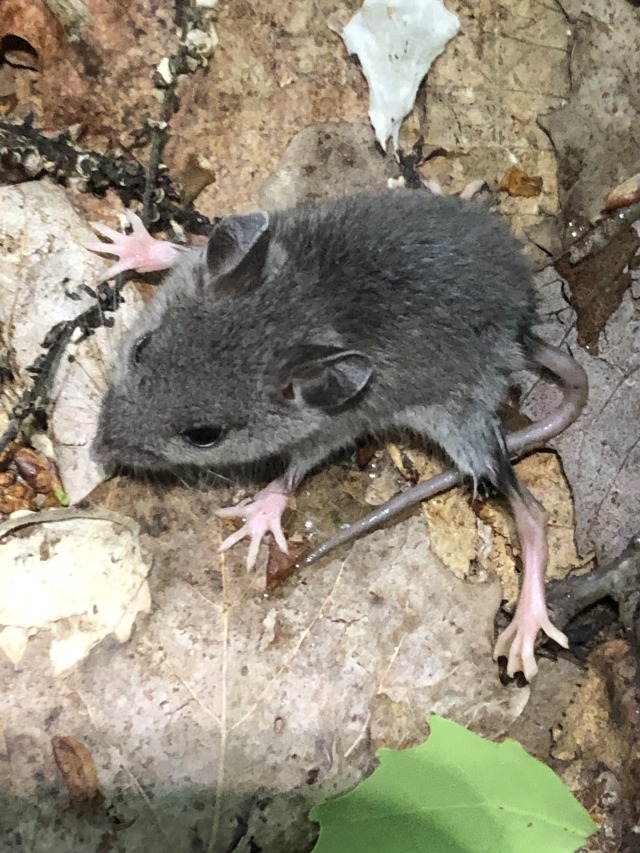
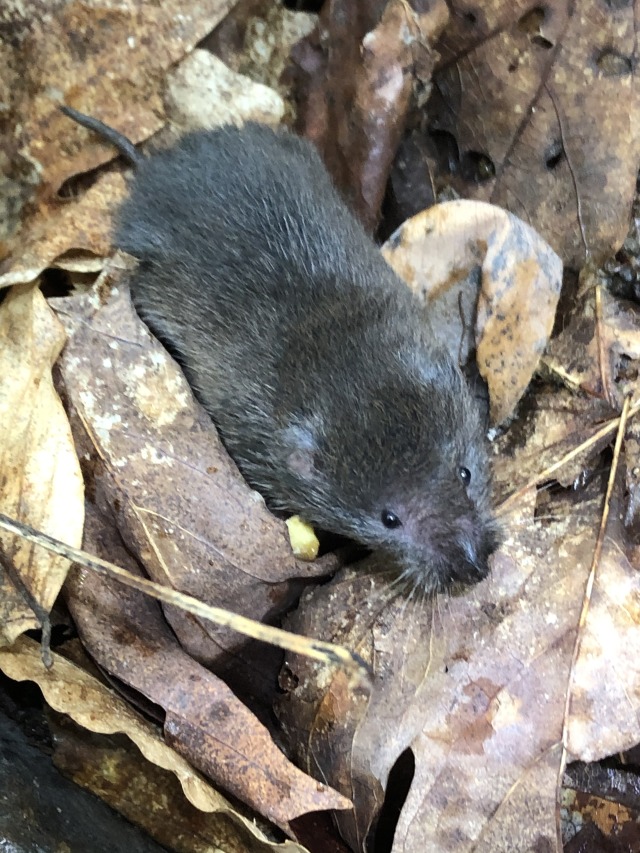
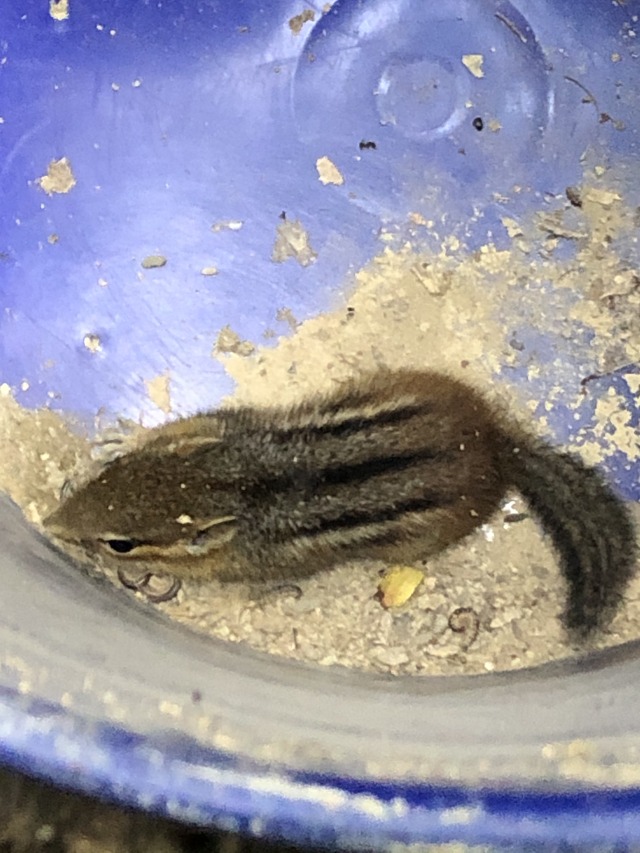
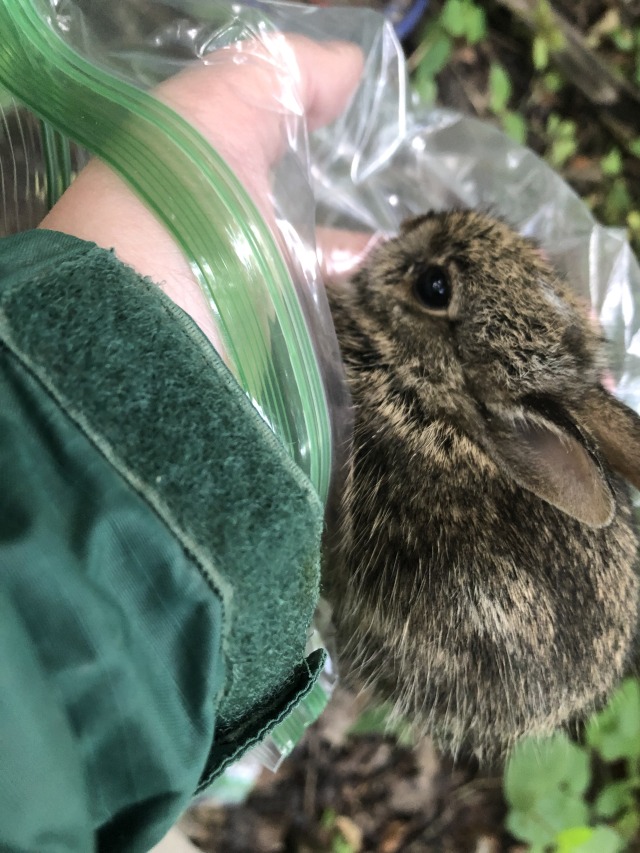
Our study’s pitfall trap by-catch also included several different mammals that scurry across the forest floor: We caught different species of mice (Fig. 3A), shrews, voles (Fig. 3B), and on single occasions a chipmunk (Fig. 3C), mole, or even an opossum! Our traps contained moist sponges to provide water for these small mammals, along with small sections of PVC pipe for shelter. We also found that anchoring a jute string to the bucket edge overhang, with knots tied every 50 – 60 mm, reduced small mammal by-catch. The string provided a means for small mammals to climb up to the ground surface and escape on their own—except for a tiny eastern cottontail rabbit (Fig. 3D), which was safely released after we encountered it.

Mouse on leaf litter.
Vole on leaf litter.
Chipmunk in a pitfall trap.
Bunny in a human hand.
Fig. 3: Small mammal encounters with a mouse (A), vole (B), chipmunk ©, and a bunny (D).

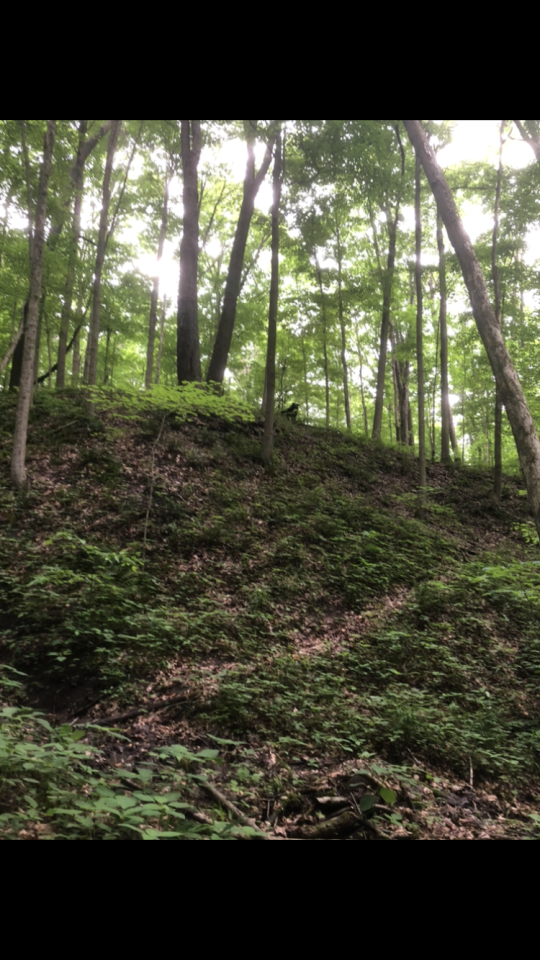
In addition to encounters with the animals caught in our pitfalls, the time we spent checking the traps provided opportunities to observe other wildlife passing through the forest. On one occasion while my field assistant and I were measuring an Allegheny dusky salamander (Desmognathus ochrophaeus) we heard a loud noise. When we both looked up a wooded slope in the direction of the sound we were shocked to see a black bear (Ursus americanus) approaching. I took a quick photo (Fig. 4), released the salamander, and we cautiously watched the bear come down the hill and walk off. The incident was nerve-wracking in the moment, but very exciting in retrospect! Also, while relaxing outside my cabin one day after a long fieldwork session, I was lucky enough to spot a bobcat walking past —a great bonus to spending so much time in the forest!

Forested area with a black bear in the distance.
Fig. 4: A surprise black bear encounter while checking pitfall traps.

All research was conducted under approved permits. Photos by A.K. Martin.

Amanda K. Martin is the Rea Postdoctoral Fellow in the Section of Amphibians and Reptiles. Museum employees are encouraged to blog about their unique experiences and knowledge gained from working at the museum.

Related Content

How To Catch 311 Amphibians in 10 Days

The Search for the Near Threatened Green Salamander, Aneides aeneus

Overwintering for Amphibians and Reptiles

Carnegie Museum of Natural History Blog Citation Information

Blog author: Martin, Amanda K.
Publication date: September 3, 2021

Share this post!

  • Share on Twitter Share on Twitter
  • Share on Facebook Share on Facebook
  • Share on Pinterest Share on Pinterest
  • Share on LinkedIn Share on LinkedIn
  • Share on Reddit Share on Reddit
  • Share via Email Share via Email

Filed Under: Blog Tagged With: Amanda Martin, amphibians and reptiles, Science News

June 15, 2021 by wpengine

Getting Started: a high school intern’s experience in the herp section

by Jaylynn Smith

Curator note: We currently have an intern from a local high school working with us for ten weeks. The goal of the internship is to gain experience working on collections care and maintenance, learn about amphibian and reptile biology and taxonomy, and to create social media content related to this experience. Look for more content from our intern in the coming weeks!

The first week of my internship was completed! So far it has been a very enjoyable experience. The opportunity to be behind the scenes and learn hands-on about the different specimens that are held in the Alcohol House, and the way they are separated into their taxonomic families has been exciting.

Before my first week I had no knowledge of how these animals were classified or the way they were preserved. However, after the first few days I gained a bit more information on them, like the way they’re stored in 70% ethanol and how there are sections for each major group (frogs, snakes, turtles, etc.). This was very fun since I got more insight and learned more about the reptiles and amphibians I’d be working with. I also learned a bit about how to maintain and take care of the collection, such as testing the concentration levels in the jars and making sure it is at 70%, and also that each jar is filled all the way to the top so the specimens won’t dry out.

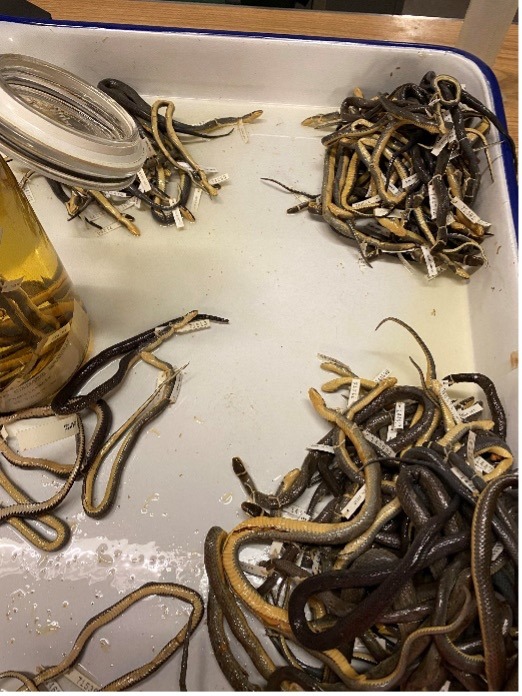
Figure 1. Counting and sorting a loan of ring-necked snakes (Diadophis punctatus).

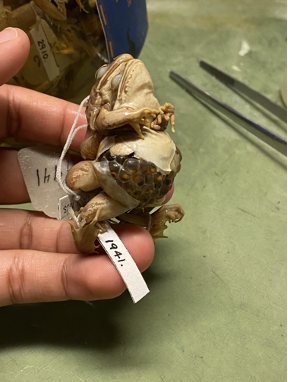
Additionally, we dove into checking the status of loans, a museum service which is very similar to the way libraries loan books. A researcher may borrow specimens for comparative study or to learn more about that specific animal. Once the borrowed materials are back in our care, we have to make sure every one of them has been returned safely. This sometimes means taking the specimens out of their jars and counting them all! (Figure 1) Doing this routine work gave me the chance to be up close with the specimens and more hands-on. I found it very interesting being able to touch the animals and see how different they are from each other, like the way patterns may differ on certain snakes or even seeing frog mating behavior (Figure 2)!

Figure 2. A male wood frog (Rana sylvatica) holding onto the female during amplexus, a mating position of frogs and toads.

Not only do I have this great opportunity through this internship, I also can share much of the museum experience with my family as well with the benefits that come along with it. Over the weekend I went to the museum with my younger siblings, allowing them to learn more and broaden their knowledge of different animals from both the past and present. While we were there, we came across the Alcohol House Interactive exhibit in Discovery Basecamp, a display featuring information, images, and even actual specimens from the Alcohol House. This gave me the chance to tell my younger siblings about what I do in the Alcohol House. I was able to talk about the specimens I worked with so far and how fascinating it all has been just in the first week. Moving forward my goal is to learn even more about the animals that I’m working with and the process that goes into taking care of them. I also hope to do my own research on them and find answers to questions I may have. But at this point in time I am very optimistic and thrilled about the future of being an intern at the Carnegie Museum of Natural History.

Jaylynn Smith is an intern in the Section of Amphibians and Reptiles. Museum employees are encouraged to blog about their unique experiences and knowledge gained from working at the museum.

Related Content

Ask a Scientist: What is the creepiest specimen in the Alcohol House?

Do Snakes Believe in the Tooth Fairy?

An Illuminating Tale of Tracking Turtles

A Summer Internship at Powdermill

Carnegie Museum of Natural History Blog Citation Information

Blog author: Smith, Jaylynn
Publication date: June 15, 2021

Share this post!

  • Share on Twitter Share on Twitter
  • Share on Facebook Share on Facebook
  • Share on Pinterest Share on Pinterest
  • Share on LinkedIn Share on LinkedIn
  • Share on Reddit Share on Reddit
  • Share via Email Share via Email

Share this post!

  • Share on Twitter Share on Twitter
  • Share on Facebook Share on Facebook
  • Share on Pinterest Share on Pinterest
  • Share on LinkedIn Share on LinkedIn
  • Share on Reddit Share on Reddit
  • Share via Email Share via Email

Filed Under: Blog Tagged With: amphibians and reptiles, behind the scenes, herpetology, Jaylynn Smith, Museum Employees

  • « Go to Previous Page
  • Page 1
  • Page 2
  • Page 3
  • Page 4
  • Interim pages omitted …
  • Page 6
  • Go to Next Page »

sidebar

About

  • Mission & Commitments
  • Directors Team
  • Museum History

Get Involved

  • Volunteer
  • Membership
  • Carnegie Discoverers
  • Donate
  • Employment
  • Events

Bring a Group

  • Groups of 10 or More
  • Birthday Parties at the Museum
  • Field Trips

Powdermill

  • Powdermill Nature Reserve
  • Powdermill Field Trips
  • Powdermill Staff
  • Research at Powdermill

More Information

  • Image Permission Requests
  • Science Stories
  • Accessibility
  • Shopping Cart
  • Contact
  • Visitor Policies
One of the Four Carnegie Museums | © Carnegie Institute | Privacy Policy | Terms of Use | Accessibility
Rad works here logo