• Skip to primary navigation
  • Skip to main content
  • Skip to primary sidebar

Carnegie Museum of Natural History

One of the Four Carnegie Museums of Pittsburgh

  • Visit
    • Buy Tickets
    • Visitor Information
    • Exhibitions
    • Events
    • Dining at the Museum
    • Celebrate at the Museum
    • Powdermill Nature Reserve
    • Event Venue Rental
  • Learn
    • Field Trips
    • Educator Information
    • Programs at the Museum
    • Bring the Museum to You
    • Guided Programs FAQ
    • Programs Online
    • Climate and Rural Systems Partnership
  • Research
    • Scientific Sections
    • Science Stories
    • Science Videos
    • Senior Science & Research Staff
    • Museum Library
    • Science Seminars
    • Scientific Publications
    • Specimen and Artifact Identification
  • About
    • Mission & Commitments
    • Directors Team
    • Museum History
  • Tickets
  • Give
  • Shop

Anthropocene Living Room

April 30, 2021 by wpengine

Warmer Springs and Earlier Birds

by Bonnie McGill

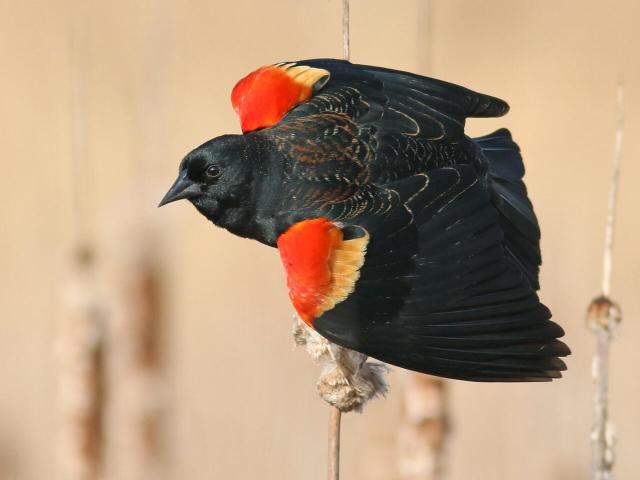
Male Red-winged Blackbird (Agelaius phoeniceus) by Jonathan Eckerson via Macaulay Library.

Male Red-winged Blackbirds! For me, their calls and bright red shoulders are one of the signs that spring is really here. Mind you, this is no subtle sign of spring that takes an expert naturalist to notice. No, this is a sign of spring that slaps you across the face, as if spring is calling, “I’m here! CONK-A-REE! Look at me!” Next time you drive past a wetland area with cattails, there is a good chance you’ll see one or more showing off their red shoulders (the brown females are beautiful too). Red-winged Blackbirds have been back in western PA and announcing their territorial claims since March. Whether you live in the country or the city, bird watching is a great way to observe the change in seasons and connect with the nature around you (and in you).

As a member of the Climate and Rural Systems Partnership (CRSP) team I’ve been gathering evidence-based stories of how climate change is impacting natural processes in western PA. Since this week is the City Nature Challenge, folks might be paying closer attention to birds, creating an opportunity for museum scientists to explain what migratory songbirds in our region can teach us about climate change.

Since 1961 scientists at the museum’s Powdermill Avian Research Center (PARC) in Pennsylvania’s Laurel Highlands have been monitoring birds. In that time they have captured, studied, marked, and released almost 800,000 birds! This week, for example, PARC’s mist nets are temporarily capturing birds like the Common Yellowthroat, Yellow Warbler, House Wren, Ruby-throated Hummingbird, American Redstart, and Wood Thrush.
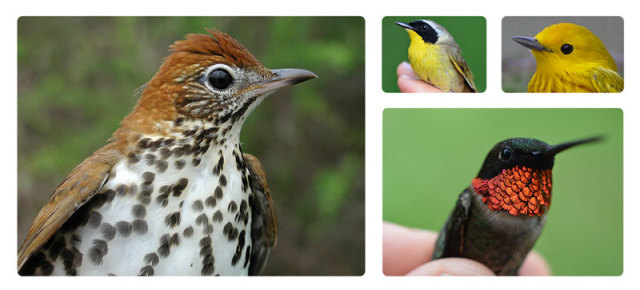
Migratory birds that are part of the PARC long term dataset (clockwise from left): Wood Thrush, Common Yellowthroat, Yellow Warbler, and Ruby-throated Hummingbird. All of these species are breeding earlier in the year in response to climate change that has already occured. Photos courtesy of Powdermill Avian Research Center.

All of these species are migratory–spending the winter in the southern US, the Caribbean, Central America, and/or South America. Many fly across the Gulf of Mexico (!) on their way north in the spring. All of these birds share another trait–they are nesting earlier in the year than they once did. We will follow the Wood Thrush as an example of how many birds are responding to the warming climate.
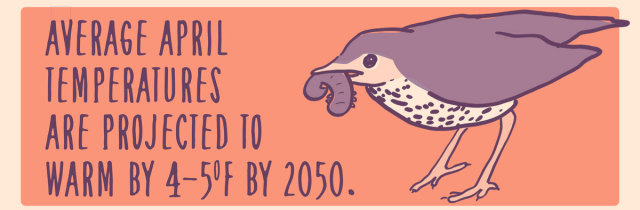
on the right side, text reads "Average April temperatures are projected to warm by four to five degrees Fahrenheit by 2050." On the left, there's an illustration of a bird holding a worm in its beak.
The artwork in this blog post is by the author and part of an infographic depicting the information written here.

PARC’s unique 50 year dataset allows scientists to study how birds respond to long term changes, including the warming climate. Average April temperatures in the Laurel Highlands have already increased by two degrees Fahrenheit since the 1960s, and are projected to warm by another four to five degrees Fahrenheit by 2050. Warmer springs trigger earlier plant budburst. Insects, especially caterpillars, feast on buds and young leaves, which have less toxins than mature leaves. Caterpillars are the breakfast of champions (among birds). So, migratory songbirds, including the Wood Thrush, need to synchronize their northward movement with the budburst. This means an earlier arrival, according to the calendar, at points all along their migration route.

Wood Thrushes arrive from Central America five days earlier than they did in the 1960s. Research suggests that migratory birds respond to temperature cues along their migration route and speed up (warmer temperatures) or slow down (cooler temperatures). Birds may be responding to temperature directly or indirectly via other temperature-dependent cues such as wind speed and direction and spring leaf out.
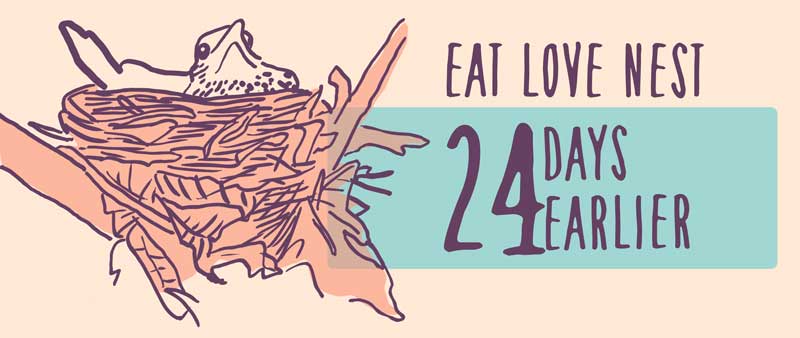
Eat, Love, Nest, 24 days earlier

Early arrival is not the only adjustment Wood Thrushes are making, however. The birds are also making their nests and hatching young earlier. Wood Thrushes are nesting 24 days earlier than they did in the 1960s. All four of the  bird species in the photo above are breeding earlier. Within the web of organisms that supplies food for birds, May 19 of the present feels like June 11 of the 1960s. The earlier nesting in response to a warming climate means birds that normally hatch and rear multiple broods per breeding season, such as House Wrens and Northern Cardinals, may  have greater reproductive capacity. PARC research shows that Gray Catbirds and Northern Cardinals are having more young in warmer springs, but other multi-brood species such as House Wrens and Common Yellowthroats are not.

While birds seem to be keeping pace with climate change now, they may not be able to in the future. Their capacity to adjust migratory and reproductive behavioral traits in response to climate change is finite. Also, we’ve already lost an estimated 3 billion North American birds since 1970 due to factors including habitat loss, insect declines, pesticide use, and predation by domestic cats. Now climate change is making bird survival even more difficult. The capacity of bird populations to evolve in response to climate change is also limited – climate change in the Anthropocene is happening much more rapidly than climate change in past epochs, many times faster than evolution can keep up. The good news is we can help birds, ecosystems, and ourselves by taking action to reduce the severity of climate change.

illustration of two birds flying with the text "You can help birds and climate"

Here are three ways individuals and communities can help birds by mitigating climate change:

1) Conserve habitat: Habitats like forests, wetlands, and prairies provide food and shelter for birds while the plants and soils remove and store carbon away from the atmosphere. These habitats are needed throughout birds’ migratory ranges. Create habitat by reducing lawns and planting native plants. For example, many birds enjoy eating the fruits of spicebush, elderberry, and black cherry, which are native to western Pennsylvania. You can find more bird-friendly plants native to your area at https://www.audubon.org/plantsforbirds.

2) Renewable energy: A just transition to renewable energy sources like properly-sited wind* and solar will reduce greenhouse gas emissions, provide local jobs, improve air quality, and help protect birds and people from climate change. *The National Audubon Society supports properly-sited wind energy.

3) Eat your vegetables: A more plant-based diet is an impactful way to reduce greenhouse gas footprints. Also, choosing food that is grown with less pesticides, and using less pesticides in the stewardship of your garden, helps support the survival of insects that are food for birds. Reductions in demand for pesticides also reduces their manufacture, which further reduces greenhouse gas emissions. Learn more from Project Drawdown.

So get out there, find the signs of spring that are gentle (Trout Lilies) and not-so-gentle (Red-winged Blackbirds), log them in iNaturalist for the City Nature Challenge, and talk with your family and your community about how you can implement one or two (or three!) of the actions suggested above!

You can also read this as an infographic here.

Thank you to the many folks who helped with the development of this blog post and infographic: Luke DeGroote, Mary Shidell, and Annie Lindsay at PARC; the Laurel Highlands network of the Climate and Rural Systems Partnership; Nicole Heller; Taiji Nelson; and Sarah Crawford.

Bonnie McGill, Ph.D. is a science communication fellow for the Climate and Rural Systems Partnership and based in the Anthropocene Studies Section at Carnegie Museum of Natural History. Museum employees are encouraged to blog about their unique experiences and knowledge gained from working at the museum.

Related Content

Teaching About Local Wildlife with the City Nature Challenge

Water Bears: Why My Yard is Like the Moon

Botanists Use Data Collected By Thoreau to Uncover Unexpected Effects of Climate Change

Carnegie Museum of Natural History Blog Citation Information

Blog author: McGill, Bonnie
Publication date: April 30, 2021

Share this post!

  • Share on Twitter Share on Twitter
  • Share on Facebook Share on Facebook
  • Share on Pinterest Share on Pinterest
  • Share on LinkedIn Share on LinkedIn
  • Share on Reddit Share on Reddit
  • Share via Email Share via Email

Share this post!

  • Share on Twitter Share on Twitter
  • Share on Facebook Share on Facebook
  • Share on Pinterest Share on Pinterest
  • Share on LinkedIn Share on LinkedIn
  • Share on Reddit Share on Reddit
  • Share via Email Share via Email

Filed Under: Blog Tagged With: Anthropocene, Anthropocene Living Room, Anthropocene Studies, Bonnie McGill, City Nature Challenge, climate change, CRSP

December 15, 2020 by wpengine

New Anthropocene Studies Paper in Curator: The Museum Journal

two hands clasped together and painted to look like the earth

A recent paper in Curator: The Museum Journal sheds light on the particular and growing relevance of natural history museums in sharing information about the Anthropocene, a proposed geological epoch, generally defined by the significant impacts of human activities on the Earth’s systems. In the 18 pages of The Anthropocene in Natural History Museums: A Productive Lens of Engagement, four co-authors use a careful comparison of two recent ground-breaking exhibitions devoted to the topic, one at a small natural history museum in Switzerland, and the other at Carnegie Museum of Natural History (CMNH), to establish how museum spaces as well as the unique materials that museums collect and preserve were effectively used to provide visitors with the means to experience the complexity, uncertainty, and interdisciplinary nature of current work in this relatively new field of study.

The Swiss exhibition, Objectif Terre: Vivre l’Anthropocene (Destination Earth: Living the Anthropocene) which was open during 2016 and 2017 at the Valais Nature Museum in the town of Sion, was the very first natural science exhibition worldwide specifically about the Anthropocene. The CMNH exhibition, We Are Nature: Living in the Anthropocene, which was open in 2017 and 2018, was the first major exhibition in North America to focus on the topic.

The paper also explores ways that the Anthropocene is driving changes in the practice of natural history science. The Anthropocene shows that humans are an integral part of nature, creating a challenge to the nature/human dichotomy that has been a common organizing principal in Western science and cultural worldviews. The authors maintain that recognition and study of ongoing human-induced changes is coupled with responsibility. Clear calls are made for scientists to explode the boundaries between natural science and social sciences, humanities and arts; and to think more critically about cultural assumptions and biases that are limiting scientific understandings and human responses to ecological crises. Analysis of the success of both exhibitions is tempered with advocation for more transdisciplinarity (people from different fields and backgrounds working together) and more attention to humanistic concerns and social equity in natural history museums. The overall conclusion of the peer-reviewed work is that in facing the Anthropocene, natural history museums are more relevant than ever. They have a critical role to play in 21st century education about social-ecological challenges, and in mobilizing community understanding and motivation to act for just sustainability.

The four co-authors came together to collaborate in the context of Gil Oliveira’s 6-month visit to CMNH to intern in the Anthropocene Studies section under the mentorship of Nicole Heller. His internship was part of attaining his Master of Arts in Museum Studies at the University of Neuchâtel. Gil had worked on the exhibition Objectif Terre: Vivre l’Anthropocene at the Valais Nature Museum with Museum Director, Nicolas Kramer.

The Anthropocene in Natural History Museums: A Productive Lens of Engagement in Curator The Museum Journal

GIL OLIVEIRA, ERIC DORFMAN, NICOLAS KRAMAR, CHASE D. MENDENHALL, AND NICOLE E. HELLER

Full Article can be found here, https://onlinelibrary.wiley.com/doi/full/10.1111/cura.12374.

Nicole Heller is Curator of Anthropocene Studies at the Carnegie Museum of Natural History. Museum employees are encouraged to blog about their unique experiences working at the museum.

Related Content

What does it mean to be for a Place?

Women in Science at Carnegie Museum of Natural History

Happy International Peace Day! 

Filed Under: Blog Tagged With: Anthropocene, Anthropocene Living Room, Museum from Home, Nicole Heller, Science News

December 15, 2020 by wpengine

What does it mean to be for a Place?

The following is a summary of a recent publication in Pacific Conservation Biology by a group of David H. Smith Conservation Research Fellows: Stephanie Borrrelle, Jonathan Koch, Caitlin McDonough MacKenzie, Kurt Ingeman, Bonnie McGill, Max Lambert, Anat Belasen, Joan Dudney, Charlotte Change, Amy Teffer, and Grace Wu. You can read the full article here.

When asked “Is protecting biological diversity and the ecosystems that support all life important to you?” most people would say “yes.” This is the work that conservation scientists like me and my friends do. We do things like figure out how to protect endangered bee species in Hawaiʻi (Koch), inform agencies how to manage the endangered whitebark pine in the Sierra Nevada (Dudney), and study how plants that grow on mountaintops in Maine are impacted by climate change (McDonough MacKenzie). However, many of us are not from the Places* we’re working to protect. In fact, many conservation scientists are descendants of colonizers and settlers (settler-colonizers) who removed, or benefited from the removal of Indigenous Peoples from these Places, which are their ancestral lands. Indigenous Peoples practicing diverse cultures lived for millennia in North America stewarding the land.

The Indigenous Peoples displaced by colonialism have distinct knowledges and cultural identities directly rooted in their lands. For example, Mauna Kea is more than a dormant volcano on the island of Hawaiʻi to the kānaka maoli (Native Hawaiians). The mountain is their biophysical and genealogical ancestor, a sacred site for cultural and spiritual activities. Another example is how Aboriginal Peoples in Australia practice cultural fire “for biodiversity, to protect the landscape, and for cultural reasons, all in one” (Steffensen 2019, p233).

Indigenous Peoples’ distinct genealogical and cultural relationship to the land and all the other beings they share the land with is far different than the relationship of settler colonizers to Place and nature. Industrial society is traditionally and intentionally very disconnected from nature, beginning with European states removing peasants from forests and the commodification of nature (Tsing 2005). For example, many of us don’t know where our food comes from; don’t have religious or cultural traditions connecting us to Place, the land, or nature; and don’t know the natural history of the creatures we encounter everyday.

So you can imagine it is more than awkward for settler-colonizer conservation scientists to be the only or dominant source of knowledge about how to conserve a colonized Place, yet for decades this has been a common occurrence. In some cases, conservationists have attempted to act as “white saviors” to local Peoples by centering the work around themselves and excluding local experts (see this piece about conservation in Africa by Mordecai Ogada). In other cases, settler-colonizer conservation has furthered the oppression of local Indigenous People by removing them from their homelands and calling them poachers when they hunt there (see this piece on US National Parks by Isaac Kantor). All with few long term conservation achievements to show for it—for evidence, look no further than the UN Convention on Biological Diversity. Turns out, preserving biodiversity is hard, as is adapting to climate change. At the local level, both of these issues require some global settler-colonial science as well as intimate knowledge of and human interaction with individual Places. I wonder who has that? …

Some settler-colonizer/non-Indigenous conservation scientists are now beginning to listen to Indigenous knowledge keepers, collaborate on research with Indigenous groups, and, in some cases, supporting and following the lead of Indigenous managers of their ancestral lands and waters. Conservation scientists are beginning to understand that the only way to long term conservation successes is to develop conservation strategies that also support the social and physical wellbeing and self-determination of the people who live there. But these settler-Indigenous partnerships are built on a troubled history of colonial violence and oppression. So, how do settler-colonizer conservationists proceed in a way that does not perpetuate harms to Indigenous Peoples? In other words, what does it mean to be for a Place when you’re not from that Place?

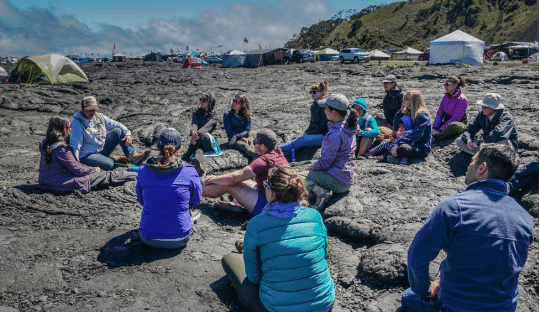
Several of my scientist friends and I wrestled with this issue after visiting kia’i (protectors) of Mauna Kea (Mauna a Wākea). It was October 2019 and we were hosted by Moana “Ulu” Ching and Noelani Puniwai, both of whom are kānaka maoli, conservation scientists, and friends with one of us (Koch).

Noelani Puniwai and Moana “Ulu” Ching (far left) met with our group of Smith Conservation Fellows at Pu’u Huluhulu near the base of Mauna Kea. We sat on black lava rock from an old lava flow. (Photo by Joan Dudney)

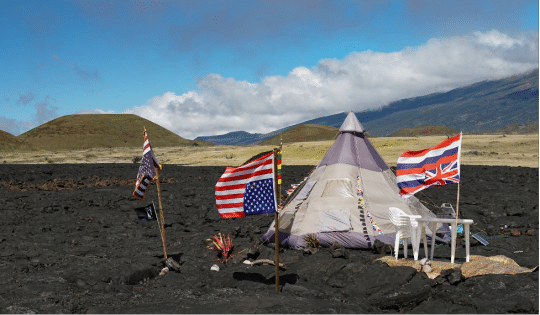
We met at the bottom of the access road to the summit of Mauna Kea. Here was a tent community of kiaʻi protesting the construction of a new telescope called the Thirty Meter Telescope on the summit of their ancestral Mauna Kea. They were occupying the entry road to prevent construction vehicles from accessing the summit; 33 kupuna (Elders, grandparents, ancestors) were arrested several months earlier marking the escalating tensions between the kiaʻi and the governmental and private institutions involved in developing the Thirty Meter Telescope. The telescope is the continuation of colonialism on Mauna Kea sponsored by 11 nations and universities against the wishes of and providing little economic benefit to kānaka maoli. Not only does construction of a 14th research structure threaten the fragile ecosystems and endangered species at the summit of Mauna Kea, construction also perpetuates a long history of colonization in Hawaiʻi that threatens the cultural, economic, and ecological well being of kānaka maoli.

One of the tents at the protest site. The upside down American and Hawaiian flags represent the kānaka maoli rejection of these colonial powers. The upside down Hawaiian flag can be seen on cars and buildings throughout Hawai’i. (Photo by Joan Dudney)

We listened as Ulu and Noelani described their experiences and perspectives on Mauna Kea and the telescope. Afterward they invited us to participate in midday protocol, and we were humbled by the experience. Protocol is a sacred community building activity that happens every day and consists of oli (chants), pule (prayer), and hula (dance). Non-kānaka maoli were allowed to observe the protocol and were invited to participate in a certain part. We showed our respect to Mauna Kea by standing in our bare feet on the road to her summit for the protocol. In one hula we were sending our energy and strength to Mauna Kea.

As conservation scientists we wanted to show our solidarity with the kiaʻi. We wanted to voice our objections to the Thirty Meter Telescope in terms of conserving the fragile summit ecosystem, and equally important, call for an end to continued colonialist practices in the name of settler-colonizer science. We channelled this energy into a policy statement opposing the construction of the Thirty Meter Telescope on Mauna Kea, which was later adopted by the Society for Conservation Biology. We further reflected on the experience and wondered what first-hand learning we could share with other conservation scientists embarking on anticolonial conservation work. We came up with a series of recommendations for scientists. You can read all of them here. Here are three major ones:

  1. Recognize the ways conservation theory and practice perpetuate the myth that North America was “empty” and “new” upon European “discovery.” For example, the mistaken belief that US National Parks never had human inhabitants despite the fact that Indigenous People have been living in and managing the lands and waters of North America for millennia.
  2. Build authentic relationships with the Indigenous Peoples whose lands we are working on. Realize that settler-colonizer science is not the “correct” or only way of knowing.
  3. Educate ourselves by learning about the history of the Places where we work and live and the Indigenous people affected by colonization. Read books and articles written by Indigenous scholars. Teach ourselves. After you have done the work to learn about the history and people(s), then reach out to Indigenous scholars, land stewards and managers.

We believe that being “for a Place” when you’re not from a Place means respect for Indigenous knowledge, continuous reflection on the consequences of our actions, and a willingness to act with humility, embrace complexity, and maintain hope. We are excited to grow and learn and contribute to the transformation of conservation science into a more inclusive, equitable, and just discipline.

*I capitalized Place throughout to emphasize its importance, akin to a person’s name being capitalized.

The Carnegie Museum of Natural History is on Seneca land and waterways, the homeland of the people we call the Monongahela, and lands and rivers used by and culturally connected to the Lenape, Shawnee, Wyandot, and Osage. I honor these ancestors, am grateful for their stewardship of these lands and waters, and acknowledge and respect their descendants alive today.

Bonnie McGill is a science communication fellow in the Section of Anthropocene Studies. Museum staff, volunteers, and interns are encouraged to blog about their unique experiences and knowledge gained from working at the museum.

Work cited

Steffensen, V. 2019. Putting the people back into the country. In: Decolonizing Research: Indigenous Storywork as Methodology. J. Archibald Q’um Q’um Xiiem, J. B. J. Lee-Morgan, and J. De Santolo, eds. Zed Books (London).

Tsing, A. L. 2005. Friction: An Ethnography of Global Connection. Princeton University Press (Princeton and Oxford).

Related Content

An Indigenous Presence: Cultural Survivance and Contemporary American Indian Art and Design

Herd Immunity and the Anthropocene

Ask a Scientist: How is gender represented in museums?

Filed Under: Blog Tagged With: Anthropocene, Anthropocene Living Room, Bonnie McGill, Museum from Home, Science News

November 18, 2020 by wpengine

Herd Immunity and the Anthropocene

When is getting an infection actually a good or a bad thing? Let’s start by talking about herd immunity. What exactly is it, and why have we been hearing about it so much during the Covid-19 pandemic?

Herd immunity, as described by the CDC, is a situation in which a sufficient proportion of a population is immune to an infectious disease (through vaccination and/or prior illness) to make its spread from person to person unlikely. When a group has a high enough percentage of immunity in its population, transmission becomes increasingly difficult for a disease to spread to even the more immunocompromised members of the community.

Although, herd immunity is obtained at different levels of community immunity depending on the disease. Some highly infectious diseases, such as measles, require about 94% herd immunity to stop community spread. According to the Mayo Clinic, about 70% of the US population would need to have immunity from Covid to stop our current pandemic.

So how do we even get herd immunity? Well, we can achieve herd immunity through two different methods. The first method is infection. Herd immunity can be achieved by having a large amount of the population getting the virus naturally. The downside of this method is that the population has to get sick and recover. Depending on the disease, short or long-term side effects or mortality rate can be very detrimental to the population.

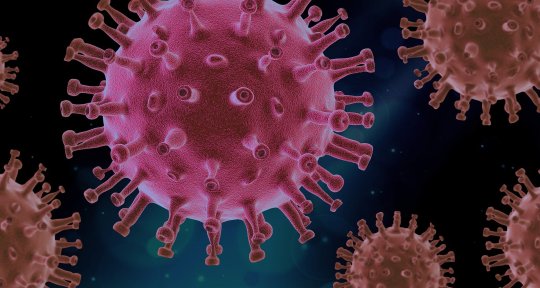
illustration of coronavirus cells

Germs have most likely existed for around 3.5 billion years (the age of the oldest living organisms, bacteria). Modern humans have only been around for about 130,000 years. Humans have only been around for a fraction of the time diseases have, but they are both a part of nature. However, in response to their presence, humans have developed immune systems that have been a part of a back and forth protecting us from harmful germs. Terrestrial vertebrates such as humans have complex immune systems that have evolved to protect them from new immunological dangers.  Getting sick is a part of life. Diseases have always been a part of nature, and that is especially true of the current time period, the Anthropocene. The Anthropocene is the current geologic age where humans have a substantial effect on their environment. During this time period, the way we interact with nature through contributing to climate change, deforestation, and urbanized lifestyles has increased the likelihood of pandemic-like illnesses to sweep over our communities. Deforestation causes loss of habitat; and with loss of habitat animals will be forced to come into contact with animals they originally wouldn’t have, including humans. This increases the chance for germs to spread to new hosts. Climate change and urbanization are also causing organisms to live closer together, allowing for diseases to spread more easily through communities. So, while diseases are a part of life and nature, occasionally there is one germ that can come around and have a profound effect on society.

I remember the news stories when NYC was first getting taken over by Covid. Medical personnel lacking PPE, hospitals overflowing, using ice trucks to store the deceased, and exhausted nurses and doctors. All of that resulted in just 22% herd immunity. At 22% herd immunity most of the population of NYC is still susceptible to Covid. If natural infection was the only way forward, so many more of NYC’s citizens would die or become severely ill. However, because this happened NYC was quick to understand the importance of instituting mitigating measures to slow the spread of the disease. Andrew Cuomo, the governor of New York, is similar to Rand Paul in that he is in a position that he can implement policies. When Andrew Cuomo, governor of New York, saw what was happening in his state, he used his ability to implement policies to follow scientific guidance surrounding closures, social distancing, masks, etc. As a result, the rates in NYC decreased. Not because of herd immunity, but because of serious measures against Covid. If we look at a different state, such as Florida, that did not take measures against Covid seriously, there were consecutive days in the state where they were having 10,000 to 15,000 new cases a day. This lacking approach to Covid caused thousands of preventable deaths. Even after months of lockdown the US is not close to herd immunity. All of the preventable deaths and long-term health complications that I’m seeing in people are going to continue with the natural spread. This is why the global race for a vaccine is so important.

The second method of reaching herd immunity is through vaccinations. By developing a vaccine for an infectious disease, we are able to reach herd immunity without having to subject our population, community, and families to the side effects and overall awful experience of falling ill. By using widespread vaccinations, we can also protect our most vulnerable members of society, like our loved ones in an older or younger age range, immunocompromised individuals, or those with allergic reactions making them unable to receive vaccines. Herd immunity is a good thing. When we have a disease like Covid, however, natural infection will cause crippling long-term effects in what were healthy people, and hundreds of thousands of preventable deaths. This is why herd immunity is good, but it depends on the method used to obtain it.

Immunity is an important part of preventing diseases in my home. Herd immunity helps me protect my family, friends, and people I come across every day. When paired with vaccines, I am able to protect more people in my community. I have a small child in my home, and older family members who I come into regular contact with. My family (my herd) and I get our vaccines and flu shots every year to help protect those more immunologically vulnerable members of our family. By doing this, my herd is creating a mutually benefiting environment where our personal actions protect those around us. The actions that we take to protect our family also protect the members of our communities and your herd too.

Humans are a part of nature, and so are diseases. Individual actions have a larger inter-connected effect on surrounding environments and society. The same thing could be said about the Covid virus spreading through the country. Society as a whole needs to develop a larger scope of thinking about how the actions of individuals affect the environment and planet. The factors I mentioned earlier, climate change, deforestation, and urbanization, are keeping steady and increasing. If these continue as they are currently, we can expect more pandemic-like diseases in our future. And when it happens, society will have to come together again to figure out the best way of adopting herd immunity to combat the disease.

As for my advice for the rest of this year, think critically, look at scientific data, vaccinations work, and in the words of Mr. Rogers, “Real strength has to do with helping others.”

Hannah Smith is an intern in the Section of Anthropocene Studies. Museum employees are encouraged to blog about their unique experiences and knowledge gained from working at the museum.

Works Cited

Glossary

Acquired Immune Deficiency Syndrome (AIDS): A medical condition where the immune system cannot function properly and…

www.cdc.gov

https://www.cdc.gov/vaccines/terms/glossary.html#commimmunity

Herd immunity and COVID-19 (coronavirus): What you need to know

Understand what’s known about herd immunity and what it means for coronavirus disease 2019 ( COVID-19). Curious as to…

www.mayoclinic.org

https://www.mayoclinic.org/diseases-conditions/coronavirus/in-depth/herd-immunity-and-coronavirus/art-20486808

Vaccines Protect Your Community

Did you know that when you get vaccinated, you’re protecting yourself and your community? This concept is called…

www.vaccines.gov

https://www.vaccines.gov/basics/work/protection

Anthony S. Fauci, M.D.

Dr. Fauci was appointed director of NIAID in 1984. He oversees an extensive portfolio of basic and applied research to…

www.niaid.nih.gov

https://www.niaid.nih.gov/about/anthony-s-fauci-md-bio

https://www.nytimes.com/2002/02/26/science/when-humans-became-human.html

https://www.nationalgeographic.com/science/prehistoric-world/precambrian-time/

https://www.britannica.com/science/immune-system/Evolution-of-the-immune-system

https://www.hsph.harvard.edu/c-change/subtopics/coronavirus-and-climate-change/

https://www.inc.com/geoffrey-james/45-quotes-from-mr-rogers-that-we-all-need-today.html

Related Content

Dippy and Art Cat Talk Safety

Places to Visit During a Pandemic

Combating Climate Change with Plants

Filed Under: Blog Tagged With: Anthropocene, Anthropocene Living Room, Hannah Smith, Museum from Home

November 10, 2020 by wpengine

What Does Climate Change Mean for Western PA Farmers?

Agriculture is many things when it comes to climate change: a source of heat trapping gases, a casualty of extreme weather events, and part of the solution. At Carnegie Museum of Natural History, we’re working with rural communities in western Pennsylvania to talk about climate change in conversations that connect the dots between agriculture as a source of emissions, a sector of vulnerability, and an under explored reservoir of much needed solutions. This work is happening through the Climate and Rural System Partnership (CRSP, which we pronounce “crisp”), a National Science Foundation-funded program involving three CMNH components (the Education Department, the Section for Anthropocene Studies, and Powdermill Nature Reserve), partner researchers at the University of Pittsburgh’s Center for Learning Out of School Environments, and the Mercer County Conservation District. In CRSP, we are using methods of co-production and co-design to develop climate change science and communication resources with our community partners that are relevant to the lived experiences and concerns of those partners’ and their audiences.

How is climate change impacting farmers in western PA? What would help them to make adaptive planning decisions? What mitigation actions are most attractive to western PA farmers and will best help to sustain livelihoods into the future? Are Western PA farmers already, or interested in becoming, climate champions–leading their community in mitigating and adapting to climate change on their farm?  How can the museum help? These are some of the questions we are exploring in CRSP.

Working alongside local livestock and row crop farmers, Penn State agriculture extension educators, and representatives of the Natural Resource Conservation Service (the agency formerly known as the U.S. Soil and Conservation Service), and the Mercer County Conservation District (a CRSP network hub), I have the privilege of exploring these issues and co-producing useful communication resources. Co-production is an iterative collaboration involving diverse perspectives to produce locally relevant knowledge and solutions (Norstrom et al 2020, Meadows 2015). Instead of scientists being the sole creators of new knowledge, in co-production all are creators of new knowledge.

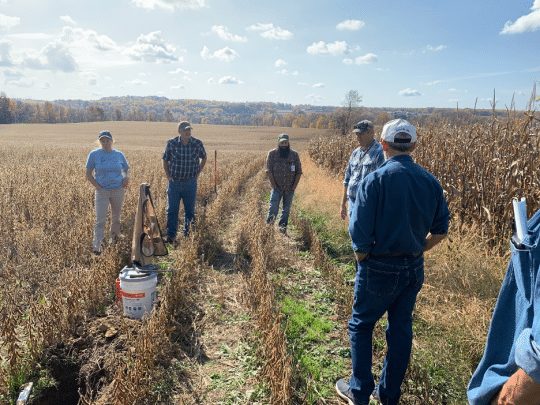
Mercer County Conservation District, CRSP partners, and other Mercer area farmers at a soil health workshop and demonstration in a no-till soybean field at Goddard State Park.

CRSP partners and I have started by developing an agriculture working group at the Mercer hub (also called the Shenango Climate and Rural Environmental Studies Team or Shenango CREST). In this group, we have compiled climate thresholds, which are climate data types that are meaningful to the everyday lives of farmers in Shenango River Valley. Global averages are not applicable here, instead we’re looking for things that affect farmers’ decision making or impacts the physical conditions required to operate. To do this, I asked the group “How do we make existing climate data, past and present, most useful? What connects climate to the everyday life of a farmer of both row crops and livestock. What is going to mean something when we talk with farmers in the Mercer area?“ Some of the thresholds that the group identified were: too much rain in the spring for planting crops, too much rain in the fall for harvesting the crops, and warmer winters in which the ground does not freeze leading to problems for soils and livestock.

Here’s an example of how the co-production process works. First, I found the best available data from 11 rural weather stations in the western PA region, each with 80-100 years of daily rainfall and temperature measurements, obtained from the National Oceanic and Atmospheric Agency’s Climate Data Online tool. Then, one of the network members identified a climate threshold as how the “July and August heat hurts milk production.” So, I explored the data to see what is happening with summer heat in rural western PA: has it been getting hotter? Will this continue in the future?

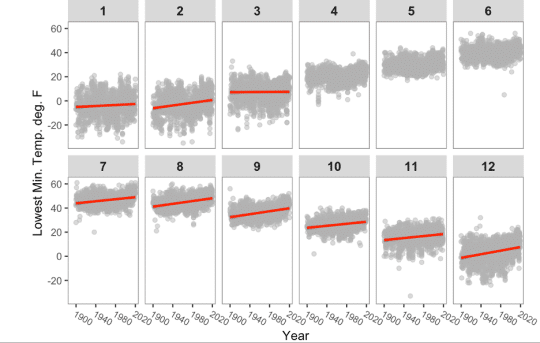
The short answer is yes. One analysis I used to explore these questions looks at the daily minimum temperatures. Warming daily minimum temperatures would mean less relief at night for the livestock as well as for crops. So, I conducted statistical analyses, and created a “rough draft” data visualization showing the minimum temperatures per month and the increasing trend over time in all months except April, May, and June (see figure below).

Preliminary analysis and rough draft visualization of monthly minimum temperatures for 1900-2020 from 11 western PA long term weather stations. Numbers at the top of each panel indicate the month. Red lines indicate a statistically significant increase over time. Each gray dot represents one weather station’s monthly minimum for that year.

Regarding dairy cows in the summer heat, this analysis revealed that since 1900 the coolest August nights have warmed 7oF in our region. Upon seeing this, one of the network members said, “Really great, local data, people can feel like they can trust it.” Another reacted, “Interesting to take a piece of climate change, make it understandable and relatable. Put science to something already happening, a thing they [farmers] are living.” The visualization prompted talk of impacts on milk production as well as changes in calving time, lambs needing shearing more often, and with soils not freezing as much in the winter, hooved animals face a potentially greater parasite load from the mud in the warmer months.

This successful first iteration of CRSP co-production suggests we are identifying climate trends with which local farmers can personally identify. Into the future, climate projections for low and high emissions scenarios show the number of days per year over 90oF in Mercer County increasing, and highlights how mitigation of climate change now will reduce that increase in temperature.

With these kinds of analyses, the Mercer agriculture working group is aiming for evidence-based and locally relevant outputs in the form of talking points, maps, and graphs about climate change impacts and solutions. We will also collect personal stories of network members and people they know that illustrate a shared experience among people in the region and a hopeful message of climate adaptation and/or mitigation.

Impacts of this work, we hope, will be to bring the narrative about climate change from insurmountable, global, and blaming, to a community-scale conversation that is tractable, local, and hopeful. Within the museum itself, this work will help us better understand how to better serve rural audiences, bridge rural and urban connections (not divisions), and have productive conversations about socio-scientific issues that cut through politicization and misinformation. The diverse connections between climate change and food production provides a “ripe” opportunity to explore how to have such conversations.

Bonnie McGill is a science communication fellow in the CMNH Anthropocene Section. Museum staff, volunteers, and interns are encouraged to blog about their unique experiences and knowledge gained from working at the museum.

Works cited:

Norström, A.V. et al. 2020. Principles for knowledge co-production in sustainability research. Nature Sustainability 3:182-190. https://doi.org/10.1038/s41893-019-0448-2

Meadow, A.M. et al. 2015. Moving toward the Deliberate Coproductin of Climate Science Knowledge. Weather, Climate, and Society 7:179-191. https://doi.org/10.1175/WCAS-D-14-00050.1

Related Content

Ask a Scientist: What is an amphibian party?

Thanksgiving and Nutritional Mineralogy

The Surrounding Trees Whispered with Their Leaves

Filed Under: Blog Tagged With: Anthropocene, Anthropocene Living Room, Bonnie McGill, CRSP, We Are Nature 2

November 9, 2020 by wpengine

The Surrounding Trees Whispered with Their Leaves

A fictional short story about a new era of inter-being communication and earth healing from past human mistakes.

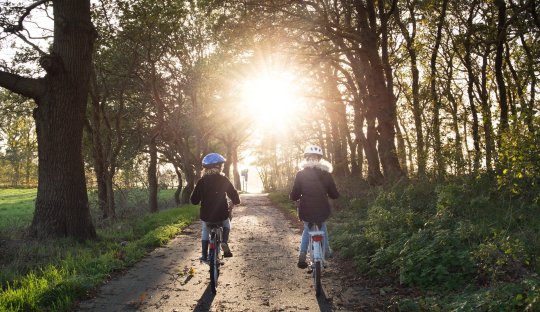
two children on bicycles riding on a path in the woods

As a transdisciplinary scholar, I am always pushing myself to experiment with new ways of communicating and exploring ideas. This summer, I was invited with my long-term collaborator, Tomas Matza, associate professor of Anthropology at University of Pittsburgh, to contribute to a Post-Covid Fantasies blog series published by the journal American Ethnologist. The prompt was to “propose imagined or speculative future scenarios for how things could be better in a post-covid world than previously.”

Writing this fantasy illustrated to me the power of speculative fiction for confronting the complexity of the Anthropocene. Anthropocene problems – climate change, biodiversity loss, pandemics – are overwhelming. How are we possibly going to solve the myriad of challenges that we all face living on a crowded, hot planet? It’s hard enough these days just to go to the grocery store!  But with speculative fiction – or imagining futures, we can transcend the practical affairs of “real life” and let our minds wander freely. We can explore unthinkable changes and fantastical scenarios.

For me one of the most surprising aspects of the pandemic experience was how it caused society to stop, at least for a while. The sudden downturn in consumerism, production, travel, and consequently large drops in carbon emissions, was remarkable and unprecedented (documented in the scientific literature here and here). It made me wonder…how will society change in the 21st century? How might people in the future look back at the world today and see it from a radically different perspective? What will trigger the changes that result in our society becoming sustainable? Rather than being through incremental policy work and gradual change, perhaps it will come in a most unexpected way – a giant jump forward – caused by interspecies mingling beyond our wildest dreams?

I hope you enjoy our fantasy, and the other contributions in this series. And I encourage you to write your own post-covid fantasy! What do you imagine for the future?

Nicole Heller is Curator of Anthropocene Studies at the Carnegie Museum of Natural History. Museum employees are encouraged to blog about their unique experiences working at the museum.

Related Content

Anthropocene Living Room (Video)

The Inequity of Summer Heat

From the Allegheny to Our Kitchen Sinks

Filed Under: Blog Tagged With: Anthropocene, Anthropocene Living Room, Museum from Home, Nicole Heller, Science News

  • Page 1
  • Page 2
  • Page 3
  • Page 4
  • Go to Next Page »

sidebar

About

  • Mission & Commitments
  • Directors Team
  • Museum History

Get Involved

  • Volunteer
  • Membership
  • Carnegie Discoverers
  • Donate
  • Employment
  • Events

Bring a Group

  • Groups of 10 or More
  • Birthday Parties at the Museum
  • Field Trips

Powdermill

  • Powdermill Nature Reserve
  • Powdermill Field Trips
  • Powdermill Staff
  • Research at Powdermill

More Information

  • Image Permission Requests
  • Science Stories
  • Accessibility
  • Shopping Cart
  • Contact
  • Visitor Policies
One of the Four Carnegie Museums | © Carnegie Institute | Privacy Policy | Terms of Use | Accessibility
Rad works here logo