• Skip to primary navigation
  • Skip to main content
  • Skip to primary sidebar

Carnegie Museum of Natural History

One of the Four Carnegie Museums of Pittsburgh

  • Visit
    • Buy Tickets
    • Visitor Information
    • Exhibitions
    • Events
    • Dining at the Museum
    • Celebrate at the Museum
    • Powdermill Nature Reserve
    • Event Venue Rental
  • Learn
    • Field Trips
    • Educator Information
    • Programs at the Museum
    • Bring the Museum to You
    • Guided Programs FAQ
    • Programs Online
    • Climate and Rural Systems Partnership
  • Research
    • Scientific Sections
    • Science Stories
    • Science Videos
    • Senior Science & Research Staff
    • Museum Library
    • Science Seminars
    • Scientific Publications
    • Specimen and Artifact Identification
  • About
    • Mission & Commitments
    • Directors Team
    • Museum History
  • Tickets
  • Give
  • Shop

Blogs about the Anthropocene

Scientists use fossils and other traces to understand how the planet changed over time. In the past these changes were caused by forces like volcanic eruptions and shifts in oceans currents. Now there’s a new force of nature shaping the planet: humans. The effects on air, land, and water are significant enough that scientists propose we are a new geological time – the Anthropocene – or age of Humans.

These blogs are about the many facets of human impact on the Earth, documenting this new age.

January 30, 2019 by wpengine

The Search for the Near Threatened Green Salamander, Aneides aeneus

By Kaylin Martin

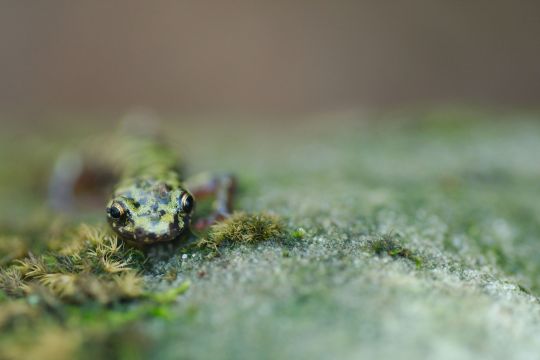
green salamander
Photo credit: Aaron Semasko

Fueled by caffeine and the promise of a sighting of the elusive and threatened green salamander, I made my way to the assigned meeting point in Fayette County, Pennsylvania. I was told we would be meeting a contact that could lead us to his secret location wherein there was prime habitat for green salamanders. Slowly, a muddy truck approached us and motioned for us to follow him. Thirty minutes of unpaved, unmarked, pothole riddled roads later I was standing in front of a hillside with rough terrain.

I knew I was in for an intense hike. Green salamanders are found in rock crevices in outcroppings or on the sides of cliffs. Unlike most salamanders that can be found abundantly under damp logs or rocks, green salamanders are extreme habitat specialists. Because of their habitat requirements, these salamanders are considered Near Threatened by the IUCN Red List of Threatened Species. The green salamander is listed as Endangered in Indiana, Ohio, Maryland, and Mississippi, as Threatened in Pennsylvania, and as Protected in Georgia. Some herpetologists argue that they should be nationally classified as Endangered, given that population sizes are decreasing due to habitat loss, drought and road development.

Armed with flashlights, our group of enthusiastic herpetologists made our way toward outcrops of rock along the hillside. We pointed our flashlights into every small crevice big enough to fit a salamander, hoping to see two large round eyes staring back at us. Within the first hour, we found a handful of common slimy salamanders, Plethodon glutinosus. Distinguished by their black color with silver or gold spots running along their backs, slimy salamanders are most known for the sticky substance they exude when threatened. Mostly found under logs or stones, the slimy salamander is also known to utilize its climbing abilities to crawl into crevices of shale banks, the same habitat that green salamanders favor.
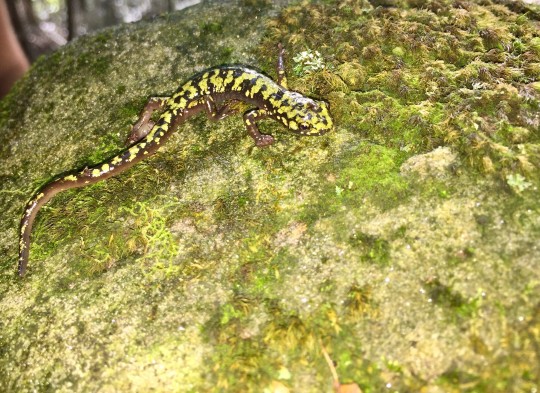
green salamander

As I was photographing an eastern red-backed salamander, Plethodon cinereus, I heard a yelp of excitement, “A green! A GREEN!” A few agonizing minutes of scrambling through brambles and rocky terrain to get to my colleague ensued. As I approached, I was filled with excitement. Being the Curatorial Assistant of Amphibians and Reptiles allows me to catalogue specimens from all over the world, collected by renowned scientists in my field. This position gives me a platform to tell the public about why amphibians and reptiles are so important to our ecosystem. The thrill of seeing a Near Threatened salamander in its natural habitat reaffirmed my love for my career and the honor I feel in being an ambassador for amphibians and reptiles. Nothing beats the opportunity to photograph the species camouflaged into the moss around it, or the few minutes where you promise yourself and the species in front of you that your life’s goal is to promote environmental awareness of Pennsylvania herpetofauna (reptiles and amphibians), and the hope that maybe the green salamander will thrive in Pennsylvania in the age of the Anthropocene.

What can you do? Check out the Pennsylvania Amphibians and Reptiles Survey at https://paherpsurvey.org/.If you find an amphibian or reptile, take a photo and send it to the PA Herp Survey to help document the biodiversity and status of Pennsylvania herpetofauna.

Kaylin Martin, M.Sc, is the curatorial assistant in the Section of Amphibians and Reptiles. Museum employees are encouraged to blog about their unique experiences and knowledge gained from working at the museum.
Filed Under: Blog Tagged With: amphibians, amphibians and reptiles, Anthropocene, herpetology, Kaylin Martin, pennsylvania, reptiles

January 24, 2019 by wpengine

Anthropocene Living Room

Welcome to the Anthropocene Living Room, a new space in the museum inspired by how humans have and will continue to shape natural history and nature. Hear Dr. Nicole Heller, Curator of the Anthropocene, share her vision for the space and introduce its various elements including items from our collections, books, and other tools for reflection and learning.

Filed Under: Blog Tagged With: Anthropocene, Anthropocene Living Room, climate change, nature, Nicole Heller

January 17, 2019 by wpengine

Art, Science and the Intersection of Knowledge

By Eric Dorfman

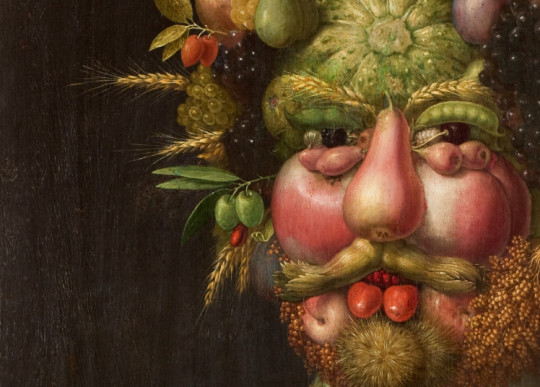
Detail of Vertumnus, by Mannerist painter Giuseppe Arcimboldo produced in Milan c. 1590. Arcimboldo’s most famous work, it depicts the Holy Roman Emperor Rudolf II as Vertumnus, the Roman god of the seasons, transformation and abundance.

I’ve always loved this painting. Vertumnus looks serenely at the viewer, a slight smile making you think he knows something you’d like to. It’s a clever work of Mannerism, seamlessly weaving a complex array of perfectly rendered fruits and other plants into the portrait of a human face full of character. The portrait is of the Holy Roman Emperor Rudolf II, a contemporary of Elizabeth I, William Shakespeare and the flowering of one of the important periods in Western culture.

By linking Rudolf to Vertumnus, Giuseppe Arcimboldo makes a supremely flattering gesture. The Holy Roman Emperor is, by this reference, a godlike figure, responsible for eliciting positive change in his empire. While the painters of the 16th century were no strangers to allegory, this work has always struck me as particularly effective. Perhaps I’m just drawn to the sense of fun. Equally, however, it wouldn’t be as effective to me if the plants weren’t so engaging.

By marrying art and science (in this case, plant anatomy), Arcimboldo attempts to describe the world and, in some way, help us understand his version of it through the oblique mechanism of allegory.

One of our most primal needs is to understand the world around us, and then share that understanding. We are motivated to understand because we – humans in general – are (justifiably) afraid of the unknown. In fact, the craving for order and predictability is a trait that may have had its origins in our most ancient roots as a survival skill in our earliest ancestors. The early Hominids, like any other animal, would have been vulnerable to the dangers of changing environmental conditions. Being able to recognize and react appropriately kept them alive and that impetus is today equally resonant to business people as to hikers.

Bringing them down to their common denominators, art and science have much in common in this regard. The fields cause us to reflect, explore and communicate aspects of the world around us.

“The greatest scientists are artists as well.” – Albert Einstein, 1923

Many scientists I know (myself included) are either arts practitioners or have deep appreciation for the arts. Perhaps Isaac Asimov is the greatest 20th century example of this. Aside from being a professor of biochemistry at Boston University, he was a prolific writer who wrote or edited more than 500 books on just about every subject imaginable from science fiction, to Shakespeare to off-color limericks.

Even disregarding the ways art and science might be superficially similar, it’s also worth thinking about how they can also be integrated. Considerable creativity is needed to make scientific breakthroughs and art is just as often an expression (or the product) of scientific knowledge. The science behind singing opera, mixing paint colors, baking, fashion design or creating perspective in a drawing, all have strong scientific underpinnings. In fact, getting the science down to the point where it is second nature is the mark of a true master.

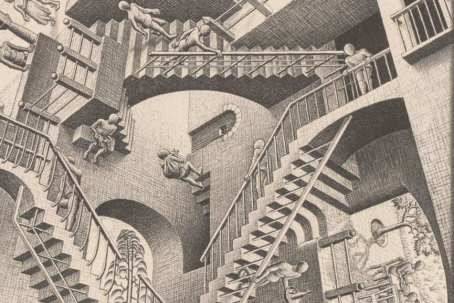
Detail of Relativity by Maurits Cornelius Escher, 1953

Using mathematics creatively was the hallmark of the Dutch artist Maurits Cornelius Escher who, although not having mathematical training made art that had a strong mathematical component. Many of the drawings for which he is best known were built around impossible landscapes. In his seminal 1979 book Gödel, Escher, Bach: An Eternal Golden Braid, Douglas Hofstadter explores common themes in the lives and works of logician Kurt Gödel, M. C. Escher, and composer Johann Sebastian Bach, wrapping up concepts fundamental to mathematics, symmetry, and intelligence within the lives of these three people.

When both artists and scientists are successful, it because they change our perceptions of the world, causing us to see it – and ourselves – differently. Where they fail is when they present nothing new. “Derivative” is a condemnation in either field.

The Legacy of da Vinci

In his book How to Think Like da Vinci (MJF Books, 2015), Daniel Smith says of Leonardo:

We wonder how one man could be so skilled across the arts and sciences. The answer is that he recognized no intellectual separation between his work as an artist and as a scientist. Instead the art and the scientist were conjoined, their ideas flowing effortlessly together informing his practice in whatever discipline he happened to be focusing upon on any given day… the Mona Lisa could not have been painted had he not devoted countless hours to the study of anatomy (page 75).

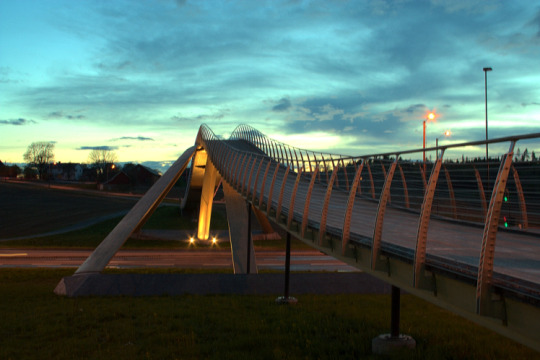
The Vebjørn Sand Da Vinci Project bridge
The Vebjørn Sand Da Vinci Project bridge, based on a design by Leonardo Da Vinci. Photo: Åsmund Ødegård, 2005

The talents of da Vinci as a bridge engineer were demonstrated in 2001, when artist Vebjorn Sand built the da Vinci-Broen bridge in Norway using da Vinci’s never-realized plans for a bridge originally meant to stretch across the Golden Horn in Istanbul. The Ottoman Sultan Bajazet II, who commissioned it rejected the design as an architectural impossibility. So – almost 500 years after its design – da Vinci and his design were vindicated.

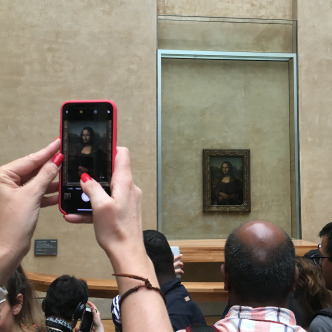
And yet, the world at large forgets most overlooks his scientific and engineering achievements, focusing on him as an artist, the creator of two of the most famous paintings in history.

crowd in front of the Mona Lisa

It was bad luck that da Vinci’s work was lost to civilization for almost 200 years, through a combination of poor planning, carelessness and profiteering. Michael White, in this 2000 biography Leonardo: The First Scientist speculates on modern society, had this not been the case:

…Leonardo had made startling discoveries in his studies of optics, mechanics, anatomy and geology. He had created a form of plastic, developed a sophisticated predecessor of the camera (the camera obscura), written of contact lenses and steam power, explained why the sky was blue and developed visual techniques for representation of the body that would only be seen again with the invention of the CAT scan.

We can only wonder what would have happened to the history of science, and from that the development of technology, if Leonardo’s work had been known about and read widely soon after his death. Where would we be today? What technological wonders now enjoy? (page 4)

STEAM: The Arts in Science Education

Recognizing this great potential for integration, how can we move into a realm of true interdisciplinarity, which represents a nexus between the arts and sciences? One avenue I find promising is STEAM education, which explores these concepts as an integrated whole, rather than as silos to be conquered separately.

woman and girl looking at laptop together

Many people are aware of STEM (science, technology, engineering, and math). It has been in use sufficiently long for educators to see outcomes and practices unfold in schools across the nation. More recently, however, some educators have proposed adding an “A” (for arts) to the STEM curriculum. In doing so, they have sparked a national debate about whether the arts have a place in STEM education.

Today’s innovators are rewarded for creativity, both from employers and by the marketplace. Working collaboratively in open work spaces, sharing ideas globally with other thinkers, and combining their STEM powers with more artistic talents. From the open-air Brooklyn offices of Kickstarter that inhabit an old pencil factory, to the dog-friendly work spaces of Seattle-based Rover, these celebrate humanity and creativity as being fundamental to the design process. (See the full story at Artsy)

If the marketplace is ready for this sort of thinking, it presents the field of Education with an opportunity. Integrating knowledge can be highly beneficial to students because in the real world, these challenges blend together. Teaching children how to challenge assumed knowledge and come up with unique combinations is fundamental to true innovation. From the perspective of da Vinci (and the many other thinkers who followed, from Francis Bacon to John Ruskin), this integration was so fundamental as to go without question.

Practitioners who use science and math to create innovations also use design-thinking to help conceptualize their work. Their communication incites enthusiasm in the the funding community in order to secure support for their initiatives. They also work collaboratively with colleagues and investors to improve and expand ideas, and then speak eloquently about progress and discoveries to an engaged public.

Similarly, artists often must understand accounting if they are running their own business, as well as the materials with which their artworks are composed, and the regimes of humidity and temperature within which the pieces must be stored.

Creating factions out of the areas of study and focusing solely on testing and rigor contributes to the continually low levels of student engagement in STEM. The “A” of arts in STEAM provides the essential ingredients of relevance, immediacy and passion to unlock what there is to love about science and its sibling subjects.

A Final Thought: We Need Art and Science to Save the Planet

The Earth is in trouble. The litany of environmental catastrophes is too long to recount and, for which, the concept of the Anthropocene (the shortly-to-be-named Age of Humanity) in some way serves as a convenient focal point. Even if you choose not to buy into the fact that our climate is changing due to human activity, it’s impossible to deny the estimated 87,000 tons of garbage in the World Ocean, vanishing coral reefs, global declines of amphibians, bees and many other groups. Although you can’t deny it, do you have to care?

In this book Consilience: The Unity of Knowledge, the great biologist E. O. Wilson introduces his concept with the following words:

The greatest enterprise of the mind has always been and always will be the attempted linkage of the sciences and humanities. The ongoing fragmentation of knowledge and resulting chaos in philosophy are not reflections of the real world but artifacts of scholarship (page 8).

These words resonate to me because it is in the unity of knowledge that I find the greatest hope for our future. Especially in the United States, for true environmental protection to take place, people have to care. When I was young, environmental protection meant setting aside breeding habitat for threatened species or banning the whale hunt. Now, single-species issues (which today are even more severe) have been eclipsed by issues that everybody has to care about. Air, water, arable land and other environmental goods and services.

Greenpeace ad

Who is it that helps people care? This ad from Greenpeace (c2008) presents a wonderfully simple question: “Do you know what’s in your food?” It provides the most basic call to action, urging you to ask questions about hidden GMOs in the food you eat. For me, it works because Greenpeace found humor in a very serious subject. It’s engaging, without preaching and, rest assured, there’s science behind the message.

In some ways, Greenpeace is doing what Giuseppe Arcimboldo did 450 years earlier. Using plants as a sort of visual synecdoche, both artists tell a bigger story with their visualization, one that’s based on the psychical properties of those plants and what they represent. This is the kind of clever thinking that gives me hope and confirms the place of interdisciplinarity across the arts and sciences.

If we want to own our future, we must take control of our present, using every tool at our disposal. Tomorrow’s world is bright for those willing to make bold experiments. The next generation needs polymaths.

Eric Dorfman is the Daniel G. and Carole L. Kamin Director of Carnegie Museum of Natural History. Eric oversees strategic initiatives, operations, and research at the museum. He is an active advocate for natural and cultural heritage and has published books on natural history and climate change, as well as children’s fiction and scholarly articles on museology and ecology. Read more of Eric’s work on his blog. 

Filed Under: Blog Tagged With: Age of Humanity, Anthropocene, art

January 17, 2019 by wpengine

Fish Story

by Patrick McShea

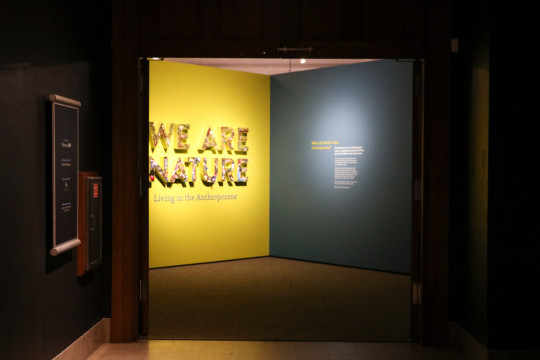
entrance to We Are Nature exhibition

Museum educators who helped interpret We Are Nature: Living in the Anthropocene during the ground-breaking exhibition’s ten-month run now pay close attention to explanations of Anthropocene-related themes. When exceptional examples are encountered, we feel compelled to share them.

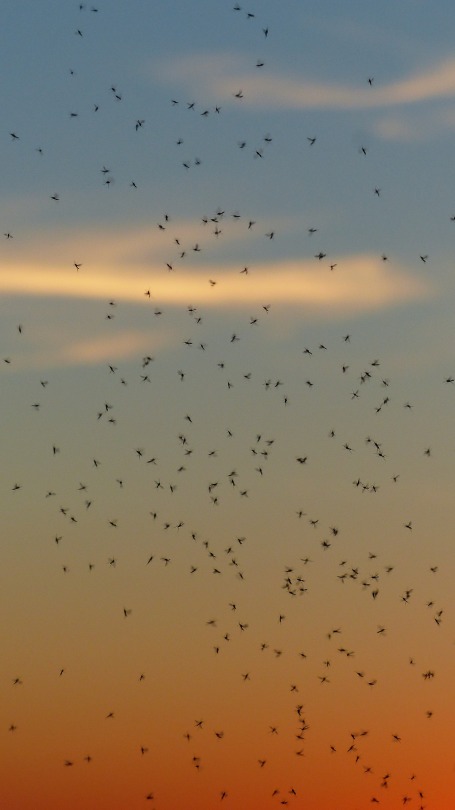
Recently, in a New York Times article about how a decades-long decline in insect populations is now causing alarm, author Brooke Jarvis addresses the apparent invisibility of environmental degradation that occurs over generations.

She presents the term “shifting baseline syndrome” for the phenomenon, and by way of memorable example summarizes the results of an unusual research study from 2008.

Marine biologist Loren McClenachan, of the Scripps Institute of Oceanography, quantified the decline of fish associated with Florida Keys coral reefs by examining historic photos, 1956 – 2007, of the sportfishing customers and catches of three long established charter boat companies.

Although smiles remained consistent across the decades, prize fish got considerably smaller. As Jarvis notes in her summary, “The world never feels fallen, because we grow accustomed to the fall.”

mosquitos at sunset - insect apocalypse

For more details, check out Brooke Jarvis’ full article, The Insect Apocalypse Is Here.

Patrick McShea works in the Education and Visitor Experience department of Carnegie Museum of Natural History. Museum employees are encouraged to blog about their unique experiences and knowledge gained from working at the museum.
Related Content

Fish and the Fourth of July?

Rising Through the Educator Ranks

Stage and Screen Sharing

Carnegie Museum of Natural History Blog Citation Information

Blog author: McShea, Patrick
Publication date: January 17, 2019

Share this post!

  • Share on Twitter Share on Twitter
  • Share on Facebook Share on Facebook
  • Share on Pinterest Share on Pinterest
  • Share on LinkedIn Share on LinkedIn
  • Share on Reddit Share on Reddit
  • Share via Email Share via Email

Filed Under: Blog Tagged With: Anthropocene, fish, Pat McShea, We Are Nature, We Are Nature: Living in the Anthropocene

January 2, 2019 by wpengine

Earth History in Your Hand

By Gil Oliveira

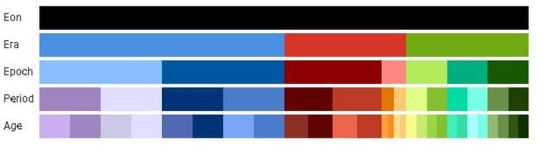
© Chart: The Conversation, CC-BY-ND

In my previous blog, I wrote about the last Jurassic World movie, which ends with the rise of a new fictional Jurassic Age, where humans and dinosaurs must learn to coexist. The Jurassic is one of the most famous geological time-periods. But when exactly was the Jurassic? The Jurassic Period ran from 200 to 145 million years ago. A long time ago… To put it into perspective, the origin of our species, Homo sapiens, dates back approximately 300 thousand years ago, which also seems a long time ago, but represents only 0.007% of the entire history of the planet (4.5 billion years)! What happened on Earth the 99.993% of the time when we did not yet even exist?

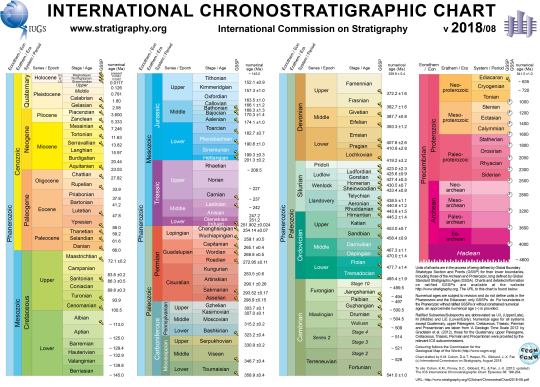
To understand earth history, natural history museums travel back through time. To do this they use a communication tool called the Geological Time Scale. In the same way we measure time with segments (such as years, months, weeks, and days), geologists subdivide deep time into useable, agreed upon units (eons, eras, periods, epochs, and ages).

chronostratigraphic chart
© ICS: http://www.stratigraphy.org, CC BY-NC-ND

But the Geological Time Scale is not exactly a calendar, because these time intervals are not equal in length like the hours in a day. Instead, divisions are based on significant events in the history of the Earth, that are detectable in rock, fossil and ice records, such as the extinction of the dinosaurs 66 million years ago, which defines the beginning of the Cenozoic era.

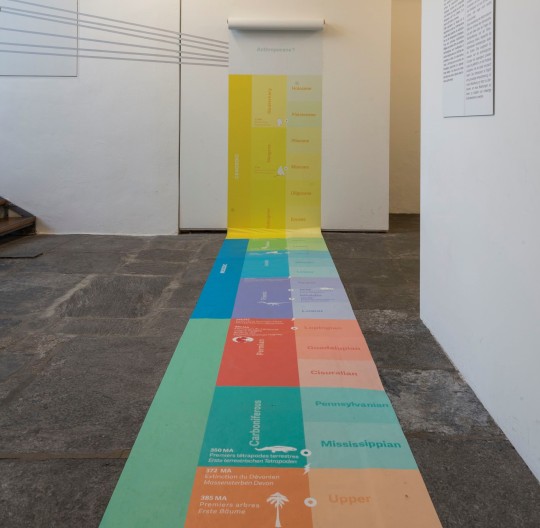
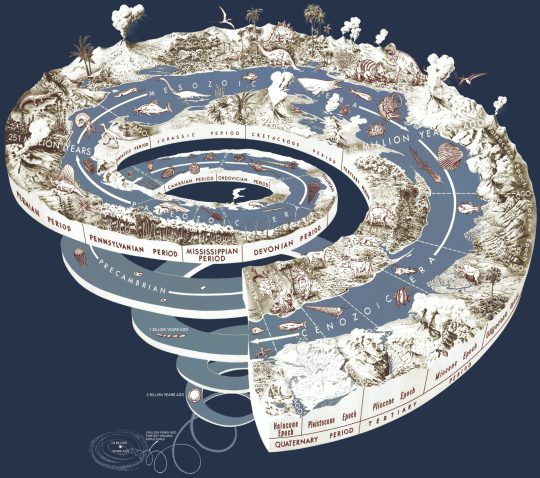
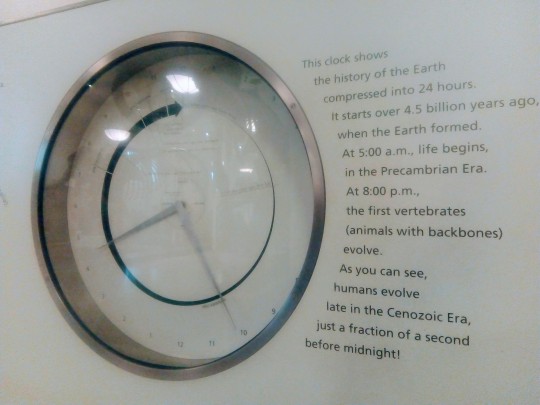
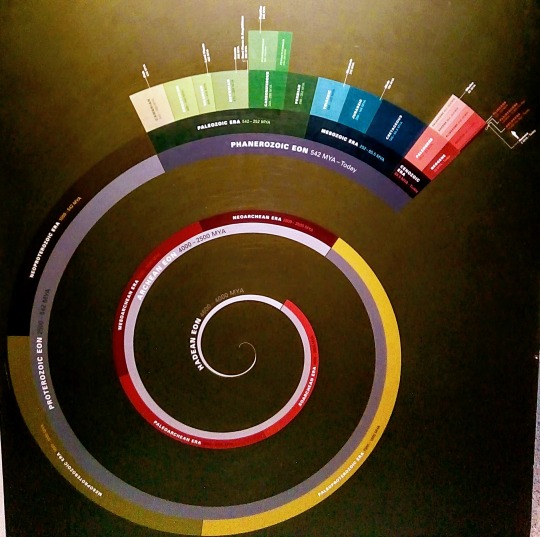
Museums don’t seek to teach the official chart of geologic time. But they seek to teach about deep time and the planet’s history, helping to put current times into a longer historical context. Museums use different techniques to make the geological time scale comprehensible. One approach is linear and usually consists of a strip of paint that represents the geological time scale rolled out on a surface. It was used for instance in the Objective Earth: Living in the Anthropocene exhibition at the Valais Nature Museum (Switzerland), which rolled out a linear poster around 30 feet long on the ground (and the wall). A second approach I have seen is more focused on aesthetics and takes the form of a spiral of time. Another technique is to take the age of the Earth and compress it into one year or one day. The American Museum of Natural History in New York used this approach with a 24-hour clock. The label indicates that life began at 5 am and the first vertebrates evolved at 8 am. As for the humans, they appeared just a fraction of a second before midnight.

Objective Earth. Living the Anthropocene © Robert Hofer


illustration of deep time
© USGS https://pubs.usgs.gov/gip/2008/58/


clock illustrating deep time
© Gil Oliveira

Each approach has benefits and disadvantages. The Geologic Time Spiral for instance can be visually striking, but the perspective of the spiral’s depth runs the risk to lose any perception of the proportion of geological time, which is the main information. It may also give a false impression of accelerating events (geological, biological, climatic, human) as we move closer to the present.

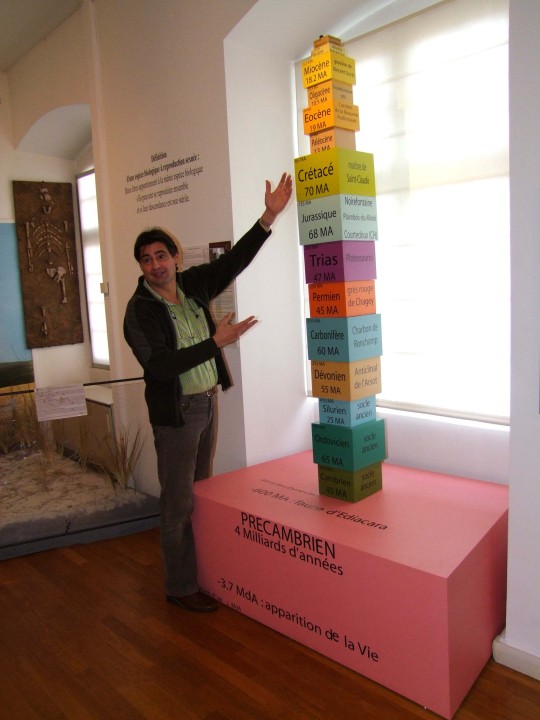
In 2007, the Cuvier Museum in Montbeliard (France) came up with a new way to represent the geological time scale. Thierry Malvesy, now curator of Geology Collections at the museum of natural history of Neuchatel (Switzerland), did it using cubes of different volumes. The advantage is to respect the proportions of time while allowing the public to see everything at a glance. It was used to explain the principle of biological evolution, emphasizing the importance of time in the evolution of life.

Cuvier Museum, 2007 © Thierry Malvesy

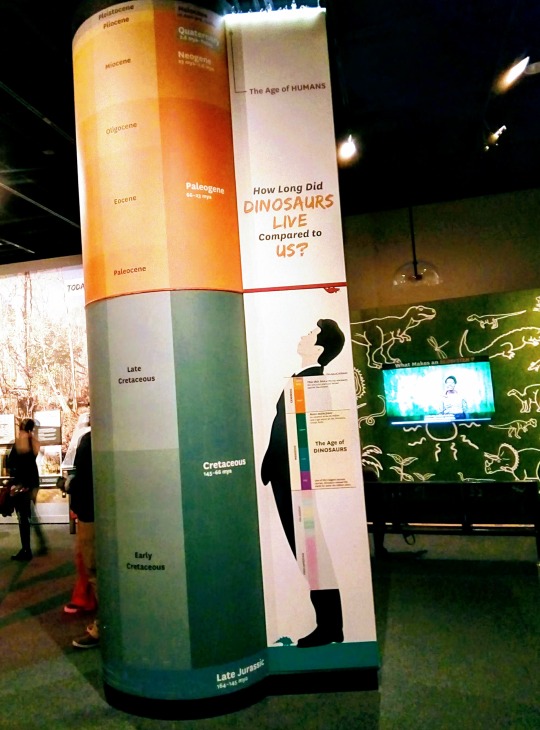
What is the best way to make the geological time scale understandable? There’s no easy answer. Each approach is a compromise in a way. The dinosaurs exhibit at the Smithsonian’s National Museum of Natural History uses both the spiral and the linear approach. This choice may only be temporary, as the new hall called The David H. Koch Hall of Fossils—Deep Time will open in less than a year. I wonder which approach they will use to help visitors connect to Earth’s distant past?

illustration of deep time
© Gil Oliveira
how long did dinosaurs live compared to us?
© Gil Oliveira


As the Carnegie Museum of Natural History is embracing the Anthropocene as a major theme for the future, it is important to place this newly proposed epoch in deep time. It is equally important for museums to find the best way to do it.

Gil Oliveira is postgraduate student working as an intern in the Section of the Anthropocene at the Carnegie Museum of Natural History. Museum employees are encouraged to blog about their unique experiences working at the museum.

Filed Under: Blog Tagged With: Anthropocene, Anthropocene Living Room, Gil Oliviera, museums

October 24, 2018 by wpengine

A Striking Success in Protecting Birds

by John Wenzel

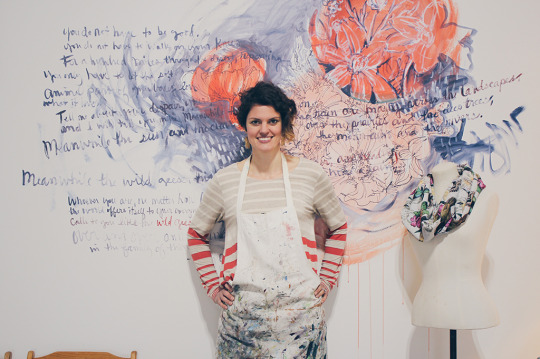
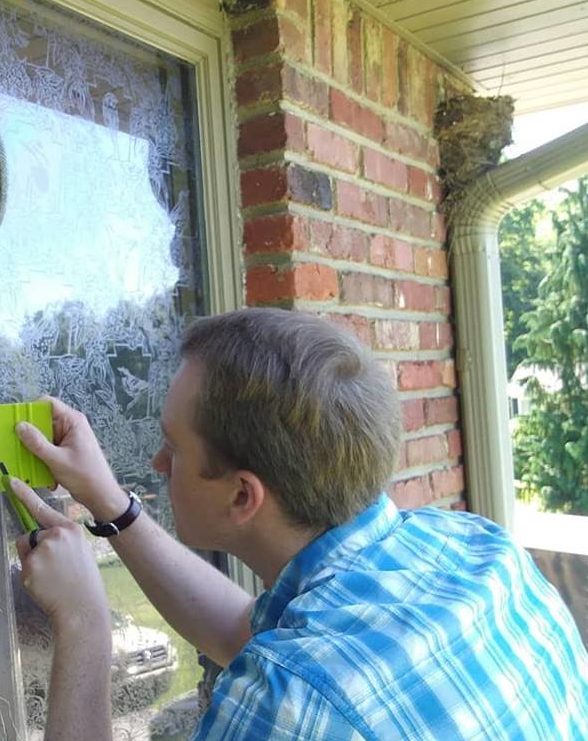
A particular point of pride of our bird research is the BirdSafe Pittsburgh program. A consortium of environmental groups and concerned citizens is working to create a more bird-friendly city, from restoring urban habitat to advising builders and architects on designing structures that will be less dangerous to birds. One of our prime collaborators has been Ashley Cecil, who was Artist in Residence at Carnegie Museum of Natural History. Ashley’s art is bird-themed, including one work that was reproduced on adhesive film that reflects UV light and is highly visible to birds. This film can be applied to windows so that birds will see Ashley’s pattern and avoid collision rather than see a reflection of a distant tree they would approach, striking the window. The film is available in color, making the window look like a stained glass, and in transparent form, resembling lace.

Ashley Cecil in front of her art work

But does the film work? If you put the film on the window, does it reduce bird strikes? As the Director of Powdermill Nature Reserve, I thought I should lead by example and test the film on my own house. I have been monitoring bird strikes at my home since August of 2015. From about 6:00 am to 8:00 am, three or four days a week (at total of six to eight hours a week), I listened for strikes and recorded them. They are not random, nor evenly distributed. Certain windows seem to be a repeated problem, while others never seem to get hit. My house has 15 windows of various dimensions, plus a cathedral window that is 11 feet high and 21 feet wide. No bird has ever hit that window as far as I know. Most strikes occur when migrating birds are coming through, usually April and May, or September and October. When there is a flush of migration, it shows: I had seven strikes from August 27 to 31 in 2015, in only 10 hours of observation. Ignoring seasonal variation, and averaging across the entire data set, a rough estimate is that I observed about one strike for every 20 hours of observation. On June 14, 2018, our Urban Bird Conservation Coordinator, Jon Rice, installed the transparent film on the five most dangerous windows, leaving the others bare.

Jon rice applying birdsafe window

We have had zero bird strikes since the film was installed. To assess the effect of the film, consider that in the same period in 2017 we had seven strikes, in 2016 we had four, and in 2015 we had nine. Years have some random variation, but clearly, there is a reduction from these earlier three years’ average of 6.7 down to 0. More than that, my wife Donna and I became more vigilant since the installation of the film, and we logged about 10 or 12 hours of observation per week rather than six or eight we did for the baseline. If we use the baseline expected frequency of one bird per 20 hours of observation, then with the more thorough observations we would have expected a little more than one bird every two weeks, or about 10 birds in the 18 elapsed weeks, rather than 6.7. Using a simple “chi-square” statistic to estimate the difference between an expectation of 10 birds and an observation of zero, the probability is one in a thousand that we would get zero birds by random variation from an expectation of 10 birds. In other words, if our recent sample differs from our baseline probability purely by chance, we would have to measure 1,000 years to get one year as far from expectation as we got in 2018 following application of Ashley’s film. According to our scientific standards, we reject proposals that have a probability of less than one in 20. Our analysis is less than one in 1,000. We conclude that the film works very well to prevent birds from hitting windows.

You can contact Urban Bird Conservation Coordinator Jon Rice at RiceJ@CarnegieMNH.org.

John Wenzel is the Director at Powdermill Nature Reserve, Carnegie Museum of Natural History’s environmental research center. Museum employees are encouraged to blog about their unique experiences and knowledge gained from working at the museum.
Filed Under: Blog Tagged With: Anthropocene, Ashley Cecil, birdsafe pittsburgh, conservation, John Wenzel, Powdermill Nature Reserve

  • « Go to Previous Page
  • Page 1
  • Interim pages omitted …
  • Page 8
  • Page 9
  • Page 10
  • Page 11
  • Page 12
  • Interim pages omitted …
  • Page 16
  • Go to Next Page »

sidebar

About

  • Mission & Commitments
  • Directors Team
  • Museum History

Get Involved

  • Volunteer
  • Membership
  • Carnegie Discoverers
  • Donate
  • Employment
  • Events

Bring a Group

  • Groups of 10 or More
  • Birthday Parties at the Museum
  • Field Trips

Powdermill

  • Powdermill Nature Reserve
  • Powdermill Field Trips
  • Powdermill Staff
  • Research at Powdermill

More Information

  • Image Permission Requests
  • Science Stories
  • Accessibility
  • Shopping Cart
  • Contact
  • Visitor Policies
One of the Four Carnegie Museums | © Carnegie Institute | Privacy Policy | Terms of Use | Accessibility
Rad works here logo