• Skip to primary navigation
  • Skip to main content
  • Skip to primary sidebar

Carnegie Museum of Natural History

One of the Four Carnegie Museums of Pittsburgh

  • Visit
    • Buy Tickets
    • Visitor Information
    • Exhibitions
    • Events
    • Dining at the Museum
    • Celebrate at the Museum
    • Powdermill Nature Reserve
    • Event Venue Rental
  • Learn
    • Field Trips
    • Educator Information
    • Programs at the Museum
    • Bring the Museum to You
    • Guided Programs FAQ
    • Programs Online
    • Climate and Rural Systems Partnership
  • Research
    • Scientific Sections
    • Science Stories
    • Science Videos
    • Senior Science & Research Staff
    • Museum Library
    • Science Seminars
    • Scientific Publications
    • Specimen and Artifact Identification
  • About
    • Mission & Commitments
    • Directors Team
    • Museum History
  • Tickets
  • Give
  • Shop

bird hall

May 11, 2023 by

Chirp, Chitter, Caw: Surrounded by Bird Song

Chirp, Chitter, Caw logo with a pileated woodpecker

July 1 – September 4, 2023

Presented by The World According to Sound and Carnegie Museum of Natural History

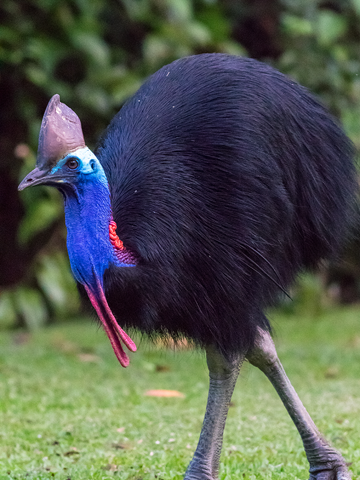
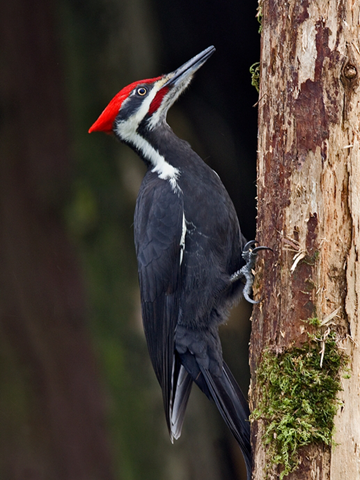
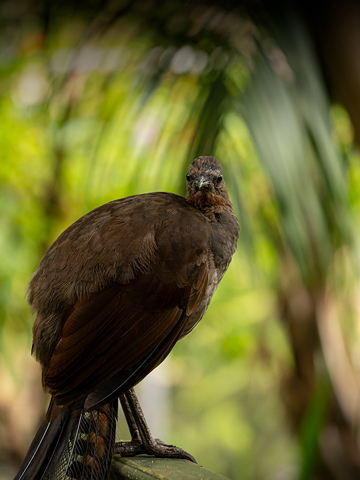
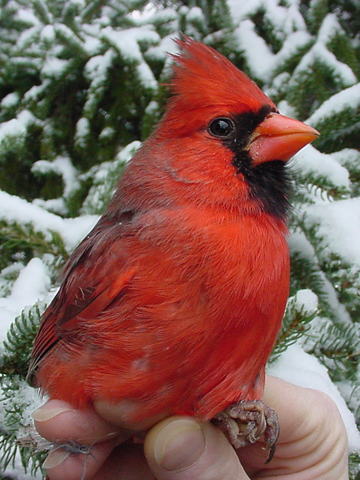
Explore the world with your ears in the new exhibition Chirp, Chitter, Caw: Surrounded by Birdsong. Relax in a listening lounge, mimic unusual bird calls, and stroll down Bird Hall to hear sonic snapshots created by artists Chris Hoff and Sam Harnett—founders of The World According to Sound. Listen to the low rumble of the Southern Cassowary, the Superb Lyrebird mimicking the songs of other birds, and the rhythmic knocks of the Pileated Woodpecker. Tune into the world of birdsong and discover the beauty and complexity of avian communication that surrounds us. Enjoy the museum’s birds like never before.
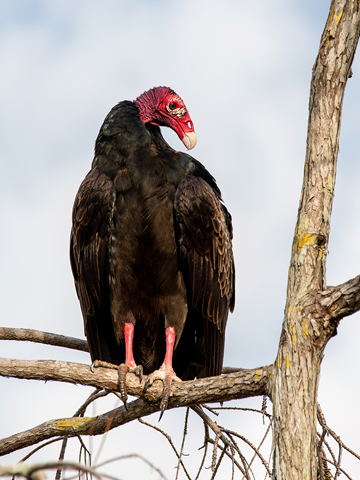
Turkey Vulture
Turkey Vulture
Southern Cassowary
Pileated Woodpecker
Superb Lyrebird
Northern Cardinal

Filed Under: Exhibitions Tagged With: bird hall, Birds, Hall of Birds, Section of Birds

November 3, 2020 by wpengine

Turkeys

by Stephen Rogers

November is the month best known for the holiday celebrated on the fourth Thursday of the month, Thanksgiving, which revolves around one of the classiest of birds in Pennsylvania, the Wild Turkey. Most people are familiar with the local, reasonably tame, birds that roam around Pittsburgh, but few know the history of this noble bird. By the early 1900s habitat loss and over-hunting had left the species in dire shape. Wild turkeys disappeared at one point from Ohio, New York, as well as 16 other states of its original range. The Pennsylvania Game Commission (PGC) can be credited with bringing back the species in the state. The birds became more common field and forest scenery beginning in the mid-1980’s as the agency abandoned a turkey farm that produced captive-bred birds for stocking, and focused restorations efforts on trapping wild turkeys from the areas with sustainable populations, notably northcentral PA and the mountainous areas of Somerset and Westmoreland counties, and re-locating them to areas with suitable habitat. The PGC continues to set the hunting seasons within the state, expanding or restricting both the time periods and locations for hunting to maintain a healthy wild turkey population.

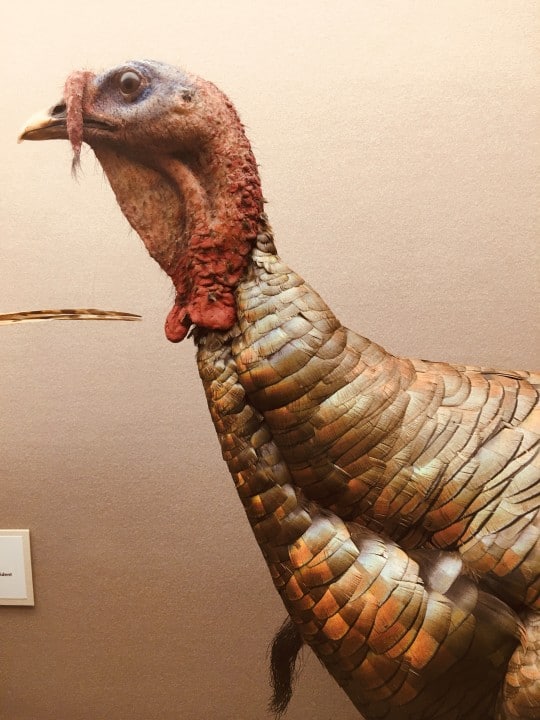
close up of turkey taxidermy mount

Carnegie Museum of Natural History has wild turkey egg sets, skeletons, study skins, taxidermy mounts, and some fluid-preserved specimens from eight states as well as a couple from the failed PGC turkey farm. I was raised in northcentral PA and have contributed two turkey specimens to the collection over my years of working for the museum. One of these, a preserved fluid head, had the distinction of being dissected to study its brain by an ornithologist at the Smithsonian Institution who worked with a CMNH curator, Brad Livezey. They studied higher-level phylogeny and their publication can be seen here.

In recent years the PGC has brought back turkey hunting for two days around Thanksgiving throughout that state as an addition to regional seasons that vary depending on population levels. Because we are encouraged to blog, I thought I would relate a Thanksgiving Turkey tale here.

Among my most memorable Thanksgivings was the holiday 49 years ago, in 1971, when our family had the family of my mother’s twin sister over for dinner. Hunting was what occupied most of my waking thoughts in those days, but my hunting partner, my dad, had to work that morning and it became my task to take my Uncle John and cousin Ronnie out in four inches of new snow that had fallen the day before. My aunt, who was undergoing breast cancer treatment, wanted to spend time with her twin to celebrate perhaps their last holiday together. For these sisters and their daughters, getting the “menfolk” out of the way seemed to be the best way to create the proper atmosphere.

I had never hunted with Uncle John or Ronnie before, but I knew where to find a turkey flock.  After a mile-long hike we busted up a flock and John promptly missed one of the scattering big birds. At this point we split up, hoping to run into lone turkeys as they tried to regroup. I headed in the direction of some of the fleeing birds to use a turkey call, while John and Ronnie sat amid the large laurel thicket we had rousted the flock from.

After a period of time, Uncle John had to do what bears are notoriously known for doing in the woods. An experienced hunter would always keep his shotgun handy anywhere while hunting, but John leaned his gun against a tree and went a few feet away to do his business. Of course, out came a few turkeys into a clearing just yards away from him, looking at him with apparent wonder at what he was doing with his pants down.

We never got a turkey that day, but among the many Thanksgivings I have experienced it was the most memorable. As we all ate turkey around the ping-pong table in the basement that evening, Uncle John took his ribbing with great humility, and the banter took my aunt’s thoughts away from the cancer which was late stage at that time.

As we commemorated Breast Cancer Awareness last month, it should be on everyone’s mind that mammograms should still be done in this era of COVID.

I hope to take my gun out for a walk this Thanksgiving, but I imagine the turkeys will socially distance from me. Shooting a bird isn’t the end all of a hunt, it’s the memories we make afield.

For more history on the wild turkey see:

History of the Wild Turkey in North America

A Look Back at Wild Turkeys

Stephen Rogers is Collection Manager in the Section of Birds at Carnegie Museum of Natural History. Museum employees are encouraged to blog about their unique experiences and knowledge gained from working at the museum.

Related Content

Ravens and Crows, What’s the Difference? 

Powerlifting Poultry and Mallards That Marathon

Bard Birds

Carnegie Museum of Natural History Blog Citation Information

Blog author: Rogers, Stephen
Publication date: November 3, 2020

Share this post!

  • Share on Twitter Share on Twitter
  • Share on Facebook Share on Facebook
  • Share on Pinterest Share on Pinterest
  • Share on LinkedIn Share on LinkedIn
  • Share on Reddit Share on Reddit
  • Share via Email Share via Email

Filed Under: Blog Tagged With: bird hall, Birds, Hall of Birds, Section of Birds, Stephen Rogers

August 12, 2019 by wpengine

Travels with a Sketchbook: A Natural History Artist’s Observations at the Museum

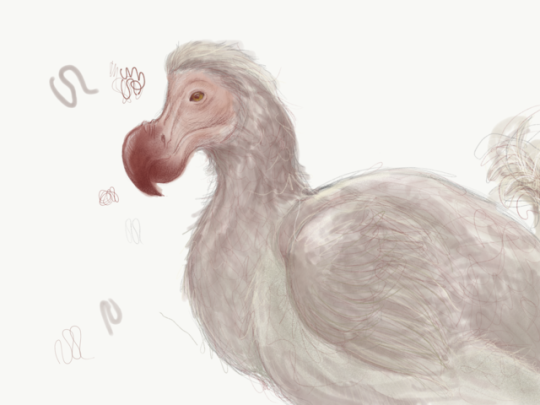
Carnegie Museum of Natural History has a large and expansive collection of artifacts, oddities, and wonders. It also has its fair share of mounted animals and skeletons on display, which makes it an ideal spot for the wandering artist. Where else can an artist study both extinct and extant species up close and in great detail? If, like me, you’re an illustrator who loves to draw animals, you could, for example, grab your sketchbook and head to the museum’s Bird Hall to get a close look at the flightless dodo (Raphus cucullatus). Driven to extinction by European colonists during the 1600s, early artists’ renderings provide some of the best evidence for the dodo’s appearance in life. Perhaps surprisingly, this bird is now known to be closely related to pigeons!

Dodo (Raphus cucullatus) in Bird Hall at Carnegie Museum of Natural History. Sketch by the author.

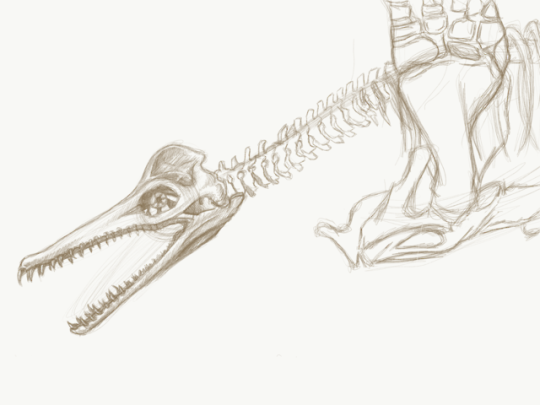
If your tastes are more prehistoric, check out the museum’s sprawling Dinosaurs in Their Time exhibition. Travel back in time to ancient seas and imagine the graceful movements of the plesiosaur Dolichorhynchops bonneri while the giant carnivorous mosasaur Tylosaurus proriger hovers ominously above you. These marine reptile groups vanished in the mass extinction that also wiped out non-avian dinosaurs roughly 66 million years ago.

Skeleton of the short-necked plesiosaur Dolichorhynchops bonneri in the Dinosaurs in Their Time exhibition at Carnegie Museum of Natural History. Sketch by the author.

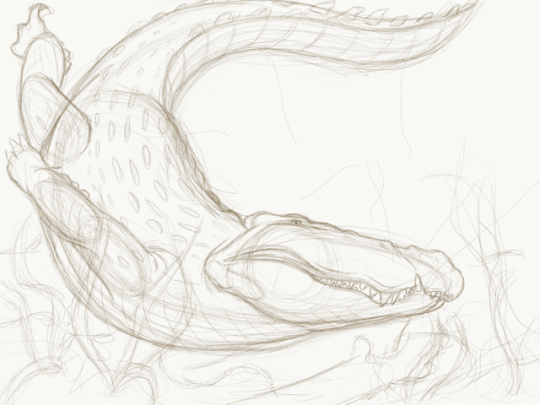
Or perhaps you’re more interested in observing and sketching modern day animals? If so, visit the Hall of North American Wildlife and Hall of African Wildlife on the museum’s second floor. Get up close and personal with the Nile crocodile (Crocodylus niloticus) trio and capture their anatomy in detail. It’s the safest way to do so – not to mention the only way to do so here in Western Pennsylvania! (Reports of alligators in our rivers notwithstanding.)

Nile crocodile (Crocodylus niloticus) in the Hall of African Wildlife at Carnegie Museum of Natural History. Sketch by the author.

So, my fellow artists and nature lovers, as I hope this post has shown, there are scores of species to inspire you here at the museum. Grab your sketchbook and come on over!

Hannah Smith is an intern working with Scientific Illustrator Andrew McAfee in the Section of Vertebrate Paleontology at Carnegie Museum of Natural History. Museum employees, interns, and volunteers are encouraged to blog about their unique experiences and knowledge gained from working at the museum.

Related Content

Celebrating Women in the Natural History Art Collection

Art and the Animal

New Vision of Old Rock Art

Carnegie Museum of Natural History Blog Citation Information

Blog author: Smith, Hannah
Publication date: August 12, 2019

Share this post!

  • Share on Twitter Share on Twitter
  • Share on Facebook Share on Facebook
  • Share on Pinterest Share on Pinterest
  • Share on LinkedIn Share on LinkedIn
  • Share on Reddit Share on Reddit
  • Share via Email Share via Email

Filed Under: Blog Tagged With: Andrew McAfee, bird hall, Birds, dinosaurs in their time, fossils, Hall of African Wildlife, Vertebrate Paleontology

June 12, 2019 by wpengine

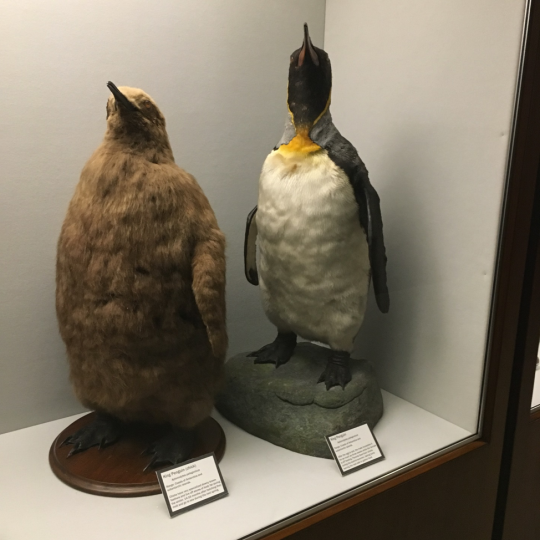
Why Do the King Penguins in Bird Hall Look so Different from Each Other?

king penguin chick and adult in Bird Hall

Visitor comments often offer insight into the effectiveness of museum displays. The most candid comments are overheard snatches of conversation, some as touching as they are humorous.

The setting: Bird Hall at Carnegie Museum of Natural History, 2:00 p.m. on a summer afternoon.

Three siblings, the oldest about nine, were studying a pair of king penguin taxidermy mounts while their mother, a few display cases away, looked at a different group of birds.

The mother walked toward her children as the nine-year-old explained the birds to his younger brother and sister, “This one is the girl penguin, and this one is the boy penguin. They really look different. The girls are brown and fuzzy, and the boys are black and white.”

The mother quickly surmised the misinterpretation and offered a gentle correction without any trace of ridicule: “The brown one’s a young bird. The label says ‘chick,’ but that doesn’t mean it’s a girl.”

Patrick McShea works in the Education and Visitor Experience department of Carnegie Museum of Natural History. Museum employees are encouraged to blog about their unique experiences and knowledge gained from working at the museum.

Filed Under: Blog Tagged With: bird hall, Birds, Education, Pat McShea, Patrick McShea

March 11, 2019 by wpengine

A Match Made by Coevolution

Darwin once predicted the existence of a pollinator after examining the star-shaped flower of the orchid Angraecum sesquipedale, a flower whose nectar is at the end of a 30 cm tube. Darwin wrote that “in Madagascar there must be moths with probosces capable of extension to a length of between ten and eleven inches [25.4–27.9cm].” Twenty years after Darwin’s death, his prediction was proven correct with the discovery of a moth, Xanthopan morganii praedicta, which boasted a proboscis 20 cm in length. In 1992, natural history observations of the moth feeding on the extreme flower and transferring pollen provided even more evidence that this plant and insect were tangled in a coevolution that resulted in their extreme morphology.

Coevolution is now a cornerstone of biology and has been well developed through examples of flowering plants and insects, parasites and hosts, predators and prey, and even gut microbiomes and human health. In fact, the influence of closely associated species on each other in their evolution is so ubiquitous one could argue that evolution is coevolution—as the boundary between what is an individual versus a consortia of different species blends as we dive deeper into the units that natural selection is acting upon. The microbiome and human health example helps illustrate the problem of defining an individual, specifically because scientists now think that microbial cells outnumber human cells in your body. Moreover, there is growing evidence this diversity of symbionts on our bodies complete metabolic pathways and serve other physiological functions. Coevolution crisscrosses the natural histories of organisms, creating nuances that sometimes complicate things.

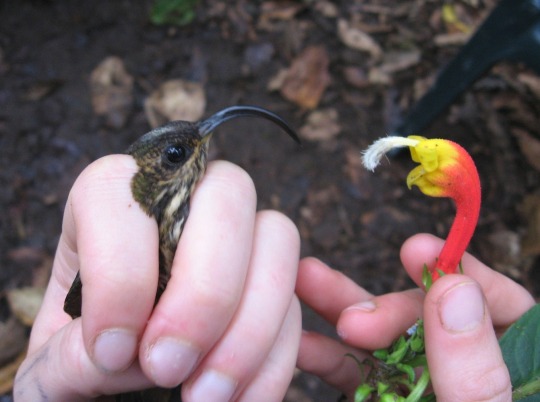
With so much excitement and work surrounding coevolution, it is romantic to stumble across an example of coevolution fit for a kindergarten class. In the collection of birds at the Carnegie Museum of Natural History, we recently finished an analysis of 24 Costa Rican hummingbirds and the pollen types found on their bodies and were reminded of Darwin’s predictions of coevolution over 100 years ago with orchids and moths. The White-tipped Sicklebill (Eutoxeres aquila) is a hummingbird with an extreme bill curve, with an appearance that would remind kindergarteners of Jim Henson’s Gonzo Muppet. Putting this bird next to its favorite food, Centropogon granulosus, illustrates coevolution in an exciting way that doesn’t tangle you up in learning about microbes or imagining other complex ecological relationships. Like Darwin’s orchid and moth, this hummingbird and its preferred flower allow us to see coevolution is all around us.

sicklebill hummingbird and its preferred flower

In an ongoing study at the Carnegie Museum of Natural History’s Section of Birds, we were reminded of the natural history observations and predictions that led to an explosion in the field of coevolution. By studying pollen types collected from hummingbirds in Costa Rica we confirmed that the White-tipped Sicklebill (Eutoxeres aquila) feeds mostly on Centropogon granulosus, a match made by coevolution.

Chase Mendenhall is Assistant Curator of Birds, Ecology, and Conservation at Carnegie Museum of Natural History. Museum employees are encouraged to blog about their unique experiences and knowledge gained from working at the museum.

Filed Under: Blog Tagged With: bird hall, Birds, Botany, Chase Mendenhall, evolution, Section of Birds

March 11, 2019 by wpengine

The Symbol of the Anthropocene in Preparation at the Carnegie Museum

black question mark on white background

As an intern in the Anthropocene section at the Carnegie Museum, I had the privilege of exploring some of its treasures, either preserved in the collections or displayed for the public, and reflecting on how objects can help us consider the planetary changes underway in the Anthropocene.

During my explorations, I was asked what was my highlight, or what object best exemplifies the Anthropocene to me?

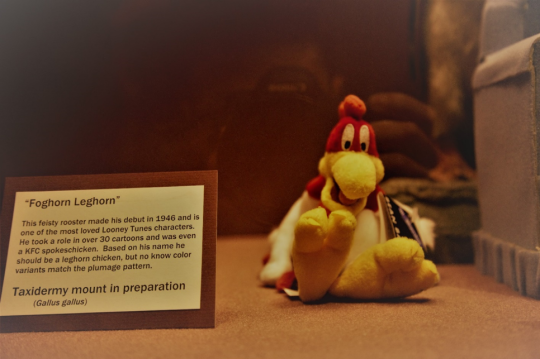
Picture from case in Bird Hall. Taxidermy mount in preparation because Steve Rogers, collections manager of Birds, is still waiting to find a specimen that looks like the Foghorn Leghorn.

Turns out – my most vivid symbol of the Anthropocene is absent. It is not found in either the collections, or in the gallery halls (although it is found in the cafeteria)!

Yes indeed, my favorite symbol is the commercial broiler chicken, likely one of the most common birds in the world because it reaches slaughter weight in less than half the time of other domestic or wild chickens! Surprised? Disappointed? Let me explain…

Last year, the director of the museum, Dr. Eric Dorfman, wrote a compelling blog titled Counting Your Chickens: The World’s Most Numerous Bird. Chickens are likely the most numerous bird in the world. In light of the Anthropocene, we could even say in Earth history. There are about 23 billion chickens alive at any given time. By comparison, the second most numerous bird reported is the red-billed quelea, which lives across the continent of Africa, with an estimated population of 1.5 billion.

You probably wonder how the chicken conquered the world. Its long journey began around 7,000 years ago when it was first domesticated from the red junglefowl (Gallus gallus), native to south-east Asia. But the bird’s trajectory radically changed in the second half of the 20th century, during what is now called “The Great Acceleration.” With changes in farming practice and the intensive production of broilers, the chicken population exploded. Meat-chicken consumption is still on the rise with more than 65 billion chickens consumed globally in 2016.

The commercial broiler chicken is even more radically different from its ancestors and other kinds of chickens. The change is about their shape, genes, and chemistry. Their genes, for instance, have been altered so that the birds are constantly hungry. In other words, they have been bred for a specific purpose: to gain weight rapidly (and they do it five times faster than chickens from the mid-20th century). It is a perfect example of what Richard Pell, director of the Center for PostNatural History and Associate Professor of Art at Carnegie Mellon University, means by the term “postnatural,” that is an organism that has been intentionally and heritably altered by humans.

The commercial broiler chicken is the direct result of human intervention. One could argue that selective breeding practices are not new. However, the Anthropocene captures a very recent rupture in Earth’s history by highlighting rapid and unprecedented changes at a planetary scale. Commercial broiler chickens and their biology shaped by humans, created in just a few decades, symbolize the transformation of the Earth’s biosphere. And new research suggests that the commercial broiler chicken’s distinctive bones could become fossilized markers of the Anthropocene. Perhaps it would be more appropriate to talk about the Gallucene.

Stories like this show how the Anthropocene offers an opportunity to rethink how we view natural history and what we put in our collections. The Carnegie Museum of Natural History is undertaking this ambitious and necessary shift in order to understand what it means to live in this new epoch.

Gil Oliveira is an intern in the Section of the Anthropocene. Museum employees are encouraged to blog about their unique experiences and knowledge gained from working at the museum.

Filed Under: Blog Tagged With: Anthropocene, bird hall, Birds, Gil Oliviera

  • Page 1
  • Page 2
  • Page 3
  • Interim pages omitted …
  • Page 5
  • Go to Next Page »

sidebar

About

  • Mission & Commitments
  • Directors Team
  • Museum History

Get Involved

  • Volunteer
  • Membership
  • Carnegie Discoverers
  • Donate
  • Employment
  • Events

Bring a Group

  • Groups of 10 or More
  • Birthday Parties at the Museum
  • Field Trips

Powdermill

  • Powdermill Nature Reserve
  • Powdermill Field Trips
  • Powdermill Staff
  • Research at Powdermill

More Information

  • Image Permission Requests
  • Science Stories
  • Accessibility
  • Shopping Cart
  • Contact
  • Visitor Policies
One of the Four Carnegie Museums | © Carnegie Institute | Privacy Policy | Terms of Use | Accessibility
Rad works here logo