• Skip to primary navigation
  • Skip to main content
  • Skip to primary sidebar

Carnegie Museum of Natural History

One of the Four Carnegie Museums of Pittsburgh

  • Visit
    • Buy Tickets
    • Visitor Information
    • Exhibitions
    • Events
    • Dining at the Museum
    • Celebrate at the Museum
    • Powdermill Nature Reserve
    • Event Venue Rental
  • Learn
    • Field Trips
    • Educator Information
    • Programs at the Museum
    • Bring the Museum to You
    • Guided Programs FAQ
    • Programs Online
    • Climate and Rural Systems Partnership
  • Research
    • Scientific Sections
    • Science Stories
    • Science Videos
    • Senior Science & Research Staff
    • Museum Library
    • Science Seminars
    • Scientific Publications
    • Specimen and Artifact Identification
  • About
    • Mission & Commitments
    • Directors Team
    • Museum History
  • Tickets
  • Give
  • Shop

Bob Androw

May 18, 2023 by Erin Southerland

Can’t Choose Just One: Asking an Entomologist to Name Their Favorite Native Species

by Bob Androw

I was recently asked what my favorite native species of beetle is. A seemingly simple question, but one with no simple answer. I thought first of my primary group of study, the Cerambycidae – the long-horned beetles. But with nearly 1,300 species in North America – which one? Then I pondered the scarab beetles, which I call my “mistress” group – the one I mess around with when the cerambycids aren’t looking. The week before I was asked this question, I was in southern Georgia looking for specimens of an undescribed (new to science) species of scarab beetle in the genus Serica – but while a current priority, I can’t call that my “favorite”.

Then, I remembered the species of long-horned beetle that I looked for in Georgia but did not see. Along a sandy county road, I noticed a lush stand of common elderberry, Sambucus canadensis L. that was in the early stages of blooming. I stopped to check those blooms for any flower-visiting cerambycids and was dismayed to find no insect activity – probably a result of the unusually cool and windy weather.

As I was examining the elderberry plants, visions of one of the eastern United States’ more aesthetic species of Cerambycidae flashed into my head – that of Desmocerus palliatus (Forster), or as it’s known by its common name, the elderberry borer. The larvae of the beetle bore in the living pith at the base of the stems. The adults are a beautiful metallic blue with the basal half of their elytra vivid orange. The beetle can be found on elderberry plants, either walking on the stems or clinging to the underside of the leaves. On hot days from May to early July, they can sometimes be found flying around the plants in search of mates. 

But, despite a thorough search by squatting low under the plants and looking upward for hiding beetles, none were seen. My timing may have been off for their flight period in that area, the unseasonably cool weather may have delayed their emergence, or there just may not be a population in that particular stand of elderberry. 
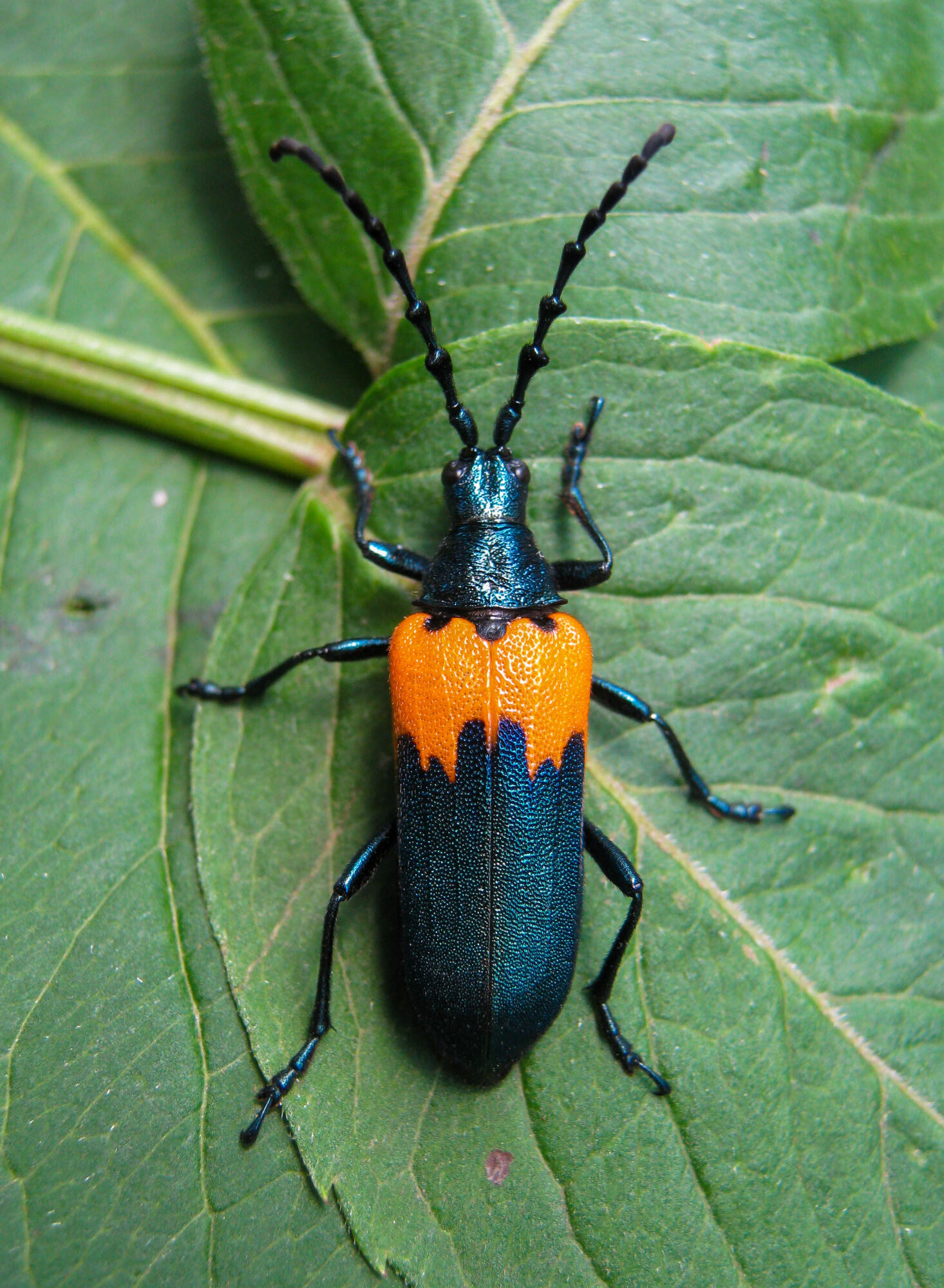
Female Desmocerus palliatus, on elderberry leaf in Lancaster County, PA.
Image from BugGuide, credit: Chris Rorabaugh, Florida.
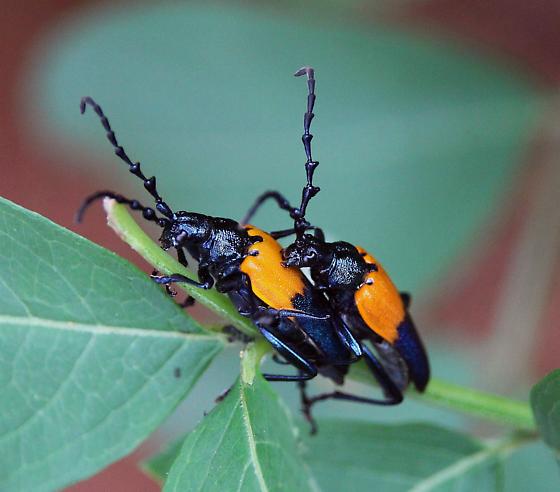
Mating pair of Desmocerus palliatus, on elderberry in Franklin County, Missouri.
Image from BugGuide, credit: James Trager, Missouri

I think that most could agree that Desmocerus palliatus is one of the finest U.S. cerambycids and while not necessarily uncommon, it is just elusive enough to make every encounter a pleasant experience. And I guess that’s reason enough to consider it my favorite – at that moment, in that place…

Bob Androw is Collection Manager of Invertebrate Zoology at Carnegie Museum of Natural History.

Related Content

The BSF – Leveraging Our Collections and Expertise to Help Fight Invasive Species

So, Just What is a Wheel Bug?

Do No Harm: Dealing with Spotted Lanternflies

Carnegie Museum of Natural History Blog Citation Information

Blog author: Androw, Bob
Publication date: May 18, 2023
Share this post!

  • Share on Twitter Share on Twitter
  • Share on Facebook Share on Facebook
  • Share on Pinterest Share on Pinterest
  • Share on LinkedIn Share on LinkedIn
  • Share on Reddit Share on Reddit
  • Share via Email Share via Email

Filed Under: Blog Tagged With: Bob Androw, Bug Hall, Invertebrate Zoology, Science News

April 2, 2021 by wpengine

A Little Harbinger of Spring…

by Bob Androw

As I begin to write this, it’s early March, the sun is shining, the temperature outside is climbing over 50°F and I’m starting to think… “I need to go look for some deer poop!”

As an entomologist, I’ve developed a mental calendar not based on seasons or months… but rather on what species of insects are likely to be out and about on any given day of the year. Once summer arrives, the specificity disappears and it just becomes a question of whether it’s a “good bug day” or not – based entirely on the weather and my chances of prying myself out of the museum (or the house, in these new times) to go somewhere and chase them.

During autumn, the onset of wet weather and cooling temperatures gradually reduces the number of active insects. Like most organisms, I tend to head for shelter from the outside environment, settling indoors to wait out the winter. Of course, winter is time for “bug work” as well – but rather than hunting living specimens, time is dedicated to catching up on the lab work set aside during ‘collecting’ season. This entails pinning and labeling specimens collected earlier in the year, performing identifications, data-basing specimen records, and working on manuscripts.

But then there’s spring – that pivotal period that influences one to keep checking the weather forecast, hoping for warming days. This seemingly never-arriving season focuses one’s attention on how fast the last snow is melting off. It’s a time that has me searching for signs of plant shoots breaking the soil surface and tree buds exhibiting tiny slivers of green to announce the upcoming burst of foliage.

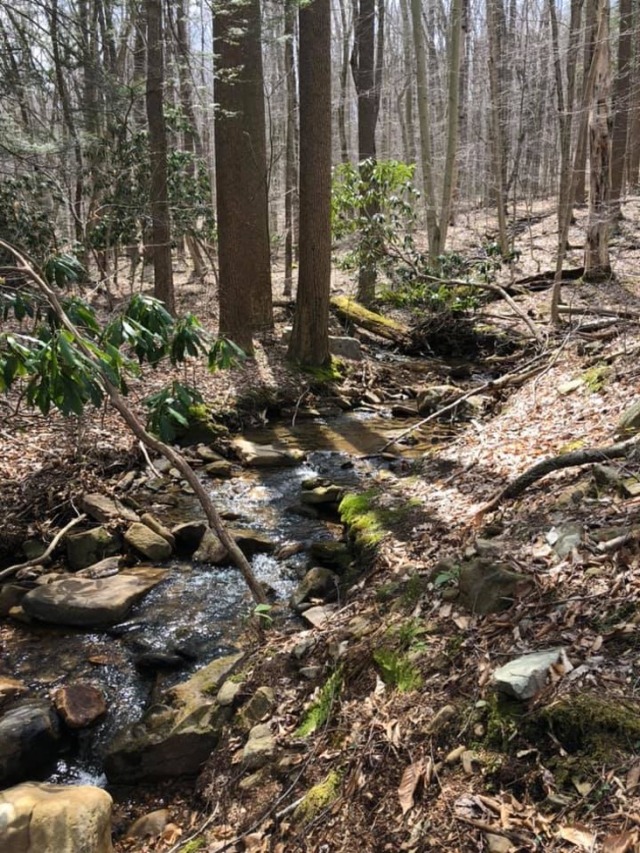
Hardwood forest habitat in late winter at Powdermill Nature Reserve in the Laurel Highlands of Pennsylvania. Image courtesy of the Powdermill Nature Reserve Facebook page.

Once these signs converge to indicate spring is just around the corner – it’s time to test the theory that winter is finally ending by – you got it! – going to look for deer poop!

Now, don’t get me wrong – deer regularly poop all year round – which is good for them – but during the first warm days of spring – or more accurately the warmest days of late winter – a little beetle becomes active and begins its own search for deer dung.

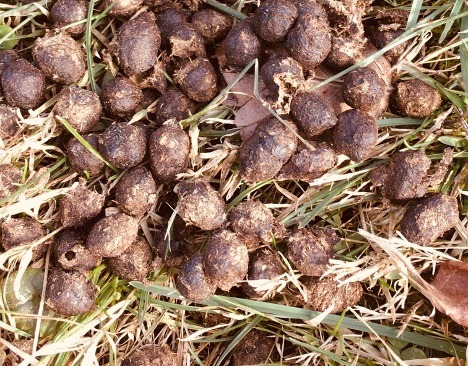
A typical pile of deer dung. The pellet in the lower left corner shows a hole created by a feeding beetle.

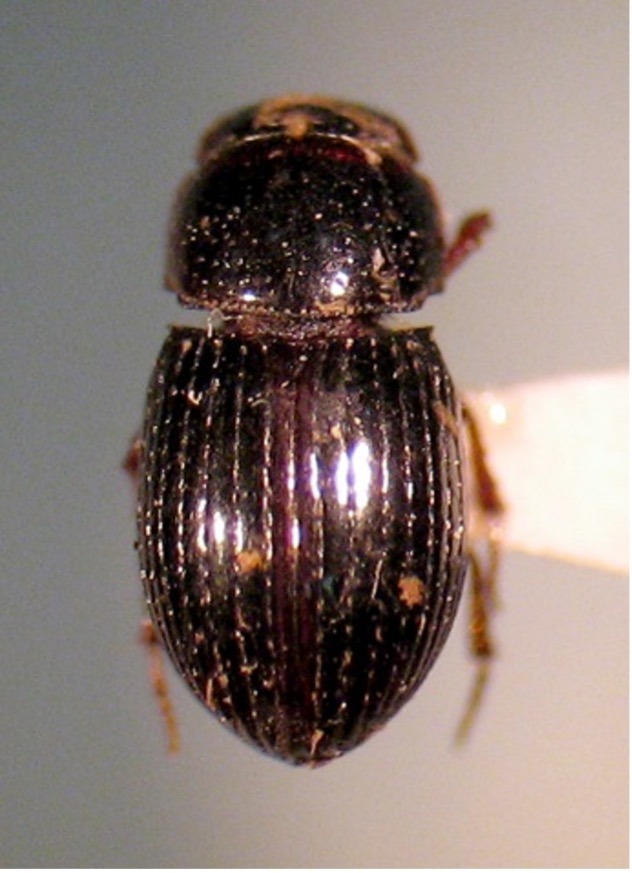
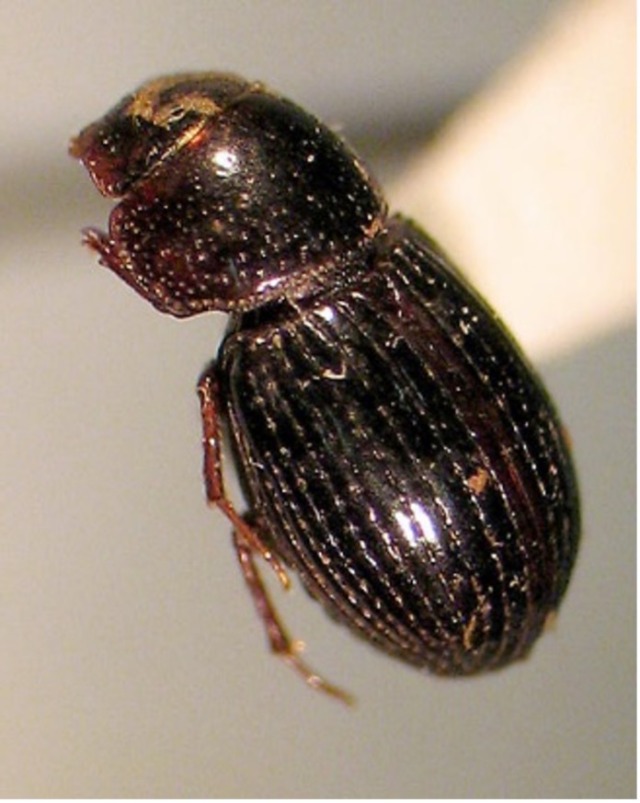
The species Dialytellus tragicus (Schmidt, 1916) is a mere 3mm in length and one of only two species in the genus Dialytellus. My favorite location to search for it is the museum’s field research station, Powdermill Nature Reserve, in the Laurel Highlands. Dialytellus tragicus is found in forested areas of the northeastern United States, but is sporadic in distribution and never seems to be overly common. The other species in the genus, Dialytellus dialytoides (Fall, 1907), is more widely distributed in the eastern states, much more common, and is taken frequently in pitfall traps. The genus Dialytellus is a member of the large subfamily Aphodiinae in the large family Scarabaeidae, the scarab beetles.

The Aphodiinae is a diverse group of small to tiny beetles, with over 400 species occurring in the United States and Canada. Nearly all of them are specialists on animal dung for feeding as adults and for provisioning their larvae with food. Many are considered ‘generalists’ which means they will utilize whatever dung they find – from cattle, horses, deer, pigs, dogs, and even humans (Oh, there are some stories to tell there…). Some species dig tunnels in the soil under dung and create brood chambers where they lay eggs on dung brought down from the source on the ground surface, but most lay eggs directly in the dung and the larvae develop within.

A fair number of aphodiine species are ‘specialists’, utilizing dung from only certain species of animals. In the Great Plains region of the U.S., the group reaches its greatest diversity of species for North America, with most species being obligate associates with prairie dogs, living in the burrows and feeding in the dung ‘middens’ that the resident prairie dogs create. In the Pacific Northwest, aphodiines are often associated with the burrows of marmots. In the Southeast, many species are associated only with pocket gophers, while a few have evolved to live only in the nests of squirrels, or packrats, feeding on decaying nest materials. Some of these specialized beetles have even evolved to live in ant nests, feeding on plant detritus in the ants’ garbage heaps.

beetle specimen
Dialytellus tragicus (Schmidt, 1916). Specimen data: PENNSYLVANIA: Westmoreland County, Powdermill Nature Reserve, 15 March 2003, in deer dung, R. Androw, coll. Image from BugGuide.net, courtesy of Blaine Mathison, Salt Lake City, Utah.

Dialytellus tragicus is able to pull me out of the house and into the woods in late winter on an annual search first for piles of deer dung, and then if lucky, beetles. The beetles can be found inside the deer dung pellet, which means the search entails splitting dung pellets to find the precious one with a beetle inside. Thankfully, deer dung is dry and hard and has little odor, so the process is less offensive than it sounds. Still, I would guess that laying on one’s side in the leaves, splitting pellets with a forceps as if they were little coconuts with prizes inside, isn’t a common way to celebrate the onset of Spring – no Facebook group for us folks!

Most specimens that I have collected have been found during the middle two weeks of March, always on days where the temperatures have been over 50°F for at least the preceding three days. It takes a few days of warmer weather to get the beetles up and moving. I’ve learned that searching for them later in the year – say mid-April – never produces specimens of D. tragicus, but instead produces numerous specimens of another aphodiine, the extremely abundant generalist, Oscarinus rusicola (Melsheimer, 1845). Circumstantial evidence would suggest that as D. tragicus evolved alongside O. rusicola in eastern forests of North America it shifted its period of activity to earlier in the season to avoid competition for resources with the more abundant O. rusicola.

By the end of February of any normal year, the urge to get out of the house and into the woods starts to become irresistible, but the insects are more patient – waiting for the perfect number of degree-days to become active. Knowing this little beetle is out there early – and is not necessarily easy to find – provides the perfect impetus to shake off the winter dust and go out to look for it. In a year like the one we’ve all suffered through, this little beetle is even more appreciated as an excuse to rouse and get moving again.

Bob Androw is a Collection Manager for Invertebrate Zoology. Museum employees are encouraged to blog about their unique experiences and knowledge gained from working at the museum.

Related Content

So, Just What is a Wheel Bug?

Do No Harm: Dealing with Spotted Lanternflies

The BSF – Leveraging Our Collections and Expertise to Help Fight Invasive Species

Carnegie Museum of Natural History Blog Citation Information

Blog author: Androw, Bob
Publication date: April 2, 2021

Share this post!

  • Share on Twitter Share on Twitter
  • Share on Facebook Share on Facebook
  • Share on Pinterest Share on Pinterest
  • Share on LinkedIn Share on LinkedIn
  • Share on Reddit Share on Reddit
  • Share via Email Share via Email

Filed Under: Blog Tagged With: Bob Androw, Invertebrate Zoology, Science News

August 18, 2020 by wpengine

The BSF – Leveraging Our Collections and Expertise to Help Fight Invasive Species

Within the CMNH Section of Invertebrate Zoology resides a program called the Biodiversity Services Facility – the BSF for short. The program is a revenue-generating insect screening and identification service whose principle client is the U.S. Department of Agriculture’s (USDA) Animal and Plant Health Inspection Service (APHIS) and Plant Protection and Quarantine Program (PPQ), as well as various state departments of agriculture. The BSF is designed to support time-sensitive survey work being performed by these agencies to detect invasive species, primarily wood-boring beetles.

As the Primary Identifier and Program Manager of the BSF, I can accurately describe 2020 as a busy year by citing a workload of nearly 8,000 raw trap samples generated through 23 survey projects being run in 16 states, stretching from Maine to Georgia and west to Nebraska and Kansas.

So how did it all begin? Let’s take a look…

In 2001, the country suffered the greatest tragedy in recent memory, the terrorist attacks of September 11. As a response, in 2002, the Office of Homeland Security was created, and during the following years, federal funding and personnel were reallocated from efforts to guard against agricultural and environmental threats to increase screening for human-centered security threats to the country. This resource shift created a void in the areas of pest detection and identification, and it became increasingly important to find outside support to help fill the gaps.

In 2005, through collaboration with Dr. Robert Acciavatti, an entomologist with the U.S. Forest Service and a long-time Research Associate in the Section of IZ, a proposal for a proof-of concept study was submitted to the U.S. Forest Service to determine if the museum could provide the needed identification services as a private contractor to the U.S. Department of Agriculture. The proposal called for funding staff to do the contract work as well as providing some collection support for the Section of Invertebrate Zoology. All aspects of the process were quantified: how long it took to check in samples; the time spent in proofing data; the number of samples that could be screened in a day; the number of specimen ID’s generated from any given sample; the resources needed to archive specimens; and the time involved in managing the activities. And most importantly – could it all be done in a fiscally responsible way to offer a service cheaper than existing options, while generating enough funding to complete the work as well as support the essential staff? The results of the project concluded that, yes… it could.

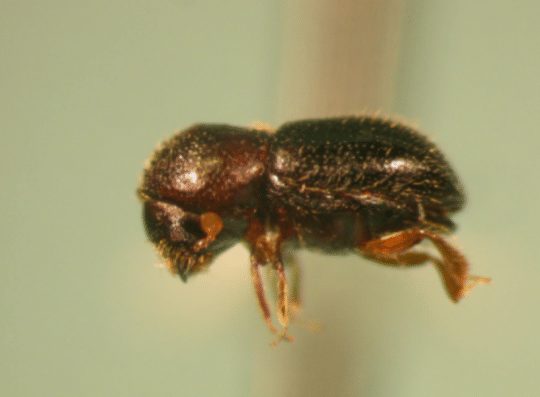
The icing on the cake during the proof-of-concept study was the detection of an invasive bark beetle species (Coleoptera: Curculionidae: Scolytinae) native to eastern Asia, Anisandrus maiche Stark. It was found in samples collected at the Moon Industrial Park near the Pittsburgh International Airport. It had not previously been recorded from the United States and in subsequent years was found to already have spread into eastern Ohio and the West Virginia panhandle before its discovery in the Pittsburgh area. Not only had the project proved the work could be done at a competitive price for the USDA, it proved that the taxonomic expertise in the Section of IZ was up to the task. The BSF was officially launched in 2006 and to date has processed nearly 95,000 raw samples, generating nearly $2,000,000.00 in outside funding.

Figure 1. Anisandrus maiche Stark (a species of bark beetle), about 2 mm in body length.

First detected in the United States in 2005 by Robert Androw.

(Image courtesy of Dr. Robert Acciavatti)

When I screen samples, I work against a ‘Priority Pest List’ developed by the USDA that contains the exotic species considered to be the greatest potential environmental threats should they be introduced into the country. In addition to the twenty or so priority pests, I screen for nearly 75 other species known to have been previously intercepted at ports or established in the U.S. to aid in monitoring the distribution of those species. The USDA efforts are guided by a practice dubbed EDRR – Early Detection, Rapid Response – a plan of responding quickly to any new pest detection to improve the likelihood that it can be extirpated before it can spread and become a major problem. To help meet this goal, I work under a self-imposed 90-day deadline for every sample – from the time a sample arrives with its associated collection data, it gets processed and the results reported to the client within 90 days. Prior to the BSF’s formation and involvement, samples could sometimes take as long as two years to get processed by the over-taxed screeners within the existing system.

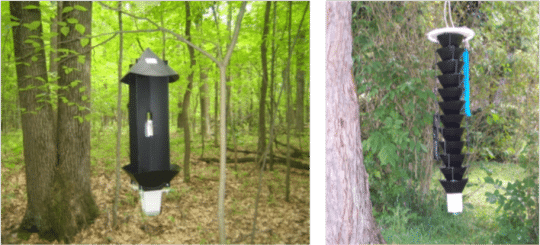
Most samples are collected using one of two types of traps: the Lindgren funnel trap and the Cross-vane panel trap. Both act as “silhouette” traps – their dark, vertical design can appear to be the trunk of a tree to a flying insect. These can effectively capture many species through this deceptive visual cue alone, but most often, the traps are baited with various chemical lures designed to attract specific species or genera of beetles. Traps can be deployed in forests, in urban parks, outside of warehouses or any other location where pest species may potentially be found. Most traps are run for a period of 10-14 days before the sample is removed from the collection cups and submitted to the BSF.

Figure 2. A Cross-vane panel trap (left) and Lindgren 12-funnel trap (right). Flying insects collide with the trap and fall down into the white sample collection cups which are filled with preservative. The white and blue pouches are filled with chemical lures. (Images from the BSF advertising flyer)

The two most commonly monitored lineages of beetles – Curculionidae (weevils and bark beetles) and Cerambycidae (long-horned beetles) – are both wood-boring taxa, with the damage usually being done by the larvae. The nature of the damage differs across lineages, with most of the damage caused by long-horned beetles being physical in nature – burrows and holes in the wood which hasten decay as well as providing avenues of access to other wood-boring insects. The bark beetles cause a variety of damage but are more likely to spread plant disease by boring into wood and creating chambers in which fungus is deposited by the female as an eventual food source for the larvae. While the long-horned beetles are moderate to large in size, most bark beetles in the weevil subfamily Scolytinae – the primary group of concern – are tiny insects generally less than 3mm in length.

Many target species are small enough to be accidentally discarded if attempts are made to “clean” the sample by removing leaves or other debris. Therefore, the BSF requires raw, unsullied samples to be submitted by our collaborators to ensure that no target taxa are lost during handling of the samples. We have another benign ulterior motive for raw samples to be submitted – to allow us to assess the “bycatch” in detail. This includes examining all specimens in the sample, not just checking for the species on the lists of known pests. This scrutiny ensures the detection of any new invasive not yet known to occur in the country, as was the case with Anisandrus maiche. The bycatch also provides a wealth of native specimens to augment the main IZ research collection. As I screen the samples, I extract all target species, specimens of uncommon to rare native species, specimens representing groups of special interest to the IZ staff, and specimens in groups for which specialists are available to provide identification.

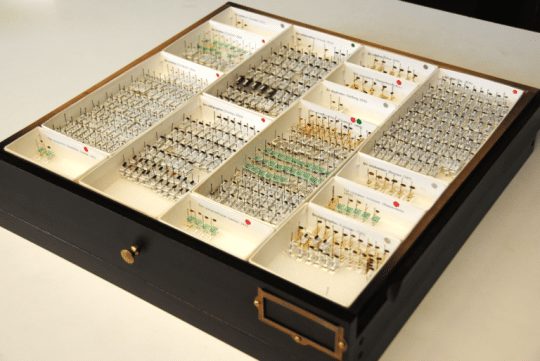
Once the specimens are extracted from the samples, they are prepared and labeled and then sorted by taxonomic groups for identification by me or other specialists. Once ID’d, the specimens have their data captured in a data base with the information made available to the customer through their project page on the BSF web site. In a recent data dump, over 70,000 records of a wide variety of insects, but primarily beetles – were provided to USDA in response to their request for data for a bycatch assessment study. All specimens extracted and data based are permanently archived in the research collections in the Section of Invertebrate Zoology. This allows for reexamination of the actual specimens reported upon as well as providing the comparative material for future identification efforts.

Figure 3. A curated drawer of identified bark beetles from the research collection in the Section of Invertebrate Zoology.

Many of these specimens were acquired from BSF projects over the years.

The bycatch also provides a continual influx of material for various projects underway in the Section of IZ.  My personal group of interest is the Cerambycidae – or long-horned beetles – and thousands of specimens have been documented in support of several faunal studies in progress. Lindgren trap samples from West Virginia have generated many records for long-horned beetles that will be used for an eventual publication on the Cerambycidae of West Virginia. Records of ground beetles taken from the trap samples are being compiled for a publication by Robert Davidson, Collection Manager Emeritus, documenting new state records of Carabidae. Thousands of specimens, from many families of beetles, have also been loaned to various specialists to garner determinations to further enhance the main research collection.

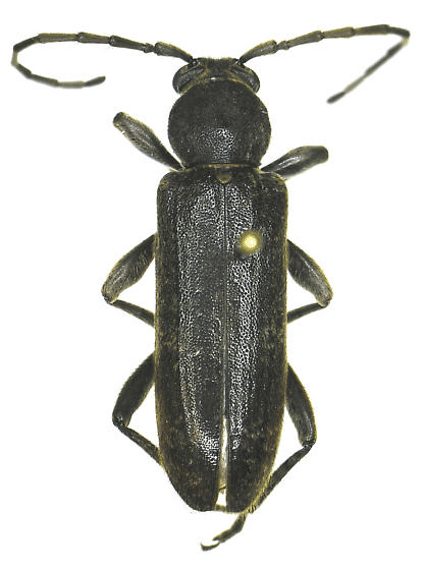
Figure 4. The ‘velvet long-horned beetle’ – Trichoferus campestris (Faldermann) – is a species introduced from Asia into the United States. Specimens from several eastern states have been found in BSF samples. (Image from BugGuide.net, courtesy Jeff Brown, Huber Heights, Ohio)

All-in-all, the Biodiversity Services Facility is a win-win situation – the funding supports collection staff and provides revenue for supplies and equipment, and the USDA and other clients get much needed support in their screening and identification efforts at a competitive price. The samples provide an annual infusion of specimens into the Carnegie collection and the clients receive information that would be otherwise lost about the insects coming to their traps. And maybe most importantly, the BSF leverages the taxonomic expertise of the IZ staff against real-world problems and contributes to making an impact in protecting our environment from invasive pest species.

Bob Androw is Collection Manager in Invertebrate Zoology. Museum employees are encouraged to blog about their unique experiences and knowledge gained from working at the museum.

Related Content

Do No Harm: Dealing with Spotted Lanternflies

How to Prepare Insect Specimens

Mobilizing Millions of Marine Mollusks: Seashells by the Eastern U.S. Seashore

Carnegie Museum of Natural History Blog Citation Information

Blog author: Androw, Bob
Publication date: August 18, 2020

Share this post!

  • Share on Twitter Share on Twitter
  • Share on Facebook Share on Facebook
  • Share on Pinterest Share on Pinterest
  • Share on LinkedIn Share on LinkedIn
  • Share on Reddit Share on Reddit
  • Share via Email Share via Email

Filed Under: Blog Tagged With: Bob Androw, Invertebrate Zoology, Science News, Section of Invertebrate Zoology

September 27, 2019 by wpengine

An Annual Return to My Bug-loving Roots

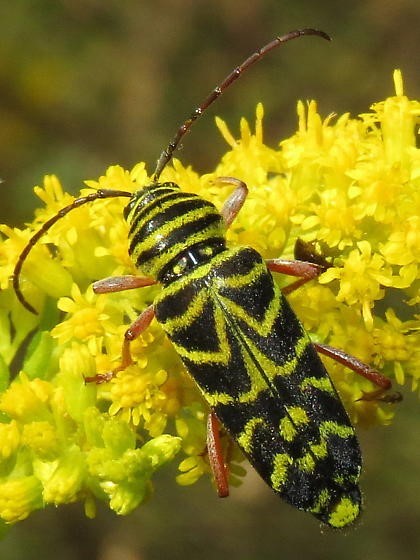
black and beetle on goldenrod
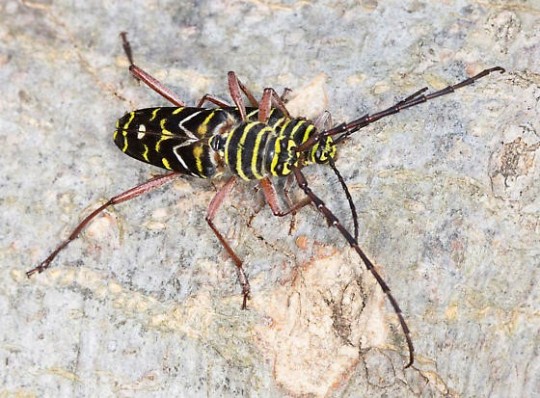
Image used by permission of Stuart Tingley, Cormierville, New Brunswick, Canada. Megacyllene robiniae (Forster), female on bloom of goldenrod

It’s that time of year again when one of my favorite beetles, Megacyllene robiniae (Forster), is starting to appear. Called the “locust borer” due to its larva’s habit of feeding in the living wood of black locust trees, it is one of the last species of long-horned beetle (family Cerambycidae) to emerge in late summer. Adults can be found feeding on the flowers of goldenrod, starting around late August and persisting in the field well into October. The beautiful yellow and black patterned beetles are strikingly colored, but can be quite cryptic when resting on the flowers of goldenrod, which shares the same shade of yellow as the beetle. As long as a larval host source is nearby, a stroll in a field of goldenrod is sure to produce a few adults, boldly feeding on pollen in broad daylight, yet still difficult to visually sort out from the background of the flowers which they visit.

Megacyllene is a genus of Cerambycidae that elicits as much sentimental as scientific interest for me, because it was one of the first long-horned beetles I encountered as a kid. I can still remember coming home from school in the early autumn and heading out into a large field of goldenrod behind my Ohio home to look for the beetles. The only other species of Megacyllene present in Ohio and Pennsylvania is Megacyllene caryae (Gahan) – the “painted hickory borer.” Contrary to M. robiniae – it is one of the earliest cerambycids to emerge in late April to early May, the adults having eclosed in the fall and remaining in their pupal cells until spring. I vividly remember my grandfather bringing home a load of hickory firewood one January, unaware that it was infested with the beetles. Upon splitting a log, he found the adults in their pupal cells awaiting the Spring warmth to emerge. He and I together split those logs smaller and smaller looking for more specimens. We ended up with a nice series of beetles and a bunch of wood whittled down to kindling size!

Image used by permission of Shannon Schade, Elkton, MD. Megacyllene caryae (Gahan), mating pair

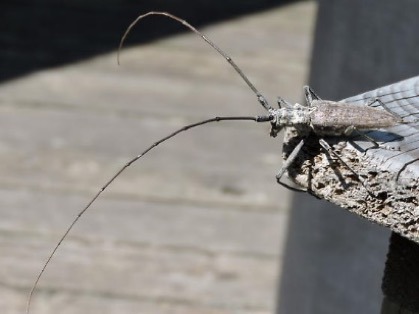
Monochamus notatus (Drury) is a spectacular species of long-horned beetle, common in Pennsylvania in stands of white pine. The larva feeds under the bark of dying or dead pine and its feeding can be heard as a high-pitched rasping sound as far as 20 feet from the tree. This behavior has earned the species the common name of “pine sawyer” – the noise resembling the sound of an old-fashioned two-man crosscut saw raking back and forth through a log.

Image used by permission of Carolyn Waddell, Bugguide #1184417, Creative Commons, Ottawa, Ontario, Canada. Monochamus notatus (Drury), male

When I was thirteen, while camping at Mohican State Park in north-central Ohio with my family, I was sitting at a picnic table eating lunch. Suddenly, a large male M. notatus came wafting through the campsite, its lengthy antennae trailing behind it, and looking about the size of a small bird to my young bug-enthusiast eyes. I dropped my food, jumped from the table, grabbed my net, and swept the beast out of the air – the first cerambycid beetle that I ever collected! I still have that specimen 46 years later and I attribute it with starting me on the road to specializing on the family Cerambycidae – now my strongest area of taxonomic expertise. I have seen millions of specimens of long-horned beetles from all around the globe during my career, but that one specimen generates more sentiment than the rest combined – I can still smell the pine scent in the air on that day I caught it.

Collecting insects as a kid was the gateway into an amazing world of diversity, and as it turned out, the foundation of what would become my career and lifelong passion. When I look at specimens I caught in those early years, they produce a flood of memories – of specimens caught and of those that got away; of woods where I memorized every fallen log and patch of flowers; of the copy of Josef Knull’s 1946 book “The Long-horned Beetles of Ohio,” with its pages worn and every word read over and over again a thousand times; even the long bike rides, carrying my net and jars out to areas remote from my home in search of “wild” areas in which to hunt for beetles. The specimens serve as little time machines – carrying me back to my childhood and the dawn of my interest in entomology. Going into the field now is more sophisticated, and structured, and planned – better gear, GPS units to record localities, a lifetime of experience to rely upon – not to mention a car that can take me farther afield. But those days of simple exploration, where nearly every venture outdoors uncovered some new wonder, will always be some of my most cherished memories – and those beetles on pins will always be the vehicles that carry me back to that wondrous time in my life.

Bob Androw is a Scientific Preparator in Invertebrate Zoology. Museum employees are encouraged to blog about their unique experiences and knowledge gained from working at the museum.

Filed Under: Blog Tagged With: beetles, Bob Androw, Invertebrate Zoology, pennsylvania

March 22, 2019 by wpengine

So, Just What is a Wheel Bug?

As March was approaching, I knew I was ‘on deck’ to produce a blog entry originating from our Section of Invertebrate Zoology. Looking at the calendar, I saw that the deadline would land around the 15th of the month, and something nagged at me about that date – what was the significance? Why, yes – the Ides of March was looming! Shakespeare’s Caesar failed to heed the warnings, and in the end… met his assassin…

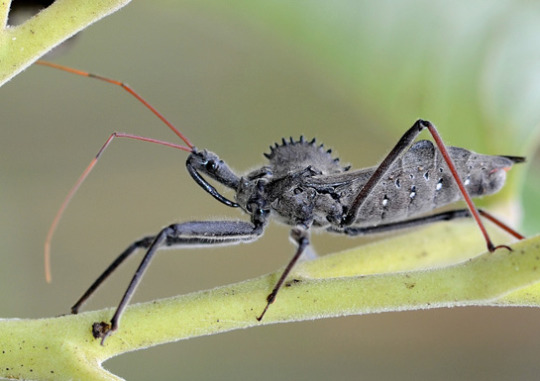
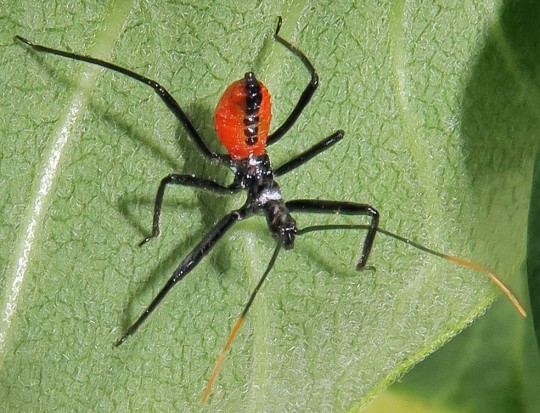
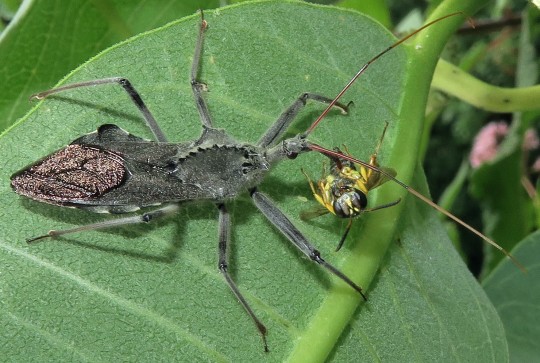
So, let’s take a look at an insect that carries the moniker of “assassin bug” – a species that possesses a bite of which everyone should truly beware. The insect is Arilus cristatus (Linnaeus), a species of ‘true bug’ in the order Heteroptera, in the family Reduviidae, collectively known as the assassin bugs. Arilus cristatus also carries the common name of ‘wheel bug’ due to the distinctive, serrated crest on its pronotum that in profile resembles a portion of a wheel or gear. No other insect in the United States possesses such a structure and the ‘wheel’ allows this species to be readily identified. In addition to the odd cog-like crest, the bug is large – nearly 1 ½ inches in length in mature adults and is dull gray in coloration. The immatures, or nymphs, look entirely different – they are small, bright red and lack the ‘wheel.’

Wheel bug, Arilus cristatus (Linnaeus) (Heteroptera: Reduviidae) (Image ©Rich Kelly, New Hyde Park, NY. Used with permission)

The wheel bug occurs throughout the southern half of the United States, ranging northward to the upper Midwest and southern New England. While Southwest Pennsylvania is within its natural distributional range, it appears to have become more common in our area over the last decade. People began bringing specimens into the museum for identification at an increasing rate starting around 10 or so years ago. While the evidence is anecdotal, the apparent increase in their abundance in our area could be a result of our changing climate – as our region becomes warmer on average, the environment becomes more suitable for the wheel bug, allowing it to thrive. Another potential factor for its increased numbers in our area is the introduction of an invasive species, the brown marmorated stinkbug, Halyomorpha halys Stål — a true bug species native to eastern Asia. With an increase in easily captured prey, the wheel bug may be exploiting this new food source. On a number of occasions, I have witnessed wheel bugs feeding on the introduced stinkbugs in the field.

Immature of the wheel bug, Arilus cristatus (Image ©Seth Ausubel, Washington Crossing, PA. Used with permission)

All of the reduviids are predatory on other invertebrates, using their beak-like mouthparts to pierce their prey and inject a powerful mix of enzymes that kills and begins digesting their prey from the inside, similar to the feeding habits of spiders. I can attest, from personal experience, to the extreme pain this insect can inflict by its bite. Wheel bugs, like many Insects, can be attracted to lights at night, and while collecting around some bright gas station lights some years ago, I foolishly decided to pick one up by the wheel with my bare fingers, assuming it could not reach me with its relatively short beak – and oh, how wrong I was! The initial bite was not terribly bad, but unusual, feeling like a tiny electrical shock. In less than a minute, however, a sharp, burning sensation began spreading the length of my thumb. The pain reached a crescendo in about 5 minutes and stayed at that level for several hours. The next day, the burning had subsided, but was replaced by a dull, throbbing ache that felt as if I’d smashed my thumb with a hammer. That discomfort persisted for a couple more days, yet oddly, there was no swelling and no obvious redness or sore at the site of the bite.

Arilus cristatus feeding on a hymenopteran (Image ©Seth Ausubel, Washington Crossing, PA. Used with permission)

While the bite of the wheel bug can certainly be a painful experience, and potentially worse in individuals that have a sensitivity or allergic reaction to the bite, they are rightfully considered a beneficial insect. Their predatory behavior helps rid gardens and forests of a wide variety of pest insects, from leaf-feeding beetles to caterpillars — a process of natural pest elimination known as biocontrol. So, if you should encounter a wheel bug — mid- to late summer is their peak time of activity — enjoy observing this odd insect and appreciate it for the role it plays in the environment. But heed my warning — resist any temptation to pick it up for a closer look!

Bob Androw is a Scientific Preparator in Invertebrate Zoology. Museum employees are encouraged to blog about their unique experiences and knowledge gained from working at the museum.

Filed Under: Blog Tagged With: Bob Androw, bugs, insects, Invertebrate Zoology

November 7, 2018 by wpengine

Why One Bug Just Won’t Do…

by Bob Androw

When visitors tour the insect collections in the Section of Invertebrate Zoology, the conversation often turns to numbers. How many rooms house the collection? Three, all quite full. How many total drawers are in those rooms? Well, roughly 30,000, at last count. How many specimens are in those drawers? We like to quote a figure of 13 million, give or take a few (but no one has counted recently). How many staff members are there to take care of all those bugs? Well – seven on a good day – that’s just 1,857,143 specimens per staff member…

And then the big questions always hit – why do you have so many specimens? Why do you have so many of the same species?

While there are many rarities represented by one to just a few specimens, the truth is that the majority of species are represented by several to many hundreds of individuals, referred to as a ‘series.’ So how do these series end up in the collection, and what is the purpose for multiple examples of individual species?

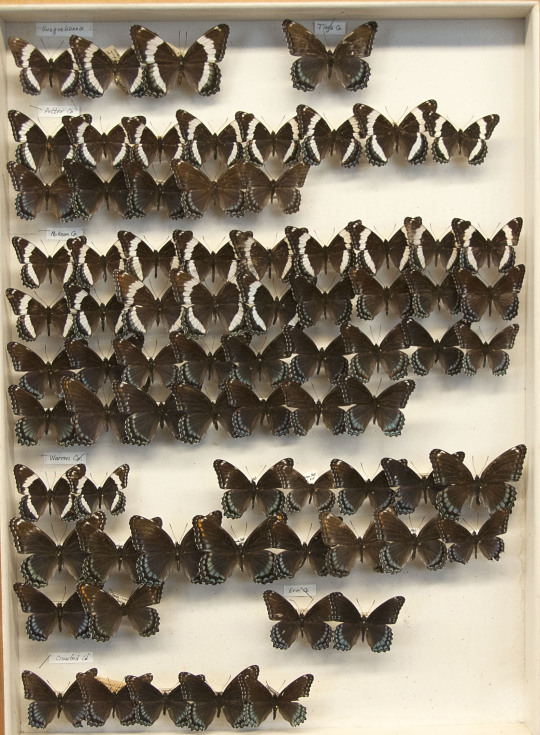
A simple answer, but not one that explains much, is that the age of the collection alone contributes to long series, especially of common species. Since its founding in 1896, if just a single red-spotted purple butterfly (Limenitis arthemis (Drury)), were deposited each year, 122 specimens would now be present. But the series of that common species probably numbers ten times that by now. So how, and why?

set of butterfly specimens

Over the years, museum staff have been active in traveling and collecting and were, and are, continually adding new materials to the collection. But an even greater number of specimens have come in the form of donations – entire collections, representing lifetimes of work, often come to us after their owner’s passing. These are sometimes from professional entomologists, but more often they are the legacy of non-professional, avocational collectors. These donated collections all vary drastically in their holdings, but common species are generally present, increasing the length of series of these taxa in the museum’s collection.

Back to all those red-spotted purples! Collected by a variety of people in a variety of places and times, they provide examples of the individual variation within the species, as well as critical locality and temporal documentation – or data – that help researchers understand the life history and distribution of the species. In these times of increasing global temperatures, the old data can be used as a baseline to compare against current information – does the butterfly still occur where it had in the past? Does it occur further north, now that the climes are more temperate in areas that used to be too cold? Or has it been pushed into higher elevations to evade hotter conditions in its historical habitat? By having large series, there is more data to help fill out the story of this butterfly species’ life history – past and present.

When those red-spotted purples were caught, the collectors were probably aware of what species they were – but what about species that cannot be easily identified in the field? The vast majority of insects are small to minute and cannot be identified until they are prepared and examined under a microscope. In the insect world, small size is coupled with enormous diversity. Entomologists regularly collect long series in the field to increase the odds of documenting more diversity – more specimens likely mean more species.

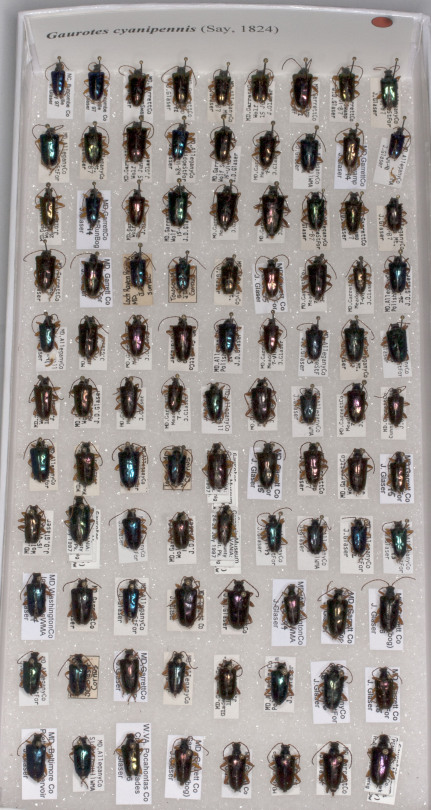
Not only is there a great diversity of species, but many insects exhibit variation within a species – in size, in color, and in differences between females and males. Populational differences are often evident within a species – sometimes to the extent that subspecies are described, discrete in their distribution and readily separated by physical characteristics. In the longhorned beetle Gaurotes cyanipennis (Say), individuals vary in color from blue to green to coppery to purple and all color forms can usually be found together in any given locality. But if you examine a long series of museum specimens you will notice the majority of specimens collected in the central third of Pennsylvania are all purple – rarely any other colors. The reason for this has not yet been determined, but by having long series of this common beetle, the trend can be seen, and questions can be asked.

set of longhorned beetle specimens

Insects can be collected by hand, one specimen at a time, but to more fully sample the biodiversity of a habitat, various types of traps can be deployed: pitfall traps; light traps; intercept and malaise traps; baited traps; with many specially designed to capture specific taxa. Traps allow for passive collecting over time, greatly increasing the volume, and diversity, of specimens compared to what a person could capture by hand. These trap samples can provide long series of specimens, insight into the biodiversity of a habitat and good data on population sizes. Select specimens are prepared, labeled and deposited in the collection and the remainder of the trap sample is archived to be available for future research. The specimens are not unlike the scores of books on a library’s shelves, their data labels all containing a little piece of the story about a living creature’s existence, documenting its occurrence in some place, at some time, on our planet.

So, when asked “why so many?”, the answer is multi-faceted: accumulation of specimens over time, from staff activity and donations of materials; the sheer biodiversity of insects composed of thousands of species; and long series documenting variation, distribution and seasonal occurrence. And chances are, as you read this, dozens more specimens are being added to the amazing insect collection at the Carnegie Museum of Natural History.

Bob Androw is a Scientific Preparator in Invertebrate Zoology. Museum employees are encouraged to blog about their unique experiences and knowledge gained from working at the museum.

Filed Under: Blog Tagged With: biodiversity, Bob Androw, Invertebrate Zoology

  • Page 1
  • Page 2
  • Go to Next Page »

sidebar

About

  • Mission & Commitments
  • Directors Team
  • Museum History

Get Involved

  • Volunteer
  • Membership
  • Carnegie Discoverers
  • Donate
  • Employment
  • Events

Bring a Group

  • Groups of 10 or More
  • Birthday Parties at the Museum
  • Field Trips

Powdermill

  • Powdermill Nature Reserve
  • Powdermill Field Trips
  • Powdermill Staff
  • Research at Powdermill

More Information

  • Image Permission Requests
  • Science Stories
  • Accessibility
  • Shopping Cart
  • Contact
  • Visitor Policies
One of the Four Carnegie Museums | © Carnegie Institute | Privacy Policy | Terms of Use | Accessibility
Rad works here logo