• Skip to primary navigation
  • Skip to main content
  • Skip to primary sidebar

Carnegie Museum of Natural History

One of the Four Carnegie Museums of Pittsburgh

  • Visit
    • Buy Tickets
    • Visitor Information
    • Exhibitions
    • Events
    • Dining at the Museum
    • Celebrate at the Museum
    • Powdermill Nature Reserve
    • Event Venue Rental
  • Learn
    • Field Trips
    • Educator Information
    • Programs at the Museum
    • Bring the Museum to You
    • Guided Programs FAQ
    • Programs Online
    • Climate and Rural Systems Partnership
  • Research
    • Scientific Sections
    • Science Stories
    • Science Videos
    • Senior Science & Research Staff
    • Museum Library
    • Science Seminars
    • Scientific Publications
    • Specimen and Artifact Identification
  • About
    • Mission & Commitments
    • Directors Team
    • Museum History
  • Tickets
  • Give
  • Shop

Bonnie Isaac

December 31, 2018 by wpengine

Expanding the value of herbarium specimens with citizen science app, iNaturalist

By Mason Heberling

Biological collections are at the heart of the natural history museum. Biological collections are large and diverse, with specimens of shells, bugs, birds, fossils, bones, plants, and more. They were collected anywhere from the sidewalk in front of the museum this past spring to a remote jungle on the other side of the world a century ago.

Each of the roughly 22 million objects at the Carnegie Museum of Natural History have valuable scientific stories to tell. Knowledge derived from museum specimens motivate or inform nearly every aspect of museum practice. Specimens are used directly in museum exhibitions and programming. Specimens are sources of scientific data, used by researchers both at the museum and across the world to understand the past, present, and future of life. And these specimens continue to be used in new and innovative ways to inform us about the world and the impact of humans in the Anthropocene.

Collecting from nature for admiration and study is an ancient practice, with plant collecting among the oldest. The oldest known collection of plants, known as an herbarium (plural: herbaria), dates to 16thcentury Italy!

But specimen collecting is not a dated practice; it is not just something botanists used to do. Plant collecting remains to this day an active and necessary part of botanical science. With over half a million plant specimens, the Carnegie Museum herbarium is not stagnant.  Our collection continues to grow. New specimens are collected and added to the herbarium each year, expanding the scope of the collection and therefore its scientific and societal relevance. In fact, in the recent era of rapid environmental change, new collections are all the more important.

Despite the continued importance of this practice, the standard process for collecting new specimens has change remarkably little through time. Major changes in collection practices include the use of GPS coordinates and to a lesser extent, specific sampling methods for genetic analyses.

In the Section of Botany, Bonnie Isaac (Collections Manager) and I are developing innovative ways to maximize the future use of our collections. One way we are doing this is by linking our collections to the popular citizen science platform, iNaturalist (inaturalist.org). iNaturalist is a free resource available online or as a mobile app that allows users to record biodiversity observations. We are using iNaturalist in the field and in the herbarium to facilitate new collections and expand the research value of specimens.
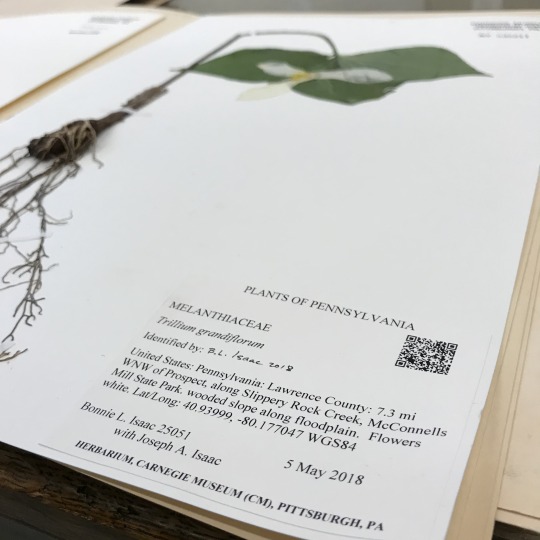
Herbarium specimen of large flowered trillium (Trillium grandiflorum) with QR code on label
Herbarium specimen of large flowered trillium (Trillium grandiflorum) with QR code on label that directs researchers to the associated iNaturalist observation, including images of the plant in the wild.

Before collecting a specimen, we take images in the field of the specimen in real life. These images are uploaded to iNaturalist, including other data such as date, time, location, and species identification. Other iNaturalist users can also contribute directly through verifying the identity of the specimen or making other comments.

Back in the herbarium, we export this information from iNaturalist to create unique herbarium labels for each specimen. We are using QR codes to link the specimens to the online iNaturalist observation. These QR codes can be read by most mobile devices. Among other information, the iNaturalist observation account online permanently links images from the field to the physical specimens in the herbarium.

What color were the flower petals? What was the size of the plant? Did it have a unique pattern on the bark?  What was the branching pattern? These questions and more can be asked to place herbarium specimens in a more complete context.

We envision a future where researchers can go through the herbarium with a mobile device such as a tablet or smart phone, scan QR codes on specimens, and be immediately directed to images of the specimen in the field.

Our article outlining this approach is available for free online:

Heberling, J. M., and B. L. Isaac. 2018. iNaturalist as a tool to expand the research value of museum specimens. Applications in Plant Sciences 6(11): e1193.  https://bsapubs.onlinelibrary.wiley.com/doi/epdf/10.1002/aps3.1193

Mason Heberling is Assistant Curator of Botany at the Carnegie Museum of Natural History.


Check back for more! Botanists at the Carnegie Museum of Natural History have embarked on a three-year project to digitize nearly 190,000 plant specimens collected in the region, making images and other data publicly available online. This effort is part of the Mid-Atlantic Megalopolis Project (mamdigitization.org), a network of thirteen herbaria spanning the densely populated urban corridor from Washington, D.C. to New York City to achieve a greater understanding of our urban areas, including the unique industrial and environmental history of the greater Pittsburgh region. This project is made possible by the National Science Foundation under grant no. 1801022. Any opinions, findings, and conclusions or recommendations expressed in this material are those of the author(s) and do not necessarily reflect the views of the National Science Foundation.
Filed Under: Blog Tagged With: Bonnie Isaac, Botany, Hall of Botany, herbarium, iNaturalist, Mason Heberling, plants

November 12, 2018 by wpengine

Pennsylvania Botany 2018

by Bonnie Isaac

Carnegie Museum of Natural History (CMNH) was well represented at PA Botany 2018. The 4th Biennial Pennsylvania Botany Symposium took place on November 2nd and 3rd at the Penn Stater Hotel and Conference Center. CMNH staff were there in full force.  PNR Director John Wenzel, Post-Doctoral Fellow Mason Heberling, Botany Collection Manager Bonnie Isaac, and Botany Curatorial Assistant Sarah Williams attended in addition to over 200 other people. This event features a day of workshops followed by a day of presentations. CMNH Botany folks were involved in both the workshops and the symposium talks. Williams & Isaac assisted workshop leaders, Heberling was a student in one of the workshops, and Wenzel was a symposium speaker.  CMNH Botany volunteer Joe Isaac was the instructor for the workshop for Botanical Consultants.

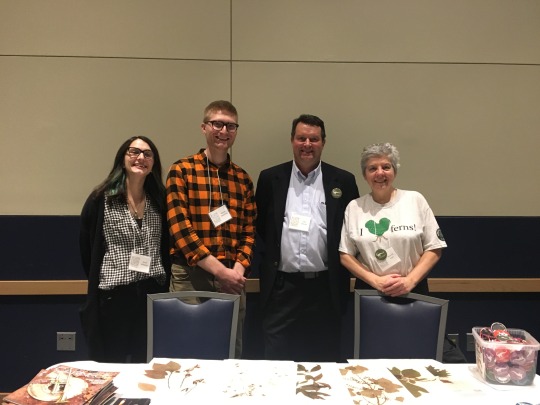
Curatorial Assistant Sarah Williams, Post-Doctoral Fellow Mason Heberling, PNR Director John Wenzel and Botany Collection Manager Bonnie Isaac at CMNH Table in the Exhibitor hall at PA Botany 2018.

John Wenzel’s presentation highlighted some of the exciting things going on at Powdermill Nature Reserve and CMNH integrating botany and technology. John showed the crowd some of the cool techniques developed at PNR for forest study using drones and computer simulation of trees as well as introducing them to the new AR Perpetual Garden App available for free in app stores. This app helps people learn about the effects of the deer population on an environment. It shows how the forest should look compared to how the forest looks when deer are over abundant. The app features Woodland In Balance vs. Woodland Out of Balance Scenarios along with dialogue to explain the differences and why they differ.

CMNH Botany has been active in this event since its inception in 2012. We hope to see more people attend this conference on plants and how important they are.  You can find more information for this conference and other plant related items at PABotany.org.

Bonnie Isaac is the Collection Manager in the Section of Botany. Museum employees are encouraged to blog about their unique experiences and knowledge gained from working at the museum.

Filed Under: Blog Tagged With: Bonnie Isaac, Botany, John Wenzel, Mason Heberling, plants, Powdermill Nature Reserve, Sarah Williams

October 12, 2018 by wpengine

New England Aster – Aren’t you glad you Aster?

by Bonnie Isaac

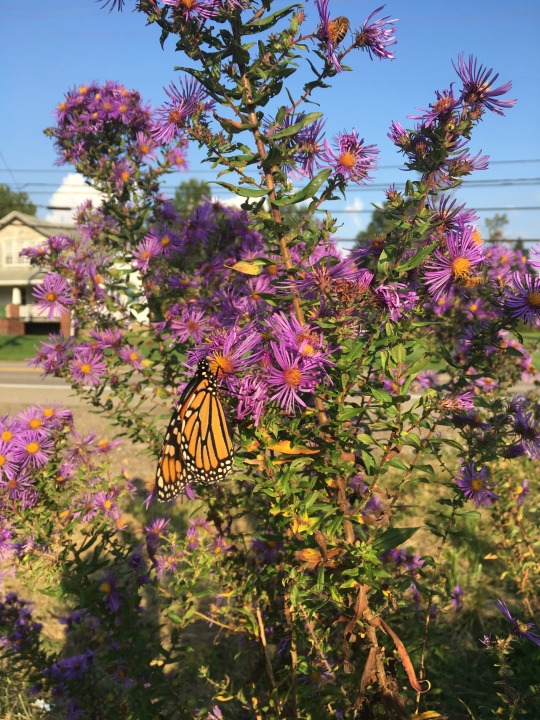
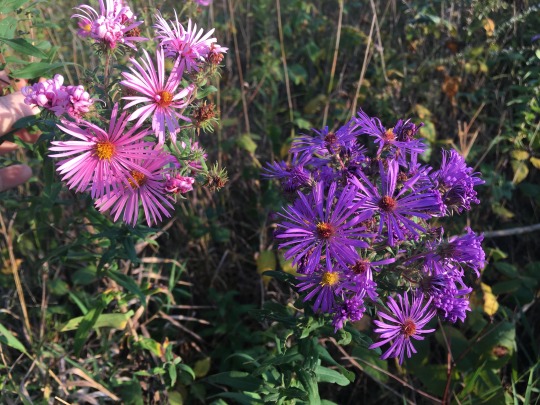
New England Aster

Fall is typically the time of year when we think plants are getting ready for winter. Think of trees changing colors and losing their leaves. Actually, some plants are just beginning to come into their own at this time of year.  The New England Aster is at its prime bloom now.  The purple, or sometimes pink, ray flowers are a spectacular sight along our open roadsides and fields.

Monarch butterfly on New England Aster

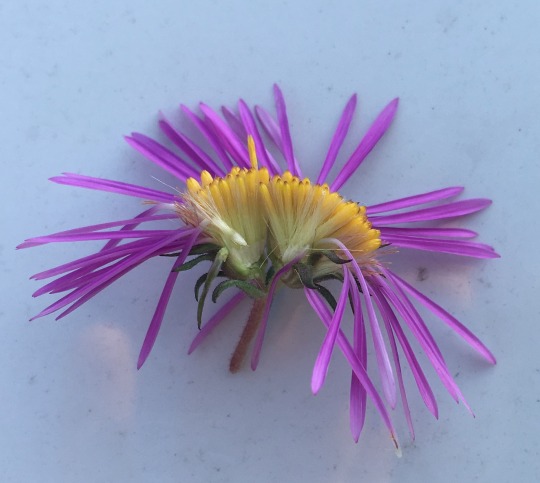
New England Aster is common across Pennsylvania and is known from almost all counties in the commonwealth. This beautiful plant is a member of the Aster family which is commonly called the Composite family.  This family is called the composite family because the flower heads are made up of many small flowers (florets) close together composing what looks like one larger flower.

detail of New England Aster florets


Next time you look at a dandelion, daisy, or sunflower, look closely. You can see many florets. Flowers, like the New England Aster, that bloom late in the year, are very important sources of nectar for bees and butterflies.

Bonnie Isaac is the Collection Manager in the Section of Botany. Museum employees are encouraged to blog about their unique experiences and knowledge gained from working at the museum.

Filed Under: Blog Tagged With: Bonnie Isaac, Botany, flowers, pennsylvania, plants

September 18, 2018 by wpengine

Hidden Treasure of Pittsburgh Found

by Bonnie Isaac

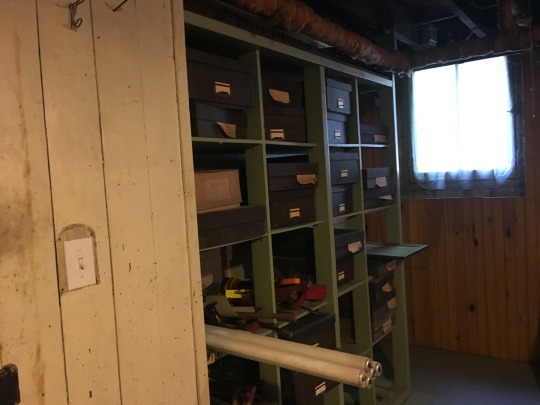
Recently I received a call from a woman who had bought an estate and discovered a hidden treasure in the basement. The basement contained 28 boxes of herbarium specimens. These boxes contained the private herbarium of Charles Boardman. Boardman was a research associate of Botany here at the museum from 1951 until his death on January 5, 1983. He had built his own herbarium space in his basement. These specimens are already mounted and in remarkably good shape for having been stored in a basement unattended for over 30 years.

Herbarium space built in the basement of Charles Boardman’s house with boxes of specimens.

Amazingly enough, there was also a letter with the collection with some details about his life. Charles Boardman was born in Buffalo, New York in 1903. Mr. Boardman attended the Massachusetts Institute of Technology and became a professional engineer. Charles was especially interested in mosses which led to his affiliation with Carnegie’s own Otto Jennings. Boardman accompanied Jennings on many field trips and collected specimens for the Manual of Mosses of Western Pennsylvania written and illustrated by Jennings. Boardman’s moss collection was donated to Duke University at his request shortly after his death. His vascular plant collection remained hidden in his basement until just a few weeks ago.

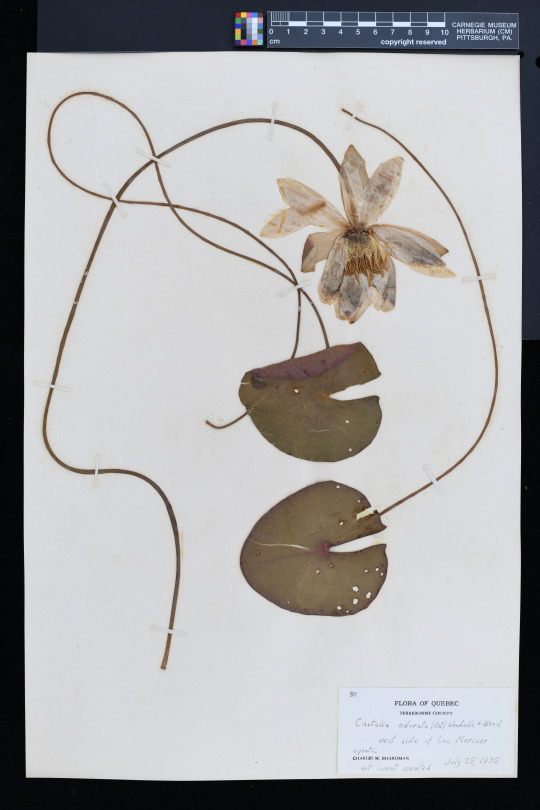
Water lily specimen
Water lily specimen found in Boardman’s personal herbarium.

Most of the specimens are from the 1930’s and 1940’s collected from Pennsylvania and beyond. In the coming weeks and months, we will process this amazing gift to see how many specimens are in this hidden treasure and put them into the main herbarium here at the museum for researchers to use in the future. You never know where a historic treasure may be lurking.

Bonnie Isaac is the Collection Manager in the Section of Botany. Museum employees are encouraged to blog about their unique experiences and knowledge gained from working at the museum.

Filed Under: Blog Tagged With: Bonnie Isaac, Botany, Charles Boardman, herbarium, Mason Heberling, Pittsburgh, plants

September 14, 2018 by wpengine

Collected on this day in 1989

by Mason Heberling

You can get see plants from all over the world without ever leaving the herbarium. Herbaria are powerful resources that enable research that would otherwise not be possible, comparing plant species collected from across the world, at different times of year.

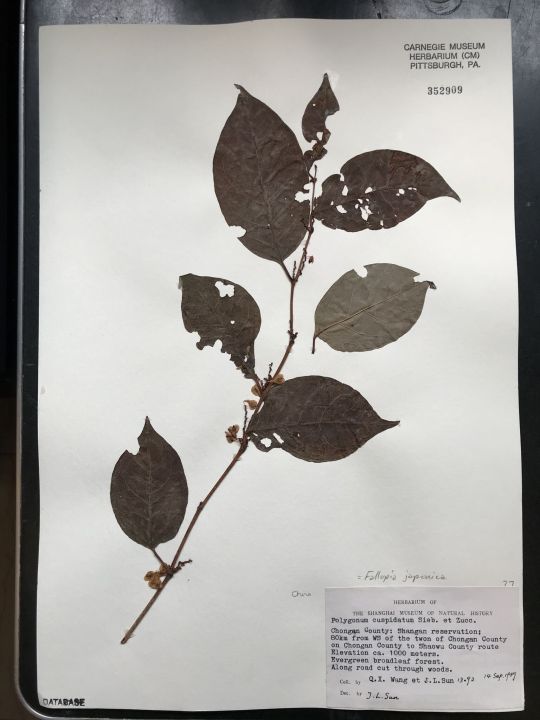
Japanese knotweed specimen

This specimen of Japanese knotweed (Fallopia japonica, formerly known as Polygonum cuspidatum) was collected in China on Sept 14, 1989 by Q.X. Wang and J.L. Sun.

Even if you’ve never been to East Asia, this species might be familiar to you.  Although native to China, Japan, and Korea, Japanese knotweed is now common across much of the temperate world, including the United States and Europe. In Pittsburgh, Japanese knotweed (and related introduced knotweed species) form dense stands along rivers, streams, and roadsides.

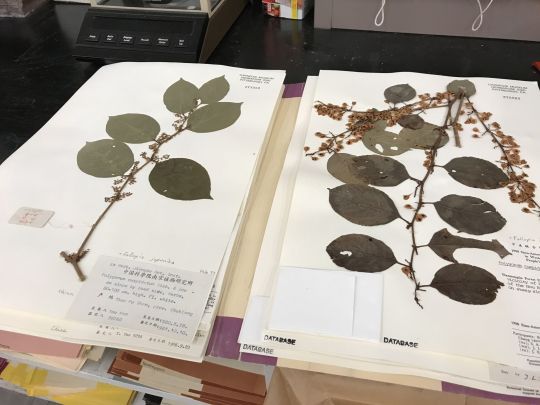
Japanese knotweed specimens

Specimens collected from both the native and introduced ranges can be compared to better understand plant invasions. For example, do invasive species look the same in their home range?

Although Collected On This Day posts tend to be biased towards specimens collected in Pennsylvania, the Carnegie Museum of Natural History herbarium includes specimens from many countries around the world. In fact, about one-third of the 530,000+ specimens are from outside the United States.

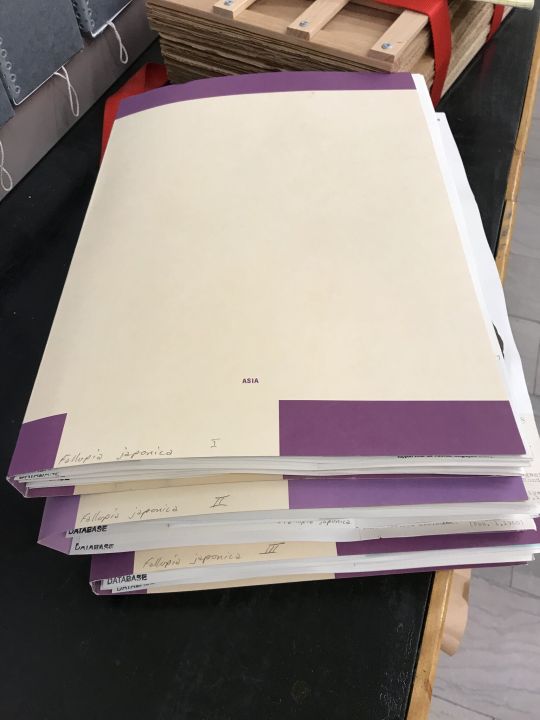
folders filled with Japanese knotweed specimens
47 of the 96 specimens of Japanese knotweed in the Carnegie Museum of Natural History’s herbarium were collected outside of the United States.

How do these species from far away regions end up at the Carnegie Museum?  Many are from expeditions from botanists affiliated with the museum – much in the same way locally collected specimens become part of the collection.  But many others are obtained through exchange with other herbaria.  Many plant collectors often collect duplicate specimens to send to several herbaria.  Most herbaria have exchange programs, where specimens (usually duplicates) are exchanged between institutions.  This practice functions to build the collection to include new species and specimens.  But it also has an important function to safeguard the future of the data.  In the case of damage (such as pest outbreaks or even fire, in the recent devastating case at the Museu Nacional in Brazil), having specimens spread across several institutions helps ensure the future of specimens.

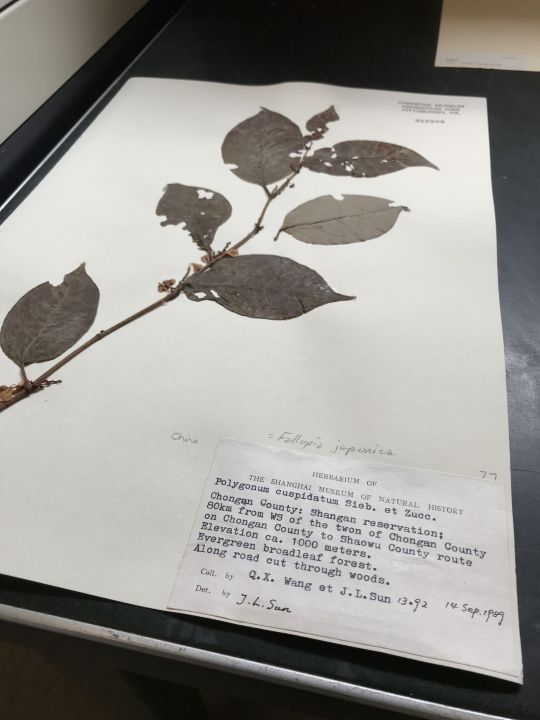
Japanese knotweed

Note the label on this specimen shows this specimen was at one time associated with the herbarium of the Shanghai Museum of Natural History.

Botanists at the Carnegie Museum of Natural History share digital specimens from the herbarium on dates they were collected. They have embarked on a three-year project to digitize nearly 190,000 plant specimens collected in the region, making images and other data publicly available online. This effort is part of the Mid-Atlantic Megalopolis Project (mamdigitization.org), a network of thirteen herbaria spanning the densely populated urban corridor from Washington, D.C. to New York City to achieve a greater understanding of our urban areas, including the unique industrial and environmental history of the greater Pittsburgh region. This project is made possible by the National Science Foundation under grant no. 1801022.

Filed Under: Blog Tagged With: Bonnie Isaac, Botany, collected on this day, herbarium, Mason Heberling

August 13, 2018 by wpengine

Plant Specimen Images Now Online

By Bonnie Isaac

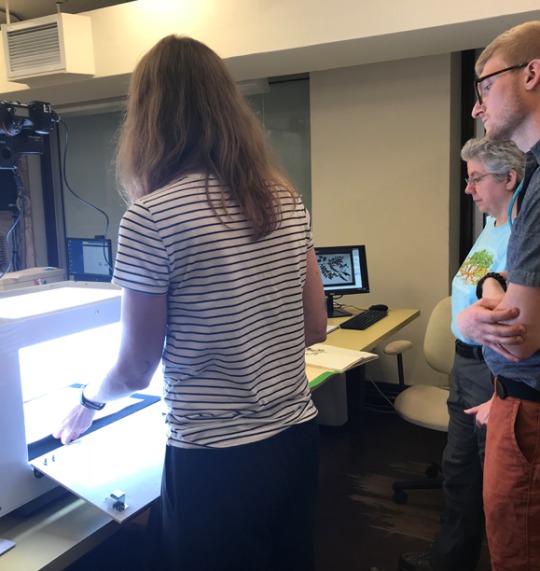
Anne Barber training Botany staff Mason Heberling and Bonnie Isaac to use the new imaging station
Anne Barber training Mason Heberling and Bonnie Isaac to use the new imaging station for our NSF grant.


Anne Barber, the Research Project Coordinator for the Mid-Atlantic Megalopolis TCN recently came to Pittsburgh to train the Botany staff (Bonnie Isaac, Mason Heberling, and Sarah Williams) to use our new imaging equipment.  We spent a day and a half learning how to image our specimens and get them up on the Mid-Atlantic Herbaria portal. We are now up and running and images of our specimens are making it to the internet.

We will be photographing the specimens from Pennsylvania, Delaware, New Jersey, New York, Maryland, and D.C. for this project. These images will be added to the portal for the mid-Atlantic region over the next three years.  You can search our specimen database to find out what specimens we have or watch for the images of these specimens to start appearing.

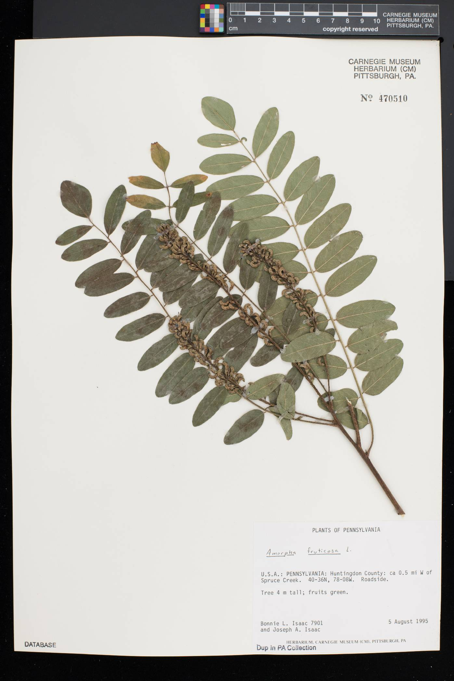
What was the lucky specimen to be first imaged and added to the portal?  Just by chance, it was a specimen that I collected in Huntingdon County back in 1995.

Amorpha fruticosa specimen
Amorpha fruticosa specimen from Pennsylvania collected by Bonnie Isaac, first specimen imaged with the new imaging station.


Bonnie Isaac is the Collection Manager in the Section of Botany. Museum employees are encouraged to blog about their unique experiences and knowledge gained from working at the museum.

Filed Under: Blog Tagged With: Bonnie Isaac, Botany, plants

  • « Go to Previous Page
  • Page 1
  • Page 2
  • Page 3
  • Page 4
  • Page 5
  • Go to Next Page »

sidebar

About

  • Mission & Commitments
  • Directors Team
  • Museum History

Get Involved

  • Volunteer
  • Membership
  • Carnegie Discoverers
  • Donate
  • Employment
  • Events

Bring a Group

  • Groups of 10 or More
  • Birthday Parties at the Museum
  • Field Trips

Powdermill

  • Powdermill Nature Reserve
  • Powdermill Field Trips
  • Powdermill Staff
  • Research at Powdermill

More Information

  • Image Permission Requests
  • Science Stories
  • Accessibility
  • Shopping Cart
  • Contact
  • Visitor Policies
One of the Four Carnegie Museums | © Carnegie Institute | Privacy Policy | Terms of Use | Accessibility
Rad works here logo