• Skip to primary navigation
  • Skip to main content
  • Skip to primary sidebar

Carnegie Museum of Natural History

One of the Four Carnegie Museums of Pittsburgh

  • Visit
    • Buy Tickets
    • Visitor Information
    • Exhibitions
    • Events
    • Dining at the Museum
    • Celebrate at the Museum
    • Powdermill Nature Reserve
    • Event Venue Rental
    • Gift Cards
  • Learn
    • Field Trips
    • Educator Information
    • Programs at the Museum
    • Bring the Museum to You
    • Guided Programs FAQ
    • Programs Online
    • Climate and Rural Systems Partnership
  • Research
    • Scientific Sections
    • Science Stories
    • Science Videos
    • Senior Science & Research Staff
    • Museum Library
    • Science Seminars
    • Scientific Publications
    • Specimen and Artifact Identification
  • About
    • Mission & Commitments
    • Directors Team
    • Museum History
  • Tickets
  • Give
  • Shop

Botany Blogs

These blogs are written about and by our Section of Botany researchers. The herbarium at the museum which contains approximately 3,000 type specimens--specimens that define an entire plants' species. These type specimens only represent about 0.6 % of the collection.

Mason Heberling, head of the section, regularly shares herbarium specimens that have been "Collected on this day" in history.

August 1, 2019 by wpengine

Western Pennsylvania Mushroom Club (WPMC) and Carnegie Museum Team Up for New Fungarium

WPMC is pleased to announce that Pittsburgh’s Carnegie Museum of Natural History has been added to the list of Partner Fungaria for the North American Mycoflora Project (NAMP).
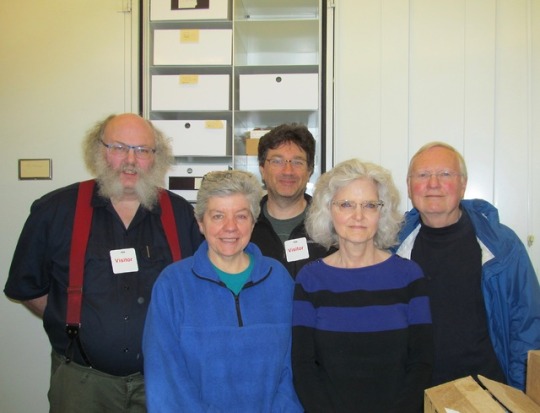
From left to right: La Monte Yarroll, Bonnie Isaac, Richard Jacob, Cecily Franklin, John Stuart.

NAMP is a collaboration between professional mycologists and citizen scientists to identify and map the distribution of macro-fungi throughout North America. Key components of the project include careful documentation and preparation of specimens (vouchering), depositing these specimens in herbaria where they can be accessed for later examination by anyone researching the organism, and DNA sequencing to complement the morphological observations that amateur mycologists already use. NAMP provides a framework and tools to allow independent projects, organized and administered by local mushroom clubs and other groups, to contribute data to a unified framework for documenting and understanding fungal biodiversity in North America.

During May, WPMC representatives met with Bonnie Isaac, Co-Chair of Collections for Carnegie Museum, to discuss and formalize our agreement to provide the new fungarium with high-quality collections, appropriately preserved and with all of the necessary meta-data. Carnegie Museum would then accession the specimens and upload storage information to the MyCoPortal collections index. On behalf of WPMC’s Scholarship Committee, we presented Bonnie with a check in support of our new partnership.

Blog post courtesy of the Western Pennsylvania Mushroom Club Newsletter, July/August 2019.

Bonnie Isaac is the Collection Manager in the Section of Botany. Museum employees are encouraged to blog about their unique experiences and knowledge gained from working at the museum.
Filed Under: Blog Tagged With: Bonnie Isaac, Botany

July 12, 2019 by wpengine

Who Likes Teaberry? Collected 56 Years Ago

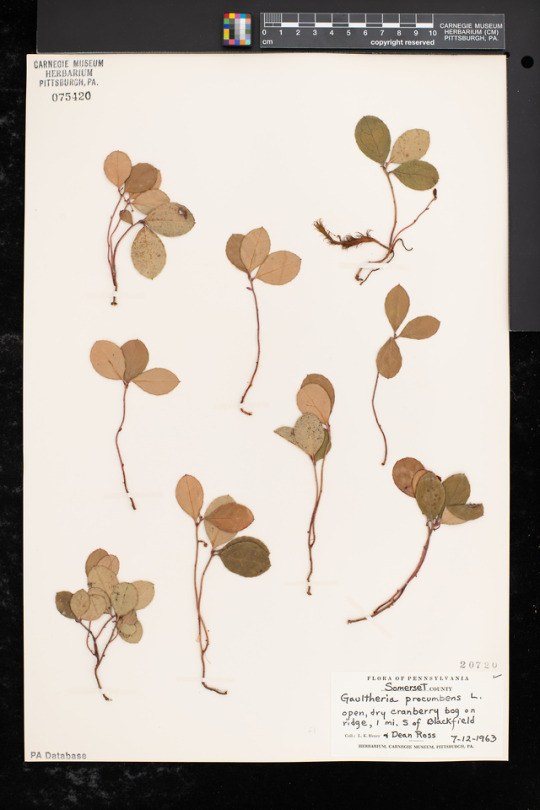
teaberry specimen

This specimen of eastern teaberry (Gaultheria procumbens), also called American wintergreen, was collected on July 12, 1963 by Leroy Henry (Carnegie Museum Curator of Botany at the time) and Dean Ross in a cranberry bog in Somerset county, Pennsylvania.

It is perhaps best known by many as a unique wintergreen flavor of chewing gum and ice cream, especially in Pennsylvania. Atlas Obscura says Teaberry ice cream: “sometimes looks like Pepto-Bismol and smells like Bengay.” Penn State Berkey Creamery calls it  the  “best treat of a bygone era.”

Teaberry is in the heath (blueberry) family, Ericaceae.  It is a small shrub growing along the ground, found across the Eastern US and has distinctive evergreen leaves.

Find a high resolution image of this teaberry specimen (and more) online at midatlanticherbaria.org.

Check back for more! Botanists at the Carnegie Museum of Natural History share digital specimens from the herbarium on dates they were collected. They have embarked on a three-year project to digitize nearly 190,000 plant specimens collected in the region, making images and other data publicly available online. This effort is part of the Mid-Atlantic Megalopolis Project (mamdigitization.org), a network of thirteen herbaria spanning the densely populated urban corridor from Washington, D.C. to New York City to achieve a greater understanding of our urban areas, including the unique industrial and environmental history of the greater Pittsburgh region. This project is made possible by the National Science Foundation under grant no. 1801022.

Mason Heberling is Assistant Curator of Botany at the Carnegie Museum of Natural History. Museum employees are encouraged to blog about their unique experiences and knowledge gained from working at the museum.
Filed Under: Blog Tagged With: Anthropocene, Botany, collected on this day, Leroy Henry, Mason Heberling, plants

July 8, 2019 by wpengine

A Plant Popular During the Revolutionary War



Ceanothus americanus tea plant specimen

Happy Independence Day! What better way to celebrate than with herbarium specimens of New Jersey tea (Ceanothus americanus), named for the fact that it was used as a substitute for tea by colonists and American soldiers during the American Revolutionary War. There was presumably a shortage of black tea, which was imported. Although the leaves contain no caffeine, it fit the bill. The plant also has a much longer history before European settlement.  Tribes of the Missouri River used the leaves for tea as well, and tribes of the Great Lakes used the plant to treat digestive ailments.

New Jersey tea, also called Indian tea, can be found not only in New Jersey, but across the eastern United States.  It is in the buckthorn family (Rhamnaceae), which is unsurprisingly also family to introduced shrub/tree, common buckthorn  (Rhamnus cathartica).

Ceanothus americanus tea plant specimen

These specimens were both collected in Pennsylvania on the 4th of July.  One in Luzerne county by Alfred Twining 1907, who wrote a flora of Northeastern PA ten years later.  Many of his specimens are at the Everhart Museum of Natural History, Science, and Art in Scranton, PA.

The other Independence Day New Jersey Tea specimen was collected by Robert Leberman in Crawford county in 1986.  Leberman established the bird banding program at the Carnegie Musuem of Natural History’s Powdermill Nature Reserve in 1961.  It continues today as the longest running, year-round banding research operation in the country.

New Jersey Tea is a beautiful shrub, important for many pollinators, and food source for other wildlife. The plant is also sold commercially by many native plant nurseries to plant in your yard or garden.

All plants have a cultural history and a scientific one. As you remember the signing of the Declaration of Independence and the American Revolution, think too about New Jersey Tea’s impact on our country. Did John Hancock drink it before signing? (Totally made that up).

Find high resolution images of these specimens (and 290 more!) online: http://midatlanticherbaria.org/portal/collections/list.php?db=328&taxa=Ceanothus+americanus&usethes=1&taxontype=2

Check back for more! Botanists at the Carnegie Museum of Natural History share digital specimens from the herbarium on dates they were collected. They have embarked on a three-year project to digitize nearly 190,000 plant specimens collected in the region, making images and other data publicly available online. This effort is part of the Mid-Atlantic Megalopolis Project (mamdigitization.org), a network of thirteen herbaria spanning the densely populated urban corridor from Washington, D.C. to New York City to achieve a greater understanding of our urban areas, including the unique industrial and environmental history of the greater Pittsburgh region. This project is made possible by the National Science Foundation under grant no. 1801022.  

Mason Heberling is Assistant Curator of Botany at the Carnegie Museum of Natural History. Museum employees are encouraged to blog about their unique experiences and knowledge gained from working at the museum.
Filed Under: Blog Tagged With: Anthropocene, Botany, collected on this day, Mason Heberling, plants

July 3, 2019 by wpengine

What does Pittsburgh have to do with the Wimbledon tennis tournament?

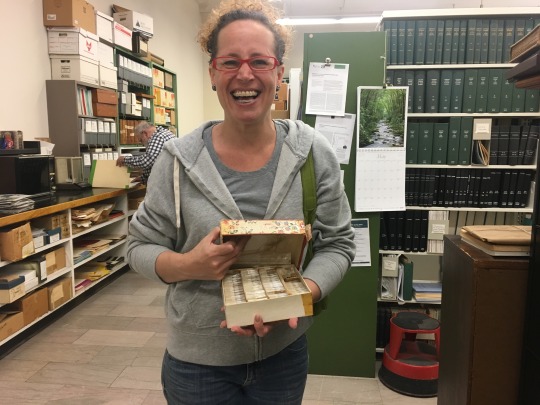
Recently Penny See came to visit me here at the museum to show me her mother’s seed collection.  My interest was piqued when she told me about her mother, Janet Emma Gregory. This is one of those situations where all my favorite things collided.  Anything having to do with botanical history, women in science or Pennsylvania will catch my attention. The story I was told captures all of those and more. I asked Penny to tell me about her mother in her own words. Here is what Penny wrote for me.

Penny See with her mother’s seed collection.

My mother, Janet Emma Gregory, always had a special place in her heart for plants. She used to say, “My hands are always dirty, but my heart is always happy.” She was born in Surrey, England on April 21st, 1943. Her Father, Thomas Gregory, was awarded by the British Royal Horticulture Society for his accomplishments in Floral Landscape Design.

I recall all sorts of stories that she shared about her life and growing up in England with all the lush gardens. One of my favorites was about a Laburnum or Golden Chain Tree. An elderly man that lived two doors down from them had a large one growing in his garden. One day, he had decided to cut it down, but my Mother walked over and begged him to spare it. He obliged and allowed her to come and spend time with the tree whenever she liked, she took him up on the invitation often. When they moved to the United States in 1972 she planted one of her own and I too, have one growing in my yard now.

As a young teen, she attended Nonsuch County School for Girls, a selective specialist science school in the London borough of Sutton. In those days, boys and girls were schooled separately and each school had focused studies for the students, collegiately training them for careers beginning at a young age. Following in her father’s footsteps, Janet chose to focus her time at Nonsuch studying Botany and Latin.

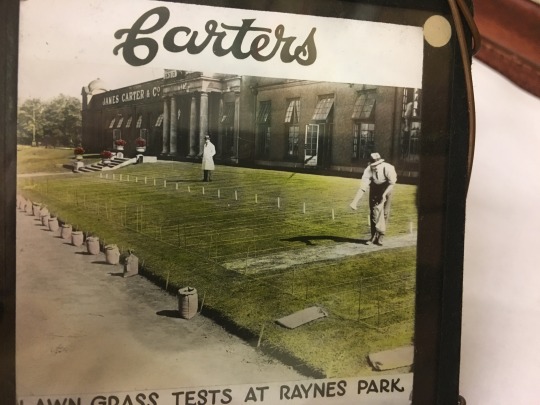
Upon leaving school, she was employed at Carter’s Tested Seeds of Raynes Park in Southwest London. Carter’s was a premier seed supply company renowned for their quality standards with a goal of providing unadulterated seeds to large companies, farmers, and the everyday gardener. Rising to fame with the hybridization of the Sweet Pea, Carter’s quickly gained national respect.

Photo of lantern slide showing the grass plots at Carters Tested Seeds.

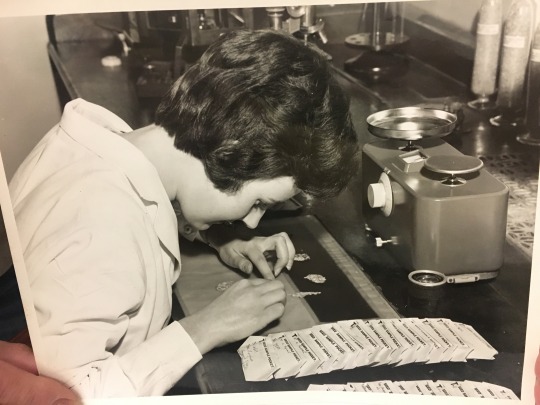
Janet’s focus at Carter’s was creating new grasses, from ornamental and specialty to everyday grasses like you’d find in your yard. As the hybrids were created, they would plant samples in long strips in the gardens outside of Raynes Park. Interested customers could come and choose the variety that suited their purposes best. To her delight, one of the grasses she created was chosen to be used on the courts at Wimbledon and they showed their appreciation by offering her a lifelong invitation to attend the Wimbledon matches.

Janet Gregory working with seeds at Carters Tested Seeds.

During her employment at Carter’s she created a very impressive collection of seeds. Everything from English flowers and weeds, to vegetables and trees, she meticulously gathered, packaged, labelled, and organized them alphabetically and by genus. I have fond memories of browsing through them as a kid and when she passed, she left them to me. It’s this seed collection that brought me to The Carnegie Museum of Natural History to meet with Bonnie Isaac.

So back to the original question. What does Pittsburgh have to do with the Wimbledon tennis tournament?

It turns out, that the woman who created the grass mix used on the courts has family right here in Pittsburgh!

Seed collection video by Sarah C. Williams.

Bonnie Isaac is the Collection Manager in the Section of Botany. Museum employees are encouraged to blog about their unique experiences and knowledge gained from working at the museum.
Filed Under: Blog Tagged With: Bonnie Isaac, Botany

June 21, 2019 by wpengine

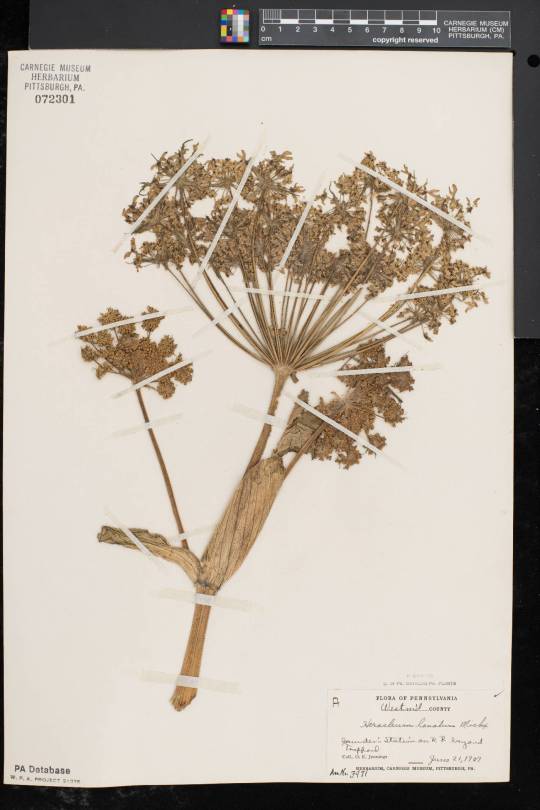
Cow Parsnip: All collected 112, 85, and 59 years ago!

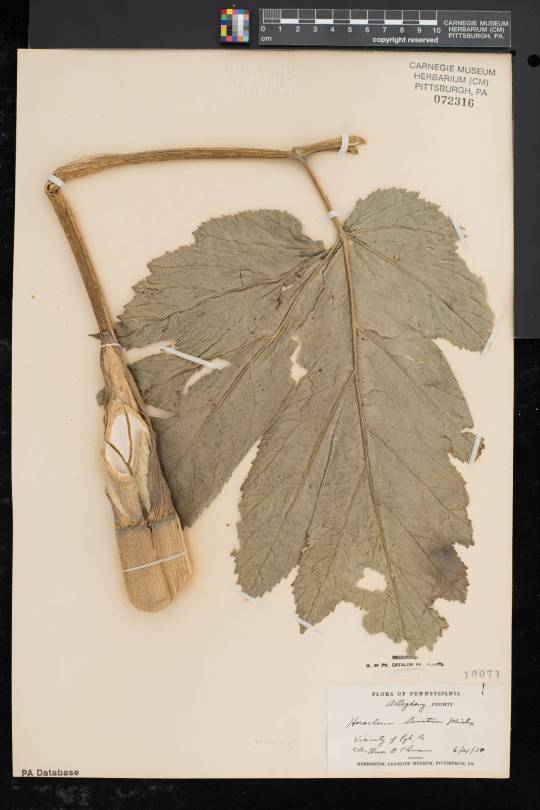
cow parsnip specimen

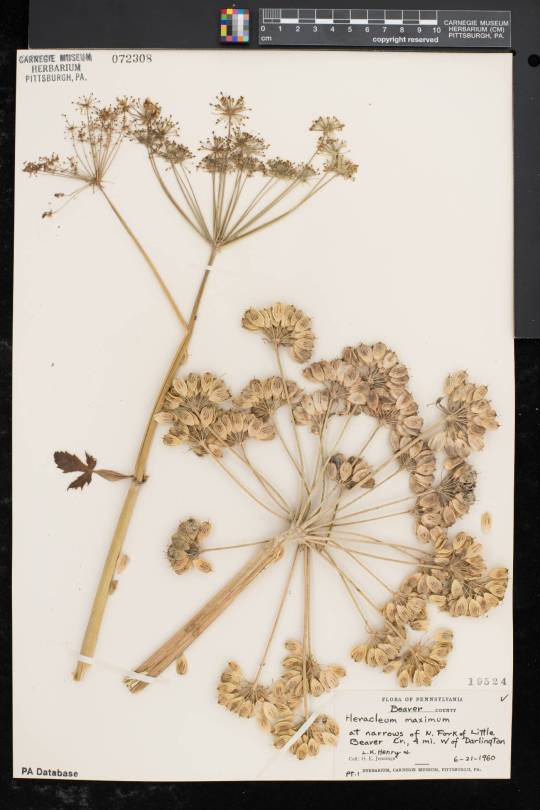
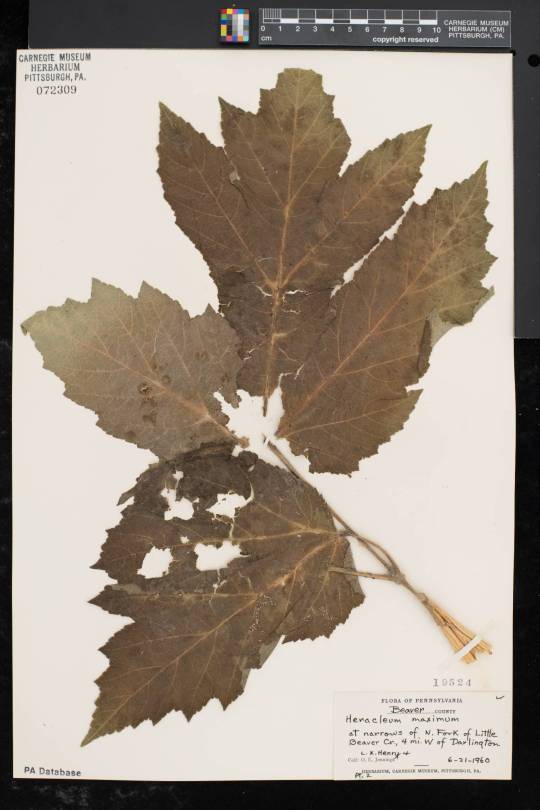
Whoa, this plant will catch your attention!  Although towering in at up to eight feet tall with leaves two feet wide, Cow parsnip (Heracleum maximum, aka Heracleum lanatum) is not a tree, but herbaceous (non-woody). This species is the largest member of the carrot family (Apiaceae) native to North America. It can be found along shaded roadsides, waterways, and the edge of woods. Its flower structure consists of many small white flowers on short stalks connected at a single point – an umbrella of flowers – botanically known as an “umbel.” Umbels are characteristic of the carrot family (think of the perhaps better recognized Queen Anne’s lace, Daucus carota, which is also known as “wild carrot”).

These specimens were all collected on June 21 – but years apart in 1907 (Westmoreland county, PA), 1934 (Pittsburgh), and 1960 (Beaver county, PA).

cow parsnip specimen

This species is often confused with giant hogweed. Cow parsnip is often confused for the non-native plant called giant hogweed (Heracleum mantegazzianum). Giant hogweed has hit the news media in the past few years and is on many people’s radar, as it is considered a significant public human health concern. This plant is highly poisonous and designated as a federal noxious weed. The sap of giant hogweed causes “phytophotodermatitis,” meaning serious skin inflammation occurs when contacted skin is exposed to sunlight.  Skin rashes can be very severe.  The sap can cause temporary or permanent blindness. Cow parsnip has a similar set of chemicals in its sap, and although not as poisonous, be careful around these plants.

Giant hogweed can be 8-20 feet tall with leaves up to 5 feet wide!  It is thought to be eradicated in Pennsylvania. Although similar to the Pennsylvania native species cow parsnip, giant hogweed is noticeably larger in height and flower size. (see herbarium specimen here – it took 6 sheets!)

See here for a nice comparison between these similar species.

Given the size of members of the genus, the name Heracleum (derivative of Hercules) is quite fitting.

cow parsnip specimen

Specimen records and images for this species in the CM herbarium are now publicly available online.

Check back for more! Botanists at the Carnegie Museum of Natural History share digital specimens from the herbarium on dates they were collected. They have embarked on a three-year project to digitize nearly 190,000 plant specimens collected in the region, making images and other data publicly available online. This effort is part of the Mid-Atlantic Megalopolis Project (mamdigitization.org), a network of thirteen herbaria spanning the densely populated urban corridor from Washington, D.C. to New York City to achieve a greater understanding of our urban areas, including the unique industrial and environmental history of the greater Pittsburgh region. This project is made possible by the National Science Foundation under grant no. 1801022.

Mason Heberling is Assistant Curator of Botany at the Carnegie Museum of Natural History. Museum employees are encouraged to blog about their unique experiences and knowledge gained from working at the museum.
Related Content

Collected On This Day in 2001: Giant Hogweed

Collected On This Day in 1982: One Specimen Isn’t Always Enough

Pressed Flowers Come Alive by Telling Their Pollination Story

Carnegie Museum of Natural History Blog Citation Information

Blog author: Heberling, Mason
Publication date: June 21, 2019

Share this post!

  • Share on Twitter Share on Twitter
  • Share on Facebook Share on Facebook
  • Share on Pinterest Share on Pinterest
  • Share on LinkedIn Share on LinkedIn
  • Share on Reddit Share on Reddit
  • Share via Email Share via Email

Filed Under: Blog Tagged With: Botany, collected on this day, Mason Heberling, plants

June 7, 2019 by wpengine

Collected 189 Years Ago: Strawberry Bush

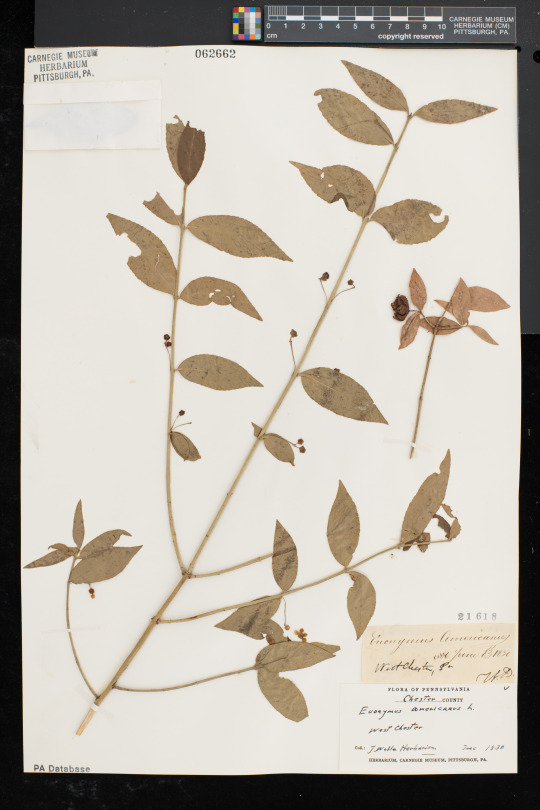
strawberry bush specimen

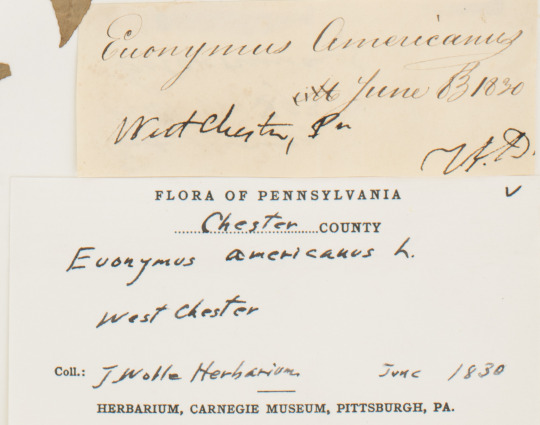
This is a special specimen. The Carnegie Museum of Natural History herbarium is full of specimens of scientific and historical importance. And this is a notable one, collected in June 1830 by William Darlington in West Chester, Pennsylvania. William Darlington (1782-1863) was an important figure in the history of Pennsylvania botany. Darlington was a physician, politician (US House of Representatives 1815-1823), and as you might guess – a botanist! At the University of Pennsylvania, Darlington studied botany under Benjamin Smith Barton, a well-known botanist who also trained Meriwether Lewis (of the Lewis & Clark Expedition). He spent most of his life in West Chester, PA. He wrote some of the earliest botanical works, including a flora of Chester County in 1826 and others on agriculture. Many of his specimens are among the earliest documentation of Pennsylvania’s flora and are preserved in the William Darlington herbarium at West Chester University.

This particular specimen is of the native shrub Euonymus americanus, commonly called “strawberry  bush.” Despite the name, it is not related to strawberries, but is in the bittersweet/spindle family, Celastraceae. You may recognize some similarities with the related species from East Asia, burning bush (Euonymus alatus), which is commonly planted due to its bright red fall color (around Cathedral of Learning in Pittsburgh, and many other places).  However, burning bush should not be planted, as it is invasive, spreading into natural areas.

label from strawberry bush specimen

In the Carnegie Museum herbarium, there are 62 specimens collected by Darlington between 1828 and 1840, mostly from Chester County, PA.

How’d some of Darlington’s specimens end up at the Carnegie Museum? This specimen is part of Jacob Wolle’s personal collection, who was the grandfather of William Holland, the first director of the museum.

This specimen image is now publicly available online.

Read more about Darlington and  other influential figures in the history of botany in Pennsylvania at Herbarium World.

Check back for more! Botanists at the Carnegie Museum of Natural History share digital specimens from the herbarium on dates they were collected. They have embarked on a three-year project to digitize nearly 190,000 plant specimens collected in the region, making images and other data publicly available online. This effort is part of the Mid-Atlantic Megalopolis Project (mamdigitization.org), a network of thirteen herbaria spanning the densely populated urban corridor from Washington, D.C. to New York City to achieve a greater understanding of our urban areas, including the unique industrial and environmental history of the greater Pittsburgh region. This project is made possible by the National Science Foundation under grant no. 1801022.  

Mason Heberling is Assistant Curator of Botany at the Carnegie Museum of Natural History. Museum employees are encouraged to blog about their unique experiences and knowledge gained from working at the museum.
Filed Under: Blog Tagged With: Botany, Mason Heberling, plants, William Darlington

  • « Go to Previous Page
  • Page 1
  • Interim pages omitted …
  • Page 8
  • Page 9
  • Page 10
  • Page 11
  • Page 12
  • Interim pages omitted …
  • Page 28
  • Go to Next Page »

sidebar

About

  • Mission & Commitments
  • Directors Team
  • Museum History

Get Involved

  • Volunteer
  • Membership
  • Carnegie Discoverers
  • Donate
  • Employment
  • Events

Bring a Group

  • Groups of 10 or More
  • Birthday Parties at the Museum
  • Field Trips

Powdermill

  • Powdermill Nature Reserve
  • Powdermill Field Trips
  • Powdermill Staff
  • Research at Powdermill

More Information

  • Image Permission Requests
  • Science Stories
  • Accessibility
  • Shopping Cart
  • Contact
  • Visitor Policies
Stay in the loop! Sign up for our newsletter(s).
One of the Four Carnegie Museums | © Carnegie Institute | Privacy Policy | Terms of Use | Accessibility
Rad works here logo