• Skip to primary navigation
  • Skip to main content
  • Skip to primary sidebar

Carnegie Museum of Natural History

One of the Four Carnegie Museums of Pittsburgh

  • Visit
    • Buy Tickets
    • Visitor Information
    • Exhibitions
    • Events
    • Dining at the Museum
    • Celebrate at the Museum
    • Powdermill Nature Reserve
    • Event Venue Rental
    • Gift Cards
  • Learn
    • Field Trips
    • Educator Information
    • Programs at the Museum
    • Bring the Museum to You
    • Guided Programs FAQ
    • Programs Online
    • Climate and Rural Systems Partnership
  • Research
    • Scientific Sections
    • Science Stories
    • Science Videos
    • Senior Science & Research Staff
    • Museum Library
    • Science Seminars
    • Scientific Publications
    • Specimen and Artifact Identification
  • About
    • Mission & Commitments
    • Directors Team
    • Museum History
  • Tickets
  • Give
  • Shop

Carnegie Museum of Natural History

February 9, 2022 by Erin Southerland

Climate Change Myth Busting at the Museum

by Dr. Bonnie McGill

If you’ve visited the museum recently you may have noticed some new orange labels throughout the exhibit halls. These are part of an innovative visitor experience titled, We Are Nature: A New Natural History. I helped write the label you’ll find in Benedum Hall of Geology next to the oil and coal specimens. Its six-word headline reads “Burning fossil fuels causes climate change”. 
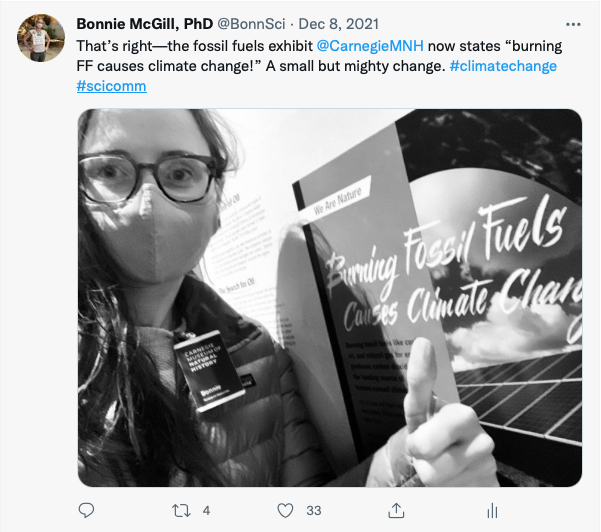
Tweet includes a selfie photo of the author in front of the new label. The tweet reads “That’s right—the fossil fuels exhibit @CarnegieMNH now states ‘Burning FF causes climate change’! A small but mighty change. #climatechange #scicomm” My twitter handle is @BonnSci and the museum is @CarnegieMNH.
Screenshot of a tweet I sent in December. 

This is an important exhibit update. When looking at a big chunk of coal, it’s hard to not think about climate change. Fossil fuel combustion is the leading cause of climate change. For example, from 2010-2019, burning fossil fuels (coal, oil, natural gas) accounted for 81-91% of total human-caused CO2 emissions (IPCC AR6 WGI 2021 ch 5 p 6). Over that same time period the measured global average temperature was 1.6-2.2 oF (0.9-1.2 oC) warmer than the pre-industrial global average temperature. This increase cannot be explained by natural processes (such as changes in solar irradiance or volcanoes), which actually decreased the temperature by 0.2 oF (0.1oC), according to the Intergovernmental Panel on Climate Change (IPCC) (IPCC AR6 WGI 2021 ch 3 p4).

While the museum has understood the science of anthropogenic climate change for many years, adding these new labels explicitly linking fossil fuels to climate change has created opportunities for new discussion and questions about what scientists know and what they don’t know. To help address these questions, the CMNH Natural History Interpreters have been working with the Climate and Rural Systems Partnership (CRSP) to bolster their climate conversation skills and climate science knowledge. One tool we at CRSP have developed with our regional network of community partners is a climate change myth busting resource that breaks down some of the most commonly repeated myths about climate change. 

Let me show you how the climate change myth busting resource works. For example, here is one myth we hear a lot:

“The climate has always changed, therefore this is natural.”

The guide provides three types of information to address the myth:

1. The science bottom line

Yes, the climate has always changed. This time it’s different. It’s more rapid than past changes and it can only be explained by human activity. 

2. The science in more detail (not a script, simply background information)

Past climate changes were dominated by naturally occurring cyclical changes in the Earth’s orbit and axis. Volcanoes and asteroid impacts have also changed the chemistry of the atmosphere and, thus, Earth’s temperature in the past. These forces continue to have effects. Today natural forces contribute a -0.2 oF effect on modern day global warming, which cannot explain the warming observed today. Human activities contribute a net increase of 1.4-2.3 oF. This means humans are having a 7- to 11-fold greater impact on global temperature than non-human forces of nature.

Scientists have 99.999% certainty that current climate change is human-caused. As the IPCC says “its unequivocal”. One of the strongest lines of evidence comes from comparing observed (past) global average temperatures with projections from climate models for the same time period. Only the climate models that include heat-trapping gas emissions from human activities match the observed temperatures (see plot below). Climate models that include only natural forces of climate change do not match observed changes in global temperature. 
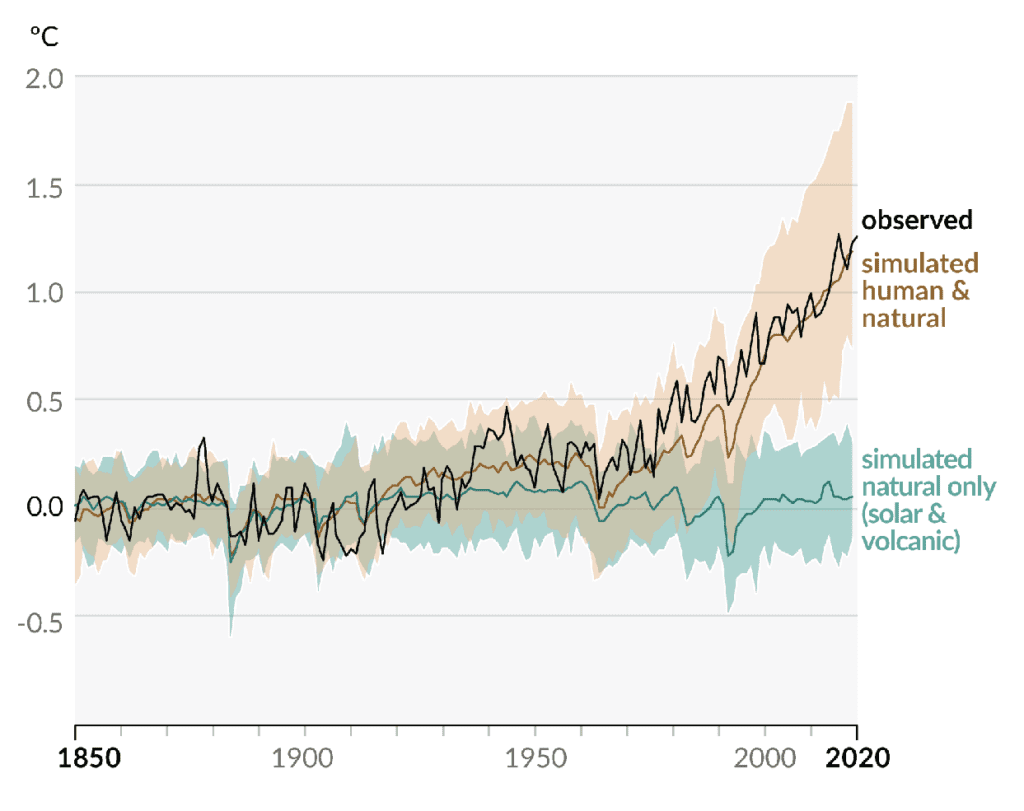
Line graph of degrees C -0.5 to 2.0 on the vertical axis vs. year 1850-2020 on the horizontal axis. The lines stay near zero until about 1960 when the black (observed temperature) and brown (simulated temperature driven by humans and natural factors) move upward to about 1.5 degrees in 2020. The green line (simulated natural factors only) stays near zero and does not match the observed line.
Change in global surface temperature (annual average) as observed (in black) and simulated using human & natural (brown) and only natural (green) factors (both 1850-2020). Source: Intergovernmental Panel on Climate Change (IPCC) Working Group 1 (WG1) Sixth Assessment Report (AR6) Summary for Policymakers. https://www.ipcc.ch/report/ar6/wg1/#SPM

Additionally, fossil fuels are the only source of carbon (representing millions of years of plant-stored carbon) large enough to explain the observed increase in atmospheric CO2. The carbon isotopes in the CO2 match the carbon isotopes of fossil fuels. 

3. Ideas for moving the conversation toward solutions

Recognize that the person engaging in conversation seems to agree that the climate IS changing–shared agreement is vitally important.

It’s true the Earth’s climate has always changed—our planet has had ice ages and Hothouse periods caused by natural changes in the Earth’s orbit and axis, changes in solar irradiance, and volcanoes. This time it’s different. Natural cycles, solar energy, and volcanoes alone are not enough to explain the increase in atmospheric CO2 concentrations and Earth’s temperature. Human emissions of greenhouse gases, primarily from the burning of fossil fuels, do explain the increase in CO2 and temperature.

Knowing it is human-caused means it can be human-solved! It is important that we’re on the same page about the cause of climate change, so that we can develop effective solutions. For example, you could say, “Perhaps you might be interested in learning more about climate solutions, many of which improve other conditions too like our health?” For solutions to talk about see Project Drawdown. Transitioning to renewable energy will benefit air and water quality and human health.

Climate change information added to galleries, and training staff on climate science and techniques for talking about it in friendly ways, are just a few examples of how the scientists, educators, and exhibitions team are working together at CMNH to explore Anthropocene topics like climate change. We want to engage museum visitors and work with our regional communities to have productive climate conversations, open discussions that are oriented toward climate solutions and a positive future. Because at the end of the day that is what really matters. 

May 2022 update: Here is the completed myth busting resource, “Breaking up with climate myths with climate fact flip cards.” 

We also recommend this resource from our partner the Climate Advocacy Lab for learning more about having relational climate conversations.

Bonnie McGill, Ph.D. is a science communication fellow for the Climate and Rural Systems Partnership and based in the Anthropocene Studies Section at Carnegie Museum of Natural History. Museum staff, volunteers, and interns are encouraged to blog about their unique experiences and knowledge gained from working at the museum.

Related Content

What Does Climate Change Mean for Western PA Farmers?

Understanding Fossil Fuels Through Carnegie Museums Exhibits

Guiding a Local Focus on Climate Education

Carnegie Museum of Natural History Blog Citation Information

Blog author: McGill, Bonnie
Publication date: February 10, 2022
Share this post!

  • Share on Twitter Share on Twitter
  • Share on Facebook Share on Facebook
  • Share on Pinterest Share on Pinterest
  • Share on LinkedIn Share on LinkedIn
  • Share on Reddit Share on Reddit
  • Share via Email Share via Email

Filed Under: Blog Tagged With: Benedum Hall of Geology, Bonnie McGill, Carnegie Museum of Natural History, CRSP, We Are Nature 2

February 2, 2022 by Erin Southerland

Groundhog as Archaeologist

by Dr. John R. Wible
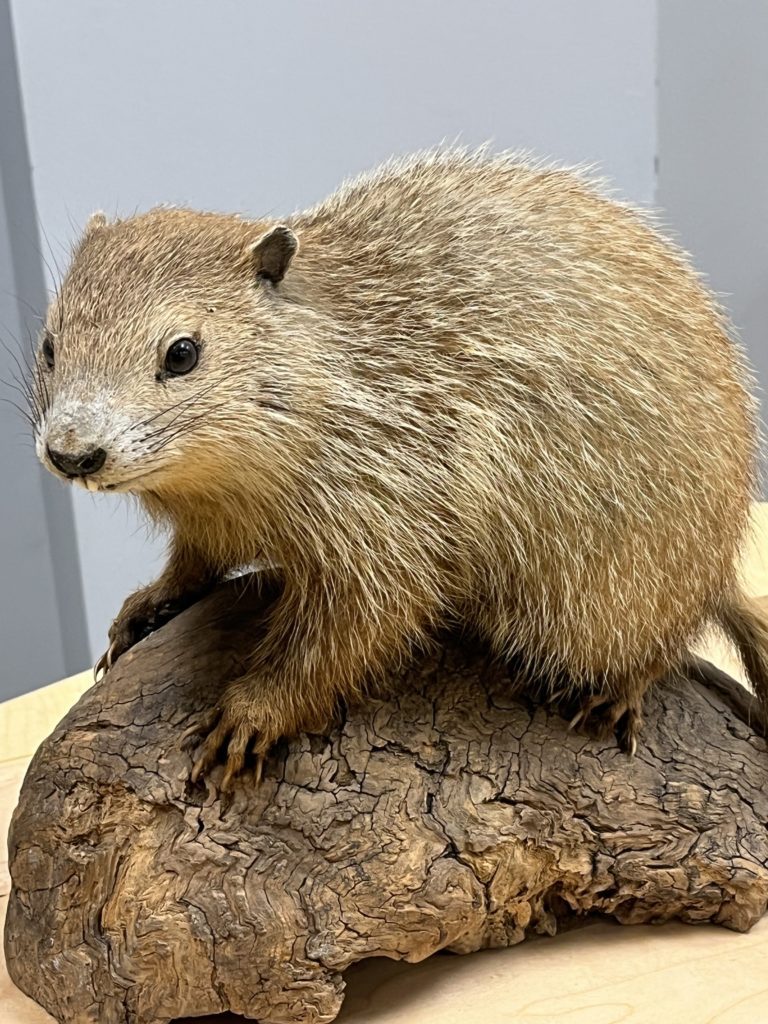
groundhog taxidermy mount

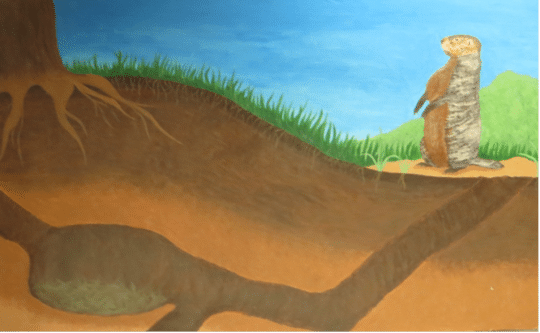
Groundhogs (Latin name: Marmota monax) are mostly solitary; they dig and spend a lot of time in elaborate burrows. There is usually a main burrow entrance, a foot across with a mound of excavated dirt marking it, and several auxiliary exits. The burrow is designed with twists and turns so that it will not flood. Side chambers serve as suitable places to hibernate and as latrine, which when “full” is sealed off. Because of their digging pastime and the holes they create, groundhogs are seen as pests by many homeowners, fearing property damage, and horse owners, fearing injury to their steeds.

illustration of a groundhog standing near the entrance to a groundhog burrow

Once a year, in early February, the pest label for groundhogs is ditched for that of a weather prognosticator, our own Punxsutawney Phil is the prime example. However, for Western Pennsylvanians, the so-called pest activity of one groundhog led to one of the most important scientific discoveries of our region: the renowned archaeological site of Meadowcroft Rock Shelter in Washington County. As a child growing up on the property, Albert Miller believed that Native Americans had been there. But proof did not come until 1955 when he was investigating an animal burrow and discovered stone and ceramic artifacts. The rest is local history so to speak!

Early on, the burrow was said to belong to a badger. But there is only a single record of a badger in Pennsylvania, believed to have been transported by train to Indiana County. Now, a groundhog is the suspected culprit responsible for the true discovery of artifacts at Meadowcroft. Perhaps Meadowcroft marmot would be an appropriate name!

John Wible, PhD, is the curator of the Section of Mammals at Carnegie Museum of Natural History. Museum employees are encouraged to blog about their unique experiences and knowledge gained from working at the museum.

Related Content

The Woodchuck…or Groundhog?

Groundhog Day 2020

Groundhog Architecture

Carnegie Museum of Natural History Blog Citation Information

Blog author: Wible, John
Publication date: February 2, 2022

Share this post!

  • Share on Twitter Share on Twitter
  • Share on Facebook Share on Facebook
  • Share on Pinterest Share on Pinterest
  • Share on LinkedIn Share on LinkedIn
  • Share on Reddit Share on Reddit
  • Share via Email Share via Email

Filed Under: Visitor Info Tagged With: Carnegie Museum of Natural History, John Wible, mammals, Science News

January 21, 2022 by Erin Southerland

“Mush-room” for Exploration

by Sara Klingensmith

Mushrooms are becoming popular! Visitors to Powdermill Nature Reserve often bring photos of colorful mushrooms in hopes of learning the identity of each. On nature hikes, the appearance of eccentric mushrooms such as viscid violet cort (Cortinarius iodes), stinky squid (Pseudocolus fusiformis), and some of the color-changing boletes (family Boletaceae) expand perspectives of what exists in nature. People are beginning to pay more attention to these understudied organisms and discovering that fungi do more than decompose. Fungi assist in many ecological processes such as symbiotic partnerships, carbon storage, primary colonization, and parasitism.

How Do We Know When and Where to Find Mushrooms?

Across this vast Kingdom of organisms, only some fungi deploy the charismatic spore-bearing structures we casually call mushrooms when certain environmental conditions are met. Scientifically speaking, these recognizable structures are termed macrofungi (visible sporocarps or fruitbodies). Among the various groupings of fungi, two produce macrofungi we are likely to notice during nature walks: Basidiomycota (external spore production or “club fungi”) and Ascomycota (internal spore production or “sac fungi”). 

A mushroom is only the reproductive structure of a fungus. For many species, spores produced within hymenophores (reproductive structures such as gills or pores) are released through an active process called ballistospory. Wind, rain, and animals may help further spore dispersal. The bulk of a fungus lies in the root-like mycelial network within a nourishing substrate (its food). Leaf litter, soil, plants, scat, and even other fungi are all different types of substrates for fungi. 

Determining when we will see the most mushrooms erupting from their substrates is challenging because there are multitudes of factors influencing fungal communities. Like many organisms, certain species will thrive better in certain habitats and elevations. Some fungi are tied to their host’s health, phenology, and life stage, which may also be influenced by forest management practices and climate change. Because fungi are fundamentally interwoven with their environment, these organisms undergo succession along with whole forest communities, and even on a single growth substrate. 

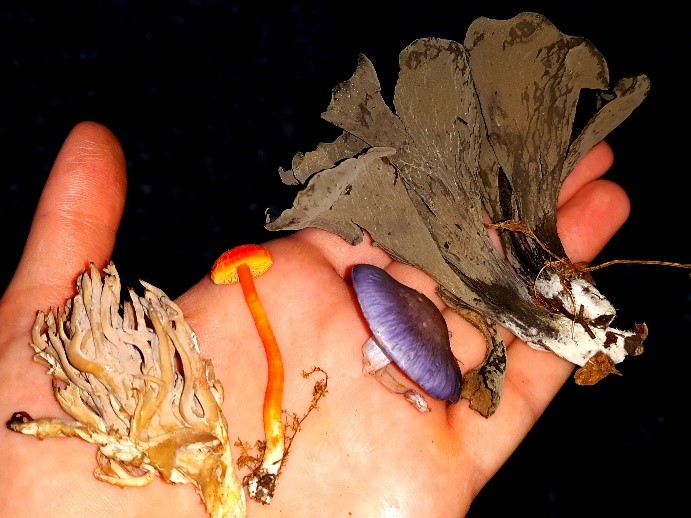
four different mushrooms held in a hand
Examples of Basidiomycete mushrooms; left to right: coral-shaped fungi (probable families: Clavulinaceae and Gomphaceae), waxy cap (Hygrocybe sp.), viscid violet cort (Cortinarius iodes), and Eastern black trumpet (Craterellus fallax)
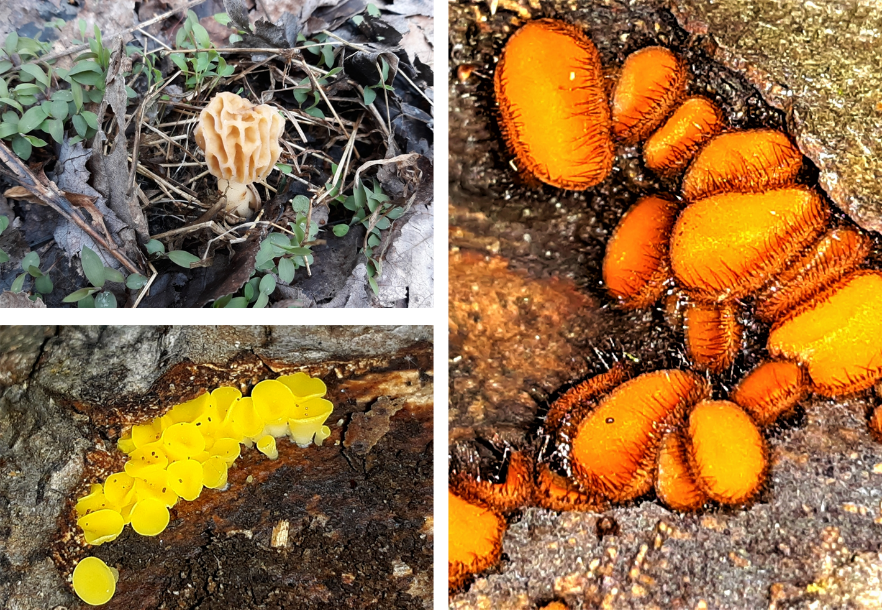
collage of three different mushrooms
Examples of Ascomycete mushrooms; top left: morel (Morchella sp.), bottom left: yellow fairy cups (Calycina citrina), and right: eyelash cups (Scutellinia sp.).

Through general observations, we have determined certain species have seasonal fruiting periods. Experienced foragers learn from experience when to search for morels, and we’ve likewise learned when to expect the fruiting of many other fungi species. Some fruitbodies are ephemeral, whereas others produce mushrooms that may persist on trees for years. While the presence of mycelium is generally linked to the appearance of mushrooms, some studies have observed an uncoupling of factors equating abundant mycelium with high sporocarp production. These findings apply particularly to fungi that form symbiotic relationships with plants—the ectomycorrhizal fungi (symbiotic macrofungi)!  This fungal phenomenon has been observed in a few ectomycorrhizal species. For example, research that examined the relationship between mycelial and sporocarp abundance of Boletus edulis, also known as the king bolete, found no correlation between sporocarp production and distribution and the abundance of below-ground mycelium. This means some species of mycorrhizal fungi can appear abundant above ground, but lack a robust underground network expected to support such a high sporocarp population. Therefore, aboveground species richness may not reflect mycelial productivity for some species.

Current research suggests that soil moisture and temperature highly influence the appearance of mushrooms. For example, a dry spell may reduce sporocarp production by 50% in pine forests, yet the mycelial networks presumably continue their cryptic business below the soil surface. Research in the Mediterranean region suggests that precipitation is a limiting factor for sporocarp production for both mycorrhizal and saprotrophic fungi; however, more research is needed to examine these factors in different regions and habitats. 

While fungi lack the mechanisms to use photosynthesis, light plays a role in growing mushrooms. Many fungi species show phototropic responses by growing towards light sources, with certain species failing to produce mushrooms in the absence of light. 

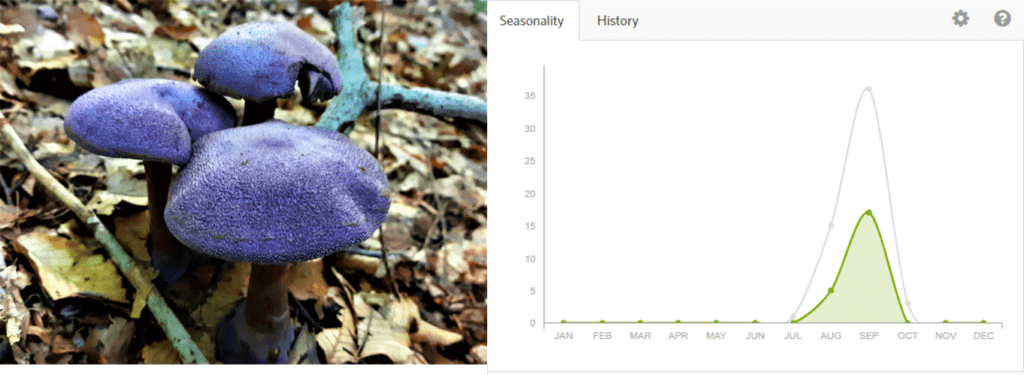
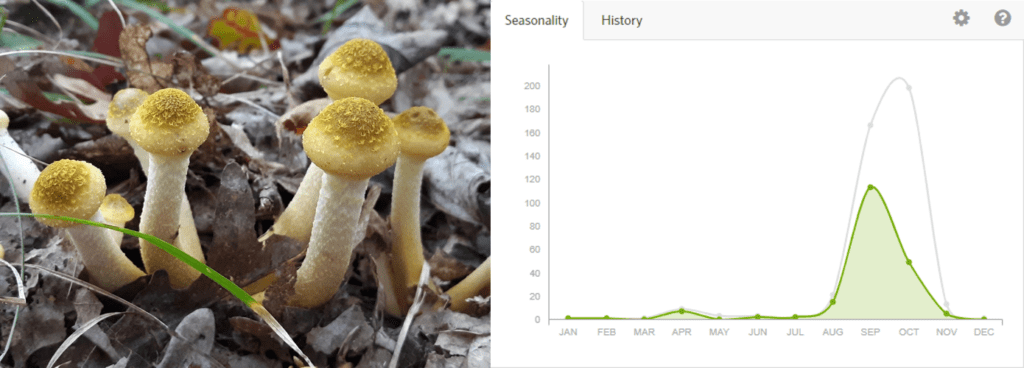
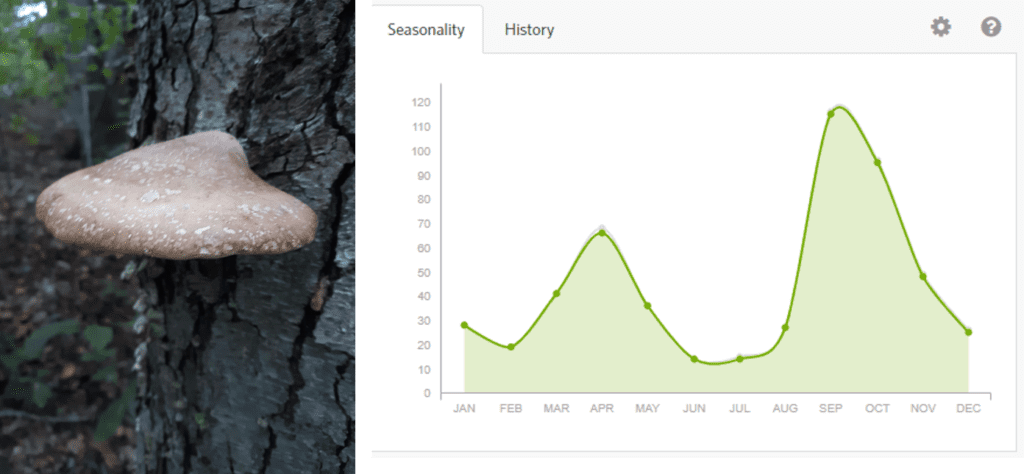
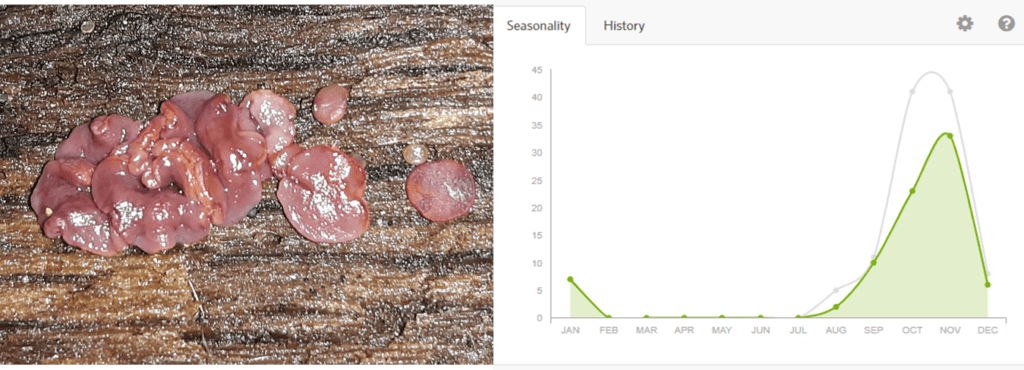
While the appearance of mushrooms can be seasonal and highly variable, searching after a good rainy period might improve your chances of finding some fantastic fungi! Listed below are a handful of species found at Powdermill, along with simple charts of their seasonal observation trends obtained from iNaturalist, a free online site and app promoting community science. Thanks to participating community members, these graphs reflect observation frequencies across seasons in the state of Pennsylvania. The green line represents research grade observations, meaning more than two-thirds of the identifiers agree on the identification. The gray line represents verifiable observations that have yet to attain research grade status. Because observations are on-going, these graphs may change as more data accumulates. 

purple jelly disk mushrooms and graph showing seasonality
Purple jellydisk (Ascocoryne sarcoides) – saprotrophic fungi that are typically found on decaying hardwoods.
violet webcap mushrooms and graph showing seasonality
Violet webcap (Cortinarius violaceus) – mycorrhizal fungi found in beech and oak forests.
honey mushrooms and graph showing seasonality
Honey mushroom (Armillaria mellea) – parasitic/saprotrophic fungi found in oak dominated forests.


birch polypore and graph showing seasonality
Birch polypore (Fomitopsis betulina) – parasitic/saprotrophic fungi commonly associated with birch trees.  

Sara Klingensmith is an Environmental Educator and Naturalist at Powdermill Nature Reserve. Museum employees are encouraged to blog about their unique experiences and knowledge gained from working at the museum.

Sources

Alday, J., Martínez de Aragón, J., de-Miguel, S. et al. Mushroom biomass and diversity are driven by different spatio-temporal scales along Mediterranean elevation gradients. Sci Rep 7, 45824 (2017). https://doi.org/10.1038/srep45824

Binion, E. Denise, et al. Macrofungi Associated With Oaks of Eastern North America, West Virginia University Press, 2008. 

Ekblad, A. et al. The production and turnover of extrametrical mycelium of ectomycorrhizal fungi in forest soils: role in carbon cycling. Plant Soil (2013) 366: 1-27. 

De la Varga, Herminia & Águeda, Beatriz & Martínez-Peña, Fernando & Parladé, Javier & Pera, Joan. Quantification of extraradical soil mycelium and ectomycorrhizas of Boletus edulis in a Scots pine forest with variable sporocarp productivity. Mycorrhiza. 22. 59-68. (2011) 10.1007/s00572-011-0382-2.

De la Varga, H., Águeda, B., Martínez-Peña, F. et al. Quantification of extraradical soil mycelium and ectomycorrhizas of Boletus edulis in a Scots pine forest with variable sporocarp productivity. Mycorrhiza 22, 59–68 (2012). https://doi.org/10.1007/s00572-011-0382-2

De la Varga, H., Águeda, B., Ágreda, T. et al. Seasonal dynamics of Boletus edulis and Lactarius deliciosus extraradical mycelium in pine forests of central Spain. Mycorrhiza 23, 391–402 (2013). https://doi.org/10.1007/s00572-013-0481-3

Štursová M, Kohout P, Human ZR, Baldrian P. Production of Fungal Mycelia in a Temperate Coniferous Forest Shows Distinct Seasonal Patterns. Journal of Fungi. 2020; 6(4):190. https://doi.org/10.3390/jof6040190

iNatualist.org

MushroomExpert.com

Lodge, D. J. et al. Terrestrial and Lignicolous Macrofungi. 2004. 10.1016/B978-012509551-8/50011-8.

Related Content

Fungi Make Minerals and Clean Polluted Water Along the Way

Photogenic Fungi

What Does Climate Change Mean for Western PA Farmers?

Carnegie Museum of Natural History Blog Citation Information

Blog author: Klingensmith, Sara
Publication date: January 21, 2022

Share this post!

  • Share on Twitter Share on Twitter
  • Share on Facebook Share on Facebook
  • Share on Pinterest Share on Pinterest
  • Share on LinkedIn Share on LinkedIn
  • Share on Reddit Share on Reddit
  • Share via Email Share via Email

Filed Under: Visitor Info Tagged With: Carnegie Museum of Natural History, Powdermill Nature Reserve, Sara Klingensmith, We Are Nature 2

December 20, 2021 by Erin Southerland

Sea Snails from Christmas Island

by Timothy A. Pearce

There really is a Christmas Island. It is in the Indian Ocean about 250 km (155 mi) SW of Java and it is administered by Australia. Christmas Island, which was uninhabited by humans until the late 1800s, has a highly endemic flora and fauna, reflecting little human disturbance. Nearly two-thirds of the island is designated as a national park. 

Carnegie Museum of Natural History has two species of sea snails from Christmas Island. Neither of these species is endemic to the island, and neither is rare.

Money Cowries from Christmas Island

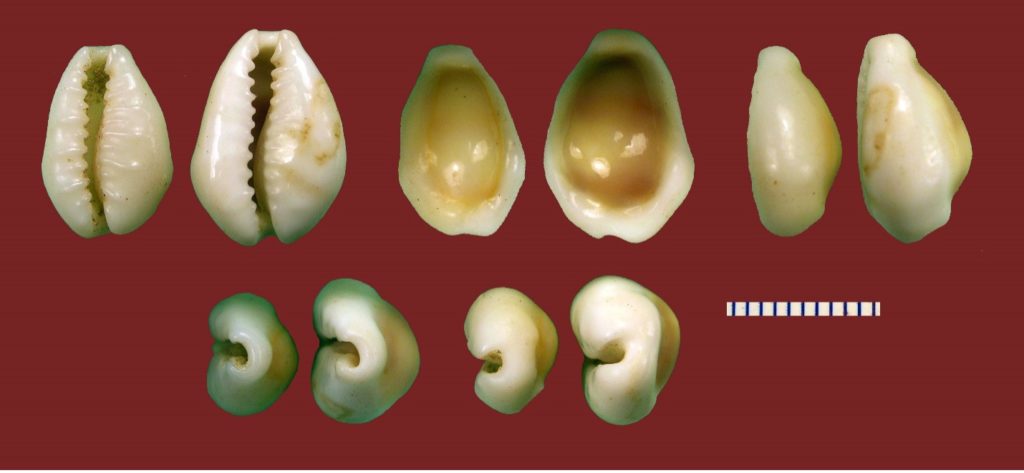
Ten Monetaria moneta snail shells from Christmas Island on a red background.
Fig. 1. Monetaria moneta, the money cowry, from Christmas Island. Views from top left: aperture, dorsal, left side, anterior, posterior. Specimen CM 123323 at Carnegie Museum of Natural History. Scale in mm. Photo by T.A. Pearce. 

These Moneteria moneta (Fig. 1), also known as money cowries, are from Christmas Island. They were donated to the museum by Casimir Potyraj, Jr. in September of 2012, although we don’t know when they were collected. These specimens are smaller than average M. monetaria. This species of cowry is used as decoration and was used as currency in many islands of the south Pacific Ocean region into the 1800s. Both the genus and the species names, Monetaria moneta, reflect their use as currency. This species occurs broadly in tropical areas of the Indian and Pacific Oceans, but not in the Atlantic. Monetaria moneta is in the cowry family, Cypraeidae, a group of snails appreciated around the world for their shiny, colorful shells, that look like they have a zipper underneath.

Castor Bean Shells from Christmas Island

Four castor bean shells from Christmas Island on a green background.
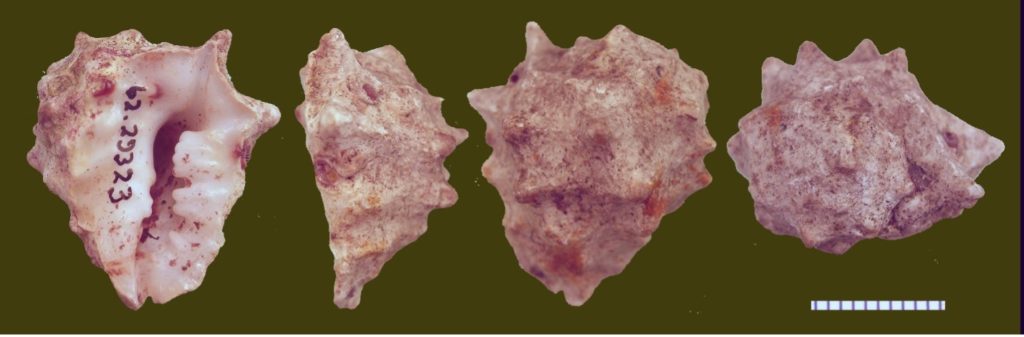
Fig. 2. Drupa ricina, the castor bean shell, from Christmas Island. Views from left: aperture, side, dorsal, spire. Specimen CM 62.29323 at Carnegie Museum of Natural History. Scale in mm. Photo by T.A. Pearce. 

This Drupa ricinus (Fig. 2), also known as the castor bean shell, is also a sea snail from Christmas Island. It came to Carnegie Museum of Natural History by way of the British Museum of Natural Science on July 25, 1935. It’s unclear whether that was the date the British Museum gave it to us, or the date it was collected; my guess is the former. Like the Monetaria moneta, Drupa ricinus also occurs broadly in tropical areas of the Indian and Pacific Oceans, but not in the Atlantic. Drupa ricinus is in the murex family, Muricidae, which includes snails that produce the purple dye prized by the Romans and Phoenicians.

Every day is Christmas on Christmas Island! We wish Merry Christmas to all the creatures there.

Timothy A. Pearce, PhD, is the head of the mollusks section at Carnegie Museum of Natural History. Museum employees are encouraged to blog about their unique experiences and knowledge gained from working at the museum.

Related Content

A Perfect Mineral for the Christmas Season

Ask a Scientist: How did snails evolve from living in water to living on land?

Collected on Christmas Eve 1883: Mistletoe

Carnegie Museum of Natural History Blog Citation Information

Blog author: Pearce, Timothy A.
Publication date: December 20, 2021

Share this post!

  • Share on Twitter Share on Twitter
  • Share on Facebook Share on Facebook
  • Share on Pinterest Share on Pinterest
  • Share on LinkedIn Share on LinkedIn
  • Share on Reddit Share on Reddit
  • Share via Email Share via Email

Filed Under: Blog Tagged With: Carnegie Museum of Natural History, mollusks, Science News, Tim Pearce

December 14, 2021 by Erin Southerland

Carnegie’s Water Fountains

by Albert D. Kollar

Potable Water Sources

Access to drinking water from a water fountain seems to be passé today with the ubiquitous availability of plastic water bottles from vending machines. In 2018, as an effort to ‘change the culture’ in the use of plastic water bottles by museum staff and patrons, the Oakland museums, Carnegie Museum of Natural History, and Carnegie Museum of Art (respectively CMNH and CMOA), installed filling stations for reusable water bottles. These eco-friendly “fountains” are located adjacent to the Fossil Fuels Cafeteria in CMNH, and in the rest room lobby of CMOA1 (Fig. 1), and their rapid and wide acceptance invites a deeper consideration of drinking water as an amenity in a public facility.  

gray and silver water fountain
Fig. 1.

The public water supply in the massive Oakland building comes from the Pittsburgh Water and Sewer Authority’s Herron Hill Reservoir, which in turn draws its supply from the Highland Park Reservoir in the city’s East End1. The water, which is initially sourced from the Allegheny River, undergoes several treatments before it is pumped to the reservoir. 

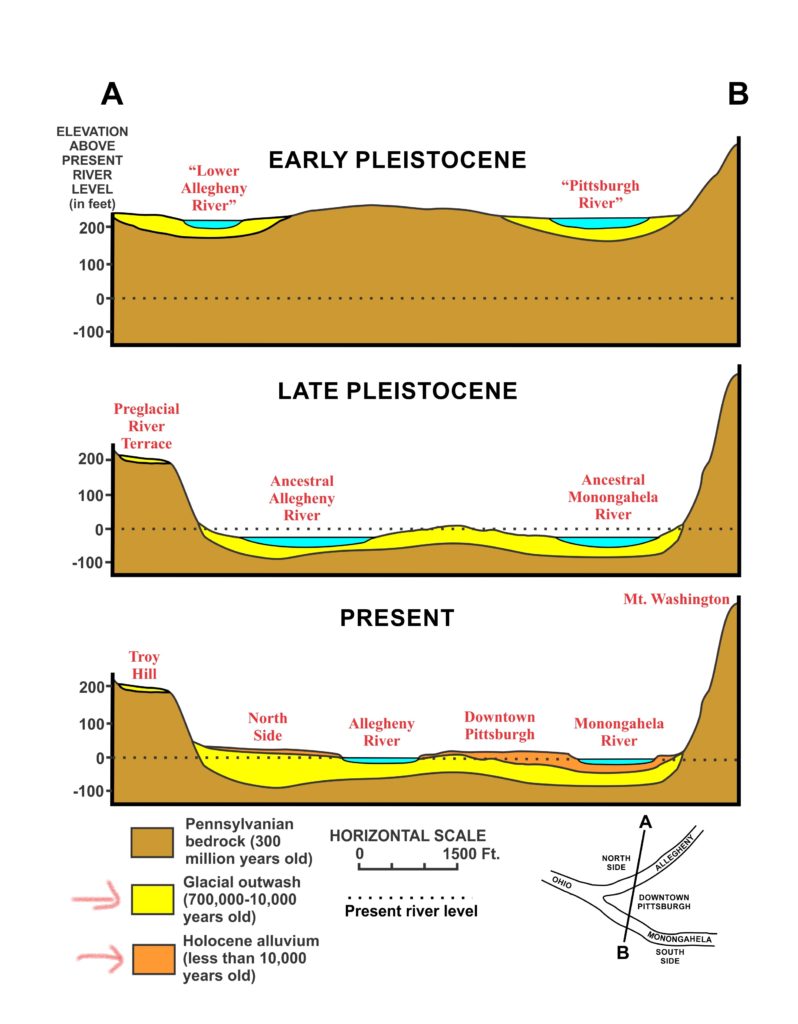
The geologic perspective on our water supply also bears mention here. The glacial melt waters of the Pleistocene Epoch filled the potable aquifers of western Pennsylvania2 (Fig. 2 red arrows). With population growth in the 20th Century, water demands for agricultural, industrial, and residential uses led to the depletion of these aquifers within the Allegheny River Basin. Today potable waters stored in reservoirs are principally drawn from the three rivers of Pittsburgh, waterways replenished to a significant degree by rain fall and snow melt.

chart looking at glacial outwash in the Allegheny River Basin in the Pleistocene and at present
Fig. 2

A myth in the minds of many Pittsburghers is the city’s Fourth River. According to a 2016 publication by John Harper2, the Fourth River does not exist as underground caves, fissures, or cavities under any of the three rivers. As shown in Fig. 2, (red arrows) glacial outwash and Holocene alluvium comprise thick deposits of sediment within the river valleys, and tiny interconnected pore spaces between sand grains and pebbles allow water from the rivers and their adjoining floodplains and riverbanks, to move slowly but freely through this sediment. At some locations this subterranean flow is accessed by artesian wells, the most prominent example being the fountain in Point State Park.  

Carnegie’s Water Fountains

Presentation is important, especially for something as vital as drinking water, and within the halls and hallways of the Carnegie building complex in Oakland, carved stone is frequently part of the refreshment package. Visitors encounter three types of water fountains. In the 1907 Carnegie Institute Extension, a Beaux-Arts masterpiece designed by architects Alden and Harlow, water fountains are plumbed through either white Carrara Marble from Italy or yellow Hauteville fossil limestone of France. In the Museum of Art wing built in 1974, thirsty patrons are served by chrome water fountains (Fig. 3). 

two chrome water fountains
Fig. 3

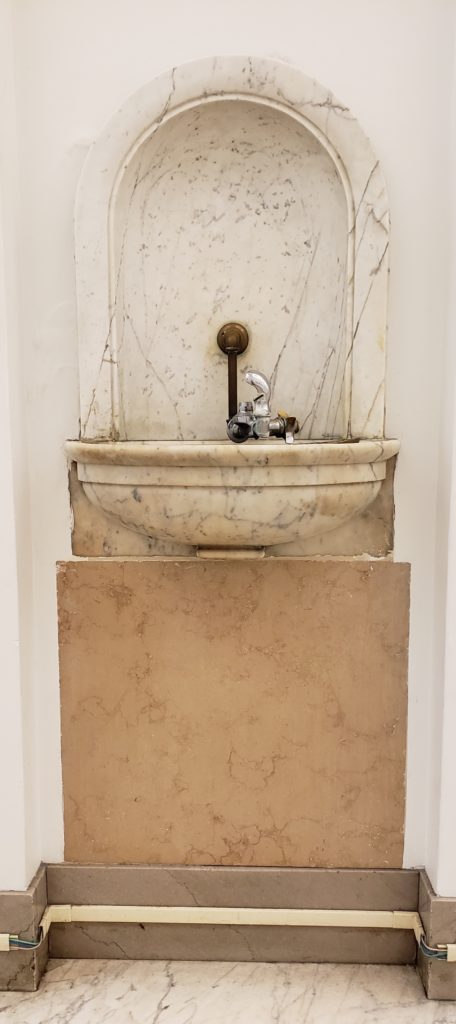
Carrara Marble was created during the Cenozoic Era when limestones formed during the Triassic or early Jurassic age limestones underwent metamorphosis.4 The locations of the eighteen Carrara Marble fountains in the 1907 building include the engine room, basement hallways, the Carnegie Library of Pittsburgh first floor lobby (Fig. 4), Carnegie Music Hall vestibule hallway, the Carnegie Lecture Hall, and exhibit halls on the second and third floors of Carnegie Museum of Natural History.3 Although the Carrara Marble fountains originally had red brass fixtures (Fig. 4), some now operate with replacement fixtures of chrome1. 

marble water fountain
Fig. 4

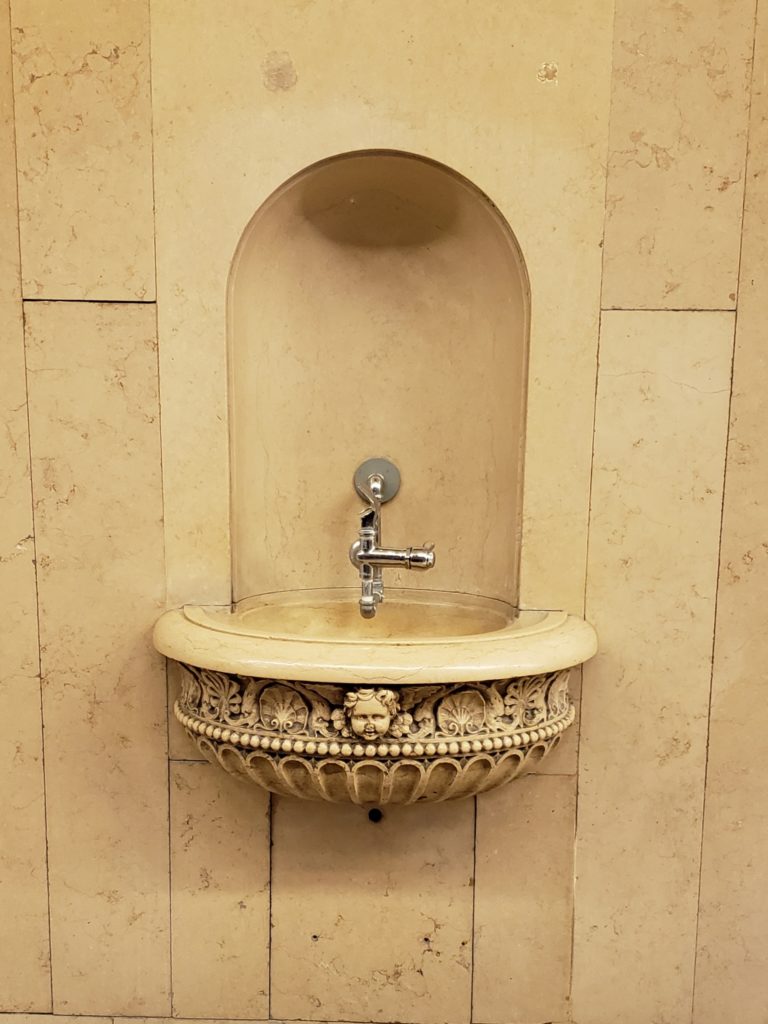
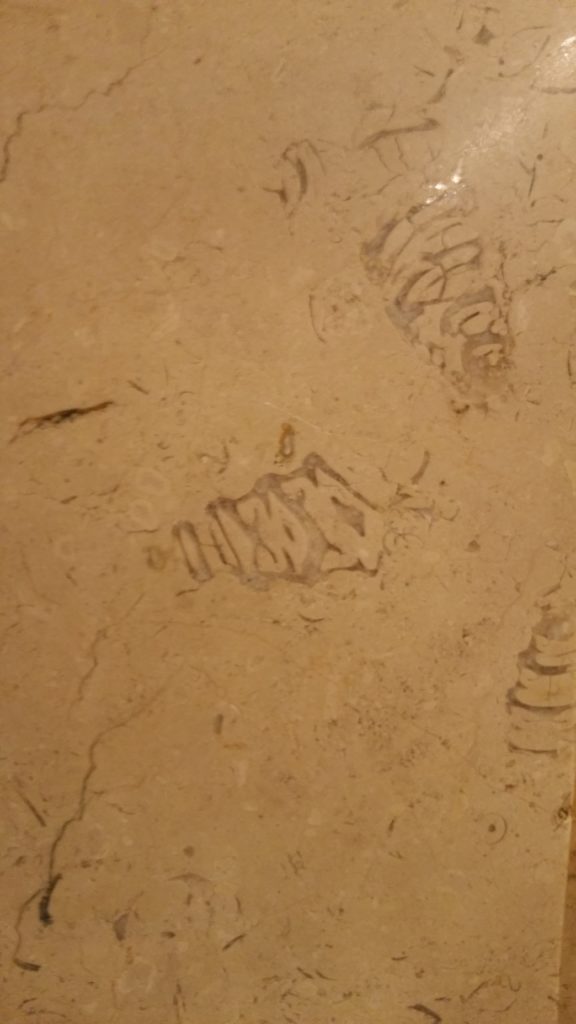
There are three Hauteville limestone fountains along the walls of the three floors in the Grand Staircase Hall. These neo-Baroque fountains feature carvings that represent a diverse group of invertebrate fossils and an allegory human face (Fig. 5). The fountains are surrounded by the Hauteville limestone wall panels with Cretaceous age snail Nerinea (Fig. 6) visible in many Hauteville floor tiles, walls, door framing, and pedestals.5 Some 350 tons of Hauteville limestone were used for the interior stone in the Grand Staircase and throughout the Carnegie Institute Extension.6 The Hauteville fountains also originally used red brass fixtures, and now function with chrome replacements.

limestone water fountain
Fig. 5
snail fossils in limestone
Fig. 6

A World-Famous Fountain In Rome And More

If there’s a place in a discussion of fountains to consider the top of the scale, an Italian reference belongs here. One of the most famous water fountains in the world is the Baroque Trevi Fountain (Nicola Salvi, Giuseppe Pannini, architects) that opened in 1762 in Rome7. The fountain had its moments in classic movies such as, Federico Fellini’s La Dolce Vita (1960) with Marcello Mastroianni and Anita Ekberg in the leads8 (Fig. 7, image by Hernán Piñera).  

Trevi Fountain
Fig. 7

Around 19 BC, aqueducts were constructed in ancient Rome to bring pure water to the city from mountains 13 km (8.1 mi) from Rome9. Roman citizens enjoyed the function of a fountain not only as a source of clean water but as a gathering place.  

The Trevi Fountain is made of travertine, a sedimentary limestone (calcium carbonate) quarried in the Italian village of Bogni di Tivoli10. The village is noted for travertine quarries that produced the exterior stone for the Roman Amphitheater opened in 80 AD11 and the building of the Getty Museum in Los Angeles, California (1997). 

Travertine forms when ground water combines with carbon dioxide in the soils to form carbonic acid waters that then dissolve subsurface limestone. As these calcium carbonate-concentrated waters flow through the cracks in the bedrock they eventually precipitate a new rock called travertine. 

An excellent example of travertine formation can be observed at Mammoth Hot Springs in Yellowstone National Park. High above the Hot Springs, rainwater seeps into the buried Cretaceous age limestone where it mixes with carbon dioxide gas that rises from a subterranean magma chamber dissolving the calcium carbonate that is carried along in the underground streams through fractures in the overlying strata. Once the water exits the bedrock, travertine terraces start to build as the carbon dioxide gas escapes, leaving behind the calcium carbonate mineral. 

Travertine in Oakland: In an abandoned sandstone quarry behind Phipps Conservancy in Schenley Park travertine deposits is preserved on the exterior of the quarry rock12.  The site is no longer open for visitors.

Albert D. Kollar is the Collection Manager for the Section of Invertebrate Paleontology. Museum employees are encouraged to blog about their unique experiences and knowledge gained from working at the museum.

References

  1. Young, T. Carnegie Museum of Pittsburgh Facilities. 
  2. Harper, J. A. 2016. The Geological Evolution of Pittsburgh’s Three River. PAlS Publication 21. 
  3. Kollar et al. 2020. Connemara Marble at the Carnegie Institute Extension. ACM, 86, 207-2
  4. Price, M. T. 2007. The Sourcebook of Decorative Stone: An Illustrated identification guide. 287 pp.
  5. Kollar, A. D. 2020. https://carnegiemnh.org/carnegie-museum-grand-staircase/
  6. Kollar, A. D. 2021 DE L’ÉCHAILLON À L’ANNEXE DU CARNEGIE INSTITUTE DE PITTSBURGH Saint-Quentin-sur-Isère, 18 Septembre 2021.
  7. Pinto, J. A. 1986. The Trevi Fountain. Yale University Press. 326 pp. 
  8. Fellini, F. 1960. La Dolce Vita. The Criterion Collection, Paramount Home Entertainment
  9. Beard, M. 2015. SPOR A History of Ancient Rome. Liveright Publishing Corporation. 606 pp.
  10. Hirt, A. M. 2010. Imperial Mines and Quarries in the Roman World Organizational Aspects 27 BC-AD 235. Oxford Press, 551 pp. 
  11. Acocella, A. 2013. Travertine, An Italian Stone. Journal ARCHITETTURA DI PIETRA.
  12. Kollar, A. D. The Geology of Oakland, in manuscript. 

Related Content

Understanding Fossil Fuels through Carnegie Museum Exhibits

A Century Ago, a Donor Walked into the Museum

The Connemara Marble: A Cross-Atlantic Connection Between Ireland and Pittsburgh

Carnegie Museum of Natural History Blog Citation Information

Blog author: Kollar, Albert D.
Publication date: December 14, 2021

Share this post!

  • Share on Twitter Share on Twitter
  • Share on Facebook Share on Facebook
  • Share on Pinterest Share on Pinterest
  • Share on LinkedIn Share on LinkedIn
  • Share on Reddit Share on Reddit
  • Share via Email Share via Email

Filed Under: Blog Tagged With: Albert Kollar, Carnegie Museum of Natural History, invertebrate paleontology, Science News

December 8, 2021 by Erin Southerland

Ruthie the Red-Nosed Reindeer: The Natural History Behind Some Classic Christmas Carols

by Shelby Wyzykowski 

We all know Dasher and Dasher and Prancer and Vixen, Comet and Cupid and Donner and Blitzen. But do you recall the most famous reindeer of all? It’s Ruthie the red-nosed reindeer of course! No, that definitely does not sound quite right, does it. There is no Ruthie in the traditional song that we all know and love. The lead reindeer that guides Santa’s sleigh on that foggy Christmas Eve should be Rudolph, a boy, not Ruthie, a girl. Or so the song says. There are several widely known Christmas carols that incorporate animals into their lyrical stories. They are songs that many people know by heart and faithfully sing year after year. But have you ever taken the time to stop and really think about the ways in which wildlife are portrayed in these melodic tales? Are these stories scientifically accurate accounts that hold true to the realities of the natural world? Or are they simply lyrical flights of holiday fancy?

The Twelve Days of Christmas

“The Twelve Days of Christmas”, first published in England in 1780, is a carol that documents a very long list of gifts that a true love gives to their sweetheart over a period of twelve days. By the end of the ballad, the lucky giftee receives 184 birds, more than enough to open their own aviary. The large, feathered flock of six different avian species includes a partridge in a pear tree (twelve times over).

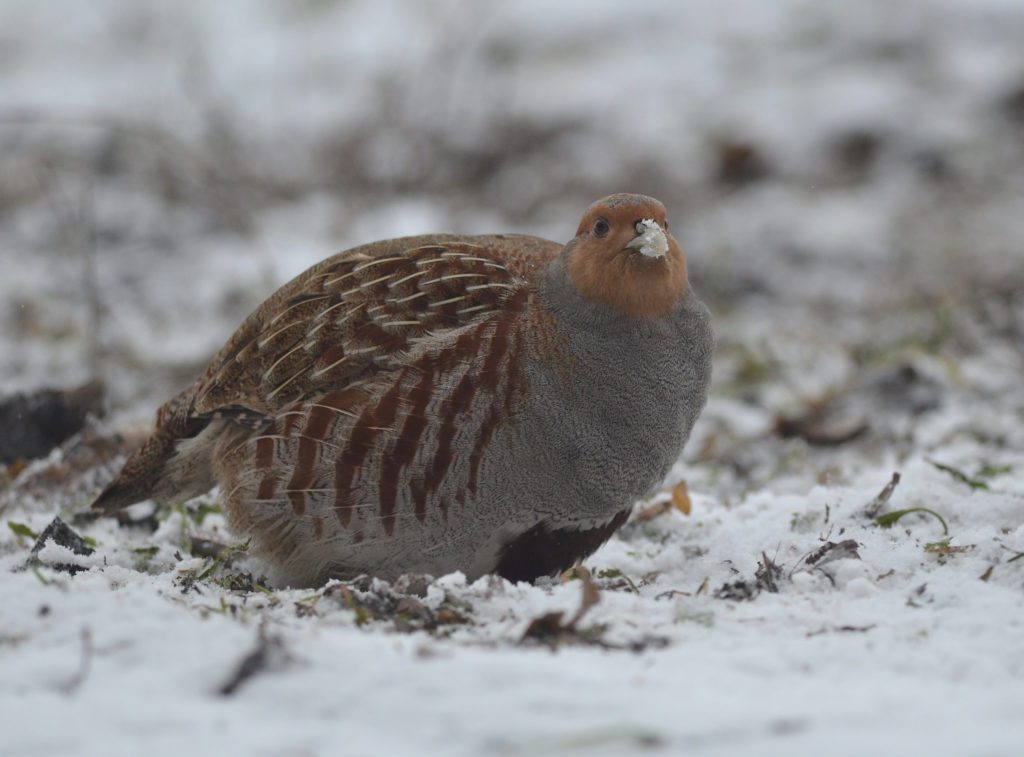
gray partridge on snowy ground
Gray Partridge. Image by Ekaterina Chernetsova (Papchinskaya) via Flickr.

A partridge in a pear tree would not be the most ideal gift since, not only would gift wrapping be a challenge, but it might not be possible to find such a gift. Do partridges even roost in pear trees? Though the iconic image of a treed fowl paints a pretty yuletide picture, it is not a natural occurrence in the real world. In North America, two species of partridge introduced as game birds have well-established populations. The Gray Partridge (Perdix perdix), a native of Europe, can be found in northern prairies, where it roosts and forages mostly on the ground, at the bases of shrubs, and, during winter, on the snow. The Chukar Partridge (Alectoris chukar), a native of Eurasia, inhabits the arid American West, where it roosts beneath sagebrush, under juniper trees, in rock outcrops, or in open rocky areas. Not only do both species build their nests exclusively on the ground, they are also both primarily seed-eaters (but they do enjoy the occasional leaf or insect). So, pears as a food source are of no real interest to either type of partridge.  

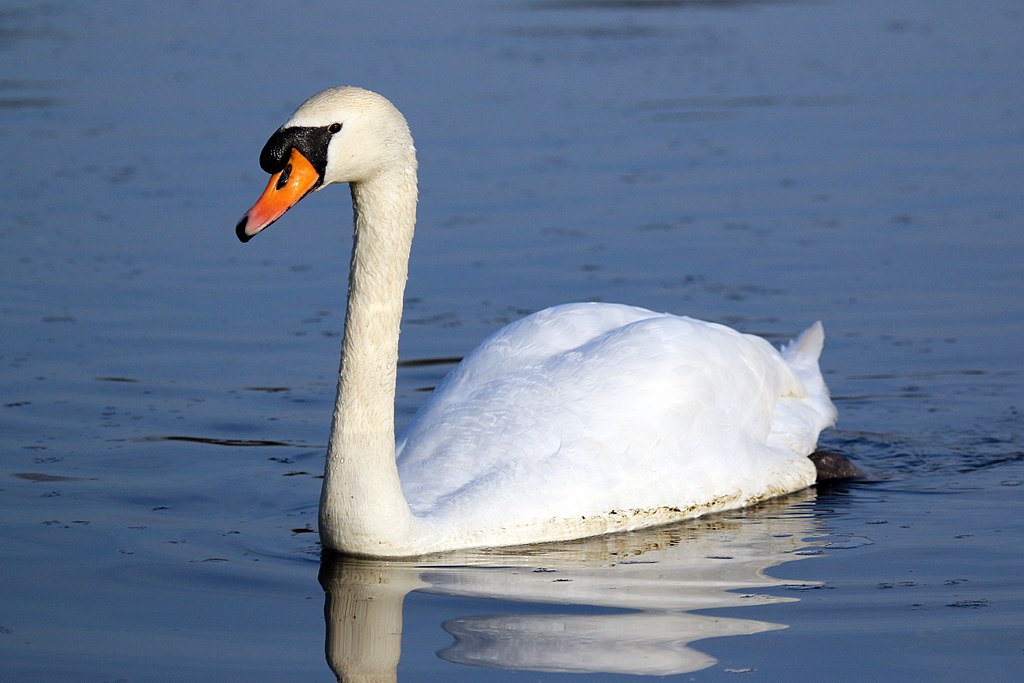
swan on the water
Mute Swan. Image by Charles J. Sharp, CC BY-SA 3.0, via Wikimedia Commons.

Among the many other birds this carol features are the “swans a-swimming”. If your beloved happens to be an avian enthusiast, the Mute Swan just could be the most fitting of gifts on the seventh day of Christmas. These birds have traditionally been associated with romance because of their graceful swimming and their long and beautifully curved S-shaped necks. They also mate for life, and paired couples tend to charmingly swim side by side. Native to Europe and parts of Asia, Mute Swans were brought to the United States as pond ornaments for private estates and have since gained a foothold in this country. Mute Swans, being very territorial, usually do not migrate and may be present at the same location all year round. They are very content living in icy cold weather if there is an abundant supply of food at hand. But can they swim in the blustery, inhospitable conditions of December, as this song claims? Surprisingly, the answer is yes. You would imagine that swimming in frigid waters would unmercifully freeze the feet of waterfowl, but swans and other waterfowl avoid this frosty fate by utilizing an intricate heat-exchange system called counter-current circulation. Through an intertwining of arteries and veins, the circulation system in the legs of these birds functions as a natural radiator. When arterial blood moving from the body to the feet passes alongside the venous blood returning from the feet to the body, heat is transferred from the warm arteries to the cool veins. This process keep’s the swan’s body at the right temperature while the extremities are still just warm enough to avoid tissue damage. There’s no doubt that if humans were gifted with this same circulatory trick, many a day of snow shoveling, and car cleaning would be made much more bearable!

Walking in a Winter Wonderland

One of the time-honored favorites of the season is “Walking in a Winter Wonderland,” the 1934 classic song about a couple’s romance during the holiday season. Though a snowman plays a prominent part in this tune, two types of bird are also mentioned.

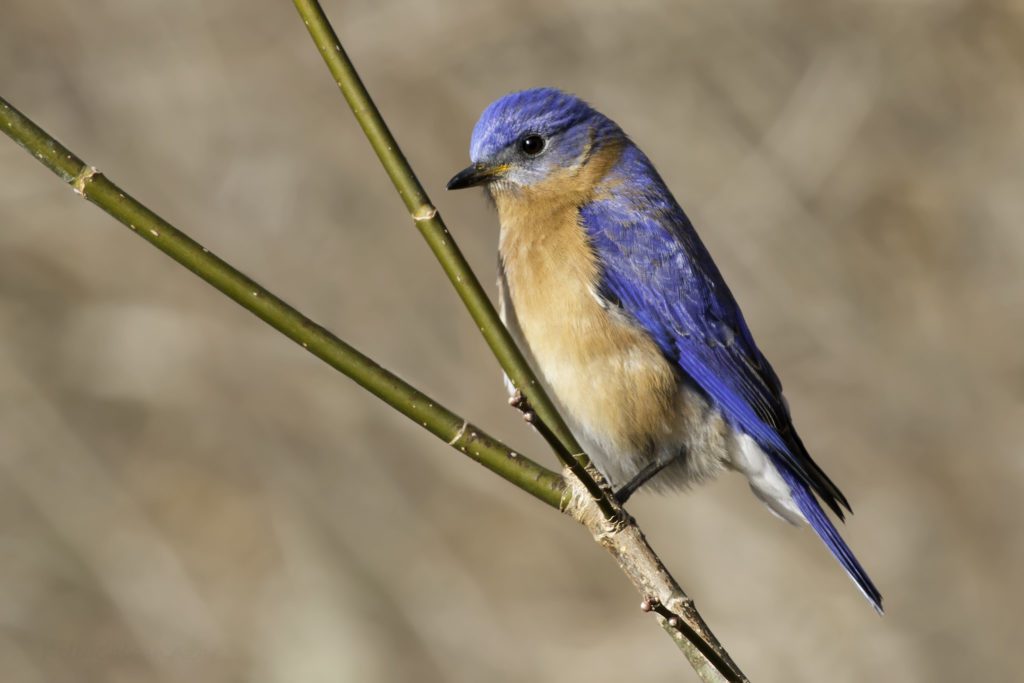
bluebird on a branch
Eastern Bluebird. Image by Kelly Colgan Azar via Flickr.

The first is introduced into the musical story with the line “gone away is the bluebird.” This bluebird might symbolize the sadness that comes with being parted from a loved one. Or could it just literally mean that the songbird has left the wintry weather for warmer climes? Feathered with eye-catching plumage of bright azure and rust, the Eastern Bluebird (Sialia sialis) is found in many parts of our country during much of the year. However, as winter approaches, much of the population migrates to the southern U.S., with some members of the species flying as far south as Central America. Though they are occasionally seen in wintry weather, most do not return north again until February or March. So, if your own personal Winter Wonderland happens to be somewhere in the northern United States, the lyrics “gone away is the bluebird” are fairly accurate.

But what about the mysterious “new bird” that’s “here to stay” and sings a love song as the happy couple goes along? Some song aficionados suppose that the “new bird” represents the elation that two people share when starting their new life together. Others suggest that the unnamed bird is actually the stork, ready and waiting to eventually deliver a little bundle of joy. But storks cannot sing, can they? Well, no, not really. The Wood Stork is the only stork native to North America. It is a very large, heavy-billed bird that wades in the shallows of southern swamps, marshes, ponds, and lagoons. Adult storks are mostly silent except for the occasional hissing. They also can be heard bill clappering, which is when they make a loud, clattering sound by quickly opening and snapping shut their bills. But young storks do have a musical repertoire of sorts. Within stork breeding colonies, which are usually located in stands of tall cypress, nestlings will make a noisy ruckus as they beg for food. Their loud calls sound a bit nasally, kind of like a braying donkey. If the wood stork is in fact the “new bird”, his attempt at singing a love song would not be considered particularly romantic by many, unless you happen to be a lovesick donkey in search of a mate (as a side note, both male and female donkeys use bray vocalization during courtship).

Rudolph the Red-Nosed Reindeer

Image by Darkmoon_Art via Pixabay.

Now let’s get back to the catchy 1949 jingle about the gutsy hooved hero whose red nose saved Christmas. The surprising truth about “Rudolph the Red-Nosed Reindeer” is that these animals can actually have red noses! Reindeer have densely packed arrays of capillaries in their noses, which can sometimes cause them to appear pink. An excess flow of blood to their nose warms the air that they breathe in and can also help regulate their body temperature under extreme environmental conditions. To avoid overheating while running (or, in Rudolph’s case, flying) for long periods of time, large volumes of blood are brought to the nose where the excess heat can radiate out into the air. 

Also, according to the song, male reindeers at the North Pole sport their antlers well into the darkest days of winter. But outside the boundaries of Santa’s domain, males begin to shed their antlers in late autumn after the fighting of rutting season has ended. Females retain their antlers well into the spring when their calves are born. Access to food is critical during their winter pregnancy, so they must use their antlers to defend patches of vegetation in small areas of cleared snow. Also, during the colder months, females are in better physical condition than males because they have much larger stores of energy. Females enter winter with about fifty percent body fat, whereas the fat percentage of males can dip as low as five percent. So, although there don’t seem to be any females helping to pull Santa’s heavy, gift-laden sleigh, rest assured that these ladies would be more than capable of taking on the task!

Natural History of Christmas Songs

So now we know the true story behind some of our favorite Christmas ditties. Storks don’t sing sweet songs of love. And you’ll never see a partridge anywhere near a pear tree, not at Christmas or at any other time of the year. Yet despite the scientific inaccuracies of these traditional holiday songs, we still unconditionally adore them for what they represent…the joyous and hopeful spirit of the season. But what about Rudolph? If the reindeer rules of winter favor females, how can we account for our red-nosed friend and all of the other males that make up Santa’s team? Well, perhaps we can attribute it to a little bit of Christmas magic at work. Maybe some seasonal miracle allows these reindeer to hang on to their antlers for just long enough so that they can take part in that worldwide flight on the big night. We can only guess, since it seems to be a closely guarded secret between Santa and his crew. They’re the only ones that know the whole story. But that’s okay, because, during the holiday season, do we always need to know why things happen the way that they happen? Probably not. Sometimes, it’s perfectly fine just to wonder and imagine and not know all the answers. 

Because, sometimes, just believing is enough.

Shelby Wyzykowski is a Gallery Experience Presenter in CMNH’s Life Long Learning Department. Museum staff, volunteers, and interns are encouraged to blog about their unique experiences and knowledge gained from working at the museum.

Related Content

Fraser Fir

The Feast of the Seven Fishes

Are Santa’s Reindeer Real Mammals?

Carnegie Museum of Natural History Blog Citation Information

Blog author: Wyzykowski, Shelby
Publication date: December 13, 2021

Share this post!

  • Share on Twitter Share on Twitter
  • Share on Facebook Share on Facebook
  • Share on Pinterest Share on Pinterest
  • Share on LinkedIn Share on LinkedIn
  • Share on Reddit Share on Reddit
  • Share via Email Share via Email

Filed Under: Blog Tagged With: Carnegie Museum of Natural History, HATW, Shelby Wyzykowski, Super Science

  • « Go to Previous Page
  • Page 1
  • Page 2

sidebar

About

  • Mission & Commitments
  • Directors Team
  • Museum History

Get Involved

  • Volunteer
  • Membership
  • Carnegie Discoverers
  • Donate
  • Employment
  • Events

Bring a Group

  • Groups of 10 or More
  • Birthday Parties at the Museum
  • Field Trips

Powdermill

  • Powdermill Nature Reserve
  • Powdermill Field Trips
  • Powdermill Staff
  • Research at Powdermill

More Information

  • Image Permission Requests
  • Science Stories
  • Accessibility
  • Shopping Cart
  • Contact
  • Visitor Policies
One of the Four Carnegie Museums | © Carnegie Institute | Privacy Policy | Terms of Use | Accessibility
Rad works here logo