• Skip to primary navigation
  • Skip to main content
  • Skip to primary sidebar

Carnegie Museum of Natural History

One of the Four Carnegie Museums of Pittsburgh

  • Visit
    • Buy Tickets
    • Visitor Information
    • Exhibitions
    • Events
    • Dining at the Museum
    • Celebrate at the Museum
    • Powdermill Nature Reserve
    • Event Venue Rental
  • Learn
    • Field Trips
    • Educator Information
    • Programs at the Museum
    • Bring the Museum to You
    • Guided Programs FAQ
    • Programs Online
    • Climate and Rural Systems Partnership
  • Research
    • Scientific Sections
    • Science Stories
    • Science Videos
    • Senior Science & Research Staff
    • Museum Library
    • Science Seminars
    • Scientific Publications
    • Specimen and Artifact Identification
  • About
    • Mission & Commitments
    • Directors Team
    • Museum History
  • Tickets
  • Give
  • Shop

herpetology

July 14, 2020 by wpengine

Meet Amanda Martin, New Post-Doctoral Researcher in the Section of Amphibians and Reptiles

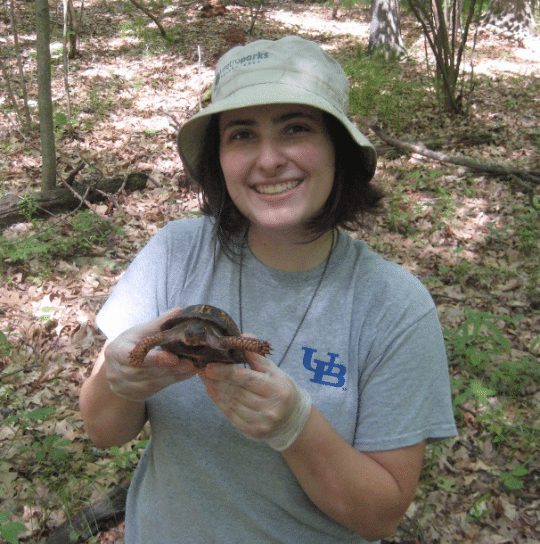
photo of woman holding a turtle

Hello everyone, my name is Amanda Martin and I’m a new post-doctoral researcher in the Amphibians and Reptiles section. I received both my Ph.D. and M.S. in Biological Sciences from Bowling Green State University, and my B.S. in Psychology and Interdisciplinary Studies from the State University of New York at Buffalo.

My herpetological career all started after watching Anaconda, the movie, when I was about six years old. I did not like the depiction of this wonderful creature, and since then I have been passionate about conserving and reducing other’s fear of snakes. During graduate school, I discovered that I really enjoy other amphibians and reptiles, especially the abundant red-backed salamanders which I found under logs almost every day during my research surveys. Even though I love studying snakes, I spent most of my time working with eastern box turtles using radio telemetry. One of my favorite aspects of working with these turtles is that they are easy to catch! I did, however, have some ninja turtles that liked to hide from my volunteer research assistants. Finding amphibians and reptiles can be quite challenging. I love this kind of treasure hunt because it is incredibly rewarding when you do find them!

Check out my website for more information about my previous research at: https://amandkm.wixsite.com/martin

Conservation in Action: Exploration of Changes in Land Cover over Time

In northwestern Ohio and southeastern Michigan lies a dynamic and diverse landscape, the Oak Openings Region which has been the focus of large ongoing conservation by the Green Ribbon Initiative. Over ten years ago, a land cover map was created to facilitate the enhancement and restoration of critical natural areas. Since then, local conservation partners have been changing the landscape to increase the area of natural habitats, such as upland prairie and savanna. But to see whether these efforts worked or not, they needed a new map to see these changes on the landscape. We, Martin and Root 2020, worked together with our local partners to build an updated map for region and explored these changes in land cover over a 10-year period.

We used satellite imagery and trained our model with confirmed ground sites for 14 different land cover types, including five communities of concern (swamp forest, floodplain forest, deciduous forest, upland savanna/prairie, and wet prairie). We then examined change over time by comparing total area or number of patches per land cover between the 2016 map and the 2006 map. We found that natural land covered 33% and human-modified land covered 67% of the total region. Over 10 years, natural classes increased, and cultural classes decreased in total area by 5.8%, although not all types of natural habitat increased (e.g., forest habitat decreased) and much of the natural habitat was found in small isolated pieces rather than large blocks of similar habitat. Many of these changes are likely a result of natural recovery and disturbance, and conservation efforts by the Green Ribbon Initiative. This large-scale view for conservation is needed to create conservation initiatives for different species and their natural habitats and illustrates the challenges that land managers face in restoring natural lands as humans continue to modify their surroundings.

Scientists use these types of land cover maps to better understand the interaction between species and their habitats. One aspect of this interaction is the creation of habitat suitability models, where you identify potential new habitat locations for species using occurrence data (where you find an individual) and environmental layers (land cover, elevation, distance to streams or roads, etc.). We did this for 15 target species focused on the 5 major communities of concern for Oak Openings Region using this land cover map. As Dr. Martin starts her new work with Dr. Sheridan in the amphibian and reptile section, they will be exploring this type of research utilizing the museum’s vast collection!

Link to article: https://doi.org/10.1007/s00267-020-01316-2

Journal: Environmental Management

Title: Examining Land Use Changes to Evaluate the Effects of Land Management in a Complex, Dynamic Landscape

Abstract: Anthropogenic alterations to landscapes have increased as the human population continues to rise, leading to detrimental changes in natural habitats. Ecological restoration assists in recovery by altering habitats to improve conditions and foster biodiversity. We examined land cover changes over time within a complex, dynamic region in the Midwest to assess the long-term effects of conservation. We used Landsat 8 bands for a 15-class land cover map of Oak Openings Region using supervised classification. We validated our map and achieved an overall accuracy of 71.2% from correctly classified points out of total visited points. Change over 10 years, from 2006 to 2016, was explored by comparing class statistics from FRAGSTATS between our map and original land cover map. We found that natural land, i.e., forest and early successional, covered 33%, with 10% permanently protected, while human-modified land, i.e., agricultural and developed, covered 67% of the region. Over 10 years, natural classes increased, and cultural classes decreased by 5.8%. There were decreases for the three forest communities and increases for the two early successional communities. These changes are likely the result of natural recovery and disturbance, and conservation efforts by the Green Ribbon Initiative. Changes in habitat also came with distribution changes, e.g., increased fragmentation for some classes, which was readily visible. Our useful method measured functionality by emphasizing changes in composition and configuration. Our approach provides a tool for assessing cumulative regional-scale effects from site-level management and conservation. This large-scale view for conservation is needed to effectively mitigate future changes.
Filed Under: Blog Tagged With: Amanda Martin, herpetology, Science News

July 14, 2020 by wpengine

How to catch 311 amphibians in 10 days

Step 1: Deploy pitfall traps across Powdermill Nature Reserve

Step 2: Get out of the way and let nature do the rest

Over the course of 10 days in June of this year, I captured 311 amphibians of 12 different species. Every day, rain or shine, I spent over four hours checking 132 pitfall traps and several more hours identifying, measuring, and weighing the day’s amphibian haul. I did a rinse and repeat of this cycle for 10 days straight. Why would anyone do all of this for what Carl Linnaeus, the father of modern taxonomy, once described as “vile animals” with “a foul odor” (Wahlgren, 2011)? Although this sentiment might still ring true for some people today, I did this because amphibians are in serious trouble—more than 30% of species are facing extinction. The threats to amphibians range from habitat losses to disease epidemics, but these are merely symptoms of the underlying cause: unnatural changes brought about by the Anthropocene. Human-induced alterations to nature are irrevocably modifying biodiversity so rapidly that species we learned about in grade school are now extinct and, if we view amphibians as sentinel organisms, then the worst is yet to come.

The Powdermill Nature Reserve is a protected site in Pennsylvania’s Allegheny Mountains where, since 1956—the year it was established by a forward-thinking herpetologist— the property has functioned in a similar way as forests did before human settlement swept across the region. In the early 1980s, scientists at the Carnegie Museum of Natural History studied the amphibian community at the Powdermill Nature Reserve and, serendipitously, established the empirical baseline necessary to study how environmental changes have affected amphibian biodiversity in the Alleghenies (Meshaka, 2009).

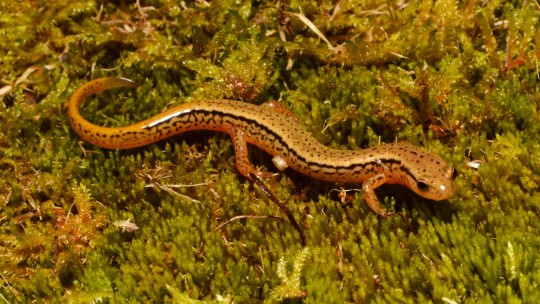
close up photo fo orange salamander with black stripes

Examining the results of amphibian trapping during two long ago Junes offers insight into the reserve’s value. In June 1982, 78 traps captured 262 amphibians of 11 species. In June 1983, 54 traps captured 174 amphibians of 11 species. While the species richness has not changed much since the 1980s, there has been species turnover and shifts in abundance, with some species becoming more common in the community. The Two-lined Salamander (Eurycea bislineata), for example, went from 0 captures in June of 1982 and 1983 to 7 captures this June. In terms of standardized trap nights in June (i.e., the number of traps multiplied the number of days opened), a combined rate of 0.11 amphibians per trap was detected across the two years in the 1980s, compared to a rate of 0.24 amphibians per trap this year. What could the ecological scenario be that has led to such an apparent increase in the amphibian capture rate over this 40-year period? Could trophic cascades be involved? Perhaps the protection of habitats in 1956 helped forest regeneration, and this change led to improved stream health and greater water retention later into the season via increased canopy cover. By providing better habitat and more resources for the streamside invertebrates that makeup the main prey base of forest-dwelling amphibians, such a transformed system might benefit amphibian communities indirectly. It’s also possible that some entirely different mechanism produced this result.

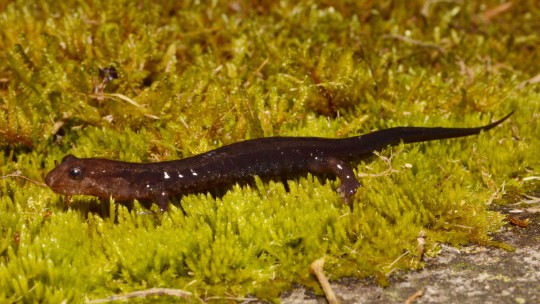
photo of Allegheny Dusky Salamander

The species that dominated captures historically and today was the Allegheny Dusky Salamander (Desmognathus ochrophaeus), which went from 0.048 individuals per trap in June from the 1980s to a slightly increased rate this June of 0.052 individuals per trap. Interestingly, the average body size of female Allegheny Dusky Salamanders has not changed over the 40-year study period, suggesting stability in morphology despite other studies reporting salamander species either shrinking (Caruso et al., 2014) or growing (McCarthy et al., 2017) in response to warmer temperatures brought about by recent climate change. Without the founding of the Powdermill Nature Reserve and the herculean efforts of historical and modern scientists from the Carnegie Museum of Natural History, we would not be able to understand the extent that humans have impacted biodiversity, let alone the data needed to solve mysteries of the modern world.

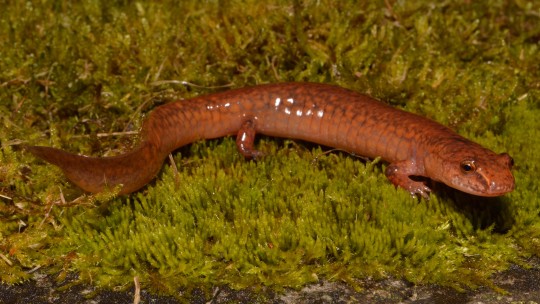
photo of spring salamander
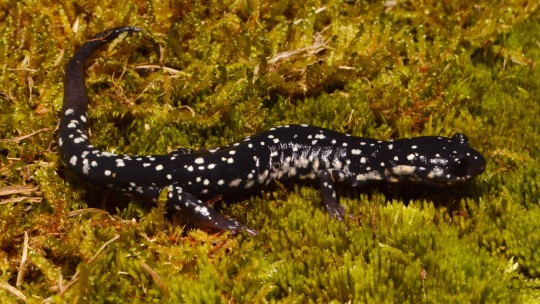
photo of black salamander with white spots
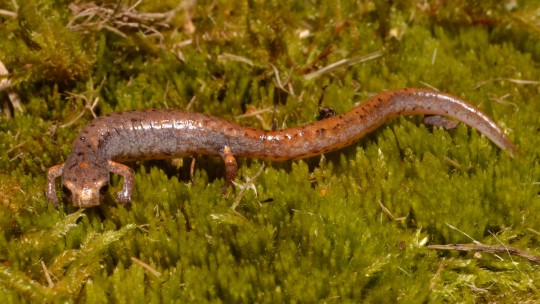
photo of four-toed salamander

So, when I look at a Spring Salamander (Gyrinophilus porphyriticus) or a Slimy Salamander (Plethodon glutinosis) or a Four-toed Salamander (Hemidactylus scutatum) from the Powdermill Nature Reserve, I don’t see Linnaeus’s “terrible animal” with a “ghastly color”, rather, I see profound resiliency in the face of tremendous pressure, and the power that natural history collections and protected areas hold for improving our relationship with biodiversity.

Daniel F. Hughes is the Rea Post-doctoral Fellow in the Herpetology Section at Carnegie Museum of Natural History. Museum employees are encouraged to blog about their unique experiences and knowledge gained from working at the museum.

References:

Caruso, N.M., Sears, M.W., Adams, D.C. and Lips, K.R., 2014. Widespread rapid reductions in body size of adult salamanders in response to climate change. Global Change Biology, 20: 1751–1759.

Meshaka, Jr., W.E., 2009. The terrestrial ecology of an Allegheny amphibian community: Implications for land management. The Maryland Naturalist, 50: 30–56.

McCarthy, T., Masson, P., Thieme, A., Leimgruber, P. and Gratwicke, B., 2017. The relationship between climate and adult body size in redback salamanders (Plethodon cinereus). Geo: Geography and Environment, 4: e00031.

Wahlgren, R., 2011. Carl Linnaeus and the Amphibia. Bibliotheca Herpetologica, 9: 5–37.

Related Content

What is an Amphibian Party?

The Search for the Near Threatened Green Salamander, Aneides Aeneus

What’s in the Rivers?

Filed Under: Blog Tagged With: Daniel Hughes, herpetology, Museum from Home, Powdermill, Powdermill Nature Reserve, Science News

June 18, 2020 by wpengine

Eastern Garter Snake Encounter

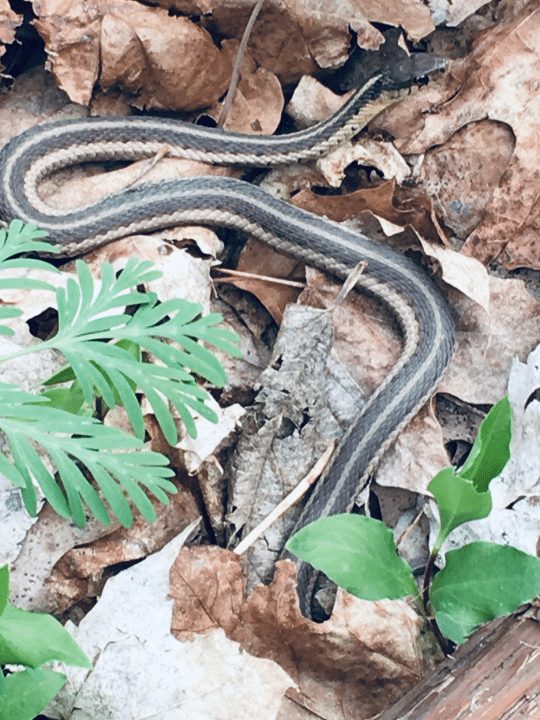
photo of garter snake in leaves

The eastern garter snake never moved. I only noticed the harmless reptile because my hands were within inches of its sleek body as I crouched to photograph a large-flowered trillium. The image above is a result of an abrupt subject change, but rushing wasn’t necessary. I was later able to photograph the intended wildflower without disturbing its striped neighbor.

After perhaps 90 seconds of sharing space with the snake, I backed carefully away from the blooming patch of forest understory within the Allegheny Land Trust’s Barking Slopes Natural Area. Later that day, in the pages of a trusted reference book, I found an explanation for what seemed an unusually passive predator.

Amphibians and Reptiles of Pennsylvania and the Northeast, is a Cornell University Press publication from 2001 by three authors with deep ties to CMNH, Arthur C. Hulse, long a Research Associate for the Museum’s Section of Herpetology, the late C. J. McCoy, a curator within the Section between 1964 and 1993, and Ellen J. Censky, a curator within the Section between 1994 and 1998.

The 5 pages of the 400-page volume devoted to garter snakes includes a description of the snake’s wide range of reactions to close encounters with our species.

“At one extreme, some remain fairly quiescent and allow themselves to be picked up and will not attempt any defensive behavior. At the other extreme, individuals flatten the head and body, flare the lips to expose teeth, and strike violently.”

The authors cite research indicating that young garter snakes are more aggressive after eating a large meal, a behavior that might occur because recently ingested food reduces their mobility, and therefore their chances for successful escape.

By this line of reasoning, the docile creature I encountered might simply have been hungry.

Patrick McShea works in the Education and Visitor Experience department of Carnegie Museum of Natural History. Museum employees are encouraged to blog about their unique experiences and knowledge gained from working at the museum.

Related Content

Northern Ribbon Snake

Lost and Found

Flying Snakes? Unique Reptile Adaptations

Filed Under: Blog Tagged With: Education, Educators, herpetology, Museum from Home, Pat McShea, Patrick McShea

March 27, 2020 by wpengine

Lantern Slides

As someone who was born in 1998, I grew up in a world full of LED screens. With the click of a button, screens come to life and display anything and everything. The black mirror suddenly stops reflecting your anticipating face and a myriad of icons and a colorful image burn themselves into your retinas. I couldn’t imagine another way of consuming images. I’ve perused old photo albums with glossy, physical photos as a fun trip down memory lane with my parents, but digital images displayed on our computer desktop or our television screen was my first remembered experience of imagery. Holding a camera, clicking a button, and having the image still and lit up on the camera screen. How else could it be?

I’ve worked in the Carnegie Museum of Natural History for 3 years now in the Herpetology department, and it never ceases to amaze me. I’ve been fascinated by the beautiful specimens from all corners of the world, some of which can’t be found in nature anymore. Our Alcohol House is home to many preserved frogs, salamanders, snakes, and turtles that I have worked closely with and appreciated for their features and patterns. Seeing these creatures that I would have to travel across the world to see in real life is a treat every time I go to the museum.

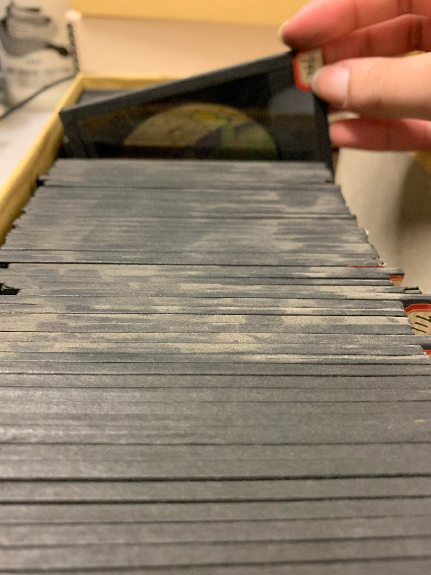
I recently moved from working on our physical preserved specimens to start a project of cataloging lantern slides that were used for presentations in the 1920s. We pulled out the boxes labeled Lantern Slides with numbers from 1- 1000. I opened it up, imagining vintage, unedited photographs with bright colors on glass. And instead it was filled with hundreds of dusty, sooty (Pittsburgh’s classic problem) rectangle slides stacked up in an unassuming row. I gingerly picked one up to see if I could see the image, and I could see a dull outline of a frog, nothing special, and less colorful and detailed than the preserved frogs I had seen from all corners of the world in the Alcohol House or the beautiful National Geographic photos I have seen online. Just a piece of dark glass with an outline of a frog. This…was going to be boring.

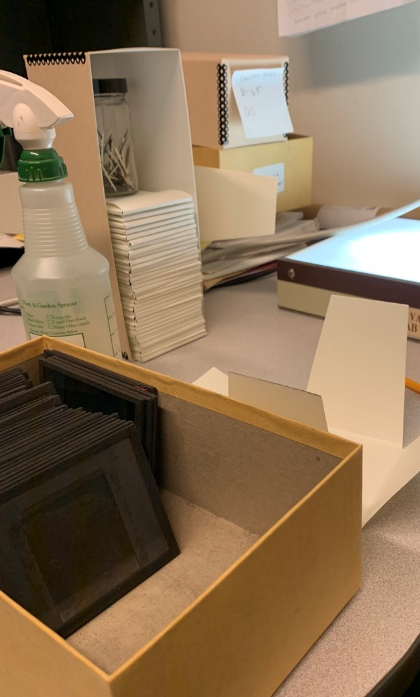
I sat down for my first day of going through the slides and set up my station for cleaning and recording the information on the slides. I saw that a new gadget had been added to my repertoire of conservation tools, a light box. I plugged it in and pressed the button–nothing. Sighing, I did the archaic press-and-hold, and the light slowly flickered on, creating a large rectangle of plain, white light. Buttons were meant to immediately turn something on and show me images, and this silly box not only required a press-and-hold but just showed me light! Dejectedly, I picked up the first lantern slide, number one, and looked at the dark image with the outline of a frog. I wiped off the black soot, and began to record the information, slide 1, photograph, frog… I wrapped it up to make sure that the glass and image wouldn’t get damaged and placed it into a new box. 999 more to go.

I went to pick up the next slide, when my eyes fell on the light box, which was currently acting as a glorified lamp. Should I make this task even more grueling by adding the extra step of placing the boring image on the boring light or should I just work through all of them as fast as possible and go back to handling our amazing specimens? I decided to take the extra step of placing the slide on the light box.

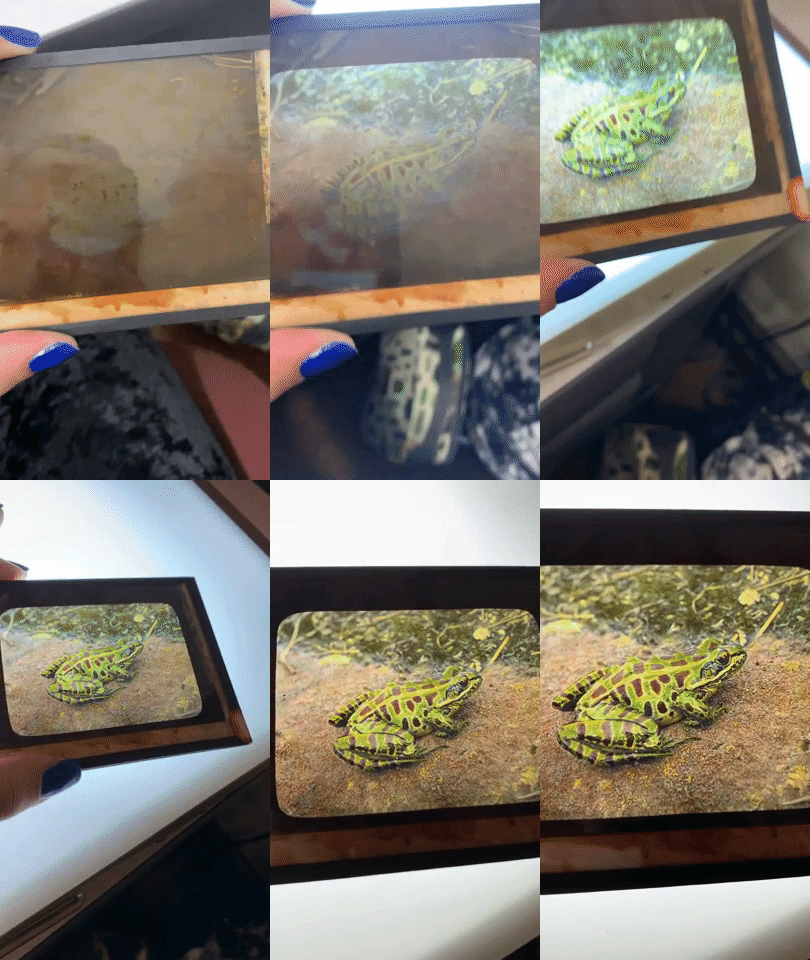
And suddenly, the image came to life.

The vague green with some dark splotches that was dull on the slide became the vibrant color I had imagined, and the details of the frog’s pattern were crisp and clear. The image had an almost 3D, life-like quality that the screen does not have the depth to convey. I was shocked that these dust covered glass rectangles were holding such secrets within them, and that all it took was placing them on a light box to unveil their beauty. Without immediate gratification, I had made up my mind that these images weren’t beautiful, when all I had to do was take a few extra steps to discover images unlike those that I had seen on screens. I proceeded to take the image off and watch it revert back to dull and lifeless, and place it back on to the light box and watch it come to life, and marvel at how these little glass slides went from boring to fascinating in a second.

Lantern slides felt like they were of the past, a time where image projecting and quality must have been worse—right? By working with these old, dusty slides, I was able to see images of reptiles and amphibians the likes of which I hadn’t seen before. I now relish every opportunity I have to go into the museum and look at salamanders, snakes, alligators, and a whole host of other creatures (and researchers) on the light box. The Carnegie Museum of Natural History is rich with resources from the past and working with the Herpetology Department has given me the opportunity to get an inside look into how the museum might have operated far before even my grandparents were born. Getting involved in helping out at the museum is a wonderful way to get involved in outreach, science communication, and is an overall enriching experience!

Swapna Subramanian is an Anthropology and Ecology & Evolution double major at the University of Pittsburgh, and a volunteer in the Section of Herpetology at the Carnegie Museum of Natural History. Museum employees are encouraged to blog about their unique experiences and knowledge gained from working at the museum.

Filed Under: Blog Tagged With: amphibians and reptiles, herpetology, Science News

April 5, 2019 by wpengine

What Makes Reptiles So Unique?

What makes reptiles so unique? Curator of Amphibians and Reptiles, Jennifer Sheridan, shares some of her favorite facts about the unique adaptations of reptiles including flying lizards and flying snakes. She also addresses how human activities impact reptiles like turtles, and how they adapt to changes in climate.

Ask a Scientist is a video series where we ask our research staff questions about the millions of amazing objects and specimens stored in our museum collection. Tune in on YouTube, and submit your own questions at https://carnegiemnh.org/visitor/ask-a-scientist-videos/

Filed Under: Blog Tagged With: amphibians and reptiles, Anthropocene, herpetology, Jennifer Sheridan, Lizards, reptiles, snakes

March 13, 2019 by wpengine

Photos of Fluid-Preserved Specimens: A Different Kind of Portrait

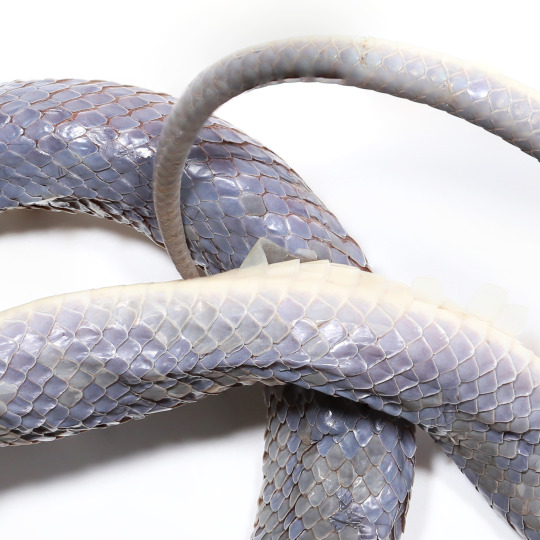
detail of snake specimen preserved in alcohol

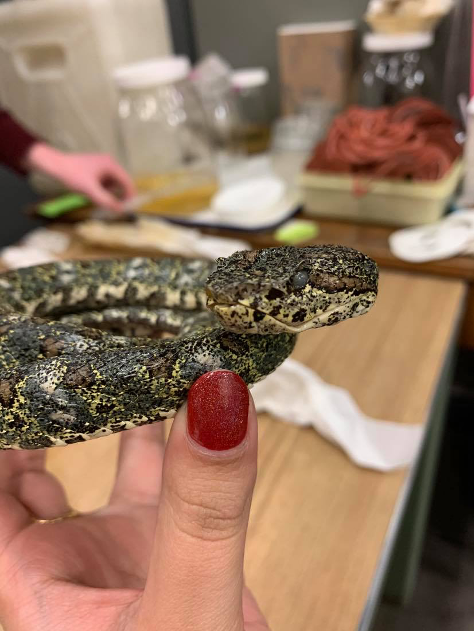
I met Kaylin Martin, a curatorial assistant for the Carnegie Museum of Natural History (CMNH), at an internship fair when I was a transplant to Pittsburgh in September 2018. I was immediately drawn to her booth because it was made up of the most alluringly macabre set of oddities. The table was comprised of floating, translucent creatures in glass jars that I would come to know had been preserved in alcohol. In addition to the slick, scaly bodies of reptiles, there were vibrantly colored feathers of birds and their delicate skeletons splayed out on the white linen cloth of the booth. I thought then what I know to be true in an even greater sense now: that each was like a tiny work of art which had once been alive.

My background is in photography, which I studied at NYU before transferring to Pitt to major in the broader subject of digital media. I got the sense that CMNH was looking for interns with more of a scientific bent to their interests and education, but I was persistent about working in the alcohol house because I felt that there is an element of romanticism in going to great lengths to preserve such small lives. This appealed to me as my main interest has always been in portraiture. I felt like this could be a new kind of portraiture and the next step for me in my creative endeavors.

That fall I learned that the sum total of specimens of a particular type at a natural history museum is called a collection, in the same way that the Carnegie Museum of Art has its impressionist or modernist collections, for example. The Section of Amphibians and Reptiles at CMNH has the 10th largest such collection in North America, making it no small task for Stephen Rogers, the collections manager, to keep up with the care and preservation of each specimen.

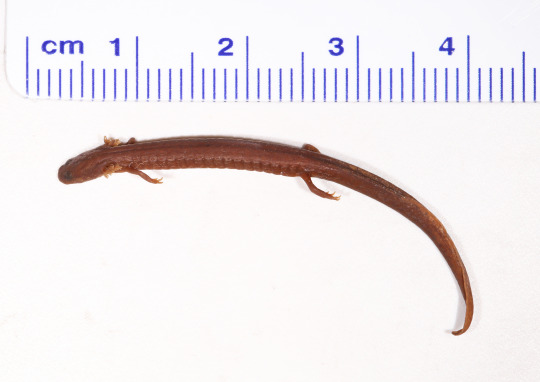
salamander next to ruler showing salamander is just over 4 centimeters long

Since starting as a photographic intern last year, I have photographed over 300 specimens (a fraction of the more than 230,000 specimens) from this collection as part of an ongoing project to digitize and upload images of paratypes to iDigBio.org. Mainly I work with tiny salamanders, some no larger than my fingernails, as many of the snakes were photographed the summer before I arrived. Sometimes Kaylin comes to me with special requests she’s received from researchers, which can be for photos of anything in the alcohol house, from frogs, to skinks, to snakes. In fact, some photos I shot of one such request were of a holotype (the individual from which a species is described) and will be published in Annals of Carnegie Museum this year.

After hours spent inspecting these creatures up close, I’ve come to recognize undeniably human qualities in them. In particular, the salamanders’ feet at the lower half of their bodies, which remind me of human hands. At times I remember that they are our distant ancestors and feel slightly ashamed that I barely thought of them or the well-being of the ones still living before my time at CMNH. It’s what I like best about being able to spend my time at the museum: that you never know what you might learn but also what you might remember. Facts you may have read or retained from school take on new meaning when you’re able to see evidence of them up close.

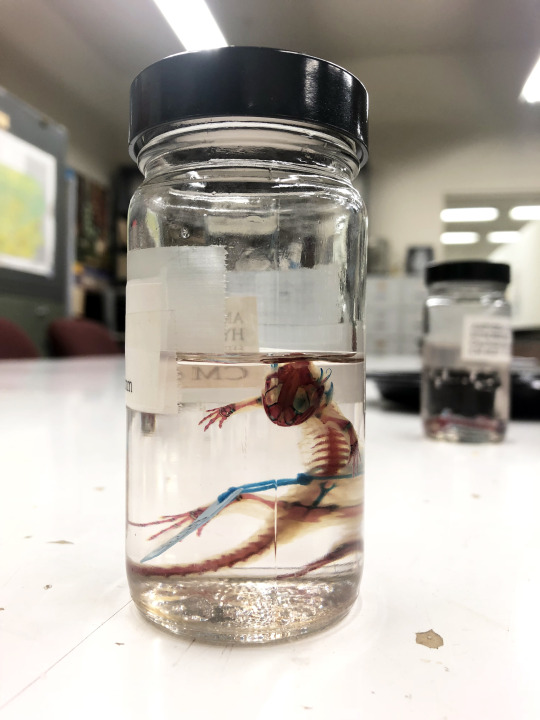
cleared and stained specimen preserved in alcohol in a jar

Just the other day in the CMNH offices, I saw a specimen that had been “cleared and stained.” After inquiring about it, I learned that this is a very old technique in anatomy, a process by which the specimen is chemically treated to render it transparent and stain its nervous system different colors. While the resulting specimen is useful for scientific research, it is also strikingly beautiful. I thought while looking at this strangely beautiful and arresting object that it wholly encapsulated my realization that scientists are more like artists than most people expect. For instance, both are inclined to ask the larger and more difficult questions of our existence such as: what is life? what happens after it? where did we come from? and what will we leave behind?

The researchers at CMNH are largely responsible for investigating and attempting to answer such questions. Jennifer Sheridan, assistant curator of Amphibians and Reptiles at CMNH, is specifically concerned with how climate change and human actions are affecting these indispensable species. If you are an inquisitive person who appreciates natural beauty and finds yourself motivated to preserve it then I encourage you to volunteer your time and talents to learn and work alongside the herpetology team at the Carnegie Museum of Natural History.

Rosemary Bencher is a work-study student in Amphibians and Reptiles. Museum employees are encouraged to blog about their unique experiences and knowledge gained from working at the museum.

Filed Under: Blog Tagged With: amphibians and reptiles, herpetology, photography, Rosemary Bencher

  • « Go to Previous Page
  • Page 1
  • Page 2
  • Page 3
  • Page 4
  • Page 5
  • Page 6
  • Go to Next Page »

sidebar

About

  • Mission & Commitments
  • Directors Team
  • Museum History

Get Involved

  • Volunteer
  • Membership
  • Carnegie Discoverers
  • Donate
  • Employment
  • Events

Bring a Group

  • Groups of 10 or More
  • Birthday Parties at the Museum
  • Field Trips

Powdermill

  • Powdermill Nature Reserve
  • Powdermill Field Trips
  • Powdermill Staff
  • Research at Powdermill

More Information

  • Image Permission Requests
  • Science Stories
  • Accessibility
  • Shopping Cart
  • Contact
  • Visitor Policies
One of the Four Carnegie Museums | © Carnegie Institute | Privacy Policy | Terms of Use | Accessibility
Rad works here logo