• Skip to primary navigation
  • Skip to main content
  • Skip to primary sidebar

Carnegie Museum of Natural History

One of the Four Carnegie Museums of Pittsburgh

  • Visit
    • Buy Tickets
    • Visitor Information
    • Exhibitions
    • Events
    • Dining at the Museum
    • Celebrate at the Museum
    • Powdermill Nature Reserve
    • Event Venue Rental
    • Gift Cards
  • Learn
    • Field Trips
    • Educator Information
    • Programs at the Museum
    • Bring the Museum to You
    • Guided Programs FAQ
    • Programs Online
    • Climate and Rural Systems Partnership
  • Research
    • Scientific Sections
    • Science Stories
    • Science Videos
    • Senior Science & Research Staff
    • Museum Library
    • Science Seminars
    • Scientific Publications
    • Specimen and Artifact Identification
  • About
    • Mission & Commitments
    • Directors Team
    • Museum History
  • Tickets
  • Give
  • Shop

Invertebrate Zoology

February 10, 2020 by wpengine

A Journey to France to Uncover the Mysteries of the Carnegie’s Grand Staircase

The Carnegie Institute has been in existence for 125 years and is one of the greatest architectural buildings ever designed in Pittsburgh. In 1985, Carnegie Institute President Robert Wilburn invited Dr. Cynthia R. Field, the Smithsonian’s Architecture Historian, to assess the artistic value of the museum. He asked, “what do you think is the most valuable specimen or painting in the museum?” She said, “The Building Itself is the Greatest Object of the entire Museum Collection” (Fig. 1).

image

Fig. 1: Carnegie plaque

The internationally-famous architect, I.M. Pei, who designed the Louvre’s glass pyramid that sits in the Louvre’s central courtyard in Paris, France, opined, “Architecture is the very mirror of life. You only have to cast your eyes on buildings to feel the presence of the past, the spirit of a place; they are the reflection of society.” In 2018, Architecture Digest ranked the Carnegie’s Grand Staircase the 8th best museum staircase in the world. The Grand Staircase was built by the Pittsburgh architectural firm of Alden and Harlow at the apex of America’s Gilded-Age building boom. During my research, I discovered that the architects employed multicolored classic marbles and fossil limestones in the interior design from Algeria, Croatia, Greece, France, Ireland, Italy, and the United States. The commission to build the Grand Staircase in 1907 incorporated two classical French fossil limestones in the columns and pillars, floor tiles, steps, walls, balconies, and water fountains. This monumental Beaux-Arts style staircase is modeled after the L‘Opéra Garnier ‛a Paris, Grand Staircase in France, c. 1875, and was visited by a French Delegation with Andrew Carnegie (Fig. 2). The architecture described as Beaux-Arts was taught at the École des Beaux-Arts in Paris, from the mid-19th century until 1900. It drew upon the principles of French neoclassicism and used modern building materials, i.e., iron and glass. And as such, it became a preferred architectural style in the United States from 1895 until 1910 in cities such as, Boston, Chicago, New York City, Pittsburgh, and Washington D.C.

image

Fig. 2: French delegation and Andrew Carnegie

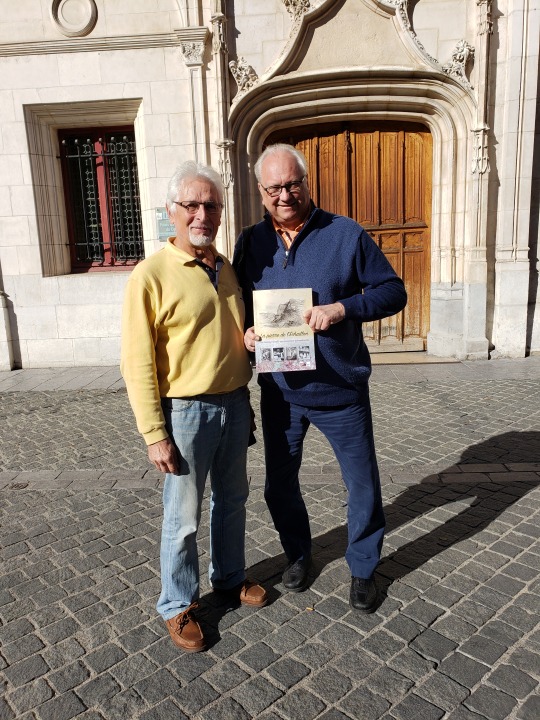
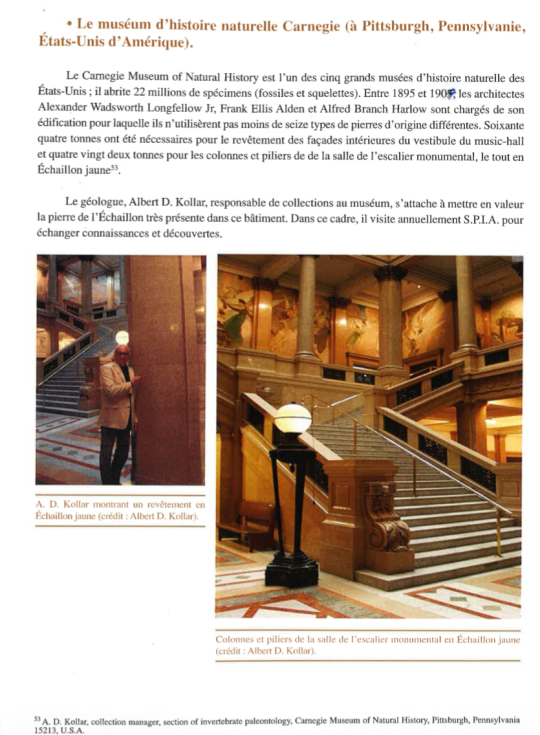
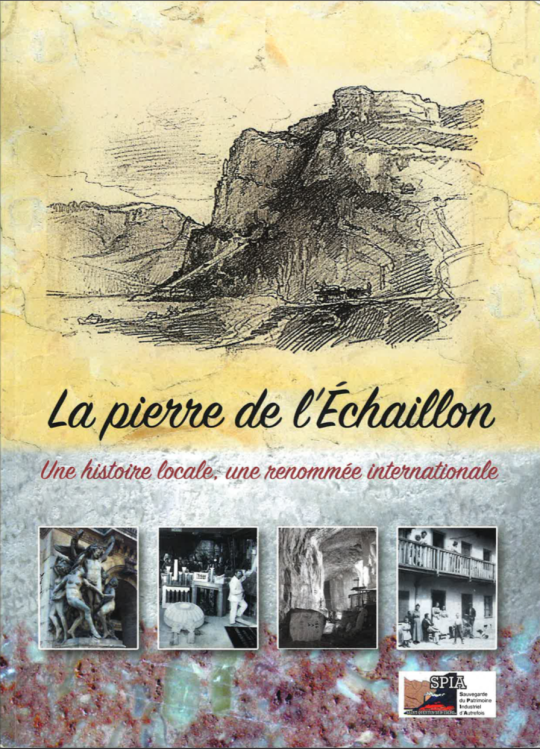
In 2019, The Carnegie’s Grand Staircase and Music Hall Foyer were recognized in the book La pierre de l’Échaillon Une histoire locale, une renommée international for the use of Échaillon jaune (yellow) ornamental stone in the museum’s columns, pillars, and walls (Fig. 3). This book was published by S.P.I.A. (Sauvegarde du Partrimoine Industriel d’Autrefois, a historical society founded by Jean Paul Rey, president) (Fig. 4).  In the book, they describe how a small French village of l’Échaillon, pronounced Esh-ee-own, received recognition for its white marble (a limestone) used by famous French architects in 64 classic buildings and sculptures from 1875 to the early 20th century (Fig. 5).  I first met Jean Paul in October of 2016, when I was invited to give a presentation at an S.P.I.A. meeting on my research on the Carnegie’s l’Échaillon.  The meeting was held in an old schoolhouse in the village of Saint-Quentin-sur-Isère, Département de Isère, in southeast France.
image

Fig. 3: The Grand Staircase

image

Fig. 4: Jean Paul Rey and Albert D. Kollar
image

Fig. 5: Book cover

The French Limestones in the Carnegie’s Architecture

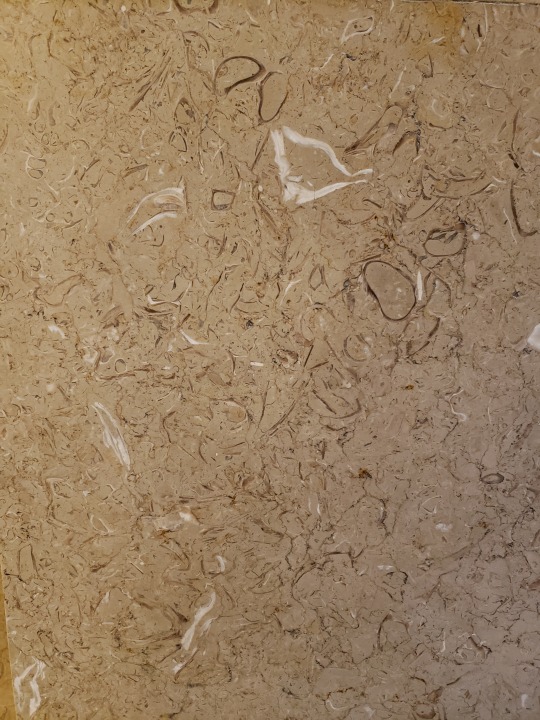
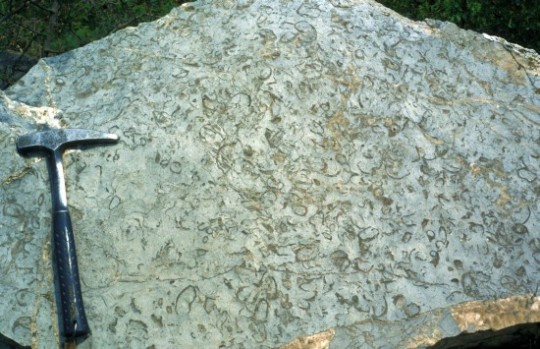
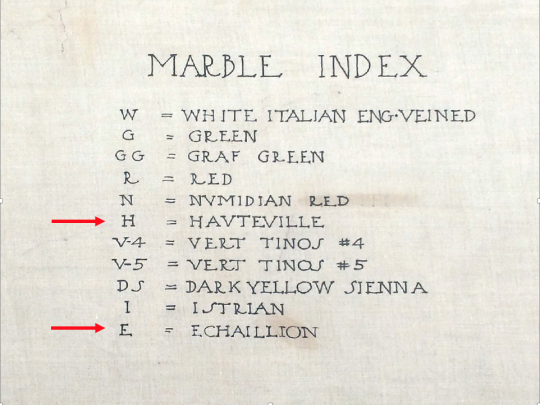
The Carnegie building stones research project progressed significantly, once we obtained the digital images of the architect’s blueprints from the Carnegie Museum of Art’s Architecture Department. With the assistance of my co-authors, Rich Fedosick and Kay Hughes of the Section of Invertebrate Paleontology, we examined the blueprints to understand the architects Marble Index terminology (Fig. 6). Eventually, we were able to interpret and recognize the location of the two French limestones based on the Marble Index letters, E for Échaillon and H for Hauteville. From a nonscientific perspective, the architects considered the Carnegie’s interior stones to be marbles. However, the geological definition of a marble is when a rock defined as a limestone or dolomite is subjected to high heat and pressure from geologic forces forms a metamorphic rock.  The six stones listed in the Marble Index as marbles, are limestones, a sedimentary rock enriched with fossil seashells. The characteristic rudist fossils and yellow color that distinguish the Échaillon stone are found in the 18 pillars and the 22 columns that rise 3.8 meters or 12.5 feet about the Grand Staircase, and in the walls of the Music Hall Foyer (Fig. 7).
image

Fig. 6: Marble index E and H letters

image

Fig. 7: Échaillon fossils

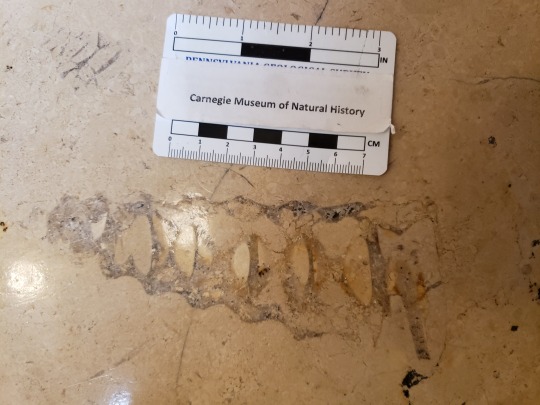
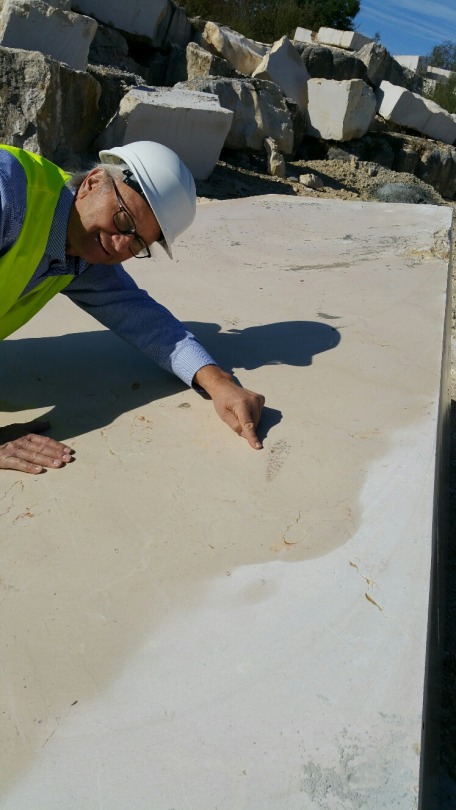
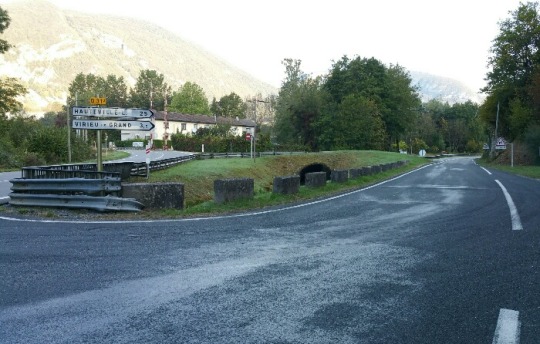
The other French limestone used in the Carnegie is Hauteville. This limestone was quarried from the Plateau d’Hauteville in the Ain Department, in eastern France. I visited this quarry in 2016 to investigate the geology of the quarry operation, to uncover evidence of the common fossil snail Nerinea in the quarry rock (Fig. 8), and to learn more about the cultural history of the region (Fig. 9).  The Hauteville limestone was used in the Grand Staircase walls, balcony features, water fountains, vestibule steps, and as floor tiles. Other locations include, the Hall of Sculpture and Hall of Architecture floors, the walls along the grand hallway, the Music Hall vestibule floor, the Founder’s Room vestibule floor, the floor and steps in the Smoking Room (now offices), the Forbes Avenue vestibule entrances to the music hall, carriage drive, and museum and fine arts. Moreover, the Hauteville floor tiles are distributed throughout the Carnegie Library of Pittsburgh main entrance corridors. The Hauteville stone is beige in color and contains many visible fossils, none more distinctive than the robust Nerinea, a 12.7 cm/5-inch-long snail that serves as the index fossil for the limestone identification (Fig. 10).
image

Fig. 8: Hauteville Quarry fossil snail
image

Fig. 9: Hauteville directional signs

image

Fig. 10: Nerinea snail in Carnegie floor

Introduction to the l’Échaillon Carrières

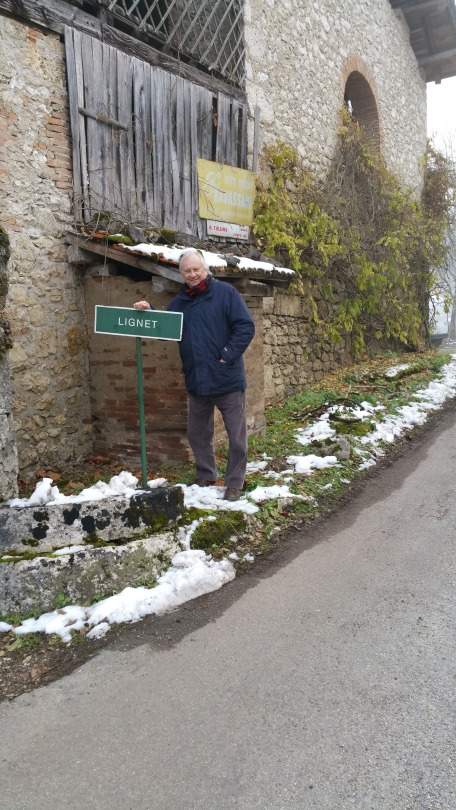
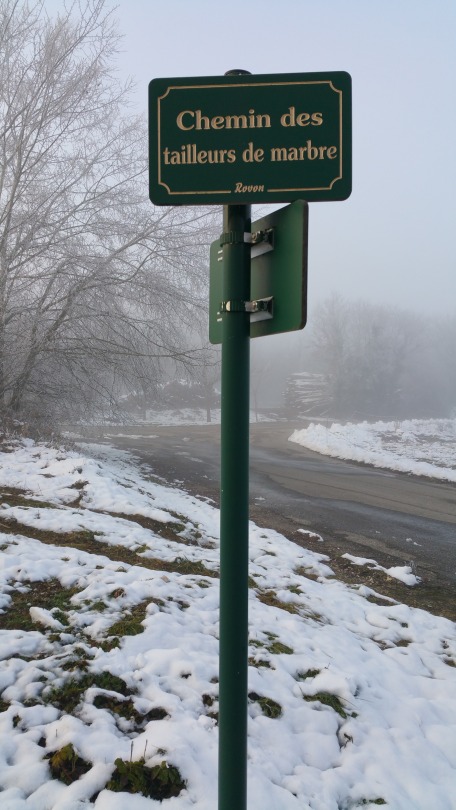
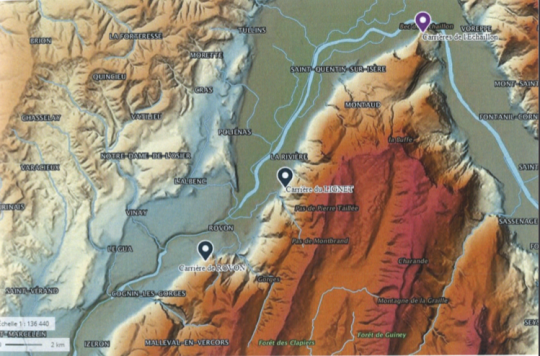
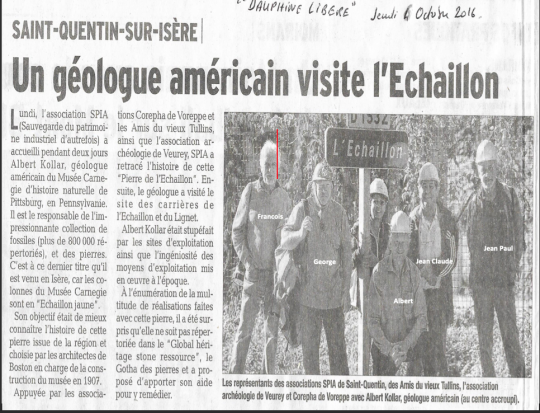
There are three carrières or quarries in the Vercors cliffs located in the Isère River Valley that were excavated for White Echaillon or “Echaillon blanc,” Yellow Echaillon or “Echaillon jaune,” and Pink Echaillon or “Echaillon rose” during the 19th and early 20th century (Fig. 11).  These unique color combinations became popular for various interior and exterior architecture features in 194 buildings in western Europe, North Africa, and the United States. In 2016, Jean Paul Rey and members of S.P.I.A. led me on a field trip to the abandoned classic l’Échaillon white quarries (Fig. 12). We explored what is thought to be a 2,000-year-old Roman quarry and walked through a maze of underground caverns and narrow tunnels that contained abandoned mining equipment.  The other two Echaillon carrières are located several kilometers south in the small villages of Lignet, where the Pink Echaillon was quarried (Fig. 13) and Rovon, where the Yellow Echaillon was excavated (Fig. 14).
image

Fig. 11: Echaillon quarries locations, S.P.I.A.
image

Fig. 12: Visit to Echaillon

image

Fig. 13: Lignet Quarry Marker

image

Fig. 14: Rovon quarry

Cularo, Grenoble, and the white l’Echaillon stone

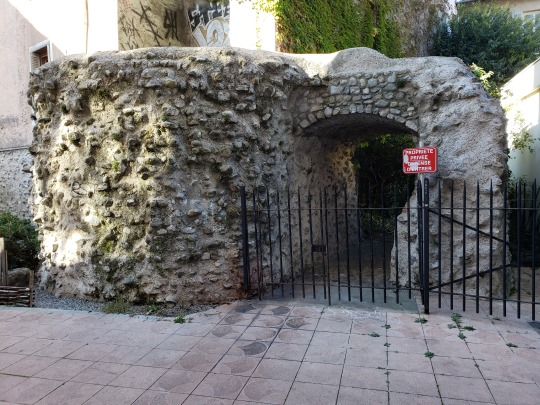
A fortuitous discovery was made by S.P.I.A. for their book while searching for evidence of the white l’Echaillon in the Gallo-Romans era 4th century Cularo or Grenoble, France today. In the Saint Laurent crypt that is preserved many meters below the modern-day street level tramway, a white capitol on top of a white limestone column was identified as l’Echaillon. This white capitol stone is presumably from the Roman quarry adjacent to the white l’Echaillon underground caverns. When Emperor Gratian ruled the Roman Empire from 367 to 383 A.D., he renamed Cularo after himself. Cularo thus became Gratianopolis, which through a later phonetic shift became Graignovol and then Grenoble. Although hard to find among the narrow streets and passageways of Grenoble, is a section of a Roman wall that once encircled Cularo, a portion of which is protected by a fence. This historic wall can be seen at Passage Sainte-Claire on the corner of Rue Lafayette, in the central city of Grenoble (Fig. 15). I suspect some of the white cobbles embedded in the wall may have their origin from the white l’Echaillon Roman quarry. Undoubtedly, more research will be necessary to make an affirmative conclusion.
image

Fig. 15: Roman wall

“Geology of the l’Échaillon Carrières”

The drawing of a new geologic map on the l’Echaillon carrières by Professor Thierry Dumont of the Université Grenoble-Alpes, confirms stratigraphically, the ages of the three limestone quarries. Among the three, the white Echaillon limestone is late Jurassic in age, whereas the pink Lignet and yellow Rovon limestones are early Cretaceous in age. The formal geologic name for the rose and yellow limestones is the Urgonian Formation. Fossils are abundant in the three limestones. Dr. Claudie Durand of Le musèum d’Histoire naturelle de Grenoble (Fig. 16) curated a diverse collection of 163 species of invertebrate fossils from l’Echaillon first published in 1919. Geologically, the three limestones were deposited in the tropical Tethys Seaway a circum-equatorial ocean of the Mesozoic Era. The strata form the Vercors carbonate platform, a buildup of late Mesozoic rudist (bivalve mollusk) reefs spanning 25 million years of evolution from (late Jurassic 140 million years ago to early Cretaceous 165 million years ago) (Fig. 17).  

image

Fig. 16: Dr. Claudie Durand

image

Fig. 17: Rudist (bivalve) reef fossils

The Rovon carrière provenance and fossils

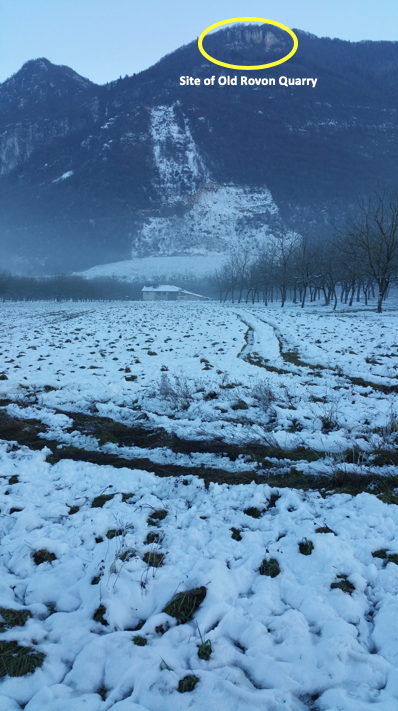
The primary goal of this research is to define the geology and authenticate the specific provenance of all marbles, fossil limestones, sandstones, and the singular igneous granite rock used in the Carnegie building. The search for the provenance of the Carnegie’s yellow Echaillon was initiated in December of 2017 by Jean Paul Rey, when we were introduced to the Forman of the modern-day Rovon quarry. After a long discussion about our objectives, he granted permission to visit the old quarry. As darkness fell, we met with a local farmer who directed us to the quarry location in the Vercors cliffs that rise some 538 meters above his snow-covered field (Fig. 18).  
image

Fig. 18: Verors cliffs and old Rovon quarry

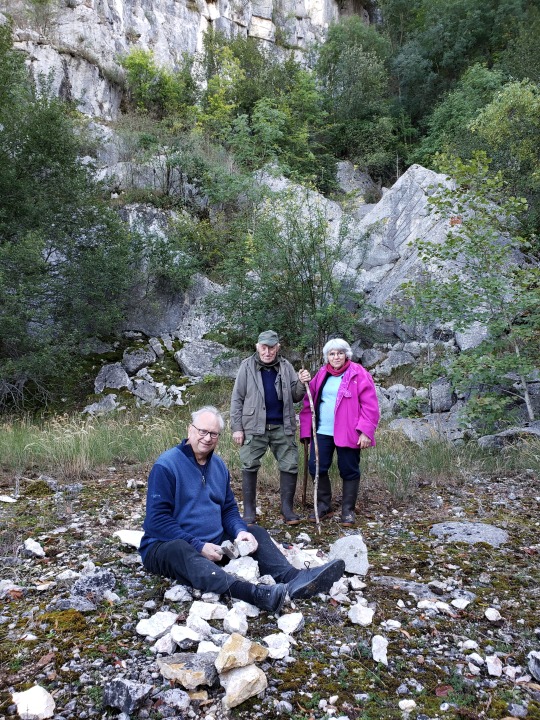
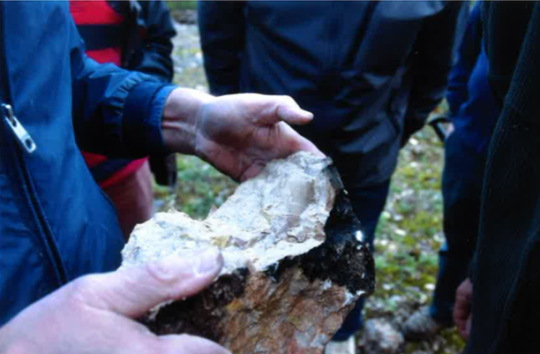
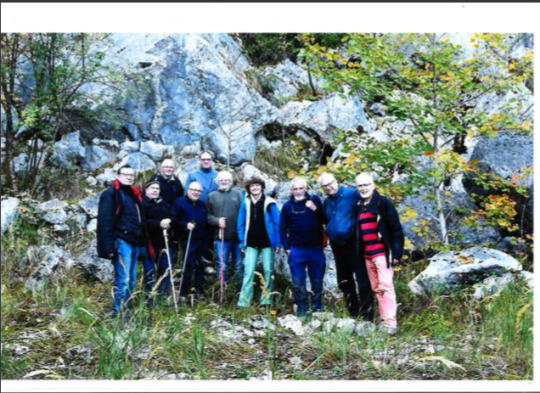
In October of 2018, the S.P.I.A. team pre-arranged to have several 4-wheel trucks transport ten people including Professor Fabienne Giraud-Guillot of the Université Grenoble-Alpes to the Rovon quarry. We ascended the long steep road that ended some 500 m from the main quarry. Surprisingly, the quarry was filled with massive limestone boulders that were cut by mechanical wire saws from the cliff rock (Fig. 19). Such large boulders make it virtually impossible to break with small hammers. For actual fossil collecting purposes, it is better to search for smaller size rocks to break apart (Fig. 20). This past October, transport to the Rovon quarry riding in a 55-year-old Russian built farm tractor was a treat (Fig. 21). And the fossil collecting was a success with 21 complete specimens collected for the museum of the diagnostic Caprina rudist bivalve clam (Fig. 22). The shape of these fossils closely resembles the fossils preserved in the Echaillon limestone in the Grand Staircase and Music Hall Foyer. Additional geologic data is being reviewed by colleagues from the Geology Department at the University of Zagreb in Croatia and the University of Ireland at Galway.  
image

Fig. 19: S.P.I.A. team

image

Fig. 20: Collecting fossils

image

Fig. 21: Russian tractor

image

Fig. 22: Caprina rudist clam

“Carnegie’s Grand Staircase in the 21st Century”

A study published this month by the BMJ, formerly The British Medical Journal, suggested that “when people of all ages participate in the arts and visit museums once a month or even every few months, they are likely to be more engaged in the world and may actually live longer.” Years ago, the Oscar winner actor Russell Crowe was in Pittsburgh, and he was asked what he did on his days off. In reply, he said, “I ride my bicycle to look at buildings and the architecture of the city.” I. M. Pei states, “Architecture brings people together.” I agree.

Maybe it’s time to reconsider how the Carnegie’s Grand Staircase is promoted to the public at large. For instance, the current arrangement of the free-standing dioramas situated on the first floor, awkwardly impede the flow of patrons walking among the pillars, columns, and the taking of photographs of the Grand Staircase.  Moreover, the placement of these dioramas detracts from the visual enjoyment of the famous John White Alexander multicolor murals. An artistic feature of the murals is their connection to the stone colors to enhance the first and second floors architectural features. The best vantage points to see this fabulous spectrum of color is from the third-floor balcony looking down to the first and second floors.

The Carnegie Museum of Art (Museum of Fine Arts) will be celebrating its 125th Anniversary in the fall of 2020. The Grand Staircase was designed as the showcase entrance to the Museum of Fine Arts for Pittsburghers of the early 20th Century. One hundred and twenty-five years later, perhaps, this world-class space can once again establish a new generation of museum patrons and become the destination as a place to be for its cultural and intellectual heritage.  And don’t forget, this staircase can be an Instagram-worthy site for a family portrait to encourage our younger audiences to visit too.

Albert D. Kollar is the Collection Manager in the Section of Invertebrate Paleontology at Carnegie Museum of Natural History. Museum employees are encouraged to blog about their unique experiences and knowledge gained from working at the museum.
Filed Under: Blog Tagged With: Albert Kollar, Invertebrate Zoology, Science News

October 24, 2019 by wpengine

Centipede or Millipede? What’s the Difference?

Quick, what was that? It scuttled by in a flash, but you caught a few defining characteristics. It had many legs and a long, segmented, wiggling body. You know you’ve seen one before. Was it a centipede or a millipede?

A few unique characteristics help define which of our many-legged friends is which.

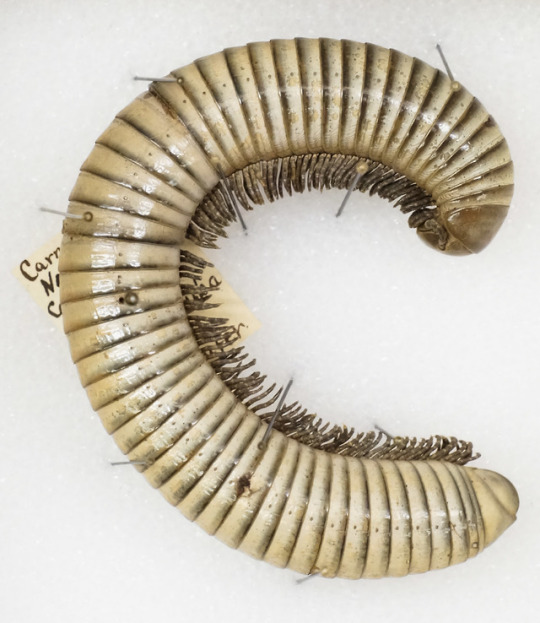
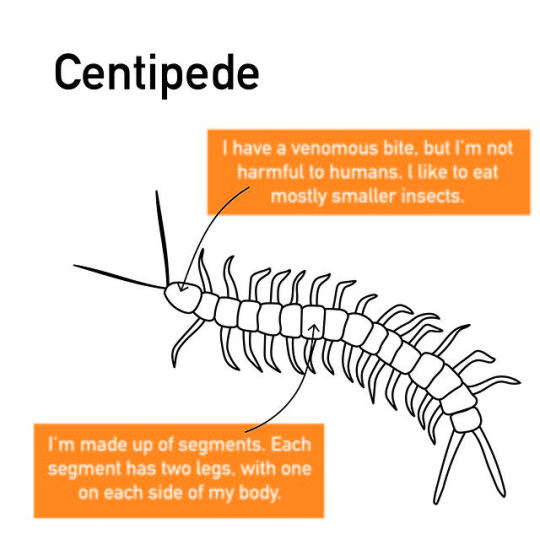
centipede specimen

What’s the difference?

Both centipedes and millipedes are made up of segments that link together to form one, long body. With this body form in common, it might be hard to tell the difference between the two at first glance. Here are a few tips to spot the differences:

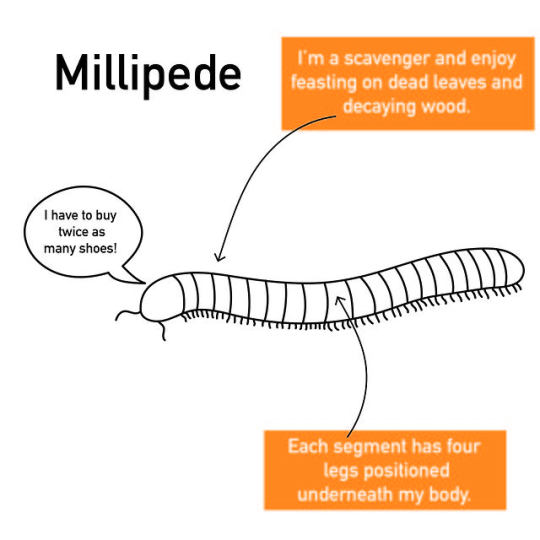
  • Millipedes have two sets of legs per segment positioned directly under their body. Centipedes have one set of legs per segment positioned on the side of their body.
  • Centipedes mostly eat insects after killing them with their venom. Millipedes feast on decomposing plants.
  • If looking from the side, centipedes have a flatter body while millipedes are more rounded.
  • They respond to threats in different ways. A millipede will coil up and release a smelly secretion. Centipedes can bite (which is typically harmless to humans) and run away quickly.
drawing of a millipede
drawing of a centipede

It’s all in the “family”

These two also have enough in common to make them “cousins” in the animal kingdom.

  • Scientists have grouped them together because of their similar segmented bodies.
  • Both have poor or non-existent vision and rely on other senses, like the feel of vibrations.
  • They prefer to live in dark environments, which is why you may have seen them in an unlit corner of your basement.
  • The longest species of each measure about six inches in length.

Say no to “Nope!”

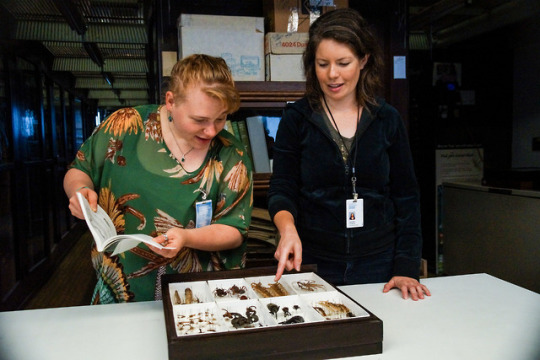
Of course, they may not be the most pleasant creatures to some folks. There is, however, plenty to observe and you’ll find they really are quite fascinating! At the Carnegie Museum of Natural History, Curatorial Assistant Catherine Giles and Collection Assistant Vanessa Verdecia study these animals and many more in the Section of Invertebrate Zoology. Scientists like them across the world could use your help!

There are not many known studies of centipedes or millipedes, even though they are incredibly common and span the globe. Catherine said she would urge people not to say “Nope!” when it comes to centipedes and millipedes. Instead, we should be curious. Studies need to be done in the field with live specimens (ecology) and in labs or offices classifying specimens (taxonomy).

There are more than 3,000 known and an estimated 8,000 species of centipedes. There are upwards of 7,000 known and 80,000 estimated species of millipedes. Millipedes can be found in moist forest areas, while centipedes prefer dry environments. Try and find examples of both species. Take a closer look. Do you notice the differences outlined here? What about the similarities? If you were to study these creatures, would you prefer to be on the scene or in the lab? There’s no wrong answer as long as you don’t say, “Nope!”

Curatorial Assistant Catherine Giles and Collection Assistant Vanessa Verdecia with a box of specimens

Fun Fact

“Milli” is a latin prefix for 1,000 and “centi” is for 100.  Don’t assume that’s exactly how many legs each has on its entire body, though!

Some species of millipedes can have as many as 750 legs. Centipedes can have more than 350 legs.

Learn more in Nature Lab!

Filed Under: Blog Tagged With: Centipede, Education, Invertebrate Zoology, Nature 360, Nature Lab

September 27, 2019 by wpengine

An Annual Return to My Bug-loving Roots

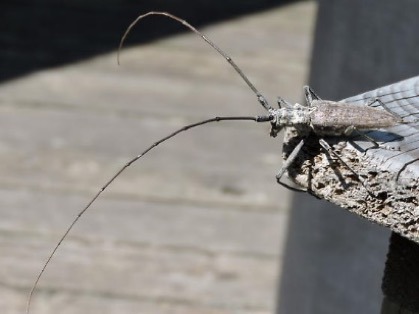
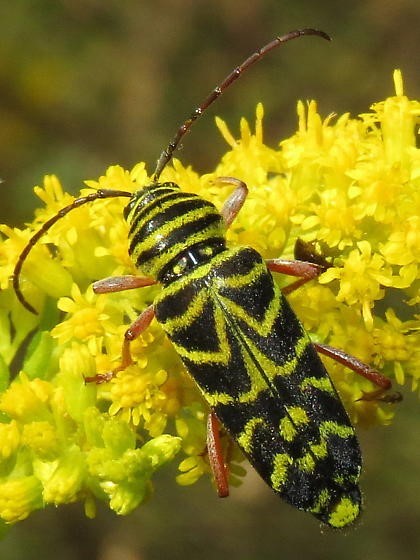
black and beetle on goldenrod
Image used by permission of Stuart Tingley, Cormierville, New Brunswick, Canada. Megacyllene robiniae (Forster), female on bloom of goldenrod

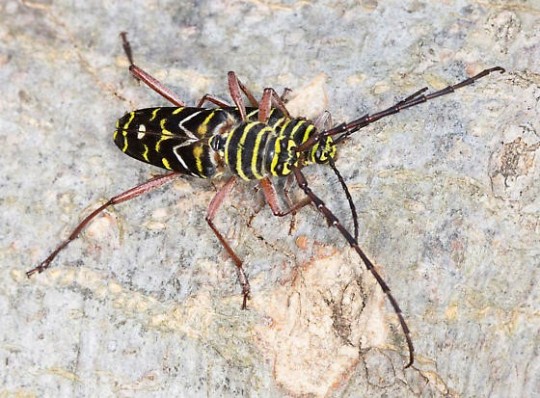
It’s that time of year again when one of my favorite beetles, Megacyllene robiniae (Forster), is starting to appear. Called the “locust borer” due to its larva’s habit of feeding in the living wood of black locust trees, it is one of the last species of long-horned beetle (family Cerambycidae) to emerge in late summer. Adults can be found feeding on the flowers of goldenrod, starting around late August and persisting in the field well into October. The beautiful yellow and black patterned beetles are strikingly colored, but can be quite cryptic when resting on the flowers of goldenrod, which shares the same shade of yellow as the beetle. As long as a larval host source is nearby, a stroll in a field of goldenrod is sure to produce a few adults, boldly feeding on pollen in broad daylight, yet still difficult to visually sort out from the background of the flowers which they visit.

Megacyllene is a genus of Cerambycidae that elicits as much sentimental as scientific interest for me, because it was one of the first long-horned beetles I encountered as a kid. I can still remember coming home from school in the early autumn and heading out into a large field of goldenrod behind my Ohio home to look for the beetles. The only other species of Megacyllene present in Ohio and Pennsylvania is Megacyllene caryae (Gahan) – the “painted hickory borer.” Contrary to M. robiniae – it is one of the earliest cerambycids to emerge in late April to early May, the adults having eclosed in the fall and remaining in their pupal cells until spring. I vividly remember my grandfather bringing home a load of hickory firewood one January, unaware that it was infested with the beetles. Upon splitting a log, he found the adults in their pupal cells awaiting the Spring warmth to emerge. He and I together split those logs smaller and smaller looking for more specimens. We ended up with a nice series of beetles and a bunch of wood whittled down to kindling size!

Image used by permission of Shannon Schade, Elkton, MD. Megacyllene caryae (Gahan), mating pair

Monochamus notatus (Drury) is a spectacular species of long-horned beetle, common in Pennsylvania in stands of white pine. The larva feeds under the bark of dying or dead pine and its feeding can be heard as a high-pitched rasping sound as far as 20 feet from the tree. This behavior has earned the species the common name of “pine sawyer” – the noise resembling the sound of an old-fashioned two-man crosscut saw raking back and forth through a log.

Image used by permission of Carolyn Waddell, Bugguide #1184417, Creative Commons, Ottawa, Ontario, Canada. Monochamus notatus (Drury), male

When I was thirteen, while camping at Mohican State Park in north-central Ohio with my family, I was sitting at a picnic table eating lunch. Suddenly, a large male M. notatus came wafting through the campsite, its lengthy antennae trailing behind it, and looking about the size of a small bird to my young bug-enthusiast eyes. I dropped my food, jumped from the table, grabbed my net, and swept the beast out of the air – the first cerambycid beetle that I ever collected! I still have that specimen 46 years later and I attribute it with starting me on the road to specializing on the family Cerambycidae – now my strongest area of taxonomic expertise. I have seen millions of specimens of long-horned beetles from all around the globe during my career, but that one specimen generates more sentiment than the rest combined – I can still smell the pine scent in the air on that day I caught it.

Collecting insects as a kid was the gateway into an amazing world of diversity, and as it turned out, the foundation of what would become my career and lifelong passion. When I look at specimens I caught in those early years, they produce a flood of memories – of specimens caught and of those that got away; of woods where I memorized every fallen log and patch of flowers; of the copy of Josef Knull’s 1946 book “The Long-horned Beetles of Ohio,” with its pages worn and every word read over and over again a thousand times; even the long bike rides, carrying my net and jars out to areas remote from my home in search of “wild” areas in which to hunt for beetles. The specimens serve as little time machines – carrying me back to my childhood and the dawn of my interest in entomology. Going into the field now is more sophisticated, and structured, and planned – better gear, GPS units to record localities, a lifetime of experience to rely upon – not to mention a car that can take me farther afield. But those days of simple exploration, where nearly every venture outdoors uncovered some new wonder, will always be some of my most cherished memories – and those beetles on pins will always be the vehicles that carry me back to that wondrous time in my life.

Bob Androw is a Scientific Preparator in Invertebrate Zoology. Museum employees are encouraged to blog about their unique experiences and knowledge gained from working at the museum.
Filed Under: Blog Tagged With: beetles, Bob Androw, Invertebrate Zoology, pennsylvania

August 21, 2019 by wpengine

Lasius will Amaze-i-Us

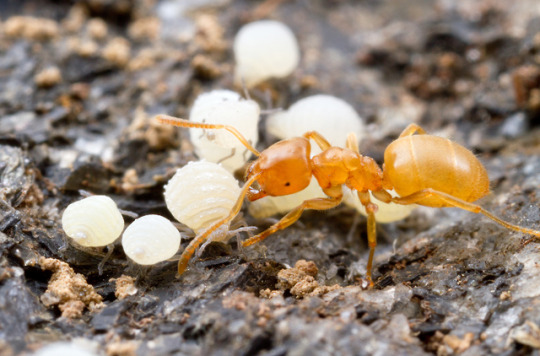
Lasius workers tending a flock of aphids underground. Photo by Alex Wild.

Common Lasius ants tend aphids that live underground feeding on plant roots. They protect the herd of aphids from other ants, and move them to more productive roots if the plant dies back. Sometimes the future queen will pick up an aphid in her mandibles and carry it along on the mating flight, and place it on a good root in the wall of the first nest chamber to start a new herd of aphids.

At this time of year, Lasius have their mating flights. A warm day with some rain in the afternoon to soften the soil, and then a clear sky near sundown would be perfect. The ants will be in the top of the nest, awaiting the exact right moment. Somewhere between about 4:00 pm and 7:00 pm, when the atmosphere is just right, workers dig several passages to the surface, and usually the small and slender male ants emerge first, taking flight quickly. Future queens, much larger than the workers or males, and bearing large wings, emerge next and take flight. All the colonies in the landscape where the weather is appropriate may emerge in a time span as short as five or ten minutes.  We found dozens of colonies of two species (below) emerging in an area of our lawn about 20 feet by 40 feet.

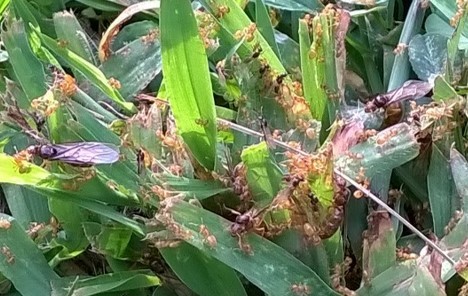
Silver wings of many male Lasius neoniger are obvious as they prepare to take flight. Photo by Donna Wenzel.

The many gossamer wings may give the impression of smoke rising from the soil. Swallows, swifts, and other birds will fly in circles snapping up the winged ants. The queens will mate with one or a few males, who die promptly, and then the queens will dig into the moist soil and create a chamber for her new nest, maybe with an aphid she carried along the way to start her new colony.

But the life of Lasius ants is not all pastoral peace and harmony. Two different methods of parasitic attack have evolved where a queen of one species of Lasius will invade the nest of a different species of Lasius to take it over. In one of these methods, the parasitic queen releases citronella, a lemon-like odor that is pleasant to humans but communicates alarm to ants. The workers avoid the invading queen who works her way into the chamber where the host queen is. Quickly, the parasitic queen accumulates the odor of the host colony, and the workers will not recognize her as an alien usurper.

Here we see several large, winged Lasius claviger queens among many small workers, preparing to fly. These queens will parasitize mature colonies of other species, such as L. neoniger above. A few small, dark males are visible top, center. Photo by Donna Wenzel.

A different method used by some species is that the queen is very hairy or armored, and simply fights her way into the host nest. There, the invader may kill the host queen. By either method, the parasitic queen takes over the host nest, and the workers of the original colony, not knowing any better, spend their lives raising the offspring of the parasitic queen. As the original workers die out, the workers of the parasitic queen replace them until the colony is entirely of the parasitic species.

If you keep a sharp eye out at this time of year, you have a good chance of observing a mating flight of Lasius or another ant species, but you have to be in the right place at exactly the right time!

John Wenzel is the Director at Powdermill Nature Reserve, Carnegie Museum of Natural History’s environmental research center. Museum employees are encouraged to blog about their unique experiences and knowledge gained from working at the museum.
Filed Under: Blog Tagged With: bugs, insects, Invertebrate Zoology, John Wenzel, Powdermill Nature Reserve

July 23, 2019 by wpengine

Brood VIII Birthday Bash

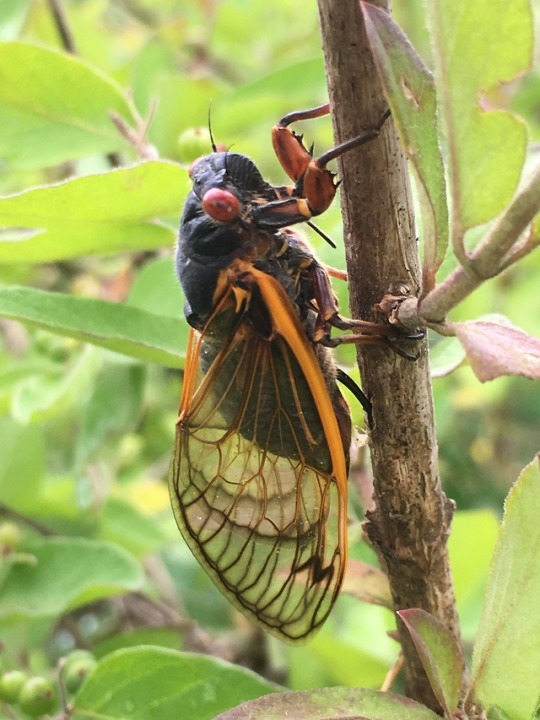
Photo by Andrea Kautz.

Millions upon millions of tiny cicada nymphs are being born. The periodical cicadas that emerged in our area (called “Brood VIII”) earlier this summer mated and laid eggs in the twigs of woody plants. Cicadas do not feed on twigs; they pierce the twigs on the underside, with a knife-like egg-laying tube called an ovipositor, and lay 10 to 20 eggs per incision. In the photo above, you can see the ovipositor behind the female’s back leg, inserted into the twig. At rest, the ovipositor would extend the length of the abdomen, so this one is about half embedded in the twig. In mid or late July, those eggs will hatch and the tiny nymphs will fall to the ground. They burrow down to find roots, where they will remain for 17 years, sucking plant juice.

Females can make dozens of separate incisions to lay hundreds of eggs in total. Because the cicadas need to leave their offspring on roots that will persist for 17 years, they prefer laying eggs in trees rather than shrubs, and tend to pick harder species, such as oaks, rather than softer woods like tulip poplar. Although they can feed on evergreen roots, the resinous nature of the sap in the twigs tends to suffocate the eggs, and they rarely lay eggs in evergreens. They can also feed on grass roots, and a big tree above a lawn becomes a popular egg-laying site. The many separate wounds on the twig interrupt water flow from the roots, and the twig often breaks or dies.

Photo by John Wenzel.

These damaged twigs are called “flagging” by cicada biologists, and they are a clear indicator of the density of females at a site.  This red maple over a lawn shows extensive flagging. A big tree may be supporting hundreds of thousands of eggs.

Photo by John Wenzel.

Despite the obvious damage to the tree, it appears that most trees do not suffer much unless they are little saplings. In fact, fruit tree farmers in the 1800s reported that their trees produced better crops the year after this natural pruning process.  Another benefit of the cicadas is that the millions of emergence holes open up the soil for air and water penetration and provide an avenue for nutrients at the top to pass into lower soil layers.  Although many people find the mass emergence of periodical cicadas to be annoying, they represent an inspiring and beneficial piece of our ecosystem, unique to eastern North America.

John Wenzel is the Director at Powdermill Nature Reserve, Carnegie Museum of Natural History’s environmental research center. Museum employees are encouraged to blog about their unique experiences and knowledge gained from working at the museum.
Filed Under: Blog Tagged With: Cicadas, insects, Invertebrate Zoology, John Wenzel, Powdermill Nature Reserve

July 3, 2019 by wpengine

What Do Bugs Do During the Winter?

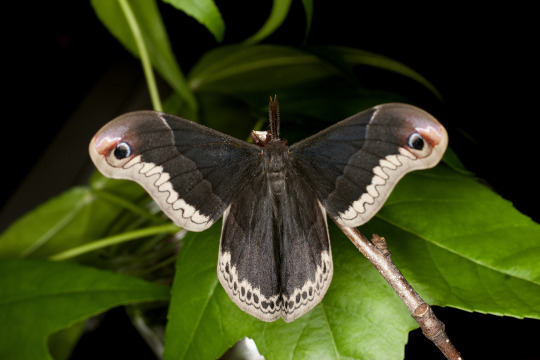
moth on plant at night

Ever wonder what happens to insects during the winter?  Depending on the species they will overwinter during one of the stages of their development.  In the case of the Promethea moths that were reared in Invertebrate Zoology last year, the caterpillar culture formed cocoons in the summer of 2018.  In their natural setting those cocoons protect the pupae as they experience diapause during the cold winter months.  Diapause is a state of dormancy that allows the specimens to survive harsh environmental conditions.

The pupae need to experience diapause before responding to the normal queues that trigger the adult moths to emerge from their cocoons. Insects depend on light and temperature queues which dictate when to enter the stages in their life cycle. In the lab setting, winter conditions were simulated by placing the cocoons in the refrigerator from November through March.

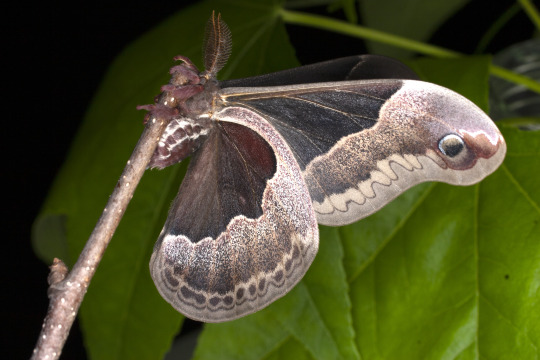
moth on plant at night

Luckily, the overwintering technique was successful and we had adult moths emerge in late May.  Look for these moths in your backyard as they emerge from their cocoons this summer. Watch for caterpillars that look like these, which will hatch from eggs laid by the adult moths flying this summer. These caterpillars will grow and form cocoons which will enter diapause this winter and continue the cycle.

Vanessa Verdecia is a collection assistant in the museum’s Invertebrate Zoology Section. Museum employees are encouraged to blog about their unique experiences and knowledge gained from working at the museum.
Filed Under: Blog Tagged With: Invertebrate Zoology, Vanessa Verdecia, wintertide

  • « Go to Previous Page
  • Page 1
  • Page 2
  • Page 3
  • Page 4
  • Page 5
  • Page 6
  • Interim pages omitted …
  • Page 10
  • Go to Next Page »

sidebar

About

  • Mission & Commitments
  • Directors Team
  • Museum History

Get Involved

  • Volunteer
  • Membership
  • Carnegie Discoverers
  • Donate
  • Employment
  • Events

Bring a Group

  • Groups of 10 or More
  • Birthday Parties at the Museum
  • Field Trips

Powdermill

  • Powdermill Nature Reserve
  • Powdermill Field Trips
  • Powdermill Staff
  • Research at Powdermill

More Information

  • Image Permission Requests
  • Science Stories
  • Accessibility
  • Shopping Cart
  • Contact
  • Visitor Policies
One of the Four Carnegie Museums | © Carnegie Institute | Privacy Policy | Terms of Use | Accessibility
Rad works here logo