• Skip to primary navigation
  • Skip to main content
  • Skip to primary sidebar

Carnegie Museum of Natural History

One of the Four Carnegie Museums of Pittsburgh

  • Visit
    • Buy Tickets
    • Visitor Information
    • Exhibitions
    • Events
    • Dining at the Museum
    • Celebrate at the Museum
    • Powdermill Nature Reserve
    • Event Venue Rental
  • Learn
    • Field Trips
    • Educator Information
    • Programs at the Museum
    • Bring the Museum to You
    • Guided Programs FAQ
    • Programs Online
    • Climate and Rural Systems Partnership
  • Research
    • Scientific Sections
    • Science Stories
    • Science Videos
    • Senior Science & Research Staff
    • Museum Library
    • Science Seminars
    • Scientific Publications
    • Specimen and Artifact Identification
  • About
    • Mission & Commitments
    • Directors Team
    • Museum History
  • Tickets
  • Give
  • Shop

mollusks

February 10, 2020 by wpengine

Land Snail Webbhelix multilineata Rediscovered Living in Pennsylvania After 72 Years

Imagine the excitement of finding an organism that was presumed extinct. Until 2019, the handsome land snail Webbhelix multilineata had not been documented anywhere in Pennsylvania since 18 May 1947 so it was presumed locally extinct (it does still survive elsewhere in the Mid-West). Finding a living individual of that species in Pennsylvania this year is cause for excitement.

Webbhelix multilineata has never been an abundant snail in Pennsylvania. Of 10 museum records of that species in PA, all but one is in western Pennsylvania from 1898 to 1947. The one record from eastern Pennsylvania, in Berks County, was collected about 1938.
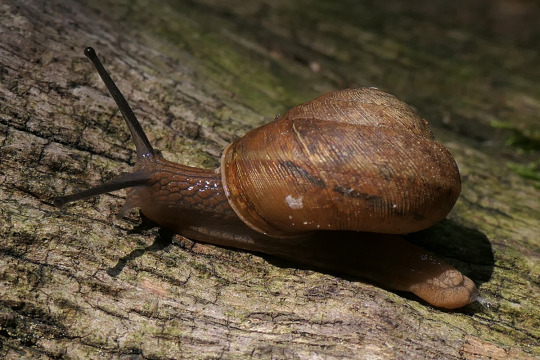
Fig. 1. Webbhelix multilineata juvenile found in York County in 2019 (photo: Kerry Givens).

Photographs of an immature Webbhelix multilineata in Hellam Hills Natural Area in York County, Pennsylvania were sent to me on 2 Jun 2019 (Fig. 1). I recognized the species by the reddish spiral lines on the shell and by the relatively large, reddish body tubercles. This sighting is the first record in 72 years of Webbhelix multilineata anywhere in Pennsylvania, and it represents a new county record as well.

Curiously, this snail was seen in the relatively dry habitat of a mature deciduous forest, at least 150 m from the nearest stream. Five scientific publications indicate its habitat to be low, moist areas including floodplains, marshes, and swamps. I wonder why the York County snail is from such a different habitat.

Because this snail is now known to be living in Pennsylvania, it can no longer be considered locally extinct, so conservation organizations such as the Natural Heritage Program will monitor it. Although there is no evidence that the snail population recovered (as opposed to just being overlooked), I like to think that conservation efforts have played a role in improving conditions for this snail.

I am grateful to Kerry Givens for noticing and photographing the snail, and for alerting me to its existence.

Timothy A. Pearce, PhD, is the head of the mollusks section at Carnegie Museum of Natural History. Museum employees are encouraged to blog about their unique experiences and knowledge gained from working at the museum.
Filed Under: Blog Tagged With: mollusks, Science News, Tim Pearce

October 29, 2019 by wpengine

Tornadoes, Snails, and Sample Sizes

woman collecting snail species specimens
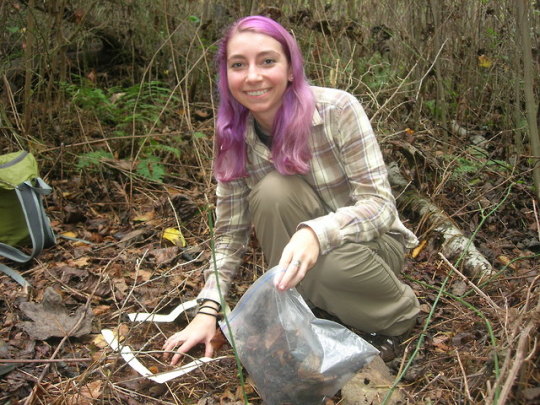
Abbey collecting snails after braving unkind vegetation. Photo by Tim Pearce.

In 2012, a tornado felled trees in four places at Carnegie Museum’s field station, Powdermill Nature Reserve in southwestern Pennsylvania, about 1-hour drive East of Pittsburgh. Each blowdown was 3-6 ha (8-15 acres), within 3 km (2 miles) of each other. These blowdowns provide natural replicates to examine land snail response to habitat change. Given that some snail species are known to occur in forests and others in meadows, we might expect the snail species composition to shift when the wind turns part of a forest into a meadow.

Samples taken in 2016 showed differences in snail species community composition between the blowdown areas and the adjacent, intact forest. However, other statistical tests did not show differences that were significant, but they were nearly significant.

A good scientist should readily accept “no difference” when statistical results show that the differences are not significant. However, when the differences are tantalizingly close to significant, one might wonder whether “no difference” is real, or if a larger sample size might have demonstrated a significant difference.

So, we sampled again this year and took more samples. We are still processing the samples, so results are not in yet, but with the larger sample size, we will accept “no difference” if that is what the statistics tell us.

In the photo, Abbey is collecting leaf litter (containing snails) at the Laurel Run blowdown. The sample she collected contained 23 snails, of five species: Glyphyalinia indentata, Punctum minutissimum, Striatura ferrea, Striatura milium, and Zonitoides arboreus.

Timothy A. Pearce, PhD, is the Head of the Section of Mollusks and Abbey Hines is a Gallery Experience Presenter at Carnegie Museum of Natural History. Museum employees are encouraged to blog about their unique experiences and knowledge gained from working at the museum.
Filed Under: Blog Tagged With: land snails, mollusks, Powdermill Nature Reserve, snails, Tim Pearce

September 18, 2019 by wpengine

Is It a New Species? Wish They All Could Be California Snails

Discovering a new species is exciting but determining whether it’s a new species can take some doing.

photo of possible new Trilobopsis species snail
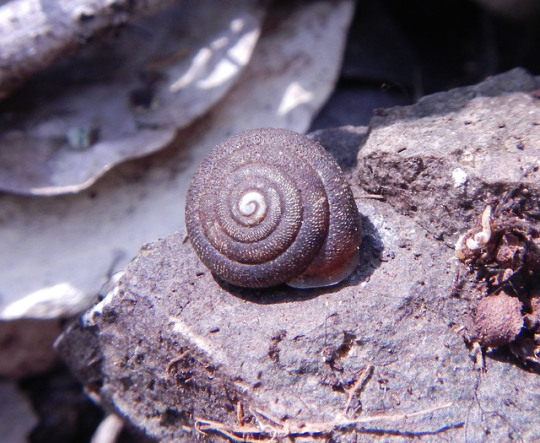
Fig. 1. Trilobopsis species from Santa Cruz Island. Note scale-like hairs on shell. Diameter approximately 8 mm (1/3 inch). (Photo by T. Pearce)

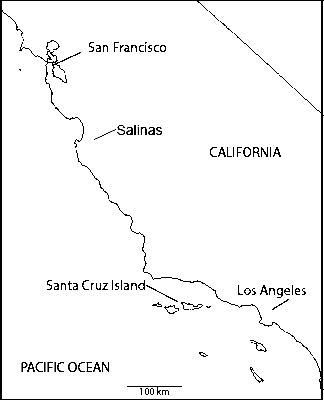
During our project on land snails in the California Borderlands, team member Jeff Nekola discovered a population of the land snail genus Trilobopsis on Santa Cruz Island (Fig. 1). That genus does not occur on any other California Channel Islands; in fact, the closest known mainland locality for that genus is 335 km (210 mi) north in the Salinas Area. We recognize that conditions on the northern Channel Islands tend to be cooler than the adjacent mainland, due to the California Current, and some other typically northern plant and animal taxa (or close relatives) also occur surprisingly far south on the northern islands. The Santa Cruz Island population of Trilobopsis represents a serious range extension to the south for the genus (Fig. 2). Is it merely a range extension of a known species, or could it be a new species?

Fig. 2. Trilobopsis on Santa Cruz Island are 335 km south of the nearest other population near Salinas.

Peculiarities about the distribution of Trilobopsis on Santa Cruz Island make us wonder if it is a long-established native species or a recent introduction from the mainland. Its localized occurrence on Santa Cruz Island spans only a couple of hectares (a few acres) near an area where humans have been active over the past century or so. Small ranges, near human activity, often hint that a population was introduced. In contrast, if the snail had been on the island for thousands of years, we would expect it to have spread to other parts of the island that have suitable habitat.

Fortunately, team member Barry Roth is an expert on Trilobopsis. He is a very careful worker, scrutinizing shell features and internal soft-part anatomy before drawing conclusions. His impression is that the Santa Cruz snail is different from any described species. The next question could be, to what mainland form is it most closely related?

These days, DNA can supplement evidence from shell and internal anatomy features to help elucidate relationships. To get DNA, we usually need live-caught individuals. While museum collections contain libraries of snail shells, and sometimes soft parts, rarely do they contain all the species needed, or fresh enough DNA for the comparison. So, it was time for a field trip.

In August 2019, team member Charles Drost organized an expedition to northern California to seek live specimens of Trilobopsis species for DNA. Jeff had annotated numerous maps with known locations, compiled from some of my past field work (when I was a student at Berkeley in the mid-1980s) and extensive field work by Barry. Fortunately, despite the normal late summer drought conditions, we were able to find living specimens of Trilobopsis at nearly all the target sites we visited.

Fig. 3. Charles showed me where to find live Trilobopsis snails in a log. (Photo by C. Drost)

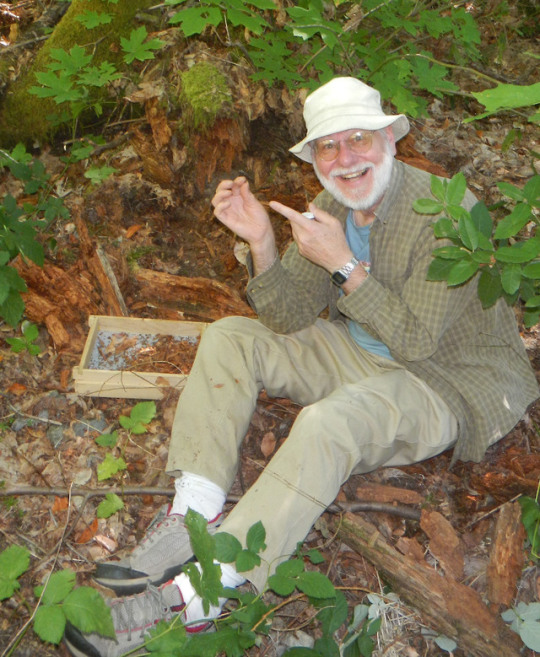
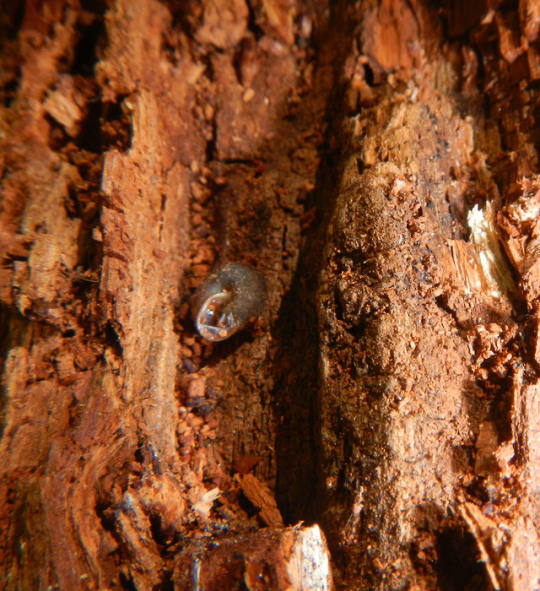
We were struck by the differing habitats of some populations. We think of typical Trilobopsis species living in talus rock piles (as does the one on Santa Cruz Island), but we found some populations living in leaf litter, and one population we found was living inside of rotting logs (Figs. 3-4).

Fig. 4. Living Trilobopsis in a cavity in rotting log. (Photo by C. Drost)

One likely side benefit of this research will be a revision of the genus; there might be more species of Trilobopsis than currently recognized, or there might be fewer species than currently recognized if some forms simply look different by growing in different environments.

We await results of the DNA comparisons, so we can learn which mainland populations are most closely related to the Santa Cruz Trilobopsis. Gotta love those California snails.

Timothy A. Pearce, PhD, is the head of the mollusks section at Carnegie Museum of Natural History. Museum employees are encouraged to blog about their unique experiences and knowledge gained from working at the museum.
Filed Under: Blog Tagged With: mollusks, new species, Section of Mollusks, Tim Pearce

June 25, 2019 by wpengine

Sperm Whales and Giant Squid: Just-So Story and Co-Evolution

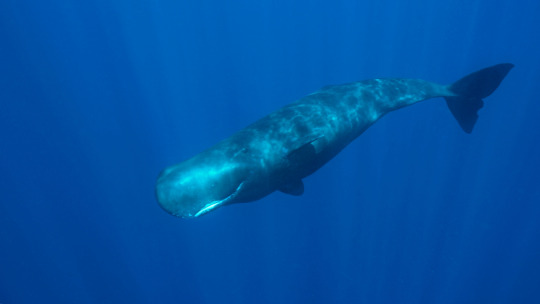
sperm whale underwater

Sperm whales dive to great depths (to more than 2 km or 1.4 mi deep) to catch one of their favorite foods: giant squid. But how did the first sperm whale know it would find giant squids in the ocean depths? The following story is speculation that makes sense but has no facts to support it. Scientists often refer to such stories as just-so stories, named after the stories by author Rudyard Kipling. But while Kipling’s just-so stories are fanciful, my story is plausible.

Before whales evolved, it could be that giant squids lived near the ocean surface. After whales evolved and discovered that squids are tasty, the giant squids might have started living in deeper water, to escape the whale predators. Some whales might have started diving more deeply (and developed specialized physiology allowing them to hold their breath up to 90 minutes and to resist the great pressure at depth) so they could feast on the squid, so the squid might have responded by living deeper still. Cycles like this, between predators and prey, are examples of co-evolution. This cycle could have continued until the squid lived in some of the deepest parts of the ocean, and the sperm whales dove to those great depths to eat the tasty squids. That just-so story might explain why giant squid live at depth, and how sperm whales are able to dive that deep to find them.

Humans hunted sperm whales heavily from the 1700s to the middle 1900s and reduced their numbers possibly to a third what they were historically. Fewer whales would mean less predation pressure on giant squids. With reduced predation pressure, giant squids might venture into shallower water.

It is possible that such a change in squid behavior could lead to more sightings of giant squids over the last few decades (squids caught in fishing nets and caught on cameras). Or it is possible that improvements in technology explains the increased sightings. You might be thinking that humans have interacted with giant squids for centuries – consider the myths of giant squids attacking ships. I agree that humans have known about giant squids for centuries, but I doubt anyone had previously ever seen one alive. Humans are likely to have known about giant squids from examining the gut contents of sperm whales, or possibly from a squid carcass that floated to the ocean surface after it died.

drawing of a kraken devouring a sailing ship

We might never know the real answer to why giant squid live at depth, and why sperm whales are able to dive to such great depths (and how they know squids are there). This co-evolutionary just-so story is a plausible explanation.

Timothy A. Pearce, PhD, is the head of the mollusks section at Carnegie Museum of Natural History. Museum employees are encouraged to blog about their unique experiences and knowledge gained from working at the museum.
Filed Under: Blog Tagged With: Cephalopods, mollusks, Tim Pearce

May 14, 2019 by wpengine

Horizontal Gene Transfer, the Placenta, and Velvet Worms

Everyone reading this (except you robots out there) inherited genes from their mother and father. This is the predominant way, in multicellular animals and plants, for genes to be transferred from one organism to another, from parent to child, and is called vertical gene transfer. But less commonly, genes can be transferred from an individual unrelated to you, possibly from a different species, and is called horizontal gene transfer. Viruses accomplish horizontal gene transfer naturally, while in the lab, genetic engineers use viruses to transfer genes horizontally to create genetically modified organisms.

The gene syncytin-2, which produces an essential membrane between the mammalian placenta and the developing fetus, appears to have come from retroviruses, who use the gene to produce a membrane around their virus capsule. If our ancestors had not acquired this retrovirus gene, you and I would not be here today. We have to be grateful for horizontal gene transfer.

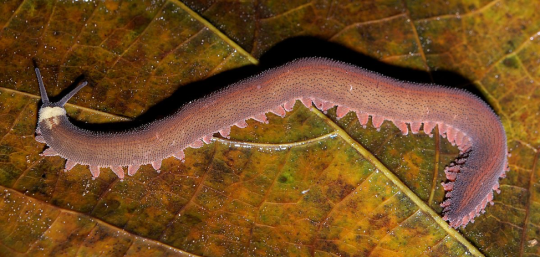
Now for the speculative part of this article. Velvet worms (Onychophora) are a whole phylum (major group) of animals most people have never encountered. They look kind of like a cross between an earthworm and a millipede.

A velvet worm of the genus Oroperipatus. [image from Wikipedia]

Nowadays, they are tropical and terrestrial, but their marine relatives once occurred 500 million years ago. Unusual for their bizarre habit of shooting strings of glue at their prey, some (not all) velvet worms have placentas. That leads me to two questions, the answers to which I do not know. (1) Did retroviruses transfer this essential membrane-producing gene to the velvet worms, as they did for mammals? (2) Do the velvet worms that have a placenta also have a belly button?

To address the question whether retroviruses transferred the gene, researchers could examine whether the syncytin-2 gene occurs in velvet worms, and if so, determine whether the gene’s DNA in velvet worms matches that of the retroviruses? Finding a close DNA match for the syncytin-2 gene in both groups of organisms would be a strong case that the retroviruses are responsible. To determine whether they have a belly button, let’s get some velvet worms and scrutinize their bellies with a microscope.

Timothy A. Pearce, PhD, is the head of the mollusks section at Carnegie Museum of Natural History. Museum employees are encouraged to blog about their unique experiences and knowledge gained from working at the museum.
Filed Under: Blog Tagged With: mollusks, Section of Mollusks, Tim Pearce

May 3, 2019 by wpengine

Is Jabba the Hutt a Slug?

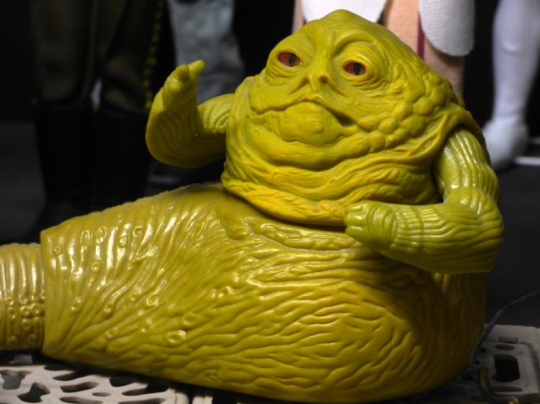
Jabba the Hutt action figure
Image credit: Tomasz Mikołajczyk from Pixabay.

The movie Star Wars introduced us to Jabba the Hutt, with a slug-like body form. In the movie, he was an unsavory character and notorious Crime Lord with a fondness for Princess Leia.

Was Jabba the Hutt a real slug, or did he just look like one? In biology, we know that creatures can look similar either by descent or convergence. Two individuals that look similar by descent implies that their past common ancestor also looked similar. An example of similarity by descent is crows and canaries, that fly and look similar because their common ancestor could fly and looked similar. On the other hand, two individuals that look similar by convergence implies that their past common ancestor looked different, but they acquired their similar features independently. An example of similarity by convergence is birds and bats, that both fly and have wings, but their common ancestor did not fly or have wings.

It is easy to notice that Jabba the Hutt has a body shape like a slug, but I also noticed that he has features of other groups of creatures, for example, he has arms with fingers, as many tetrapod vertebrate animals have.

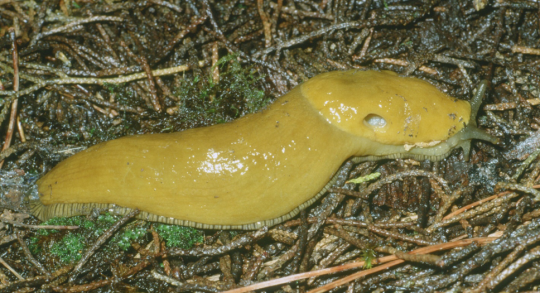
California banana slug (Ariolimax cf californicus), photo by Tim Pearce.

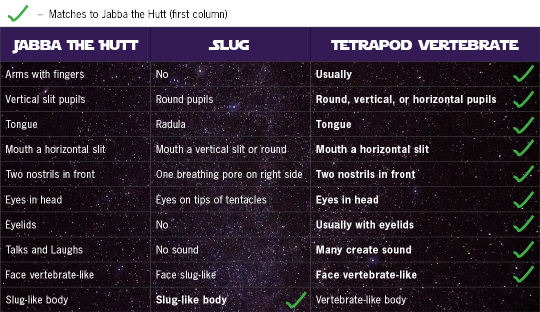
To evaluate whether Jabba the Hutt is slug-like because he is a real slug by descent or due to convergence, let’s compare Jabba the Hutt’s features with those of slugs and tetrapod vertebrates.

Table comparing 10 features of Jabba the Hutt to those of slugs and Tetrapoda

table comparing Jabba the Hutt to slugs vs. tetrapod vertebrates

The table shows that Jabba the Hutt’s features match those of Tetrapoda in 9 out of 10 features (checked off in the table), suggesting he belongs to Tetrapoda vertebrates.

I conclude that Jabba the Hutt was not a slug.

I note that one can find suggestions on the internet that Jabba the Hutt had a skeleton, which is further support for my conclusion that he was not a slug.

Finally, I want to note that slugs can be very nice creatures. Comparing the villainous Jabba to a slug is disrespectful to slugs.

Timothy A. Pearce, PhD, is the head of the mollusks section at Carnegie Museum of Natural History. Museum employees are encouraged to blog about their unique experiences and knowledge gained from working at the museum.

Filed Under: Blog Tagged With: mollusks, Section of Mollusks, Star Wars, Tim Pearce

  • « Go to Previous Page
  • Page 1
  • Page 2
  • Page 3
  • Page 4
  • Page 5
  • Page 6
  • Interim pages omitted …
  • Page 10
  • Go to Next Page »

sidebar

About

  • Mission & Commitments
  • Directors Team
  • Museum History

Get Involved

  • Volunteer
  • Membership
  • Carnegie Discoverers
  • Donate
  • Employment
  • Events

Bring a Group

  • Groups of 10 or More
  • Birthday Parties at the Museum
  • Field Trips

Powdermill

  • Powdermill Nature Reserve
  • Powdermill Field Trips
  • Powdermill Staff
  • Research at Powdermill

More Information

  • Image Permission Requests
  • Science Stories
  • Accessibility
  • Shopping Cart
  • Contact
  • Visitor Policies
One of the Four Carnegie Museums | © Carnegie Institute | Privacy Policy | Terms of Use | Accessibility
Rad works here logo