• Skip to primary navigation
  • Skip to main content
  • Skip to primary sidebar

Carnegie Museum of Natural History

One of the Four Carnegie Museums of Pittsburgh

  • Visit
    • Buy Tickets
    • Visitor Information
    • Exhibitions
    • Events
    • Dining at the Museum
    • Celebrate at the Museum
    • Powdermill Nature Reserve
    • Event Venue Rental
  • Learn
    • Field Trips
    • Educator Information
    • Programs at the Museum
    • Bring the Museum to You
    • Guided Programs FAQ
    • Programs Online
    • Climate and Rural Systems Partnership
  • Research
    • Scientific Sections
    • Science Stories
    • Science Videos
    • Senior Science & Research Staff
    • Museum Library
    • Science Seminars
    • Scientific Publications
    • Specimen and Artifact Identification
  • About
    • Mission & Commitments
    • Directors Team
    • Museum History
  • Tickets
  • Give
  • Shop

mollusks

March 6, 2019 by wpengine

The Origins of El Niño and the rise of Peruvian Civilization: The Mollusk that made Jim Richardson’s Career

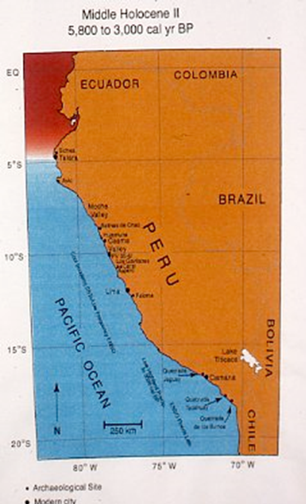
In 1965 I went to the far north coast of Peru to the petroleum town of Talara to conduct dissertation research. In my survey of archaeological sites, I discovered the stratified site of Siches (10,000-4,000 BP), which had an assemblage of mangrove mollusks. This was startling to shell experts since the southern distribution of mangrove environments is now 120 miles north in southern Ecuador. So, how to explain this thermally-anomalous Mollusca assemblage (TAMA) existing in a stark desert landscape? With further research I published articles in 1981 and 1983 in the Annals of Carnegie Museum, proposing that there must have been a change in the ocean current system off this desert coast relating to El Niño (ENSO). By the early 1980’s our research team, devoted to explaining the distribution of other TAMAS at sites as far south as Lima, included Research Associate Dan Sandwiess of the University of Maine and Jack Donahue and Bud Rollins of Pitt’s Geology Department. In 1986, in the Journal of Geoarchaeology we published the article The Birth of El Niño: Geoarchaeological Evidence and Implications, which outraged oceanographers and geologists. They said, “How can you change the ocean current system of the eastern Pacific to explain the presence of your weird shells?” We kept plugging away at this line of research and in 1996 we published in Science, Geoarchaeological Evidence from Peru for a 5000 Years BP. Onset of El Niño.  In 2006 Sandweiss and I published Climate Change, El Niño, and the Rise of Complex Society on the Peruvian Coast during the Middle Holocene in a Dumbarton Oaks volume devoted to archaeological research on El Niño. Further documentation of the dramatic changes in the ocean current off the coast of Peru comes from the analysis of fish fauna from Siches by Research Associates Betsy Reitz and Dan Sandwiess in the Bulletin of the Florida State Museum 2019.
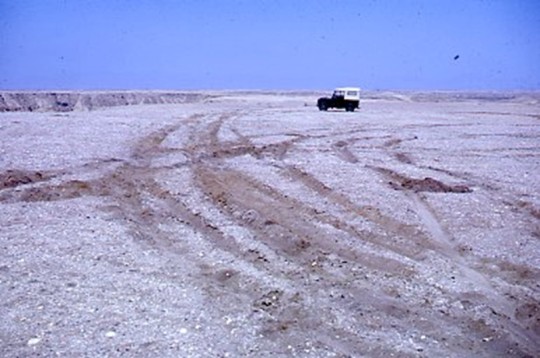
Siches Site Before Excavation 1965

In a nutshell, the results of over 50 years of research at coastal sites from Ecuador to Chile provides the following scenario: El Niño was present but of unknown frequency from 13,000 to 8,800, absent or rare between 8,800 to 5,800, infrequent from 5,800 to 3,200, obtaining its modern recurrence intervals about 3,200 years ago. This research on El Niño, the weather catastrophe that impacts not only the Central Andes but is felt around the world as floods and droughts, has revolutionized our thinking on the development of the first civilization in South America, centered on the Peruvian north coast. Circa 5,800 years the warm current washing the Peruvian coast north of Lima was replaced with the cold Peru (Humboldt) current, which brought with it the huge resource of schooling fish, making Peru one of the richest fishing grounds in the world. These fish resources became the foundation for the rise of temple centers on the north coast, on which Research Associate Michael Moseley based his theory of the maritime foundations of Peruvian civilization. All other civilizations are agriculturally based.
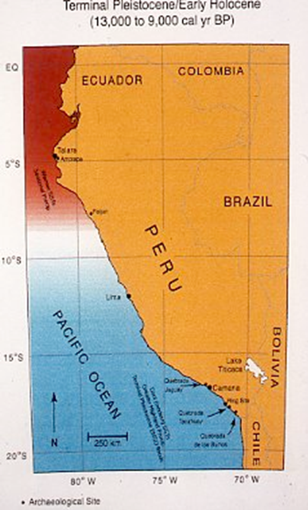
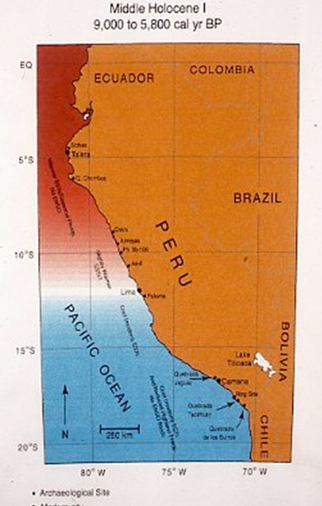
Changes in Peruvian Ocean Current System


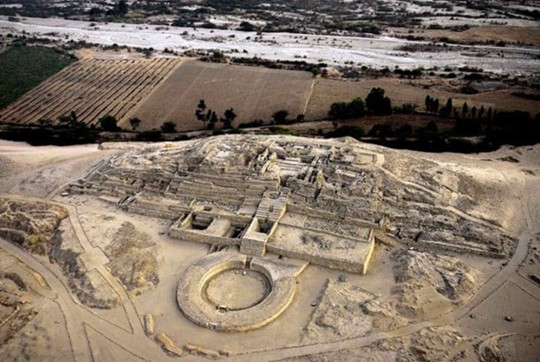
Caral, Supe Valley, North Coast. Temple Complex 5000 BCE

It is amazing that the discovery of insignificant mangrove shells at Siches became the basis for not only proving that El Niño is only 5,800 years old, but provided the causal factors for the origin of Peru’s first civilization. This research just shows that if you live long enough, decades of research will finally pay off with incredible results.
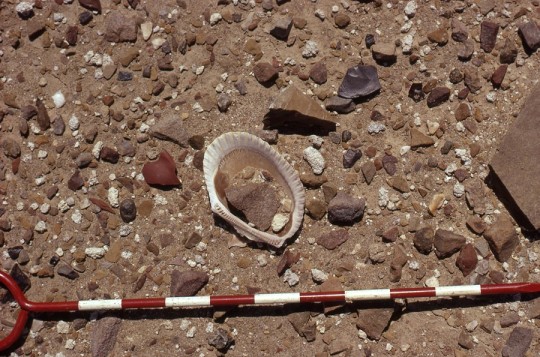
The Shell That Changed Jim’s Life.

James B. Richardson III is the Emeritus Chief Curator of the Section of Anthropology and Emeritus Professor of Anthropology at the University of Pittsburgh. Museum employees are encouraged to blog about their unique experiences and knowledge gained from working at the museum.
Filed Under: Blog Tagged With: anthropology, Jim Richardson, mollusks

February 19, 2019 by wpengine

Octopus mystery: how do they see color?

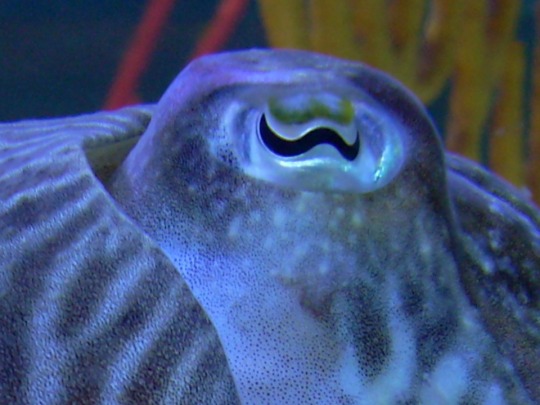
eye of a cuttlefish
Eye of a cuttlefish. Note the W shaped pupil. (Image from Wikimedia Commons)

The eyes of cephalopods like octopus, squid, and cuttlefish possess only one kind of photoreceptor, implying that they are colorblind, being able to see only in greyscale. But wait! They are famous masters of camouflage, being able to blend with their surroundings, and they signal each other in intricate color patterns. These feats suggest that they are not colorblind.

Two main hypotheses to explain this mystery are (1) they also see with their skin (Wardill et al. 2015) or (2) they make use of chromatic aberration (Stubbs & Stubbs 2016).

Cephalopods certainly do possess photosensitive molecules called opsins in their skin, so potential exists for cephalopods to detect light with their skin. However, the photosensitive molecules in the skin are like those in the eyes, so it’s not clear how that would help them see color any better than the eyes do.

Chromatic aberration is the differential bending of light of different wavelengths (colors). That’s how a prism splits white light, and why when your eyes get dilated by the eye doctor, besides things becoming blurry, you also see rainbows around things. Light of different wavelengths passing through a lens has different focal points. For most organisms and for human-made optical devices, chromatic aberration is a problem to be minimized.

The chromatic aberration hypothesis proposes that instead of avoiding chromatic aberration, cephalopods enhance it using their peculiar off-axis pupil shapes. This enhancement allows them to detect color by monitoring image blurring as focus changes. Computer models show that this method of image detection is possible.

Such use of chromatic aberration could explain why cephalopods have such bizarre pupil shapes. The pupil in some octopuses is an elongate slit, and in cuttlefish, it is the shape of a W.

These two hypotheses yield different predictions under certain circumstances, such as colors on a flat field (for which focus would not change). Now we await results of experiments testing between these two possibilities. Then we will have an answer for how cephalopods can see color, despite having the appearance of being color blind. We might need to re-evaluate other creatures that have been labeled colorblind.

Timothy A. Pearce is Curator of Collections, Section of Mollusks at Carnegie Museum of Natural History. Museum employees are encouraged to blog about their unique experiences and knowledge gained from working at the museum.
Literature cited

Kingston, A.C.N., Wardill, T.J., Hanlon, R.T. & Cronin, T.W. 2015. An unexpected diversity of photoreceptor classes in the longfin squid, Doryteuthis pealeii. PLoS ONE 10(9): e0135381. doi.org/10.1371/journal.pone.0135381

Stubbs, A.L. & Stubbs, C.W. 2016. Spectral discrimination in color blind animals via chromatic aberration and pupil shape. Proceedings of the National Academy of Science U.S.A.113: 8206–8211. doi: 10.1073/pnas.1524578113

Filed Under: Blog Tagged With: Cephalopods, mollusks, Section of Mollusks, Tim Pearce

January 28, 2019 by wpengine

Snail Extinction – Bad Situation Getting Worse

By Timothy Pearce

Move Aside Rosy Wolf Snail, the New Guinea Flatworm Wreaks Greater Devastation

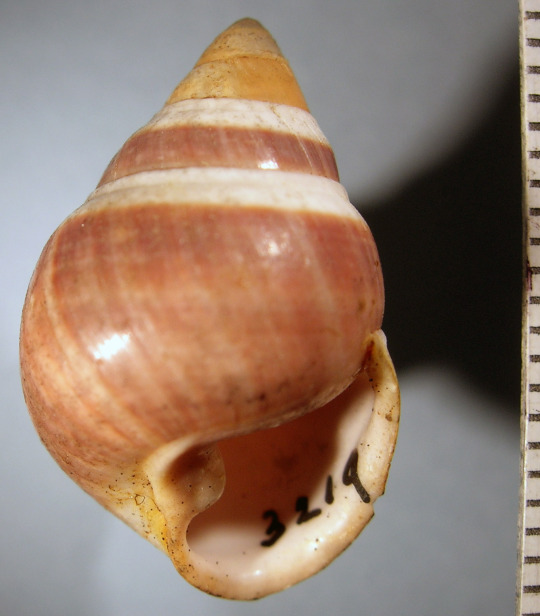
Another species of land snail went extinct on January 1, 2019. George, the last member of his species, Achatinella apexfulva, died in a captive breeding facility at the University of Hawaii. The loss of this snail, and this species, is sad from many perspectives, I’ll mention two: first, George’s species is the first land snail ever described from Hawaii; second, this loss contributes to the largely overlooked extinction crisis of land snails around the world.

Achatinella apexfulva shell
Achatinella apexfulva from the Carnegie Museum of Natural History collection.

George was named after Lonesome George, the last Galapagos tortoise of the subspecies Geochelone nigra abingdoni, who died in 2012. Like most land snails, George the snail was hermaphroditic (having both male and female parts), so either male, female, or androgynous names would have been appropriate.

News outlets including New York Times, National Geographic, and National Public Radio, as well as various blogs (e.g., https://www.shellmuseum.org/curators-corner) have well-covered the story of George’s passing, so look there for more details that I won’t repeat. Those outlets mentioned threats leading to the demise of tree snails, including the introduced rosy wolf snail, a snail-eating snail credited with causing snail extinctions on some Pacific Islands. However, none of those news outlets mentioned the New Guinea flatworm, which is already showing itself to be a much greater threat to snail-kind than the rosy wolf snail.

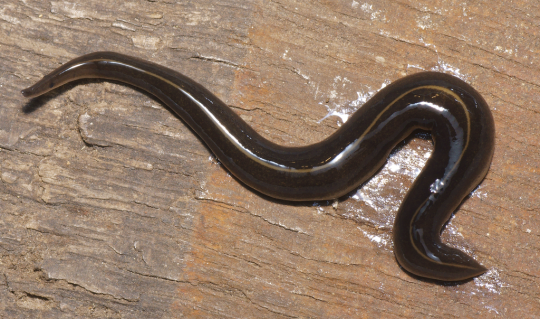
New Guinea flatworm
The New Guinea flatworm (Platydemus manokwari) eats land snails so efficiently that it is causing snail extinctions. Photo from Wikimedia Commons.

The New Guinea flatworm (Platydemus manokwari), which eats mostly snails, has been categorized as one of the 100 worst invasive species. Originally found in New Guinea, human activity has introduced it to many tropical and temperate regions of the world where it has had significant negative impacts on the rare endemic land snail fauna of some Pacific islands. Evidence indicates that predation by the New Guinea flatworm is the greatest cause of the extinction or drastically reduced numbers of several native snails. Up to 65 mm (2.5 inches) long, it can follow snail mucus trails to catch prey, sometimes even into trees, so its presence in Hawaii seriously threatens the remaining Hawaiian tree snails.

In 2015, the New Guinea flatworm was found in Florida, from which it poses a threat to land snails on the mainland of the USA. A colleague told me that in some of the Everglade hammocks where the flatworm has reached, all you can find now are dead, empty shells of the colorful tree snails that were gobbled by the flatworm. The flatworm does not survive in colder climates, so for the time being, the northern United States might be spared from this scourge. The flatworm survives best at 18 to 28 C (64-82F) and nearly ¼ of them survived in an experiment down to 10°C (50F) for 2 weeks.

Timothy A. Pearce is Curator of Collections, Section of Mollusks at Carnegie Museum of Natural History. Museum employees are encouraged to blog about their unique experiences and knowledge gained from working at the museum.
Filed Under: Blog Tagged With: land snails, mollusks, Section of Mollusks, snails, Tim Pearce

January 8, 2019 by wpengine

Warm Those Heart Cockles

By Timothy A. Pearce

The phrase “cockles of your heart” refers to the cockle-like ventricles of the heart. But the cockles that Mary quite contrary had in her garden, and the cockles being sold by Molly Malone, are bivalve mollusks that have heart-shaped shells. Of the cockles, one of the most heart-shaped is Corculum cardissa, also known as the heart cockle.

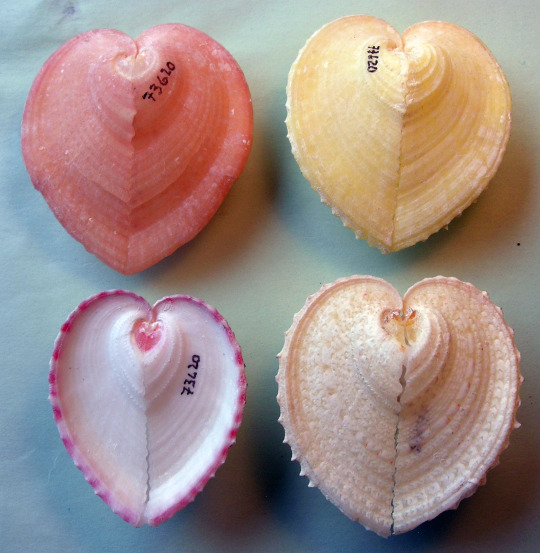
heart cockle specimens
Corculum cardissa (heart cockles) have tiny windows in their shells that let in light for their internal algae to photosynthesize. Photo by Tim Pearce.

Corculum cardissa and the related giant clams (genus Tridacna) have microscopic dinoflagellate algae living inside their bodies (in the mantle, gills, and the liver).

Remarkably, the shells of Corculum cardissa have tiny translucent windows that allow light to penetrate so the algae can photosynthesize. The cockle gets food from the algae, and the algae get a safe place to live. They live together in symbiosis (as happy as an alga).

The windows appear to direct and focus light onto the parts of the clam body containing algae, rather than simply dispersing light (Carter & Schneider 1997).

Both Corculum cardissa and the giant clams live in the Indo-Pacific region. They inhabit shallow water because there is not enough light below about 20 m depth for their algae.

The giant clams and heart cockles (Corculum) are perhaps the only bivalves having a symbiotic relationship with dinoflagellates (Farmer et al., 2001).

Second to the corals, these clams are the best-studied systems of photosynthetic symbionts in animals.

Now there is a story to warm the cockles of your heart on these cold winter days!

Timothy A. Pearce is Curator of Collections, Section of Mollusks at Carnegie Museum of Natural History. Museum employees are encouraged to blog about their unique experiences and knowledge gained from working at the museum.
Literature

Carter, J.G. & Schneider, J.A. 1997. Condensing lenses and shell microstructure in Corculum, (Mollusca: Bivalvia). Journal of Paleontology, 71(1): 56-61.

Farmer, M.A., Fitt, W.K. & Trench, R.K. 2001. Morphology of the symbiosys between Corculum cardissa (Mollusca: Bivalvia) and Symbiodinium corculorum (Dinophyceae). Biological Bulletin, 200: 336-343.

Filed Under: Blog Tagged With: mollusks, Tim Pearce

October 31, 2018 by wpengine

The Tell-Snail Heart

by Timothy A. Pearce

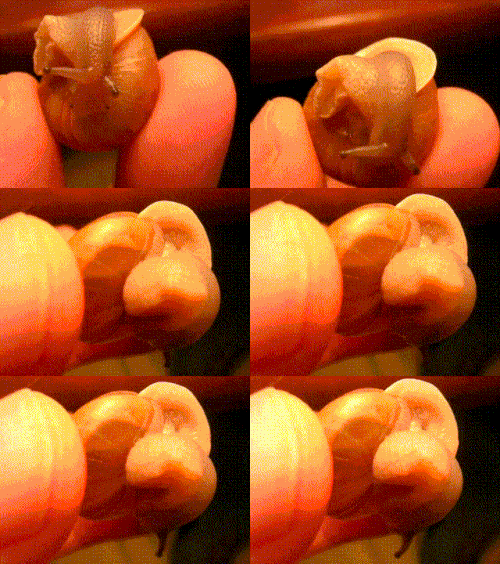
gif of a snail's heart beating

Edgar Allen Poe is well-known as an American writer of poems and short stories, including some spooky works that are often repeated around Halloween. Many people are surprised to learn that Poe once edited a book on shells, “The Conchologist’s First Book”, published in 1839. Poe’s shell book is a condensed version of a book by Thomas Wyatt. Poe wrote the preface and introduction initially; then he made more substantial changes.

Poe’s short story, “The Tell-Tale Heart,” is about someone who kills a man, then hides the body under the floorboards. The murderer, while talking with the police, is initially calm, but goes mad from the perceived sound of a heartbeat, and thinking the sound is the dead man’s beating heart, confesses to the crime.

In honor of Halloween and in recognition of Poe’s contributions to the study of mollusks, I made this gif movie of a snail’s heart beating, visible through the shell. The snail is Neohelix dentifera (the big-tooth whitelip snail), a land snail commonly found in Pennsylvania and elsewhere in northeastern North America. First you see the face with the four tentacles (the upper two tentacles have eyes on the tips; the lower tentacles are for smelling and tasting). Then as I turn the snail you get a quick peek at the breathing pore above the head, then you can look through the translucent shell to see the heart beat 3 times. It is the Tell-Snail Heart!

Timothy A. Pearce is Curator of Collections, Section of Mollusks at Carnegie Museum of Natural History. Museum employees are encouraged to blog about their unique experiences and knowledge gained from working at the museum.

Related Content

Vampire Squid: Cutest Dracula

Happy Highsmith Halloween! A Review of Two Scary Snail Short Stories by Patricia Highsmith

Shark-ish Beasts vs. Cephalopods: Which is Predator, Which is Prey, and is One an Artist?

Carnegie Museum of Natural History Blog Citation Information

Blog author: Pearce, Timothy A.
Publication date: October 31, 2018

Share this post!

  • Share on Twitter Share on Twitter
  • Share on Facebook Share on Facebook
  • Share on Pinterest Share on Pinterest
  • Share on LinkedIn Share on LinkedIn
  • Share on Reddit Share on Reddit
  • Share via Email Share via Email

Filed Under: Blog Tagged With: halloween, mollusks, snails, Tim Pearce

October 22, 2018 by wpengine

Are slugs and snails the same thing?

Are slugs and snails the same thing? Head of Mollusks Dr. Timothy Pearce takes us behind the scenes in the mollusks collection to see the differences between snails and slugs. Plus, find out all about semislugs – a very special type of mollusk.

Ask a Scientist is a video series where we ask our research staff questions about the millions of amazing objects and specimens stored in our museum collection. Tune in on YouTube, and submit your own questions via Twitter @CarnegieMNH!


Filed Under: Blog Tagged With: Ask a Scientist, mollusks, slugs, snails

  • « Go to Previous Page
  • Page 1
  • Interim pages omitted …
  • Page 3
  • Page 4
  • Page 5
  • Page 6
  • Page 7
  • Interim pages omitted …
  • Page 10
  • Go to Next Page »

sidebar

About

  • Mission & Commitments
  • Directors Team
  • Museum History

Get Involved

  • Volunteer
  • Membership
  • Carnegie Discoverers
  • Donate
  • Employment
  • Events

Bring a Group

  • Groups of 10 or More
  • Birthday Parties at the Museum
  • Field Trips

Powdermill

  • Powdermill Nature Reserve
  • Powdermill Field Trips
  • Powdermill Staff
  • Research at Powdermill

More Information

  • Image Permission Requests
  • Science Stories
  • Accessibility
  • Shopping Cart
  • Contact
  • Visitor Policies
One of the Four Carnegie Museums | © Carnegie Institute | Privacy Policy | Terms of Use | Accessibility
Rad works here logo