• Skip to primary navigation
  • Skip to main content
  • Skip to primary sidebar

Carnegie Museum of Natural History

One of the Four Carnegie Museums of Pittsburgh

  • Visit
    • Buy Tickets
    • Visitor Information
    • Exhibitions
    • Events
    • Dining at the Museum
    • Celebrate at the Museum
    • Powdermill Nature Reserve
    • Event Venue Rental
  • Learn
    • Field Trips
    • Educator Information
    • Programs at the Museum
    • Bring the Museum to You
    • Guided Programs FAQ
    • Programs Online
    • Climate and Rural Systems Partnership
  • Research
    • Scientific Sections
    • Science Stories
    • Science Videos
    • Senior Science & Research Staff
    • Museum Library
    • Science Seminars
    • Scientific Publications
    • Specimen and Artifact Identification
  • About
    • Mission & Commitments
    • Directors Team
    • Museum History
  • Tickets
  • Give
  • Shop

Enjoy the Museum from Home via our Blog

Can't make it to the museum in person? We've done our best to help cultivate resources for you to enjoy from home. Activities for the whole family, different ways to experience our exhibitions and more are included in these blogs.

June 22, 2020 by wpengine

The Zebra Mussel and the Shopping Cart

Zebra mussels (Dreissena polymorpha) are eastern European freshwater bivalves that invaded North America. Something unusual about their biology facilitated this invasion.

In marine waters, many benthic (living on the bottom) animals add their babies to the plankton, the mix of small and microscopic organisms largely adrift in the water column.

The situation is different in freshwater where almost all benthic animals lay their eggs on the bottom. (Freshwater plankton exist, but the organisms that compromise it spend their whole lives as plankton.) I don’t know why marine and freshwater animals differ that way, but they do. Zebra mussels are a major exception to this rule; they live in freshwater, but they put their babies (larvae) in the plankton.

How did zebra mussels invade North America? Partially loaded ships require ballast to safely navigate at sea. Decades ago, ships were loaded with rocks and dirt (and slug eggs) as ballast, and when they reached their intended port these materials were removed and replaced with cargo. That is why so many invasive slugs (essentially all your garden slugs are non-native) arrived first in seaports and spread from there.  Ballast tanks that can be easily filled with water and drained are a design feature of modern ships, and depending upon some ship’s departure points, their ballast water sometimes contains larval zebra mussels. For many years, ships were slow enough that zebra mussel larvae arrived in North America dead, but eventually reductions in ocean crossing time worked in the invaders’ favor.  In 1988 some larval zebra mussels arrived alive in the ballast water pumped out into Lake St. Clair near Detroit. By 1990, zebra mussels had infested all the Great Lakes and now they occur in more than half of the 50 United States.
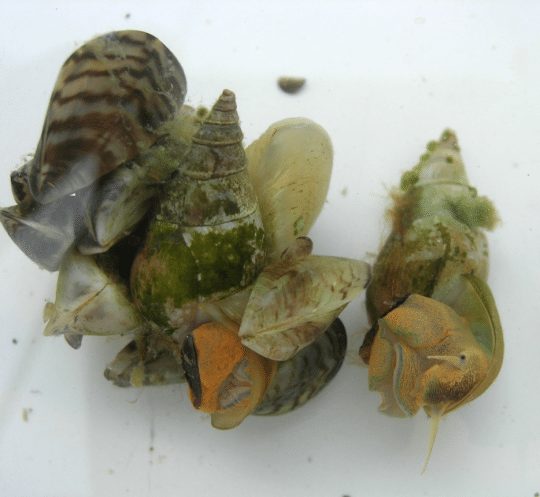
Fig. 1. Freshwater snail (Elimia livescens) colonized by zebra mussels (left) and uncolonized (right). From Douglas Lake, Michigan 30 Aug. 2015 (photo by T.A. Pearce).

The economic and ecological devastation caused by zebra mussels is legendary. Zebra mussels make threads (byssal threads) for attaching to hard objects. They clog intake pipes of city water supplies and power station cooling pipes, requiring costly removal. They compete with native mussels and young fish for food and can smother or hinder movements of our native mussels, snails (Fig. 1), and crayfish when they settle in large numbers.
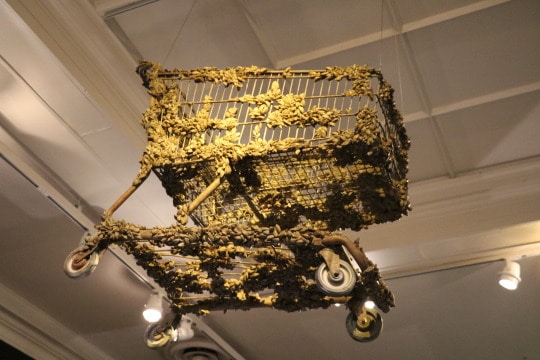
Fig. 2. Replica of shopping cart covered in zebra mussels.

A noteworthy item that became encrusted with zebra mussels is a shopping cart that was dredged out of Lake Superior in 2012. A replica of the shopping cart was on display during the We Are Nature exhibit at Carnegie Museum in 2018 (Fig. 2).

Lest you think I am biased against zebra mussels, I will note two possibly positive things you can say about them. First, they filter water efficiently and because they pump up to a liter (quart) per day, they cleaned up the formerly polluted water in Lake Erie. But even that can be negative, because they removed so much plankton from the water that our native species now have a hard time finding enough to eat. Second, because zebra mussels selectively concentrate certain toxic metals, including uranium, they have potential to be used in bioremediation efforts to clean water of this radioactive pollutant (Immel et al. 2016). But those are the only good things you can say about them. Mostly, they wreak havoc.

Literature Cited

Immel, F., Broussard, C., Catherinet, B., Plasseraud, L., Alcaraz, G., Bundeleva, I. & Marin, F. 2016. The shell of the invasive bivalve species Dreissena polymorpha: biochemical, elemental and textural investigations. PloS One, 11(5): e0154264. https://doi.org/10.1371/journal.pone.0154264

Timothy A. Pearce, PhD, is the head of the mollusks section at Carnegie Museum of Natural History. Museum employees are encouraged to blog about their unique experiences and knowledge gained from working at the museum.

Related Content

Oysters Swim Towards a Siren Soundscape

Slowest Process Ever Observed: A Trillion Times Longer Than the Age of the Universe
From Nebraska or Bust, a Truckload of Mollusks

Filed Under: Blog Tagged With: Anthropocene Living Room, Anthropocene Section, Museum from Home, Science News, Section of Mollusks, Tim Pearce

June 19, 2020 by wpengine

Behind the Scenes with the Baron de Bayet and L. W. Stilwell Collection, Part 2:  The Wild West a Century Ago

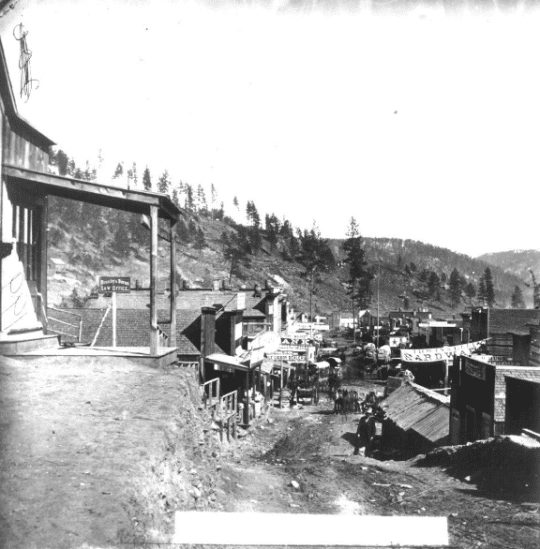
black and white photo of Deadwood from a distance
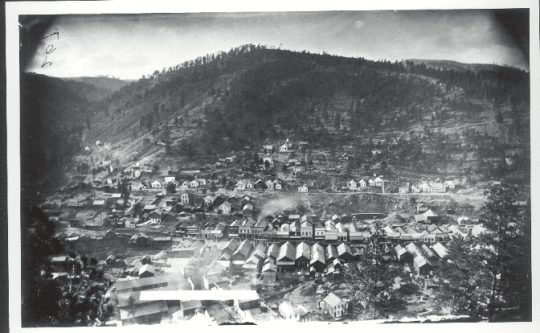
Figure 1:  Deadwood, Dakota Territories 1879.   Image courtesy of the Deadwood Historic Preservation Commission, City of Deadwood Archives.

black and white photo of a Deadwood street
Figure 2:  Deadwood, Dakota Territories 1879.  Image Courtesy of Deadwood Historic Preservation Commission, City of Deadwood Archives.

Fancy yourself on the hottest day in summer in the hottest spot of such a place without water — without an animal and scarce an insect astir — without a single flower to speak pleasant things to you and you will have some idea of the utter loneliness of the Bad Lands.”   Thaddeus Culbertson, 1850

When Lucien Stilwell stepped off the stagecoach on September 25, 1879, he was not your typical visitor to Deadwood.  Photos of Stilwell in later years show a thin scholarly figure with glasses. In 1879, Deadwood, Dakota Territories was known for gold prospecting, gambling and lawlessness.  Just three years prior, Wild Bill Hickock had been shot in the back while playing poker here.  It would be a few more years until Seth Bullock, first sheriff of Deadwood, would begin to bring order to town.

As Stilwell stepped off the stagecoach, he was leaving a fifteen-year career in the grocery and grain business in Cairo, Illinois.  A yellow fever epidemic blanketing parts of the United Sates prompted him to uproot his life.  He arrived just one day before a fire destroyed over 300 buildings and displaced over 2000 people in Deadwood.   According to Michael Runge, City Archivist of Deadwood South Dakota, photos of Deadwood in 1879 (Figures 1 and 2), were taken just before the great fire.  If you look closely at Figure 2, you can see a law office, hardware store, liquor store, and city market.

Despite the great fire and the dangers of Deadwood, Lucien W. Stilwell found a job at a bank, brought his family to town and built a home.  Along the way, he became fascinated by the fossils in the surrounding Black Hills.   He began a careful study of the region and developed relationships with other fossil collectors.   Eventually, he turned his hobby into a side business.

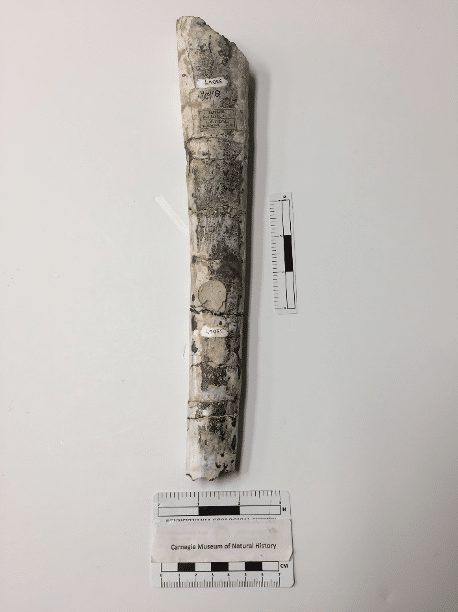
photo of faculties fossil

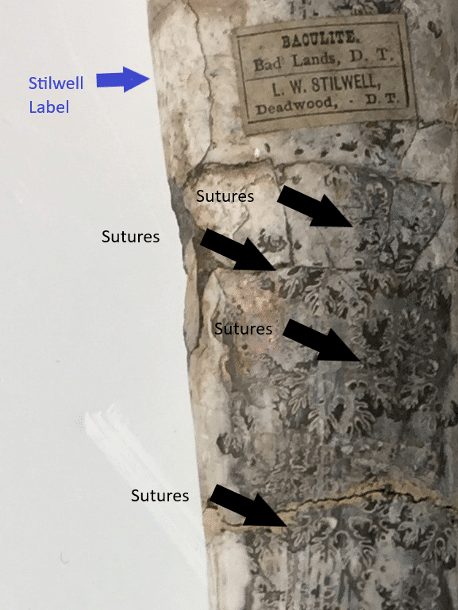
Figures 3 & 4:  CM 33067 – Baculites collected by Stilwell.  Baculites, translated as “walking stick rock”, are an extinct group of straight cephalopods that swam the seas 75 to 80 million years.  “Sutures” or growth lines are formed when the animal adds new shell material as it grows.  Sutures assist paleontologists in the identification of the genus and species.

Prior to leaving the bank in 1890, Stilwell began selling Badland fossils and minerals.  In a correspondence to the Baron de Bayet of Brussels dated January 12, 1889, Stilwell said, “I tried to catch your meaning in your last letter.  As I understand it, you wanted one of every specie and variety of fossils I had, excepting the large and costly specimens of mammals.”    

In one letter to Bayet, Stilwell wrote, “I put in a number of baculites, all of which have some different interest.  One is to show fine sutures another to show iridescence to rare degree, another to show size, another to show form so differing as to be a specie of baculite by another name…”   Albert Kollar of the Section of Invertebrate Paleontology explained that in circumstances when the exact stratigraphic locality is questionable, having the original fossil labels as seen in Fig. 4 are critical to accurate fossil identification.  Stillwell was a capable researcher because of his grasp of the geology and paleontology of the Badlands region.  Figures 3 and 4 show a baculites sold by Stilwell to Bayet.  There are 100 Stilwell fossils in the 130,000 specimen Bayet collection.

The next post in this series will explore why dealers such as Lucien W. Stilwell, found so many fossils in the Badlands.

Many thanks to the generous assistance of Michael Runge, Archivist for the City of Deadwood, South Dakota.

Joann Wilson is an Interpreter for the Department of Education and a volunteer with the Section of Invertebrate Paleontology. Albert Kollar is Collections Manager for the Section of Invertebrate Paleontology. Museum employees are encouraged to blog about their unique experiences and knowledge gained from working at the museum.

Related Content

Behind the Scenes with the Baron de Bayet and L. W. Stilwell Collection, Part 1: Crossing the Atlantic with a Boatload of Fossils

Bayet’s Bounty: The Invertebrates That Time Forgot

A Century Ago, a Donor Walked into the Carnegie Museum

Filed Under: Blog Tagged With: Albert Kollar, Benedum Hall of Geology, invertebrate paleontology, Joann L. Wilson, Museum from Home, Science News

June 18, 2020 by wpengine

Eastern Garter Snake Encounter

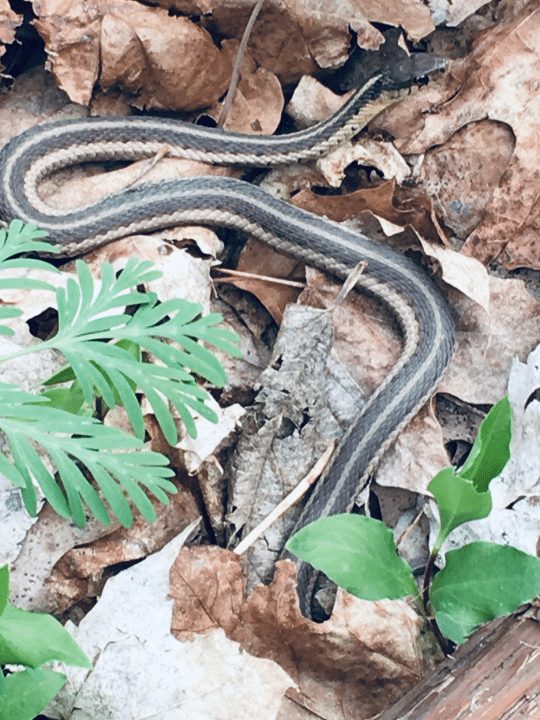
photo of garter snake in leaves

The eastern garter snake never moved. I only noticed the harmless reptile because my hands were within inches of its sleek body as I crouched to photograph a large-flowered trillium. The image above is a result of an abrupt subject change, but rushing wasn’t necessary. I was later able to photograph the intended wildflower without disturbing its striped neighbor.

After perhaps 90 seconds of sharing space with the snake, I backed carefully away from the blooming patch of forest understory within the Allegheny Land Trust’s Barking Slopes Natural Area. Later that day, in the pages of a trusted reference book, I found an explanation for what seemed an unusually passive predator.

Amphibians and Reptiles of Pennsylvania and the Northeast, is a Cornell University Press publication from 2001 by three authors with deep ties to CMNH, Arthur C. Hulse, long a Research Associate for the Museum’s Section of Herpetology, the late C. J. McCoy, a curator within the Section between 1964 and 1993, and Ellen J. Censky, a curator within the Section between 1994 and 1998.

The 5 pages of the 400-page volume devoted to garter snakes includes a description of the snake’s wide range of reactions to close encounters with our species.

“At one extreme, some remain fairly quiescent and allow themselves to be picked up and will not attempt any defensive behavior. At the other extreme, individuals flatten the head and body, flare the lips to expose teeth, and strike violently.”

The authors cite research indicating that young garter snakes are more aggressive after eating a large meal, a behavior that might occur because recently ingested food reduces their mobility, and therefore their chances for successful escape.

By this line of reasoning, the docile creature I encountered might simply have been hungry.

Patrick McShea works in the Education and Visitor Experience department of Carnegie Museum of Natural History. Museum employees are encouraged to blog about their unique experiences and knowledge gained from working at the museum.

Related Content

Northern Ribbon Snake

Lost and Found

Flying Snakes? Unique Reptile Adaptations

Filed Under: Blog Tagged With: Education, Educators, herpetology, Museum from Home, Pat McShea, Patrick McShea

June 17, 2020 by wpengine

Meet our two new curators!

Dr. Travis Olds

photo of new curator of minerals Travis Olds

Hello! My name is Travis Olds. I’m Assistant Curator of Minerals in the Section of Minerals and Earth Sciences at Carnegie Museum of Natural History. I’m from the Upper Peninsula of Michigan, the northern part of the state that is sometimes confused as being a part of Canada, but also considered by many as one of the most beautiful places on Earth. People born in the U.P., as we call it, are known colloquially as “Yoopers,” and like Canadians we are some of the kindest people you will meet. Many Yoopers have an accent that is best described as a mix between Canadian and Minnesotan; we tend to elongate and over-emphasize vowels in spoken words, with favorites being “ya, eh, you betcha, and don’tchya know.” Our favorite dish is the pasty (“pastee”), a baked meat and vegetable-filled pastry that was introduced early in our state’s history by Cornish miners who traveled to the area to make a living and share their knowledge of mining techniques developed overseas.

Hundreds of mines have operated in the U.P. over the last ~200 years, yielding billions of tons of iron and manganese used for the steel produced here in Pittsburgh, and millions of tons of copper used across the world for plumbing, electrical lines, and electronics. Although many mines in the U.P. have long been abandoned, a few iron and copper mines are still in operation today. For several generations my family has made a living working in the mines, including my father and uncle, who were large influencers to my interest in minerals.

As I started collecting and learning more about minerals I became fascinated by radioactive minerals, the ones containing uranium and thorium. Uranium minerals come in many beautiful shapes and colors. They sometimes fluoresce neon green and yellow colors under UV light, and emit invisible high-energy particles during their decay. Although we owe our basic understanding of X-rays and many modern medical technologies and treatments to early studies of radioactive minerals, uranium remains one of the most controversial elements on the periodic table. It has been used to create exceptionally valuable technology but has also created unimaginable evil and pain. In the future, I believe nuclear power will likely become one of the dominant methods for producing “base-load” power to replace the antiquated and highly pollutive coal and natural-gas burning energy plants. I study the atomic arrangement and properties of uranium minerals because they are good analogs for advancing several aspects of nuclear power generation, from mining to processing and storage of used fuel and waste. My mineral collecting trips have taken me to unique places underground in Colorado, Utah, and the Czech Republic, and thanks to the group of friends and researchers that I work with, I have been lucky to find and describe 20 new minerals. At the museum, I research minerals to improve technology and better understand how humans are changing the minerals found on the Earth’s surface.

Photos of our new minerals can be found on my Mindat.org page.

Dr. Carla Rosenfeld

photo of new curator of earth sciences Carla Rosenfeld

Hello! I’m Carla Rosenfeld, the new Assistant Curator of Earth Sciences in the Section of Minerals and Earth Sciences at Carnegie Museum of Natural History. I received my Ph.D. in Soil Science and Biogeochemistry from Penn State and a B.S in Chemistry from McGill University. Following my Ph.D., I worked as a postdoctoral fellow at the Smithsonian National Museum of Natural History and University of Minnesota. After several years away, I am so excited to be returning to Pennsylvania to continue my research!

As a researcher, I am an interdisciplinary environmental biogeochemist. I use tools from mineralogy, geochemistry, and microbiology to study how pollutants and nutrients behave in the environment. I am fascinated by how biology, geology, and chemistry interact – for example when plant roots scavenge nutrients from soils by dissolving minerals, or when organisms form biominerals (think teeth, shells, and corals). Understanding how living and non-living things interact in different environments helps us to understand and predict how nature will respond to changing climate and other human impacts. Because I’m interested in how microbes make and alter minerals in soils, I’ve visited all sorts of places to collect soils, plants, water, and microbes (mostly bacteria and fungi). I’ve been down to the bottom of the deepest and oldest underground iron mine in Minnesota (Sudan Mine, ~ 1 mile below the ground surface!), to hot springs and the world’s only captive geyser in Idaho, and, right here in Southwest PA, to acid mine drainage remediation systems! Outside of science, I love to spend time outdoors biking (I even biked across the US from CT to CA one summer), mushroom hunting (my favorite mushrooms to find are golden chanterelles, Cantharellus cibarius or Cantharellus lateritius), and generally spending time outdoors. I also love to bake (including science cakes!), and I’ve kept a spreadsheet detailing everything I’ve baked for the last 5 years!

Related Content

Fungi Make Minerals and Clean Polluted Water Along the Way!

What do Minerals and Drinking Water Have to do with Each Other?

The Mineralogy of Ice Cream

Filed Under: Blog Tagged With: Carla Rosenfeld, gems and minerals, Hillman Hall of Minerals and Gems, Museum from Home, Science News, Section of Minerals, Travis Olds, Wertz Gallery

June 16, 2020 by wpengine

The Mineralogy of Ice Cream

by Travis Olds

Have you ever made ice cream at home?

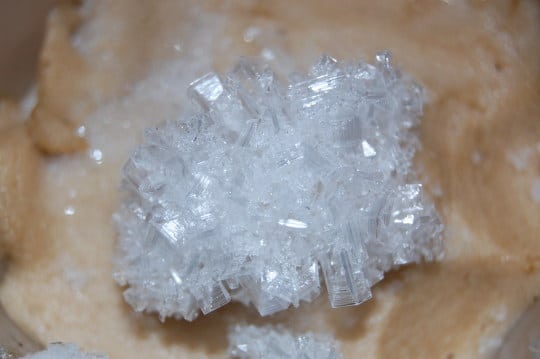
You may have noticed that homemade ice cream has a different texture than what you buy at the grocery store or get at an ice cream shop. Homemade ice cream can taste “grainy” with a coarse texture, unlike the creamy Ben and Jerry’s from the store. This is because ice crystals in homemade ice cream are usually much larger than the ice cream made by professionals.

close up of ice crystals
“Ice Crystals”by glenngurley is licensed under CC BY-NC-SA 2.0

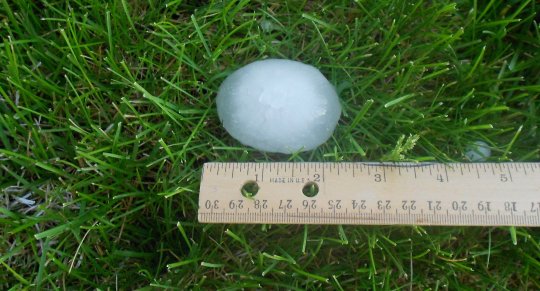
This is where mineralogy comes in. In nature, large mineral crystals take time to grow, sometimes growing for up to 100,000 years or more! The same is true for ice and snow, which happen to be minerals too. The shape and size of snow crystals that fall from the sky are controlled intricately by the outside air temperature, relative humidity, and time. Snowflakes are usually largest when they spend a long time in the air and at temperatures a bit below the freezing point, near 15 °F. At colder temperatures, the crystals grow quickly and are smaller. Fortunately, we won’t be seeing snow for a while, however, summer can bring even larger balls of ice from the sky! During thunderstorms, hail stones can grow VERY large (up to 15 cm or nearly 6 inches in diameter), sometimes spending up to 30 minutes swirling around updrafts in the icy and rainy conditions within storm clouds.

two-inch piece of hail next to ruler in the grass

To make a smooth and creamy ice cream, companies like Ben and Jerry’s use freezers cooled to very cold temperatures, -40 °F, that quickly freezes the cream thereby producing tiny ice crystals. Ice cream prepared at home is made with a salty mixture of ice and water that can reach nearly -5 °F, but at this temperature the ice crystals grow more slowly and larger. When the crystal size reaches about 50 micrometers, roughly the width of a human hair, your mouth senses the coarse texture.

Three steps you can take to make creamier ice cream at home:

1.     Use a higher fat content by adding more cream. More fat will “spread” out water molecules in the cream, creating more nucleation sites, or growth places, for ice and smaller crystals.

2.     Using crushed ice, instead of ice cubes, will bring the ice/salt mixture to a lower temperature. Also, pre-chilling the cream and sugar before placing it in the salt bath will help speed up freezing, producing smaller crystals.

3.     Use “dry ice,” or frozen carbon dioxide, available at many grocery stores, for even lower temperatures and faster crystallization. But be careful, dry ice should only be used with proper gloves and under adult supervision.

Travis Olds is Assistant Curator of Minerals at Carnegie Museum of Natural History. Museum employees are encouraged to blog about their unique experiences working at the museum.

Related Content

Hip and “Trashy” Ice Cream

What Do Minerals and Drinking Water Have To Do With Each Other?

Thanksgiving and Nutritional Mineralogy

Carnegie Museum of Natural History Blog Citation Information

Blog author: Olds, Travis
Publication date: June 16, 2020

Share this post!

  • Share on Twitter Share on Twitter
  • Share on Facebook Share on Facebook
  • Share on Pinterest Share on Pinterest
  • Share on LinkedIn Share on LinkedIn
  • Share on Reddit Share on Reddit
  • Share via Email Share via Email

Share this post!

  • Share on Twitter Share on Twitter
  • Share on Facebook Share on Facebook
  • Share on Pinterest Share on Pinterest
  • Share on LinkedIn Share on LinkedIn
  • Share on Reddit Share on Reddit
  • Share via Email Share via Email

Filed Under: Blog Tagged With: gems and minerals, Hillman Hall of Minerals and Gems, Museum from Home, Science News, Section of Minerals, Travis Olds

June 15, 2020 by wpengine

What Do Minerals and Drinking Water Have to Do With Each Other?

In the same way scientists discover new plant or animal species, new minerals are usually found by exploring new places with hard work and determination, but also sometimes by pure chance and luck. In fact, you do not need to be a scientist to make exciting discoveries. You do need, however, to follow the basic steps of the scientific method when doing any research: (1) first ask a question you are interested in; (2) research that question; (3) develop a hypothesis; (4) test it; (5) analyze the data your tests generate; (6) draw conclusions; (7) and communicate the results.

When describing a new mineral, mineralogists like me gather a slew of analytical data about the atomic arrangement, chemical makeup, and optical and physical properties to completely characterize the mineral. The data we gather is recorded and accessible, so that when others find similar crystals the analytical data for those specimens can be compared. Allowing your findings to be further tested and improved, or even shown to be wrong, forms the foundation of all fields of science and medicine.

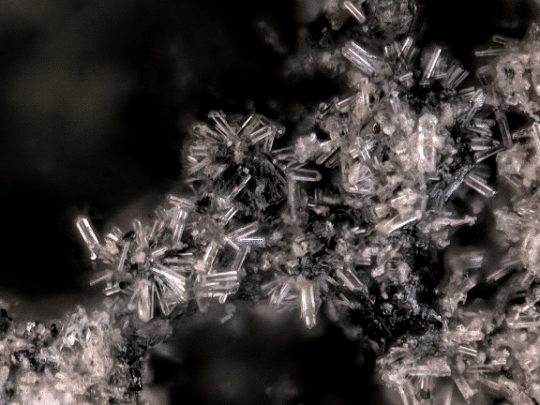
tiny hydroxylpyromorphite crystals
A microscope image of tiny transparent crystals of hydroxylpyromorphite from the Copps mine, Marenisco, Gogebic County, Michigan. Field of view is 0.45 mm. 

I recently gathered analytical data for the new mineral hydroxylpyromorphite, a mineral with a mouthful for a name, but one that is extremely important to removing toxic lead from drinking water. Hydroxylpyromorphite is a lead phosphate mineral, and part of a larger group of minerals with related crystal structures (the arrangements of atoms) called the apatite group. Our bones and teeth are made of apatite, calcium phosphate, and the natural processes that move this critical building block throughout our bodies are disrupted when exposed to lead, potentially causing brain damage and other diseases. Lead is especially dangerous to children, and to prevent lead poisoning, water treatment plants often add phosphate to the water supply. Under the right conditions, phosphate grabs strongly onto lead atoms, forming hydroxylpyromorphite and removing it from the water. Until our description, the crystal structure of this mineral was unknown. Now that we understand the crystal structure, the information can be used by others to develop better techniques or processes that reduce lead in drinking water.

Travis Olds is Assistant Curator of Minerals at Carnegie Museum of Natural History. Museum employees are encouraged to blog about their unique experiences working at the museum.

Filed Under: Blog Tagged With: gems and minerals, Hillman Hall of Minerals and Gems, Museum from Home, Science News, Section of Minerals, Travis Olds

  • « Go to Previous Page
  • Page 1
  • Interim pages omitted …
  • Page 14
  • Page 15
  • Page 16
  • Page 17
  • Page 18
  • Interim pages omitted …
  • Page 26
  • Go to Next Page »

sidebar

About

  • Mission & Commitments
  • Directors Team
  • Museum History

Get Involved

  • Volunteer
  • Membership
  • Carnegie Discoverers
  • Donate
  • Employment
  • Events

Bring a Group

  • Groups of 10 or More
  • Birthday Parties at the Museum
  • Field Trips

Powdermill

  • Powdermill Nature Reserve
  • Powdermill Field Trips
  • Powdermill Staff
  • Research at Powdermill

More Information

  • Image Permission Requests
  • Science Stories
  • Accessibility
  • Shopping Cart
  • Contact
  • Visitor Policies
One of the Four Carnegie Museums | © Carnegie Institute | Privacy Policy | Terms of Use | Accessibility
Rad works here logo