• Skip to primary navigation
  • Skip to main content
  • Skip to primary sidebar

Carnegie Museum of Natural History

One of the Four Carnegie Museums of Pittsburgh

  • Visit
    • Buy Tickets
    • Visitor Information
    • Exhibitions
    • Events
    • Dining at the Museum
    • Celebrate at the Museum
    • Powdermill Nature Reserve
    • Event Venue Rental
    • Gift Cards
  • Learn
    • Field Trips
    • Educator Information
    • Programs at the Museum
    • Bring the Museum to You
    • Guided Programs FAQ
    • Programs Online
    • Climate and Rural Systems Partnership
  • Research
    • Scientific Sections
    • Science Stories
    • Science Videos
    • Senior Science & Research Staff
    • Museum Library
    • Science Seminars
    • Scientific Publications
    • Specimen and Artifact Identification
  • About
    • Mission & Commitments
    • Directors Team
    • Museum History
  • Tickets
  • Give
  • Shop

Enjoy the Museum from Home via our Blog

Can't make it to the museum in person? We've done our best to help cultivate resources for you to enjoy from home. Activities for the whole family, different ways to experience our exhibitions and more are included in these blogs.

January 26, 2021 by wpengine

Fancy Feathers: An Unexplained Complexity in Evolutionary History

One of the most complex and highly intricate wonders of the flying world owes nothing to DaVinci’s studies on mechanical flight, the Wright brothers’ pioneering of aviation, or any other human-derived aeronautic technology. The most sophisticated piece of engineering used for flight has its origins in the Age of Dinosaurs and is one of the most common sights in our everyday lives: feathers.

Feathers as We Know Them

Modern-day feathers come in a seemingly infinite variety of sizes, shapes, and textures. Though their diversity is immense, each type is made of beta-keratin, a structural protein found in the skin of both reptiles and birds, and their branching structures have the same basic parts. The main shaft is composed of a hollow barbless base, known as the calamus or quill, and a central shaft, called the rachis. The rachis branches into main barbs and they branch even further into barbules.
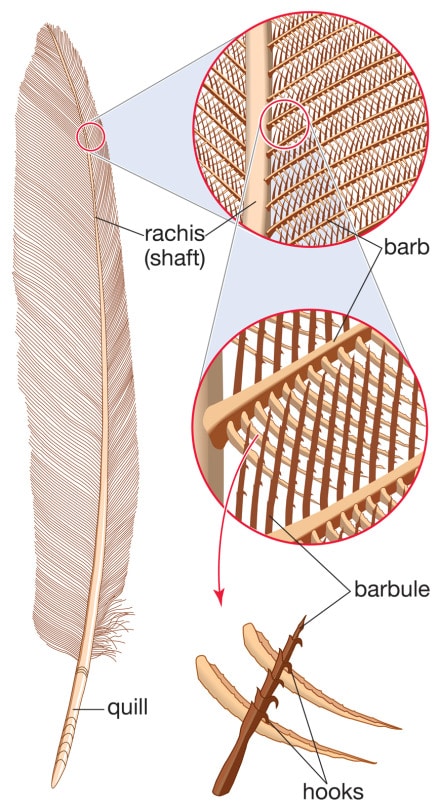
illustration of feathers showing the quill, rachis, barb, barbule, and hooks

The variety of feathers comes from small modifications to this basic branching structure to serve different functions. Feathers fall into a few general categories, which will be briefly describe here, and many more specific subcategories.
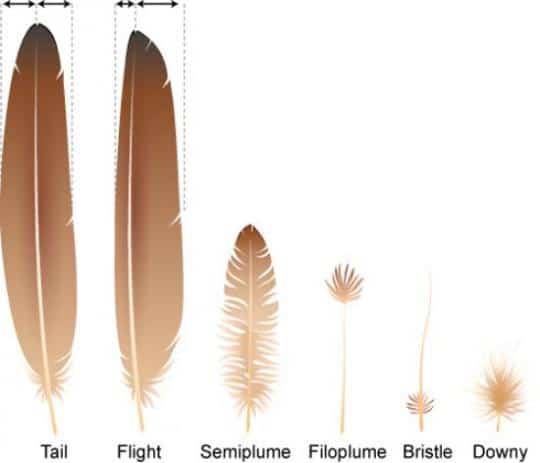
illustration of six feathers from longest to shortest: Tail, Flightl, Semiplume, Filoplume, Bristle, and Downy

Bristles have a simple, stiff, and tapered rachis with few barbs. They are usually found on a bird’s head around their mouth, nostrils, and eyelids. Some experts think they are for protection much like eyelashes, others believe they serve a sensory function as evidenced by the nerve endings found at their base, and many support both theories.

Filoplumes are also simple and mostly bare of barbs except a tuft at the tip. They are found near contour feathers. Given their placement and the presence of unmyelinated nerve fibers, which are those that support peripheral sensory functions in their base, filoplumes act like whiskers by sensing the position of contour feathers.

Semiplume and down feathers are mostly hidden underneath outer feathers. Their loose branching structures appears fluffy and is highly effective for insulation.

Contour feathers include those that cover the surface of the bird. As their name suggests, these feathers follow the shape of the body, streamlining and weatherproofing it along the way like overlapping shingles. From the central shaft extends a series of slender barbs, each sprouting smaller barbules that are lined with tiny hooks. When these grasp on to the hooks of neighboring barbules, they create a structural network that is almost weightless yet remarkably strong. As the outer visage, these feathers also support decoration and camouflage.

Contour feathers also include the amazing evolutionary innovations mentioned in the introduction: flight feathers. Flight feathers are long, stiff, asymmetrically shaped, but symmetrically paired feathers on the wings or tail of a bird. They are built for durability, shaped for precision, and combined with musculature to produce the ultimate flying tool. The wing feathers, known as remiges, have uniform windproof surfaces, or vanes, on either side of the central shaft created by the interlocked hooks found on the barbules. These feathers are asymmetric with a shorter, less flexible leading edge that support stability and maneuverability. Similarly structured tail feathers, known as retrices, are arranged in a fan shape that allows for precision steering during flight.

While we can simulate some of these characteristics with our flying technologies, we have yet to create a machine that is as versatile, efficient, and effective as bird feathers in flight. Even more impressive, birds are not stuck with one set of feathers for their whole lives. Damaged or worn feathers can be replaced through the process of molting. During a periodic molt, old feathers are shed and new ones grow in their place keeping birds in top flying shape. You can’t say that about any of our manmade flying machines.

The Question of the Evolution of Feathers
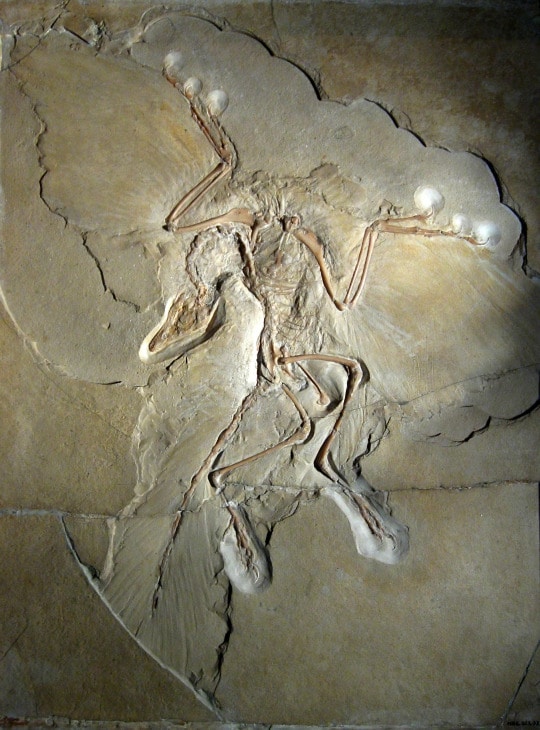
avian fossil

The consensus among paleontologists is that birds, known taxonomically as the class Aves, are a group of maniraptoran theropod dinosaurs. Evidence found in the fossil record suggests that most major lineages of modern birds arose near the end of or right after the Cretaceous period (between 65-60 million years ago). Feathers now exclusively occur in avian dinosaurs (e.g., birds), but that was not always the case. With the discovery of the bird-like dinosaur Archaeopteryx in the 1860s and confirmed with further feathered dinosaur discoveries in the 1990s, feathers have been found on much earlier, non-avian species suggesting that their evolutionary beginnings stem at least as far back as the Jurassic.
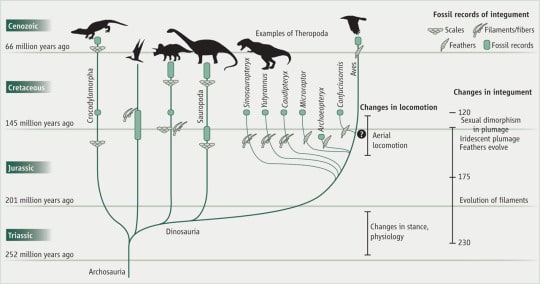
illustration of feather evolution from the Triassic to Cenozoic

Several theories have been explored and subsequently unraveled in recent years regarding the origin of birds and the evolution of feathers. Once the link between birds and reptiles was evidenced, some scientists theorized that birds did not evolve from dinosaurs. Instead, they are related by a distant common ancestor that has yet to be discovered. This theory, however, does not account for the striking similarities between the skeletons of birds and those of the highly feathered theropods.

Others theorized that maybe scales and feathers were both flat because feathers were an elongation of scales with frayed edges that eventually became the feathers we see today. They supposed that this growth over generations could have been prompted as an adaptation for flight. Maybe they helped these reptiles live in tree canopies by aiding gliding, which turned into the capability of flight. Such a “feathers-to-flight” theory would nicely tie up answers to all of the questions posed above and was fairly long-lived. With the discovery of hundreds of feathered, ground-running theropods, however, this theory proved to be discardable. So, too, dinosaurs far removed from theropods and even further removed from birds have been found with feathers that were not used for flight.
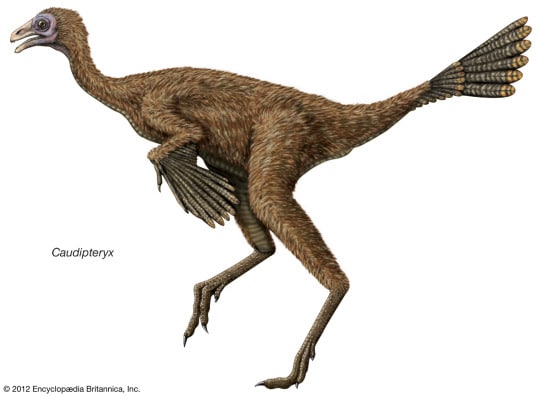
illustration of Caudipteryx

The feathers on the earliest non-avian dinosaurs did not look like the modern-day feathers described above. This fact has led to a new line of thinking about the transition from scales to feathers. From what we know from the fossil records, the earliest feathers, sometimes called protofeathers, were small, hollow filaments that appeared more like fuzz than feathers. Studying feathered specimens chronologically, the feathers slowly became more and more complex over time possibly because of an evolutionary impetus. The study of this feather development has prompted a new look into the genomic manipulation of placodes. Integumentary placodes are embryonic structures involved in the development of hair follicles, feathers, and teeth. Recent studies using modern genomic methods to identify feather-associated placodes have demonstrated the ability to turn scales into feathers. By turning key molecular circuits on and off at critical stages of scale development, researchers have been able to stimulate feather-like growths in alligator skin cells.
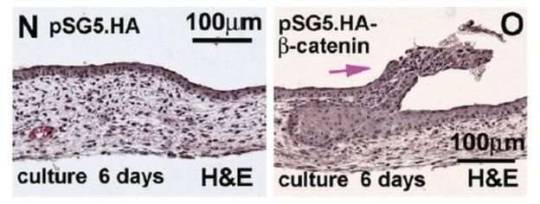
placodes

Though interesting, indeed, and something to keep an eye out for in new studies, none of this research is conclusive. Other studies suggest that convergent evolution might solve some of these riddles or more digging for fossils might be the best option. In any case, there is still much to learn about how the feathered dinosaur that you watch at your birdfeeder or hear outside your window evolved into what it is today.

Jane Thaler is a Gallery Experience Presenter in CMNH’s Life Long Learning Department. Museum staff, volunteers, and interns are encouraged to blog about their unique experiences and knowledge gained from working at the museum.

Related Content

Ask a Scientist: How are birds like dinosaurs?
Super Science Activity: DIY Catapult

Snow White Bird Search

Filed Under: Blog Tagged With: Museum from Home, Super Science, Taking Flight

January 21, 2021 by wpengine

Nerding Out Over Masting, or Why Unusual Plant Reproduction Excites Animal Ecologists

As for many people, every pandemic month that passes marks another month since I’ve been able to travel. I realized recently that this is the longest time I’ve gone without getting on a plane since about the 5th grade (my parents divorced and lived in different states), and the longest I’ve gone without leaving the country since 2004. One reason I became an ecologist is because the work afforded me the opportunity to travel as part of my job, and that aspect is one of the main things I love about my work. For many tropical ecologists, the pandemic has marked a year of lost opportunities to travel to our field sites. Though my ongoing projects will survive this missed year of data, I miss the forest, and have spent many hours remembering all the things that made me fall in love with tropical field work in the first place.

image
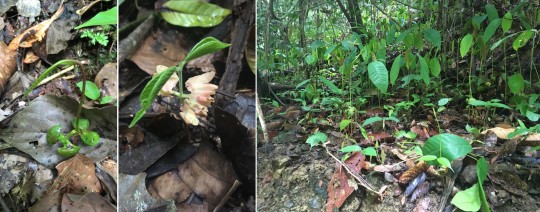
Figure 1. Seedlings at Danum Valley, Sabah, Malaysia, October 2019.

One of my favorite forest phenomena is masting. Trees in the family Dipterocarpacae dominate SE Asian rainforests. These are the world’s tallest rainforest trees, reaching more than 90 meters in height, and they reproduce by masting, which are irregular fruiting events. In northern Borneo, there is no set wet or dry season; rain falls year-round but there are sporadic dry periods that vary from year to year. Thus, there is no regular spring/flowering season like we have here in the US. Instead, the Dipterocarps reproduce in masting events, usually following strong droughts. The reason animal ecologists get excited by these masting events is because during these periods the forest seems to explode with life. The first time I went to one of my field sites (Danum Valley) was during a masting event (2010), and I had no idea how rare and special it was. I thought that it was normal to see two clouded leopards eating a mouse deer, or to see orangutans pretty much every day, or to have elephants tip over your car while you’re out surveying frogs (true story!). In the following years, I realized how incredible it was to have been there at that time. I was a little sad that my chances of seeing another masting event were low, but I got lucky again in 2019 when I spent a month at Danum during its most recent masting year.

As a herpetologist, I admit that I don’t fully appreciate all of the botanical intricacies of masting. But the most visually noticeable thing about a masting event is that it makes the forest look as though someone has planted thousands and thousands of seedlings all over the forest floor. This is incredibly striking because much of the forest doesn’t normally have a lot of undergrowth, but rather widely spaced giant trees. It would be like seeing the redwood forest with seedlings blanketing the forest floor. I have a ridiculous number of pictures of both the forest floor and individual seeds and seedlings in an enormous variety of shape and size, and will gladly bore anyone willing to look at them.

image
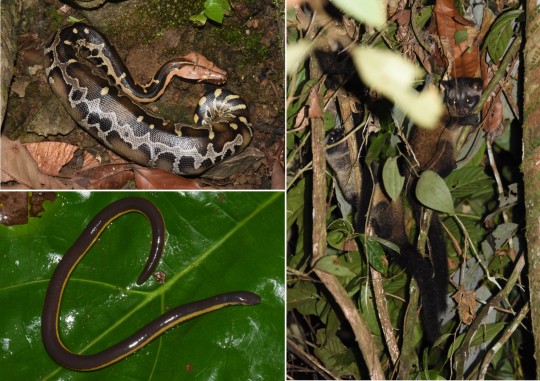
Figure 2. Borneo short python (Python breitensteini), caecilian (Ichthyophis sp.), and palm civet (Paradoxurus philippensis).

As I mentioned above, masting events also bring out heaps of animals that I don’t often otherwise see. In my first week, while setting up an introduction to electro-fishing for my students, we saw an orangutan about 30 meters away. He then came down to the forest floor, crossed the stream a little ways up from us, and walked off into the forest on the other side. Later that afternoon as I was setting up the exercise on a different stream, a lizard known as a water monitor (Varanus) was swimming downstream toward us, got spooked up onto shore by our presence, and ran right into the mouth of a concealed king cobra–!! While we couldn’t see the cobra’s full body, we clearly saw its unmistakable head scales as it was pulling the Varanus back into its hiding spot, and heard the incredible growl that cobras let out when they don’t want to be bothered. The rest of the month saw numerous species of snakes, a giant softshell turtle, my 4th ever caecilian (a limbless amphibian), mom and baby civets (a small carnivorous mammal), and in keeping with the field session’s mission, awesome frog data collected together with my students. While these animals are always present in the forest, masting events seem to bring them out in force, making all of them much easier to see.

As we start 2021, I am cautiously hoping that this year will see us all getting vaccinated, making travel safe once again. I hope to return to Borneo for more incredible encounters alongside my regular data collection, to better understand the incredible forest that hooked me into tropical field ecology in the first place.

Jennifer Sheridan is Assistant Curator in the Section of Amphibians and Reptiles at Carnegie Museum of Natural History. Museum employees are encouraged to blog about their unique experiences and knowledge gained from working at the museum.

Related Content

A Head Above the Rest: Unearthing the Story of Our Leatherback Sea Turtle

The Enduring Appeal of Snakes

Ask a Scientist: What is the creepiest specimen in the Alcohol House?

Filed Under: Blog Tagged With: amphibians and reptiles, herpetology, Jennifer Sheridan, Museum from Home, Science News

January 21, 2021 by wpengine

Are You Pishing at Me? Winter Birding in Pennsylvania


Leaves have fallen and so has snow, low clouds shroud the blue sky in a drop-ceiling effect, and the frigid air either sits still or stings in gusty winds.  Winter can be a bleak and unforgiving season, yet some birds stick around the Pittsburgh area for the coldest months while others arrive here from more northern climates to spend the winter.  Why not head to the warmer south like other birds?  What food is there among the leafless trees?  Who are these hardy little things with wings?

In the forest, the birds work throughout the day.  Moving in mixed flocks high up in skeletal trees, chickadees and titmice often lead a band of woodpeckers and nuthatches.  The flock probes crevices in tree bark or lingering brown leaves on trees for overwintering insects as eggs, pupae, larvae, or adults.  Spiders are also important food items.  These invertebrate morsels are fat and protein-rich foods especially important for tiny birds to survive cold nights.

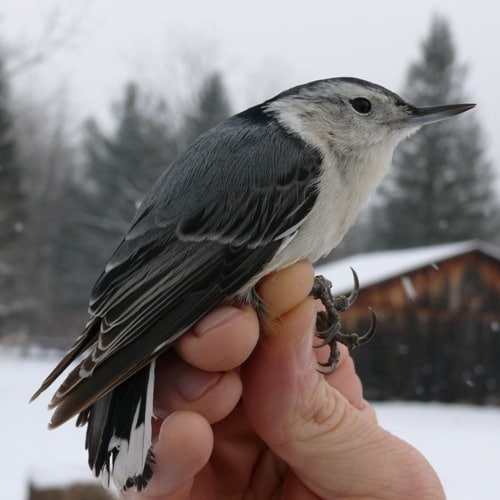
White-breasted Nuthatches are notable for scaling down tree trunks head-first.  Listen for a nasal “yank” call.

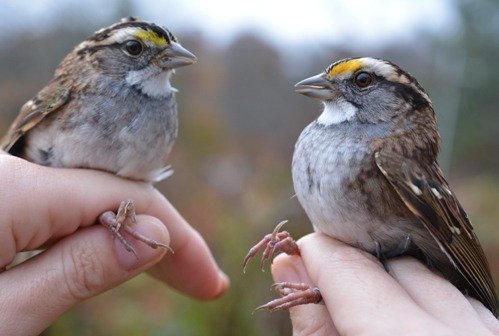
Two white-throated sparrows, with namesake white throats, but also notice the differing yellow and orange lores on these two birds.

The curious and taunting titmice and chickadees are agile fliers and keep watch for hunting hawks and owls, sending out warning calls to alert the foraging party of danger.  On the ground in protected thickets, a different flock searches for food in the forest’s leafy floor.  Resident song sparrows and tree sparrows are joined by white-throated sparrows and dark-eyed juncos from the boreal forests.  These birds avoid a long migration and the enormous energy toll it takes, choosing instead to scavenge for seeds and insects during the short winter days.  Their reward is first dibs on prime summer breeding territory—surely a distant memory to keep them warm during the long, cold winter nights.

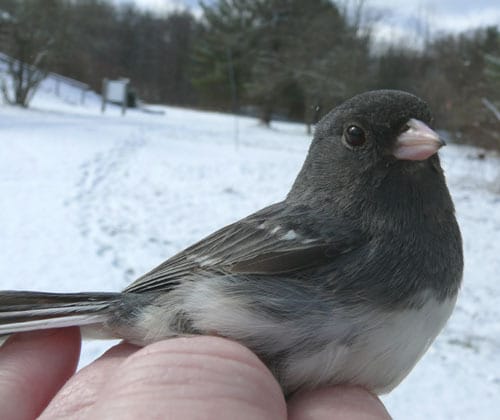
Dark-eyed Juncos are small birds with a gray back and white belly.  Also, notice the pink bill.

When Carolina wrens join these flocks, their trilling and warning calls are distinct.  For the naturalist, imitating the warning call of a bird like the wren can lure in a mixed winter flock for easier observation.  Relying on a type of voice distortion to lure birds is called “pishing.” It is a great skill for birders to master, and it’s useful year-round.  Pishing varies for the bird you want to attract, but usually has a short, staccato “p” straight into a loud “shhh” with variable inflections.  The idea of pishing is to attract birds with a warning call, a sort of call-to-arms which then triggers the formation of a tiny bird gang ready to chase off a predator.  The birds will often join in with their own warning calls and flit about nervously on nearby branches.  Observing the diversity of mixed flocks in the winter demonstrates the unique way these amazing animals work together to survive.

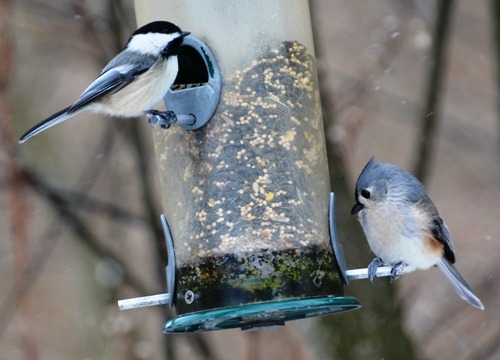
A Black-capped Chickadee (left) and Tufted Titmouse (right) at a feeder.  These two species often travel together.

Fall and winter are also the seasons for bird feeders, where hungry foragers can reliably find a banquet of millet, sunflower, and thistle seeds—even better when caked in suet.  Under some conditions feeding stations become colorful places.  The dull reddish-purple feathers of house finches and purple finches glow against a backdrop of snow, while goldfinches and cardinals ornament nearby trees.  Sparrows, titmice, wrens, and blue jays dip in and out at a feeder to fill up on seeds.  Chickadees come and peck at empty feeders, calling in a squeaky chant for a refill.

Aaron Young is a museum educator on Carnegie Museum of Natural History’s Outreach team. Museum staff, volunteers, and interns are encouraged to blog about their unique experiences and knowledge gained from working at the museum. Images from Powdermill Nature Reserve’s bird banding highlights. 

Related Content

Bird Safe Glass Installed at Carnegie Museums in Oakland

2020 Rector Christmas Bird Count

The Crows Are Back in Town

Filed Under: Blog Tagged With: Aaron S. Young, Birds, Educators, Museum from Home

January 21, 2021 by wpengine

A Head Above the Rest: Unearthing the Story of Our Leatherback Sea Turtle

When you think of BIG sea creatures, you probably imagine great white sharks, huge blue whales, or ginormous cephalopods like the giant squid (or, for the more imaginative, the Kraken!). But would you believe me if I told you that the ocean is also home to a reptile that grows far larger than a human? Many people are familiar with the “typical” green sea turtle (Chelonia mydas) or even the hawksbill sea turtle (Eretmochelys imbricata), known for its beautifully patterned shell. However, these species are dwarfed in size compared to the leatherback sea turtle (Dermochelys coriacea). Adult leatherback sea turtles are usually 6 to 8 feet long and 550 to 1500 pounds. To put that into context, imagine 3 to 8 adult men of average height and weight huddled together or 8 to 24 Labrador retriever dogs playing about in a group (now THAT would be heavenly!). An animal that big takes up a great deal of room, which is fine in the expansive ocean but is rather problematic if such a turtle is to become a museum research specimen. That is exactly the case with CM 44460, the famous leatherback sea turtle housed in the Carnegie Museum of Natural History’s Section of Amphibians and Reptiles.

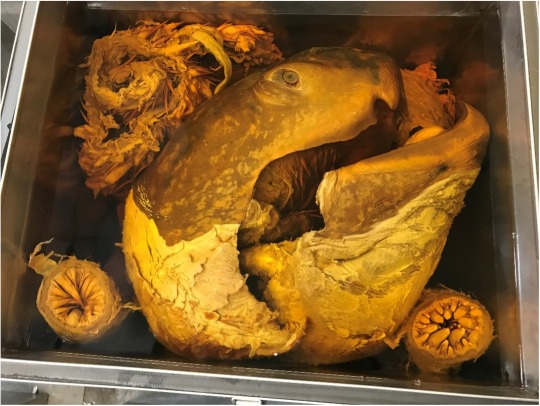
Head and esophagus of leatherback sea turtle CM 44460. The esophagus is so large it needed to be split into pieces— the two circles at the lower left and right corners of the tank and the large mass in the top left corner. Leatherback sea turtles lack teeth, and instead rely on spikey protrusions present in their mouths and esophagi to keep down their favorite prey item, jellyfish.

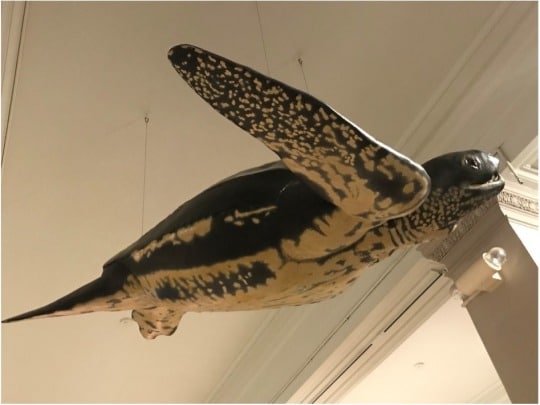
Cast of CM 44460 hanging above visitors in Discovery Basecamp.

When people tour the Section of Amphibians and Reptiles, we make it a point to open one of the first metal tanks our guests see, tank 156. This tank houses a single impressive specimen – the giant head and esophagus of a leatherback sea turtle. I started as the collection manager of the section just under two years ago and, until recently, the only information I had for this specimen were the scant details noted in the section’s database and on a printed sheet attached to the lid of the tank: a fisherman had found the specimen dead when it washed ashore in Maine in 1965. That was it. I knew the entire animal (not just the head) had washed ashore since a cast was made of the body and that replica is now hanging in Discovery Basecamp. I also knew ecological and herpetological information about the species in general, but nearly every specimen in a natural history collection has a story, and I knew this one had to be good… but I didn’t know what it was…

… until I began digitizing the section’s archives.

Let’s take a step away from our leatherback sea turtle specimen to understand what “digitizing the section’s archives” really means. Carnegie Museum of Natural History is over 100 years old, and the herpetology archives date back to the museum’s inception. That means we had, at the time I became involved with the digitizing work, nearly 125 years of correspondence, field notes, specimen data, and collection-related events to clean, scan, and properly organize and house both physically and electronically. (For a more in-depth dive into this archiving process, see section archivist Ren Jordan’s post here.) It took a team of about 10 people (part-time and full-time interns, work-study students, and staff members) over a year to complete this daunting task. The treasure trove of information we unearthed in those archives is priceless, and CM 44460’s story is a treasure worth sharing.

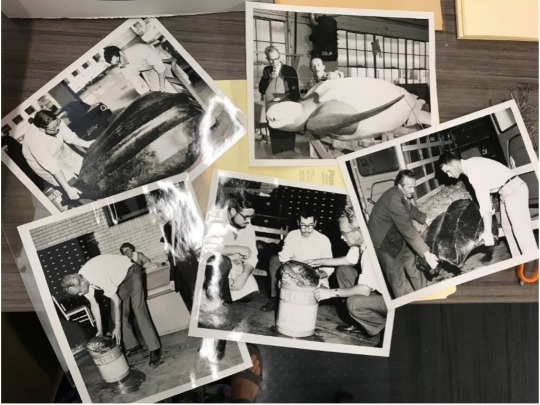
Images from archives showing how staff members prepared CM 44460 to be accessioned into the herpetology collection and displayed to the public. Clockwise from the top left: Herpetology staff members C. J. McCoy and Arthur Bianculli lift the shell onto a cart for transport; Herpetology curator Neil D. Richmond and museum preparator Otto M. Epping measure out the cast of CM 44460 created from the shell and body measurements; Preparator Otto M. Epping and Exhibits staff member Forest Hart removing the shell from a cargo van upon arrival to the Carnegie Museum; Herpetology staff members C. J. McCoy, Arthur Bianculli, and Neil D. Richmond examine the head of CM 44460 in a large potato chip can; Herpetology curator Neil D. Richmond shows the head to museum director M. Graham Netting as another staff member looks on.
black and white photo of three men pulling a turtle head out of a can

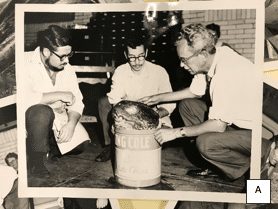
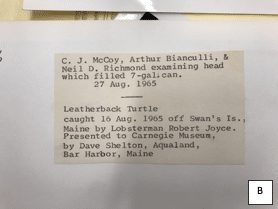
Herpetology staff members C. J. McCoy, Arthur Bianculli, and Neil D. Richmond examine the head of CM 44460 in a large potato chip can upon its arrival to the museum (A). The complete description of the image as it appears affixed to the back of the image (B).

During the digitization work, the archival material I processed included the field notes of past-curator Dr. C. J. McCoy, and among his papers was a crumbly old folder labeled “CM 44460” that required rehousing. The number lacked any context for me at the time because the section has over 180,000 catalog (or CM) numbers and, try as I might, I don’t yet have them all memorized. When I pulled out pictures from the folder, though, CM 44460’s identity instantly became apparent, for I found myself looking at the images of our famous leatherback sea turtle. One picture showed the creation of the cast and another depicted the shell being carried by two men due to its size. Another image showed Dr. McCoy crouched with two other men near a huge open tin can labeled “Potato Chips” with, shockingly, the head of dear CM 44460 peeking out of the top. A note affixed to the back of the image read “C. J. McCoy, Arthur Bianculli, & Neil D. Richmond examining head which filled 7-gal. can. 27 Aug. 1965. Leatherback Turtle caught 16 Aug. 1965 off Swan’s Is., Maine by Lobsterman Robert Joyce. Presented to Carnegie Museum by Dave Shelton, Aqualand, Bar Harbor, Maine” (Image 4B). Suddenly pieces of the story were falling into place. This specimen was transported from Maine to Pittsburgh in pieces, with the head arriving separate from the body and shell in a 7-gallon potato chip container!

A couple months later, I unearthed another folder in the archives with data from the specimen. The documents recorded the preservation process of the turtle, including measuring and weighing different organs (knowing that they would be too large to properly preserve and store), and how long it took the head to become fully and properly fixed in formalin. Through these notes, I learned that the turtle was a female measuring 7’5” from the tip of her tail to the tip of her snout, and that her ocean wandering was powered by a flipper-span of 8’4”! Based upon her carapace (the top part of a turtle shell) measuring in at 5’5”, this turtle was likely sexually reproductive and, therefore, rather old. CM 44460’s story is so much clearer now and really goes to show how each specimen in a collection has its own unique history just waiting to be investigated.

Stevie Kennedy-Gold is the collection manager for the Section of Amphibians and Reptiles at Carnegie Museum of Natural History. Museum employees are encouraged to blog about their unique experiences and knowledge gained from working at the museum.

Related Content

Ask a Scientist: What is a pitfall trap (for herpetology)?

Do Snakes Believe in the Tooth Fairy?

Lantern Slides

Filed Under: Blog Tagged With: amphibians and reptiles, herpetology, Museum from Home, Science News, Stevie Kennedy-Gold

January 19, 2021 by wpengine

Insect metamorphosis: the key to a fresh new start

For many people, the new year represents an opportunity to make a fresh start, consider self-improvement, or turn over a new leaf. As in all fields of human endeavor, insects are way ahead of us and have already developed the ultimate technology for personal reinvention: metamorphosis.

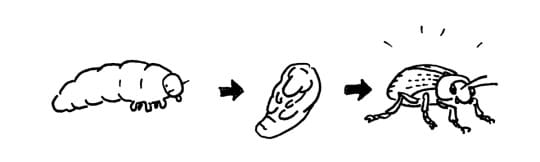
drawing of the stages of metamorphosis

Among entomologists, “metamorphosis” refers to the process by which a tiny hatchling insect becomes a fully functioning adult. This process can take place in two ways. Incomplete metamorphosis is the process by which an insect molts through a series of increasingly large, adult-like stages (“instars”) before completing the final molt into an adult. Insects that develop this way include grasshoppers, stink bugs, dragonflies, termites, and mantises.

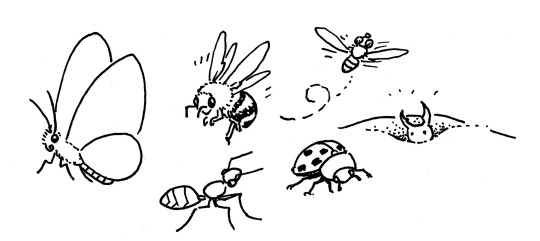
drawing of various insects including a butterfly, bee, and beetle


Complete metamorphosis, on the other hand, involves a (typically) worm-like larva which undergoes a quiescent, or inactive, pupal stage before reaching adulthood. Insects that undergo complete metamorphosis include beetles, ants, bees, wasps, lacewings and antlions, flies, and moths. These orders are often described as “holometabolous,” which simply means that their development includes pupation.

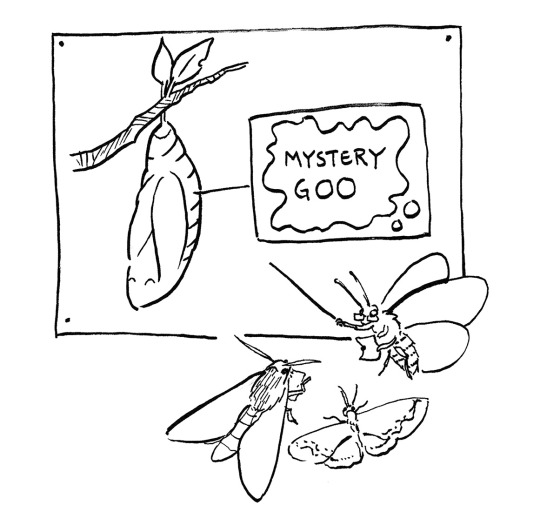
drawing of a moth teaching other moths about cocoons and turning to "mystery goo"


The process of pupation is fascinating and mysterious: essentially, the caterpillar zips itself up into a sleeping bag made of its own skin, turns to soup, and comes out a butterfly. How?

In fact, insect pupation remained a scientific mystery for many years, largely because of the difficulty in observing the pupation process without destroying or interfering with development. However, interfering with development turned out to be the key to understanding this process: early investigators (e.g. Jan Swammerdam, the 17th century microscopist) discovered that structures corresponding to the approximate positions of future wings could be dissected from within late stage, prepupal larvae. Several centuries later, the ability to induce fluorescence in selected cell lines allowed researchers to observe the activity of these future wings, legs, and antennae throughout larval development. This research led to the identification of what are now known as “imaginal discs.”

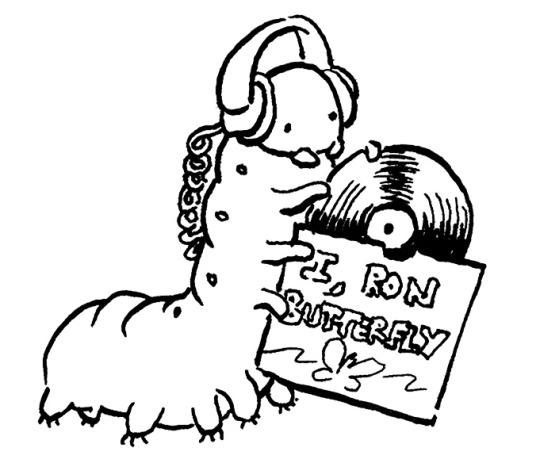
caterpillar wearing headphones holding a record called "I, Ron Butterfly"

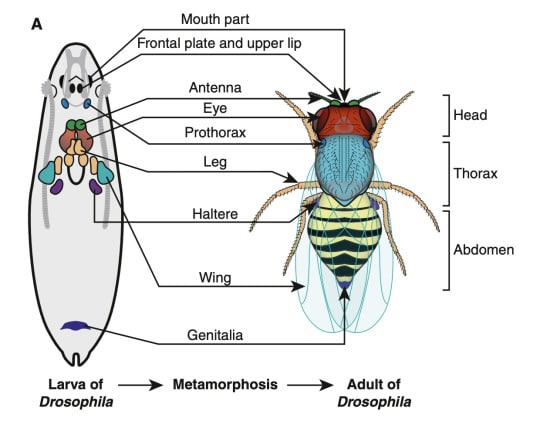
Here’s how it works: secret little collections of cells are formed during embryogenesis, and rest dormant inside the larva as it grows. The larva and its essential larval structures (usually the digestive system) grow larger, but the dormant cells do very little. These cells are known as imaginal cells and their aggregate structures are called imaginal discs (The term refers not to imagination, but to the imago, a synonym for the insect’s adult stage). The cells within these imaginal discs are largely dormant until a special cue— temperature, day length, growth, or otherwise— triggers the hormones that kickstart pupation. The larva forms a tough outer casing from its outermost exoskeleton or uses silk glands to create a protective nest (e.g. a cocoon).

metamorphosis diagram
Image source: Aldaz, S. and Escudero, L.M., 2010. Imaginal discs. Current Biology, 20(10), pp.R429-R431.

As pupation begins and the larval body breaks down into fluid, the imaginal discs begin to undergo rapid development, telescoping outward to form the longer legs, wings, antennae, mouthparts, and other complex adult body structures. The only remnants of the larva that stay functional are the tracheae, hollow tubes which allow it to breathe.

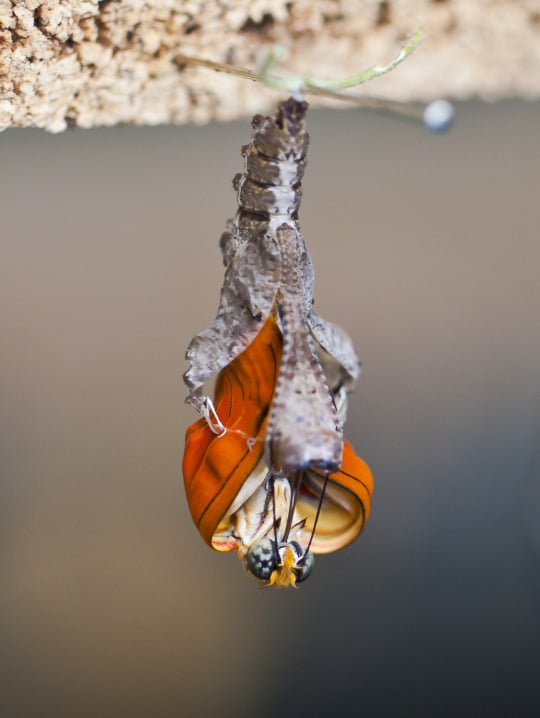
Once the adult structures are fully formed, they will remain soft in order to fit inside the now too-small pupa. The pupal case splits open, and the newly emerged adult insect forces air and fluid into its new wings to unfurl them fully before they harden.

butterfly emerging from cocoon
Image from Creative Commons.

Forming a hard outer casing and liquefying your existing body may not sound like an inspirational concept for the new year, but perhaps it should. The lesson of the butterfly is that the developmental foundations of the beautiful, functional adult were inside the awkward, squirmy larva all along. The imaginal cells were always there, just waiting to be awakened.

For more discussion of insect pupation and tips on using caterpillars to get kids into science, see this previous IZ blog post by Dr. Jim Fetzner, “Kids and Caterpillars: Fostering a Child’s Interest in Nature by Rearing Lepidoptera (Moth and Butterfly) Larvae.”

Ainsley Seago is Associate Curator of Invertebrate Zoology. Museum employees are encouraged to blog about their unique experiences and knowledge gained from working at the museum.

Related Content

O-Do-Nates or O-Don’t-Nates: Dragonflies and Damselflies in the Section of IZ

Looking for Bugs in Your Yard

Why One Bug Just Won’t Do…

Filed Under: Blog Tagged With: Ainsley Seago, insects, Invertebrate Zoology, Museum from Home, Science News

January 15, 2021 by Erin Southerland

King’s Dream and Natural History

During the summer of 1963, Martin Luther King Jr. referenced the geographic high ground of our region in his “I Have a Dream” speech when he intoned:

“Let freedom ring from the heightening Alleghenies of Pennsylvania.” 

Fifty-seven summers later, in the face of indisputable evidence that King’s dreams have not become reality, many institutions are renewing commitments to equal opportunities at all levels of their operations. In the field of natural history, a territory that’s neither defined nor bound by museum walls, there have been clear calls for more and safer opportunities to explore the great outdoors, to routinely participate in experiences that build an interest in natural history.

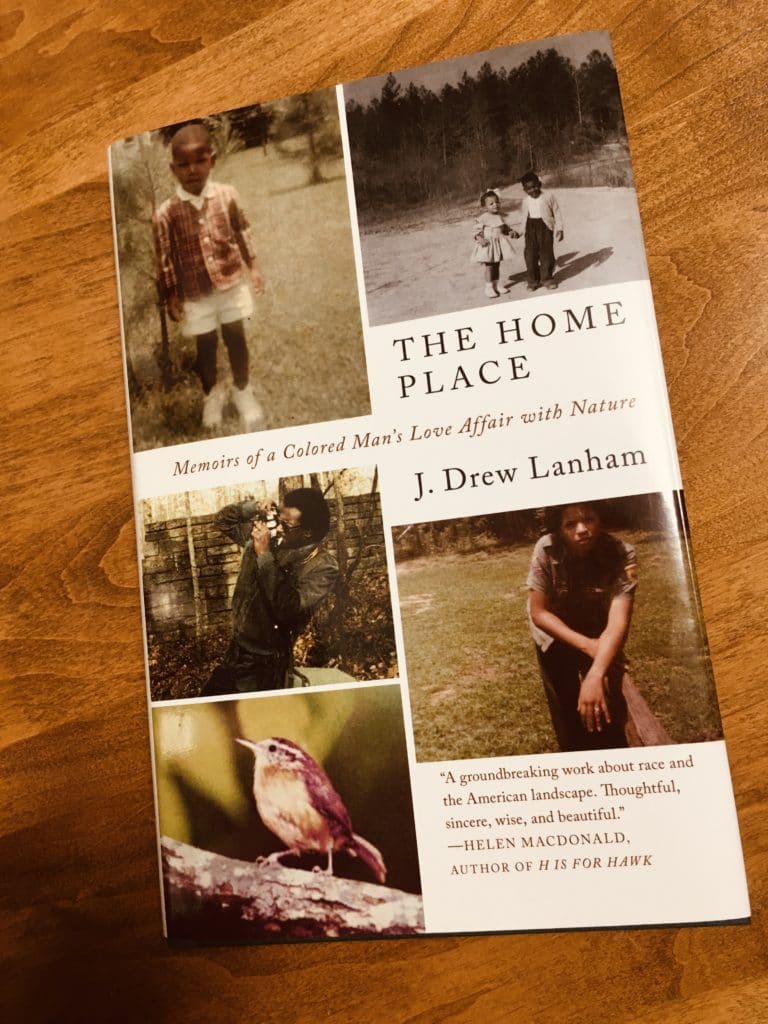
photo of the book "The Home Place: Memoirs of a Colored Man's Love Affair with Nature" by J. Drew Lanham

One of the most articulate calls can be found in The Home Place: Memoirs of a Colored Man’s Love Affair with Nature, a highly praised 2016 book by J. Drew Lanham, professor of wildlife ecology at Clemson University. In a chapter titled, Birding While Black, the author describes a field work incident while checking small mammal traps in a remote section of South Carolina mountains in the company of a white female wildlife biologist.  The two, both South Carolina Department of Natural Resources biologists, were followed, turn for turn, on twisting logging roads by three white men in a battered pickup truck, triggering, before the pursuit was abandoned, what Lanham terms “an edge that I’d only experienced in very bad dreams.”

Several paragraphs later, Lanham offers this:

The wild things and places belong to all of us. So while I can’t fix the bigger problems of race in the United States – can’t suggest a means by which I, and others like me, will always feel safe – I can prescribe a solution in my own small corner. Get more people of color “out there.” Turn oddities into commonplace. The presence of more black birders, wildlife biologists, hunters, hikers, and fisher folk will say to others that we, too, appreciate the warble of a summer tanager, the incredible instinct of a whitetail buck, and the sound of wind in tall pines. Our responsibility is to pass something on to those coming after. As young people of color reconnect with what so many of their ancestors knew – that our connections to the land run deep, like taproots of mighty oaks; that the land renews and sustains us – maybe things will begin to change.

For many of us there’s a clear “ask” in Lanham’s statements. Our answers and actions have potential to move the heightening Alleghenies region closer to King’s dream.

Patrick McShea works in the Education and Visitor Experience department of Carnegie Museum of Natural History. Museum employees are encouraged to blog about their unique experiences and knowledge gained from working at the museum.

Related Content

Harriet Tubman was a Naturalist

What Does it Mean to be for a Place?

We Are Nature: Living in the Anthropocene (Video)

Filed Under: Blog Tagged With: Museum from Home

  • « Go to Previous Page
  • Page 1
  • Page 2
  • Page 3
  • Page 4
  • Interim pages omitted …
  • Page 26
  • Go to Next Page »

sidebar

About

  • Mission & Commitments
  • Directors Team
  • Museum History

Get Involved

  • Volunteer
  • Membership
  • Carnegie Discoverers
  • Donate
  • Employment
  • Events

Bring a Group

  • Groups of 10 or More
  • Birthday Parties at the Museum
  • Field Trips

Powdermill

  • Powdermill Nature Reserve
  • Powdermill Field Trips
  • Powdermill Staff
  • Research at Powdermill

More Information

  • Image Permission Requests
  • Science Stories
  • Accessibility
  • Shopping Cart
  • Contact
  • Visitor Policies
Stay in the loop! Sign up for our newsletter(s).
One of the Four Carnegie Museums | © Carnegie Institute | Privacy Policy | Terms of Use | Accessibility
Rad works here logo