• Skip to primary navigation
  • Skip to main content
  • Skip to primary sidebar

Carnegie Museum of Natural History

One of the Four Carnegie Museums of Pittsburgh

  • Visit
    • Buy Tickets
    • Visitor Information
    • Exhibitions
    • Events
    • Dining at the Museum
    • Celebrate at the Museum
    • Powdermill Nature Reserve
    • Event Venue Rental
    • Gift Cards
  • Learn
    • Field Trips
    • Educator Information
    • Programs at the Museum
    • Bring the Museum to You
    • Guided Programs FAQ
    • Programs Online
    • Climate and Rural Systems Partnership
  • Research
    • Scientific Sections
    • Science Stories
    • Science Videos
    • Senior Science & Research Staff
    • Museum Library
    • Science Seminars
    • Scientific Publications
    • Specimen and Artifact Identification
  • About
    • Mission & Commitments
    • Directors Team
    • Museum History
  • Tickets
  • Give
  • Shop

Enjoy the Museum from Home via our Blog

Can't make it to the museum in person? We've done our best to help cultivate resources for you to enjoy from home. Activities for the whole family, different ways to experience our exhibitions and more are included in these blogs.

December 18, 2020 by wpengine

Mary Anning:  For the Love of the Blue Lias

image
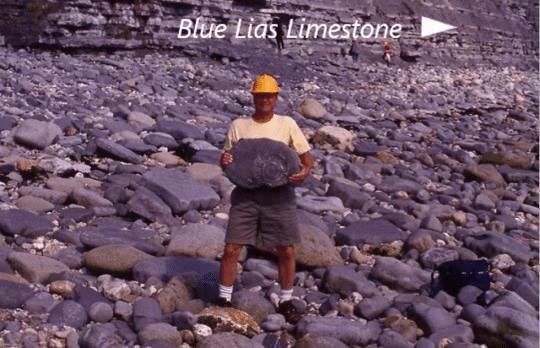
Figure 1:  Albert Kollar holding a fossil, Lyme Regis, 1999.

Two hundred million years before the birth of Mary Anning, a village in southeast England known as Lyme Regis, (Figure 1) was a shallow, watery world filled with pointy toothed reptiles, fish, and an abundance of ammonites.   By 1799, the year of Mary’s birth, these ancient seas that deposited lime, silt and mud, had long receded, but evidence of the watery past remained in the Lyme Regis limestone and mudstone cliffs.  Today, this region is part of a geologic formation of early Jurassic age known as the Blue Lias.
image
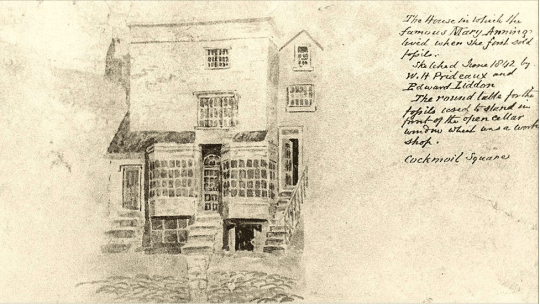
Figure 2:  Drawing of Mary Anning’s house in Lyme Regis, Dorset, England. June 1842. Text on the drawing reads: The House in which the famous Mary Anning lived when she first sold fossils. Sketched June 1842 by W. H. Prideaux and Edward Liddon. The round table for the fossils used to stand in front of the open cellar window which was a work shop. Cockmoil Square

Mary’s father, Richard Anning, hunted fossils along the Lyme Regis coast to supplement his meager carpentry income.   Mary and her brother, Joseph, accompanied their father along the landslide prone cliff in search of fossils to collect and sell to wealthy patrons and the scientific community.  When she was 11, Mary’s father died of tuberculosis. His death left Mary, her mother and brother destitute.  Despite the loss, they continued the family fossil business.  At the age of 12, just one year after her father’s death, Mary excavated and identified the first ichthyosaur.   Although Mary had no formal education and received no formal recognition for her monumental find, word of her abilities spread in the male dominated paleontological community.  By the 1820’s, she managed the family fossil shop (Figure 2), a business where survival depended on finding major new specimens.   At the age of 24, Mary uncovered the first plesiosaur skeleton and just five years later, the first pterosaur discovered in England.
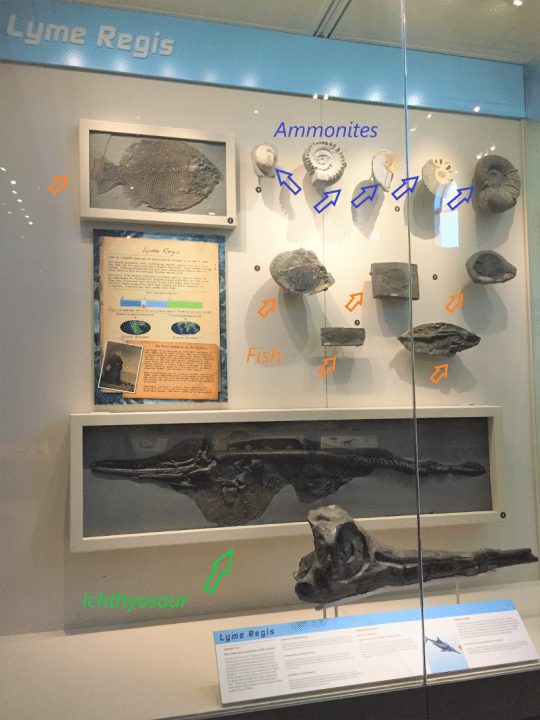
Figure 3:  Carnegie Museum of Natural History Lyme Regis display, Dinosaurs in Their Time exhibition.  Includes real fish, ammonites and an ichthyosaur.

Visitors to Carnegie Museum of Natural History’s Dinosaurs in Their Time exhibition can scrutinize fish scale sized details in fossils from the Lyme Regis cliffs, an extraordinary level of preservation that Albert Kollar witnessed in the field when he collected fossils from the locality in 1999. (Figure 3).

A new movie, titled “Ammonite,” staring Kate Winslet as Mary Anning, promises to captivate a new generation with this often-overlooked chapter in the history of paleontology.

Despite hardship, lack of recognition, and danger, Mary continued working until her death from breast cancer in 1847. Her contributions to science were not formally recognized for over a century. In 2010, the Royal Society of London named her “one of the ten most influential women scientists in British History”

In a recent CMNH blog post, William Vincett, University of Delaware graduate student and Collecting Assistant for the Section of Invertebrate Paleontology, wrote, “It’s easy to see how she developed a love of fossils after discovering such a magnificent creature as a child.”   Yes.  Mary wondered, suffered, and persevered for the love of the Blue Lias.

Joann Wilson is an Interpreter for the Department of Education and volunteer with the Section of Invertebrate Paleontology and Albert Kollar is Collections Manager for the Section of Invertebrate Paleontology.  Thanks to author Barry Alfonso for thoughtful insight. Museum staff, volunteers, and interns are encouraged to blog about their unique experiences and knowledge gained from working at the museum.

Related Content

The Hidden Fossil Treasures of the Section of Invertebrate Paleontology
Millions, Billions, and Trillions

Ask a Scientist: What is a trilobite?

Filed Under: Blog Tagged With: Albert Kollar, invertebrate paleontology, Joann Wilson, Museum from Home, Science News

December 17, 2020 by wpengine

Dutch Letters: A Sinterklaasavond Treat

Baking traditions are shared across the globe during the winter holiday season. Like many others, my family typically gets together every year to make batches of different cookies to hand out to our friends and loved ones. While this baking tradition is among the best experiences every year, my favorite baked holiday tradition is actually one that we have delivered. Deeply rooted in my family’s Dutch heritage, I look forward to our annual shipment of Dutch letters from the Jaarsma Bakery in Pella, Iowa.

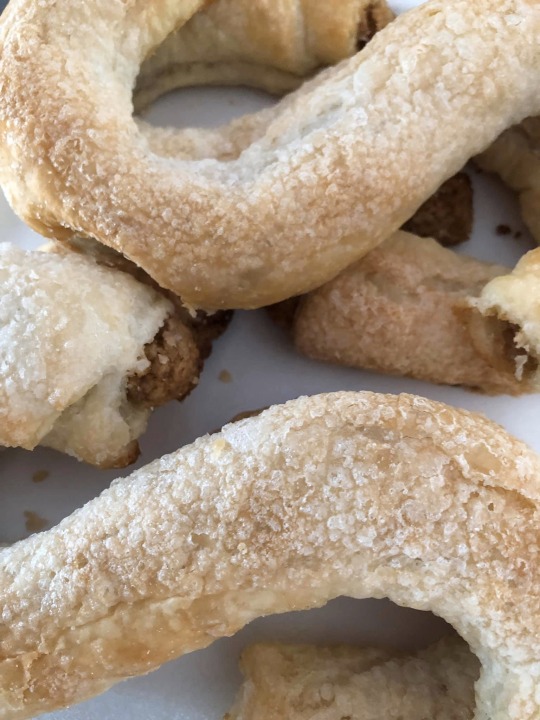
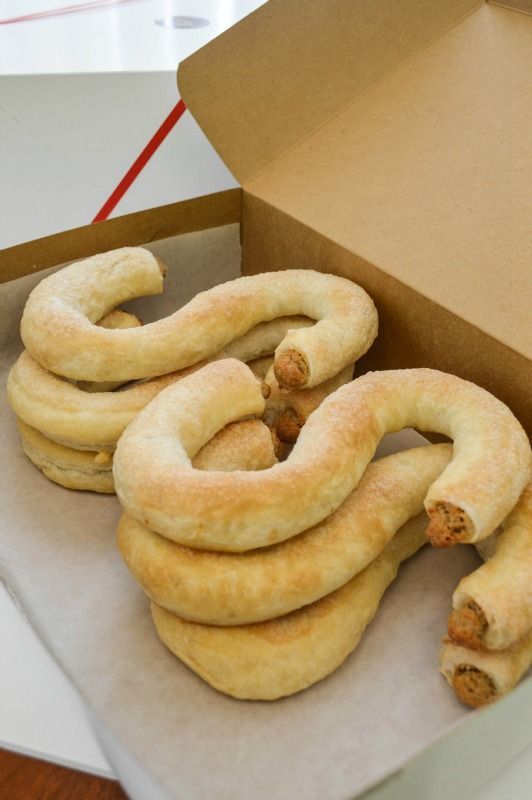
Known in Dutch as banketstaaf, banketletter, boterletter, or letterbanket, Dutch letters are rolled, log-like pastries made with banket, a puff pastry with an almond paste filling. The pastry is formed into the initial of families’ surnames or the letter S. The S shape represents the first letter of the holiday Sinterklaasavond, or Saint Nicholas’ Eve, celebrated on December 5th in the Netherlands. Letters became associated with Sinterklaas in the 19th century when a sheet was used to wrap holiday presents. A bread dough letter was then placed on top of the sheet to identify the gift’s recipient.

A typical box of Dutch letters. Note the distinct S shape.

Though common throughout the Netherlands on Sinterklassvond, it is rare to see these treats outside of Pella, Iowa in the United States. Pella was settled in 1847 by Dutch immigrants who sought to escape religious persecution in Holland, a region of the Netherlands. They brought with them many customs still around today including Delft Blue porcelain, tulips, windmills, wooden shoes, and daily coffee times known as koffieklets.

A close-up of the flaky dough used in some Dutch letter recipes.

One early immigrant to Pella, Harmon Jaarsma, brought his family recipes to the new city and founded the Jaarsma Bakery in 1898. These recipes included his recipe for the legendary Jaarsma Dutch letters, which he made in brick ovens. Along with their popularity during the winter holiday season, Dutch letters have also become an integral part of Pella’s Tulip Time Festival that occurs every May, but they’re one of my favorite family traditions I celebrate during the holiday season.

Jane Thaler is a Gallery Experience Presenter in CMNH’s Life Long Learning Department. Museum staff, volunteers, and interns are encouraged to blog about their unique experiences and knowledge gained from working at the museum.

Related Content

Holiday Coloring Pages

Make Blubber Gloves Activity

Cookie Excavation

Filed Under: Blog Tagged With: HATW, Jane Thaler, Museum from Home, Super Science

December 16, 2020 by wpengine

A Steeler Prayer

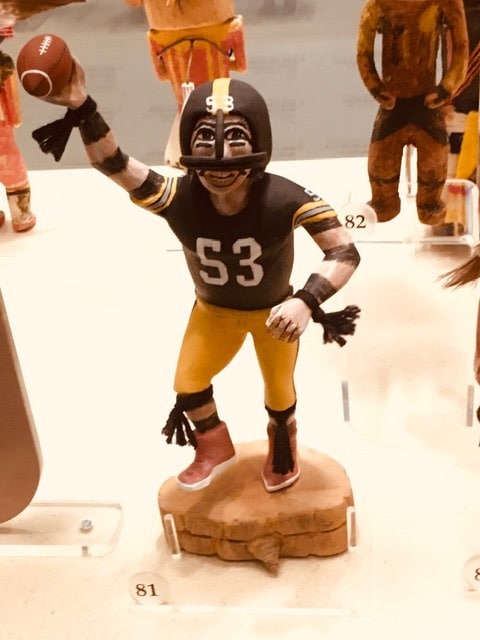
carved figure of a Pittsburgh Steelers football player holding a football

A celebratory touchdown dance in carved cottonwood has been quietly occurring at Carnegie Museum of Natural History for more than 22 years. Within the Alcoa Foundation Hall of American Indians, in the quadrant of the exhibition devoted to conveying information about the Hopi and their culture, a nine-inch high figure of a Pittsburgh Steelers player wearing number 53 holds a football aloft in his right hand. The wide-eyed grinning figure is displayed with plenty of colorful company, and its significance is best understood in terms of this carefully assembled cast.

The carved figures, which are properly called tihus, and more frequently referred to as katsinas, represent the benevolent spirit beings who live among the Hopi on three high mesas of northern Arizona for approximately a six-month period each year. An important role for the carvings is the imparting of knowledge and understanding of these beings or katsinam, and the target audiences for these life lessons are the Hopi themselves.

This aspect of limited cultural sharing was explained to museum educators in the months before the exhibition hall opened in 1998 when Hartman Lomawaima, a Hopi consultant, conducted a training session about the carvings. After a 90-minute presentation that included information about how the katsinas displayed in the hall had not been used in sacred ceremonies, he fielded a particularly pertinent question. “When we take students through the hall we won’t have the time you’ve just shared with us,” explained an experienced interpreter. “What can we tell students about these figures in a minute or two?” “That’s easy,’’ replied Hartman, “just tell them they’re three-dimensional prayers.”

A little more information about the black and gold figure can be gleaned from exhibit text. Here the carving is described as PITTSBURGH STEELER CLOWN KOYAALA, the carver identified as Regina Naha, and the creation date listed as 1992. A reputable reference on katsinas describes the word “Koyaala” as referring to clown figures of the village of Hano on First Mesa, and an internet search under the artist’s name reveals that she is from Hano.

For Steeler fans, and perhaps even for the team’s players, coaches, and administrators, there might be small comfort in knowing a “three-dimensional” prayer clad in their team’s uniform resides under the same roof as Tyrannosaurus rex. For fans of the city itself, the story of how the carving came to be on display offers another example of Pittsburgh Pride. In a font smaller than the rest of the display’s text, the figure is noted to be a “gift of Les and Joan Becker.” Deborah Harding, Collection Manager in the museum’s Section of Anthropology, was able to share some information about the couple. “Les and Joan were long-time and valuable volunteers in this section. During a visit to Arizona they spotted the Steeler carving in the shop at The Heard Museum in Phoenix, and bought it for the museum with the approval of the curator directing the hall’s development. According to the story I heard, Les was able to barter for a lower price by arguing that the figure would be displayed where it belonged, in Pittsburgh.”

Patrick McShea works in the Education and Visitor Experience department of Carnegie Museum of Natural History. Museum employees are encouraged to blog about their unique experiences and knowledge gained from working at the museum.

Related Content

Deeper Dig: Ancient Egypt Through Its Pottery

Carved Wooden Gope Board

Ice and Snow: The effects of temperature

Filed Under: Blog Tagged With: anthropology, Museum from Home, Pat McShea, Science News

December 15, 2020 by wpengine

New Anthropocene Studies Paper in Curator: The Museum Journal

two hands clasped together and painted to look like the earth

A recent paper in Curator: The Museum Journal sheds light on the particular and growing relevance of natural history museums in sharing information about the Anthropocene, a proposed geological epoch, generally defined by the significant impacts of human activities on the Earth’s systems. In the 18 pages of The Anthropocene in Natural History Museums: A Productive Lens of Engagement, four co-authors use a careful comparison of two recent ground-breaking exhibitions devoted to the topic, one at a small natural history museum in Switzerland, and the other at Carnegie Museum of Natural History (CMNH), to establish how museum spaces as well as the unique materials that museums collect and preserve were effectively used to provide visitors with the means to experience the complexity, uncertainty, and interdisciplinary nature of current work in this relatively new field of study.

The Swiss exhibition, Objectif Terre: Vivre l’Anthropocene (Destination Earth: Living the Anthropocene) which was open during 2016 and 2017 at the Valais Nature Museum in the town of Sion, was the very first natural science exhibition worldwide specifically about the Anthropocene. The CMNH exhibition, We Are Nature: Living in the Anthropocene, which was open in 2017 and 2018, was the first major exhibition in North America to focus on the topic.

The paper also explores ways that the Anthropocene is driving changes in the practice of natural history science. The Anthropocene shows that humans are an integral part of nature, creating a challenge to the nature/human dichotomy that has been a common organizing principal in Western science and cultural worldviews. The authors maintain that recognition and study of ongoing human-induced changes is coupled with responsibility. Clear calls are made for scientists to explode the boundaries between natural science and social sciences, humanities and arts; and to think more critically about cultural assumptions and biases that are limiting scientific understandings and human responses to ecological crises. Analysis of the success of both exhibitions is tempered with advocation for more transdisciplinarity (people from different fields and backgrounds working together) and more attention to humanistic concerns and social equity in natural history museums. The overall conclusion of the peer-reviewed work is that in facing the Anthropocene, natural history museums are more relevant than ever. They have a critical role to play in 21st century education about social-ecological challenges, and in mobilizing community understanding and motivation to act for just sustainability.

The four co-authors came together to collaborate in the context of Gil Oliveira’s 6-month visit to CMNH to intern in the Anthropocene Studies section under the mentorship of Nicole Heller. His internship was part of attaining his Master of Arts in Museum Studies at the University of Neuchâtel. Gil had worked on the exhibition Objectif Terre: Vivre l’Anthropocene at the Valais Nature Museum with Museum Director, Nicolas Kramer.

The Anthropocene in Natural History Museums: A Productive Lens of Engagement in Curator The Museum Journal

GIL OLIVEIRA, ERIC DORFMAN, NICOLAS KRAMAR, CHASE D. MENDENHALL, AND NICOLE E. HELLER

Full Article can be found here, https://onlinelibrary.wiley.com/doi/full/10.1111/cura.12374.

Nicole Heller is Curator of Anthropocene Studies at the Carnegie Museum of Natural History. Museum employees are encouraged to blog about their unique experiences working at the museum.

Related Content

What does it mean to be for a Place?

Women in Science at Carnegie Museum of Natural History

Happy International Peace Day! 

Filed Under: Blog Tagged With: Anthropocene, Anthropocene Living Room, Museum from Home, Nicole Heller, Science News

December 15, 2020 by wpengine

What does it mean to be for a Place?

The following is a summary of a recent publication in Pacific Conservation Biology by a group of David H. Smith Conservation Research Fellows: Stephanie Borrrelle, Jonathan Koch, Caitlin McDonough MacKenzie, Kurt Ingeman, Bonnie McGill, Max Lambert, Anat Belasen, Joan Dudney, Charlotte Change, Amy Teffer, and Grace Wu. You can read the full article here.

When asked “Is protecting biological diversity and the ecosystems that support all life important to you?” most people would say “yes.” This is the work that conservation scientists like me and my friends do. We do things like figure out how to protect endangered bee species in Hawaiʻi (Koch), inform agencies how to manage the endangered whitebark pine in the Sierra Nevada (Dudney), and study how plants that grow on mountaintops in Maine are impacted by climate change (McDonough MacKenzie). However, many of us are not from the Places* we’re working to protect. In fact, many conservation scientists are descendants of colonizers and settlers (settler-colonizers) who removed, or benefited from the removal of Indigenous Peoples from these Places, which are their ancestral lands. Indigenous Peoples practicing diverse cultures lived for millennia in North America stewarding the land.

The Indigenous Peoples displaced by colonialism have distinct knowledges and cultural identities directly rooted in their lands. For example, Mauna Kea is more than a dormant volcano on the island of Hawaiʻi to the kānaka maoli (Native Hawaiians). The mountain is their biophysical and genealogical ancestor, a sacred site for cultural and spiritual activities. Another example is how Aboriginal Peoples in Australia practice cultural fire “for biodiversity, to protect the landscape, and for cultural reasons, all in one” (Steffensen 2019, p233).

Indigenous Peoples’ distinct genealogical and cultural relationship to the land and all the other beings they share the land with is far different than the relationship of settler colonizers to Place and nature. Industrial society is traditionally and intentionally very disconnected from nature, beginning with European states removing peasants from forests and the commodification of nature (Tsing 2005). For example, many of us don’t know where our food comes from; don’t have religious or cultural traditions connecting us to Place, the land, or nature; and don’t know the natural history of the creatures we encounter everyday.

So you can imagine it is more than awkward for settler-colonizer conservation scientists to be the only or dominant source of knowledge about how to conserve a colonized Place, yet for decades this has been a common occurrence. In some cases, conservationists have attempted to act as “white saviors” to local Peoples by centering the work around themselves and excluding local experts (see this piece about conservation in Africa by Mordecai Ogada). In other cases, settler-colonizer conservation has furthered the oppression of local Indigenous People by removing them from their homelands and calling them poachers when they hunt there (see this piece on US National Parks by Isaac Kantor). All with few long term conservation achievements to show for it—for evidence, look no further than the UN Convention on Biological Diversity. Turns out, preserving biodiversity is hard, as is adapting to climate change. At the local level, both of these issues require some global settler-colonial science as well as intimate knowledge of and human interaction with individual Places. I wonder who has that? …

Some settler-colonizer/non-Indigenous conservation scientists are now beginning to listen to Indigenous knowledge keepers, collaborate on research with Indigenous groups, and, in some cases, supporting and following the lead of Indigenous managers of their ancestral lands and waters. Conservation scientists are beginning to understand that the only way to long term conservation successes is to develop conservation strategies that also support the social and physical wellbeing and self-determination of the people who live there. But these settler-Indigenous partnerships are built on a troubled history of colonial violence and oppression. So, how do settler-colonizer conservationists proceed in a way that does not perpetuate harms to Indigenous Peoples? In other words, what does it mean to be for a Place when you’re not from that Place?

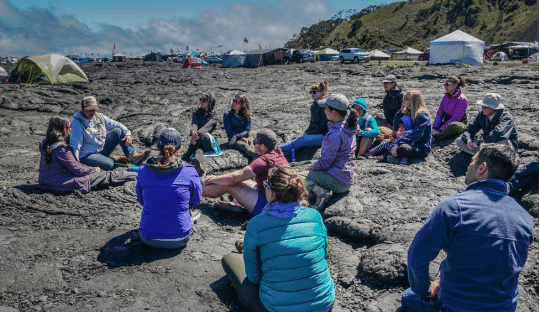
Several of my scientist friends and I wrestled with this issue after visiting kia’i (protectors) of Mauna Kea (Mauna a Wākea). It was October 2019 and we were hosted by Moana “Ulu” Ching and Noelani Puniwai, both of whom are kānaka maoli, conservation scientists, and friends with one of us (Koch).

Noelani Puniwai and Moana “Ulu” Ching (far left) met with our group of Smith Conservation Fellows at Pu’u Huluhulu near the base of Mauna Kea. We sat on black lava rock from an old lava flow. (Photo by Joan Dudney)

We met at the bottom of the access road to the summit of Mauna Kea. Here was a tent community of kiaʻi protesting the construction of a new telescope called the Thirty Meter Telescope on the summit of their ancestral Mauna Kea. They were occupying the entry road to prevent construction vehicles from accessing the summit; 33 kupuna (Elders, grandparents, ancestors) were arrested several months earlier marking the escalating tensions between the kiaʻi and the governmental and private institutions involved in developing the Thirty Meter Telescope. The telescope is the continuation of colonialism on Mauna Kea sponsored by 11 nations and universities against the wishes of and providing little economic benefit to kānaka maoli. Not only does construction of a 14th research structure threaten the fragile ecosystems and endangered species at the summit of Mauna Kea, construction also perpetuates a long history of colonization in Hawaiʻi that threatens the cultural, economic, and ecological well being of kānaka maoli.

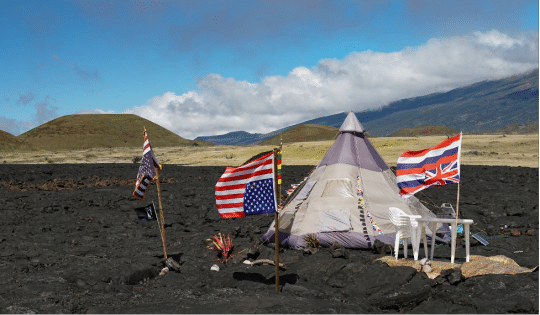
One of the tents at the protest site. The upside down American and Hawaiian flags represent the kānaka maoli rejection of these colonial powers. The upside down Hawaiian flag can be seen on cars and buildings throughout Hawai’i. (Photo by Joan Dudney)

We listened as Ulu and Noelani described their experiences and perspectives on Mauna Kea and the telescope. Afterward they invited us to participate in midday protocol, and we were humbled by the experience. Protocol is a sacred community building activity that happens every day and consists of oli (chants), pule (prayer), and hula (dance). Non-kānaka maoli were allowed to observe the protocol and were invited to participate in a certain part. We showed our respect to Mauna Kea by standing in our bare feet on the road to her summit for the protocol. In one hula we were sending our energy and strength to Mauna Kea.

As conservation scientists we wanted to show our solidarity with the kiaʻi. We wanted to voice our objections to the Thirty Meter Telescope in terms of conserving the fragile summit ecosystem, and equally important, call for an end to continued colonialist practices in the name of settler-colonizer science. We channelled this energy into a policy statement opposing the construction of the Thirty Meter Telescope on Mauna Kea, which was later adopted by the Society for Conservation Biology. We further reflected on the experience and wondered what first-hand learning we could share with other conservation scientists embarking on anticolonial conservation work. We came up with a series of recommendations for scientists. You can read all of them here. Here are three major ones:

  1. Recognize the ways conservation theory and practice perpetuate the myth that North America was “empty” and “new” upon European “discovery.” For example, the mistaken belief that US National Parks never had human inhabitants despite the fact that Indigenous People have been living in and managing the lands and waters of North America for millennia.
  2. Build authentic relationships with the Indigenous Peoples whose lands we are working on. Realize that settler-colonizer science is not the “correct” or only way of knowing.
  3. Educate ourselves by learning about the history of the Places where we work and live and the Indigenous people affected by colonization. Read books and articles written by Indigenous scholars. Teach ourselves. After you have done the work to learn about the history and people(s), then reach out to Indigenous scholars, land stewards and managers.

We believe that being “for a Place” when you’re not from a Place means respect for Indigenous knowledge, continuous reflection on the consequences of our actions, and a willingness to act with humility, embrace complexity, and maintain hope. We are excited to grow and learn and contribute to the transformation of conservation science into a more inclusive, equitable, and just discipline.

*I capitalized Place throughout to emphasize its importance, akin to a person’s name being capitalized.

The Carnegie Museum of Natural History is on Seneca land and waterways, the homeland of the people we call the Monongahela, and lands and rivers used by and culturally connected to the Lenape, Shawnee, Wyandot, and Osage. I honor these ancestors, am grateful for their stewardship of these lands and waters, and acknowledge and respect their descendants alive today.

Bonnie McGill is a science communication fellow in the Section of Anthropocene Studies. Museum staff, volunteers, and interns are encouraged to blog about their unique experiences and knowledge gained from working at the museum.

Work cited

Steffensen, V. 2019. Putting the people back into the country. In: Decolonizing Research: Indigenous Storywork as Methodology. J. Archibald Q’um Q’um Xiiem, J. B. J. Lee-Morgan, and J. De Santolo, eds. Zed Books (London).

Tsing, A. L. 2005. Friction: An Ethnography of Global Connection. Princeton University Press (Princeton and Oxford).

Related Content

An Indigenous Presence: Cultural Survivance and Contemporary American Indian Art and Design

Herd Immunity and the Anthropocene

Ask a Scientist: How is gender represented in museums?

Filed Under: Blog Tagged With: Anthropocene, Anthropocene Living Room, Bonnie McGill, Museum from Home, Science News

December 15, 2020 by wpengine

An Indigenous Presence: Cultural Survivance and Contemporary American Indian Art & Design

Museum exhibitions, especially those featuring cultural items, can sometimes give the impression of cultures or peoples frozen in time. Behind the scenes, however, CMNH is a flurry of active research and knowledge production. Work to link our collections and exhibitions to the present moment is vital.

As an art historian who studies modern and contemporary art, I often think about the connections over time and space between historic objects. Lately, I’ve been thinking about many of the American Indian belongings we have on display in Alcoa Hall, and contemporary art. This contemplation reveals the influence American Indian artists have exerted and continue to exert on the American art world.

In the early 20th century, Indian artists were instrumental in the formation of American modernism. Artists such as Awa Tsireh (San Ildefonso Pueblo), the members of the Kiowa Five (Spencer Asah, James Auchiah, Jack Hokeah, Stephen Mopope, Monroe Tsatoke and Lois Smoky), Angel De Cora (Ho-Chunk), and potter Maria Martinez (San Ildefonso Pueblo) influenced the growing trends of abstraction and patterning that defined modernist painting in the United States. These artists, along with other American Indian artists and artisans helped establish the US as a growing center of modernism in competition with Europe. Despite having their contributions and innovations undercut or co-opted by Euro-American artists and collectors, Native artists continued to produce artwork as acts of survivance. Survivance, a concept developed by cultural theorist Gerald Vizenor, is an expression of active presence. The term denotes a response to the attempted cultural and physical genocide of Native peoples in the United States that is beyond simple survival, but involves acts of resistance that declare a dynamic presence – often combining traditional ways of knowing with contemporary technologies that are specific to an individual or tribal affiliation.

Later in the century, Native artists continued to define the American art scene. Artists like Fritz Scholder (Luiseno), Kevin Red Star (Apsáalooke), Edgar Heap of Birds (Cheyanne and Arapaho), and Jaune Quick-to-See Smith (Salish) continued (and continue) to challenge the mythology of the Indian in American imaginary.  These artists, whose creations have been collected and exhibited by major museums across the country, also view their art as a form of resistance. Their work can therefore be understood as acts of survivance.

Contemporary American Indian artists are still grappling with the politics of representation, regularly fighting stereotypes while also working to preserve the cultural knowledge that the settler state tried to destroy through forced assimilation. Because of these complicated and often violent histories, it is important that, most of us, as descendants of settlers, think critically about Native inspired designs in the objects or clothing we buy. Instead of coopting from indigenous cultures, shop from companies that employ Native designers. Better yet, buy directly from Native artists who are demonstrating how traditional knowledge and ways of making are thriving in the 21st century. Featured below are just a few of the artists whose work is connected to the cultural forms and belongings on display in Alcoa Hall. Many of them also have great items for sale on their websites – just in time to find some special holiday gifts!

image
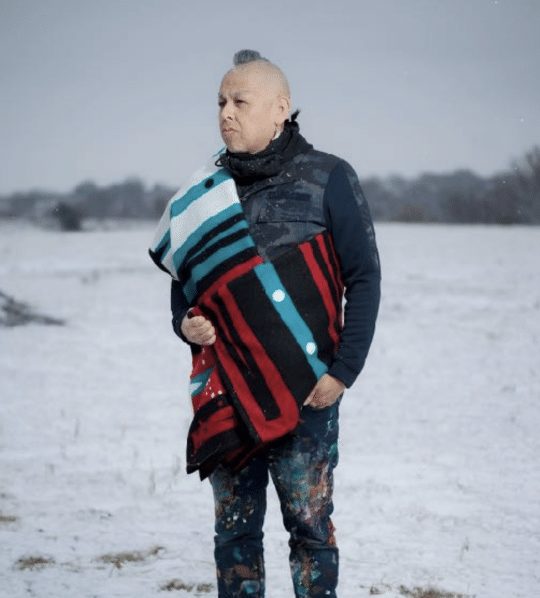
Bunky Echo-Hawk. Image credit: Ryan Redcorn

Bunky Echo-Hawk (Pawnee and Yakima) is a painter and designer who has worked with companies such as Nike and Pendleton to design Plains Indian inspired products and fundraise for Native organizations. His eye-catching and exciting work plays with indigenizing popular culture and addressing environmental racism while reinterpreting Plains Indian oral history and record keeping traditions, like winter counts, through his live painting performances. To learn more about winter counts, visit the display in Alcoa Hall featuring the Carnegie Winter Count by Dr. Thomas Red Owl Haukaas. Echo-Hawk was also the subject of a recent episode of American Masters, the PBS documentary series. Check out his website to browse some of the great prints and stickers he has for sale.

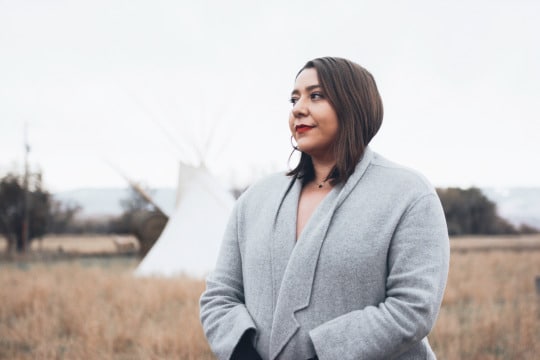
Bethany Yellowtail

Bethany Yellowtail (Apsáalooke and Northern Cheyenne) is the brilliant designer behind B. Yellowtail, a fashion brand launched in 2015. Her work is intimately connected with her social justice work in Indian Country. Her website features indigenously designed goods as well as her own collections – inspired by Apsáalooke traditions, like elk tooth dresses and ribbon skirts. Her clothing functions as wearable art that demonstrates the power and resilience of Native women and matrilineal cultural systems. I’ve purchased some of their cloth face masks – the proceeds of which benefit Native communities suffering from COVID-19. I’m confident you’ll find something you love on B. Yellowtail’s website.

John Isiah Pepion (Blackfoot) understands the ceremonial importance of making artwork, including its healing power. Pepion’s paintings, drawings, and designs are inspired by traditional practices such as winter counts and ledger drawings. Ledger art dates to the 1850s, when ledger books became one of the primary materials available to Plains Indians, especially to those imprisoned in forts as prisoners of war during the 19th-century Indian wars, without access to traditional materials like bison hides. Pepion’s work in this medium serves as cultural preservation, keeping him and his artwork tied to Blackfoot history and to Blackfoot ancestral lands. His website features original artwork, prints, and all sorts of items with his designs including scarves, stationery, blankets, and jewelry.

image
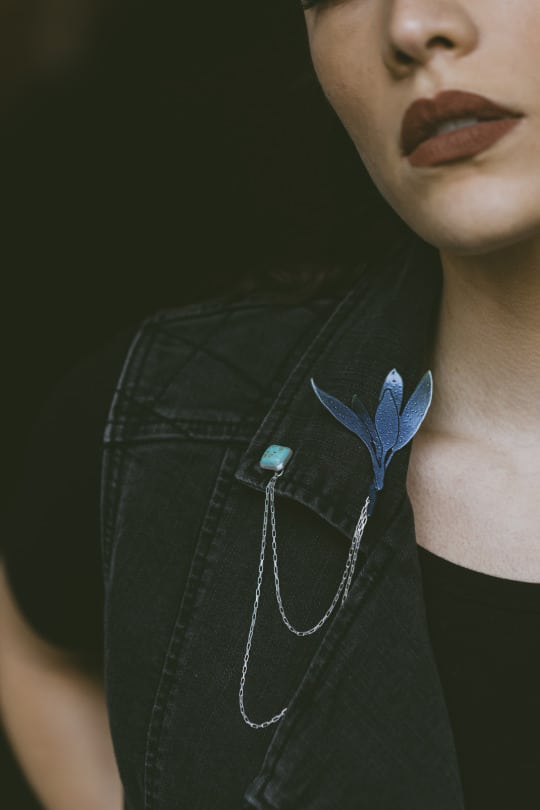
Sage Protection Pin by Margaret Jacobs. Image credit: Taylor Robinson.

Margaret Jacobs (Akwesasne Mohawk) is a sculptor and jewelry designer who works primarily in steel and pewter. Her forms are primarily abstract, but the material represents not only strength and resistance, but also references the history of Mohawk iron workers, featured in Alcoa Hall. Her abstract forms play between the organic and man-made, connecting color and shape with storytelling and family histories. You can find her sculpture or jewelry, which truly functions as wearable art, on her website.

It is important to note that Carnegie Museum of Natural History, and much of Western Pennsylvania, is on the traditional lands and waterways of the Seneca, Lenape (Delaware), and the people we refer to as the Monongahela (their autonym is currently unknown). These lands and waters were also important to the Shawnee, Wyandotte, and Osage nations. These lands carry the histories of these people from before their forced removal and through their struggles and triumphs for survivance well into the present moment. To find out more about the Seneca Nation (including about Seneca artists) visit the Seneca-Iroquois National Museum or Ganondagan Seneca Art & Culture Center. To learn more about the Lenape, go to the Delaware Nation or the Delaware Tribe of Indians. Or visit the Museum of Indian Culture, in Allentown, PA.

Jessica Landau has a joint appointment as Assistant Curator of Anthropology and Archaeology at Carnegie Museum of Natural History and as a Lecturer in Curatorial Studies in the History of Art & Architecture at University of Pittsburgh. Museum employees are encouraged to blog about their unique experiences and knowledge gained from working at the museum.

Related Content

Seldom Seen – Archaeological Textiles in the Eastern US

Americal Eel

Museum Conservation: Cleaning a Kayak

Filed Under: Blog Tagged With: anthropology, Jessica Landau, Museum from Home, Science News

  • « Go to Previous Page
  • Page 1
  • Page 2
  • Page 3
  • Page 4
  • Page 5
  • Page 6
  • Interim pages omitted …
  • Page 26
  • Go to Next Page »

sidebar

About

  • Mission & Commitments
  • Directors Team
  • Museum History

Get Involved

  • Volunteer
  • Membership
  • Carnegie Discoverers
  • Donate
  • Employment
  • Events

Bring a Group

  • Groups of 10 or More
  • Birthday Parties at the Museum
  • Field Trips

Powdermill

  • Powdermill Nature Reserve
  • Powdermill Field Trips
  • Powdermill Staff
  • Research at Powdermill

More Information

  • Image Permission Requests
  • Science Stories
  • Accessibility
  • Shopping Cart
  • Contact
  • Visitor Policies
Stay in the loop! Sign up for our newsletter(s).
One of the Four Carnegie Museums | © Carnegie Institute | Privacy Policy | Terms of Use | Accessibility
Rad works here logo