• Skip to primary navigation
  • Skip to main content
  • Skip to primary sidebar

Carnegie Museum of Natural History

One of the Four Carnegie Museums of Pittsburgh

  • Visit
    • Buy Tickets
    • Visitor Information
    • Exhibitions
    • Events
    • Dining at the Museum
    • Celebrate at the Museum
    • Powdermill Nature Reserve
    • Event Venue Rental
    • Gift Cards
  • Learn
    • Field Trips
    • Educator Information
    • Programs at the Museum
    • Bring the Museum to You
    • Guided Programs FAQ
    • Programs Online
    • Climate and Rural Systems Partnership
  • Research
    • Scientific Sections
    • Science Stories
    • Science Videos
    • Senior Science & Research Staff
    • Museum Library
    • Science Seminars
    • Scientific Publications
    • Specimen and Artifact Identification
  • About
    • Mission & Commitments
    • Directors Team
    • Museum History
  • Tickets
  • Give
  • Shop

Enjoy the Museum from Home via our Blog

Can't make it to the museum in person? We've done our best to help cultivate resources for you to enjoy from home. Activities for the whole family, different ways to experience our exhibitions and more are included in these blogs.

January 15, 2021 by wpengine

Becoming a Science Educator

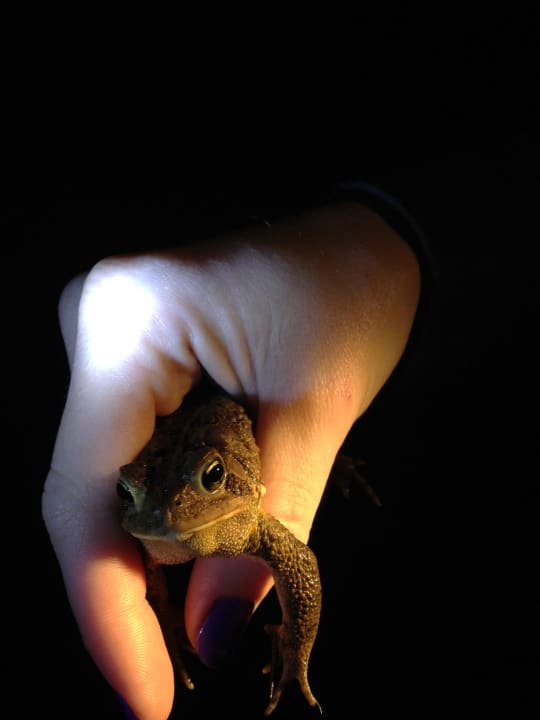
An American toad, similar to those found in the author’s childhood backyard.

Think back to when you were a child – what was your favorite way to learn how something works? Mine was to ask loads of questions and then jump in and get my hands dirty. I specifically remember catching toads in the backyard with my mom, asking questions about their appearance and where they lived. She would tell me about the myth of them giving you warts, that they might pee on your hand if they were scared, and how to hold them gently and then let them go.  Twenty years later, I became a research ecologist studying amphibian diseases, and I learned how to sharpen these inclinations into more robust skills: how to create focused questions and experiments, collect and analyze data, and present the findings to a range of audiences.

Today, I teach and design curriculum for home-school and summer camp programs at Carnegie Museum of Natural History. Fostering the learners’ own questions and devising hands-on ways to investigate them is the focus of my work. Science and nature provide unlimited opportunities for first-hand investigations, and the process of metamorphosis is one of my favorite examples.

An 8-year-old camper has likely learned about butterfly metamorphosis in school, and might be able to name the four stages: egg, caterpillar, pupa, and adult. Scientists call this four-stage process “complete metamorphosis,” a term whose qualifier invites one to wonder, “what is incomplete metamorphosis?” Enter the majestic dragonfly. Dragonflies also go through metamorphosis, but with only three stages: egg, nymph, and adult; their transformation is therefore termed “incomplete.” Noting this small difference suggests another question: what else is different about a dragonfly?
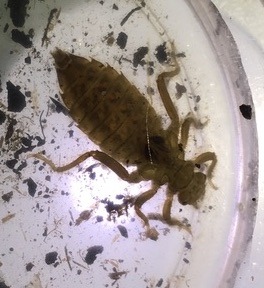
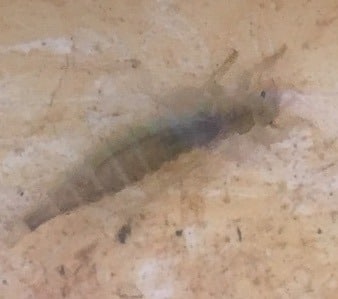
Above and below: Dragonfly nymphs collected and released in a Pittsburgh section of the Ohio River.
dragonfly nymph

Well those first two stages – eggs and nymphs – are in water! That is why they are part of the far larger group of aquatic macroinvertebrates, creatures with no backbone that can be seen without magnification and that live at least part of their life in water. Some dragonfly nymphs are impressive predators and can live for years in this aquatic phase, even though their adult lives last only a few weeks. In what ways, I challenge the 8-year-olds, is this transformation similar or different from that of a caterpillar and a butterfly?
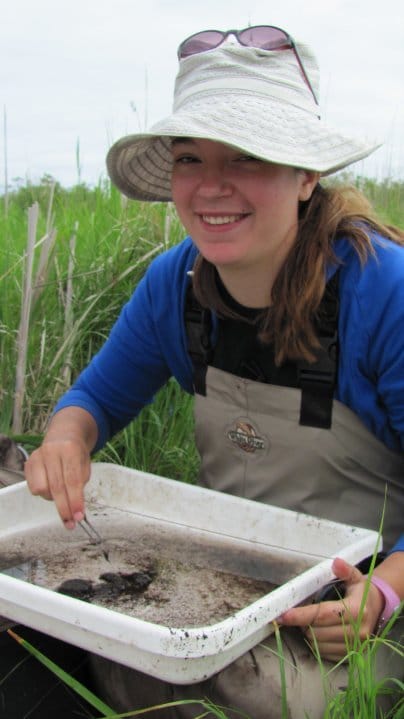
science educator Jenise Brown in a field looking through a tray of water
Jenise looking through a stream water sample for aquatic macroinvertebrates in a sorting tray.

After we’ve explored these questions, we make a trip behind the scenes to look at some insect specimens up close, and allow the students to directly ask the museum’s research scientists even more questions. Finally, we visit Powdermill Nature Reserve to get our hands muddy by looking for dragonfly nymphs and other aquatic macroinvertebrates in the research station’s namesake stream. And before we know it, we’ve done actual science: used the scientific method to gain understanding about the world around us!

I came to teaching from research science because I love building interactive experiences of the world around us like these into courses that can educate and inspire young people. This type of scientific inquiry is universal, and these practices can be adjusted for age. A class about dragonflies for a 12-year-old group, for example, might focus on data collection and include the presentation of our findings to the younger campers. Whatever the age level though…I get to get my hands dirty.

Jenise Brown is a Museum Educator with Carnegie Museum of Natural History. Museum staff, volunteers, and interns are encouraged to blog about their unique experiences and knowledge gained from working at the museum.

Related Content

We Are Nature: Living in the Anthropocene (Video)
Indiana Jones and the Rosetta Stone

Teaching in the Parks

Filed Under: Blog Tagged With: Education, Educators, Jenise Brown, Museum from Home

January 8, 2021 by wpengine

A Visit to the Mammoth Site, Hot Springs, SD

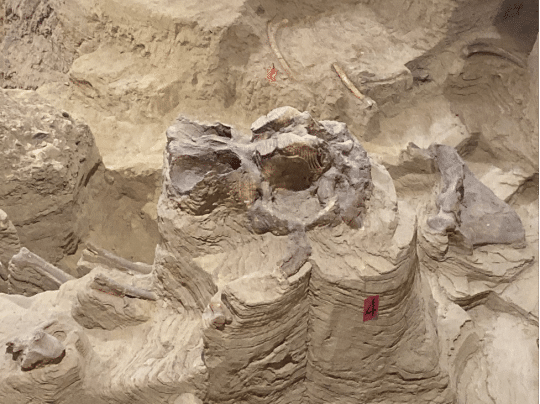
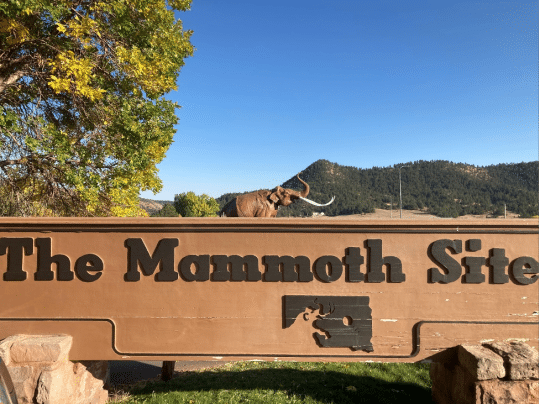
Did you know that not all museums display their fossil specimens mounted in life-like poses? At The Mammoth Site of Hot Springs, South Dakota, visitors view fossils “in situ,” or as they were discovered, and because excavation continues year-round, this unique museum is also an active dig site.

brown sign that says The Mammoth Site
A sign welcomes visitors to The Mammoth Site of Hot Springs, South Dakota.

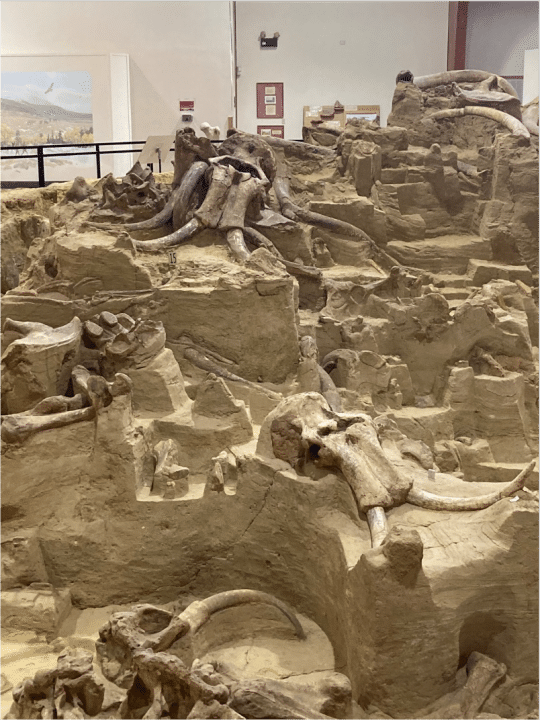
Instead of being held in place by the fabricated support structures that are so crucial to traditional fossil displays, bones at The Mammoth Site rest on sediment and appear in the same orientations in which they were found. The remains of more than 60 Columbian mammoths (Mammuthus columbi) have been documented here to date, comprising the world’s most extensive collection of skeletons of these Ice Age elephant relatives.

The Mammoth Site was discovered in 1974 when the landowner decided to build a housing development on the 14-acre plot. While the heavy machine operator was bulldozing a small hilltop, he found tusks and bone. Construction stopped and officials at four colleges were contacted, but none expressed interest in the find. Fortunately, the son of the heavy machine operator, who had taken geology and archaeology courses in college, was able to gain interest from one of his former professors, who was then conducting fieldwork in Arizona. When the professor arrived at the site a few days later he recognized the exposed bones of four to six individual mammoths and the potential for more nearby. He arranged for a field crew to salvage and stabilize the visible bones, teeth, and tusks, and returned the next summer with a group of students to do more excavating. A complete skull with tusks attached was the prize find of these more organized recovery efforts, and by the end of the summer the landowner had decided the tract’s highest value was as a place for scientific study.

mammoth skulls in situ
Mammoth skulls with tusks attached at The Mammoth Site. Notice the sediment supporting the fossils.

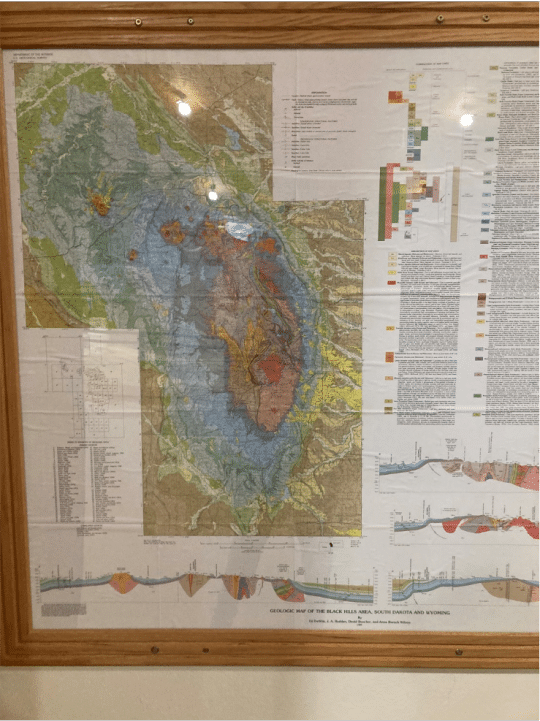
I recently had the opportunity to visit The Mammoth Site, which is located in the Black Hills, a scenic region of green pine trees and deep red earth. Once you purchase your admission, you are directed to a theater where a looped video introduces the relevant geologic history. The site is the result of a sinkhole that developed when groundwater dissolved the limestone layers through which it flowed. Subterranean water-filled caverns were an early product of this process, but as the water table lowered the caverns weakened and collapsed, resulting in a deep sinkhole with a chimney-like shaft, through which a warm artesian spring percolated to the surface. In three phases over a period of 750 years, the sinkhole refilled with sediment and the remains of mammoths and other creatures before it was eventually reduced to a mud wallow.

photo of geologic map
Geologic map of the beautiful Black Hills area of South Dakota and Wyoming.

After the theater, the bonebed is the next stop. The museum has a special app that can be listened to with headphones for a tour of the bonebed. The bonebed room is very large and naturally lit and has a high beam ceiling with windows at the top of one wall. There is a crane attached to the rafters that is used to move any specimens that need to be permanently removed from the ground. Because a large tusk can weigh over 100 pounds, and skulls far more than this, this overhead crane is an essential tool.

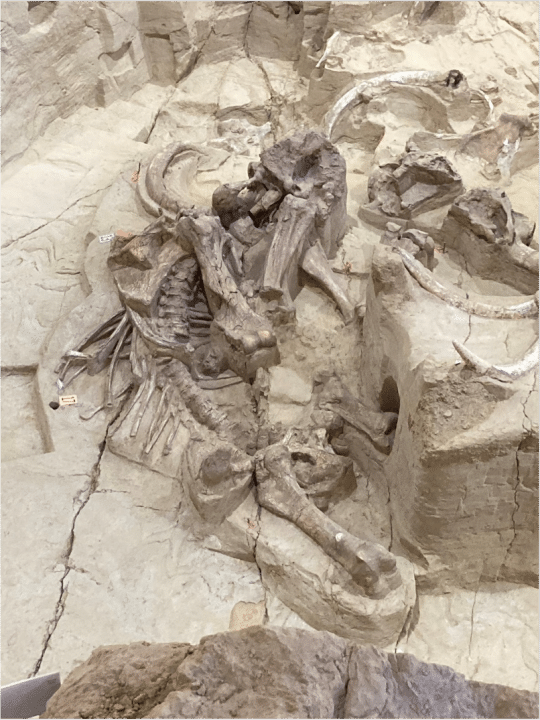
complete mammoth skeleton
The most complete mammoth skeleton or “model mammoth,” found in the deep end of the bonebed. It is used to compare to the remains of others to determine attributes such as age, size, and sex.

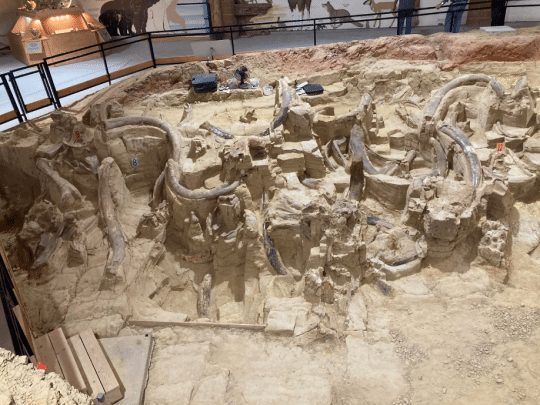
How, you ask, do researchers know there are over 60 individuals in the sinkhole? For every mammoth or person or other critter with a skeleton, there are a certain number of each bone in the body. Because mammoths have two tusks it is possible to count the number of tusks in the bonebed, 123, and divide by two to calculate the presence of at least 62 individuals.

bonebed at Mammoth Site
How many tusks can you find in this section of the bonebed?

Determining the sex of a mammoth is possible when its pelvis is well-preserved with minimal crushing or distortion. By measuring a specific spot on the pelvis and the width of the pelvic canal at a certain area, and comparing these two measurements, it can be determined whether the pelvis belonged to a male or female mammoth. This calculation is possible because males are generally larger than females, and also because females had a proportionally larger pelvic canal to aid in giving birth. Mammoth remains recovered at The Mammoth Site have all been male. Although the presence of more than 60 males but no females at the site may seem surprising, studies have shown that “natural death traps” such as The Mammoth Site captured many more males than females. This may be because, rather than living in herds led by a knowledgeable matriarch, relatively inexperienced male mammoths typically traveled alone, making them more likely to get stuck in these kinds of traps.

It is also possible to age a mammoth using growth rates of bones and the state of fusion of the epiphyses (the ends of the limb bones); however, it is most accurate to age these animals by measuring their teeth. The length and width of the occlusal (= chewing) surface is then used to verify which of their six sets of teeth they were using at the time of death. Generally, a mammoth’s life span could be as long as 60 to 80 years, an age when the animal would be relying upon its sixth set of teeth. When these teeth wore down, starvation would follow. Dental comparisons at The Mammoth Site indicate that most of the remains represent mammoths that were between 15 and 29 years old when they died, with a few in their late forties or early fifties.

mammoth skull fossil in situ
An upside-down mammoth skull shows holes at the front where the tusks attach. Two sets of molars are also visible (I think).

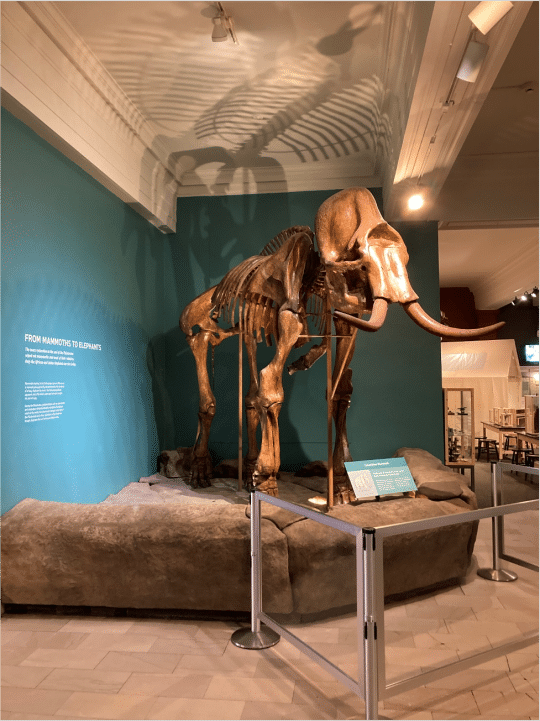
When you next visit Carnegie Museum of Natural History, be sure to head to Pleistocene Hall, where we have our very own mounted Columbian mammoth skeleton on display!

mounted mammoth fossil
The mounted Columbian mammoth at Carnegie Museum of Natural History.

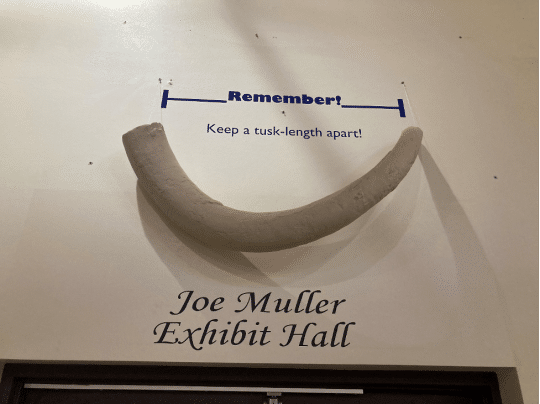
And please remember to keep a tusk-length apart! (Social distancing the mammoth way.)

Linsly Church is a Curatorial Assistant in the Section of Vertebrate Paleontology at Carnegie Museum of Natural History. Museum staff, volunteers, and interns are encouraged to blog about their unique experiences and knowledge gained from working at the museum.

Related Content

Ask a Scientist: What kind of dinosaur is a megaraptorid?

Early Bats: Ancient Origins of a Halloween Icon

Mesozoic Monthly: Vegavis

Filed Under: Blog Tagged With: Linsly Church, Museum from Home, Science News, Vertebrate Paleontology

December 30, 2020 by wpengine

The Bromacker Fossil Project Part XIII: What We Learned

New to this series? Need to catch up on your reading? Here are all the previous posts for the Bromacker Fossil Project: Part I, Part II, Part III, Part IV, Part V, Part VI, Part VII, Part VIII, Part IX, Part X, Part XI, and Part XII. 

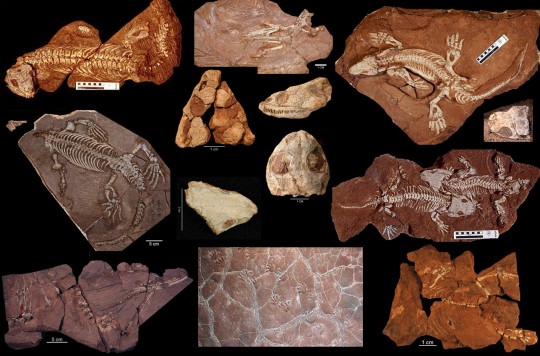
Collage of the fossils highlighted in this series. Images not to scale. Photos by the author, Dave Berman, and Thomas Martens.

The Bromacker quarry is a rare site in that it preserves exquisite, articulated fossils of a unique vertebrate fauna that lived in an atypical or rarely recorded Early Permian (~290 million years ago) setting. Early in our work at the Bromacker, we became aware that the fossil vertebrates we were finding were unknown or extremely rare in Europe but were closely related or identical to species commonly found in North America. Until then, most of the fossil vertebrates found in Europe were discovered in gray to black sediments deposited in ancient lake beds, whereas the fossils from the Bromacker quarry occurred in red beds representing a terrestrial setting. Paleontologists looking for fossils in Europe typically prospected the gray to black sediments where fossils were relatively plentiful rather than red beds, which were thought to represent arid environments not conducive to fossil preservation.

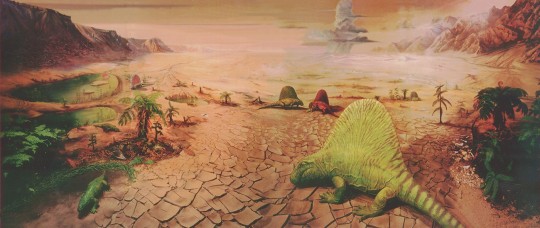
Photograph of a diorama showing the Tambach Basin 290 million years ago, which was once exhibited at the Museum der Natur, Gotha. It was built in 1996, so many of the inhabitants of the basin weren’t yet discovered. One of these is Dimetrodon teutonis, which was inadvertently depicted as being large and numerous. Image provided by Thomas Martens, 2020.

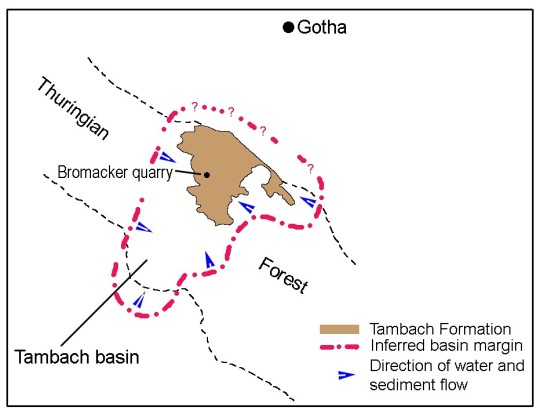
In a collaborative effort to help determine how the fossil deposit at the Bromacker quarry formed and why its vertebrate fauna is unique, Dave Berman invited his colleague David Eberth to join us for the 1998 field season. David is a geologist/vertebrate paleontologist who was then employed by the Royal Tyrrell Museum of Palaeontology in Canada but is now retired. The sediments preserving the Bromacker fossils are part of a rock unit called the Tambach Formation and were deposited in the Tambach Basin. The results of David’s study, built in part upon investigations by other geologists and paleontologists, indicate that the Tambach Basin was situated within an ancient mountain range and isolated from river systems. At the time the fossils were deposited, the basin was internally drained, and as a result, when it rained, water would flow towards the basin center and form ephemeral ponds and lakes. Based on the geology, fossil plant assemblage, and geographic setting of the Tambach Basin, David concluded that the climate was possibly similar to the wet‑and‑dry tropical climate of modern North African savannas, Brazilian Campos, or the Venezuelan Llanos.

Map showing the areal extent of the Tambach Formation today and the inferred boundary of the Tambach Basin, with arrows indicating direction of water flow. The northern boundary of the basin is not preserved, but it was thought to have been closed when the Bromacker fossil deposit formed. Modified from Eberth et al., 1997.

Most of the fossils discovered at the Bromacker quarry came from two massive units, the more fossiliferous of which is about 21 inches thick, that formed in separate major flooding events. David theorized that these deposits formed when heavy rain caused a sheet-flood of sediment‑laden water to sweep down the sides of the Tambach Basin and across the basin floor, killing any animals that couldn’t escape the flow. The sheet-flood transported the carcasses to the basin center where they were deposited, rapidly buried, and eventually fossilized. These deposits record a unique snapshot of vertebrate life in the Tambach Basin, because only animals inhabiting the basin would have been captured by the sheet-flood.

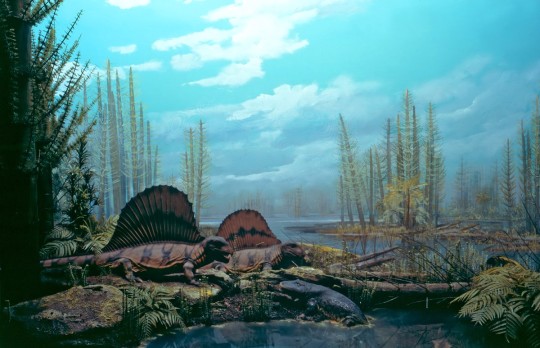
In contrast, most Early Permian fossil‑bearing deposits in North America formed on coastal or alluvial plains. Carcasses would’ve been transported to the deposition sites by rivers, some of which had a large geographic reach. These types of deposits can accumulate over a long period of time and have potential to mix together fossils from different environments.

Photograph of a diorama once exhibited at Carnegie Museum of Natural History that shows a typical Early Permian peat swamp or backwater swamp of a major river system. A similar modern environment would be the Okefenokee Swamp, Georgia. Photo by Mindy McNaugher, 2007.

Besides having an atypical geographic setting, the makeup of the Bromacker vertebrate fauna differs from those known from other Early Permian sites. The Bromacker vertebrate fauna has a low diversity of terrestrial tetrapods, but more importantly, it lacks fishes and aquatic to semi‑aquatic constituents. This is probably due to the Tambach Basin’s isolation from regional river systems and because it experienced seasonal to sub‑seasonal drying, making it difficult for water-reliant vertebrates to become established. Based on numeric counts of individual specimens, we determined that the relatively large‑sized herbivores Diadectes, Orobates, and Martensius greatly outnumbered the synapsid apex predators Dimetrodon and Tambacarnifex. We think the rarity and low diversity of synapsid carnivores is probably due to the lack of an aquatic to semi‑aquatic component in the food chain.

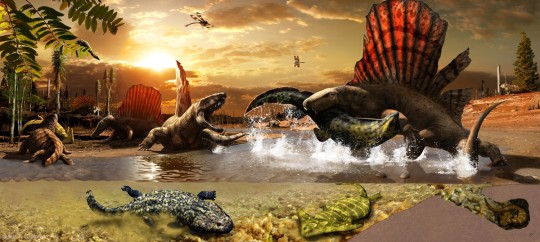
In contrast, most Early Permian North American localities preserve a diverse, mixed aquatic‑terrestrial fauna that either lived in water or was closely associated with water and aquatic food chains. Herbivores were rare in terms of both diversity and numbers, whereas synapsid apex predators were diverse and numerous.

A more dynamic North American Early Permian scene that includes a mixed aquatic‑terrestrial vertebrate fauna. The Dimetrodon on the right has caught a freshwater shark, demonstrating the importance of aquatic animals in the food chain. © Julius Csotonyi/Houston Museum of Natural Science.

The Bromacker is the oldest known terrestrial vertebrate ecosystem in which herbivores greatly outnumber apex carnivores, and in that respect, it resembles terrestrial vertebrate ecosystems of today. A modern example is the African savanna in which large herds of herbivores such as zebra, wildebeest, and buffalo provide a food source for a much smaller number of carnivores including lions, cheetahs, and hyaenas. Indeed, we consider the Bromacker to represent an early stage in the development of the modern terrestrial vertebrate ecosystem and that these early stages were restricted to upland areas isolated from aquatic‑based food chains.

This summary concludes the Bromacker Fossil Project blog post series. I hope that you’ve enjoyed reading it. Cast replicas of many of the fossils described in this series are exhibited in the Fossil Frontiers display case in CMNH’s Dinosaurs in Their Time exhibition, so be sure to look for them on your next visit. I’m grateful to Dave Berman, Albert Kollar, Thomas Martens, and Stuart Sumida, who answered numerous questions and provided photographs, and to Patrick McShea and Matt Lamanna for their editing skills. Click here to read the paper by Eberth et al. 2000.

Amy Henrici is Collection Manager in the Section of Vertebrate Paleontology at Carnegie Museum of Natural History. Museum employees are encouraged to blog about their unique experiences and knowledge gained from working at the museum.

Related Content

Vertebrate Fossils from Bears Ears National Monument, Utah

Mesozoic Monthly: Scipionyx

Ask a Scientist: What is the “Crazy Beast?”

Filed Under: Blog Tagged With: Amy Henrici, dinosaurs in their time, Museum from Home, Science News, Vertebrate Paleontology

December 29, 2020 by wpengine

Milkweed Observations

Opportunities to capture dramatically different seasonal pictures of the same subject come with the territory of our temperate region. Next year, consider challenging yourself to document how a flower bed or prominent deciduous tree transforms seasonally in response to changing light, temperature, and moisture.

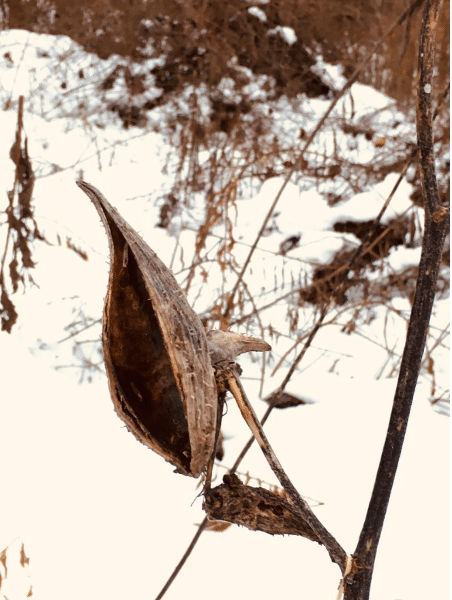
milkweed in winter with snow

The picture above, taken on the first day of winter, records the deteriorated condition of the common milkweed plant (Asclepias syriaca) I began observing during the first week of summer. The image might easily be termed an end point, but for documentation images that preceded it.

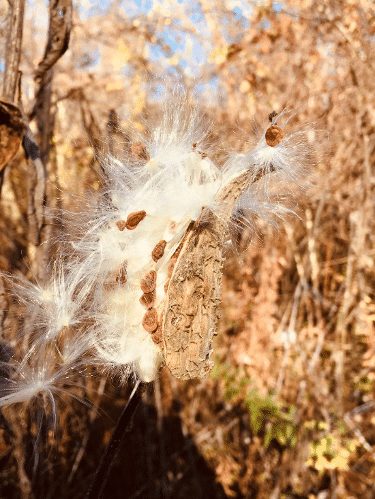
milkweed in autumn

Here, on a bright early November day, the burst seed pod offered dozens of matchhead-sized brown seeds, each attached to sparkling down-like filaments to the wind. With this picture as reference, the empty winter solstice pod implies continuance as much as conclusion.

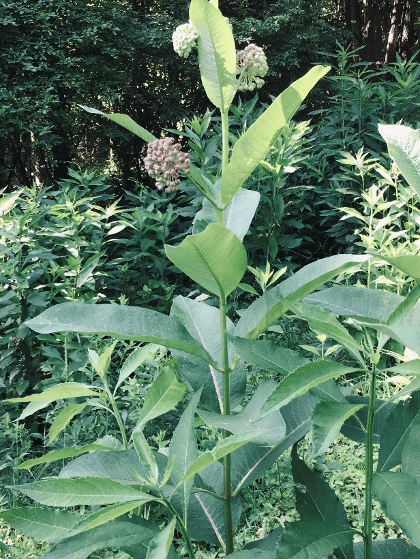
milkweed plant in summer

My observations began in late June, several days after the summer solstice, and just before the milkweed plant bloomed. My resolution for future observations is to begin them far earlier in the growing season, and to learn more about the insect fauna associated with the plant.

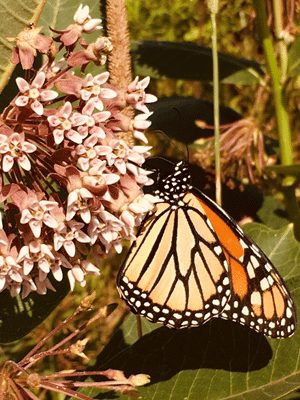
monarch butterfly on milkweed

Monarch butterflies (Danaus plexippus), a species currently experiencing alarming population declines, are the most well-known insects associated with milkweed. This one pictured above visited the plant’s lavender blossoms on July 25.

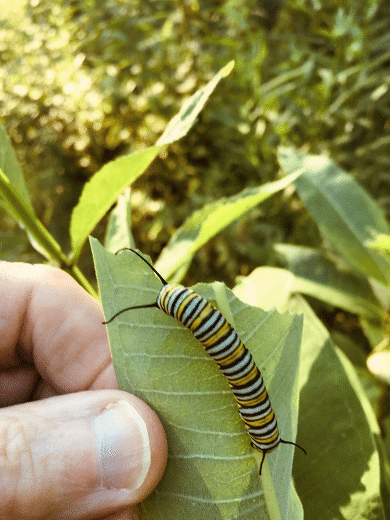
monarch caterpillar on milkweed leaf

Monarch butterfly caterpillars, such as the one photographed eating this leaf on August 19, are dependent on milkweed for nourishment and the predator protection they gain from the plant’s toxins.

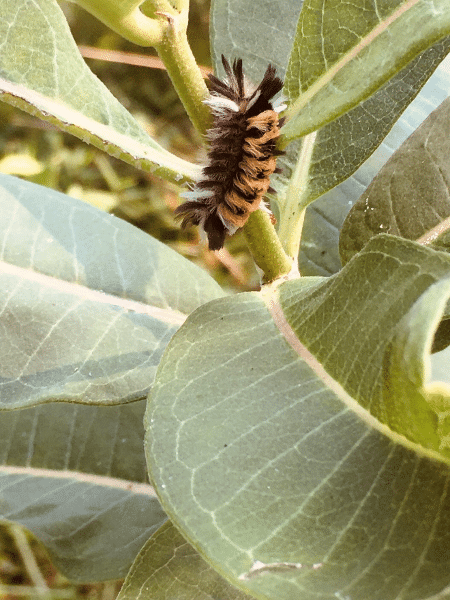
milkweed tussock moth caterpillar on milkweed

A lesser known milkweed dependent insect is the milkweed tussock moth (Euchaetes egle). A caterpillar of the species was photographed on the plant in mid-August.

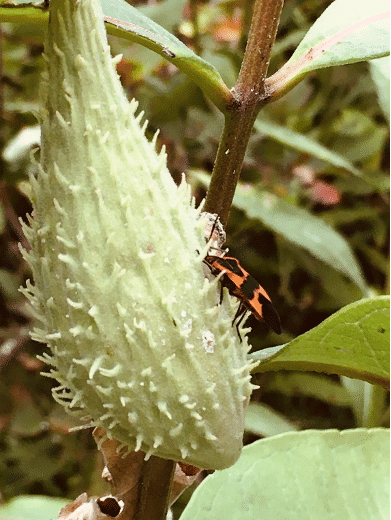
large milkweed bug on milkweed plant

The diet of the large milkweed bug (Oncopeltus fasciatus) includes seeds, so the presence of seed pods does not necessarily guarantee a bountiful crop the next growing season. The insect pictured above visited the plant on August 21.

Patrick McShea works in the Education and Visitor Experience department of Carnegie Museum of Natural History. Museum employees are encouraged to blog about their unique experiences and knowledge gained from working at the museum.

Related Content

Collected on This Day in 1934: European larch

Ask a Scientist: How do you find rare plants?

A Steeler Prayer

Filed Under: Blog Tagged With: Botany, Education, Museum from Home, Pat McShea

December 18, 2020 by wpengine

Waddling in a Winter Wonderland: How Penguins, Humans, and other Animals Traverse Ice and Snow

Winter in Pennsylvania has it pros and cons. The not-so-wonderful aspects of the season, such as shoveling sidewalks and trudging through knee-deep snow drifts, can be considered character builders at best.  But then there’s the fun stuff, like ice skating and sledding.  These can more than make up for the negative things, especially if you’re a kid. As a child, I remember doing these winter activities (plus making snowmen and snow angels, too).  A lot of the activities that we see as leisure fun have actually been around for thousands of years.  Through invention and adaptation, both humans and animals have learned how to deal with their wintry landscapes and safely travel from one icy area to another.

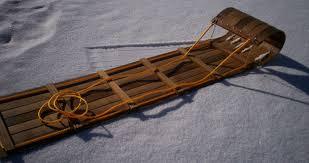
photo of a toboggan

Today, people associate ice skating with sports and recreation.  But, for a long time in human history, skates were essential for winter travel.  They date back at least 3,000 years to around the end of the Bronze Age, when the people of Eastern Europe and Russia created skates out of animals’ shin bones (most likely cow and horse).  These bone skates lied flat to the ice so the wearer could glide in all directions.  However, control and speed were somewhat lacking.

But a dramatic change happened in the 13th century when the metal blade was introduced.  Two hundred years later, better control and faster speed were achieved when sturdier bindings were added.  Rapid travel was now possible during the cold winter months.  In the 15th century Netherlands, for example, the canals that were built to power water mills and irrigate farmland in the summer would transform into frozen highways for thousands of travelers in the winter.

Today, we no longer need to depend on nature because temperature-controlled ice rinks are at our disposal all year round.  But, whether the ice is natural or man-made, scientists are still not 100% sure how ice skating is possible.  There are multiple theories.  One is that the extreme pressure of the skate blade on the ice creates a high viscosity bead of melt water that the skate glides on.  Another theory says that the uppermost layer of ice is made up of an extremely thin (10-20 nanometers) layer of freely moving water molecules.  The skate blade glides across this quasi-liquid layer.  It’s very similar to the support provided by the surface tension of the top layer of liquid water.  Whatever the reason that makes skating possible, people just know that they really like it.  Skating is an extremely popular activity, especially as it relates to sports.

Athletes can prefer different temperatures and textures of ice.  “Slow ice” is warmer, softer, and rougher, and figure skaters prefer it for pushing off and landing complicated jumps.  In contrast, hockey players prefer “fast ice.”  It’s colder, harder, and smoother, which makes skating faster, passing easier, and puck behavior more predictable.

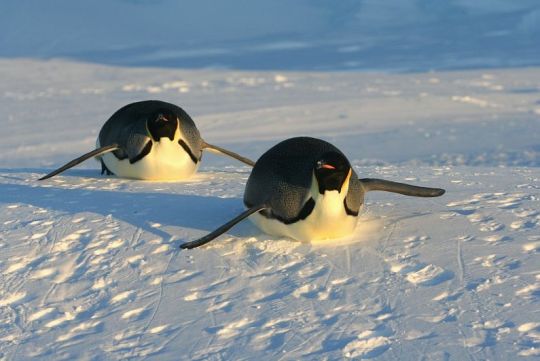
And if you could equate a hockey player to any creature in the animal world, it would be a penguin.  These experts of ice travel prefer “fast ice.”  This is because they use tobogganing as a primary way to get around.  The toboggan, a thin, flat, flexible piece of wood, has been used for centuries by humans as a transporter of supplies as well as for leisure fun.  But, in the case of penguins, they themselves are the toboggan!  Walking for penguins is slow-going.  They can only waddle along at about 1.5 mph.  With tobogganing, penguins can move faster with no risk of falling.  On horizontal ice, they slide around on their bellies, using their flippers and feet for propulsion, steering, and braking.  But when they find a nice downslope…stand back!  Like tiny tuxedoed torpedoes, penguins can slide down an icy hill at surprising speeds.

two penguins sliding on snow

While penguins love to take advantage of ice’s gliding properties, polar bears have developed adaptations that keep slipping and sliding to a minimum.  The sole of a polar bear’s foot has thick, black pads that are covered with small, soft dermal bumps (also called papillae) that create friction between their foot and the ice.  Long hairs growing between the pads and toes, plus curved claws, also provide traction.  They are the only bears that walk in a plantigrade, heel-to-toe, manner. Their gait is almost human-like, with the one slight difference that their toes point inward to avoid slipping.  Their forepaws are also similar in structure to a human hand, so much so that it would be difficult for the average person to tell the difference between the bones of a polar bear paw and the bones of a human hand.  This round, flattened paw shape acts like a snowshoe that spreads out their weight as they move over the snow.

Polar bears aren’t the only animals adapted to walking on top of snow.

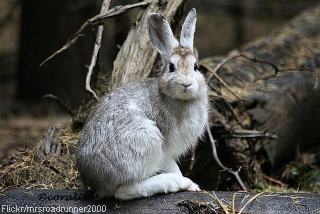
Thousands of years ago, large regions of the world were snowbound for much of the year, including North America. This meant animals needed to adapt to their environments; some of these animals are still around today, like the snowshoe hare, whose wide, furry, large-toed feet—larger than any other rabbit species— allowed them to move easily over deep snow.

photo of a snowshoe hare

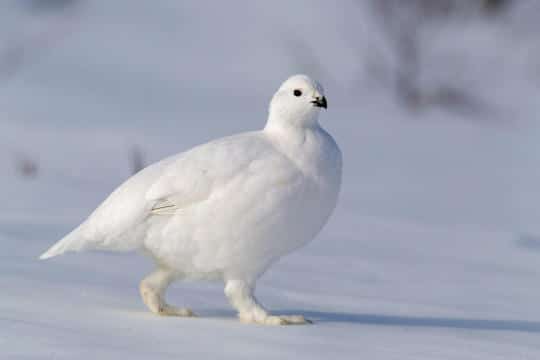
Like the hare, the ptarmigan, a partridge-like grouse, also lives in North America and has its own set of built-in snowshoes.  As winter approaches, its feet become more feathery and they grow longer claws.  These seasonal changes increase the weight-bearing surface of their feet by four times and reduce sinking in the snow by half.

photo of a ptarmigan on snow

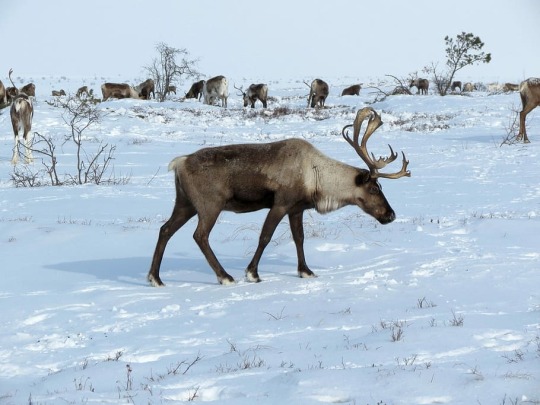
Caribou (also known as reindeer in Russia and Scandinavia) go through a similar transformation with the coming of winter.  Their sharp-edged hooves grow longer, their foot pads get tougher, and extra fur grows between and around their toes.  These changes transform their already wide, flat feet into the ideal snowshoe for a frosty trek.  For animals such as these, developing coping strategies for cold weather transport are essential to surviving and thriving in a frozen landscape.

caribou in snow

So this winter, if you just happen to be strolling along admiring the Narnia-esque view around you, and you fail to notice that patch of ice at your feet, you may end up flat on your back, staring up at the sky, wondering “Why me?” but don’t despair.  Instead, take comfort in the fact that even penguins, the masters of the ice, slip and take spectacular spills from time to time. At least you’re in good company!

Shelby Wyzykowski is a Gallery Experience Presenter in CMNH’s Life Long Learning Department. Museum staff, volunteers, and interns are encouraged to blog about their unique experiences and knowledge gained from working at the museum.

Related Content

Snowstorm in a Jar Activity

Make Blubber Gloves Activity

Cookie Excavation Activity

Filed Under: Blog Tagged With: HATW, Museum from Home, Super Science Days

December 18, 2020 by wpengine

Tuscarora Nu Yah

NU YAH! NU YAH! NU YAH! The sounds of the New Year at Tuscarora Nation in western New York.  For the past one hundred years and longer the Tuscarora have celebrated the New Year in a very unique way.

Three days before the new year our men go out on a hunting competition. Old men versus young men is the battle. It doesn’t matter if you are 60 and have no children you are considered a young man.  Old men are considered anyone with children. Only the reservation boundaries are eligible for the hunt. Rabbits, pheasant, and deer beware this day our men are looking for game to slay for the New Year’s Feast.

The hunt takes place from sunup to sun down. At 8:00 p.m. sharp all game must be at the Old Gym for The Count. There is a young man captain and an old man captain. Each present their group’s game and proceed to count in Tuscarora to see who will win the prize! The prize? The winner gets to watch the loser clean all the game.

The women of the territory will prepare the game for The Feast which will take place at noon on New Year’s Day.

The highlight of our New Year’s festival is the morning of January 1st when Nu Yah takes place. Young and old go door to door calling “Nu Yah! Nu Yah!” at each resident’s door. You must yell loud to be heard. If you don’t yell loud enough adults will prompt you to “say it again.”

Homemade cookies, brownies, rice krispie treats, doughnuts, and sometimes an apple are given from each home very similar to Halloween but adults participate too. Many visitors request a treat for the driver.

In the old days when I still participated in Nu Yah (before my family came along and I had to stay home to watch the door while my husband took our children Nu Yahing) we would often find a store bought cookie or an apple tossed to the side of the road. Homemade goods were the desired treats of the day.

If it was 10 degrees out we bundled up like snowmen and ran from the car to the house and yelled Nu Yah, threw our treats in our bag and headed right back to the warm car that waited. If it was warm out our Ma, Aunt, or Uncle or whoever was our driver would usually come to the door with us and spend some time standing at the door visiting and catching up with friends and family.

While our clan system of bear, deer, wolf, beaver, turtle, eel, and snipe runs through our maternal line, on New Year’s Day we also celebrated our father’s clan. If your father’s clan was a member of the house you visited for Nu Yah you also called out “Uwiire” to receive a special treat sometimes a gingerbread man or a piece of pie. In this way on this special day of the year the men were also recognized and important.

My mother who is 80, and one of 10 children, recalls her father walking with them to Nu Yah and directing them to his family clan homes so they knew which houses to ask for uwiire. I imagine this was also a way of teaching them to know who their family was. Her mother was a beaver just as all her sons and daughters were. Her father was a bear. A household that included a bear was a bonus for them to collect an extra goodie.

In the old days she said people would start coming at 6:00 a.m. and it was custom to yell Nu Yah and just walk in and grab your treat which was usually ready and waiting on a table by the door. Nowadays the first visitors arrive about 8:00 a.m.

While we looked forward with great anticipation to go Nu Yahing, we also looked forward to being old enough to help serve at The Feast. The women cooked for 3 days to prepare for this special day. The rabbits were soaked in water to make rabbit pie. The deer cooked to serve as a side dish.

While the men prepared the cornbread and cornsoup, the women peeled potatoes for mashed potatoes, baked hams and about 150 different pies all while visiting and laughing together. On the day of the feast when we got to be teenagers we would rush home from Nu Yah, change our clothes to something nice and get to the Old Gym to help bring the plates to the guests.

Everyone is welcome to come to The Feast. Many families planned their visits home on this special day so they could see and visit as many family members as possible.

The past few years at our Tuscarora Elementary School, our culture teacher has organized a school wide Nu Yah for our students. They go by grade to different rooms in the school and yell Nu Yah to receive their cookies. The Tuscarora Language teacher bakes cookies with the students for the adults to pass out. In this way each child can participate in Nu Yah and know our tradition even if, for some reason, they don’t get out to take part on New Year’s Day.

The best Nu Yah times that I can remember always involved the adults participating with us, coming in to the homes and taking a few minutes to visit.

To come from a cold, crisp morning into a cozy house with smiling faces and delicious aromas, relatives happy to see us, happy to share their lovely goods, and leave with a Nu Yah! Nu Yah! warmed us better than huddling over my grandparent’s old kerosene heat stove.

We always knew who had the best baked goods, who would be the happiest to see us, who would say every year, “gosh, you look just like your ma!” It was a good feeling to belong to such a loving community where our special New Year’s Festival has happened every year for over a hundred years because of the efforts and dedication of all our Tuscarora people.

Angela Jonathon is a resident of the Tuscarora Nation and affiliated with the Seneca-Iroquois Museum thorough the Tuscarora History Group. She has written this blog at the request of Dr. Joe Stahlman, Director of the Seneca-Iroquois Museum.

Related Content

Dutch Letters: A Sinterklaasavond Treat

The Feast of the Seven Fishes 

Ask a Scientist: What does the motif on this vessel mean?

Filed Under: Blog Tagged With: anthropology, HATW, Museum from Home, Science News, Super Science

  • « Go to Previous Page
  • Page 1
  • Page 2
  • Page 3
  • Page 4
  • Page 5
  • Interim pages omitted …
  • Page 26
  • Go to Next Page »

sidebar

About

  • Mission & Commitments
  • Directors Team
  • Museum History

Get Involved

  • Volunteer
  • Membership
  • Carnegie Discoverers
  • Donate
  • Employment
  • Events

Bring a Group

  • Groups of 10 or More
  • Birthday Parties at the Museum
  • Field Trips

Powdermill

  • Powdermill Nature Reserve
  • Powdermill Field Trips
  • Powdermill Staff
  • Research at Powdermill

More Information

  • Image Permission Requests
  • Science Stories
  • Accessibility
  • Shopping Cart
  • Contact
  • Visitor Policies
One of the Four Carnegie Museums | © Carnegie Institute | Privacy Policy | Terms of Use | Accessibility
Rad works here logo