• Skip to primary navigation
  • Skip to main content
  • Skip to primary sidebar

Carnegie Museum of Natural History

One of the Four Carnegie Museums of Pittsburgh

  • Visit
    • Buy Tickets
    • Visitor Information
    • Exhibitions
    • Events
    • Dining at the Museum
    • Celebrate at the Museum
    • Powdermill Nature Reserve
    • Event Venue Rental
  • Learn
    • Field Trips
    • Educator Information
    • Programs at the Museum
    • Bring the Museum to You
    • Guided Programs FAQ
    • Programs Online
    • Climate and Rural Systems Partnership
  • Research
    • Scientific Sections
    • Science Stories
    • Science Videos
    • Senior Science & Research Staff
    • Museum Library
    • Science Seminars
    • Scientific Publications
    • Specimen and Artifact Identification
  • About
    • Mission & Commitments
    • Directors Team
    • Museum History
  • Tickets
  • Give
  • Shop

Enjoy the Museum from Home via our Blog

Can't make it to the museum in person? We've done our best to help cultivate resources for you to enjoy from home. Activities for the whole family, different ways to experience our exhibitions and more are included in these blogs.

April 2, 2020 by wpengine

Rabbit Bone Reward

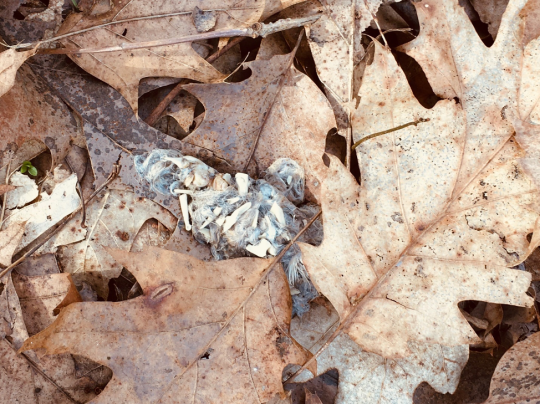
During a mid-March search for a great horned owl nest in an Allegheny County park, a loose jumble of rabbit bones and fur served as a consolation prize. On a mile-long hike that lacked a definitive owl sighting, the rabbit remains were at least evidence of the big winged predator’s recent presence.

Owls swallow their prey whole or in large chunks. After chemical processing within an owl’s stomach separates digestible tissue from bones, teeth, fur, and feathers, these indigestible elements are compressed into a pellet and coughed-up.

The rain-dissected pellet rested on an oak-leaf cushion directly below a 12-foot high trail-crossing branch that might well have been the owl’s cough-up perch.  As I imagined a well-fed owl occupying the perch, I recalled a challenge distilled through the wide-ranging conversations of the museum’s recent 21st Century Naturalist Project: How can all who utilize natural history collections routinely summon the imagination necessary to link individual specimens with the environments that once sustained them?

The energy flow represented just by the tiny bundle of white bone and blue-gray fur, for example, ran back in time to the rabbit and all the plant growth that nourished it, and infinitely forward to an owl then incubating eggs of another generation on a hidden nest.

For more information about owl pellets please visit:

https://www.allaboutbirds.org/news/what-are-owl-pellets

Patrick McShea works in the Education and Visitor Experience department of Carnegie Museum of Natural History. Museum employees are encouraged to blog about their unique experiences and knowledge gained from working at the museum.
Filed Under: Blog Tagged With: Education, Museum from Home, Patrick McShea

April 1, 2020 by wpengine

Draw a Bird!

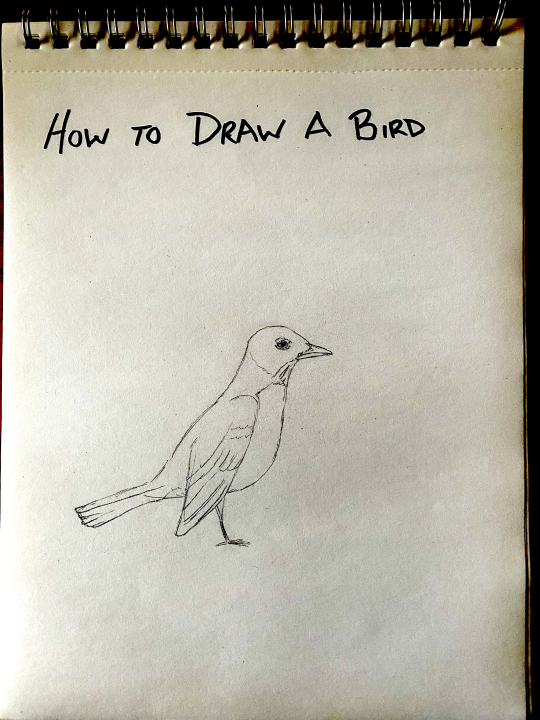
Have you been spending a lot of time looking out your window?  I have and I’ve decided to do something about it.  So, let me show you how to draw the birds that you see.

Illustrating or drawing nature is a method that some scientists use while taking notes.  Sometimes a photo doesn’t always capture the details that a scientist wants to make notes about, so they’ll draw an animal, plant, insect, or even a whole scene in order to fully record what is happening.  It’s also fun to make a sketch of your favorite flower or animal.

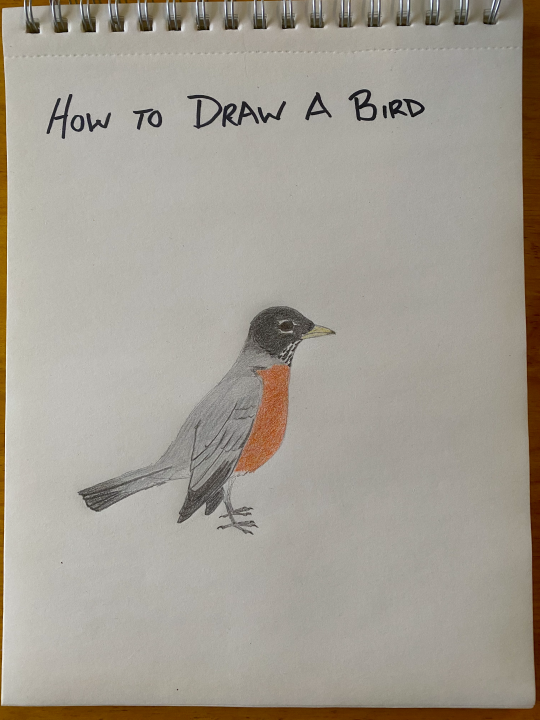
This time of year, there are a lot of robins around my neighborhood, so I’ll show you how I created this sketch of one and you can follow along too.

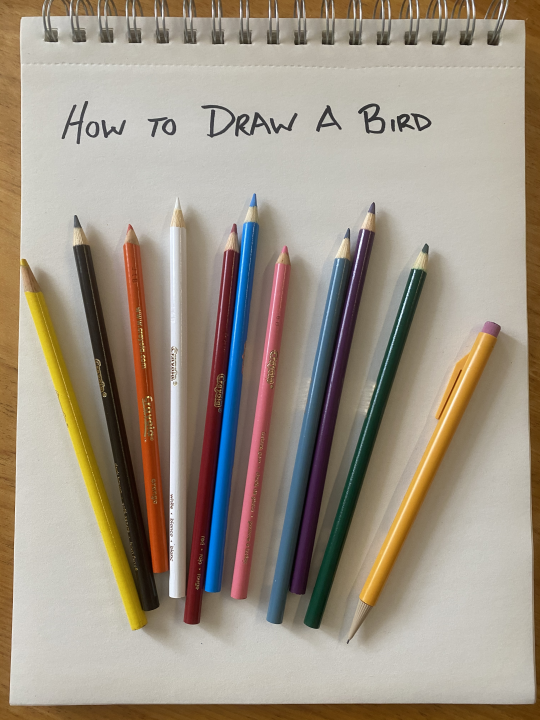
Before we get started you might need to gather some supplies.  Use a pencil and eraser, just in case you make some mistakes (it’s okay to make a mistake).  Get some paper and a comfy spot to draw—make sure you cover your table to avoid making marks on it.  Don’t forget the colors!  I like colored pencils, but you can use markers, crayons, paint, or anything else to color with.

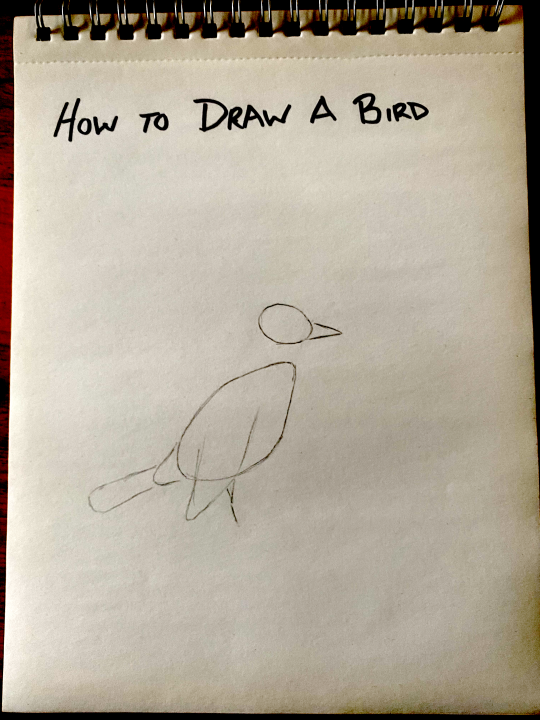
Step 1: Shapes

Use some basic shapes—circles, triangles, squares, and lines—to make the general shape of what you want to draw.  Use light pencil strokes so that they’ll be easy to erase later.

Try to keep all of your shapes balanced to one another—you don’t want your bird to have a huge head!  I like to use a photo that I’ve taken or found online to use as a reference for what I’m drawing.

If you want to take it to the next level, you can also check out the different field marks on a bird.

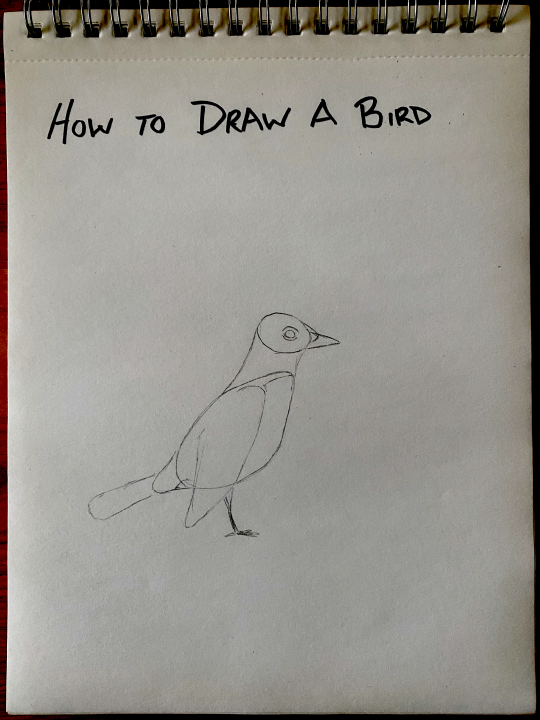
Step 2: Silhouette

Next let’s connect our shapes so that we can have a good outline of our subject.  You can add eyes and some of the rough edges.  Try to zone out where your colors will change too—for instance the robin’s red belly will be different than its grey back, so I’ll add a line to mark that.

Step 3: Details

Add more details.  Add feathers on the wing and tail, add in details on the beak, head, and eye.  You can also erase some of those shapes we made in step 1 and feel free to make a few changes to those shapes if you want to.

It’s also important in this step to know how detailed you want to be—sometimes simple is good.  If your sketch is small, then less details might be better, but if your sketch is big, then you can add lots of little details.  It’s up to you!

Step 4: Color

This step is optional, sometimes scientists will just write down what colors they noticed because they can’t always carry around a whole art kit.  However, if you have some time, then adding color to your drawing can really bring it to life.

You can use crayons, markers, paint, or any other color tool you want.  It’s always a good idea to test your colors on a separate piece of paper to see if they’re right for you or to try out a mix of colors.  Birds can be lots of different colors!

Be proud of your sketches!  No one else could have made it the same way that you did.  By drawing and coloring plants, animals, and other nature you can sharpen your observation skills and gain a better appreciation for the beauty and uniqueness of all life.

Aaron Young is a museum educator on Carnegie Museum of Natural History’s Outreach team. Museum staff, volunteers, and interns are encouraged to blog about their unique experiences and knowledge gained from working at the museum.
Filed Under: Blog Tagged With: activities, Birds, Education, Museum from Home

March 31, 2020 by wpengine

Mesozoic Monthly: Nemicolopterus

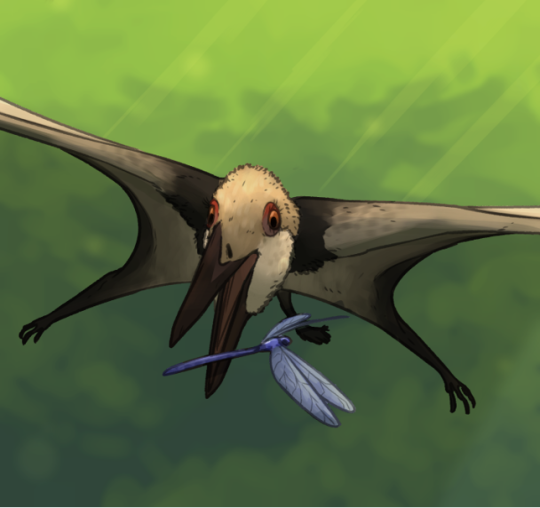
Welcome back to Mesozoic Monthly! Spring has sprung, and you know what that means: baby animals are coming! It only makes sense that the star of this month’s post should be as small and cute as chicks or puppies. With a wingspan of less than 10 inches (25 centimeters), Nemicolopterus crypticus is one of the tiniest known pterosaurs – about the size of an American Robin!

Life reconstruction of the adorable little pterosaur (flying reptile) Nemicolopterus crypticus by paleoartist Connor Ashbridge, used with permission. You can find Connor’s other work on Instagram @pantydraco.

Nemicolopterus is a pterosaur, a kind of prehistoric animal that is commonly called a “pterodactyl” or “flying dinosaur.” However, pterosaurs are not dinosaurs! Dinosaurs are all animals within a specific group of reptiles known as the Dinosauria. Pterosaurs comprise a separate group of reptiles that were specialized for flight, called the Pterosauria. These flying reptiles are extraordinary; they not only represent the earliest-known flying vertebrates (animals with backbones), but they also achieved flight in a different manner than did modern flying vertebrates (birds and bats)! Over half the length of a pterosaur’s wing was made up by a single super-long finger (specifically, the fourth finger, aka the ‘ring finger’ of a human) that anchored a broad skin membrane. It might seem like it’d be impossible to fly on just one finger, but many pterosaurs managed to grow to gargantuan sizes. Cousins of Nemicolopterus known as azhdarchids (one of which, Quetzalcoatlus, soars above T. rex in Carnegie Museum of Natural History’s Dinosaurs in Their Time exhibition) could reach estimated wingspans of 39 feet (12 meters). That’s as big as a small airplane!

Tiny, fuzzy, and adorable, Nemicolopterus would have looked a lot like a baby bird if you could take a trip back to the Cretaceous and see this pterosaur in the wild. In fact, the only specimen we have of Nemicolopterus may have been a baby! It’s often difficult to tell just based on its fossilized skeleton whether a prehistoric animal was fully mature or still in the process of growing and changing when it died. One way of telling if a fossil reflects an adult is whether certain bones have completely fused together (the technical term is coossified). You may know that humans have more separate bones as babies than we do as adults; this is because, as a person grows, certain bones like the ones that make up your skull fuse together along lines called sutures. Many baby bones also tend to be soft and flexible because they start out as cartilage, which is replaced by solid bone over time through a process called ossification. Several important bones in the Nemicolopterus fossil are ossified, so we can be sure that it was not a hatchling. However, since paleontologists agree that this specimen was still young when it died, and also that baby pterosaurs were precocial (i.e., able to effectively move about and find food on their own shortly after hatching), there’s still a significant chance that the Nemicolopterus fossil represents a young life stage of another, larger pterosaur.

There’s a good candidate for which pterosaur might be the adult form of Nemicolopterus, if indeed the only known fossil is just a baby of another species: Sinopterus is a tapejarid pterosaur that lived at the same time and place as the little fellow. Tapejarids are unique because they were likely arboreal and had beaks that appear useful for eating plants or fruit. Nemicolopterus crypticus was named the “hidden flying forest dweller” as an homage to the forested wetlands in which it lived roughly 120 million years ago, in what is now Liaoning Province in northeastern China. It spent its time in the trees, attempting to avoid predatory dinosaurs such as the famously bird-like dromaeosaurid Microraptor or the distant T. rex relative Sinotyrannus.

Lindsay Kastroll is a volunteer and paleontology student working in the Section of Vertebrate Paleontology at Carnegie Museum of Natural History. Museum staff, volunteers, and interns are encouraged to blog about their unique experiences and knowledge gained from working at the museum.
Filed Under: Blog Tagged With: Museum from Home, Science News, Vertebrate Paleontology

March 25, 2020 by wpengine

Robin Watch

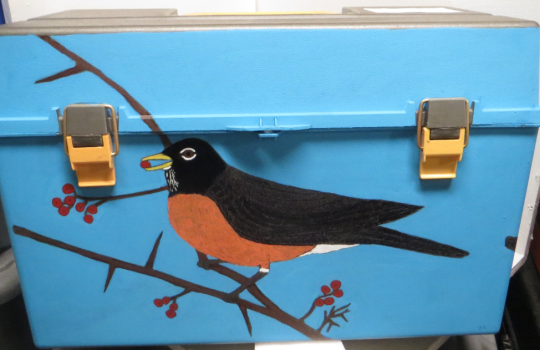
(above) The American Robin Box in the CMNH Educator Loan Program, with art work by John Franc. The loaning of educational materials has been suspended during the Covid-19 pandemic.

As a bird watcher, I’m out of the house early at this time of the year, listening for the calls of newly arrived migrating birds. New days begin in a still dark neighborhood with a steadily growing feathered chorus. Although the calls of a few Northern cardinals and Carolina wrens are close enough for me to guess the location of each singers’ perch, they are far outnumbered by American robins whose blended notes reach my ears from every compass point.

On recent mornings I’ve come to value the abundant presence of robins as a tonic to human nerves frazzled by the life-disrupting spread of Covid-19. The species’ horizon-wide dawn concert is a prelude to an active visible presence in the same territory all day. With minimal effort, little prior planning, and without violating protocol for social distance spacing, you can observe robins flying to and from cover, hopping over grassy feeding areas in search of worms, fighting rivals for mates and territory, and even gathering dried grass and mud for nest construction.

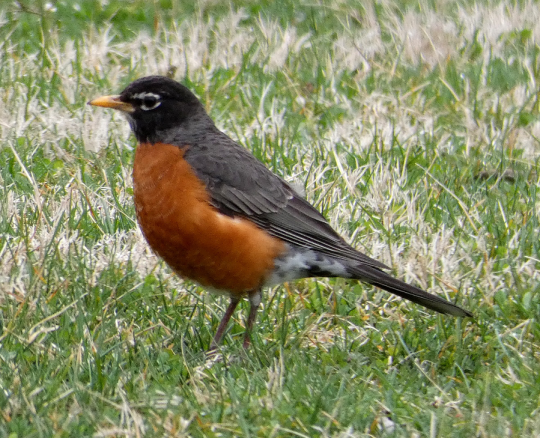
Photo by Amy Henrici.

Through such simple observations it’s possible to reach what naturalist Margaret Renkl, writing recently in The New York Times, termed “the alternate world we need right now, one that exists far beyond the impulse to scroll and scroll.”

A pre-pandemic, but still contemporary call for all of us to become better robin watchers can be found in A Season On The Wind, ornithologist Ken Kaufman’s 2019 account of spring bird migration near his home along the Lake Erie shore in western Ohio.

“Their songs are loud and rich and their colors are bold, from the deep yellow of the beak to the bright rufous orange of the chest. If the American robin were a rare bird, we would climb mountains or walk through fire to catch a glimpse of it. Why should we appreciate it any less just because it’s around us every day?”     (A SEASON ON THE WIND, Inside the World of Spring Migration, Houghton Mifflin Harcourt, 2019.)

A far older robin endorsement can be found in the writings of John James Audubon. In early June of 1833, when the renowned bird artist arrived on the barren coast of Labrador, he encountered a robin singing from a snow-free patch of grass.

“That song brought with it a thousand pleasing associations referring to the beloved land of my youth, and soon inspired me with resolution to persevere in my hazardous enterprise.”

Audubon’s praise for the species continues for several paragraphs, and his deep appreciation for the wide-ranging bird includes an aspect unfamiliar to modern robin watchers. After describing how wintering robins in the American south feed on “the fruits of our woods,” he reminds readers that under these circumstances “they are fat and juicy and afford excellent eating.”

For more information about robins including song recordings:

https://www.allaboutbirds.org/guide/American_Robin/id

For read a fuller account of Audubon’s praise for robins:

https://www.audubon.org/birds-of-america/american-robin

For Margaret Renkl’s full essay about the value of nature observation:

https://www.nytimes.com/2020/03/23/opinion/coronavirus-nature-outdoors.html

Patrick McShea works in the Education and Visitor Experience department of Carnegie Museum of Natural History. Museum employees are encouraged to blog about their unique experiences and knowledge gained from working at the museum.
Filed Under: Blog Tagged With: Birds, Education, Museum from Home, Patrick McShea

March 18, 2020 by wpengine

Collected on this Day in 1951: Bedstraw

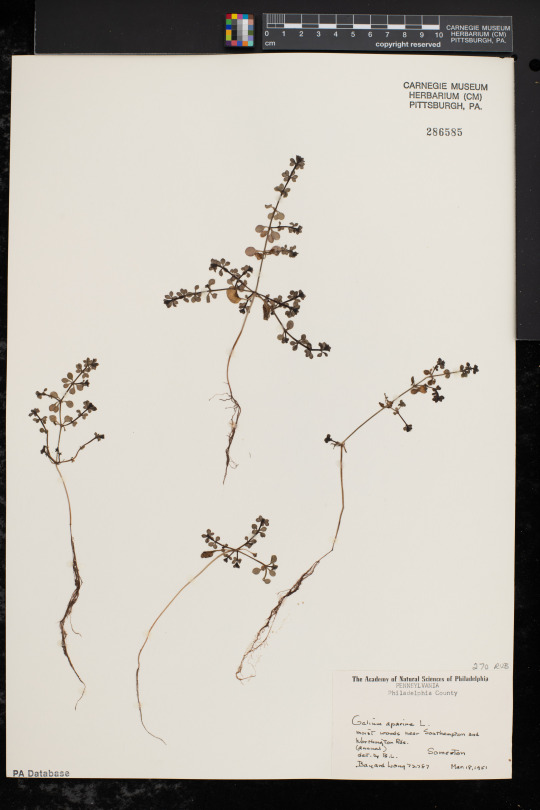
This bedstraw specimen was collected on March 18, 1951 by Bayard Long in Philadelphia county, Pennsylvania.

Bayard Long (1885-1969) was a Philadelphia-area botanist and an active member of the Philadelphia Botanical Club (founded in 1891 and still exists today).  He was a prolific collector and served as Curator of the Club’s Local Herbarium for 56 years (housed at the Academy of Natural Sciences).

Fogg writes of his collections in 1970 in the journal Rhodora: “It is doubtful that anyone ever possessed a higher standard for the quality of an herbarium specimen than Bayard Long.  Every leaf had to be laid out flat, every inflorescence properly displayed, every flower part clearly shown. Extra flowers and loose fruits and seeds were placed in pockets affixed to the sheet. Root systems (collected in their entirety whenever possible) were scrupulously clean, habitats were accurately described, and localities were identified to the nearest tenth of a mile and closest compass point. All of this seems the more remarkable when it is realized that Long collected close to 80,000 numbers, not including collections made as a member of Fernald’s expeditions.”

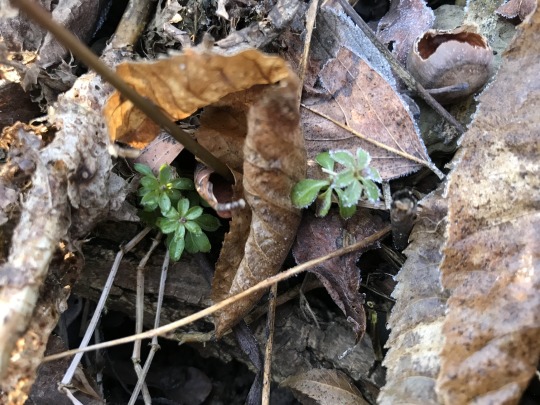
Bedstraws (species in the genus Galium, in the coffee family Rubiaceae) are common and memorable in our woods. They have many historical and traditional uses. In particular, they were used to stuff mattresses, hence the funny name. Also called cleavers or catchweed, the stems are sticky (due to fine hook hairs) and can be fun to stick on your clothes. They have likely stuck to you or your pet. This specimen is Galium aparine. An annual plant, seeds germinate in spring and produce tiny white flowers. They are emerging now, poking through the leaf litter.

Find this specimen and more here.

There are >64,000 specimens collected by Bayard Long currently digitized and online.

Check back for more! Botanists at the Carnegie Museum of Natural History share digital specimens from the herbarium on dates they were collected. They are in the midst of a three-year project to digitize nearly 190,000 plant specimens collected in the region, making images and other data publicly available online. This effort is part of the Mid-Atlantic Megalopolis Project (mamdigitization.org), a network of thirteen herbaria spanning the densely populated urban corridor from Washington, D.C. to New York City to achieve a greater understanding of our urban areas, including the unique industrial and environmental history of the greater Pittsburgh region. This project is made possible by the National Science Foundation under grant no. 1801022.

Mason Heberling is Assistant Curator of Botany at the Carnegie Museum of Natural History. Museum employees are encouraged to blog about their unique experiences and knowledge gained from working at the museum.
Filed Under: Blog Tagged With: Botany, collected on this day, Mason Heberling, Museum from Home, Science News

  • « Go to Previous Page
  • Page 1
  • Interim pages omitted …
  • Page 24
  • Page 25
  • Page 26

sidebar

About

  • Mission & Commitments
  • Directors Team
  • Museum History

Get Involved

  • Volunteer
  • Membership
  • Carnegie Discoverers
  • Donate
  • Employment
  • Events

Bring a Group

  • Groups of 10 or More
  • Birthday Parties at the Museum
  • Field Trips

Powdermill

  • Powdermill Nature Reserve
  • Powdermill Field Trips
  • Powdermill Staff
  • Research at Powdermill

More Information

  • Image Permission Requests
  • Science Stories
  • Accessibility
  • Shopping Cart
  • Contact
  • Visitor Policies
One of the Four Carnegie Museums | © Carnegie Institute | Privacy Policy | Terms of Use | Accessibility
Rad works here logo