• Skip to primary navigation
  • Skip to main content
  • Skip to primary sidebar

Carnegie Museum of Natural History

One of the Four Carnegie Museums of Pittsburgh

  • Visit
    • Buy Tickets
    • Visitor Information
    • Exhibitions
    • Events
    • Dining at the Museum
    • Celebrate at the Museum
    • Powdermill Nature Reserve
    • Event Venue Rental
  • Learn
    • Field Trips
    • Educator Information
    • Programs at the Museum
    • Bring the Museum to You
    • Guided Programs FAQ
    • Programs Online
    • Climate and Rural Systems Partnership
  • Research
    • Scientific Sections
    • Science Stories
    • Science Videos
    • Senior Science & Research Staff
    • Museum Library
    • Science Seminars
    • Scientific Publications
    • Specimen and Artifact Identification
  • About
    • Mission & Commitments
    • Directors Team
    • Museum History
  • Tickets
  • Give
  • Shop

Nicholas Sauer

March 2, 2022 by Erin Southerland

Antarctica and the Anthropocene: Novel Species to the Polar South and Their Ecological Impact

by Nicholas Sauer

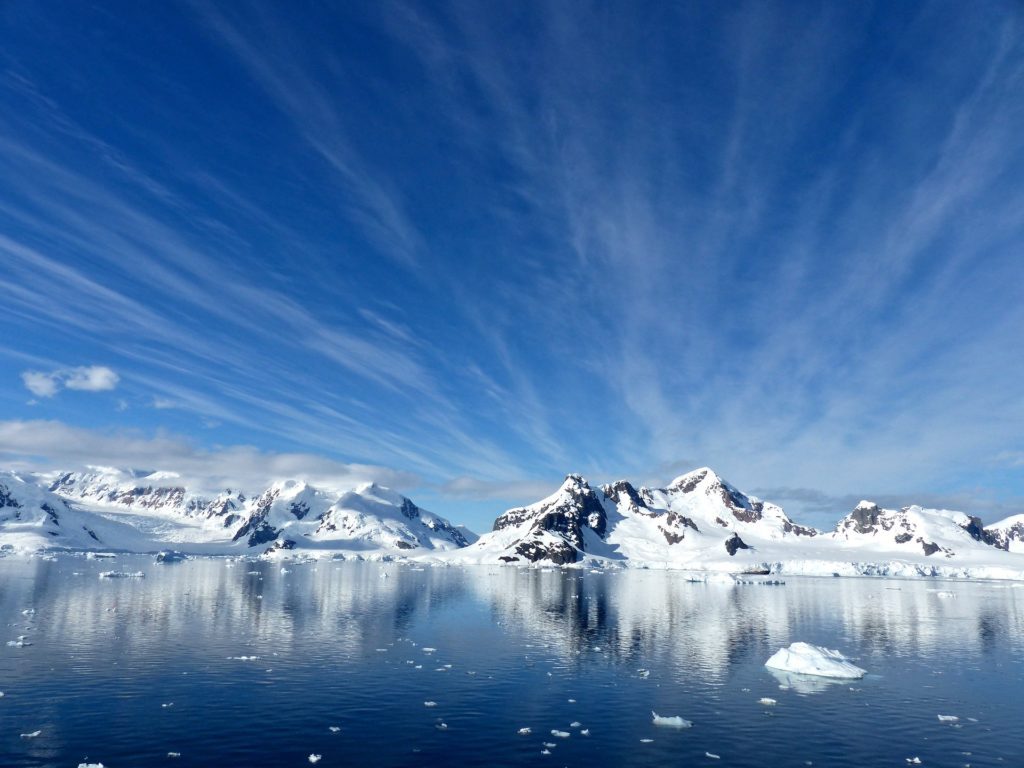
For better or worse, humans have left an impact on every corner of the globe, and Antarctica is no exception. One of the ways humans have altered Antarctica’s unique environment is by unintentionally introducing new plant and animal species to the continent. The presence on the continent of human-introduced novel species can be interpreted as a mark of the Anthropocene, a term scientists use for the recent decades during which human activities have created environmental impacts great enough to constitute distinct geological and earth system change, and a new era in the Earth’s history. While most novel species do not survive Antarctica’s polar elements, a few do. As of 2021, there were eleven known novel invertebrate species, including insects and mollusks, thriving on the more hospitable coastal areas of Antarctica. For context, there are 163 species of bivalves, 568 species of gastropods, and three species of insects that currently make the continent home. Of the three insect species, only the midge B. antarctica, flightless and measuring under a centimeter long, is native to Antarctica. Novel species while not always intrinsically dangerous to their new homes and neighbors, have the potential to change their adopted ecosystems in profound and unforeseen ways.
Antarctica

Eretmoptera murphyi – a novel midge to Antarctica changes nutrient cycling

One of the most fascinating of Antarctica’s human-introduced invertebrate species is the midge Eretmoptera murphyi, that has made Signy Island, Antarctica home since the 1960s. This species of midge inadvertently made its way to the polar South as a stowaway on a scientific expedition focused on plant transplantation. The insects found Signy Island well-suited for colonization: they have no predators there, can survive “ice entrapment,” continue to respire when in water, and produce larvae unfazed by freezing temperatures. The fact that the species is parthenogenetic—that is, reproduces without fertilization—also eases its survival. Each new generation emerges from the soil and melting ice over the course of the summer season and then disperses on the wind, expanding the species’ range. Today the density of some E. murphyi populations on Signy exceed that of any other insect population on the island. 

Furthermore, the midge discovered an excellent food source in the island’s abundant peat deposits. E. murphyi consumes the peat and then excretes it as nitrogen-rich soil. In the area that the midge occupies, the amount of nitrogen in the soil matches what a scientist could expect to find in soil surrounding a seal colony. The novel midge’s excretion of nitrogen is “opening nutrient cycling bottlenecks” on the island says Jesamine Bartlett, a scientist studying E. murphyi on Signy. Bartlett compares the species to an earthworm regarding its creation of nutrient-rich soil. However, per Bartlett, the island has never before hosted a creature that performed such a role to her knowledge. It remains to be seen just how this heightened level of nitrogen in the soil—which acts as a fertilizer—could alter the abundance of the island’s plant populations, particularly that of mosses, hair grass, and pearlwort. In addition to its potential effect on Signy’s flora, scientists caution that E. murphyi could eventually outcompete and displace the island’s pre-existing insect populations, particularly that of B. antarctica, Antarctica’s only endemic insect species and one that can only reproduce via fertilization. Because it is parthenogenetic and reproduces more easily, scientists are curious to see if the novel midge E. murphyi could one day prove heartier than the native species, and what the presence of the novel midge means for Signy Island’s biodiversity in the long-term.

How Are Novel Species Introduced to Antarctica?

Species such as E. murphyi spread into new territories traveling with humans, often via the laces and tread of shoes, acting as literal living components of our footprint. Seeds of non-native plants hitch a ride to new habitats on human travelers’ clothes. In fact, each tourist unknowingly brings on average an estimated nine seeds with them to Antarctica according to Stephen Chown of Stellenbosch University in South Africa. In 2010 there were approximately 40,000 tourists who visited the continent. That’s potentially 360,000 novel seeds introduced to Antarctica in just one year, though most will not successfully establish themselves. According to a study led by researchers from Monash University in Australia, only sixteen percent of Important Bird Areas in Antarctica are found in regions “negligibly impacted” by humans. These scholars and conservationists argue that the image of Antarctica as “remote” is unhelpful and obscures the profound impact humans have on its coastal regions, regions that contain the continent’s greatest biodiversity. The goal of the team’s research is to encourage Antarctic Treaty nations to take concrete steps to further protect Antarctica’s natural environment and wildlife. As a landmass not under the jurisdiction of any one nation, Antarctica’s ecological protection hinges on global cooperation.

More than ever before, maintaining Antarctica’s unique ecosystems—safeguarding the continent’s biosecurity—is of paramount importance. The scientific community and the ecotourism industry are making efforts to adhere stringently to the Antarctic Treaty, the Antarctic Conservation Act, and Antarctic Science and Tourism Conservation Act, international agreements in place to protect the continent’s delicate ecology and facilitate ethical research and tourism. Per these agreements, travelers to Antarctica are prohibited from bringing seeds, plants, or animals including insects onto the continent. Travelers are also barred from bringing probiotics and SCOBY (symbiotic culture of bacteria and yeast), a key ingredient of kombucha and yogurt. Both products contain “biologically viable organisms”—bacteria—that could have an adverse effect on the Antarctic environment if left uncontrolled. Under the Antarctic treaties, cargo en route to Antarctica  must be thoroughly inspected and sanitized before being shipped and unloaded. Customs inspectors from treaty-member nations are on the lookout for rotting fruits and vegetables, food scraps, spores, mold, soil, living animals, and signs of living animals like wasps’ nests, and a vast array of other “biosecurity risk material.” The United States’ Antarctic Program Participant Guide asks that prospective researchers make sure that “there are no seeds or other plant parts caught in Velcro, no mud on boots, and no grass inside cuffs.” Even the smallest of novel organic materials onboard ship or onboard a traveler’s sleeve have the potential to impact Antarctica’s isolated environment. 

Antarctica in the Anthropocene 

In the profoundly interconnected world of the Anthropocene, people have introduced many novel species to Antarctica, be they mollusks attached to a ship’s hull, seeds stuck to a scientist’s parka, or midges clinging to a hiking boot or plant specimen. Novel species cause direct changes to the local ecology, and the impacts may be getting more dire, as the continent is also being altered by human-caused global climate change. Already Antarctica is warming five times as fast as the global average, and its ice sheets are melting  (with grim consequences to the coastal regions everywhere as sea levels rise). Global climate change can only be solved through people and nations working collaboratively to reduce dependence on fossil fuels. And in the meantime in Antarctica, as we travel deeper into the twenty-first century, the scientific community and governments around the world are learning to be more mindful of the human impact on Earth’s southernmost continent and searching for ways—such as better biosecurity—to keep Antarctica’s unique ecology as intact and resilient as possible.

Nicholas Sauer is a Gallery Experience Presenter in CMNH’s Life Long Learning Department. Museum staff, volunteers, and interns are encouraged to blog about their unique experiences and knowledge gained from working at the museum. 

References

“Antarctica.” National Geographic. 2021. <https://www.nationalgeographic.org/encyclopedia/antarctica/>.

“Antarctica more widely impacted by humans than previously thought.” Sciencedaily.com. 17 July 2020. <https://www.sciencedaily.com/releases/2020/07/200717120155.htm>.

Bartlett, Jesamine, et al. “An insect invasion of Antarctica: the past, present and future distribution of Eretmoptera murphyi (Diptera, Chironomidae) on Signy Island.” Insect      Conservation and Diversity, vol. 13, January 2020. <https://onlinelibrary.wiley.com/doi/full/10.1111/icad.12389>. 

Garcia, Sierra. “Antarctica Is Warming. Are Invasive Species on the Way?” Jstor.org. 28 June 2021. <https://daily.jstor.org/antarctica-is-warming-are-invasive-species-on-the-way/>.

Lucibella, Michael. “Insects in the Extreme: What the Genes of Antarctica’s Tough Little Midge             Can Tell Us.” The Antarctic Sun. 29 June 2020. <https://antarcticsun.usap.gov/science/4427/>.

Perkins, Sid. “Antarctica Threatened by Alien Seed Invasion.” Wired.com. 3 March 2012. <https://www.wired.com/2012/03/antarctica-plant-seeds/>.

Scharping, Nathaniel. “Even Antarctica has Invasive Species.” Discovermagazine.com. 19 Dec. 2018. <https://www.discovermagazine.com/environment/even-antarctica-has-invasive-species>.

Sexton, Chrissy. “Non-Native Insect Species Become a Major Threat in Antarctica.” Earth.com. 19 Dec. 2018. <https://www.earth.com/news/non-native-insect-species-antarctica/>.

Shukla, Priya. “Tourists are Bringing Invasive Species to Antarctica.” Forbes.com. 27 Dec. 2021. < https://www.forbes.com/sites/priyashukla/2021/12/27/tourists-are-bringing-invasive-species-to-antarctica/?sh=1244b66f3bc8>.

Solly, Meilan. “How Antarctica’s Only Native Insect Survives the Freezing Temperatures.” Smithsonian Magazine. 10 Sept. 2019. <https://www.smithsonianmag.com/smart- news/how-antarcticas-only-insect-resident-survives-freezing-temperatures-180973087/>.

“33 Antarctic Species We Love and Must Protect: Part 1.” Pew Charitable Trusts. 16 Sept. 2014. <https://www.pewtrusts.org/en/research-and-analysis/fact-sheets/2014/09/counting-          downtoccamlr#:~:text=Antarctic%20mollusks,new%20species%20have%20been%20dis         covered.>.

“United States Antarctic Program Participant Guide: 2018-2020 Edition.” National Science Foundation. June 2018. < https://www.usap.gov/USAPgov/travelAndDeployment/documents/ParticipantGuide_2018-20.pdf>.

“What is Biosecurity?” Australian Antarctic Program. 14 July 2020. <https://www.antarctica.gov.au/antarctic-operations/travel-and-logistics/cargo-and-      freight/biosecurity-measures/what-is-biosecurity/>.

“What is Biosecurity Risk Material (BRM)?” Australian Antarctic Program. 14 July 2020.<https://www.antarctica.gov.au/antarctic-operations/travel-and-logistics/cargo-and-          freight/biosecurity-measures/biosecurity-risk-material/>.

Related Content

Pittsburgh’s Moths Reflect Human Impact of Industry

Climate Change Never Takes a Holiday: The Phenomenon of the Pizzly Bear

Magnificent Frigatebirds: The Flying Pirates of the Caribbean

Carnegie Museum of Natural History Blog Citation Information

Blog author: Sauer, Nicholas
Publication date: March 2, 2022
Share this post!

  • Share on Twitter Share on Twitter
  • Share on Facebook Share on Facebook
  • Share on Pinterest Share on Pinterest
  • Share on LinkedIn Share on LinkedIn
  • Share on Reddit Share on Reddit
  • Share via Email Share via Email

Filed Under: Blog Tagged With: Nicholas Sauer, We Are Nature 2

December 8, 2021 by Erin Southerland

Climate Change Never Takes A Holiday: The Phenomenon of the Pizzly Bear

by Nicholas Sauer
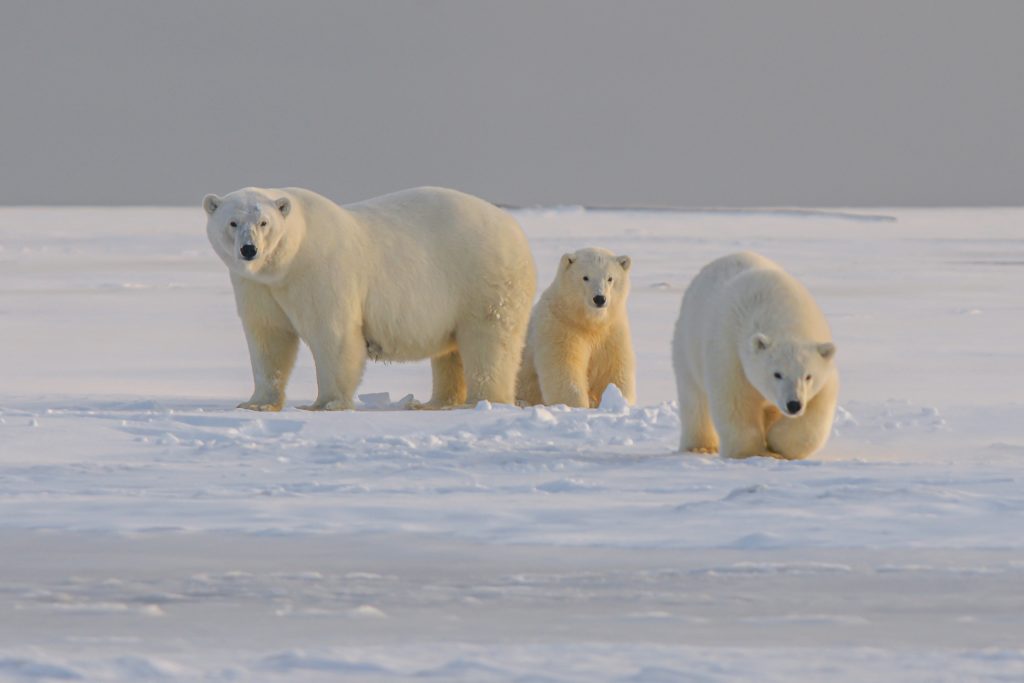
three polar bears in the snow
Polar bears. Photo by Hans-Jurgen Mager on Unsplash

At this time of year, you’re apt see TV commercials in which cuddly and good-natured polar bears share delicious colas with one another in the spirit of the season. However, neither the mythology nor reality surrounding polar bears—nor bears in general—are quite so idyllic. Even their scientific names possess an element of menace and foreboding. Ursus arctos horribilis—the grizzly—speaks for itself. Ursus maritimus—the polar bear—hints that this predator is as much at home hunting its prey in water as it is on the Arctic ice. In fact, polar bears can swim for several days without stopping. 

Throughout history these creatures have inspired fear in the heart of many a human. Members of the Lewis and Clark Expedition were shocked that none of their party were devoured by grizzlies in the Pacific Northwest. Some Renaissance cartographers labeled the mysterious Arctic realms: hic sunt ursi albi, or “here be white bears” (dragons are overrated anyway). Other Europeans of that era drew polar bears as if they were enormous white wolves with serpentine tails.

The stark whiteness of the polar bear fascinated Ishmael, the narrator of Herman Melville’s 1851 classic Moby Dick: “The irresponsible ferociousness of the creature stands invested in the fleece of celestial innocence and love; and hence, by bringing together two such opposite emotions in our minds, the Polar bear frightens us with so unnatural a contrast.” The white whale of the novel is terrifying in much same way—that such a beast should be the hue of angelic robes is overwhelming to Ishmael. Coincidently, try thinking of Moby Dick as a creature feature, and I bet you won’t find it as intimidating and esoteric a read (it worked for me). 

Grizzly and polar bears have often been misinterpreted and sensationalized by their human neighbors. However, the scientific community in recent decades has begun to regard these two species of bear as complex and vulnerable creatures of great power. Indigenous populations in North America have long understood this. Specifically, the Inuit revere the polar bear for its human-like traits. For instance, both species hunt with patience and intelligence, are capable of play, and demonstrate maternal devotion to cubs. 

Climate Change and Pizzly Bears

Regrettably, climate change is rapidly altering the Arctic ecosystem, putting the polar bears’ long-term future in jeopardy. Polar bears have a highly specialized diet, consisting mainly of seals. Sea ice has long provided the bears with a seal hunting platform, and its late formation and early melt creates progressively more difficult conditions for these bears to hunt their favorite blubbery menu item. Diminished ice cover has forced them to search out other food sources including garbage left behind by humans. In their quest for food, polar bears have come into increased contact with Inuit communities, sometimes resulting in human fatalities. In addition to these confrontations, polar bears are increasingly crossing paths with grizzly bears within the expanding overlap of each species’ geographic range. Polar bears and grizzlies are not so genetically distant from each other to preclude hybridization, and in 2006 the scientific community found that the bears do breed together in the wild. Their shared progeny are known as pizzlies, or grolar bears (which name do you like better?). 

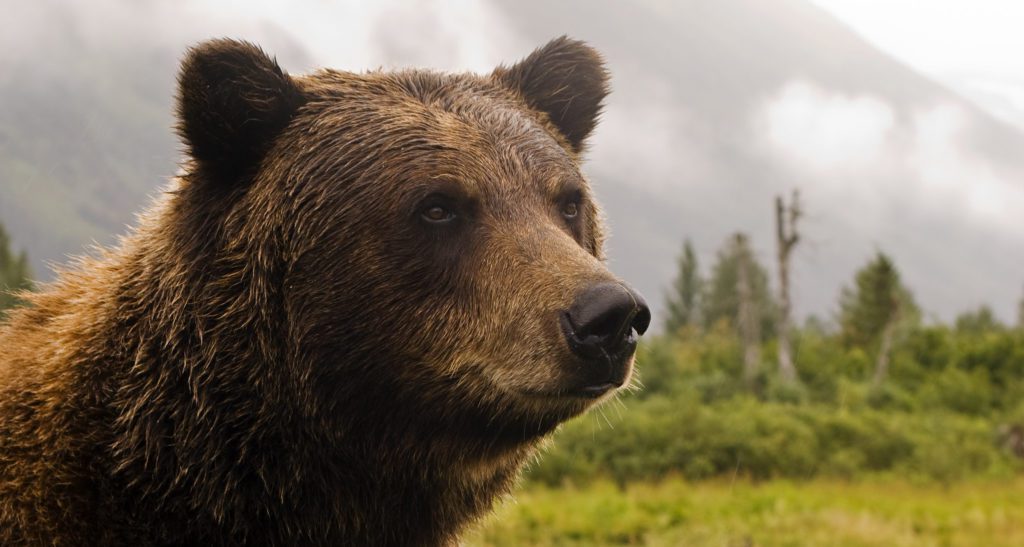
Grizzly bear. Image by Princess Lodges via Flickr.

Grizzly bears dominate the territory that they share with polar bears because they are better adapted to the varied climate, terrain, and available food sources. Unlike polar bears, grizzlies follow an opportunistic diet that includes plant tubers and carrion in addition to live prey. Paleontologist Larisa DeSantis of Vanderbilt University posits that the hybrid pizzlies may possess modified skulls and teeth that could plausibly allow them to adopt the indiscriminate feeding habits of the grizzly bear. However, DeSantis points out that the hybrid bears also lose some of the abilities of their parents; for example, pizzlies are not as adept at swimming as their polar bear forbears. 

The twin fear among scientists is that 1) the number of polar bears will dwindle, and 2) hybridization will increase to such an extreme that polar bears will be one day be subsumed into the general grizzly population. The polar bear may face extinction over the next century if nothing is done to conserve the species. Much remains to be discovered about the hybridization of polar bears and grizzlies. What we do know for sure is that pizzlies are a product of profound environmental instability and crisis. Polar bears may star in heartwarming commercials during the holidays—but these creatures and their ecosystem are in grave danger of a different kind of warming, one associated with climate change.

Nicholas Sauer is a Gallery Experience Presenter in CMNH’s Life Long Learning Department. Museum staff, volunteers, and interns are encouraged to blog about their unique experiences and knowledge gained from working at the museum.

References

“Bears on the Lewis and Clark Expedition.” America’s Library. Accessed 29 Sept. 2021. <http://www.americaslibrary.gov/aa/lewisandclark/aa_lewisandclark_bears_2.html>.

Casselman, Anne. “Longest Polar Bear Swim Recorded—426 Miles Straight.” National Geographic. 22 July 2011. <https://www.nationalgeographic.com/science/article/110720- polar-bears-global-warming-sea-ice-science-environment>.

Cockburn, Harry. “Climate crisis pushing polar bears to mate with grizzlies, producing hybrid ‘pizzly’ bears.” The Independent. 15 April 2021. <https://www.independent.co.uk/climate-change/news/pizzly-bear-polar-grizzly-hybrid-b1831847.html>.

Engelhard, Michael. “How Polar Bears Became the Dragons of the North.” Smithsonian Magazine. 31 May 2017. <https://www.smithsonianmag.com/science-nature/polar-bears- dragons-of-the-north-180963502/>.

Melville, Herman. Moby-Dick; or The Whale. 1851. Project Gutenberg. Accessed 29 Sept. 2021. <https://www.gutenberg.org/files/2701/2701-h/2701-h.htm#link2HCH0042>.

“Polar Bear Figurine.” Bristol’s Free Museums and Historic Houses. Accessed 29 Sept. 2021. <https://museums.bristol.gov.uk/narratives.php?irn=11245>.

Strong, Walter. “It’s no surprise for Inuit — Baffin Bay polar bears defy past assumptions with stable population.” CBC.  3 March 2020. <https://www.cbc.ca/news/canada/north/baffin-bay-polar-bears-nunavut-1.5472492>.

Tien, Caroline. “Polar Bear-Grizzly Bear Hybrids Likely to Become More Common Thanks to Climate Change.” Newsweek. 29 April 2021. <https://www.newsweek.com/polar-bear-grizzly-bear-hybrids-likely-become-more-common-thanks-climate-change-1587568>.

Related Content

Waddling in a Winter Wonderland: How Penguins, Humans, and Other Animals Traverse Ice and Snow

Pittsburgh’s Moths Reflect Human Impact of Industry

An Immersive Alaskan Scene

Carnegie Museum of Natural History Blog Citation Information

Blog author: Sauer, Nicholas
Publication date: December 15, 2021

Share this post!

  • Share on Twitter Share on Twitter
  • Share on Facebook Share on Facebook
  • Share on Pinterest Share on Pinterest
  • Share on LinkedIn Share on LinkedIn
  • Share on Reddit Share on Reddit
  • Share via Email Share via Email

Filed Under: Blog Tagged With: HATW, Nicholas Sauer, Super Science, We Are Nature 2

August 13, 2021 by wpengine

Magnificent Frigatebirds: The Flying Pirates of the Caribbean

by Nicholas Sauer

Fish and other aquatic animals aren’t the only ones who go splish-splash is an ocean biome. Let’s not forget our feathered friends, the birds. Today, we’ll be taking a closer look at one of the most conspicuous of all seabirds, the Magnificent Frigatebird (fregata magnificens), also known as the Man o’ War Bird.

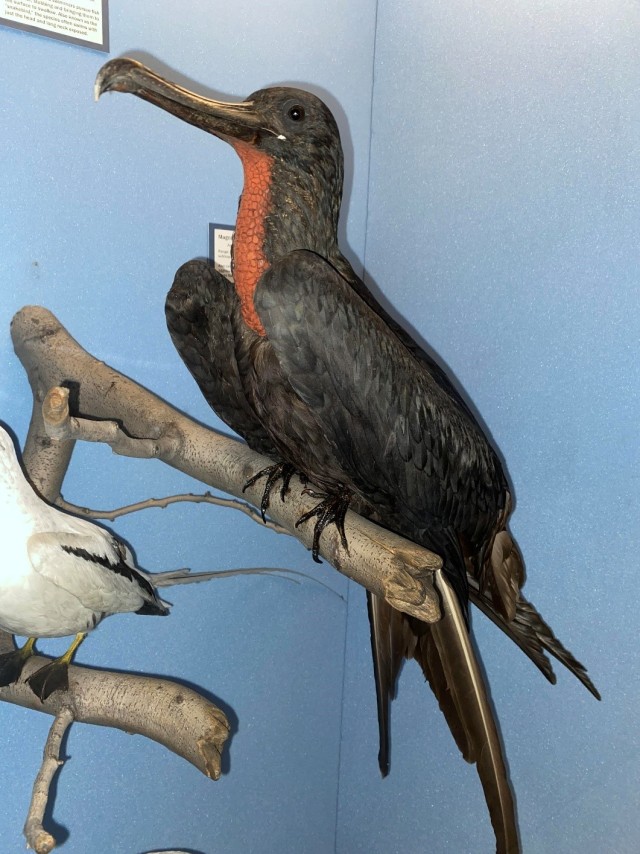
Frigatebird taxidermy mount in a museum
Did you know the museum has a frigatebird on display in Bird Hall?

These birds primarily live and breed on the islands of the Caribbean having been observed by scientists and bird watchers on the Marquesas Keys and Dry Tortugas. They are also found nesting on human-made structures like pier pilings from Texas’s Galveston Bay to the Atlantic coast of southern Florida. Frigatebirds make both the Atlantic and Pacific Oceans their home, flying on occasion over the isthmus of Panama. In fact, Magnificent Frigatebirds are able to remain airborne for up to a month and a half over their watery environs without the need to land. Some frigatebirds even adapt their hunting and flying practices to specific wind patterns that will allow them to travel and forage more efficiently.

The species is well-suited for such a lifestyle with a wingspan averaging 7.5 feet and a lengthy forked tail which maximizes their aerodynamic abilities. If you ever catch sight of a Magnificent Frigatebird from the shoreline you will see that this species is a stark example of sexual dimorphism. The female is covered in dark brown or black feathers and has a white breast and underbelly. The males are entirely black with a bright red throat pouch which they inflate like a balloon for mating purposes. To attract a mate, the males, often perched together among mangrove trees, will inflate their throat pouches, and then raise and vibrate their wings, calling out with guttural shrieks. When a female chooses a mate, the male takes on the responsibility of finding sticks to build a platform-like nest. He brings these materials to the female who then typically builds the nest on her own. Figatebirds live in colonies, but these communities are by no means free of strife. Both parents incubate a single egg between them each mating season and feed their young after it has hatched. It is paramount that the mother and father maintain vigilance over their nest. At least one parent must be present, or otherwise fellow members of the colony will prey on their neighbors’ eggs and newborns. After twenty to twenty-four weeks the juvenile is able to fly for itself. However, another sixteen weeks will elapse before the young frigatebird reaches full maturity and the mother feeds it for the last time.

Magnificent frigatebirds feed on flying fish, tuna, squid, jellyfish, and crustaceans. As opportunistic feeders they aren’t picky about their dietary choices. Interestingly enough, when hunting they never swim or float on the surface of the water. When swooping down to catch aquatic prey, they confine themselves to surface-dwellers, specifically life that resides in the top inch of water, that is, the epipelagic or “sunlight” zone.

Sometimes frigatebirds will dispense with hunting and foraging altogether and let other birds do the work. They are what scientists describe as “kleptoparasitic.” In other words, they are pirates stealing food literally from the mouths of other birds. Frigatebirds use their intimidating size, ferocious bill, and acrobatic flight abilities to wrest fish from the mouths of almost any bird they can, from seagulls to blue-footed boobies and even brown pelicans. Either that, or they force the weaker birds to regurgitate their prey during midair skirmishes. In these battles, the frigatebird often bites and tears at the target bird’s tail feathers until the victim submits to highway robbery. The frigatebird then catches their target’s lunch before it drops back into the sea. This strategy helps the frigatebird conserve energy and minimize risk while hunting and also gives the bird its extravagant name. Like the pirate ships and British navy man o’ wars of history and myth, the Magnificent Frigatebird prowls the tropics and takes what it likes by a show of force. These beautiful but fierce seabirds demonstrate the intricate adaptions—flying on specific winds and the use of kleptoparasitism—necessary for a creature to thrive in an environment divided between land and sea.

Nicholas Sauer is a Gallery Experience Presenter in CMNH’s Life Long Learning Department. Museum staff, volunteers, and interns are encouraged to blog about their unique experiences and knowledge gained from working at the museum.

References

De Monte, Silvia et al. “Frigatebird behaviour at the ocean-atmosphere interface: integrating animal behaviour with multi-satellite data.” Journal of the Royal Society, Interface 9, no.77 (2012): 3351-8.

Kaufman, Ken. “Magnificent Frigatebird.” National Audubon Society. Accessed 29 July 2021. <https://www.audubon.org/field-guide/bird/magnificent-frigatebird>.

“Layers of the Ocean.” National Weather Service: National Oceanic and Atmospheric Administration. Accessed 29 July 2021. <https://www.weather.gov/jetstream/layers_ocean>.

Osorno, J.L., et al. “Kleptoparasitic Behavior of the Magnificent Frigatebird: Sex Bias and Success.” The Condor 94 (1992): 692-698. <https://sora.unm.edu/sites/default/files/journals/condor/v094n03/p0692-p0698.pdf>.

Stittleburg, Vicki and Maria Hart. “Magnificent Frigatebird.” Houston Audubon Society. 2021. <https://houstonaudubon.org/birding/gallery/magnificent-frigatebird.html>.

Related Content

Survival of the Fishiest: Astonishing Adaptations of the Aquatic World

Super Science Saturday: Splish Splash (August 14, 2021)

Ocean Lessons

Carnegie Museum of Natural History Blog Citation Information

Blog author: Sauer, Nicholas
Publication date: August 13, 2021

Share this post!

  • Share on Twitter Share on Twitter
  • Share on Facebook Share on Facebook
  • Share on Pinterest Share on Pinterest
  • Share on LinkedIn Share on LinkedIn
  • Share on Reddit Share on Reddit
  • Share via Email Share via Email

Share this post!

  • Share on Twitter Share on Twitter
  • Share on Facebook Share on Facebook
  • Share on Pinterest Share on Pinterest
  • Share on LinkedIn Share on LinkedIn
  • Share on Reddit Share on Reddit
  • Share via Email Share via Email

Filed Under: Blog Tagged With: Birds, Nicholas Sauer, ssssplash

June 21, 2021 by wpengine

Wulfenite and Mimetite: CMNH’s Crystal Banquet

by Nicholas Sauer

Scientific information provided by Dr. Carla Rosenfeld, Assistant Curator of Earth Sciences

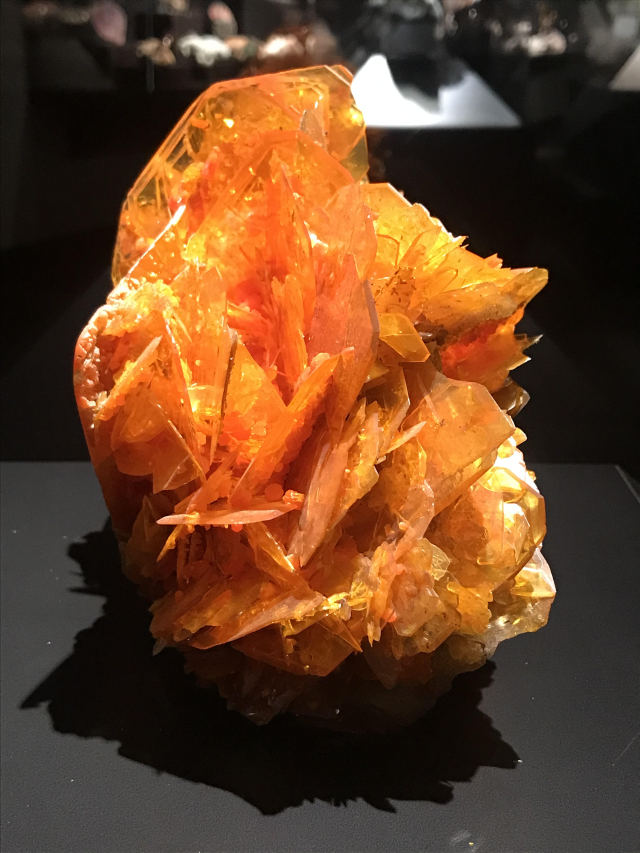
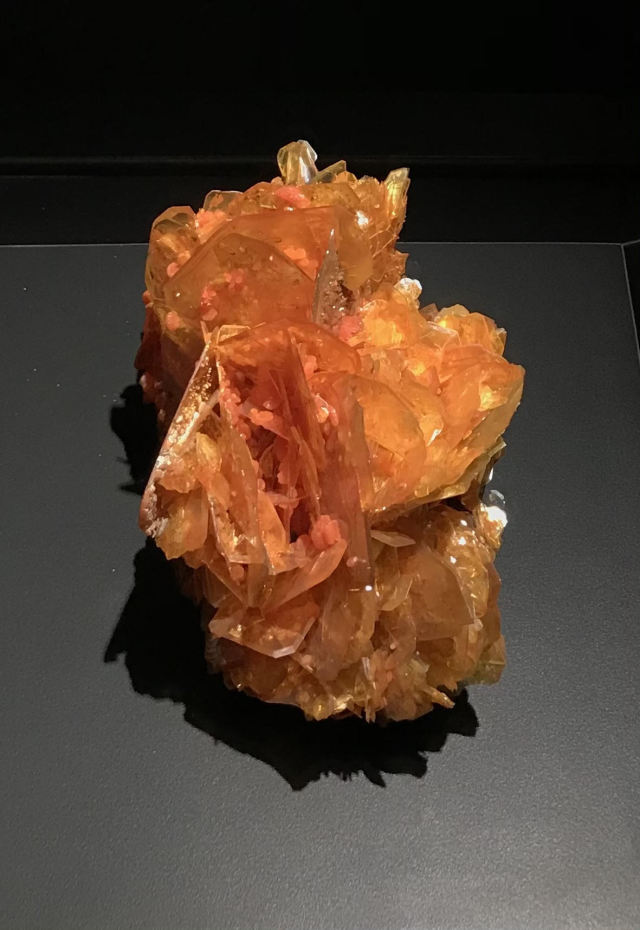
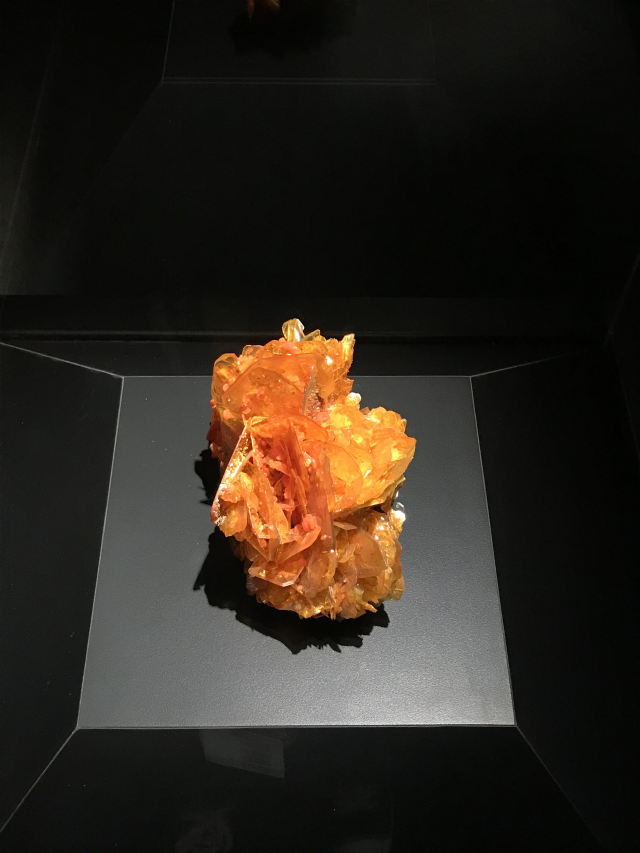
Carnegie Museum of Natural History’s specimen of Wulfenite and Mimetite is one of its most fascinating. It first caught my attention because it looks so distinctly like a piece of abstract art made out of honey barbeque potato chips. It was only afterward that I discovered that the museum’s official nickname for the specimen is appropriately just that, “BBQ Chips.”

wulfenite and mimetite specimen

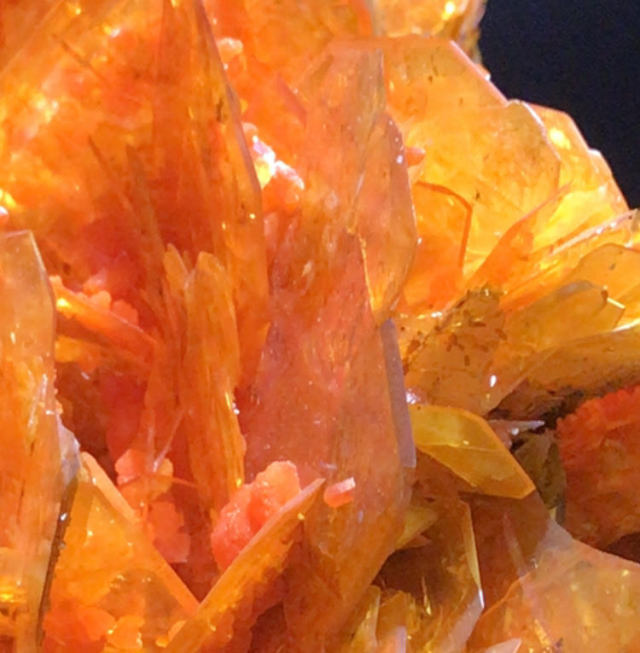
The potato-chip-shaped structures in question are thin, tabular crystals of wulfenite. A crystal is the physical, three-dimensional form that a mineral takes on in nature. The wulfenite is thin, broad, and relatively flat just like a table is, so that’s why scientists classify it as “tabular.” Sometimes, due to the conditions under which it was formed, wulfenite might also take on the shape of small pyramids.

close-up of wolfenite and mimetite specimen

The naming of wulfenite has a fascinating history itself. It was first discovered and described in the late 18th century by Austrian mineralogist Ignaz von Born (1741-1791) who gave it the name plumbum spatosum flavo pellucidum. Now, don’t be intimidated by the Latin, it is just a literal description of what von Born thought he found: yellow glasslike lead ore. Scientists later renamed the mineral wulfenite in 1845 when they discovered a deposit of it in Bleiberg, Austria. The new namesake, Franz Xavier von Wulfen (1728-1805), had spent his professional life studying the lead ores of the area. The mineral was also sometimes called melinose, after the Greek word “meli” meaning “honey,” so it is not surprising that the specimen first brought to my mind the image of honey barbeque chips in color as well as shape. While it was Austrian scientists who gave it its modern-day name, wulfenite exists in many locations around the world, including China, Arizona, and Mexico. Wulfenite even became Arizona’s state mineral in 2017. Our own BBQ chips specimen came from the San Francisco mine in Sonora, Mexico and was acquired in 1988.

However, there’s more than just wulfenite on display behind the glass in CMNH’s Hillman Hall of Gems and Minerals. If you look closer you will see groups—aggregates—of small spheres interspersed among the crystalline potato chips. These small spheres are composed of the mineral mimetite, which often forms alongside wulfenite in nature as both are leaden in their chemical makeup. Specifically, mimetite is a mineral that forms as a product of the oxidation of galena (lead sulfide) and arsenopyrite (iron arsenic sulfide). Mimetite got its name because it “mimics” the appearance of other lead-based minerals, particularly pyromorphite. The aggregates of mimetite you see at the museum have what scientists call a “botryoidal habit.” Translation: the mineral has a characteristic shape—habit—which in this case is grape-like—“botryoidal,” from the Greek. So, again, it isn’t so outlandish to describe wulfenite as “potato-chipian” when mimetite is described by scientists literally as a “cluster of grapes.” In fact, I’m starting to get a little hungry. Scientists often name their new discoveries after something familiar to them that has a similar shape or property.

But how did “BBQ Chips” come to take on its unique shape and remarkable coloration? Specific patterns of atoms that make up the minerals’ internal structure give wulfenite and mimetite their repeating and intricate form. The color of the specimens depends on their chemical composition. For instance, the wulfenite on display at CMNH gets its fiery orange hue from trace amounts of chromium lurking deep within the crystal. It is ironic that what scientists call an “impurity”—the chromium—gives the wulfenite one of its most striking and aesthetically pleasing features, its coloration. The mimetite, on the other hand, has a similar burnished orange color because of the presence of arsenic, mimetite being composed of lead chloride arsenate.

wulfenite and mimetite specimen from above

The Carnegie Museum of Natural History’s specimen of wulfenite and mimetite showcases the beauty and complexity of the natural world, the entwining of two distinct and breathtaking minerals in one display. Their bright colors and arresting shapes are the product of chemical reactions, time, and specific environmental conditions. The gastronomical names that their coloration and visible structures have garnered over the years—from “BBQ Chips” to “clusters of grapes”—make them a mineralogical feast for scientists and museum patrons alike.

wulfenite and mimetite specimen

Nicholas Sauer is a Gallery Experience Presenter in CMNH’s Life Long Learning Department. Museum staff, volunteers, and interns are encouraged to blog about their unique experiences and knowledge gained from working at the museum.

References

Ascarza, William. “Wulfenite, Arizona’s State Mineral, is Theme for Current Tucson Gem Show.” Tucson.com. 12 April 2020. <https://tucson.com/news/local/wulfenite-arizonas-state-mineral-is-theme-for-current-tucson-gem-show/article_00d6cbc2-80bb-57fd-8288-9ba0f189041f.html>.

“Mimetite.” Smithsonian National Museum of Natural History. <https://geogallery.si.edu/10026354/mimetite>.

“Minerals, Crystals, and Gems: Stepping Stones to Inquiry.” Smithsonianeducation.org. 2013 <http://www.smithsonianeducation.org/educators/lesson_plans/minerals/minerals_crystals.html>.

“Mineral of the Year 2020.” Naturhistorisches Museum Wien. 2020. < https://www.nhm-wien.ac.at/en/research/mineralogy__petrography/mineral_of_the_year>.

Russell, Peter. “Oxidized Zone Minerals.” University of Waterloo. 1 March 2006. <https://waterloo.ca/wat-on-earth/news/oxidized-zone-minerals>.

“Wulfenite.” Smithsonian National Museum of Natural History. <https://geogallery.si.edu/10026003/wulfenite>.

“Wulfenite—Collected from Sonora, Mexico.” Saint Louis Science Center. 2021. <https://www.slsc.org/wulfenite-collected-from-sonora-mexico/>.

Related Content

Pyromorphite from Zambia

An Egg-cellent Hobby!

Super Science Activity: DIY Sundial

Carnegie Museum of Natural History Blog Citation Information

Blog author: Sauer, Nicholas
Publication date: June 21, 2021

Share this post!

  • Share on Twitter Share on Twitter
  • Share on Facebook Share on Facebook
  • Share on Pinterest Share on Pinterest
  • Share on LinkedIn Share on LinkedIn
  • Share on Reddit Share on Reddit
  • Share via Email Share via Email

Share this post!

  • Share on Twitter Share on Twitter
  • Share on Facebook Share on Facebook
  • Share on Pinterest Share on Pinterest
  • Share on LinkedIn Share on LinkedIn
  • Share on Reddit Share on Reddit
  • Share via Email Share via Email

Filed Under: Blog Tagged With: minerals, minerals and gems, Nicholas Sauer, sssminerals, Super Science

May 21, 2021 by wpengine

Pittsburgh’s Moths Reflect Human Impact of Industry

by Nicholas Sauer

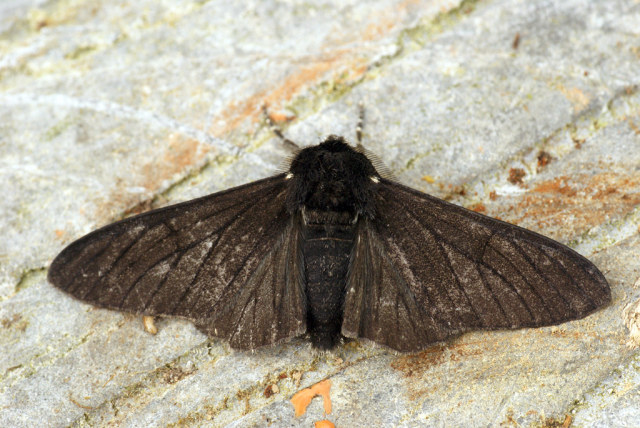
I began to think in earnest about industrial melanism while working at the Carnegie Museum of Natural History in 2018 when the We Are Nature exhibit was on display as part of the museum’s intensive focus on the Anthropocene. There was an unassuming corner of the exhibit devoted to the fate of the peppered moth (Biston betularia) during the Industrial Revolution. Dark-colored—melanistic—peppered moths were rare in England and Germany until the Industrial Revolution and the inevitable increase of air pollution from the burning of fossil fuels. With the rise of heavy industry, pale peppered moths began to stick out like bright specks on soot-covered vegetation. These pale moths were easy targets for hungry birds. The coal-choked environment favored the moth populations that possessed a gene for darker coloration, providing an example of natural selection at work. In recent years, scientists have located the specific gene that accounts for the darker moths and can trace the changing selection on color variation in peppered moths back to at least 1819 when the burning of coal for industrial purposes began to pick up steam in the British Isles.

In 1896, English entomologist J.W. Tutt theorized that his nation’s industrial conditions profoundly affected local moth populations. He argued that lichen on trees provided camouflage for the salt-and-pepper-colored moths. According to Tutt, industrial pollution killed off the lichen and, in turn, the pollution—soot and ash—camouflaged the darker moths, particularly the dark form of Biston betularia, f. carbonaria. It was not until the 1950s that Tutt’s theory was tested. Through a series of experiments, lepidopterist Bernard Kettlewell demonstrated that when both light and dark peppered moths (f. typica and carbonaria respectively) were released in industrially-contaminated woodlands in Birmingham and Dorset, England, birds fed on the most “conspicuous” form, f. typica, the pale moths. Kettlewell’s experiment would wind up in science textbooks for decades to come as a demonstration of natural selection.

Black moth on light background.
“[1931] Peppered Moth (Biston betularia) f.carbonaria” by Bennyboymothman is licensed under CC BY 2.0

In the wake of Kettlewell’s findings, similar experiments were conducted in the United States, even in the Pittsburgh area. The scientist leading the melanism study in the Eastern United States in the 1950s, Denis Frank Owen (1931-1996), pored over the moth collections right here at the Carnegie Museum of Natural History as well as those of several other natural history museums in the Northeast and Midwest. A transplant from England at the beginning of his long career as an ecologist, Owen sought to test whether or not Kettlewell’s results would be reflected in his own data on the American side of the Atlantic. Owen’s own findings were very much like Kettlewell’s. This, of course, was unsurprising in the case of Pittsburgh considering the massive amount of pollutants that were emitted by the city’s steel mills. To get a good idea of how polluted the city was at that time, check out the two soot-stained squares that remain on the mural The Crowning of Labor on the second and third floors of CMNH’s Grand Staircase.

Owen discovered that Pittsburgh had some of the earliest records of industrial melanism in the Northeast—melanistic forms of Epimecis hortaria (or, the Tulip Tree Beauty) dating from 1922 and Biston cognataria dating from 1910. Owen posited in his research that the number of melanistic moths were increasing in the late 1950s and early 1960s, particularly in environs surrounding industrial cities like Detroit and Pittsburgh, even as far as outlying rural areas. At Westmoreland County’s Powdermill Nature Reserve, all eight of the peppered moths observed in a 1957 study were melanistic, according to Owen.

Unfortunately, records of industrial melanism were never kept as meticulously in the U.S. as they were in the U.K., so our understanding of how widespread the phenomenon was States-side is incomplete. However, since the 1970s, much more data has been collected on peppered moths in the U.S. than before. This data has reflected the implementation of clean air regulations and tracked the overall decline in the ratio of melanistic peppered moths in favor of the pale form, supporting the theory that these moth populations, either Biston betularia (f. typica or carbonaria) or their cousins, are subject to natural selection that is weighted by pollution. Biologist Bruce S. Grant has suggested that more recent data from the post-industrial era be put to greater educational use—not to supplant Kettlewell’s famous experiment, but to supplement it with more up-to-date scientific findings.

Regrettably, even in the “Post-Industrial” era following the birth of the Environmental Protection Agency (1970) and the Clean Air Act (1972), peppered moths are subject to human-exacerbated environmental threats. In the 1980s, when scientists sought an explanation for the continued presence of melanistic moths in rural eastern Pennsylvania, they instead discovered two major dangers to peppered moths and their habitat. First, so-called gypsy moths (Lymantria dispar dispar)—an invasive species introduced to the U.S. by humans in the 19th century—were rapidly defoliating the woodlands that the peppered moths called home. Secondly, the Pennsylvania Department of Forestry was spraying the area with the pesticides Dylox and Dimilin to combat Lymantria dispar and may have adversely affected the peppered moths in the process.

This example of the twin dangers of invasive species and pesticide use, in addition to the earlier instances of industrial pollution, demonstrate human beings’ profound effect on the natural world during the Anthropocene. The travails of the peppered moth are key to understanding the influence humans have on the ecosystems around them, so far as becoming even a variable in the way natural selection operates. The Pittsburgh area and the scientific collections at CMNH have played an important part in the study of industrial melanism in peppered moths and will continue to do so as the natural world responds in its way to human influence. The decline in melanistic moth numbers that correlates with cleaner air and more conscientious environmental regulations provides hope that that human influence is not uniformly negative.

Nicholas Sauer is a Gallery Experience Presenter in CMNH’s Life Long Learning Department. Museum staff, volunteers, and interns are encouraged to blog about their unique experiences and knowledge gained from working at the museum.

Works Cited

Blakemore, Erin. “New Evidence Shows Peppered Moths Changed Color in Sync with Industrial Revolution.” Smithsonian Magazine, 1 June 2016. <https://www.smithsonianmag.com/smart-news/new-evidence-peppered-moths-changed-color-sync-industrial-revolution-180959282/>.

Cook, M.L., et al. “Post Industrial Melanism in the Peppered Moth.” Science, no. 3 (Feb 7, 1986): 611. Gale In Context: College, link.gale.com/apps/doc/A4128493/CSIC?u=pitt92539&sid=CSIC&xid=56d31b9d. Accessed 17 Apr. 2021.

Grant, Bruce S. “Fine Tuning the Peppered Moth Paradigm.” Evolution 53, no. 3 (1999): 980-984.

Grant, B.S. and L.L. Wiseman. “Recent History of Melanism in American Peppered Moths.” Journal of Heredity 93, 2 (March 2002): 86-90. <https://academic.oup.com/jhered/article/93/2/86/2187377>.

Manley, Thomas R. “Temporal Trends in Frequency of Melanistic Morphs in Cryptic Moths of Rural Pennsylvania.” Journal of the Lepidopterists’ Society 42, no. 3 (1988): 213-217.

Maynard, M. and Geoffrey T. Hellman. “Comment.” The New Yorker Magazine, 13 August, 1955: 15. <https://www.newyorker.com/magazine/1955/08/13/comment-4365>.

Owen, D.F. “Industrial Melanism in North American Moths.” The American Naturalist 95, no. 883 (Jul.-Aug., 1961): 227-233. <https://www.jstor.org/stable/2458933?seq=1>. Accessed 18 April 2021.

Rudge, David Wyss. “The Role of Photographs and Films in Kettlewell’s Popularizations of the Phenomenon of Industrial Melanism.” Science and Education 12 (2003): 261-287.

Smith, David A.S. “Obituary: Denis Owen.” The Independent, 23 Oct. 1996. <https://www.independent.co.uk/news/obituaries/obituary-denis-owen-1359897.html>.

Related Content

Incredible Junk Food Diets: Creatures That Clean Up Our World

Activity: Snail Sensory Bag

Super Science Coloring Pages

Carnegie Museum of Natural History Blog Citation Information

Blog author: Sauer, Nicholas
Publication date: May 21, 2021

Share this post!

  • Share on Twitter Share on Twitter
  • Share on Facebook Share on Facebook
  • Share on Pinterest Share on Pinterest
  • Share on LinkedIn Share on LinkedIn
  • Share on Reddit Share on Reddit
  • Share via Email Share via Email

Share this post!

  • Share on Twitter Share on Twitter
  • Share on Facebook Share on Facebook
  • Share on Pinterest Share on Pinterest
  • Share on LinkedIn Share on LinkedIn
  • Share on Reddit Share on Reddit
  • Share via Email Share via Email

Filed Under: Blog Tagged With: Bug Bonanza, Nicholas Sauer, pennsylvania, Pittsburgh

October 13, 2020 by wpengine

Invasion of the Leaf Galls!

Happy Gall-oween! Mwah-hahaha! Prepare yourselves for the silent invasion of the leaf galls! Over the summer and into the early fall, you may have seen something very strange happening to the oak trees of Southwestern Pennsylvania. Small, furry growths, brown or orange in color, have been appearing on oak leaves. If you haven’t seen them, imagine a Tribble from Star Trek, but in miniature size growing directly on the leaves of a shady oak.

These are leaf galls—but they aren’t an alien lifeform nor a devastating tree blight. They are the product of a fascinating chemical reaction.

Early in the spring, just as the oak trees are beginning to bud, gall wasps (from the family Cynipidae) lay their eggs on the brand-new leaves. These creatures—smaller than a fruit fly and lacking the ability to sting—might also lay their eggs on the twigs of the trees or on the stems of goldenrod. Once the wasp eggs hatch, the larvae begin to eat the leaf on which they were deposited. This is when things get interesting: when the chemicals in the larvae’s saliva mingle with the plant hormones in the leaf, the gall begins to form. Depending on the drop site and the species of gall wasp (there are over 700 species in the United States alone that target oaks), the appearance of the gall will be different. For instance, when the eggs hatch on a branch or twig and begin their feast, the gall will have a dense, spherical appearance. This is the specific kind of gall that gives the phenomenon its name: “galla” means “oak-apple” in Latin.  Some leaf galls might take on the shape of tiny brown flying saucers as they did in Jefferson and Forest Counties in recent years. Some other galls have the appearance of spindly red fingers or peppers protruding from the leaf. The variety of tree and leaf galls are, in a word, kaleidoscopic.

While there is great variation in the physical appearance and structure of leaf galls, they each serve a shared purpose. The chemicals that the larvae secrete as they “chew” stimulate the leaf into creating a gall for shelter and sustenance. The gall is a protective, nutrient-providing dome over the developing larvae. While the galls sometimes interrupt the process of photosynthesis and cause some leaf browning and curling, they won’t kill the tree itself. The gall wasp is a mostly benign parasite. By mid-October, the wasp-bearing galls will fall from, or with, their leaves. The next spring, the surviving wasps will emerge from the soil.

leaf galls on green leaf

Some years, this new generation will breed sexually. Other years, it will be entirely female and reproduce asexually. That is, through parthenogenesis, the same process that the dinosaurs in the original Jurassic Park reproduce. Remember Dr. Malcolm’s famous “life finds a way” monologue? Galls are misunderstood by the general public because they perceive the phenomenon as a nuisance and eyesore. Scientists warn against treating infested trees with pesticide or scraping off the galls. Such actions would do more harm than good to the trees. Instead of being an unnerving menace, the gall wasp is an awe-inspiring example of how one animal uses its surrounding ecosystem—without excessive harm—to ensure that its kind will perpetuate itself safely and successfully.  Furthermore, the weirdly wonderful shapes and designs of the leaf gall demonstrate that nature isn’t just useful but also beautiful.  It’s that beauty that makes this seemingly bizarre invader more than a seasonal annoyance.

Nicholas Sauer is a Natural History Interpreter and Gallery Experiences Presenter at the Carnegie Museum of Natural History. Museum employees are encouraged to blog about their unique experiences and knowledge gained from working at the museum.

Related Content

Booseum: Spooky Coloring Pages

Booseum: Make Snail Slime

Scientist Takeover: Invertebrate Zoology Specimens

Filed Under: Blog Tagged With: booseum, Educator Resources, Educators, Nicholas Sauer, Super Science Days

sidebar

About

  • Mission & Commitments
  • Directors Team
  • Museum History

Get Involved

  • Volunteer
  • Membership
  • Carnegie Discoverers
  • Donate
  • Employment
  • Events

Bring a Group

  • Groups of 10 or More
  • Birthday Parties at the Museum
  • Field Trips

Powdermill

  • Powdermill Nature Reserve
  • Powdermill Field Trips
  • Powdermill Staff
  • Research at Powdermill

More Information

  • Image Permission Requests
  • Science Stories
  • Accessibility
  • Shopping Cart
  • Contact
  • Visitor Policies
One of the Four Carnegie Museums | © Carnegie Institute | Privacy Policy | Terms of Use | Accessibility
Rad works here logo