• Skip to primary navigation
  • Skip to main content
  • Skip to primary sidebar

Carnegie Museum of Natural History

One of the Four Carnegie Museums of Pittsburgh

  • Visit
    • Buy Tickets
    • Visitor Information
    • Exhibitions
    • Events
    • Dining at the Museum
    • Celebrate at the Museum
    • Powdermill Nature Reserve
    • Event Venue Rental
  • Learn
    • Field Trips
    • Educator Information
    • Programs at the Museum
    • Bring the Museum to You
    • Guided Programs FAQ
    • Programs Online
    • Climate and Rural Systems Partnership
  • Research
    • Scientific Sections
    • Science Stories
    • Science Videos
    • Senior Science & Research Staff
    • Museum Library
    • Science Seminars
    • Scientific Publications
    • Specimen and Artifact Identification
  • About
    • Mission & Commitments
    • Directors Team
    • Museum History
  • Tickets
  • Give
  • Shop

Powdermill

November 13, 2025 by Erin Southerland

Jolly Opossum (Cancelled)

When: Saturday, December 13, 2025, 4:00 – 5:00 p.m.

Where: Powdermill Nature Reserve, Rector, PA

Tickets: Free

Join us for a warm drink and to hear the tale of the Jolly Opossum! This story will delve into what the creatures of the forest are up to during the holidays. Meet Dr. Skunk, Mx. Chickadee, Mr. Bear, and, of course, the Jolly Opossum. We will also make holiday ornaments/decorations as well. Children of all ages are welcome.

Due to winter weather conditions, we have decided to cancel Jolly Opossum. Stay safe and we hope to see you at another event soon! 
 

Tagged With: Powdermill, Powdermill Nature Reserve

June 30, 2025 by Erin Southerland

A Year in Review: Bird Banding 2024

by Annie Lindsay

During the 2024 calendar year, we operated Powdermill Avian Research Center’s (PARC) bird banding station for 184 days across all four seasons, during which we banded 9,415 new birds, processed 4,581 recaptured individuals, and released 9 birds unbanded. These 14,005 birds represented 125 species, one of which was new to Powdermill’s banding dataset. 

The banding station at PARC has been running year-round since June 1961 and has accumulated over 850,000 banding records of nearly 200 species, so a new species for the station is a relatively rare event. But let’s not get ahead of ourselves and spoil the surprise, which happened near the end of 2024.

At Powdermill, we band birds year-round, which is somewhat unique among banding stations. We increase our effort during the spring and fall migration seasons and band fewer days each week during the breeding season and winter. This helps us track seasonal events like arrival and departure timing of migratory species, onset of breeding activities, relative abundance of different species, site fidelity (whether individuals come back to the same breeding or wintering areas every year), and longevity. Banding year round also allows us to observe the seasonal progression of birds from familiar to fancy and back again. 

Each year, there are species or events that cause excitement among the banding crew. Some of them might be species that are uncommonly caught at Powdermill or difficult to see in the wild, some might be individuals that are earlier or later in the season than expected, some might be favorite species that we never tire of seeing, and some might be days with unusually high capture rates or big days. As each year comes to a close, we reflect on the highlights and compile a list of our favorite moments, of which 2024 had an abundance.

The first highlight of 2024 was a Red-shouldered Hawk that we caught and banded on January 24. A species that is a little too big for our songbird-size mist nets, raptors and other large birds generally bounce right out of the nets. This bird was holding on to a trammel line with its talons which gave the bander a split-second advantage. A species that seems to be expanding its range northward, Red-shouldereds can be found in southwest Pennsylvania year-round, although this is only the 6th ever banded at Powdermill.

As winter waned and we prepared for the spring migration season, we caught an unexpectedly early Gray Catbird on March 27, setting a record for the earliest catbird banded at Powdermill (the previous earliest banding record was on April 19). Spring progressed relatively normally until May 9 when we caught Powdermill’s ninth ever Swainson’s Warbler. This is a species that has historically bred in the southeastern part of the US but was confirmed as a breeding species in Pennsylvania (at Bear Run Nature Reserve just 30 minutes south of Powdermill) for the first time in the summer of 2023. These breeding records may represent a northward range shift for this species. 

The spring migration banding season ends at Powdermill at the end of May, but we continue to band, with reduced effort, through the summer. On June 7, we caught a Tennessee Warbler, a species that migrates annually between breeding sites across much of Canada and wintering grounds in the Caribbean, Central America, and northern South America. They are commonly found at Powdermill during the migration seasons when they stop over to rest and refuel between flights. Nearly all Tennessee Warblers have moved north of us by the end of May, making our June 7 capture the second latest spring record for this species in our dataset. There was something a bit unusual about this individual: it was molting feathers that suggested that it was undergoing the post-breeding molt, something that happens before, or sometimes during, the early stages of fall migration. Although there wasn’t time for this bird to have attempted breeding, perhaps something caused this individual to turn around and head south, representing the earliest (by more than a month!) fall migrant Tennessee Warbler in our dataset. 

Summer progressed relatively normally, but the lack of rain began to become noticeable as streams became trickles and small ponds dried up. By July each year, we begin to catch birds in their post-fledging period and our capture numbers increase, but we were not expecting to have one of the biggest summer banding days in our 63-year history when we caught 153 birds on July 17. For context, we were operating about 1/3 of the nets that we run during migration and had to close the nets early due to heat, so the 153-bird day was quite impressive and our third highest summer banding total. This was the beginning of a severe drought that gripped our region through much of the second half of the year, and the ponds near PARC held some of the only locally available drinking water for breeding and migrating birds. We suspect this concentrated birds in the banding area and increased capture rate in late summer and throughout fall.

The fall migration banding season begins in August as the current year’s fledglings begin to disperse and the first migrants begin to move south. Following the trend of a higher-than-usual concentration of birds in the banding area, we had several species with above average captures and two that broke the single-day high totals. On August 16, we caught 11 Blackburnian Warblers and on September 3 we caught 35 Ruby-throated Hummingbirds. Both species breed locally, but we catch the majority of individuals during the post-breeding and fall migration season.

The second half of September and the first half of October is the busiest part of the banding year, and interesting captures came in rapid succession during that period in 2024. Soras are a species of rail, a secretive marsh bird that is usually difficult to see, and that we average fewer than one capture per year. We caught a Sora on September 21 and a second one on September 24 – these were #22 and #23 in our dataset, and only once before did we catch two in one season.

Sora
Sora banded at PARC.

September 24 held the banding crew’s biggest highlight of the year: a Kirtland’s Warbler. Kirtland’s Warblers are one of the rarest species of wood warblers in North America – it was critically endangered with a population of about 167 pairs in the 1970s-80s. It is an Endangered Species Act success story: with habitat management and control of brood parasites, the species recovered to a healthy population of ~4,500-5,000 birds and was delisted in 2019. Although it’s not an abundant species, given its migratory route between breeding grounds in Michigan and wintering grounds in the Bahamas, we knew it was just a matter of time before one was spotted in southwest Pennsylvania. Remarkably, this was not the first Kirtland’s Warbler caught at Powdermill: one was banded on September 21, 1971 when the population was at its low point.

Kirtland's Warbler
Kirtland’s Warbler

Over the years, a few possible Bicknell’s Thrushes were banded at Powdermill, but it wasn’t until 2023 that two were definitively identified here. They’re difficult to identify because they look very similar to Gray-cheeked Thrush, but average a bit smaller and more reddish in color. On September 27, we caught and banded another, this one noticeably reddish and falling well within Bicknell’s measurements. Gray-cheeked and Bicknell’s Thrushes were considered the same species until 1995, when there was enough evidence (based on morphology, vocalizations, habitat, and migration patterns) to elevate Bicknell’s Thrush to full species status.

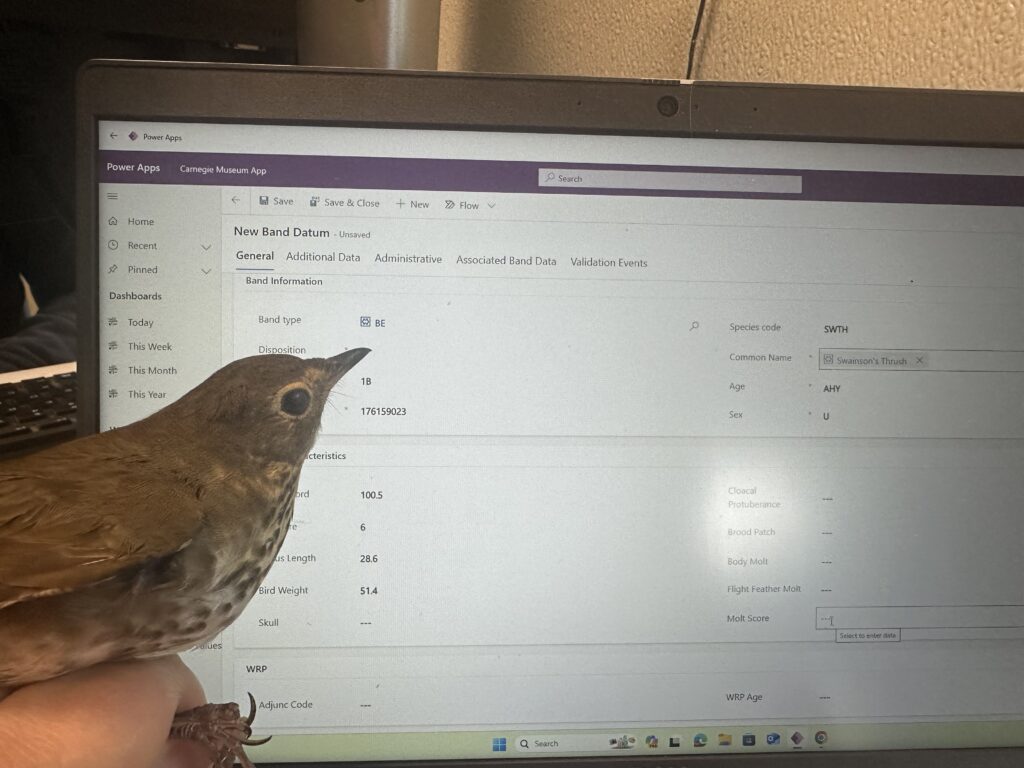
Fall migration would not be complete without a fat bird highlight. During the migration seasons, migratory songbirds increase their food intake so that they can deposit fat reserves that they use as a source of energy to fuel their overnight flights. Songbirds flap their wings continuously while they fly, so they require a lot of energy to accomplish their migrations. A Swainson’s Thrush that we caught on September 27 had accumulated impressive fat deposits, weighing in at 51.4 grams. Powdermill’s dataset contains over 17,000 Swainson’s Thrushes and only three have been heavier than this bird. A fat bird is a bird that is well prepared for migration!

Swainson’s Thrush with its banding data.

Old birds are interesting captures, and a Wilson’s Snipe that we caught on October 11 was just that. This individual was banded in 2019 and aged as a bird that hatched at least in 2017, if not earlier. Not only is this a notably old bird, but it had been recaptured three other times at Powdermill, providing us a peek into its life.

The fall migration banding season began to wane as October progressed, and our seasonal field techs’ last day was November 2.  But the surprises hadn’t stopped yet! In the morning, we caught an unusual Empidonax flycatcher (Empidonax is the genus of flycatchers that tend to pose identification challenges) – it was quite yellow on its underparts and the face proportions were not quite right for any of the species expected in the east. Further, an Empidonax flycatcher in southwest Pennsylvania this late in the year would be exceptionally rare. After a series of diagnostic measurements done independently by three of the banders on staff, we determined that this individual was a Western Flycatcher, a species found in the western part of the continent from the Rocky Mountains west to the Pacific Coast, and a species never before banded at Powdermill.

western flycatcher
Western Flycatcher

Later that evening, we set up nets to catch owls for Powdermill’s public Owling at the Moon event. Using audio lures, we attempted to catch Northern Saw-whet Owls and Eastern Screech-Owls. Successfully catching owls is very weather-dependent, and luck was on our side this year. Not only did we catch several individuals of our two target species, but we had a big surprise when we caught a Barred Owl, the second ever caught at Powdermill. The crew was excited to get to study this species in the hand and to share it with Owling at the Moon attendees.

Barred Owl

It was a busy but satisfying year, full of visitors and events, bird banding workshops, and interesting birds, and we look forward to what 2025 will bring!

Annie Lindsay is the Bird Banding Program Manager at Powdermill Nature Reserve, the environmental research center of Carnegie Museum of Natural History.

Read More Science Stories

(De)Forested Flight: An Eagle Scout Project at Powdermill

A Year in Review: Bird Banding 2023

Hummingbird Lessons

Filed Under: Blog Tagged With: Annie Lindsay, bird banding, Powdermill, Powdermill Nature Reserve

June 30, 2025 by Erin Southerland

(De)Forested Flight: An Eagle Scout Project at Powdermill

by Ollie Sparks

The first day I started volunteering as a high school Sophomore, I journeyed deep into the heavy woods of the Rector area, into a small building just off a gravel road with a sign out front that read “Powdermill Avian Research Center.” The light was on in the small, cinder block banding lab, and I could see some people through my breath materializing in front of me. It was close to 5:30 in the morning, something I was unprepared for in the middle of summer vacation. That was the first of many surprises to follow that day. 

As I accompanied the adults through net routes, watching them untangle birds caught in nets as easily as a practiced Rubix solver would twist a cube, I was amazed by the colors and sounds with each new bird. Some of these birds I recognized just from looking out my window: robins, blue jays, cardinals, and sparrows all made up the cast, but then came the birds I had never seen or heard of before, like an Ovenbird or a Northern Waterthrush. 

Once we returned to the research station, the building where my day’s journey began, each of the cotton bags containing a bird were clipped to a pulley system by a multitude of colored carabiners, and one by one they emerged from their bags, held safely and securely in the bander’s grip. My job was to record the bird’s data; important marks like wing length, age, sex, weight, species, and band size all went into the program. Afterward, the banders sent the birds on their way by releasing them out of a nearby window. It was such a quick system, necessary because of how many birds the banding team would bring in each day. 

Bird banding was not at all what I expected it to be, but there was something so enlightening about waking up, going to work like a responsible adult, and getting to spend my morning being in the wonderful outdoors. As a Boy Scout I had intermediate experience with campouts and tips for using the wilderness as a support for my life, so being immersed in it for extended periods of time while also getting to volunteer for important research really opened my eyes to a bigger world. I felt responsible for contributing, and respectful of my outdoor experiences. 

Over the next few years, I continued volunteering at Powdermill Avian Research Center (PARC), finding new birds and recording new kinds of data. This focus on wildlife, the experiences, and sense of adventure nudged me slowly toward the best decision I had ever made in my time working at Powdermill: asking to provide my Eagle Scout Project, titled “(De)Forested Flight,” to PARC. (De)Forested Flight aimed to clear overgrown vegetation around the net routes and provide nesting sites for local breeding birds. 

Ollie Sparks with his Eagle Scout project

During the summer months, the vegetation around the mist nets grows quickly, and sometimes higher than the nets, which can decrease capture rate. The banding crew maintains the habitat in the banding area so that it is consistent year after year, but timing is important: major vegetation trimming needs to happen before the birds’ breeding season to avoid the risk of destroying nests. It’s a big job and the crew needs a lot of help, so I organized a day for my BSA Troop to go to PARC and help cut vegetation in coordinated areas.

For the most impactful part of my Eagle project, I researched what cavity-nesting species breed at Powdermill and assembled 22 bird boxes for five species: Wood Ducks, Eastern Bluebirds, Eastern Screech Owls, Black-capped Chickadees, and Tree Swallows, and enlisted the help of the Troop to help hang them in appropriate habitat.

On April 15, 2025, Powdermill Nature Reserve hosted an Eagle Scout Ceremony for the completion of (De)Forested Flight. I handed out special awards to all the amazing members who attended the Ceremony, followed by an emotional speech about the incredible mentors and role models who helped shape my journey as I advanced from Scout all the way up through Eagle, my wonderful family, and my own Troop 372 for their help and devotion to my Eagle Project. Earlier that same day, the banding crew spotted an Eastern Bluebird visiting one of the nest boxes I hung up the previous summer as part of my Eagle project.

As I look back on completing my Eagle Project, I’m reminded of how important it is to get out and keep trying new things. I was extremely grateful for all the welcoming and acceptance the staff at PARC gave me, and my Eagle Project felt like a fitting way of giving back to the community I had become a part of. 

Ollie Sparks is a volunteer at Powdermill Avian Research Center and an Eagle Scout.

Read More Science Stories

A Year in Review: Bird Banding 2024

A Summer Internship at Powdermill

Hummingbird Lessons

Filed Under: Blog Tagged With: Ollie Sparks, Powdermill, Powdermill Nature Reserve

February 7, 2025 by Max Edelstein

In-person Motus Workshop

When: Thursday to Saturday, May 1–3, 6:00 p.m.–3:00 p.m.

Where: Powdermill Nature Reserve

The Powdermill Avian Research Center, as part of the Northeast Motus Collaboration, hosts both
in-person and virtual workshops for those interested in learning more about using the Motus
Wildlife Tracking System.In-person Motus Workshops are hosted at Powdermill Nature Reserve in
the beautiful Appalachian Mountains of Southwestern Pennsylvania. During this workshop, we will
discuss various aspects of the Motus Wildlife Tracking System such as installing Motus receiver
stations, data management and analysis, and attaching transmitters. Participants will have the opportunity to visit multiple active Motus stations and gain hands-on experience attaching transmitters to live birds.

Workshop activities will begin Thursday evening at 6:00 PM with a catered dinner. An introductory
presentation on Motus and an outline of the workshop will take place over dinner, and afterwards
there will be time to socialize. Friday morning will begin with rotating between hands-on
demonstrations of Motus equipment such as transmitters, antennas, and receivers. Later in the
morning, we will shift to technical lectures on transmitters and various aspects of installing Motus
receiver stations (planning, equipment, techniques, etc.) with time allotted for questions and
discussion. Catered lunch will be provided mid-way through the lectures. We will end the day by
taking a field trip to an active Motus station. On Saturday morning, participants will choose a focus
area (station installations or nanotagging) for more in-depth discussion and hands-on experience.
This will be followed by another catered lunch and presentations on data management and analysis.

For more information, you can visit motus workshop

Tagged With: Powdermill

November 1, 2024 by Webmaster CMOA

Jolly Opossum

Saturday, December 21, 12:00 – 2:00 p.m.

Powdermill Nature Reserve, Rector, PA

Pay what you wish

Join us at Powdermill Nature Reserve to hear the tale of the Jolly Opossum! This story will delve into what the creatures of the forest are up to during the holidays. Meet Dr. Skunk, Mx. Chickadee, Mr. Bear, and, of course, the Jolly Opossum. We will also make festive holiday ornaments/decorations. Children of all ages are welcome.

Tagged With: Powdermill, Powdermill Nature Reserve

September 1, 2023 by Erin Southerland

A Summer Internship at Powdermill

by Rosie Spinola

Before my science-focused internship at Powdermill Nature Reserve, I was a virtual stranger to the forests of Appalachia. Although I’ve lived in western Pennsylvania my entire life, and frequently enjoyed exploring the woods in my hometown, often, I was simply not tuned in to the diversity and intricacies of the world all around me. My short tenure at Powdermill abruptly changed that perspective. During my internship I had the pleasure of participating in a wide variety of projects and studies, each one an eye-opening learning experience.

The internship began with a crash course in tree identification from my mentor and fieldwork partner, Andrea Kautz. Vegetation surveys were the bulk of the work performed this summer in terms of both the physical labor required and the amount of information we collected. Trees, saplings, shrubs, logs; notations about the location, size, and abundance of each instance contributed to a years-long study of the forest. 

One of the major changes that we have been able to track over the years is the cataclysmic effects of the invasive Emerald Ash Borer. The Emerald Ash Borer is an invasive beetle from northeast Asia that lays its eggs in the bark of ash trees. The eggs develop into larvae that eat the cambium of the ash, destroying the tree from the inside out. Where once swathes of Powdermill land were defined by their large white ash trees, you would be hard-pressed to find a single one in today’s forest. The dead ash trees leave a hole in the canopy in their wake and, to the endless consternation of those attempting to survey the area, invasive thorny species move in.

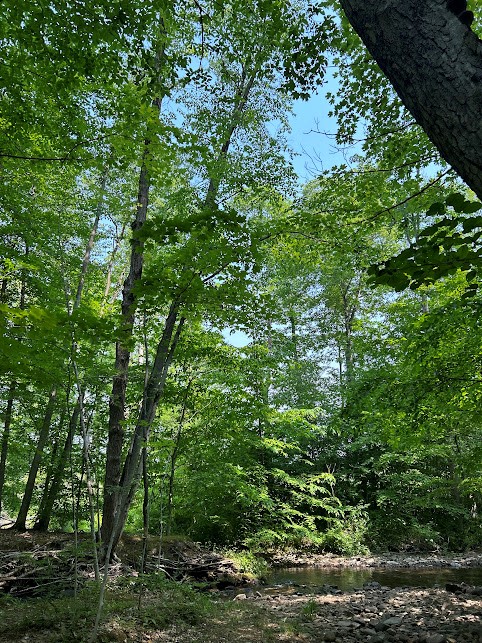
An example of an area surveyed this summer.

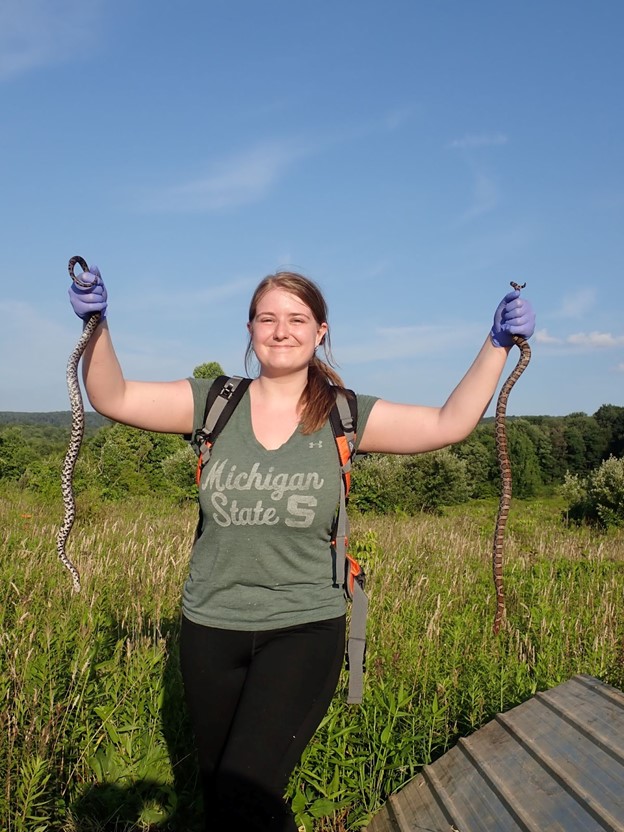
The greatest love of my life is animals, and I got to get very up-close and personal with them when Dr. Walter Meshaka visited to perform herpetology studies. One of the studies he conducted was on snake fungal disease in eastern milk snakes (Lampropeltis triangulum triangulum). Data collection in the field involved capturing individual milk snakes from beneath strategically placed metal coverboards where the reptiles had taken shelter, swabbing their skin to obtain the DNA of the skin microbiota, and then releasing them. Walter allowed me to contribute not only to the swabbing process, but to the risky business of capturing the snakes. I quickly discovered that milk snakes have a spectrum of personalities, from the patient, perfect subjects to the ornery and bitey. 

Two milk snakes next to the coverboard they were sheltering under.

While Walter was here, I was also offered the opportunity to aid him in studying another class of herps: salamanders. Strategically placed coverboards were again critical tools in the study, this time wooden, rather than metal, and placed near wetlands and streams instead of near open fields and meadows. The purpose of this study was to describe the species diversity and density of native salamander species. From our data in June and July, it appears the most abundant salamander near Powdermill’s streams is the charismatic Allegheny Mountain Dusky Salamander (Desmognathus ochrophaeus).

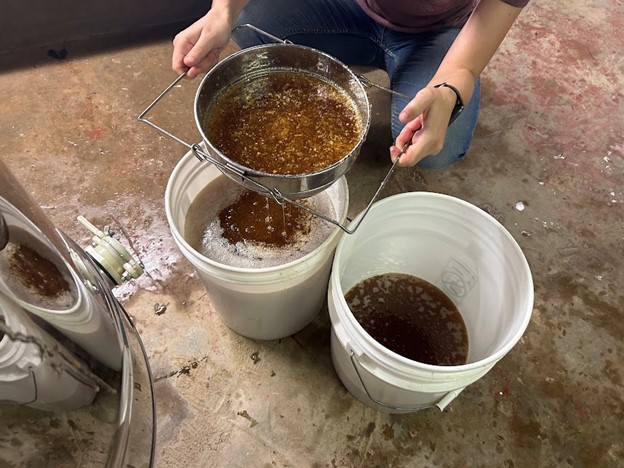
When working with Andrea, an entomologist, you can be sure that insects will be a large part of your life. We began the summer working with a personal favorite: honey bees! Powdermill maintains two hives on its property. The structures are kept healthy with supplemental food, an electrified exclosure fence (to keep out any sweet-toothed bears), and formic acid treatments to control Varroa mites. At the end of summer there was a sticky compensation for such support: We were able to collect more than eighty pounds of honey, though not without a valiant fight from the winged residents of the more territorial hive.

When collecting raw honey, the honey that drips out of the comb must be filtered through a sieve to collect bits of wax and insects.

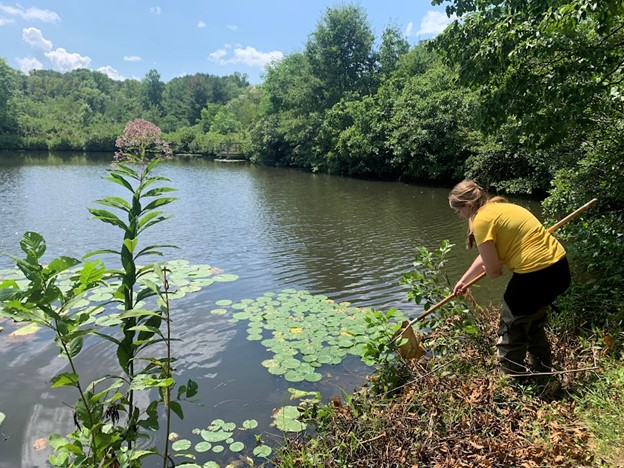
Andrea also participated in a robust, nationwide study on flying insects earlier this spring. A Malaise trap (what is essentially a vertical corral for flying insects) was set up in Crisp Field, a large meadow on Powdermill property, and throughout the summer my responsibilities included sorting everything collected in this trap. This exercise was a three-month affair. I conducted an up-close and personal survey of the sheer amount of diversity found in each order of insects, an experience mirrored by the periodic aquatic macroinvertebrate surveys we performed together along streams and ponds across the property. 

We sampled macroinvertebrates from multiple locations, pictured is a large pond near the Powdermill Avian Research Center.

From insects to reptiles to trees, each project I embarked on got me closer to truly understanding the world around us. In many ways, this meant seeing the consequences of climate change and human influence. Situations reveal themselves to be more dire than one could ever hope to understand by just reading about it. But there is hope, because understanding the world around us also means you can see just how much life worth protecting there is, if you just know how to look.

Rosie Spinola is an intern at Powdermill Nature Reserve, Carnegie Museum of Natural History’s environmental research center.

Related Content

An Intern’s Experience Studying the Ecosystem at Powdermill

Encounter with an Orb Weaver Spider: Is It Predator or Prey?

Tracking Migratory Flight in the Northeast

2023 Point Counts at Powdermill Avian Research Center

Carnegie Museum of Natural History Blog Citation Information

Blog author: Spinola, Rosie
Publication date: September 1, 2023

Share this post!

  • Share on Twitter Share on Twitter
  • Share on Facebook Share on Facebook
  • Share on Pinterest Share on Pinterest
  • Share on LinkedIn Share on LinkedIn
  • Share on Reddit Share on Reddit
  • Share via Email Share via Email

Filed Under: Blog Tagged With: Powdermill, Powdermill Nature Reserve

  • Page 1
  • Page 2
  • Page 3
  • Interim pages omitted …
  • Page 9
  • Go to Next Page »

sidebar

About

  • Mission & Commitments
  • Directors Team
  • Museum History

Get Involved

  • Volunteer
  • Membership
  • Carnegie Discoverers
  • Donate
  • Employment
  • Events

Bring a Group

  • Groups of 10 or More
  • Birthday Parties at the Museum
  • Field Trips

Powdermill

  • Powdermill Nature Reserve
  • Powdermill Field Trips
  • Powdermill Staff
  • Research at Powdermill

More Information

  • Image Permission Requests
  • Science Stories
  • Accessibility
  • Shopping Cart
  • Contact
  • Visitor Policies
One of the Four Carnegie Museums | © Carnegie Institute | Privacy Policy | Terms of Use | Accessibility
Rad works here logo