• Skip to primary navigation
  • Skip to main content
  • Skip to primary sidebar

Carnegie Museum of Natural History

One of the Four Carnegie Museums of Pittsburgh

  • Visit
    • Buy Tickets
    • Visitor Information
    • Exhibitions
    • Events
    • Dining at the Museum
    • Celebrate at the Museum
    • Powdermill Nature Reserve
    • Event Venue Rental
    • Gift Cards
  • Learn
    • Field Trips
    • Educator Information
    • Programs at the Museum
    • Bring the Museum to You
    • Guided Programs FAQ
    • Programs Online
    • Climate and Rural Systems Partnership
  • Research
    • Scientific Sections
    • Science Stories
    • Science Videos
    • Senior Science & Research Staff
    • Museum Library
    • Science Seminars
    • Scientific Publications
    • Specimen and Artifact Identification
  • About
    • Mission & Commitments
    • Directors Team
    • Museum History
  • Tickets
  • Give
  • Shop

Powdermill

September 1, 2023 by Erin Southerland

A Summer Internship at Powdermill

by Rosie Spinola

Before my science-focused internship at Powdermill Nature Reserve, I was a virtual stranger to the forests of Appalachia. Although I’ve lived in western Pennsylvania my entire life, and frequently enjoyed exploring the woods in my hometown, often, I was simply not tuned in to the diversity and intricacies of the world all around me. My short tenure at Powdermill abruptly changed that perspective. During my internship I had the pleasure of participating in a wide variety of projects and studies, each one an eye-opening learning experience.

The internship began with a crash course in tree identification from my mentor and fieldwork partner, Andrea Kautz. Vegetation surveys were the bulk of the work performed this summer in terms of both the physical labor required and the amount of information we collected. Trees, saplings, shrubs, logs; notations about the location, size, and abundance of each instance contributed to a years-long study of the forest. 

One of the major changes that we have been able to track over the years is the cataclysmic effects of the invasive Emerald Ash Borer. The Emerald Ash Borer is an invasive beetle from northeast Asia that lays its eggs in the bark of ash trees. The eggs develop into larvae that eat the cambium of the ash, destroying the tree from the inside out. Where once swathes of Powdermill land were defined by their large white ash trees, you would be hard-pressed to find a single one in today’s forest. The dead ash trees leave a hole in the canopy in their wake and, to the endless consternation of those attempting to survey the area, invasive thorny species move in.
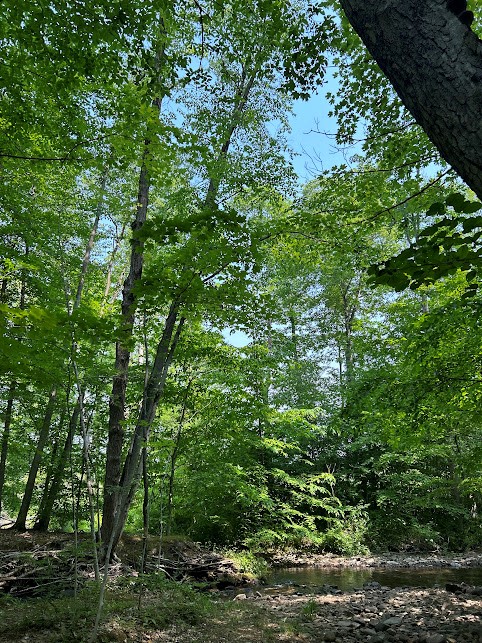
An example of an area surveyed this summer.

The greatest love of my life is animals, and I got to get very up-close and personal with them when Dr. Walter Meshaka visited to perform herpetology studies. One of the studies he conducted was on snake fungal disease in eastern milk snakes (Lampropeltis triangulum triangulum). Data collection in the field involved capturing individual milk snakes from beneath strategically placed metal coverboards where the reptiles had taken shelter, swabbing their skin to obtain the DNA of the skin microbiota, and then releasing them. Walter allowed me to contribute not only to the swabbing process, but to the risky business of capturing the snakes. I quickly discovered that milk snakes have a spectrum of personalities, from the patient, perfect subjects to the ornery and bitey. 
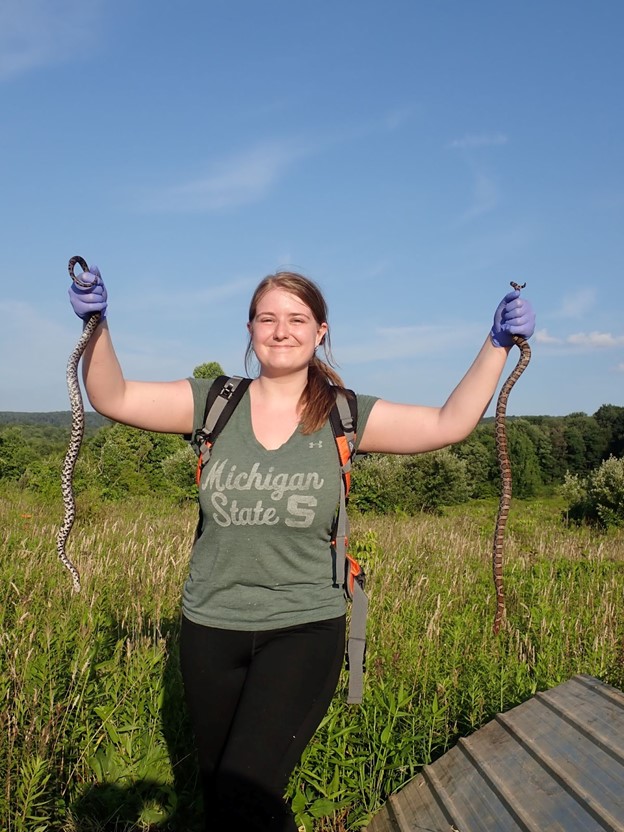
Two milk snakes next to the coverboard they were sheltering under.

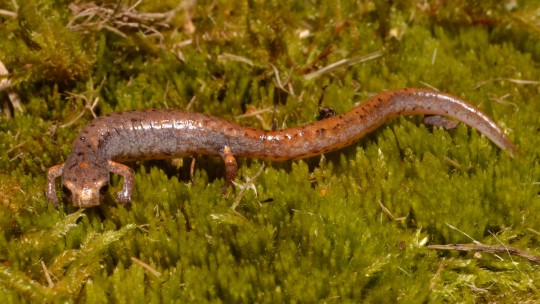
While Walter was here, I was also offered the opportunity to aid him in studying another class of herps: salamanders. Strategically placed coverboards were again critical tools in the study, this time wooden, rather than metal, and placed near wetlands and streams instead of near open fields and meadows. The purpose of this study was to describe the species diversity and density of native salamander species. From our data in June and July, it appears the most abundant salamander near Powdermill’s streams is the charismatic Allegheny Mountain Dusky Salamander (Desmognathus ochrophaeus).

When working with Andrea, an entomologist, you can be sure that insects will be a large part of your life. We began the summer working with a personal favorite: honey bees! Powdermill maintains two hives on its property. The structures are kept healthy with supplemental food, an electrified exclosure fence (to keep out any sweet-toothed bears), and formic acid treatments to control Varroa mites. At the end of summer there was a sticky compensation for such support: We were able to collect more than eighty pounds of honey, though not without a valiant fight from the winged residents of the more territorial hive.
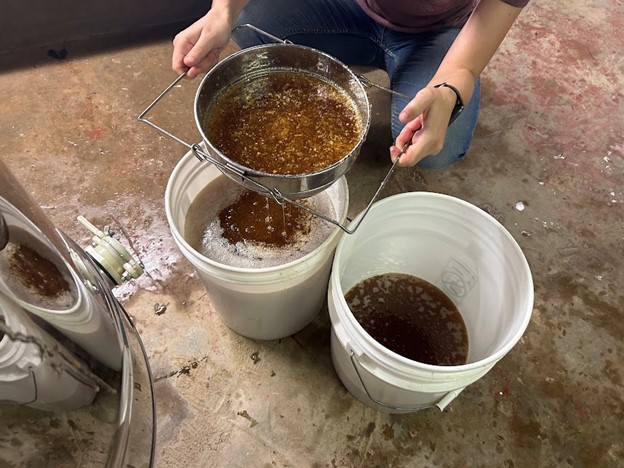
When collecting raw honey, the honey that drips out of the comb must be filtered through a sieve to collect bits of wax and insects.

Andrea also participated in a robust, nationwide study on flying insects earlier this spring. A Malaise trap (what is essentially a vertical corral for flying insects) was set up in Crisp Field, a large meadow on Powdermill property, and throughout the summer my responsibilities included sorting everything collected in this trap. This exercise was a three-month affair. I conducted an up-close and personal survey of the sheer amount of diversity found in each order of insects, an experience mirrored by the periodic aquatic macroinvertebrate surveys we performed together along streams and ponds across the property. 
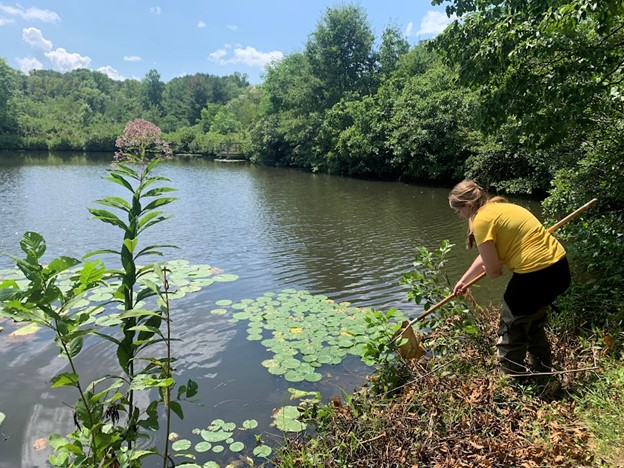
We sampled macroinvertebrates from multiple locations, pictured is a large pond near the Powdermill Avian Research Center.

From insects to reptiles to trees, each project I embarked on got me closer to truly understanding the world around us. In many ways, this meant seeing the consequences of climate change and human influence. Situations reveal themselves to be more dire than one could ever hope to understand by just reading about it. But there is hope, because understanding the world around us also means you can see just how much life worth protecting there is, if you just know how to look.

Rosie Spinola is an intern at Powdermill Nature Reserve, Carnegie Museum of Natural History’s environmental research center.

Related Content

An Intern’s Experience Studying the Ecosystem at Powdermill

Encounter with an Orb Weaver Spider: Is It Predator or Prey?

Tracking Migratory Flight in the Northeast

2023 Point Counts at Powdermill Avian Research Center

Carnegie Museum of Natural History Blog Citation Information

Blog author: Spinola, Rosie
Publication date: September 1, 2023
Share this post!

  • Share on Twitter Share on Twitter
  • Share on Facebook Share on Facebook
  • Share on Pinterest Share on Pinterest
  • Share on LinkedIn Share on LinkedIn
  • Share on Reddit Share on Reddit
  • Share via Email Share via Email

Filed Under: Blog Tagged With: Powdermill, Powdermill Nature Reserve

January 6, 2023 by Erin Southerland

2022 Rector Christmas Bird Count Results

by Annie Lindsay
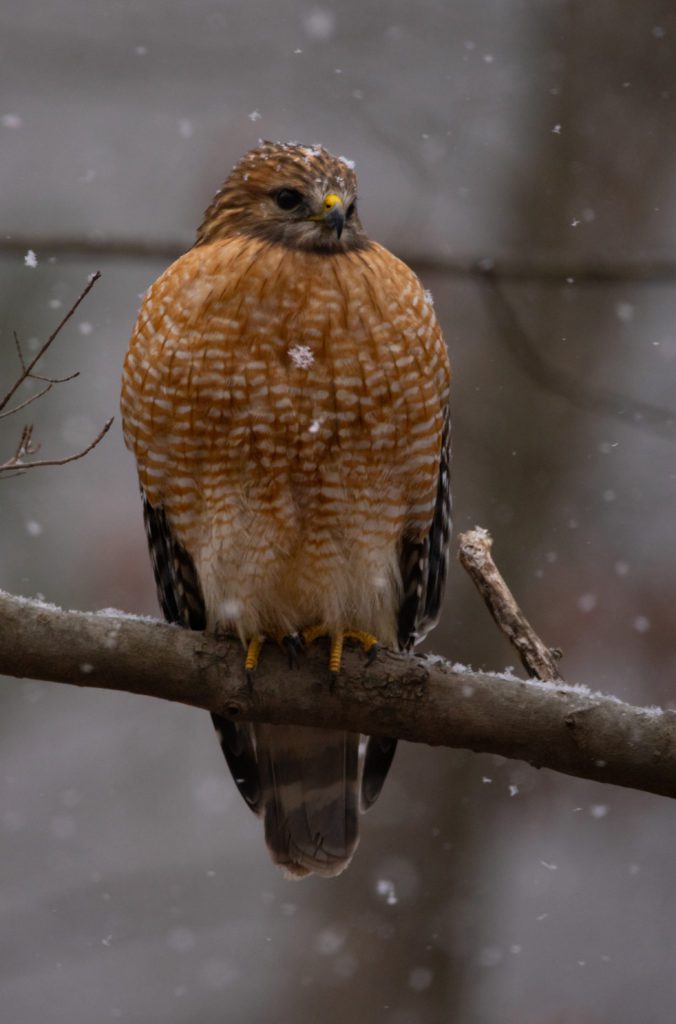
Red-shouldered Hawk. Image credit: Brady Karg

On the morning of December 17, 2022, 41 birders assembled at Powdermill Avian Research Center to receive the maps and datasheets for the sectors they’d be visiting for the annual Rector Christmas Bird Count (CBC). During the CBC, participants identify and tally every bird they see or hear within a pre-established 15-mile-diameter circle on a selected day between December 14 and January 5. The Rector count was established in 1974, but the history of the CBC extends back to 1900, when a small group listed birds in 25 count circles on Christmas Day. Now sponsored by the National Audubon Society, the CBC has expanded to include nearly 3,000 circles throughout the Western Hemisphere. The CBC welcomes birders of all skill levels and is one of the largest and longest-term community science projects. 

The Rector count’s center point is just northwest of Powdermill Nature Reserve, and encompasses a variety of habitats including the ridge-top forests of Chestnut Ridge, Laurel Summit State Park, Laurel Mountain State Park, and Forbes State Forest, the mountain stream valleys and hillsides of Linn Run State Park and Powdermill Nature Reserve, two lakes that often attract migrating or overwintering waterfowl, and rolling farmland interspersed with small towns. This habitat variety means that species diversity can be quite high, and since 1974, birders have tallied 131 species in the Rector circle. 

Last year, warm weather extended far into the fall, and the Rector count recorded high totals of many species that we would normally expect to spend the winter a bit further south. This year, however, the fall weather was more typical of southwestern Pennsylvania, and temperatures on the day of the count hovered around freezing as large, fluffy snowflakes fell throughout the morning. The day began early as a few ambitious birders searched for owls before dawn, finding eight Eastern Screech Owls. By dawn, all participants headed to their sectors to count diurnal birds, while an additional eight birders counted what they saw and heard in their yards and visiting their feeders. As dusk fell, CBC participants met at Powdermill for a tally dinner, an evening of camaraderie and sharing stories from the day. Although the species total was only 59, which is slightly below average, individual numbers for each of these species were typical. A few, including Wild Turkey, Bald Eagle, Red-shouldered Hawk, Winter Wren, and Eastern Bluebird even saw new high-count records. 

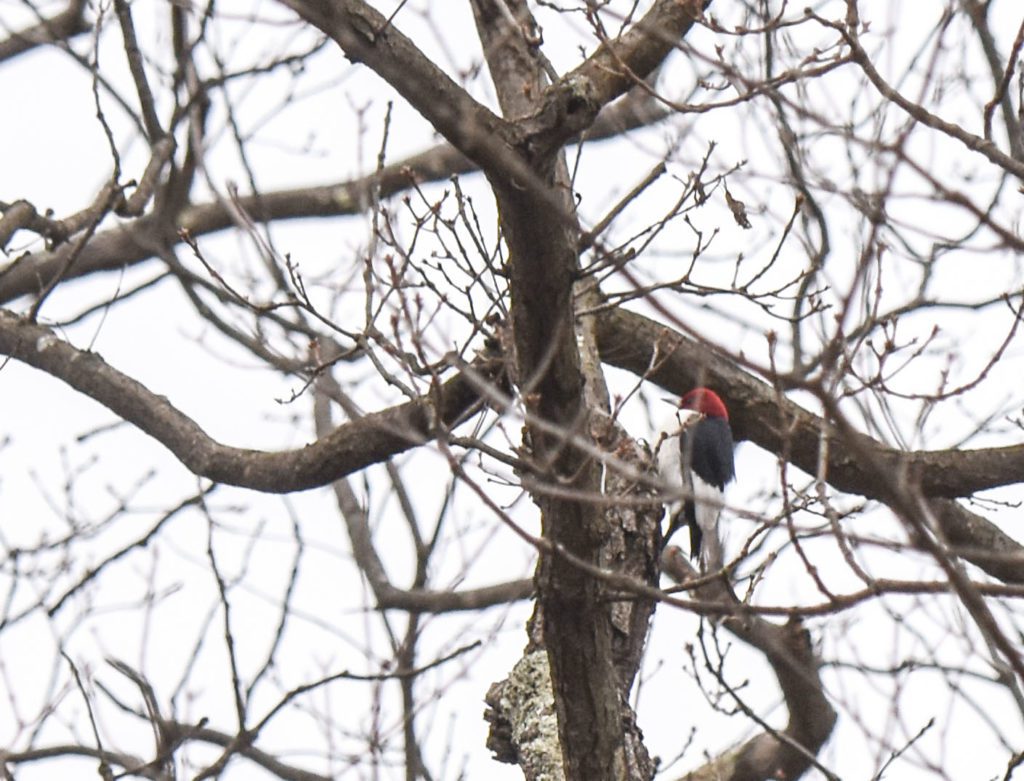
Red-headed Woodpecker. Image credit: Tom Kuehl

For the fifth year in a row, participants found Red-headed Woodpeckers during the count. This species is difficult to find in southwestern Pennsylvania, and the Rector count circle is one of the only reliable places to encounter them. A favorite of birders, this bold, color-block-patterned woodpecker always delights those lucky enough to spot one.

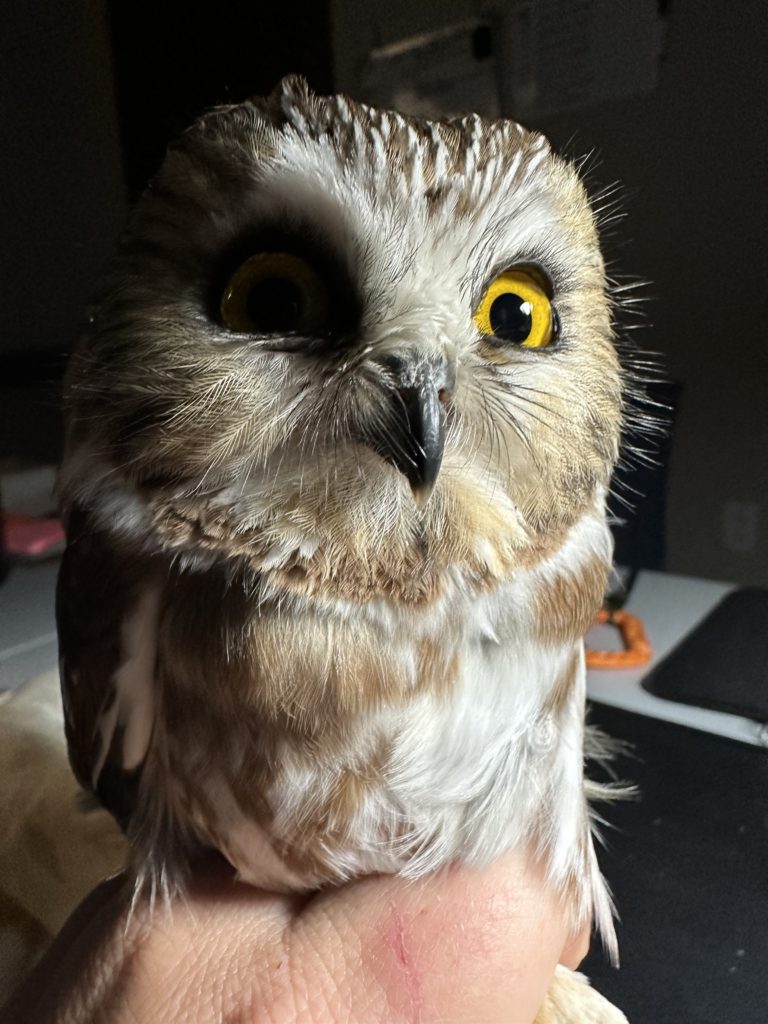
Northern Saw-whet Owl

One of the most exciting sightings of this year’s count, and the last bird encountered for the day, was a Northern Saw-whet Owl spotted near Powdermill’s nature center just as the tally dinner ended. Northern Saw-whet Owls are found in southwestern Pennsylvania primarily during fall migration, but some overwinter here, and there is evidence that a few pairs may breed locally. Saw-whets are small and do not vocalize as readily as most of the other owls, which make them difficult to find. This fall, Powdermill’s ornithologists caught and banded 99 of these tiny owls, nearly a high fall record! As the 2022 Christmas Bird Count season wraps up, we’re already looking forward to 2023. Thank you to all participants for spending the day searching every corner of the count circle looking for birds, and to all landowners for granting participants access to their properties for a much more thorough and complete count.

Related Content

2021 Rector Christmas Bird Count Results

Milestones at Powdermill’s Banding Lab

Holiday Stowaway: Northern Saw-whet Owl

Carnegie Museum of Natural History Blog Citation Information

Blog author: Lindsay, Annie
Publication date: January 6, 2023

Share this post!

  • Share on Twitter Share on Twitter
  • Share on Facebook Share on Facebook
  • Share on Pinterest Share on Pinterest
  • Share on LinkedIn Share on LinkedIn
  • Share on Reddit Share on Reddit
  • Share via Email Share via Email

Filed Under: Blog Tagged With: Annie Lindsay, Birds, Powdermill, Science News

May 26, 2021 by wpengine

Can’t Touch This

by Andrea Kautz

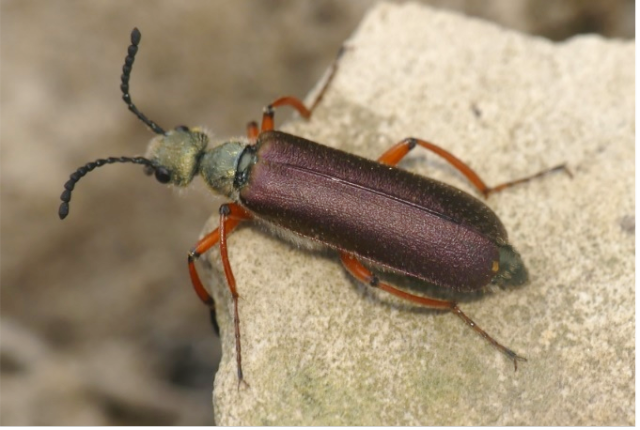
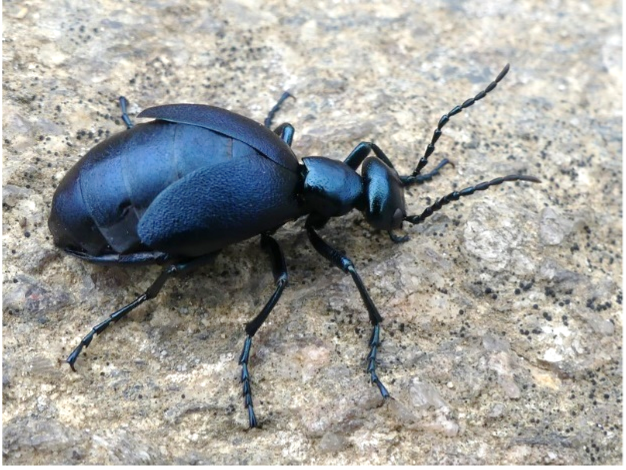
From the name of them, you may guess “blister beetles” are insects you might not want to handle. However, they sure are beautiful to look at! We’ve been noticing blister beetles out and about at Powdermill over the last week or so. Some fly around clumsily, while other flightless species scurry among the leaf litter. Beetles in this family (Meloidae) secrete a defensive substance called cantharidin, a skin irritant that can cause blistering. They are also very toxic when consumed, and can be fatal for livestock if present in the hay supply.

Multi-colored blister beetle on a rock.
Shiny blue blister beetle on a rock.
Two different genera of blister beetles that are common in SW Pennsylvania: Lytta (top) and Meloe (bottom). Top image credit: Shaun Pogacnik. Bottom image credit: Christian Grenier.

Blister beetles are parasites, mostly in the nests of ground-nesting bees and wasps. Watch this short video clip to learn more about their life cycle. Spoiler alert: In this species, the newly hatched beetle larvae clump together and attract a male bee using a fragrance, and then transfer to the female he mates with, ultimately gaining access to her nest, where they feed on both the pollen provisions and the bee larvae themselves!

Whether larvae or adults, these striking beetles certainly have a fascinating dark side. There is always more than meets the eye when it comes to entomology!

Andrea Kautz is a Research Entomologist at Carnegie Museum of Natural History’s Powdermill Nature Reserve. Museum employees are encouraged to blog about their unique experiences and knowledge gained from working at the museum.

Related Content

A Little Harbinger of Spring…

Oh Deer, That’s a Lot of Parasites!

Fourth of July and the Firefly

Carnegie Museum of Natural History Blog Citation Information

Blog author: Kautz, Andrea
Publication date: May 26, 2021

Share this post!

  • Share on Twitter Share on Twitter
  • Share on Facebook Share on Facebook
  • Share on Pinterest Share on Pinterest
  • Share on LinkedIn Share on LinkedIn
  • Share on Reddit Share on Reddit
  • Share via Email Share via Email

Share this post!

  • Share on Twitter Share on Twitter
  • Share on Facebook Share on Facebook
  • Share on Pinterest Share on Pinterest
  • Share on LinkedIn Share on LinkedIn
  • Share on Reddit Share on Reddit
  • Share via Email Share via Email

Filed Under: Blog Tagged With: Andrea Kautz, beetles, Powdermill, Powdermill Nature Reserve, Science News

December 8, 2020 by wpengine

Bobcats

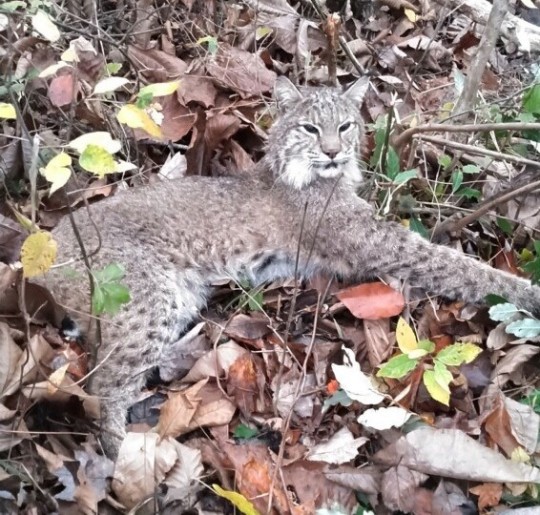
With winter approaching, visitors to Powdermill Nature Reserve can anticipate seeing the tracks in the snow of one of our most splendid residents, the bobcat! These wild felines do not hibernate, rather they remain very active in winter because of their high metabolism. Although they are commonly photographed on trail cameras at Powdermill Nature Reserve, bobcats have excellent vision and hearing and are unlikely to show themselves to people. The stealthy and efficient predators are found state-wide, and the range for the species known scientifically as Lynx rufus stretches across the North American continent from southern Canada to northern Mexico.

This adult female was photographed in late October, but photos do not really capture the full beauty of these animals. Image credit: John Wilkinson.

Bobcats are known to walk on top of fallen logs to move silently through the understory. Adults weigh up to 20 pounds, feed mostly on rodents and birds, but are capable of taking small fawns and perhaps even yearling deer. Bobcats are highly adaptable and do well even in close proximity to humans and coyotes. In our area, males wander over areas as large as 10 square miles, territories that span the smaller territories of several females. Bobcats are protected except for a brief trapping season in winter. Their coats are highly variable, and pelts are considered prime in winter, and more valuable when spotted. The highest quality, large pelts from the Rocky Mountains may sell for as much as $900. However, luckily for our cats, the market here is unlikely to provide $40 for a pelt, which will keep them safe from most trappers.

John Wenzel is the Director at Powdermill Nature Reserve, Carnegie Museum of Natural History’s environmental research center. Museum employees are encouraged to blog about their unique experiences and knowledge gained from working at the museum.

Related Content

The Christmas Bird Count During an Irruption Year

Ask a Scientist: What are murder hornets?

Brood VIII Birthday Bash

Filed Under: Blog Tagged With: John Wenzel, mammals, Powdermill, Powdermill Nature Reserve

July 20, 2020 by wpengine

A Bumble’s Blog and Bumble “Weee” Catapult Craft

Wander outside in the spring and summer and I bet you will bump into a busy bumble bee bumbling among the wildflowers. Bumble bees (Bombus sp.) are rather rotund, fuzzy bees usually with black and yellow-orange stripes. Unlike the famous honey bee that hails from Europe and Asia, most bumble bee species are native to our area. Bumble bees have small underground colonies with a loose social system, compared to that of a honey bee. While bumble bees produce honey, it is in small quantities and certainly not enough to share on an industrial scale. Still, these fuzzy bumbles play an important role as pollinators of local wildflower populations and are even adapted to pollinate certain flowers!

photo of Dutchman's breeches flower

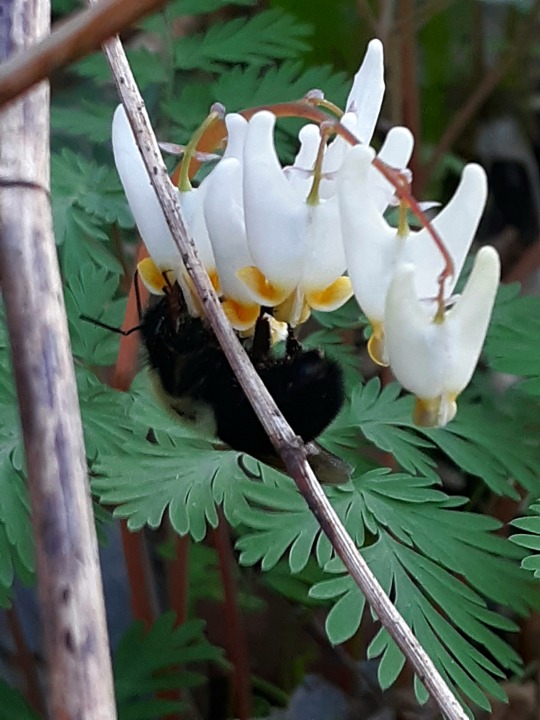
This fashionable bumble bee is trying to squeeze into a little pair of white breeches! Duchman’s breeches (Dicentra cucullaria) to be exact. A bumble bee’s proboscis (tongue) is long enough to reach the nectaries within the nectary spurs or “pant leg” and the bee is strong enough to push open the flower petals to collect pollen.

bumblebee on squawroot

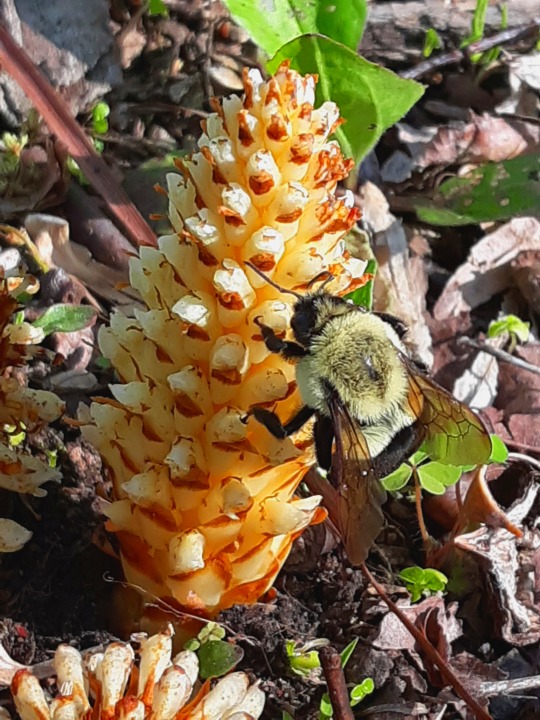
This bumble bee is sipping nectar from squawroot (Conopholis americana). Bumble bees and flies are the typical visitors of this parasitic plant! Fun fact: bumble bees “buzz” pollenate, which means they vibrate their bodies, effectively knocking pollen down into the flowers they visit.

Upon observing the flight of a bumble bee, I have noticed that while they are strong flyers, they are not the most graceful. Sometimes they miss their mark and land on a chunk of moss instead of the flower. However, they just take that moment to rest their wings before firing up their little motor and buzzing off into, hopefully, the next flower. Their rather clunky flight pattern gave me an idea for a fun activity to help young children learn about pollinators (and sneak in a STEM activity): The Bumble “Weee” Catapult! See below for assembly instructions:

Materials

      3 pipe cleaners

      Paper

      Pen or pencil

      Coloring supplies

      Scissors

      Recycled egg carton

      Recycled plastic spoon

      4-5 large Rubber bands

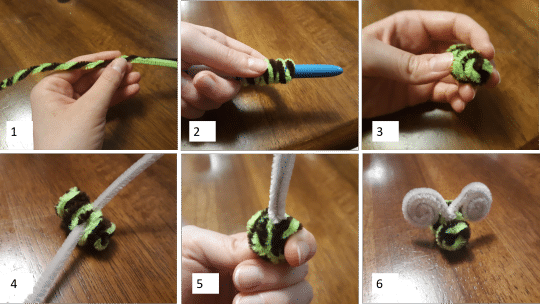
Let’s dismiss the idea of launching real bumble bees and begin building the bee puppet 😉. Pick 3 different colors of pipe cleaner. Feel free to go with traditional bee colors or mix it up!

1.     For the body, twist together two pipe cleaners.

2.     Wrap the twisted pipe cleaners tightly around a pen or pencil and slide it off.

3.     Tuck the loose ends inward and tighten up the coils on the end you would call the head.

4.     For the wings, shorten the remaining pipe cleaner by 1/3, then loop it under one of the coils of the bee’s body.

5.     Adjust the pipe cleaner for equal length on either side and twist at the base.

6.     Roll in the loose ends to finish forming your wings, thus completing the bumble bee.

step by step photos of creating a bee from pipe cleaners

Next, build the catapult to help your bee puppet fly. The catapult consists of half of an egg carton, 4-5 rubber bands, and a recycled spoon. Tension energy is generated when the spoon is pulled back. The arm stores that energy as potential energy. Upon release, that potential energy is transferred to the object as kinetic energy, moving the object away from the arm. Pictured is the simplest catapult design with rubber bands holding the spoon, or arm of the catapult, in place. Feel free to design something more elaborate!

photo of catapult made from egg carton, plastic spoon, and rubber bands

Finally, the bumble bee needs a flower to land in! Draw a flower of your choice on a piece of paper and color it in. Many bees are able to see UV light, which means they are able see colors and patterns invisible to the human naked eye. Some flowers have nectar guides that really stand out to bees, so feel free to draw some nectar guides, or lines that point to the center on your flower targets to help guide your bumble bee!

photo of paper flower

Feel free to create as many flowers as you like and propel your little bumble bee into as many flowers as you can. Happy pollinating!

Sara Klingensmith an educator at Powdermill Nature Reserve, Carnegie Museum of Natural History’s environmental research center. Museum employees are encouraged to blog about their unique experiences and knowledge gained from working at the museum.

Related Content

Jumping Spiders with Sebastian

Pittsburgh Dinosaur Driving Tour

Photogenic Fungi

Filed Under: Blog Tagged With: activities, Crafts, Museum from Home, Nature 360, Nature Lab, Powdermill, Powdermill Nature Reserve, Sara Klingensmith

July 14, 2020 by wpengine

How to catch 311 amphibians in 10 days

Step 1: Deploy pitfall traps across Powdermill Nature Reserve

Step 2: Get out of the way and let nature do the rest

Over the course of 10 days in June of this year, I captured 311 amphibians of 12 different species. Every day, rain or shine, I spent over four hours checking 132 pitfall traps and several more hours identifying, measuring, and weighing the day’s amphibian haul. I did a rinse and repeat of this cycle for 10 days straight. Why would anyone do all of this for what Carl Linnaeus, the father of modern taxonomy, once described as “vile animals” with “a foul odor” (Wahlgren, 2011)? Although this sentiment might still ring true for some people today, I did this because amphibians are in serious trouble—more than 30% of species are facing extinction. The threats to amphibians range from habitat losses to disease epidemics, but these are merely symptoms of the underlying cause: unnatural changes brought about by the Anthropocene. Human-induced alterations to nature are irrevocably modifying biodiversity so rapidly that species we learned about in grade school are now extinct and, if we view amphibians as sentinel organisms, then the worst is yet to come.

The Powdermill Nature Reserve is a protected site in Pennsylvania’s Allegheny Mountains where, since 1956—the year it was established by a forward-thinking herpetologist— the property has functioned in a similar way as forests did before human settlement swept across the region. In the early 1980s, scientists at the Carnegie Museum of Natural History studied the amphibian community at the Powdermill Nature Reserve and, serendipitously, established the empirical baseline necessary to study how environmental changes have affected amphibian biodiversity in the Alleghenies (Meshaka, 2009).

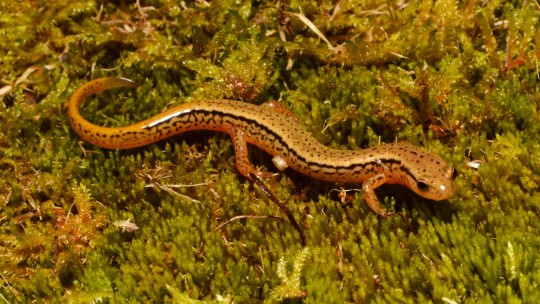
close up photo fo orange salamander with black stripes

Examining the results of amphibian trapping during two long ago Junes offers insight into the reserve’s value. In June 1982, 78 traps captured 262 amphibians of 11 species. In June 1983, 54 traps captured 174 amphibians of 11 species. While the species richness has not changed much since the 1980s, there has been species turnover and shifts in abundance, with some species becoming more common in the community. The Two-lined Salamander (Eurycea bislineata), for example, went from 0 captures in June of 1982 and 1983 to 7 captures this June. In terms of standardized trap nights in June (i.e., the number of traps multiplied the number of days opened), a combined rate of 0.11 amphibians per trap was detected across the two years in the 1980s, compared to a rate of 0.24 amphibians per trap this year. What could the ecological scenario be that has led to such an apparent increase in the amphibian capture rate over this 40-year period? Could trophic cascades be involved? Perhaps the protection of habitats in 1956 helped forest regeneration, and this change led to improved stream health and greater water retention later into the season via increased canopy cover. By providing better habitat and more resources for the streamside invertebrates that makeup the main prey base of forest-dwelling amphibians, such a transformed system might benefit amphibian communities indirectly. It’s also possible that some entirely different mechanism produced this result.

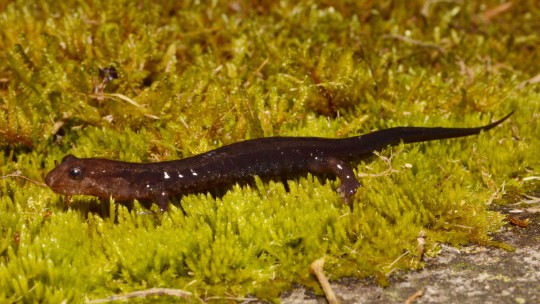
photo of Allegheny Dusky Salamander

The species that dominated captures historically and today was the Allegheny Dusky Salamander (Desmognathus ochrophaeus), which went from 0.048 individuals per trap in June from the 1980s to a slightly increased rate this June of 0.052 individuals per trap. Interestingly, the average body size of female Allegheny Dusky Salamanders has not changed over the 40-year study period, suggesting stability in morphology despite other studies reporting salamander species either shrinking (Caruso et al., 2014) or growing (McCarthy et al., 2017) in response to warmer temperatures brought about by recent climate change. Without the founding of the Powdermill Nature Reserve and the herculean efforts of historical and modern scientists from the Carnegie Museum of Natural History, we would not be able to understand the extent that humans have impacted biodiversity, let alone the data needed to solve mysteries of the modern world.

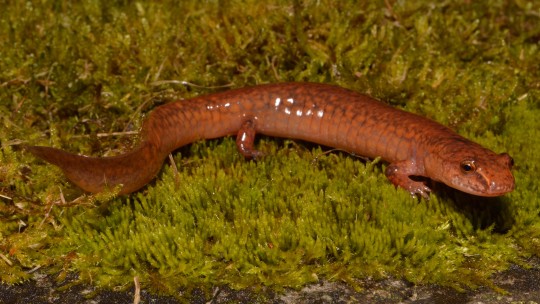
photo of spring salamander
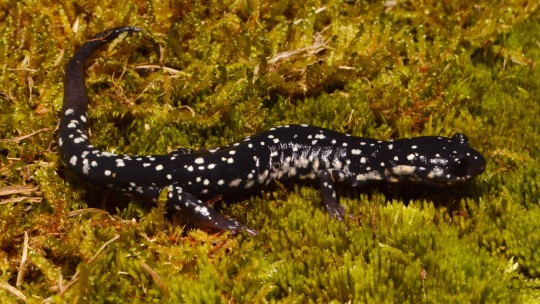
photo of black salamander with white spots
photo of four-toed salamander

So, when I look at a Spring Salamander (Gyrinophilus porphyriticus) or a Slimy Salamander (Plethodon glutinosis) or a Four-toed Salamander (Hemidactylus scutatum) from the Powdermill Nature Reserve, I don’t see Linnaeus’s “terrible animal” with a “ghastly color”, rather, I see profound resiliency in the face of tremendous pressure, and the power that natural history collections and protected areas hold for improving our relationship with biodiversity.

Daniel F. Hughes is the Rea Post-doctoral Fellow in the Herpetology Section at Carnegie Museum of Natural History. Museum employees are encouraged to blog about their unique experiences and knowledge gained from working at the museum.

References:

Caruso, N.M., Sears, M.W., Adams, D.C. and Lips, K.R., 2014. Widespread rapid reductions in body size of adult salamanders in response to climate change. Global Change Biology, 20: 1751–1759.

Meshaka, Jr., W.E., 2009. The terrestrial ecology of an Allegheny amphibian community: Implications for land management. The Maryland Naturalist, 50: 30–56.

McCarthy, T., Masson, P., Thieme, A., Leimgruber, P. and Gratwicke, B., 2017. The relationship between climate and adult body size in redback salamanders (Plethodon cinereus). Geo: Geography and Environment, 4: e00031.

Wahlgren, R., 2011. Carl Linnaeus and the Amphibia. Bibliotheca Herpetologica, 9: 5–37.

Related Content

What is an Amphibian Party?

The Search for the Near Threatened Green Salamander, Aneides Aeneus

What’s in the Rivers?

Filed Under: Blog Tagged With: Daniel Hughes, herpetology, Museum from Home, Powdermill, Powdermill Nature Reserve, Science News

  • « Go to Previous Page
  • Page 1
  • Page 2
  • Page 3
  • Page 4
  • Interim pages omitted …
  • Page 9
  • Go to Next Page »

sidebar

About

  • Mission & Commitments
  • Directors Team
  • Museum History

Get Involved

  • Volunteer
  • Membership
  • Carnegie Discoverers
  • Donate
  • Employment
  • Events

Bring a Group

  • Groups of 10 or More
  • Birthday Parties at the Museum
  • Field Trips

Powdermill

  • Powdermill Nature Reserve
  • Powdermill Field Trips
  • Powdermill Staff
  • Research at Powdermill

More Information

  • Image Permission Requests
  • Science Stories
  • Accessibility
  • Shopping Cart
  • Contact
  • Visitor Policies
One of the Four Carnegie Museums | © Carnegie Institute | Privacy Policy | Terms of Use | Accessibility
Rad works here logo