• Skip to primary navigation
  • Skip to main content
  • Skip to primary sidebar

Carnegie Museum of Natural History

One of the Four Carnegie Museums of Pittsburgh

  • Visit
    • Buy Tickets
    • Visitor Information
    • Exhibitions
    • Events
    • Dining at the Museum
    • Celebrate at the Museum
    • Powdermill Nature Reserve
    • Event Venue Rental
    • Gift Cards
  • Learn
    • Field Trips
    • Educator Information
    • Programs at the Museum
    • Bring the Museum to You
    • Guided Programs FAQ
    • Programs Online
    • Climate and Rural Systems Partnership
  • Research
    • Scientific Sections
    • Science Stories
    • Science Videos
    • Senior Science & Research Staff
    • Museum Library
    • Science Seminars
    • Scientific Publications
    • Specimen and Artifact Identification
  • About
    • Mission & Commitments
    • Directors Team
    • Museum History
  • Tickets
  • Give
  • Shop

Powdermill

March 11, 2020 by wpengine

Tarantula relative found at Powdermill

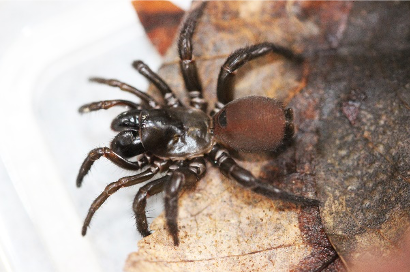
On March 6th, CMNH herpetologist Dr. Danny Hughes came across a very cool spider at Powdermill while digging holes for a salamander survey, and graciously captured it for us. We were excited to find out that it was a folding-door spider in the family Antrodiaetidae and genus Antrodiaetus!  It is related to tarantulas and belongs to the same group of primitive spiders called mygalomorphs. They are uncommonly encountered, partly because they spend most of their lives in underground, silk-lined burrows. The entrance to the burrow is camouflaged with debris so that when unsuspecting prey walk by, the spider can just reach up and out of the opening, grab its meal, and retreat (see this YouTube video for an example: https://www.youtube.com/watch?v=k5owIY63g3E).
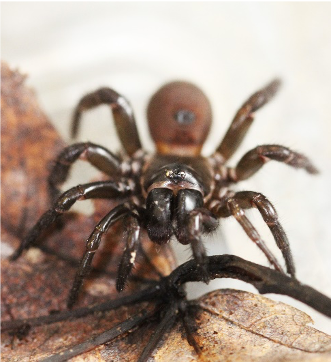
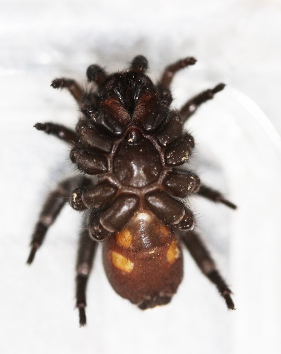
While the large fangs of these spiders may seem intimidating, they are not aggressive and are not of medical concern to humans because their venom is not very potent. In the ventral image, note the two pairs of yellow patches on the underside of the abdomen. These are respiratory structures known as book lungs. Nearly all spiders have a pair of book lungs, but only the primitive groups have two pairs.

Most folks are familiar with tarantulas which are found more in warmer climates, but these lesser-known mygalomorphs can be found right here in western PA. In fact, Powdermill is home to another family of mygalomorphs, the purseweb spiders (in the family Atypidae) which look similar, but they build silken tubes that run up along the base of a tree or rock above ground. We will be keeping our eyes peeled for this other cool family of spiders so we can photograph and show them off in another post. Stay tuned!

Andrea Kautz is a Research Entomologist at Carnegie Museum of Natural History’s Powdermill Nature Reserve. Museum employees are encouraged to blog about their unique experiences and knowledge gained from working at the museum.
Filed Under: Blog Tagged With: Invertebrate Zoology, Powdermill, Science News

February 27, 2020 by wpengine

What is Bird Banding?

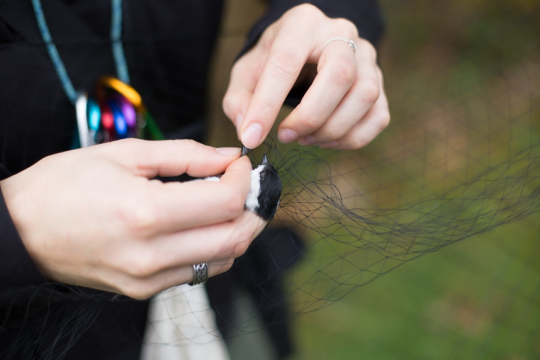
A bird bander extracts a Black-capped Chickadee from a mist net at Powdermill.

What is a bird band?

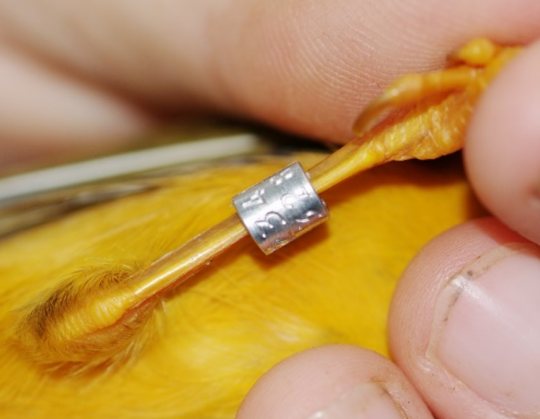
Bird bands are small aluminum rings that are engraved with a series of numbers that identifies individual birds. The bands come in different sizes from a tiny hummingbird band to a “size 9” that fits an eagle. A band fits a bird’s leg like a bracelet: it can spin around the bird’s leg but not slip over ankle or foot joints.

Bird band. Photo credit: John Fraser

How do we band birds?

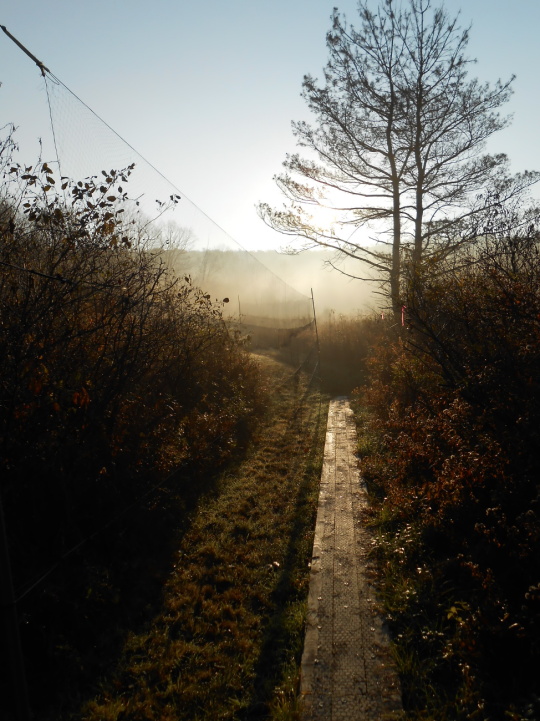
There are different ways to catch birds but at Powdermill, we primarily use mist nets or potter traps. Mist nets are very fine mesh nets that are 12 meters long and about 8 feet high that are suspended between poles in various habitat types. It’s very difficult to see mist nets, so as birds fly through the area they hit the net and gently drop into one of the net’s pockets. An experienced bird bander carefully extracts the bird, places it into a clean cotton bag, and brings it back to a central banding station or lab. In the lab, banders use specially-designed pliers to carefully close the band around the bird’s tarsus, then determine the age and sex of the bird, measure the wing length, quantify fat, weigh the bird, and release it. The banding process is quick: it usually takes less than a minute for each bird!

Who bands birds?

Bird banders operate under a permit from the federal Bird Banding Lab. Banders train as apprentices, often for many years, to learn and perfect the highly-specialized skills necessary to run their own banding stations. High-volume banding stations, usually those that operate during the migration seasons or that can catch hundreds of birds each day, usually have field techs, interns, and volunteers who help while they hone their skills.

Mist net at dawn.

When do we band birds?

Bird banders can band year-round and any time of the day or night, as long as it’s safe for birds! If it’s too hot, too cold, too windy, or too rainy we wait until conditions improve. Of course, the species and number of birds we catch depends on when we band: for example, it’s usually most productive to band songbirds in the mornings and to catch owls at night!

So, what is bird banding?

Bird banding is the process of catching birds, placing a numbered band on their legs, collecting data about each bird, then letting them go. The resulting database can be used to answer all kinds of questions about bird populations. Please stay tuned for our next blog to learn what sorts of questions we can answer from the data we collect during banding!

Annie Lindsay is Banding Program Manager at Carnegie Museum of Natural History’s Powdermill Nature Reserve. Museum employees are encouraged to blog about their unique experiences and knowledge gained from working at the museum.
Filed Under: Blog, Powdermill Tagged With: Powdermill

September 4, 2019 by wpengine

Box Turtle Time Capsule

box turtle

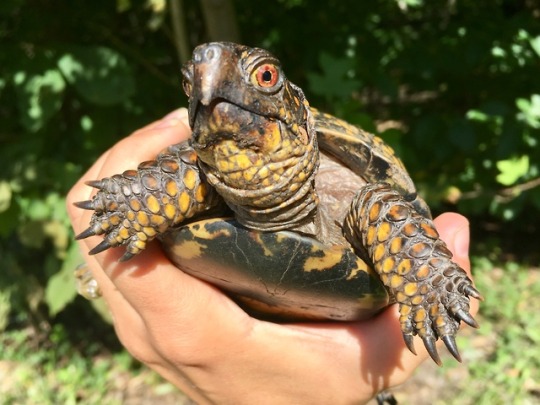
The year is 1974. Powdermill founder and Carnegie Museum of Natural History Director Dr. Graham Netting measures and marks a female box turtle found on the reserve and releases her. He estimates her age to be at least 16 years old. One wonders if he had any idea that during the 45 years since, Powdermill staff would continue to find her, alive and well.

box turtle
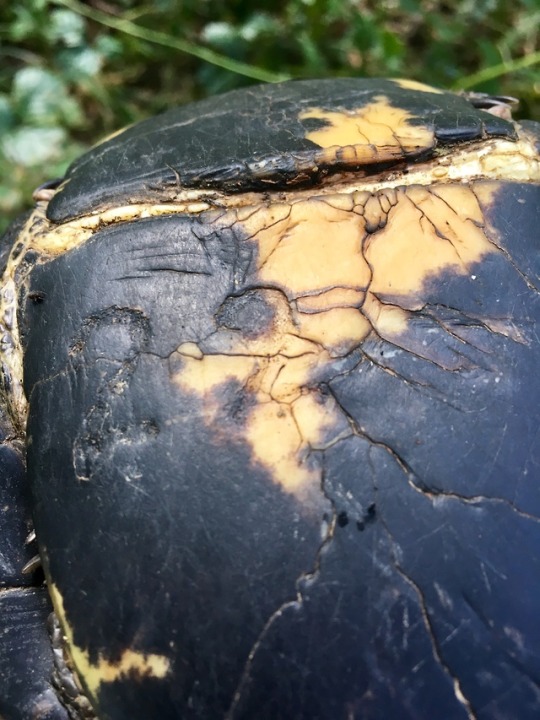
box turtle shell marked 22

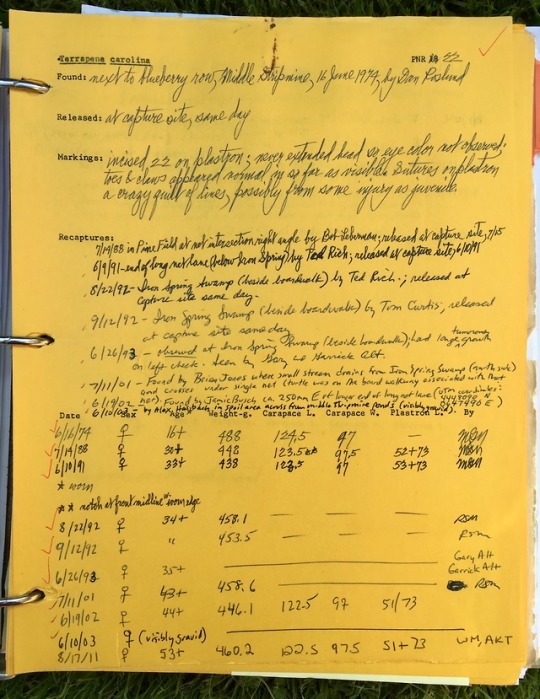
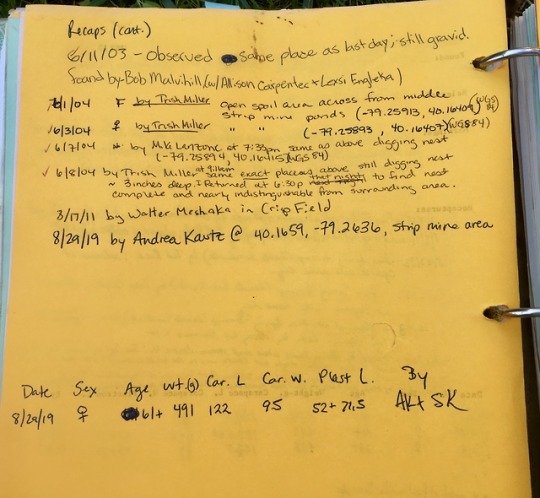
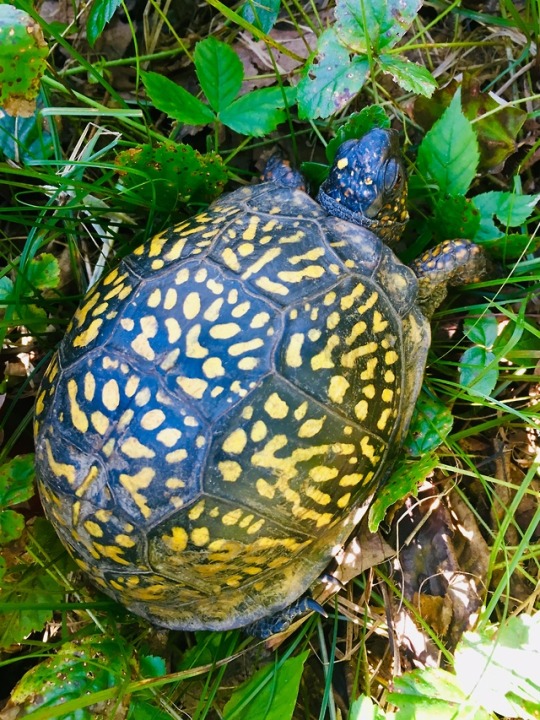
We had the pleasure of encountering box turtle 22, as she is known, on August 29. The number etched into her bottom shell is still readily visible all these years later. She was last seen 8 years ago in 2011, and again 8 years before that, in 2003. In all, she has been recaptured 15 times since 1974! For a 61-year-old (at least), she is looking good and is as close to her 16-year-old weight as we’ve ever seen. Box turtles are known to live for over 100 years in captivity, but often much less in the wild due to predation and disease. Males typically travel more than females, covering distances of up to 10 km in 14 months!

data sheet about box turtle 22

Field stations like Powdermill are so valuable to biologists because of the knowledge that can be gained from these long-term datasets. Perhaps it will be another 8 years until we see her again, and who knows how many more decades she will continue to roam the forests of the reserve. After all, with an approximate birth year of 1958, she is about as old as Powdermill itself (founded in 1956).

Andrea Kautz is a Research Entomologist at Carnegie Museum of Natural History’s Powdermill Nature Reserve. Museum employees are encouraged to blog about their unique experiences and knowledge gained from working at the museum.
Filed Under: Blog Tagged With: Andrea Kautz, Graham Netting, Powdermill, Powdermill Nature Reserve

February 19, 2019 by Kathleen

58 years, 750,000 birds: Building Powdermill’s Avian Research Center One Bird at a Time

Speaker: Luke DeGroote, Avian Research Coordinator, Powdermill Nature Preserve, Carnegie Museum of Natural History

Studies of natural history are increasingly rare, yet they underpin the questions that are asked, the validity of tests performed, and the efforts to conserve biodiversity in a rapidly changing world. How these time-honored techniques are mixed with new technology to build research and education programs for the 21st Century at Powdermill’s Avian Research Center will be presented.

Tagged With: Luke DeGroote, Powdermill

February 14, 2019 by wpengine

Getting Ready for the Great Backyard Bird Count

So you want to take part in the Great Backyard Bird Count? You’ve got your nature notebook ready and you’ve found the perfect spot to birdwatch.  What do you do next?  The Great Backyard Bird Count website has a lot of resources to help you organize your bird counts and submit your information, so you should check those out before the bird count starts.  This post will give you a basic picture of how to document the birds you see and submit your observations properly.

Make a List, Check it Twice

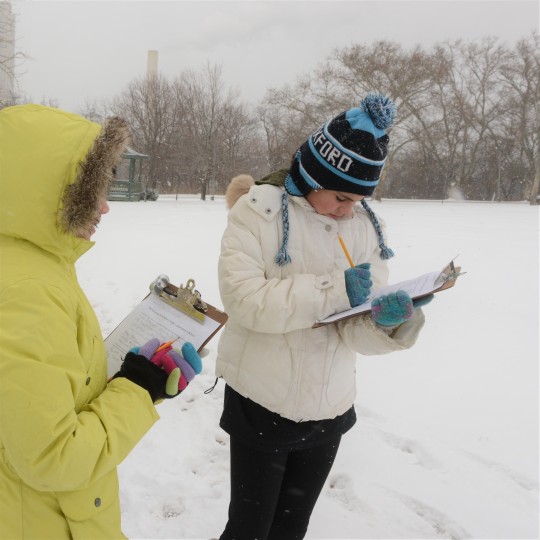
two people taking notes outside in winter
Photo credit: Jim Judkis

Creating a checklist before you start birdwatching will be really helpful in organizing your research.  You can print out this template, enter your location on the count’s website to create a checklist, or create your own guide using a list of birds found in your area.  When you enter your observations online, you will submit a “checklist” for each different session of birdwatching. These lists will document where and when you observed, what species you noticed, and how many individual birds you estimated per species.  A bird guide like the Merlin Bird ID app can help you identify birds you see.

You will want to make a new checklist for each new day, new location, or new time that you look for birds.  For example, you’ll need two checklists if you observe in the same location on two different days, in two different locations on the same day, or in the same location but at two separate times.  When you go to submit your observations, you will be asked to enter the location, date, time, and duration of your expedition.  You will also be asked whether you were walking, standing, sitting, or even riding in a car while you were counting.  Now go forth and count those birds!

Data Ready

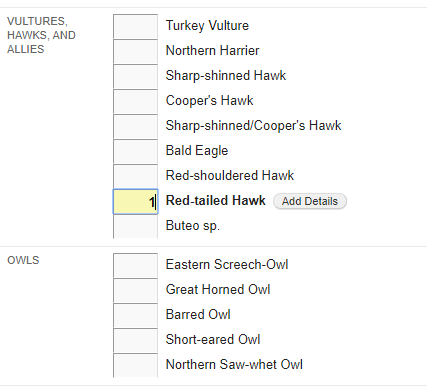
Once you have collected your data, all you need to do is go online and enter in the number of birds you saw next to the name of the birds you noticed!  You can also add details about each bird species and if you were able to take pictures of any birds, you can include them as well.

excerpt of data from bird count

Keep in Mind

The submission form will have a question at the end, “Are you submitting a complete checklist of the birds you were able to identify?” which can be confusing to some.  You should only click “no” if you are deliberately excluding a species from your list (for example you counted everything except crows).

Explore nature together. Visit Nature 360 for more activities and information.

Blog post by Melissa Cagan. 

Filed Under: Blog Tagged With: bird banding, bird hall, birding, Birds, Nature 360, Powdermill

January 22, 2019 by wpengine

Woodlands in White

By John Wenzel

As we enter 2019, I start my ninth year here, and Powdermill Nature Reserve grows cold and quiet. The summer woodland is easy to appreciate, full of sounds of birds in the day, and frogs and insects at night, but for me the forest is most elegant in winter.

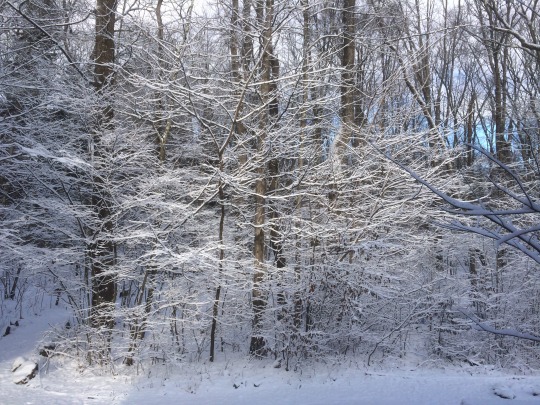
Powdermill woods covered in snow

I moved to Powdermill in January, and at first I lived alone at the reserve. My first season was one of snow and solitude, of beauty and discovery.  The woods are never as striking as when every dark twig is lined in white, creating a world of infinite fragile lace. The naked branches let the explorer see much farther than when the woods are heavy with leaves.  We see deep into the forest, and through it entirely across a hilltop or when we are above the wooded valley.  Animal tracks in the snow allow us to feel the presence of the unseen wildlife more than we do in summer. Wet seeps from mountain springs melt away spots of snow and provide the occasional soothing view of bright green moss, which is very welcome and more readily admired in the starkness of winter.

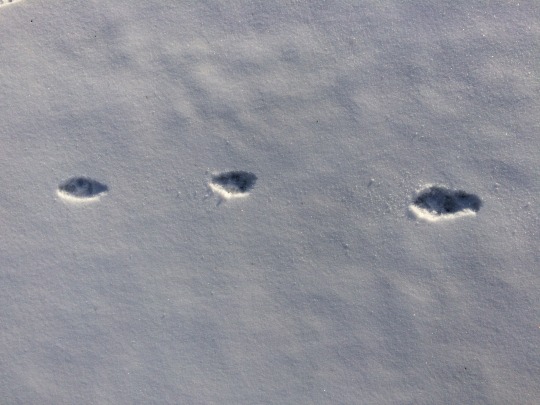
coyote tracks in snow
Coyote tracks at Powdermill Nature Reserve.

Noise of the outside world is nearly absent when a blanket of snow covers the landscape.  This makes the bubbling flow of Powdermill Run all more distinct, and more focal in the outdoor experience. In daylight, we see the million crystal reflections beneath a bright blue sky. At night, far from town, we marvel at the inestimable number of brilliant stars in the onyx above.  Perhaps because visitors to the Nature Center are few in winter, I feel that the reserve is more “mine” than at other times. My Powdermill is the quiet, winter Powdermill, dressed in white and hushed by the cold.

John Wenzel is the Director at Powdermill Nature Reserve, Carnegie Museum of Natural History’s environmental research center. Museum employees are encouraged to blog about their unique experiences and knowledge gained from working at the museum.
Filed Under: Blog Tagged With: John Wenzel, nature, Powdermill, Powdermill Nature Reserve, Winter

  • « Go to Previous Page
  • Page 1
  • Page 2
  • Page 3
  • Page 4
  • Page 5
  • Interim pages omitted …
  • Page 9
  • Go to Next Page »

sidebar

About

  • Mission & Commitments
  • Directors Team
  • Museum History

Get Involved

  • Volunteer
  • Membership
  • Carnegie Discoverers
  • Donate
  • Employment
  • Events

Bring a Group

  • Groups of 10 or More
  • Birthday Parties at the Museum
  • Field Trips

Powdermill

  • Powdermill Nature Reserve
  • Powdermill Field Trips
  • Powdermill Staff
  • Research at Powdermill

More Information

  • Image Permission Requests
  • Science Stories
  • Accessibility
  • Shopping Cart
  • Contact
  • Visitor Policies
One of the Four Carnegie Museums | © Carnegie Institute | Privacy Policy | Terms of Use | Accessibility
Rad works here logo