• Skip to primary navigation
  • Skip to main content
  • Skip to primary sidebar

Carnegie Museum of Natural History

One of the Four Carnegie Museums of Pittsburgh

  • Visit
    • Buy Tickets
    • Visitor Information
    • Exhibitions
    • Events
    • Dining at the Museum
    • Celebrate at the Museum
    • Powdermill Nature Reserve
    • Event Venue Rental
    • Gift Cards
  • Learn
    • Field Trips
    • Educator Information
    • Programs at the Museum
    • Bring the Museum to You
    • Guided Programs FAQ
    • Programs Online
    • Climate and Rural Systems Partnership
  • Research
    • Scientific Sections
    • Science Stories
    • Science Videos
    • Senior Science & Research Staff
    • Museum Library
    • Science Seminars
    • Scientific Publications
    • Specimen and Artifact Identification
  • About
    • Mission & Commitments
    • Directors Team
    • Museum History
  • Tickets
  • Give
  • Shop

Powdermill

November 26, 2018 by wpengine

It’s my flower, and I’ll fruit when I want to

by Andrea Kautz

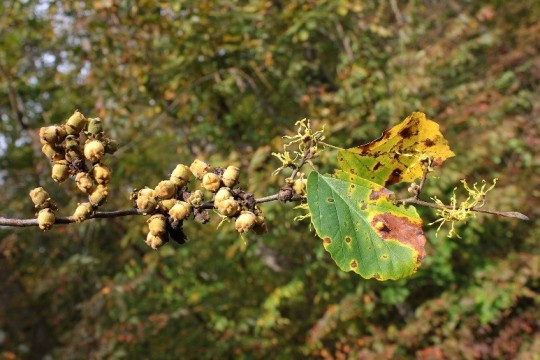
Witch hazel branch with fruits and flowers together

At this point in the year, there aren’t many blooms to be seen on a crisp hike through the woods. However, now is the perfect time to find Common witch hazel (Hamamelis virginiana) both flowering and fruiting!
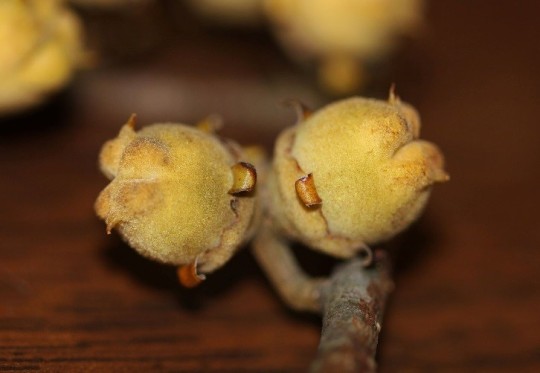
witch hazel fruits
Witch hazel fruits

Hamamelis, from the Greek words meaning “together” and “fruit,” refers to the presence of fruits and flowers at the same time. The velvety fruits you see on witch hazel at this time of year are actually from the flowers that bloomed a year ago. Once ripe, the fruit pops open and the shiny black seeds are forcibly ejected up to 30 feet away! This method of seed dispersal gives the witch hazel another common name, snapping hazelnut. The plant is medically useful for problems of the digestive tract, insect bites, minor burns, skin irritation, or colds and fevers.
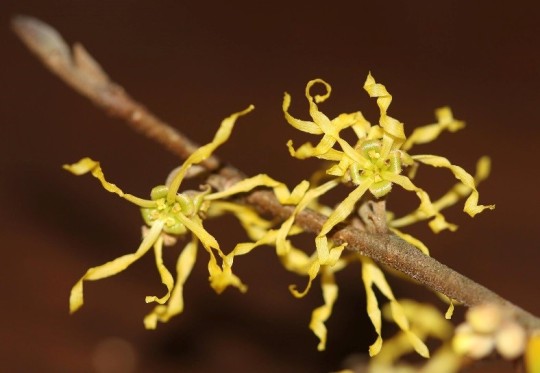
witch hazel flowers
Witch hazel flowers

While this species of witch hazel is one of the last woodland plants to bloom, the Chinese species of witch hazel is one of the first of the year to bloom in late winter, making this delightful group of plants a real rule-breaker! Be sure to keep an eye out for the curly yellow petals of the witch hazel flower on your next fall or winter hike!

Andrea Kautz is a Research Entomologist at Carnegie Museum of Natural History’s Powdermill Nature Reserve. Museum employees are encouraged to blog about their unique experiences and knowledge gained from working at the museum.
Filed Under: Blog Tagged With: Andrea Kautz, Botany, plants, Powdermill

October 1, 2018 by Kathleen

Nature at Night

Tales and Trails: Halloween at Powdermill
Flying bats, carved pumpkins, and hooting owls…What do they have to do with Halloween? Come find out as we dive into the natural history of Halloween! You will have the opportunity to explore the spooky side of Powdermill in the evening at this family-friendly event.

**Please note the time change of 5 – 8 pm. This means you are welcome to drop in any time between 5 and 8 pm!

Tagged With: halloween, owls, Powdermill

October 1, 2018 by Kathleen

Science and Nature Program and Nature Explorers

Fantastic Fall Flowers
Are the gentle scent of flowers on the breeze, bright colors dotting field and forest, buzzing insects drinking nectar making you think it must be spring? Not necessarily! Many amazing plants wait until fall to bloom. Come learn about this unusual strategy and some of the Powdermill Nature Reserve native plants that use it. Then we’ll head outside to look for fantastic fall flowers!

Leaves and Seeds
What’s more fun than planting flower seeds? Throwing them, of course! Come learn about some of the local wildflowers and their importance. Then get your hands dirty as you make your very own seed bombs to take home and use to blast your garden!

Tagged With: autumn, leaves, Powdermill

October 1, 2018 by Kathleen

Storytime and More

Why Do Leaves Change Color?
As the weather begins to cool, the trees put on a dazzling show! “Let’s-Read-and-Find-Out” what is going on with this behind the leaves sneak peek! Afterwards, we’ll go outside to collect beautiful fall leaves to press.

Tagged With: autumn, leaves, Powdermill

September 13, 2018 by wpengine

Wet Weekend!

by Joylette Portlock

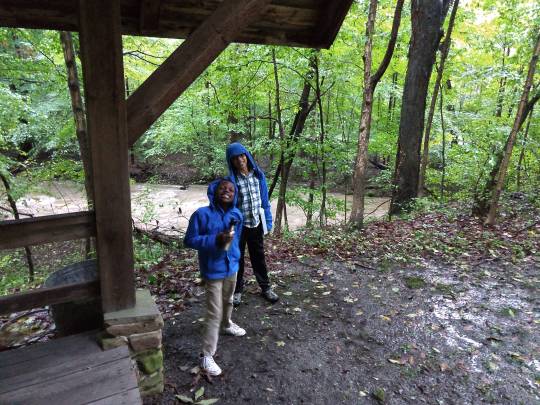
I had the chance to visit Powdermill Nature Reserve over the weekend. Yes, this past weekend, the one where it rained for three days almost continuously across a multi-state area. I took my kids with me, and we had a blast; after all, “rain is a grown-up problem.”* I have to say, the woods always feel so alive to me during/right after a hard rain. The world feels full of promise and power. As we watched Powdermill Run, swollen and wild, churning, cutting a new path through the woods after floods this summer, I thought of the power of water, to nourish, to sweep clean, and to cause damage.

kids in the rain

And, because being a grownup requires other grownup thoughts, I thought of the water in my basement, and considered, again, the costly prospect of installing a French drain around the house.

If you’re feeling like there seems to be more water than ever before, you’re not wrong. Climate change, one of the most significant challenges of the Anthropocene, is shifting the way water moves around the planet. It is resulting in more precipitation in places and at times where we don’t need it; a global phenomenon that is felt locally.

KDKA reported that this past Sunday in Pittsburgh was the second wettest day ever recorded in the area and we’ve already passed the yearly average rainfall. In other words, every drop from this point out in 2018 puts us closer to an annual “wettest ever” status, too.

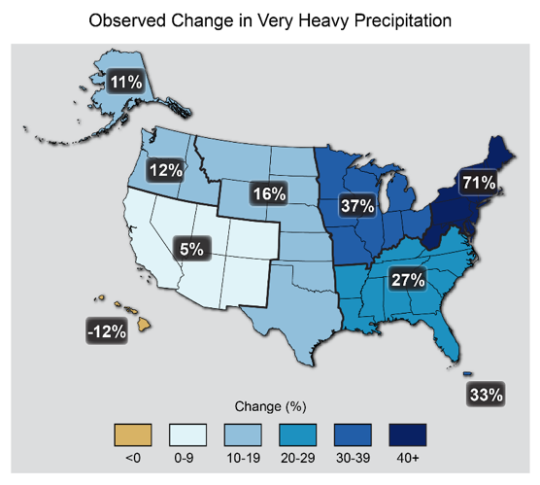
Our downpour this weekend is part of a trend. Since the 1950s, the amount of water falling during heavy downpours in this part of the U.S. has increased by 71%, per the 2014 National Climate Assessment, and that’s an increase that is definitely more than the natural variation:

The map shows percent increases in the amount of precipitation falling in very heavy events (defined as the heaviest 1% of all daily events) from 1958 to 2012 for each region of the continental United States; Adapted from: Global Climate Change Impacts in the United States.

This may come as a surprise – we usually talk about global warming in terms of heat waves and hurricanes – but climate scientists have known about these precipitation effects, which have a big impact even in non-coastal areas, for some time. It’s a big deal for flooding risk (and in areas like Pittsburgh, with a combined sewer-stormwater system, for water quality).

wow gif with LeVar Burton

In other words, it’s not just my basement at risk.

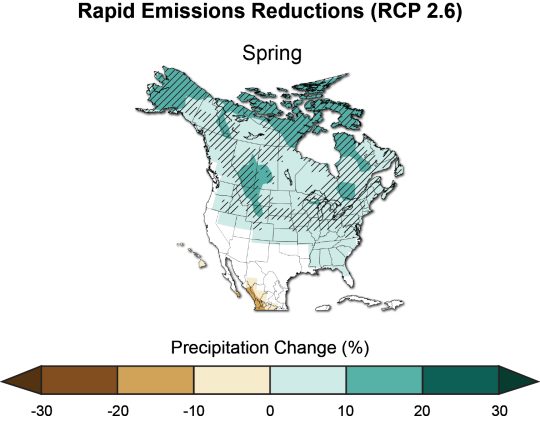
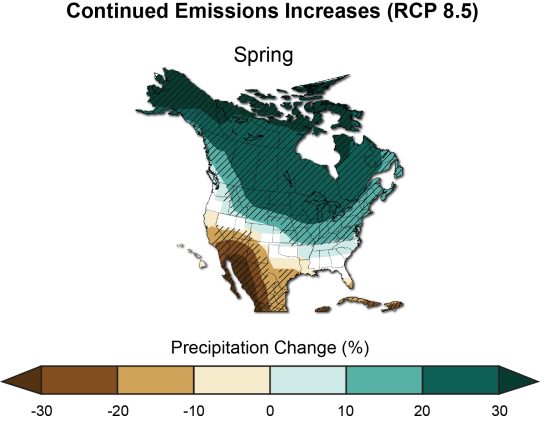
However, the forecast doesn’t have to be gloomy. Also from the National Climate Assessment: our actions right now make a difference, globally and locally. These maps show the projected difference in annual springtime precipitation, by 2090, if we take steps to dramatically reduce our impact on our climate now vs. if we don’t:

Springtime in 2090, Business as usual
Kenneth E. Kunkel, Cooperative Institute for Climate and Satellites – NC

Springtime in 2090, with changes
Kenneth E. Kunkel, Cooperative Institute for Climate and Satellites – NC

Grown-up problems, indeed. Playing in the rain can be very fun. And the world is full of promise and power. But perhaps Powdermill Run isn’t the only thing that requires a new path forward.

*Said to me by a summer camp counselor at the Pittsburgh Zoo and Aquarium in 2017 when I dropped my son off for camp on a rainy day.

Joylette Portlock, Ph.D., is associate director of science and research at Carnegie Museum of Natural History. She is also executive director of Communitopia, a nonprofit focused on climate change communication, and holds many other roles in the community. Museum employees are encouraged to blog about their unique experiences and knowledge gained from working at the museum.

From the National Climate Assessment website:

The National Climate Assessment summarizes the impacts of climate change on the United States, now and in the future.

A team of more than 300 experts guided by a 60-member Federal Advisory Committee produced the report, which was extensively reviewed by the public and experts, including federal agencies and a panel of the National Academy of Sciences.

Filed Under: Blog Tagged With: Anthropocene, climate change, Powdermill, Powdermill Nature Reserve, water

August 27, 2018 by wpengine

Sweet ‘n sassy, Sassafras

by John Wenzel

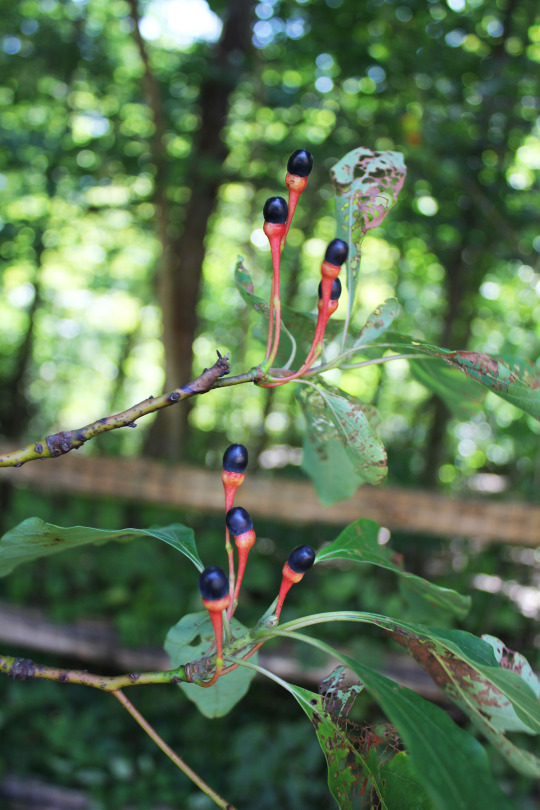
The flavoring of our popular root beer comes from the roots of sassafras, a common tree in open areas or at forest edges. Trees are either male or female, with the females producing interesting and attractive fruits in late August at our location.

sassafras fruit
Photo credit: Andrea Kautz

As is typical of members of the Laurel family, the leaves and twigs have a pleasant odor when crushed. The spice we call bay laurel is a relative of sassafras, and other relatives include our local spicebush and in the tropics avocados and cinnamon.

The leaves may be used in some Louisiana Creole cooking such as gumbo. The leaves are unusual in that the same tree may have simple leaves, or leaves with two lobes that resemble a mitten, or leaves with three lobes.

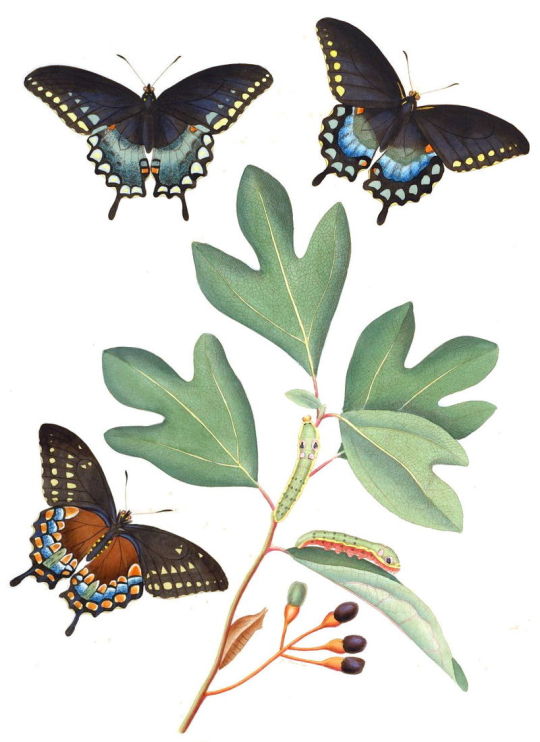
butterflies and sassafras

Sassafras is a traditional medicinal plant, and its oils were used in dentistry as both an anesthetic and disinfectant, although they are now banned in the USA due to carcinogenic properties. The tree is one of the main hosts of the attractive spicebush swallowtail butterfly, which was one of the first insects described from the New World by Linnaeus in 1758.

John Wenzel is the Director at Powdermill Nature Reserve, Carnegie Museum of Natural History’s environmental research center. Museum employees are encouraged to blog about their unique experiences and knowledge gained from working at the museum.
Filed Under: Blog Tagged With: Mason Heberling, Powdermill, Powdermill Nature Reserve

  • « Go to Previous Page
  • Page 1
  • Page 2
  • Page 3
  • Page 4
  • Page 5
  • Page 6
  • Interim pages omitted …
  • Page 9
  • Go to Next Page »

sidebar

About

  • Mission & Commitments
  • Directors Team
  • Museum History

Get Involved

  • Volunteer
  • Membership
  • Carnegie Discoverers
  • Donate
  • Employment
  • Events

Bring a Group

  • Groups of 10 or More
  • Birthday Parties at the Museum
  • Field Trips

Powdermill

  • Powdermill Nature Reserve
  • Powdermill Field Trips
  • Powdermill Staff
  • Research at Powdermill

More Information

  • Image Permission Requests
  • Science Stories
  • Accessibility
  • Shopping Cart
  • Contact
  • Visitor Policies
Stay in the loop! Sign up for our newsletter(s).
One of the Four Carnegie Museums | © Carnegie Institute | Privacy Policy | Terms of Use | Accessibility
Rad works here logo