• Skip to primary navigation
  • Skip to main content
  • Skip to primary sidebar

Carnegie Museum of Natural History

One of the Four Carnegie Museums of Pittsburgh

  • Visit
    • Buy Tickets
    • Visitor Information
    • Exhibitions
    • Events
    • Dining at the Museum
    • Celebrate at the Museum
    • Powdermill Nature Reserve
    • Event Venue Rental
  • Learn
    • Field Trips
    • Educator Information
    • Programs at the Museum
    • Bring the Museum to You
    • Guided Programs FAQ
    • Programs Online
    • Climate and Rural Systems Partnership
  • Research
    • Scientific Sections
    • Science Stories
    • Science Videos
    • Senior Science & Research Staff
    • Museum Library
    • Science Seminars
    • Scientific Publications
    • Specimen and Artifact Identification
  • About
    • Mission & Commitments
    • Directors Team
    • Museum History
  • Tickets
  • Give
  • Shop

The Bromacker Fossil Project

November 4, 2020 by wpengine

The Bromacker Fossil Project Part XI: Dimetrodon teutonis, an apex predator

New to this series? Read The Bromacker Fossil Project Part I, Part II, Part III, Part IV, Part V, Part VI, Part VII, Part VIII, Part IX, and Part X. 

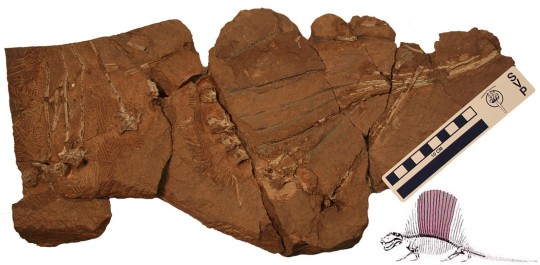
Holotype specimen of Dimetrodon teutonis, which consists of a partial vertebral column. The preserved portion of this vertebral column is highlighted in the reconstruction of Dimetrodon (lower right). Photograph by the author, 2007. Dimetrodon reconstruction modified from Romer and Price, 1940.

Specimens of two top predators have been discovered at the Bromacker quarry. Like Martensius, both are basal members of the group Synapsida, the later members of which gave rise to mammals. You might be familiar with one of them – Dimetrodon, a synapsid sometimes incorrectly portrayed with dinosaurs, which carried a tall sail on its back that was supported by bony spines. The other is a new genus and species that will be presented in my next post.

The fossil pictured above, the first-discovered specimen of Dimetrodon from the Bromacker quarry, may not look like much, but it was the first record of Dimetrodon outside of North America. The circumstances under which it was found were very different from the discovery of other fossils from the Bromacker quarry. Before Dave Berman and I arrived for the 1999 field season, Thomas Martens noticed that someone, possibly a fossil poacher, had been in the quarry overnight and knocked some rocks off the quarry lip. The rocks apparently broke upon hitting the ground, which exposed some bones. Thomas carefully picked them up and took them to his lab at the Museum der Natur, Gotha (MNG). When Dave and I met Thomas at the quarry on our first day of the field season, Thomas mentioned the find and told us that he thought the bones were ribs. We didn’t think much of it, other than horror at learning a fossil poacher might have visited the quarry overnight, one of our worst fears.

As planned, Dave and I spent the last day of the field season in the museum collections, and when Thomas let us in that morning, he reminded us to look at the potential ribs and told us where they were. Shortly after we began examining them, Dave and I simultaneously realized that the “ribs” were actually spines of Dimetrodon. We couldn’t believe our eyes, because of all the Early Permian fossils known from North America, Dimetrodon was Thomas’ favorite. Indeed, he’d used an image of it on signs at the Bromacker and included a model of Dimetrodon in a diorama, once on display in the MNG, that showed models of Bromacker animals in their environment. Thomas jumped for joy later that day when we gave him the news.

So how did Dave and I so quickly realize that the “ribs” were spines of Dimetrodon? Besides Dimetrodon, some other basal synapsids had sails, the function of which remains unknown, though scientists have speculated they could’ve been used for display or regulating body temperature. The spines (known as neural spines) supporting the sails vary in shape and length, with those of Dimetrodon and its herbivorous relative Edaphosaurus being tall and narrow, and those of another relative, the carnivorous Sphenacodon, being shorter and blade-like. Neural spines of Dimetrodon are easy to distinguish, because in addition to being long they bear fore and aft grooves, which create a dumbbell-shaped cross-sectional outline, and they lack the ‘crossbars’ that occur on the long neural spines of Edaphosaurus. When Dave and I saw the fore and aft grooves, the dumbbell-shaped cross-sectional outline of some broken spine ends, and an absence of crossbars, we knew that the “ribs” were indeed spines of Dimetrodon.
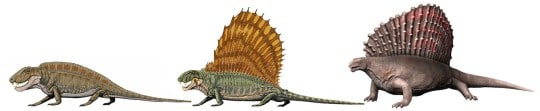
Flesh reconstructions of Sphenacodon sp. (left), Dimetrodon grandis (middle), and Edaphosaurus pogonias (right) to show the differences between their sails. Note that Dimetrodon and Sphenacodon are more closely related to one another than they are to Edaphosaurus, despite their different sail shapes. Reconstructions of Sphenacodon and Dimetrodon by Dmitry Bogdanov and that of Edaphosaurus by Nobu Tamura, all from Wikimedia Commons.

The Bromacker Dimetrodon is considerably smaller than other known species of the genus, and this is one character among other more detailed anatomical features that distinguishes it. For the new species name, Dave selected the Latin “teutonis,” which means an individual of a German tribe, in reference to the geographic origin of the holotype specimen.
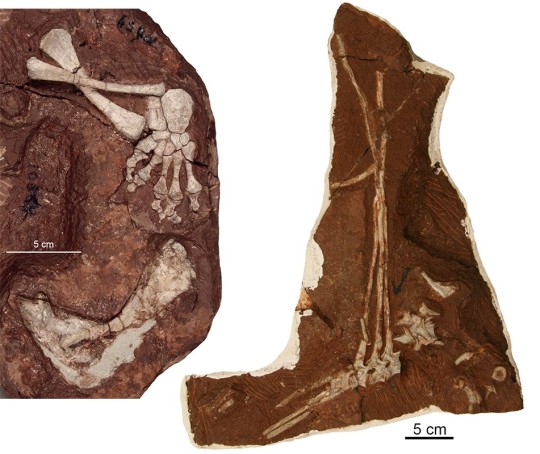
Two additional specimens of Dimetrodon teutonis. Left, hindleg and shoulder girdle bone (fused scapulocoracoid) and right, several vertebrae bearing complete to nearly complete neural spines of an individual that was larger and presumably more mature than the holotype. Photographs by the author, 2007.

Dave was able to use a mathematical equation involving measurements of the vertebrae to estimate the holotype’s weight as a living animal at 31 pounds. In contrast, other known Dimetrodon species have estimated weights of about 81–550 pounds. We later discovered additional partial specimens of Dimetrodon at the Bromacker quarry, and Dave estimated the weight of the largest specimen with vertebrae at 53 pounds, still considerably less than that of what had previously been the smallest species, D. natalis from Texas. Dimetrodon is otherwise known from numerous species from the American mid-continent and southwest that generally got larger through time.
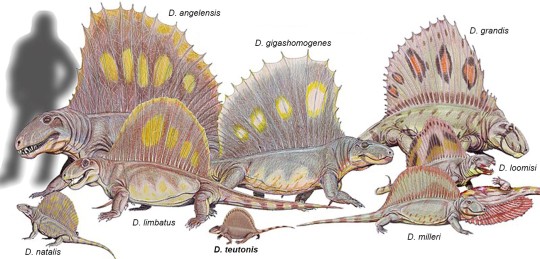
Reconstructions of various species of Dimetrodon drawn to scale. The diminutive D. teutonis is at bottom center and D. natalis, no longer the smallest species, is at bottom left. Illustration adapted from Dmitry Bogdanov via Wikimedia Commons.

All Dimetrodon species have teeth adapted for meat-eating in being teardrop-shaped with sharp edges for slashing flesh. By size and jaw position these sharp teeth are divided into precanines, canines, and postcanines of varying numbers. Unlike D. teutonis, some species even had fine serrations on their tooth edges. The only known upper jaw bone of Dimetrodon teutonis clearly has two canines, but one is missing and represented by a large gap in the tooth row that would have accommodated this tooth. The second canine is represented only by its broad base, but it too must have been large. Although it was a small animal, the teeth of D. teutonis indicate that it was a meat-eater and as such would have preyed on other vertebrates from the Bromacker, many of which were even smaller.
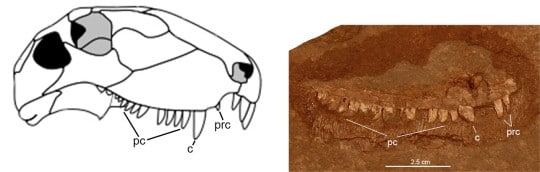
Diagrammatic drawing of the skull of Dimetrodon (left) and photograph of the maxilla or upper jaw bone (right) of D.teutonis. Abbreviations: c, canine; pc, postcanine; prc, precanine. Photographs by the author, 2007. Drawing of skull from Wikimedia Commons.

Stay tuned for my next post, which will be about the second-known apex carnivore from the Bromacker. In the meantime, here are links to scientific papers on Dimetrodon teutonis:

https://www.researchgate.net/publication/325670232_A_new_species_of_Dimetrodon_Synapsida_Sphenacodontidae_from_the_Lower_Permian_of_Germany_records_first_occurrence_of_genus_outside_of_North_America

https://www.researchgate.net/publication/288544821_New_materials_of_Dimetrodon_teutonis_Synapsida_Sphenacodontidae_from_the_Lower_Permian_of_Germany

Amy Henrici is Collection Manager in the Section of Vertebrate Paleontology at Carnegie Museum of Natural History. Museum employees are encouraged to blog about their unique experiences and knowledge gained from working at the museum.

Keep Reading

The Bromacker Fossil Project Part XII: Tambacarnifex unguifalcatus, the Tambach Executioner 
Filed Under: Blog Tagged With: Amy Henrici, Museum from Home, Science News, Section of Vertebrate Paleontology, The Bromacker Fossil Project, Vertebrate Paleontology

October 1, 2020 by wpengine

The Bromacker Fossil Project Part X: Tambaroter carrolli, an amphibian with a wedge-shaped head

New to this series? Read The Bromacker Fossil Project Part I, Part II, Part III, Part IV, Part V, Part VI, Part VII, Part VIII, and Part IX. 

Thomas Martens at the construction site for a new store in Tambach-Dietharz where he found fossils by checking loose pieces of rock on the excavation floor. Photo by Stephanie Martens, 2008.

Paleontologist Thomas Martens has an amazing ability to find fossils. After he discovered the first vertebrate fossils at the Bromacker site in an abandoned commercial quarry in 1974, he and his father Max found additional fossils in the bottom of a deep pit they’d dug with hand tools, an excavation that Dave Berman, Stuart Sumida, and I fondly dubbed the “elevator shaft.” Years later, Thomas used funding from the German federal government to drill rock cores in the field surrounding the Bromacker quarry to help understand the geology of the fossil deposit. Amazingly, at one of the spots Thomas had selected, the drill core penetrated a skeleton of Diadectes absitus. So, it wasn’t surprising that in 2008 Thomas found a skull and partial skeleton of D. absitus and a small skull of a fossil animal new to science at a construction site for a new store in the nearby village of Tambach-Dietharz.

Dave Berman (left) and Stuart Sumida (right) pose with a shopping cart in front of the Netto Discount Store, which was built in the excavation site where Tambaroter was found. Rocks of the Tambach Formation can be seen behind the retaining wall. Photo by the author, 2008.

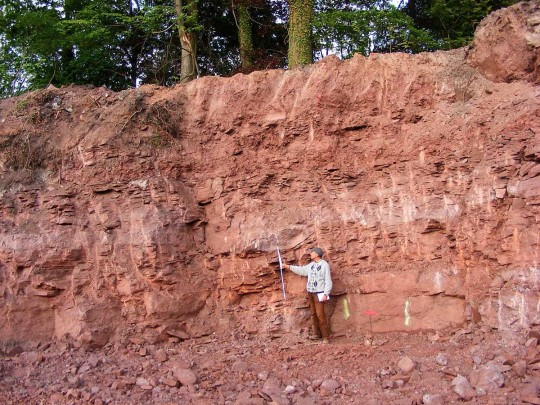
It makes sense, however, that vertebrate fossils were found close to the Bromacker quarry. Fossils from the Bromacker were preserved in the Tambach Formation, a 200–400-foot-thick unit of sediments that were deposited in the small intermontane Tambach Basin about 290—283 million years ago during the Early Permian Epoch. The Tambach Basin covered an area of about 155 square miles and was internally drained; that is, there were no rivers or streams flowing into and out of the basin. During periods of extremely heavy rain, water and mud would flow down the basin sides in what are called sheet floods and pool in the basin center, which is where the present day Bromacker quarry and Tambach-Dietharz are thought to be located. Any animals killed during these events would be carried by the sheet floods to the basin center where they’d have been quickly and deeply buried in mud settling out of the ponded water and later become fossilized. It is assumed that animals captured by the sheet flood events inhabited the Tambach Basin, because carcasses couldn’t have been carried into the basin by rivers and streams.

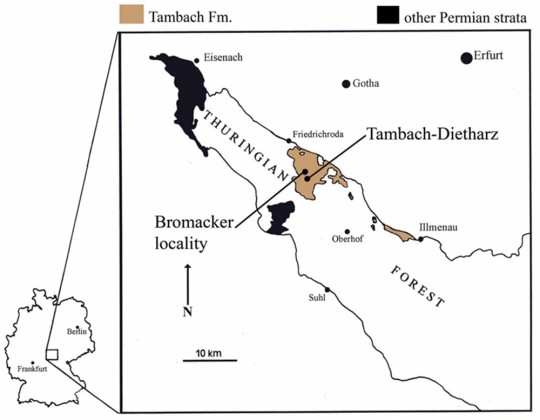
Map of Germany with inset showing the Bromacker locality and the nearby town of Tambach-Dietharz. Although the Tambach Basin in which the Tambach Formation was deposited covers about 155 square miles, outcrops of the Tambach Formation today occur in an area of only about 31 square miles.

While preparing Bromacker fossils, I’d typically read literature related to the fossil I was working on, write notes on what I thought were important features in the fossil, and give my notes to the person leading the project. When Dave was the lead, we’d typically have lots of discussion about certain features preserved in the animal, conversations that often directed the course of preparation. This time, in addition to preparing the new find, I was designated as the lead author for the publication that would name and describe it.

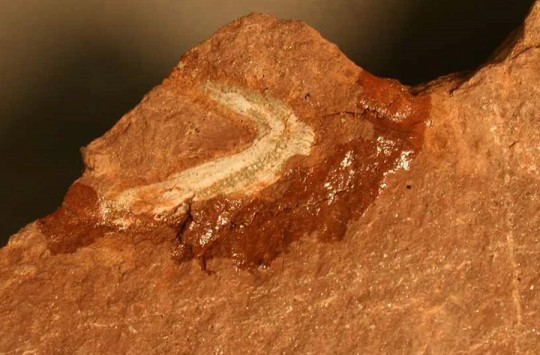
View of the underside of the skull of Tambaroter carrolli before preparation. The shiny area surrounding the skull is glue, which I applied to a crack to stabilize the specimen before preparation could begin. I had to free the skull from the surrounding rock before exposing as much of it as possible through preparation. Photo by the author, 2008.

Tambaroter is a member of the Microsauria, a diverse group of small amphibians that were once thought to be reptiles, a hypothesis that some paleontologists are currently revisiting. Microsaurs inhabited a variety of habitats and exhibited a range of body forms. Some were highly terrestrial with limb proportions similar to those of lizards, whereas others were aquatic and had elongated bodies and reduced girdles and limbs. Still others were adapted for burrowing or rooting through leaf litter. Tambaroter belongs to this latter-most group, which is named Recumbirostra for their recurved snout, in which the front of the mouth is overhung by the snout.

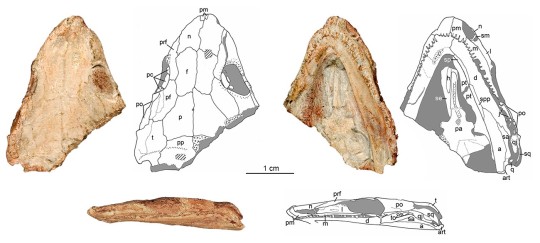
Photographs and line drawings of the skull of Tambaroter carrolli in (clockwise from upper left) dorsal (top), ventral (underside), and left lateral (side) views. Photographs by the author, 2008 and drawings by the author and modified from Henrici et al., 2011.

Tambaroter is member of the recumbirostran subgroup Ostodolepidae. I coined the name Tambaroter, which is derived from “Tamb,” for the Tambach Formation, and the Greek “aroter,” meaning plowman, in reference to the snout shape. Two previously named ostodolepids, Micraroter and Nannaroter, have the “aroter, suffix in their name, so usage of the “aroter” suffix was a continuation of this. The species name, carrolli, honors microsaur expert Robert Carroll (then Curator Emeritus at the Redpath Museum, McGill University, Montreal, Canada).

Skulls of representative ostodolepid microsaurs from geologically oldest (left) to youngest (right). A reconstruction drawing of the skull of Tambaroter was used instead of a photograph for comparison because the original fossil skull is extremely flattened (see previous image). Photographs, except for that of Nannaroter, by the author, 2009. The photograph of Nannaroter was modified from Anderson et al., 2009. Tambaroter skull reconstruction by the author and modified from Henrici et al., 2011. Scale bar of the tiny Nannaroter and other ostodolepids equals 1 cm.

When Tambaroter was published on in 2011, it was the first ostodolepid to be found outside of the USA (the others are from Oklahoma and Texas) and is the oldest one known. Other, possible ostodolepids have since been described from the American Midwest and Germany. All ostodolepids have a wedge-shaped skull and recumbent snout, which is accentuated in Pelodosotis. Based on these features, scientists think that ostodolepids burrowed or searched for worms and other prey in leaf litter. Remarkably, the skull of the tiny Nannaroter is so strongly built that it could have withstood burrowing headfirst into the ground by using its shovel-like snout to loosen dirt and its broad, flat head to push soil against the burrow ceiling. Because the sutures between individual skull bones in the Tambaroter type specimen are not tightly fused together, we think it belonged to a juvenile, so we don’t know if the adult skull would’ve been as strongly built as that of Nannaroter.

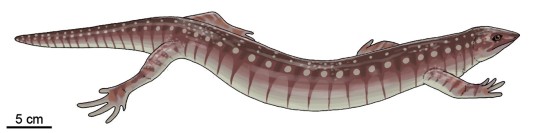
Life drawing of the ostodolepid microsaur Pelodosotis elongatum, which is known by a nearly complete specimen. Tambaroter probably had a similar body shape, though its skull would not have been as strongly wedge-shaped. Drawing modified by Carnegie Museum of Natural History Scientific Illustrator Andrew McAfee from outline drawing in Carroll and Gaskill (1978).

Stay tuned for my next post, which will feature one of the Bromacker’s top carnivores. To learn more about Tambaroter, read the publication that described the animal here.

Amy Henrici is Collection Manager in the Section of Vertebrate Paleontology at Carnegie Museum of Natural History. Museum employees are encouraged to blog about their unique experiences and knowledge gained from working at the museum.

Keep Reading

The Bromacker Fossil Project Part XI: Dimetrodon teutonis, an apex predator

Filed Under: Blog Tagged With: Amy Henrici, Museum from Home, Science News, The Bromacker Fossil Project, Vertebrate Paleontology

August 21, 2020 by wpengine

The Bromacker Fossil Project Part IX: The Dissorophoid Amphibians Tambachia, Rotaryus, and Georgenthalia, Capable Travelers

New to this series? Read The Bromacker Fossil Project Part I, Part II, Part III, Part IV, Part V, Part VI, Part VII, and Part VIII.

The Dissorophoidea are a group of ancient amphibians that were common about 290 million years ago, when the animals fossilized in the Bromacker quarry were alive. The group consists of small to medium-sized water- and land-dwelling vertebrates (animals with backbones) that ate invertebrates (e.g., dragonflies, cockroaches, and millipedes) and vertebrates smaller than themselves. Most scientists agree that modern amphibians (frogs, salamanders, and the reclusive, worm-like, subterreanean caecilians) had their origins among the dissorophoids. Three disssorophoid species are currently known from the Bromacker quarry, and at least one and possibly two more are yet to be described. Two of the described species, Tambachia trogallas and Rotaryus gothae, are members of the dissorophoid subgroup Trematopidae, and the other, Georgenthalia clavinasica, is a member of the subgroup Amphibamiformes. All of them inhabited the terrestrial realm and most likely only returned to water to breed.

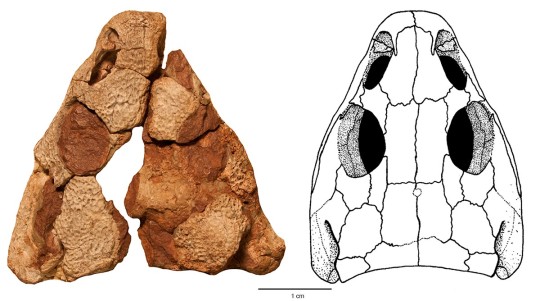
Photograph (left) and reconstruction (right) of the skull of the holotype and only known specimen of Tambachia trogallas in dorsal (= top) view. Photograph by the author (2013) and reconstruction by Stuart Sumida, modified from Sumida et al. (1998).

The first trematopid discovered in the Bromacker quarry was found by Thomas Martens in 1980, and it is represented by a poorly preserved skull and skeleton. Stuart Sumida, as lead author of the scientific paper presenting it, coined the name Tambachia trogallas. Tambachia refers to the Tambach Formation, the rock unit preserving the Bromacker fossils, which in turn is named after the nearby village of Tambach, which is now merged with the adjacent town Dietharz to become Tambach-Dietharz. “Trogallas” is from the Greek “trogo,” meaning munch or nibble, and “allas,” meaning sausage, in reference to all of the bratwurst consumed during Bromacker field seasons by the authors of the Tambachia publication (Stuart, Dave Berman, and Thomas). The state where the the quarry is located, Thuringia, is famous for its bratwurst and rightly so. A hot bratwurst for lunch was always welcomed when we experienced what Thomas called “Scandanavian summers,” which were cold and rainy. The then-Bürgermeister (mayor) of Tambach-Dietharz, who also was a butcher, was so thrilled by the name that he hosted an annual bratwurst lunch featuring brats that he’d made. This tradition was carried on by subsequent Bürgermeisters, though they had to buy the featured main course.

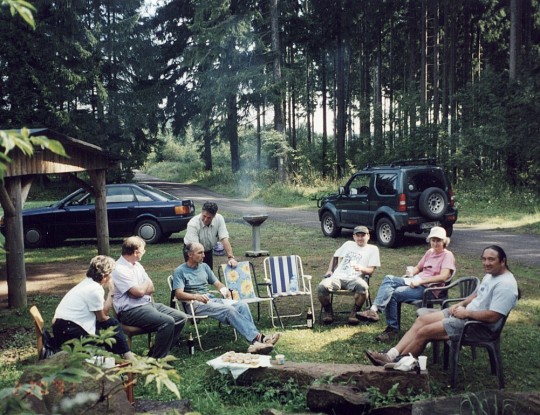
Bratwurst lunch in the Thuringian Forest close to the Bromacker quarry. Seated are (from left to right) unknown, Rainer Samietz (then Director of the Museum der Natur Gotha, now retired), Thomas Martens, Johannes Müller (then field assistant and now Professor at Museum für Naturkunde, Berlin), the author, and Stuart Sumida. The Bürgermeister is standing behind Thomas. His bratwurst grill, which he transported in his SUV, is between the vehicles. Photo by Dave Berman (2002).

Skull and partial skeleton of Rotaryus gothae in left lateral (= side) view. Photograph by the author, 2008.

When Rotaryus gothae was found in 1998, only part of the skull was exposed, so we took out a large block expecting a complete skeleton to be preserved, as typically occurs at the Bromacker. Once I began preparing the specimen, however, I was extremely disappointed to find that only a small portion of the body of the animal was present. At least we had the skull, the most scientifically important part of the skeleton. Dave led the scientific study of Rotaryus, and he named it in honor of the Gotha Rotary Club, an organization that generously provided financial support for Bromacker fieldwork. Dave sent the head of the Gotha Rotary Club three choices for the fossil’s name, and the members voted on which one to use.

At the time that Tambachia and Rotaryus were named and described in scientific publications in 1998 and 2011, respectively, trematopids were known only from the USA. Their presence at the Bromacker added to the growing list of animals previously thought to only inhabit North America, such as Diadectes and Seymouria. In hindsight, it is not surprising that trematopids also had a more cosmopolitan distribution, because although they are amphibians, their skeletons were strong enough to support their body out of water and withstand the effects of gravity, thus enabling them to disperse to far corners of the world (though hypotheses of such dispersal assume that no physical or climatic barriers prevented movement).

I was the lucky person who discovered, in 2002, the amphibamiform Georgenthalia clavinasica. I recall lifting up a block of rock that I had loosened with a hammer and chisel and seeing two ghostly eye openings staring back at me. The rest of the skeleton was preserved with the skull, but unfortunately all bone beyond the skull was extremely eroded from groundwater and had the consistency of mashed potatoes.

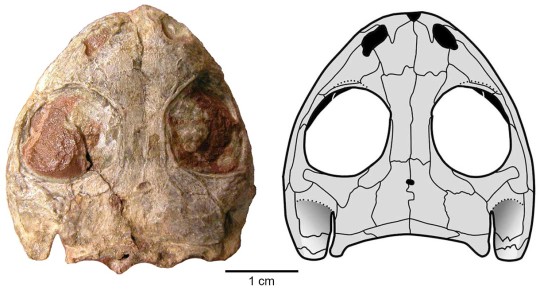
Photograph (left) and reconstruction (right) of the skull of Georgenthalia clavinasica in dorsal (= top) view. Both by Jason Anderson, 2007.

After Tambachia was named, the Bürgermeister of the nearby village of Georgenthal, whose boundaries included the Bromacker quarry, approached Dave about naming a fossil after his village. Dave then asked Jason Anderson, a colleague from the University of Calgary and the project’s lead researcher, to name it Georgenthalia. Jason created clavinasica from the Latin “clavis” for key, and “nasica” for nostril, in reference to the fossil’s keyhole-shaped nostril, a unique feature that differentiates Georgenthalia from all other amphibamiforms.

Jason, as lead author of a 2008 scientific publication, concluded that the relationship of Georgenthalia to other amphibamiforms was uncertain. Computer algorithms are used to analyze relationships of organisms by tabulating the proportion of unique characteristics shared between the members of the group under study. A group of organisms that share unique characters is called a clade, and members of a clade are considered to be more closely related to each other than they are to members of other clades. These relationships are depicted in a diagram of relatedness called a cladogram.

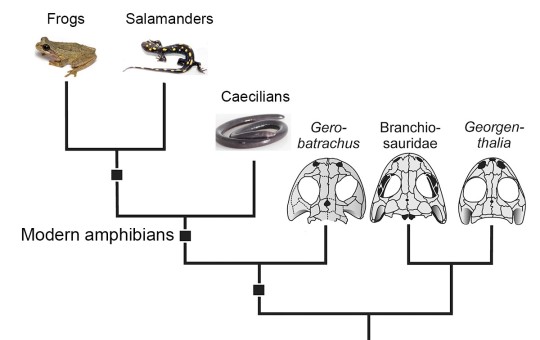
A 2019 study by dissorophoid expert Rainer Schoch (Curator, Naturkunde Museum Stuttgart) that investigated the ancestry of modern amphibians revealed Georganthalia as a member of a clade that also includes modern amphibians (see figure below). The fossil Gerobatrachus, however, is more closely related to modern amphibians than it is to the clade consisting of Georgenthalia and Branchiosauridae (a group of aquatic amphibamiforms). This indicates that although Georgenthalia (along with Branchiosauridae) is in the clade containing modern amphibians, it is not directly ancestral to them.

Cladogram showing the relationship of Georgenthalia (far right) to modern amphibians. Cladogram modified from Schoch (2019); images of modern amphibians from Wikimedia Commons.

Stay tuned for my next post, which will feature yet another terrestrial amphibian, a fossil from a locality in Tambach-Dietharz.

If you would like to learn more about Tambachia, Rotaryus, or Georgenthalia, please follow the links below.

Tambachia

Rotaryus

Georgenthalia

Amy Henrici is Collection Manager in the Section of Vertebrate Paleontology at Carnegie Museum of Natural History. Museum employees are encouraged to blog about their unique experiences and knowledge gained from working at the museum.

Keep Reading

The Bromacker Fossil Project Part X: Tambaroter carrolli, an Amphibian with a Wedge-Shaped Head 

Filed Under: Blog Tagged With: Amy Henrici, Museum from Home, Science News, Section of Vertebrate Paleontology, The Bromacker Fossil Project, Vertebrate Paleontology

July 15, 2020 by wpengine

The Bromacker Fossil Project Part VII: Eudibamus cursoris, the Original Two-legged Runner

New to this series? Read The Bromacker Fossil Project Part I, Part II, Part III, Part IV, Part V, and Part VI. 

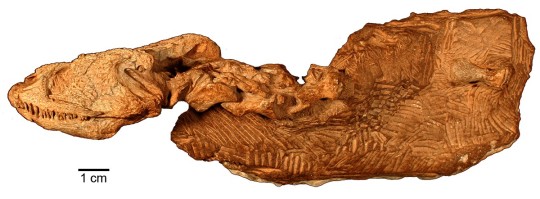
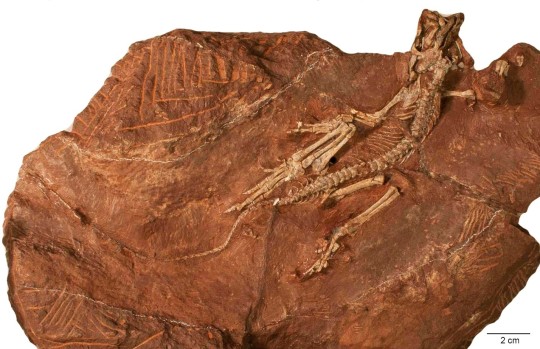
Holotype specimen of Eudibamus cursoris, the most complete bolosaurid reptile known. Photo by the author, 2013.

Stuart Sumida discovered some small bones in the Bromacker quarry in 1993, the same year that the holotype skeleton of Diadectes absitus was found. Dave Berman told me that when Stuart showed them to him, he couldn’t see anything because they were so small. Upon closer examination, Dave, Stuart, and Thomas Martens identified them as those of the captorhinomorph reptile Thuringothyris mahlendorffae. Thomas’ wife Stefani, whose maiden name is Mahlendorff, discovered the first specimen in the Bromacker in 1982, and Thomas and a colleague named it in her honor in a 1991 publication.

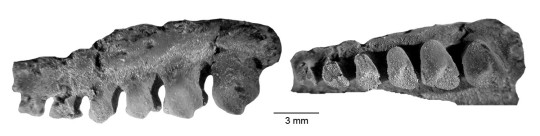
The fossil was exposed in several pieces of rock, which Thomas shipped to Carnegie Museum of Natural History (CMNH) along with the large block of rock containing Diadectes. I didn’t prepare the specimen until several years later, as other projects, including the Diadectes, overshadowed it. Once I began working on it, though, Dave and I realized that it was not Thuringothyris. Indeed, we had no idea what type of animal it was, and our puzzlement grew as I exposed more of it. The identity wasn’t revealed until I had uncovered some very unusual, tiny teeth, which under the high magnification of the preparation microscope appeared to have a bulbous cusp towering over a basin. They looked vaguely familiar to me, but because I couldn’t immediately put a name on them, I rushed to get Dave from his office. Once Dave saw the teeth, he realized that the specimen was a new genus and species in the rare, enigmatic reptile group Bolosauridae.

Tiny teeth of a bolosaurid reptile, Bolosaurus striatus, in lateral (side; left) and occlusal (chewing surface; right) views. The specimen is in the CMNH Vertebrate Paleontology collection. Photos by Spencer Lucas (Research Associate, CMNH).

Until the discovery of Eudibamus cursoris, bolosaurids were represented in the fossil record by two genera, Bolosaurus and Belebey, which were based mainly on poorly preserved skull and fragmentary jaw fossils from Texas and Russia, respectively. Even though bolosaurids had been known since 1878, their relationship to other reptiles was not well understood. The nearly complete anatomy of Eudibamus allowed our team to determine that bolosaurids are the oldest member of the ancient group of reptiles called Parareptilia. This group has no living relatives, except possibly for turtles, a hypothesis that is highly debated by scientists.

Eudibamus cursoris fossil
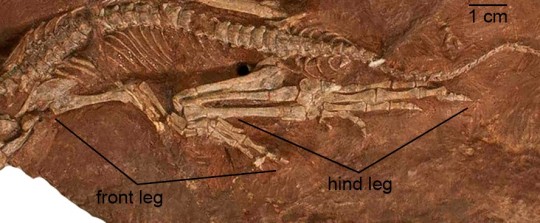
Closeup of front and hind legs of Eudibamus. The hind leg, folded upon itself, is considerably longer than the front leg. Photo by the author, 2013.

When our study of the fossil began, we realized that Eudibamus was very different than other reptiles from that time. Proportions of the limbs and positions of the articulation surfaces on the upper and lower hind leg bones indicated that, in terms of posture, Eudibamus resembled a bow-legged human with a bad back instead of a typical sprawling reptile on four legs. It could stand and locomote on its hind legs in an upright posture (bipedal) with its legs held close together and in the same plane (parasagittal).

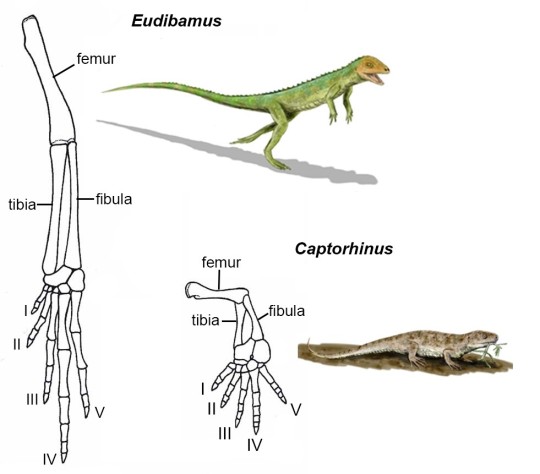
Dave was in constant phone communication with team member Dr. Robert Reisz (Professor, University of Toronto at Mississauga). One day Robert called Dave to ask if all the tail had been exposed, because he learned that modern lizards that are able to run bipedally have a long tail to help maintain their balance. The specimen was in Dave’s office and he immediately uncovered more of the tail and then let me finish the task. The tail was indeed very long and extended close to the edge of the block, which I had previously reduced in size. Additionally, we determined that the third, fourth, and fifth toes of the hind foot also were greatly elongated through lengthening of some of the individual toe bones, and that the first and second toes were extremely shortened by the reduction in size of individual toe bones. We hypothesized that when Eudibamus ran bipedally, it would rise on its toes, so that only the tips of the third, fourth, and fifth toes would contact the ground.

Drawing of the hind leg of Eudibamus cursoris (left) and the roughly contemporaneous reptile Captorhinus (right). Leg drawings are scaled to the same torso length of the whole animal. Illustrations of the animals are not to scale. Hind leg drawings are modified from Berman et al., 2000 and animal illustrations are from Wikimedia Commons.

Eudibamus occurred at least 60 million years before other bipedal, parasagittally-running reptiles appeared in the fossil record. This is reflected in its scientific name, which is derived from the Greek “eu,” meaning original or primitive, and “dibamos,” meaning on two legs. “Cursoris” is Latin, meaning runner. Examples of other reptiles using this locomotion mode are the dinosaurs Allosaurus fragilis and Tyrannosaurus rex, which you can view in CMNH’s Dinosaurs in Their Time exhibition.

So, what was the advantage of being able to run bipedally instead of running on all four legs? Lengthening the hind leg and foot would greatly increase stride length, especially if only the tips of the toes contacted the ground, which is an efficient way to increase speed. Eliminating arm to ground contact while running removes forelimbs from the path of the long-striding hind legs. The bulbous teeth and jaw structure of Eudibamusindicate that it was herbivorous. It seems likely, then, that Eudibamus used its ability to sprint to avoid becoming a tasty meal for a pursuing predator.

Eudibamus cursoris illustration
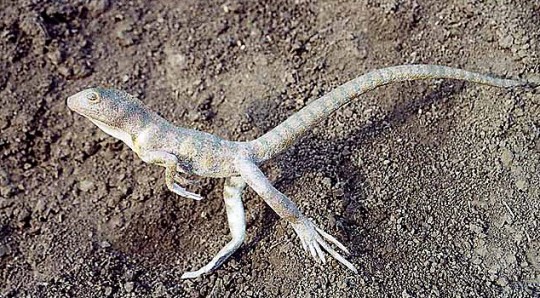
Peter Mildner (exhibit preparator at the Museum der Natur, Gotha) made a surprise visit to the Bromacker one afternoon to show us a model of Eudibamus cursoris he’d made. This image shows the model in the present day Bromacker quarry, part of the region it inhabited 290 million years ago. Photo by the author, 2006.

One of our laments is that a fossil trackway preserving Eudibamus walking quadrupedally and then switching to a bipedal gait has yet to be found.

Next time you are at CMNH, make sure you see the cast of the fossil skeleton and a model of Eudibamus that are exhibited in the Fossil Frontiers display case in CMNH’s Dinosaurs in Their Time exhibition. Stay tuned for my next post, which will feature the herbivorous mammal-like reptile Martensius bromackerensis.

For those of you who would like to learn more about Eudibamus, here is a link to the 2000 Science publication in which it was described: https://science.sciencemag.org/content/290/5493/969.

Amy Henrici is Collection Manager in the Section of Vertebrate Paleontology at Carnegie Museum of Natural History. Museum employees are encouraged to blog about their unique experiences and knowledge gained from working at the museum.

Keep Reading

The Bromacker Fossil Project Part VIII: Martensius bromackerensis, Honoring a Colleague

Filed Under: Blog Tagged With: Amy Henrici, dinosaurs in their time, Museum from Home, Science News, The Bromacker Fossil Project, Vertebrate Paleontology

June 24, 2020 by wpengine

The Bromacker Project Part VI: Seymouria sanjuanensis, the Tambach Lovers

New to this series? Read The Bromacker Fossil Project Part I, Part II, Part III, Part IV, and Part V.

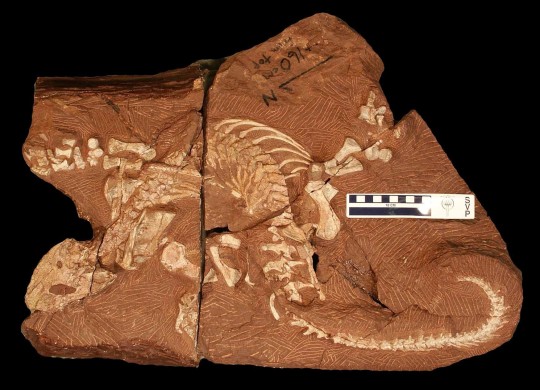
Seymouria sanjuanensis fossils
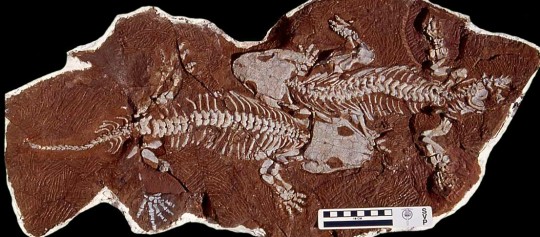
Two exquisitely preserved, nearly complete adult skeletons of Seymouria sanjuanensis that were discovered in the Bromacker quarry in 1997. Photo by Dave Berman.

At lunchtime on the last day of the 1997 field season, Thomas Martens discovered the two exquiste specimens shown above, the only fossils found that year. Thomas had uncovered a piece of the hip region with some attached vertebrae that resembled, once again, those of the ancient amphibian Seymouria. Because our work time was limited, we estimated the length of the specimen and rushed to extract it from the quarry. When we flipped the block over, a few pieces of rock fell out, revealing a series of vertebrae of a second individual in the block. We were thrilled to learn that Thomas had discovered two specimens of Seymouria. We put the rock pieces back in place and quickly finished plastering the block. There was just enough time for Dave, Stuart Sumida, and I to return to our hotel, clean up, quickly pack, and meet Thomas, his family, and his fossil preparator Georg Sommer for a celebratory dinner. What a great way to end the field season.

Working in tight quarters to quickly extract the Seymouria specimens discovered at lunchtime on the last day of the field season. Clockwise from right: Georg Sommer, Dave Berman, and the author. Photo by Stuart Sumida, 1997.

Seymouria had already been known from the Bromacker quarry. Thomas had discovered and identified two skulls in 1985, fossils he brought with him when he came to Carnegie Museum of Natural History (CMNH) in 1993 to study for six months with Dave Berman under a CMNH-financed fellowship. Both skulls were of juvenile individuals. Of the two known species of Seymouria, Dave and Thomas were excited to discover that the Bromacker skulls were nearly identical to those of Seymouria sanjuanensis. The 1997 lunchtime discovery of the two complete adult specimens confirmed the identification of the Bromacker Seymouria as S. sanjuanensis.

The first discovered species of Seymouria was Seymouria baylorensis, from near Seymour, Baylor County, Texas, from which its name was derived. Seymouria sanjuanensis was first found in San Juan County, Utah, by Dave Berman and the field team he was leading as a graduate student at the University of California, Los Angeles. Dave’s advisor, Dr. Peter Vaughn, named it Seymouria sanjuanensis in reference to the county of discovery. Another discovery of five specimens of this species preserved together was made by Dave in New Mexico in 1982.

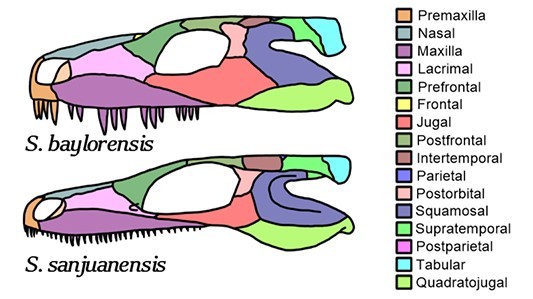
Comparison of the skulls of Seymouria baylorensis (top) and S. sanjuanensis (bottom). The individual bones of the skull are color coded. Skulls scaled to same size. Image from Wikimedia Commons.

Seymouria baylorensis is geologically younger than S. sanjuanensis and has a more robust skull, larger and fewer teeth of variable size, and a subrectangular postorbital bone compared to the chevron-shaped postorbital of S. sanjuanensis.

Seymouria is considered a terrestrial amphibian that only returned to water to breed. Its strongly built skeleton provided the support needed to move on land. With its numerous, slender, pointed teeth, S. sanjuanensis most likely ate insects and small land-living vertebrates. We know that the Bromacker Seymouria didn’t consume fish, because not a single fish fossil, scrap of fish fossil, or fish coprolite (fossil poop) has ever been found at the Bromacker quarry. Study of the rock deposits preserving the fossils at the Bromacker indicate a lack of permanent water, which would explain the absence of fish.

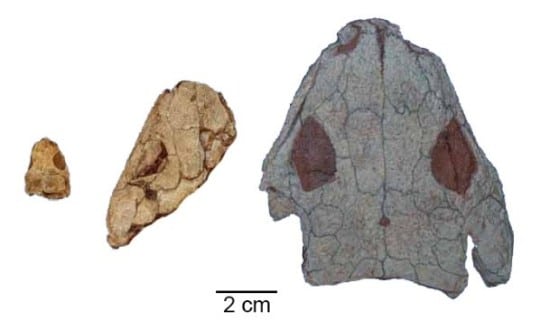
Growth series of skulls of Seymouria sanjuanensis from the Bromacker Quarry showing (left to right) early juvenile, late juvenile, and adult growth stages. Photos by the author, 2006.

Conditions for breeding must have been favorable in the Tambach Basin, the ancient basin where sediments preserving the Bromacker fossils accumulated, because several juvenile specimens of Seymouria are known. The smallest is a skull measuring about ¾ of an inch long. In a study led by our colleague Josef Klembara (Comenius University, Slovak Republic), we determined that the smallest individual was post-metamorphic—in other words, no longer a tadpole—based on the presence of certain ossified bones in the skull. In tadpoles, these skull elements are cartilaginous; that is, they haven’t yet turned to bone.

Seymouria sanjuanensis fossils
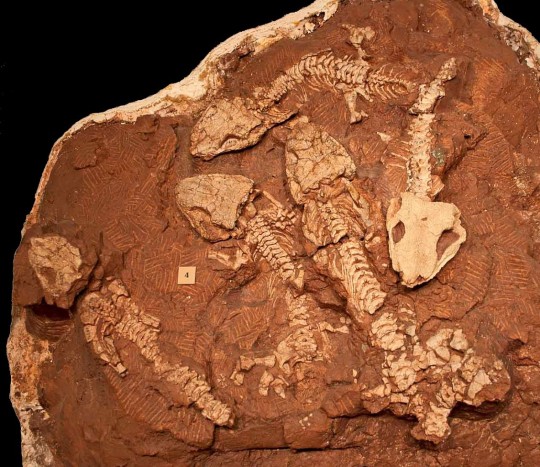
Five skeletons of Seymouria sanjuanensis preserved together were discovered in north central New Mexico by Dave Berman in 1982. These specimens are on display in CMNH’s Benedum Hall of Geology, in the “What is a Fossil?” case. Photo by the author, 2013.

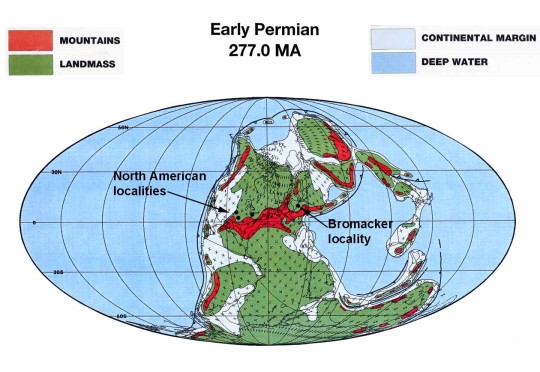
The discovery in Germany of the same species of Seymouria previously known only from New Mexico and Utah has important implications in terms of paleobiogeography (the study of the distribution of species in space and time). At the time S. sanjuanensis was alive, the continents were merged to form the supercontinent Pangaea. The presence of S. sanjuanensis across Pangaea, north of a roughly east-west trending mountain range, indicates that climatic or physical barriers (e.g., deserts, inland seas, mountain ranges) didn’t prevent its dispersal.

Map showing the arrangements of the continents in the Early Permian. The locality where Seymouria occurs in present-day New Mexico, Texas, and Utah and the Bromacker locality in present-day Germany are indicated. Map modified from Scotese, 1987.

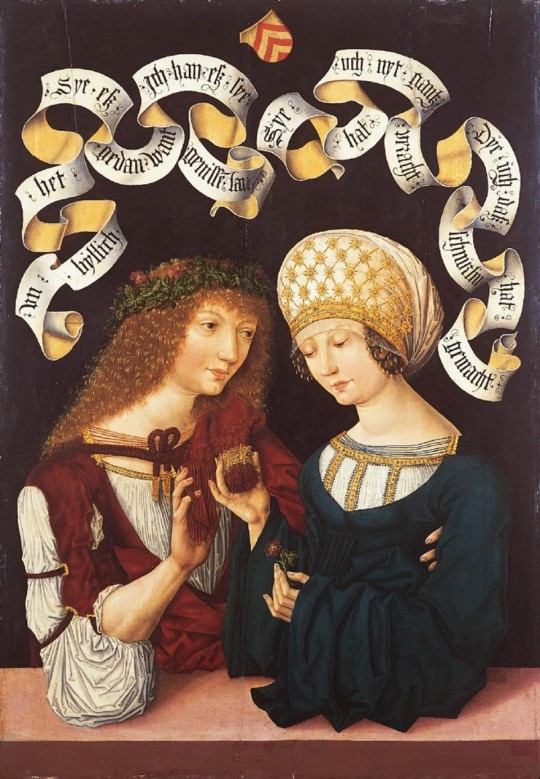
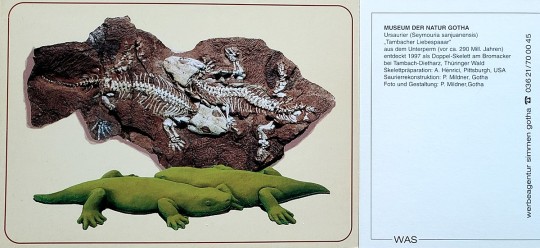
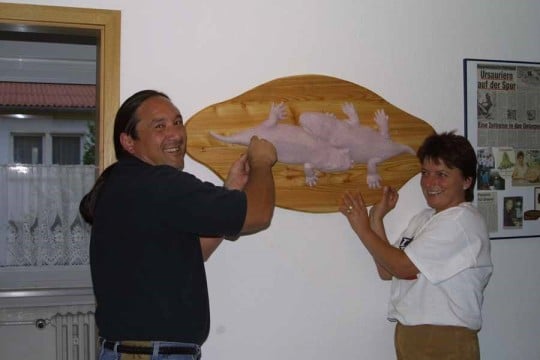
The two Seymouria specimens preserved together were a big hit in the local region in Germany. Museum der Natur (MNG) exhibit preparator Peter Mildner nicknamed them the “Tambacher Liebespaar” (“Tambach Lovers”) after a painting entitled “Gothaer Liebespaar” (“Gotha Lovers”) on exhibit in the Herzogliches Museum of the Stiftung Schloss Friedenstein (also the parent organization of MNG). This name caught on and is fondly used by our German friends and colleagues. Peter even made a fleshed-out model of the two Seymouria specimens in their death pose. The proprietor of the hotel in which we stayed hung a copy of the model of the Tambach Lovers and a framed collage of newspaper articles featuring the Bromacker on a wall in one of the hotel rooms, which she named the “Präparation Suite” (i.e. “Preparation Suite” in reference to the preparation of fossils). I often stayed in this room.

The painting entitled “Gothaer Liebespaar” (“Gotha Lovers”), which is on display at Herzogliches Museum of the Stiftung Schloss Friedenstein, Gotha, Germany. Image from Wikimedia Commons and provided by Thomas Martens.

Tambach Lovers postcard
Postcard showing the Tambach Lovers. The postcard was made for and sold by the Museum der Natur, Gotha. Photo of the postcard by the author, 2020.

Stuart Sumida (left) and Heike Scheffel, proprietor of the Hotel Wanderslaben where we stayed (right), with the model of the Tambach Lovers in the “Präparation Suite.” The framed collage to the right of the model holds newspaper articles featuring the Bromacker project. Photo by the author, 2003.

A cast of the Tambach Lovers specimen and a model of Seymouria sanjuanensis are exhibited in the Fossil Frontiers display case in CMNH’s Dinosaurs in Their Time exhibition. Be sure to look for them once the museum re-opens. And stay tuned for my next post, which will feature the unusual bipedal reptile Eudibamus cursoris.

For those of you who would like to learn more about Seymouria sanjuanensis, here is a link to the publication describing the 1997 specimens: https://www.tandfonline.com/doi/abs/10.1671/0272-4634(2000)020%5B0253%3AROSSSF%5D2.0.CO%3B2.

Amy Henrici is Collection Manager in the Section of Vertebrate Paleontology at Carnegie Museum of Natural History. Museum employees are encouraged to blog about their unique experiences and knowledge gained from working at the museum.

Keep Reading

The Bromacker Fossil Project Part VII: Eudibamus cursoris, the Original Two-legged Runner

Filed Under: Blog Tagged With: Amy Henrici, fossils, Museum from Home, Science News, The Bromacker Fossil Project, Vertebrate Paleontology

June 10, 2020 by wpengine

The Bromacker Project Part V: Orobates pabsti, Pabst’s Mountain Walker

New to this series? Read The Bromacker Fossil Project Part I, Part II, Part III, and Part IV. 

In 1995, my first year of field work at the Bromacker quarry, Stuart Sumida discovered a fossil that we initially thought was that of the amphibian Seymouria, based on the size and shape of the exposed vertebrae. This tentative identification made sense, because before our collaboration began, Thomas Martens had discovered in the Bromacker a skull of Seymouria, a creature known from localities in the USA. Months later, while I was preparing the specimen, Dave Berman and I realized the fossil wasn’t Seymouria, and that it belonged to the same unnamed animal that Thomas had collected a partial skeleton of before our collaboration began.

image of orobates pabsti
Specimen of Orobates pabsti collected in the 1995 field season. We determined that it is a juvenile. Photo by Dave Berman.

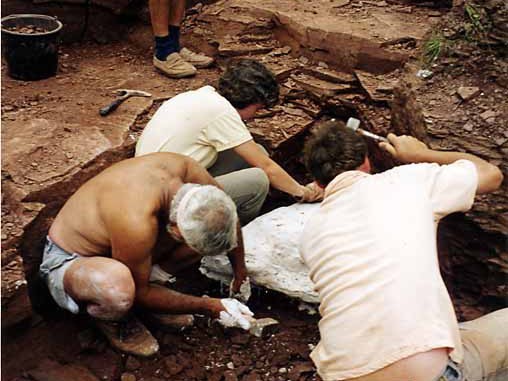
In the 1998 field season I discovered a third specimen, which is by far the most spectacular fossil that I have ever discovered. I found it towards the end of the field season when I pried up a piece of rock from the quarry floor. Upon turning over the rock piece, I saw an articulated foot preserved in it. I couldn’t believe my eyes! I knew that at the Bromacker if an articulated foot was found, the rest of the articulated skeleton should be attached to it. The problem was, we didn’t know if I had discovered a front or a hind foot, so we weren’t sure how the specimen was oriented in the quarry and whether it penetrated the nearby rock wall. Dave carefully lifted another piece of rock and thought the bones exposed in it were part of the shoulder girdle. Unfortunately, closer examination revealed that it was a piece of skull roof—another lobotomy—but, lacking x-ray vision, this is how we find fossil bone at the Bromacker. The good news was that the fossil specimen appeared to parallel the quarry wall.

image
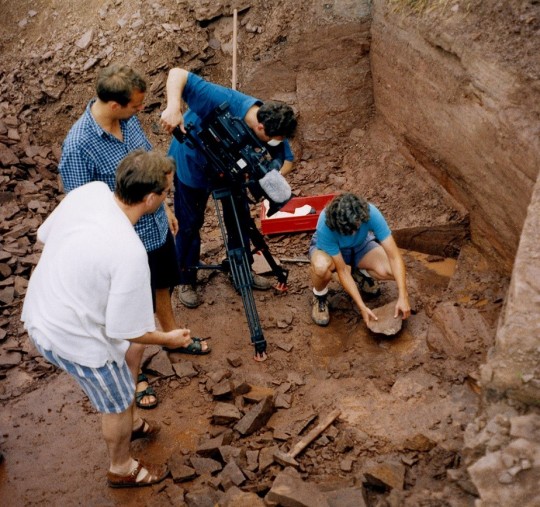
A film crew from the regional MDR television station visited us early on the day of my discovery to interview Dave and Thomas. The discovery was made after they left, so Thomas immediately notified them. They returned and recorded a reenactment of my discovery. The piece of rock I am holding contains the foot. The rest of the fossil lies in the low mound of rocks in front of me. Photo by Dave Berman, 1998.

image
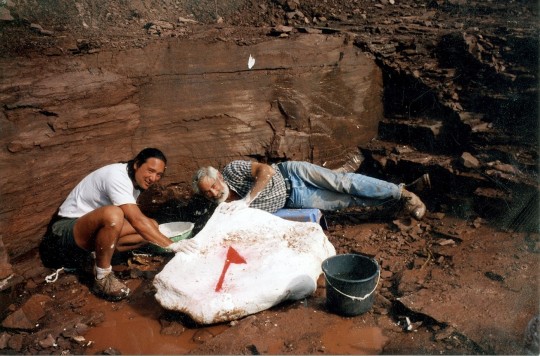
Dave and Stuart finish plastering the block. The red flag is a north arrow to indicate the orientation of the block in the quarry. Photo by the author, 1998.

Dave, Stuart, Thomas, then-graduate student Richard Kissel (University of Toronto, Mississauga), and I named the animal Orobates pabsti, which is from the Greek “oros,” meaning mountain, and “bates,” meaning walker, in reference to the Bromacker fossil environment being an intermontane basin. “Pabsti” is in honor of Professor Wilhelm Pabst for his pioneering work on the Bromacker fossil trackways.

We determined that Orobates is very closely related to Diadectes, and like Diadectes, was herbivorous. Orobates differs from Diadectes and other diadectomorphs in the group Diadectidae in a number of features, some of which are as follows: spade-shaped cheek teeth that are oriented on the jaw at an angle of 30–40° to the jaw line, rather than being close to 90°; narrower and shorter vertebral spines; 26 vertebrae between the head and hip (Diadectes has 21); proportions and shapes of individual toe bones; and digit (finger or toe) length.

image of orobates pabsti
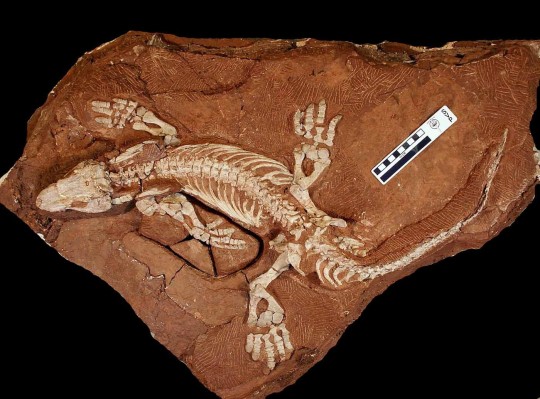
Holotype specimen of Orobates pabsti, the specimen collected in 1998. If a series of specimens exists of a new species, then the specimen that best represents the species is designated as the holotype. If only one specimen is known, it becomes the holotype by default. Photo by Dave Berman.

The Bromacker has long been famous for its exquisitely preserved fossil trackways. Identification of the particular fossil animal that made a given trackway is almost always very difficult, because body fossils often lack completely preserved hands and feet and typically are not found in association with trackways. As a result, trackways are given their own set of names, called ichnotaxa (“ichno” means track or footprint), which are typically referred to major groups of animals instead of individual species. The Bromacker is unique, however, because nearly completely preserved body fossils occur in a rock unit above the trackways, indicating they are very nearly contemporaneous. Five ichnotaxa are known from the Bromacker, and one of them, Ichniotherium, has been attributed to Diadectidae.

image
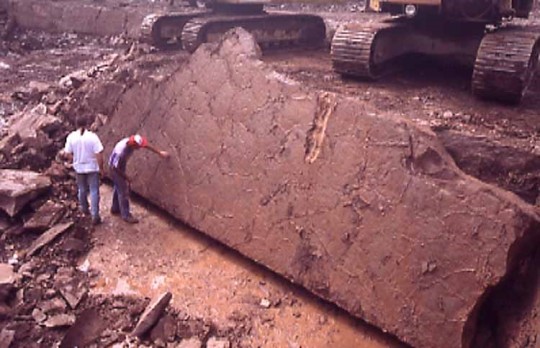
A large slab of rock being inspected for trackways shortly after it was unearthed in the commercial rock quarry. The polygonal patterns in the rock are mudcracks. Photo by the author.

Graduate student and trackway expert Sebastian Voigt (now Director at Urweltmuseum GEOSKOP, Burg Lichtenberg, Germany) often visited us at the Bromacker. In 2000, a time when Diadectes was the only known Bromacker diadectid, Sebastian and his advisor Hartmut Haubold (now emeritus at Martin Luther University Halle-Wittenberg, Germany) proposed that Ichniotherium cottae made two track types, designated as A and B, that differed according to the speed at which the trackmakers moved. This contrasted previous studies that proposed three species of Ichniotherium at the Bromacker.

Once the skeletal anatomy of Orobates became known, Sebastian realized that there were two species of Ichniotherium, and they were made by Diadectes and Orobates, respectively. He invited Dave and me to co-author a paper to present this hypothesis. We supplied Sebastian with information about skeletal differences between Diadectes and Orobates, and Sebastian used these data to firmly establish that Diadectes made Ichniotherium cottae (type B) tracks and Orobates was the trackmaker of trackways formerly identified as I.sphaerodactylum (aka I. cottae type A). Even though the makers of the trackways are now known, the ichnotaxon names are still used when referring to the trackways.

image
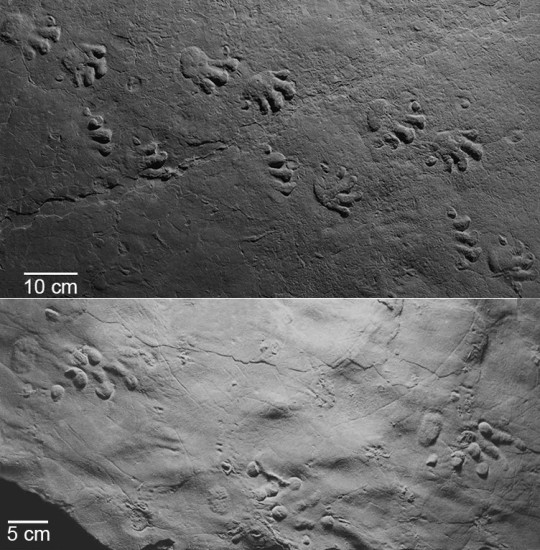
Photographs of trackways of Ichniotherium sphaerodactylum made by Orobates pabsti (top) and Ichniotherium cottae made by Diadectes absitus (bottom). Modified from Voigt (2007).

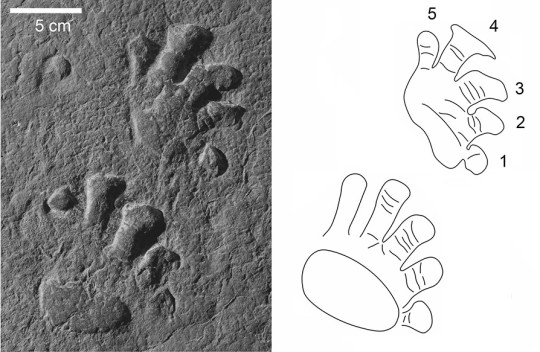
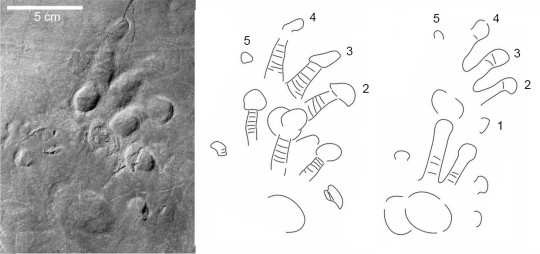
In Diadectes, the fifth digit of the hind foot is relatively shorter than it is in Orobates, which can be seen in the tracks of I. cottae and I. sphaerodactylum, respectively. Furthermore, in I. cottae trackways, the hind foot track overlaps the track of the front foot, whereas in I. sphaerodactylum the hind foot track typically doesn’t overlap the front foot track. This is because Diadectes has less vertebrae between the head and hip (21 vertebrae) than Orobates (26 vertebrae) does.

image
Front and hind foot track pair of Ichniotherium sphaerodactylum. Track made by the front foot is above the hind foot track. Digits 1–5 indicated. Modified from Voigt, 2007.

image
Front and hind foot track pair of Ichniotherium cottae. Track made by the front foot is above the hind foot track. Digits 1–5 indicated. Notice that the hind foot track overlaps the front foot track. Drawings are of different specimens than the one photographed. Modified from Voigt, 2007.

A cast of the holotype skeleton of Orobates pabsti is exhibited in the Fossil Frontiers display case in Carnegie Museum of Natural History’s Dinosaurs in Their Time exhibition. Be sure to look for it once the museum re-opens. And stay tuned for my next post, which will feature the amphibian Seymouria sanjuanensis.

For those of you who would like to learn more about Orobates, you can access the abstract here or contact Amy Henrici here. The publication on the track-trackmaker association can be found here.

Amy Henrici is Collection Manager in the Section of Vertebrate Paleontology at Carnegie Museum of Natural History. Museum staff, volunteers, and interns are encouraged to blog about their unique experiences and knowledge gained from working at the museum.

Keep Reading

The Bromacker Fossil Project Part VI: Seymouria sanjuanensis, the Tambach Lovers

Filed Under: Blog Tagged With: Amy Henrici, Museum from Home, Science News, Section of Vertebrate Paleontology, The Bromacker Fossil Project, Vertebrate Paleontology

  • Page 1
  • Page 2
  • Go to Next Page »

sidebar

About

  • Mission & Commitments
  • Directors Team
  • Museum History

Get Involved

  • Volunteer
  • Membership
  • Carnegie Discoverers
  • Donate
  • Employment
  • Events

Bring a Group

  • Groups of 10 or More
  • Birthday Parties at the Museum
  • Field Trips

Powdermill

  • Powdermill Nature Reserve
  • Powdermill Field Trips
  • Powdermill Staff
  • Research at Powdermill

More Information

  • Image Permission Requests
  • Science Stories
  • Accessibility
  • Shopping Cart
  • Contact
  • Visitor Policies
One of the Four Carnegie Museums | © Carnegie Institute | Privacy Policy | Terms of Use | Accessibility
Rad works here logo