• Skip to primary navigation
  • Skip to main content
  • Skip to primary sidebar

Carnegie Museum of Natural History

One of the Four Carnegie Museums of Pittsburgh

  • Visit
    • Buy Tickets
    • Visitor Information
    • Exhibitions
    • Events
    • Dining at the Museum
    • Celebrate at the Museum
    • Powdermill Nature Reserve
    • Event Venue Rental
  • Learn
    • Field Trips
    • Educator Information
    • Programs at the Museum
    • Bring the Museum to You
    • Guided Programs FAQ
    • Programs Online
    • Climate and Rural Systems Partnership
  • Research
    • Scientific Sections
    • Science Stories
    • Science Videos
    • Senior Science & Research Staff
    • Museum Library
    • Science Seminars
    • Scientific Publications
    • Specimen and Artifact Identification
  • About
    • Mission & Commitments
    • Directors Team
    • Museum History
  • Tickets
  • Give
  • Shop

Vertebrate Paleontology

December 19, 2022 by Erin Southerland

Stepping Back in Time

by Suzanne Nuss

I grew up in the silent Canadian Arctic, so sounds switch me to alertness. Once alert, I pause to hear spoken words. During a recent late afternoon in Dinosaurs in Their Time, I focused on a sound that moved me to alertness until it became the voice of the museum’s Gallery Experience Presenter Shannon McGuinn saying, “I found a footprint.” 

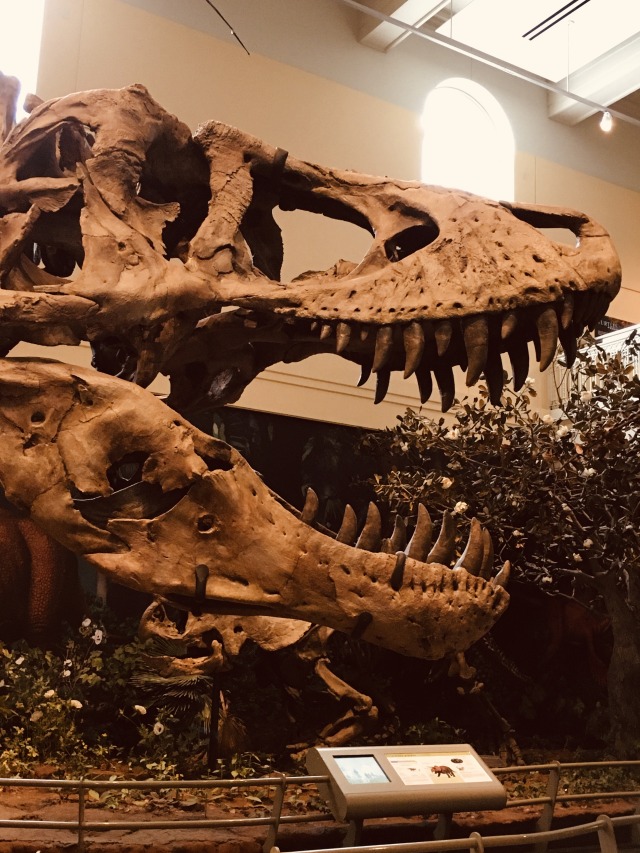
Because the exhibition hall was mostly empty of visitors, I had been standing near and contemplating the visually striking display of the holotype Tyrannosaurus rex fighting in a field of replica Cretaceous poppies against a cast of another T. rex skeleton, the fossil that since its discovery in 1997 has been known informally as Peck’s Rex. As a Natural History Interpreter, I have been walking these halls for more than six years, yet I had never noticed a footprint. “Hmm,” I thought. “Really?”

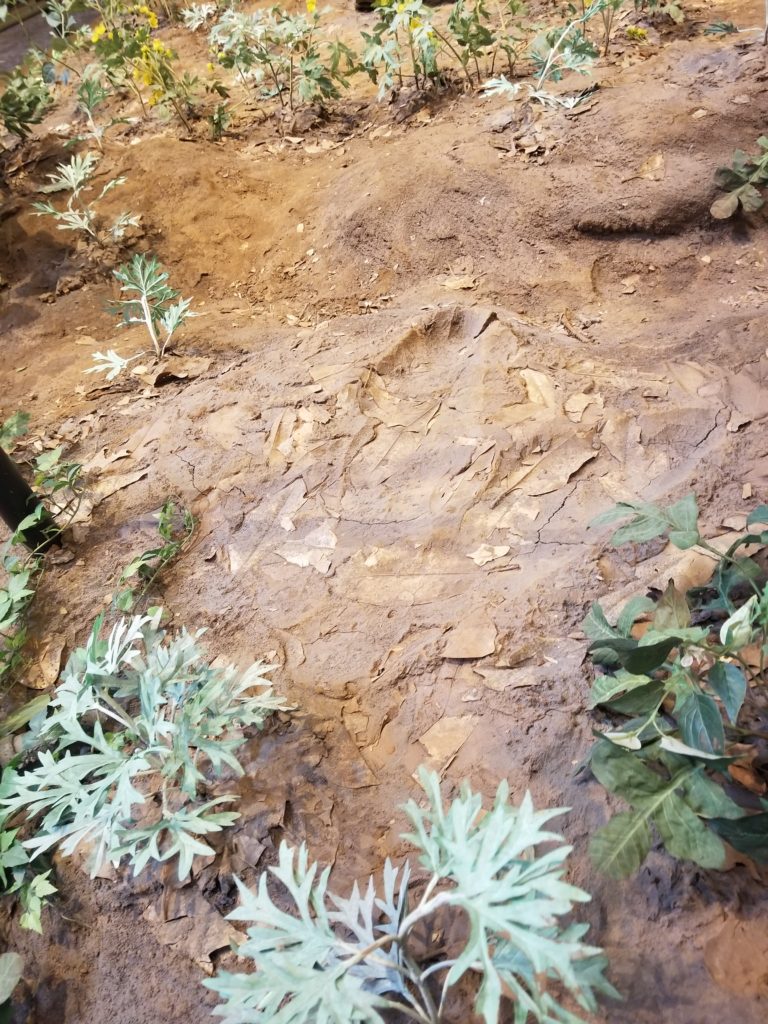
 I followed Shannon. She pointed. There it was: faint but unmistakable, on the recreated ground surface of the exhibit base, the impressions of three digits resembling a gigantic bird footprint. 
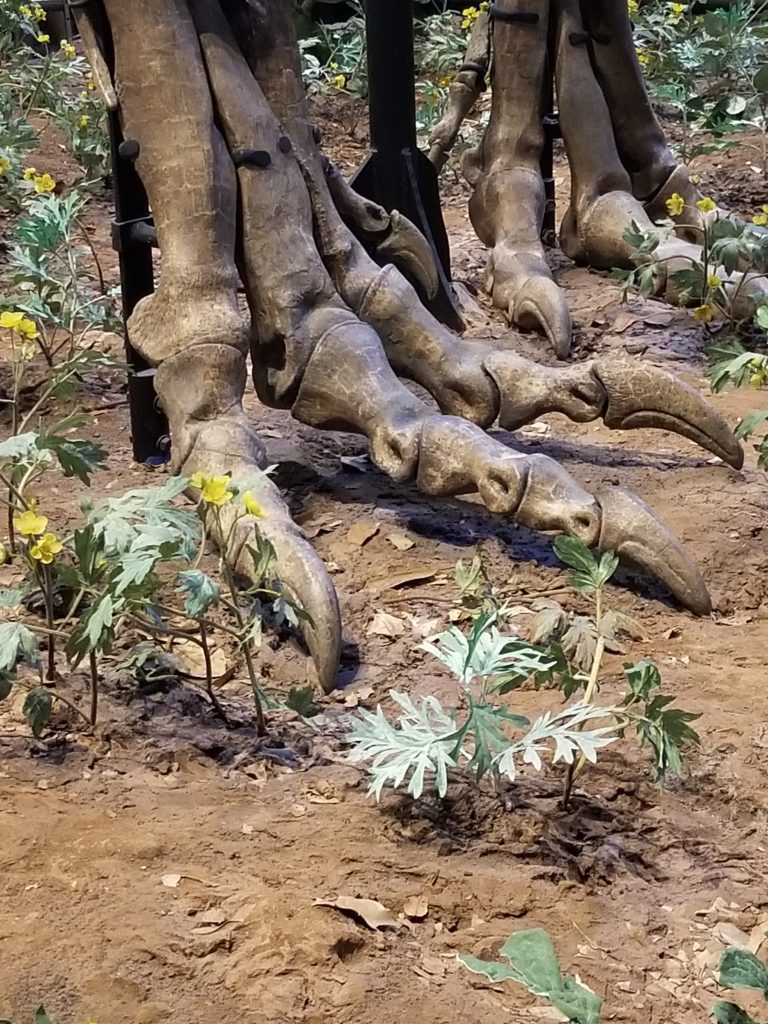
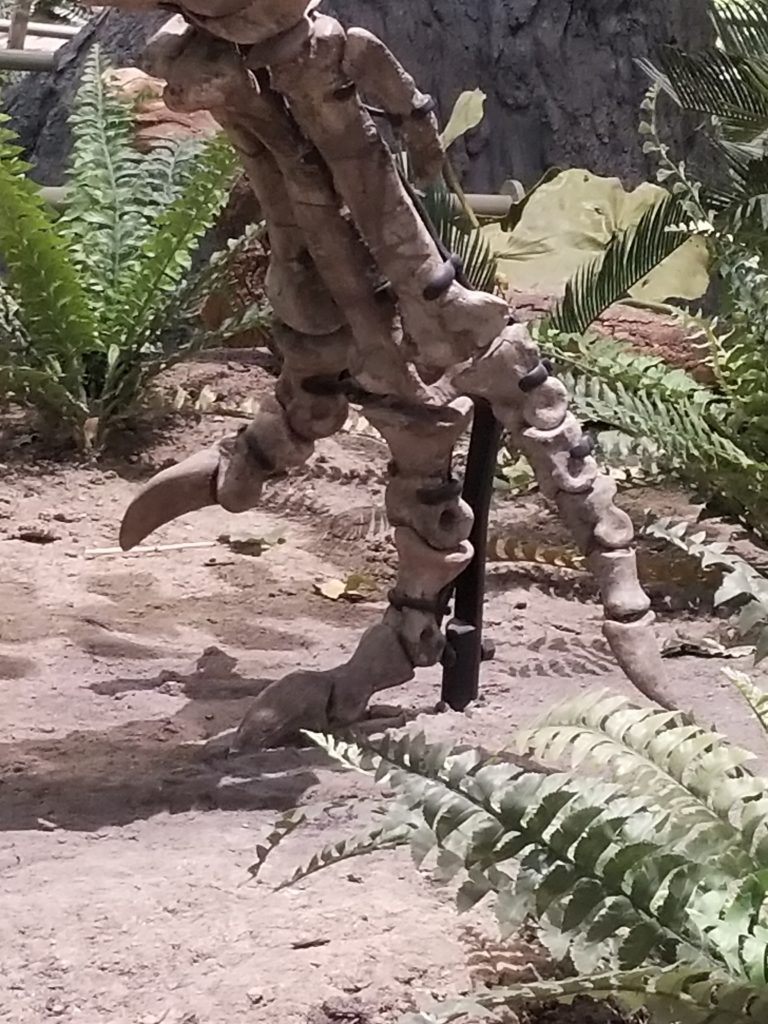
  • T. rex fossil foot

We both entertained the same thought: if there’s one track, could there be more? We trotted over behind Peck’s Rex and yes. A second footprint was visible, two feet behind and under the tail, as if the animal had been ambling along.

At this point, Dr. Matt Lamanna, the person most responsible for the scientific content of the now-15-year-old hall, walked by. Gurgling with excitement, we showed him the footprints. He was delighted by our find. “Yes. Two ‘Easter Eggs.’ When Dinosaurs in Their Time was built, we included many simulated footprints, sculpted on the basis of actual fossilized dinosaur tracks. I only wish I’d been able to add a few fake coprolites (fossil poop) too.”

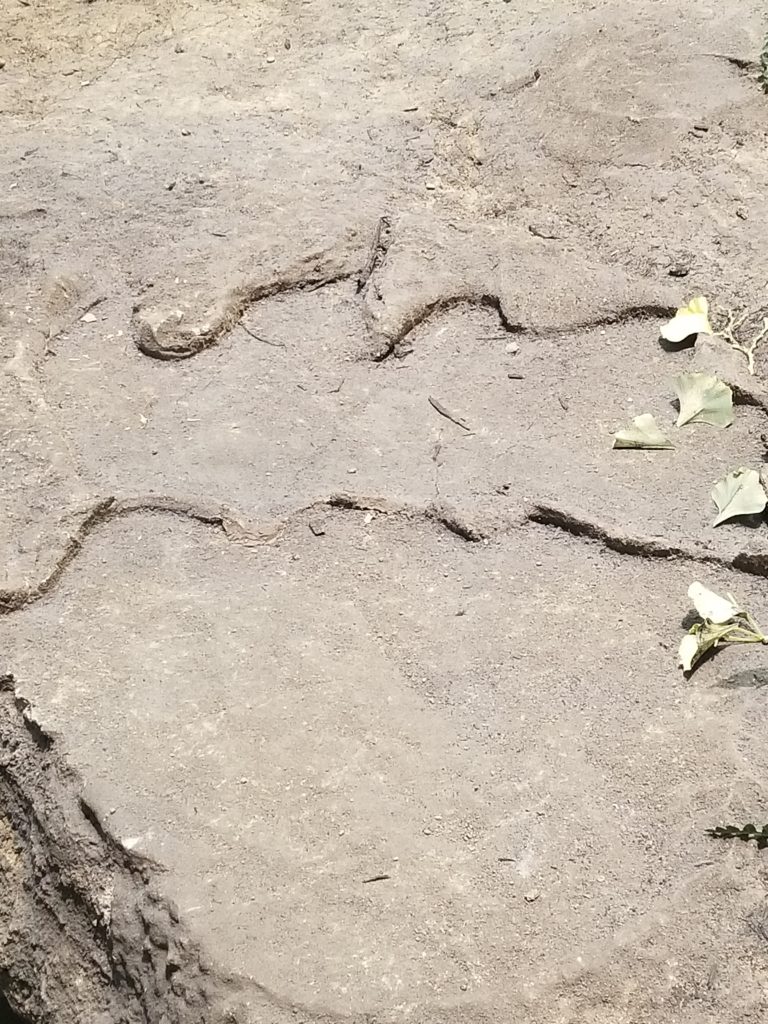
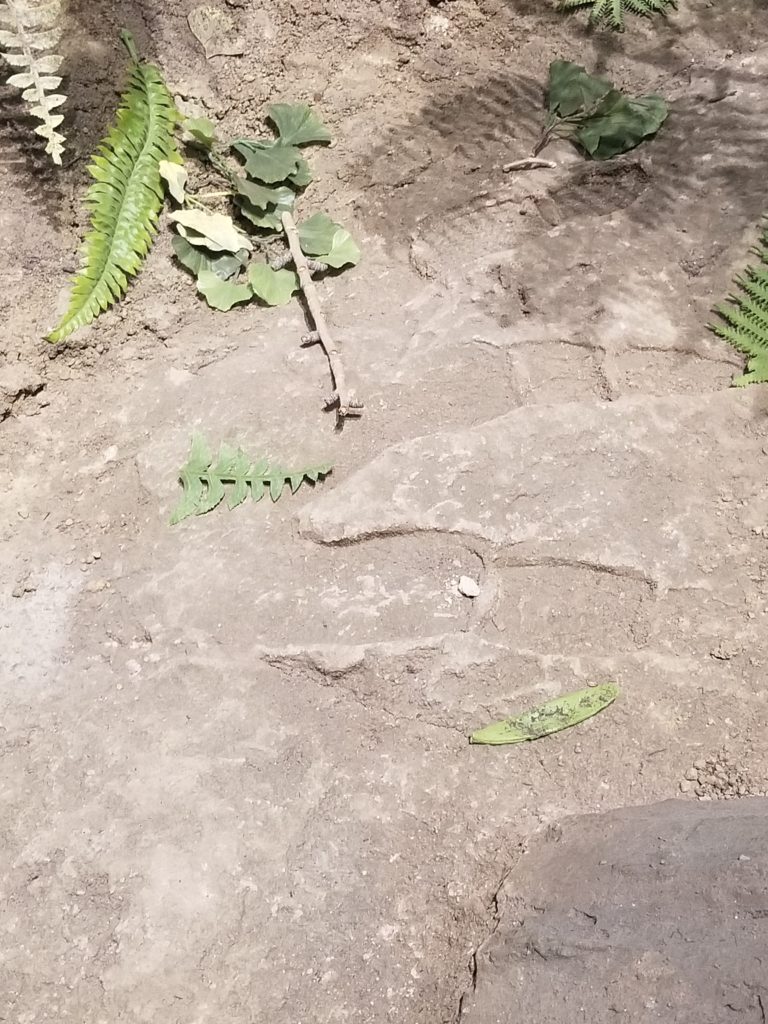
 We continued to hunt, with Matt now with us. Three toes again, much smaller. Now that we recognized the tracks as intentional creations, we wondered what animal tracks we might find.  Our third discovery, pictured below, was a faux footprint of the bird-like oviraptorosaur Anzu wyliei.
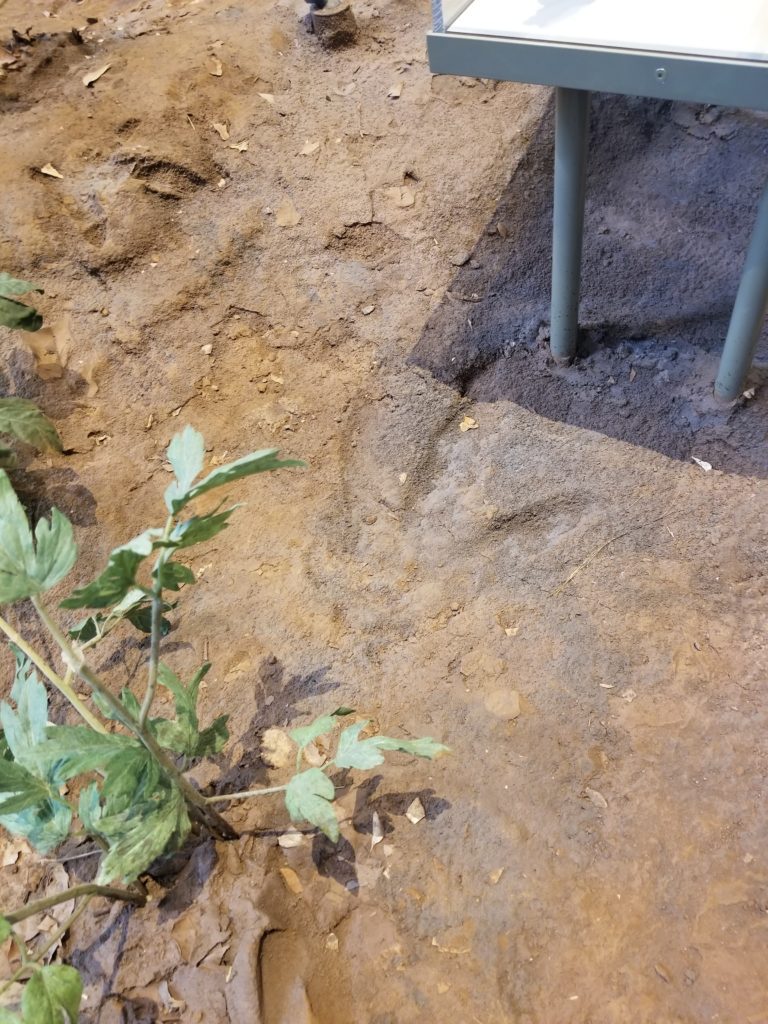
fossil footprint in a museum display

Moving into the Jurassic portion of the exhibition, we stepped back in time, figuratively speaking, by more than 80 million years, and were dwarfed by huge, long-necked, plant-eating dinosaurs (sauropods). We also found very different-looking tracks, some of which were overlapping. Our questions multiplied: could tracks like this indicate that these enormous beasts walked in herds? Is it possible to match up the toes of the foot with the footprint? Was the wide, flat heel of sauropods important for weight distribution?   
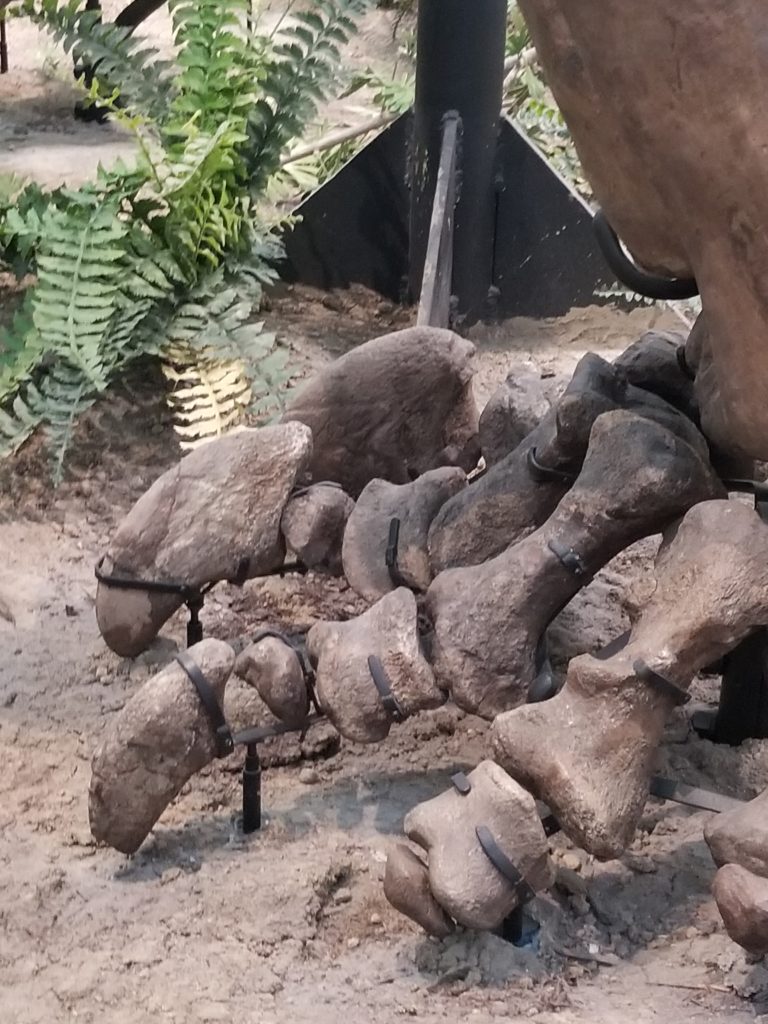
Those thoughts captivated me, mainly because I was introduced to D’Arcy Thompson’s book, On Growth and Form, when I studied biophysics at McGill University in Montreal. One section of the book was devoted entirely to demonstrating how the many kinds of tetrapods (four-limbed, backboned animals such as amphibians, reptiles, birds, and mammals) all had the same fundamental form: head, torso, and tail, with forelimbs attached at the shoulder girdle and hind limbs attached to the hip. I loved the accompanying images that stretched all the body parts to ‘morph’ one tetrapod into another. A more technical term for this concept is “homologous structures.” In the image below, a simple letter key is used to mark forelimb bones: (H) humerus, (R) radius, (U) ulna, (C) carpals, (MC) metacarpals, and (P) phalanges (the latter better known as finger and toe bones). The hind limbs match up  in a similar way.
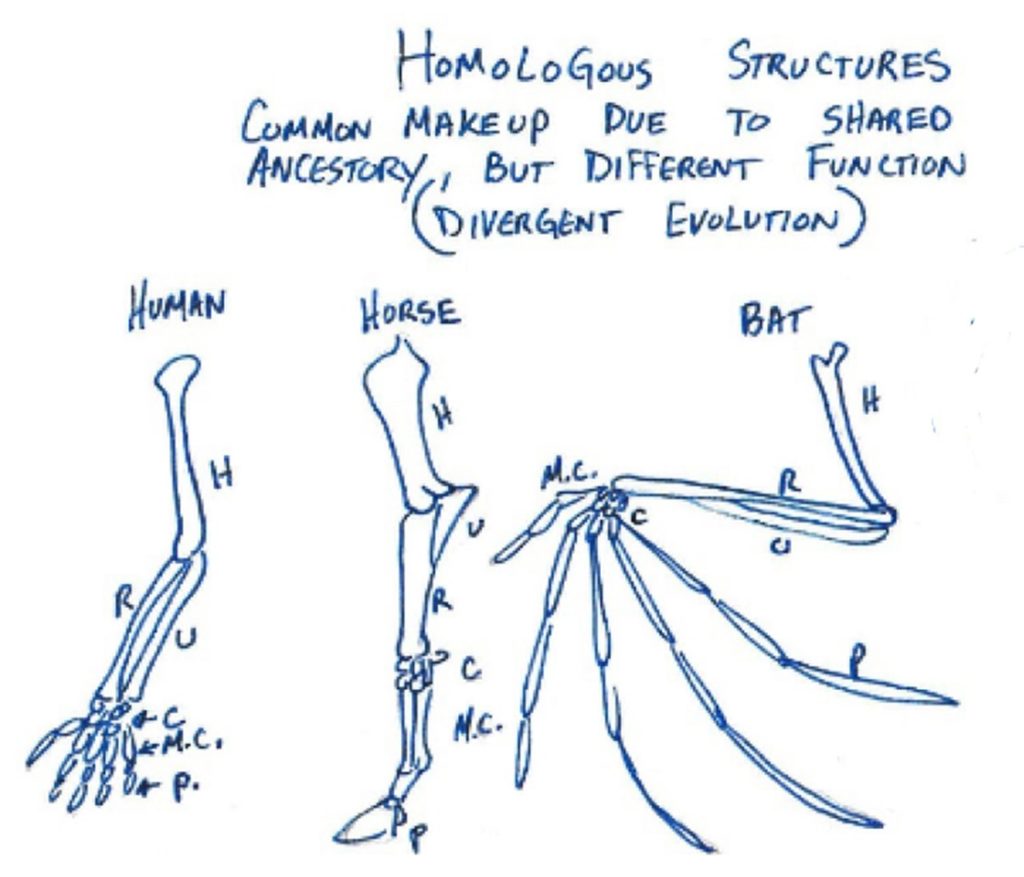
Drawing of human, horse, and bat limb skeletons side by side

I thought about what a human footprint looks like, and then a horse footprint, and even a bat footprint. Bears and humans walk with their heels on the ground (a stance known as plantigrade). Horses and giraffes walk on the very tips of their toes (unguligrade), whereas cats, dogs, and predatory dinosaurs such as Allosaurus and T. rex walked on their toes (digitigrade). 

Returning to my original spot within the dinosaur exhibition, I was determined to take a closer look. Could I tell from the fossil evidence how the species on display walked? Was it possible to identify the femur, tibia, and fibula of each skeleton?

The colorful murals lining the walls of the exhibition helped. The depictions of each creature are based upon well-studied fossils and biomechanical modelling. I could start musing about how they walked and make a guess. Each guess became a test, which produced a working hypothesis. I have since discovered that the museum’s Bird Hall and Hall of North American Wildlife are also great places to think about feet, footprints, and the biomechanics of animal movement, and why some dinosaur footprints look so much like bird footprints. 

Footprints have stories to tell about movement, behavior, and speed. Properly interpreted, footprints can reveal how long their makers’ legs might have been, the width of these animals’ hips, and even whether adults and young traveled together in family groups. What, I have been steadily wondering, would the footprints recording a fight look like? 

I don’t want to look anything up yet. I need to muddle through with my own thinking first. When I am ready, I might start with legged robot studies to clarify the physical constraints that must be considered in moving through space. I have since found simulated tracks of Allosaurus and Stegosaurus, and in my searching have also discovered how even an exhibition I know well still holds tremendous potential for inquiry and further learning.
Suzanne Nuss is a Natural History Interpreter at Carnegie Museum of Natural History.

Related Content

The Strange Saga of Spinosaurus, the Semiaquatic Dinosaurian Superpredator

The Two-Headed Dinosaur

The Bromacker Fossil Project

Carnegie Museum of Natural History Blog Citation Information

Blog author: Nuss, Suzanne
Publication date: December 19, 2022
Share this post!

  • Share on Twitter Share on Twitter
  • Share on Facebook Share on Facebook
  • Share on Pinterest Share on Pinterest
  • Share on LinkedIn Share on LinkedIn
  • Share on Reddit Share on Reddit
  • Share via Email Share via Email

Filed Under: Blog Tagged With: dinosaurs in their time, Matt Lamanna, Suzanne Nuss, Vertebrate Paleontology

June 8, 2022 by Erin Southerland

Bizarre Meat-Eating Dinosaur Joins “Rogues’ Gallery” of Giant Predators from Classic Fossil Site in Egypt’s Sahara Desert

Fossil Reveals First Evidence of Abelisaurid Dinosaurs Found in Bahariya Oasis
 
Carnivorous Dinosaur Group Known for Bulldog-like Faces, Tiny Arms, and Small Teeth

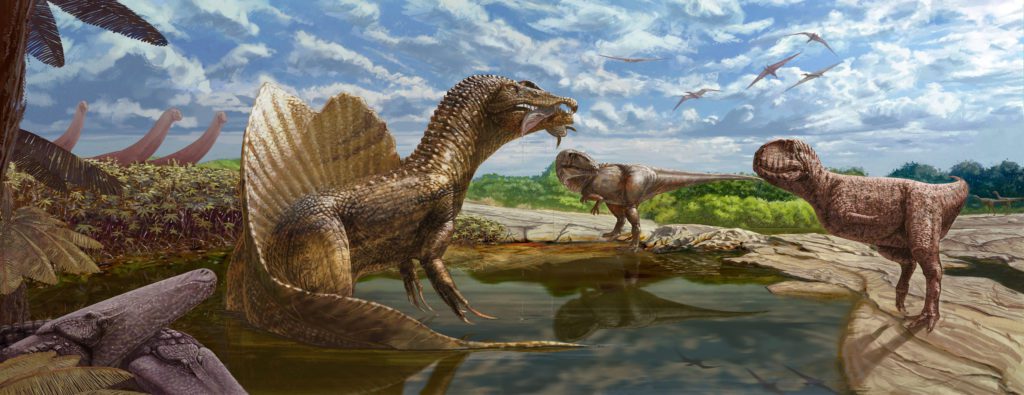
Illustration of dinosaurs in a desert oasis
Reconstruction of the ecosystem of the Bahariya Oasis in the Sahara Desert of Egypt approximately 98 million years ago, showing the diversity of large theropods (predatory dinosaurs). The newly discovered, as-yet unnamed abelisaurid (right) confronts Spinosaurus (left center, with lungfish in jaws) and Carcharodontosaurus (right center), while two individuals of the crocodilian Stomatosuchus (left) look on. In the background, a herd of the sauropod (giant, long-necked herbivorous dinosaur) Paralititan (left) warily regard these predators and two individuals of another theropod, Bahariasaurus (far right), while a flock of a still-unnamed pterosaur (flying reptile) soars above. The vegetation is dominated by the mangrove-like tree fern Weichselia. Image by Andrew McAfee, Carnegie Museum of Natural History. 

[Pittsburgh, Pennsylvania] — An Egyptian-American team of researchers has announced the discovery of a new kind of large-bodied meat-eating dinosaur, or theropod, from a celebrated fossil site in Egypt’s Sahara Desert. The fossil of a still-unnamed species provides the first known record of the abelisaurid group of theropods from the Bahariya Formation, a rock unit in the Bahariya Oasis that dates to the middle Cretaceous Era (approximately 98 million years ago). In the early 20th century, this locality famously yielded the original specimens of a host of remarkable dinosaurs—including the colossal sail-backed fish-eater Spinosaurus—which were then destroyed in World War II. Abelisaurid fossils had previously been found in Europe and in many of today’s Southern Hemisphere continents, but never before from the Bahariya Formation. The team describes the Bahariya abelisaurid discovery in a paper published today in Royal Society Open Science. 
 
The study was led by Belal Salem of the Mansoura University Vertebrate Paleontology Center (MUVP) in Mansoura, Egypt, who is also a graduate student at Ohio University and a faculty member at Benha University. The research team also included Dr. Matt Lamanna, Mary R. Dawson Associate Curator and Head of Vertebrate Paleontology and lead dinosaur specialist at Carnegie Museum of Natural History (CMNH); Dr. Patrick O’Connor, Professor of Biomedical Sciences at Ohio University; Sanaa El-Sayed, a doctoral student at the University of Michigan and the MUVP’s former vice director; Dr. Hesham Sallam, a professor at the American University in Cairo (AUC) and Mansoura University and the founding director of the MUVP; and additional colleagues from Benha University and the Egyptian Environmental Affairs Agency. CMNH Vertebrate Paleontology Scientific Illustrator Andrew McAfee produced or assisted with most of the illustrations in the paper.

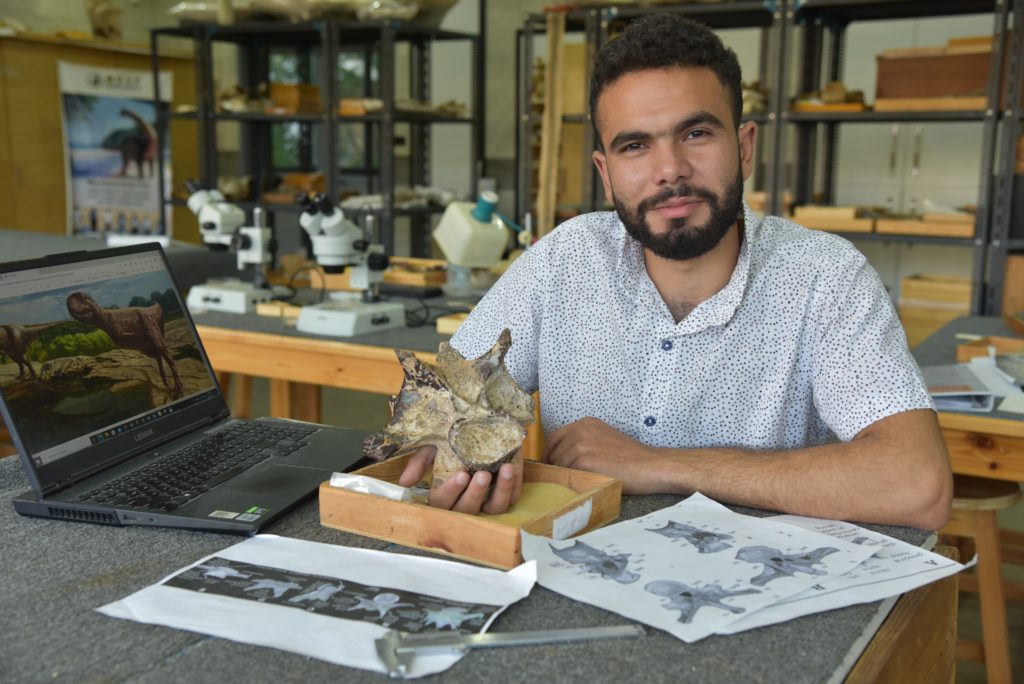
Person sitting at a desk holding a fossil
Study leader Belal Salem of the Mansoura University Vertebrate Paleontology Center (MUVP), Ohio University, and Benha University examines the roughly 98-million-year-old abelisaurid theropod neck vertebra discovered from the Bahariya Oasis that forms the basis of the new study. Photo by Hesham Sallam, American University in Cairo/MUVP. 

The fossil in question, a well-preserved vertebra from the base of the neck of a theropod, was recovered by a 2016 MUVP expedition to the Bahariya Oasis. The vertebra belongs to an abelisaurid, a kind of bulldog-faced, small-toothed, tiny-armed theropod that is estimated to have been roughly six meters (20 feet) in body length. Abelisaurids—most notably represented by the horned, demonic-looking Patagonian form Carnotaurus of Jurassic World and Prehistoric Planet fame—were among the most diverse and geographically widespread large predatory dinosaurs in the southern landmasses during the Cretaceous Period, the final time period of the Age of Dinosaurs. Along with Spinosaurus and two other giant theropods (Carcharodontosaurus and Bahariasaurus), the new abelisaurid fossil adds yet another species to the cadre of large predatory dinosaurs that roamed what is now the Egyptian Sahara roughly 98 million years ago. 
 
“During the mid-Cretaceous, the Bahariya Oasis would’ve been one of the most terrifying places on the planet,” says Salem. “How all these huge predators managed to coexist remains a mystery, though it’s probably related to their having eaten different things, their having adapted to hunt different prey.”

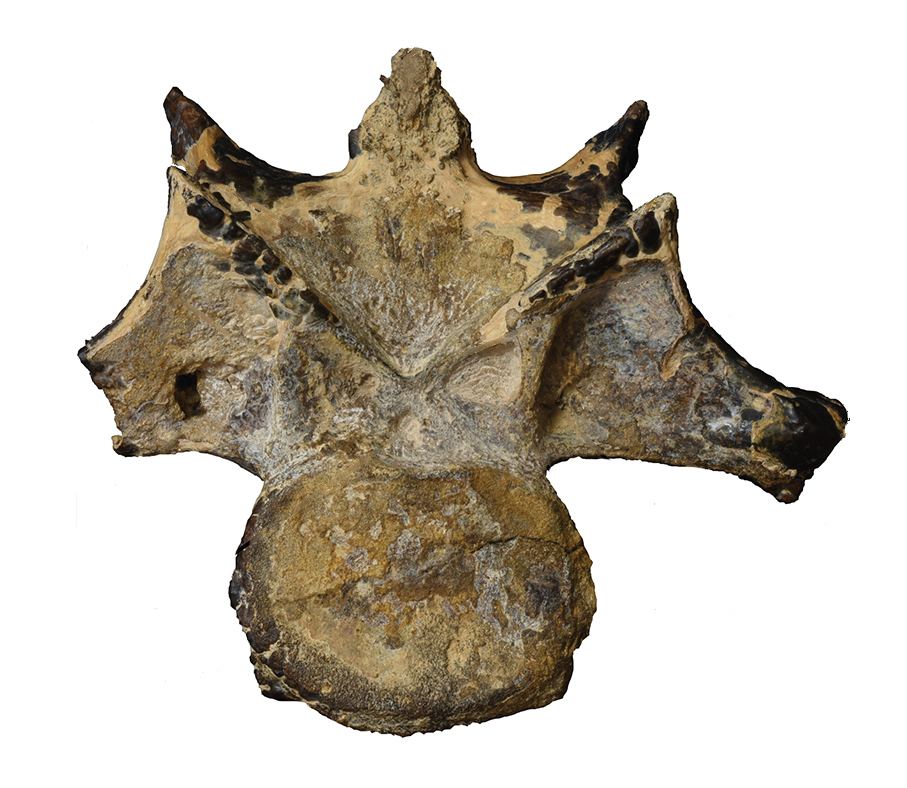
fossil vertebra
The abelisaurid neck vertebra from the Bahariya Oasis, Egypt that constitutes the first record of this dinosaur group from that classic fossil locality. The bone is shown in anterior view. Photo by Belal Salem, Mansoura University Vertebrate Paleontology Center/Ohio University/Benha University.

The new vertebra holds implications for the biodiversity of Cretaceous dinosaurs in Egypt and the entire northern region of Africa. It is the oldest known fossil of Abelisauridae from northeastern Africa, and shows that, during the mid-Cretaceous, these carnivorous dinosaurs ranged across much of the northern part of the continent, east to west from present day Egypt to Morocco, to as far south as Niger and potentially beyond. Spinosaurus and Carcharodontosaurus are also known from Niger and Morocco, and a close relative of Bahariasaurus has been found in the latter nation as well, suggesting that this fauna of large to gigantic theropods coexisted throughout much of northern Africa at this time.
 
The Site
 
The Bahariya Oasis is renowned within paleontological circles for having yielded the type specimens (the original, first-discovered, name-bearing fossils) of several extraordinary dinosaurs during the early 20th century, including, most famously, Spinosaurus. Unfortunately, all Bahariya dinosaur fossils collected prior to World War II were destroyed during an Allied bombing of Munich in 1944.
 
As a graduate student in the early 2000s, study co-author Matt Lamanna helped make the first dinosaur discoveries from the oasis since that infamous air raid, including the gargantuan sauropod (long-necked plant-eating dinosaur) Paralititan. “The Bahariya Oasis has taken on near-legendary status among paleontologists for having produced the first-known fossils of some of the world’s most amazing dinosaurs,” says Lamanna, “but for more than three quarters of a century, those fossils have existed only as pictures in old books.”

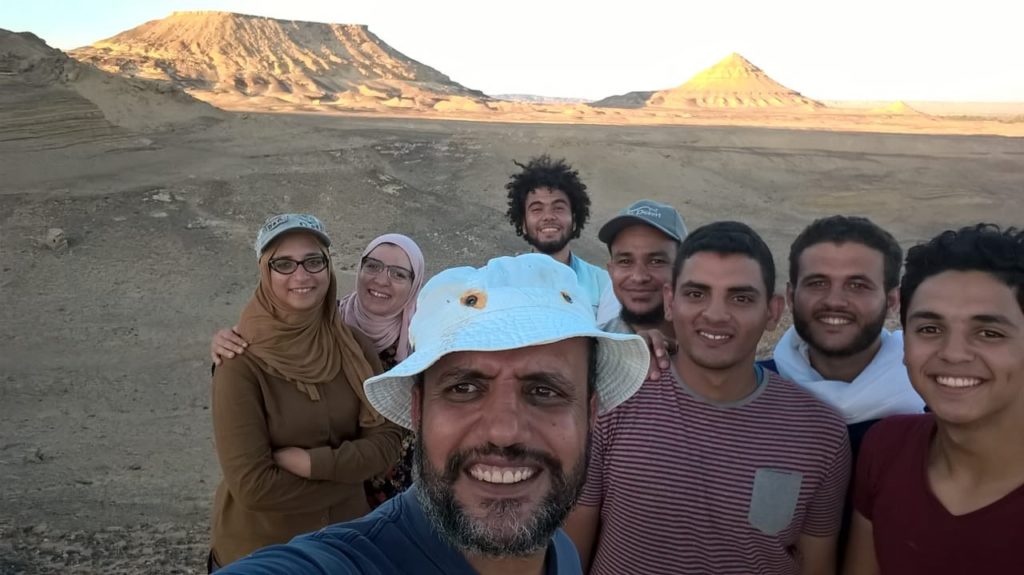
A group of people posing for a selfie in the desert
A Mansoura University Vertebrate Paleontology Center (MUVP) team exploring the Bahariya Oasis in 2018, including several authors of the new paper: Hesham Sallam (closest to camera), Sanaa El-Sayed (far left), and Belal Salem (farthest from camera). Photo by Hesham Sallam, American University in Cairo/MUVP.

Thankfully, discoveries made during recent expeditions led by researchers from AUC and MUVP—such as the new abelisaurid vertebra—are helping to restore the paleontological legacy of this classic site. These expeditions have recovered a wealth of additional fossils that the researchers plan to unveil in the near future.
 
As team member Sanaa El-Sayed, who co-led the 2016 expedition that collected the abelisaurid vertebra, explains, “this bone is just the first of many important new dinosaur fossils from the Bahariya Oasis.” 
 
The Bahariya Formation holds promise to shed further light on mid-Cretaceous African dinosaurs and the vanished ecosystems in which they once lived. Unlike more thoroughly explored rocks of the same age in Morocco that tend to yield isolated bones, the Bahariya Formation appears to preserve partial skeletons of dinosaurs and other land-living animals with a relatively high degree of frequency. The more bones that are preserved within the skeleton of a given fossil vertebrate species, the more paleontologists can generally learn about it. The propensity of the Bahariya Oasis for producing associated partial skeletons suggests that much remains to be learned from this historic locality.
 
“In terms of Egyptian dinosaurs, we’ve really just scratched the surface,” notes Hesham Sallam. “Who knows what else might be out there?”

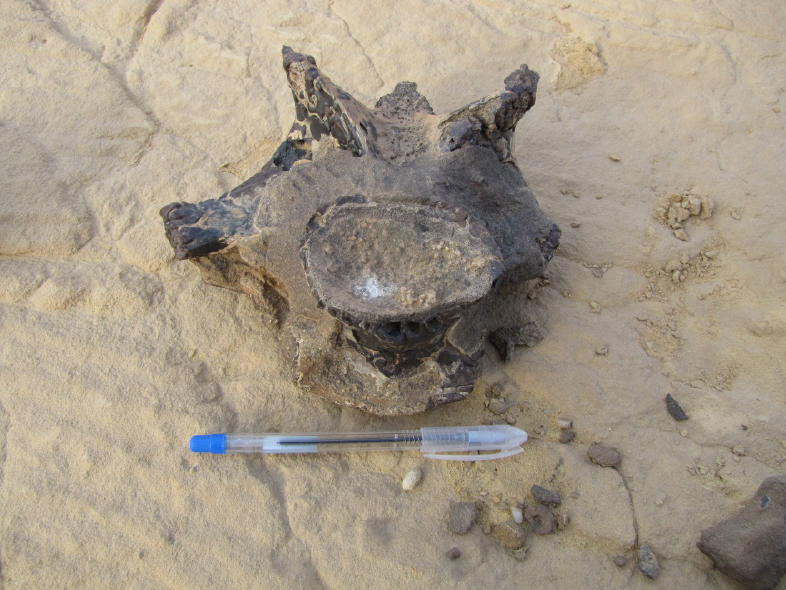
Fossil vertebra set next to a pen for scale
The abelisaurid neck vertebra, approximately 98 million years old, as it was found in the field in the Bahariya Oasis during the 2016 Mansoura University Vertebrate Paleontology Center (MUVP)/Carnegie Museum of Natural History expedition funded by the National Geographic Society. Photo by Sanaa El-Sayed, University of Michigan/MUVP.

One Fossil
 
How can the discovery of a single neck vertebra lead researchers to conclude that the fossil belongs to a member of Abelisauridae, a kind of carnivorous dinosaur that has never been found in the Bahariya Formation before? The answer is remarkably simple: it is virtually identical to the same bone in other, better-known abelisaurids such as Carnotaurus and Viavenator from Argentina and Majungasaurus from Madagascar. Additionally, Belal Salem and his collaborators conducted a computer-based evolutionary study—known as a cladistic analysis—that confirmed the placement of the species represented by the new vertebra within Abelisauridae. As co-author Patrick O’Connor, who in 2007 published an exhaustive study of the vertebral anatomy of the abelisaurid Majungasaurus, explains, “I’ve examined abelisaurid skeletons from Patagonia to Madagascar. My first glimpse of this specimen from field photos left no doubt about its identity. Abelisaurid neck bones are just so distinctive.”
 
Research on the new abelisaurid vertebra was supported by a grant to Matt Lamanna from the National Geographic Society’s Committee for Research and Exploration, grants to Hesham Sallam from Mansoura University and the American University in Cairo intramural grant program, and a grant to Patrick O’Connor from the National Science Foundation.

Filed Under: Press Release Tagged With: Matt Lamanna, Science News, Vertebrate Paleontology

September 17, 2021 by wpengine

Hunting For Fossil Frogs In Wyoming

by Amy Henrici

Collection managers at Carnegie Museum of Natural History (CMNH) typically spend their time on collection-based tasks. Sometimes, however, we are called on to clean out the office of a former curator in our respective sections. With the death of Section of Vertebrate Paleontology (VP) Curator Emerita Mary Dawson late last year, I’ve been spending time in her office sorting through numerous items she accumulated during her nearly 58-year career at the museum. While there, I can’t help but think of a conversation we had in her office many years ago when I expressed interest in obtaining a Master of Science degree in geology and paleontology at the University of Pittsburgh.

Mary agreed to be my advisor and suggested fossil fishes as a topic for my thesis, because at that time not many paleontologists were studying this group. She arranged for me to join a field crew from our Section led by curators Kris Krishtalka and Richard Stucky who planned to spend the summer of 1984 searching Eocene sediments (~56–34 million years ago) in the Wind River Basin of central Wyoming for fossils of mammals and other vertebrates. She instructed them to take me to the north end of Lysite Mountain, where during a 1965 reconnaissance geologist Dave Love (of the United States Geological Survey [USGS]) and his student Kirby Bay and others showed her some fish fossils.

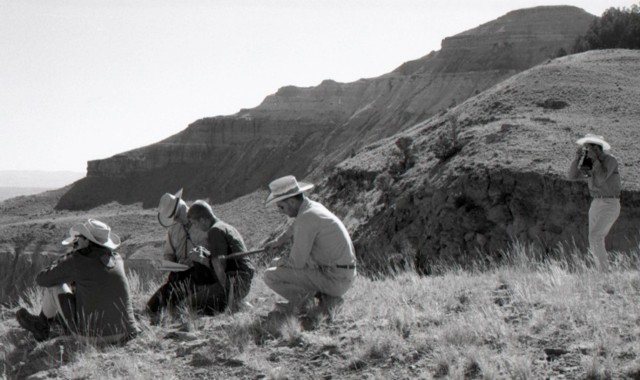
Black and white candid photo of people on a rocky hillside.
1965 reconnaissance of the north end of Lysite Mountain. The fish locality lies further below the group. Left to right, Dave Foster, USGS geologist Dave Love, Love’s student Kirby Bay, then CMNH VP Curator Craig Black, and Ted Gard. Photo by Mary Dawson, July 28, 1965.

As planned, in late June I set out from Pittsburgh in my un-airconditioned car on a three-day drive to Wyoming to join the crew who had arrived before me. Some of my time in the field was spent assisting the crew in their search for mammal fossils, something I had no experience with. My previous field work involved collecting ancient amphibian, reptile, and dinosaur fossils from the time before most mammals had evolved. Indeed, the first set of “fossils” that I collected on this trip turned out to be fragments of modern rabbit bones that Kris unceremoniously dumped into his ashtray while identifying the day’s haul after dinner. Fortunately, my skills at finding mammal fossils improved.

After a few days we went on the first of several reconnaissance trips to Lysite Mountain, which lies north of the Wind River Basin and forms part of the southern escarpment of the Bighorn Basin. To get there we drove deeply rutted and sometimes rocky dirt roads. Once there, the crew spread out in search of fossils. While some of us searched for and found incomplete and disarticulated fish fossils, others discovered a unit that produced frog fossils. When Kris and Richard showed me the frog fossils, they strongly urged me to base my thesis on the frogs instead of the scrappy fish I had collected. I quickly agreed, which was a decision that I never regretted.

We returned to our routine of prospecting for fossils in the Wind River Basin, until the planned arrival of Pat McShea (now my husband and Program Officer in the CMNH Department of Education) via a Trailways bus. The original plan was for Pat and me to drive my car daily to Lysite Mountain, but this was not feasible, given the condition of the roads. Instead the crew dropped us off with our camping gear for four days of fossil frog collecting. This was followed by a second field season in 1986, in which my sister, Ellen Henrici, joined us with her off-road capable SUV.

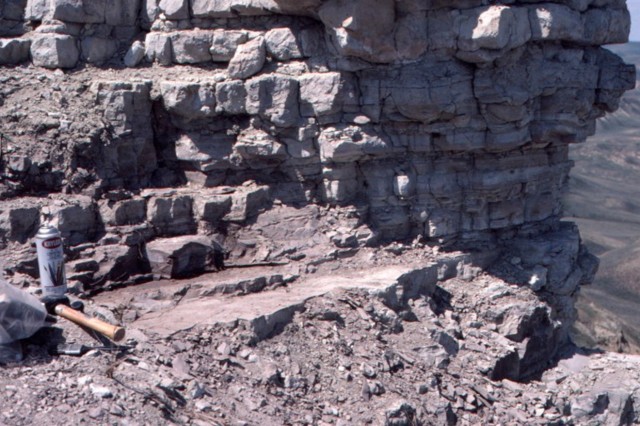
Rocky landscape with tools set out on the left side of the image.
The frog quarry, with the Bighorn Basin below, to right of quarry. Photo by the author, 1984.

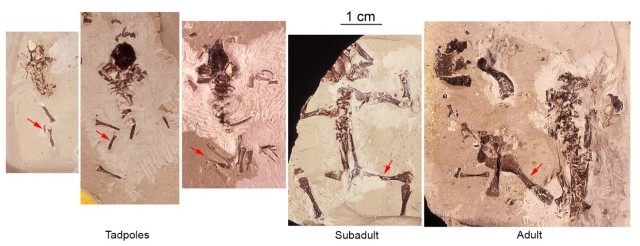
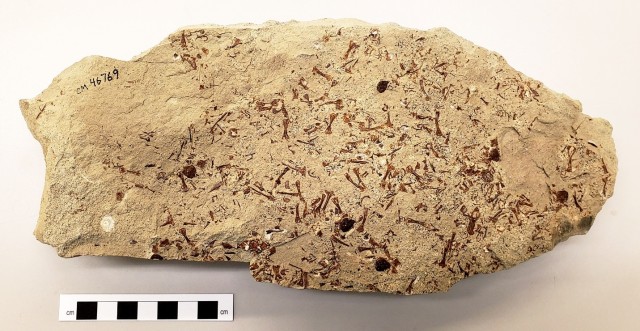
Using a hammer and chisel to pry open pieces of rock, we collected nearly 150 specimens of frog fossils in varying degrees of completeness. The preparation of the fossils and the identification of the various bones took me a long time. I eventually figured out that they were all the same type of frog and represented a new genus and species in the family Rhinophrynidae, which today is known by a single species: Rhinophrynus dorsalis, the Mexican burrowing toad. The fossil collection even includes tadpoles in various stages of development, as well as a mortality layer preserving the scattered bones of many individuals. I named this new genus and species Chelomophrynus bayi in a 1991 paper published in CMNH’s scientific journal, the Annals of Carnegie Museum.

From left to right: three tadpole fossils, a subadult frog fossil, an adult frog fossil
Growth series of Chelomophrynus bayi, arranged in order of maturity from youngest (left) to oldest (right). The red arrow points to the thigh bone (femur). A tail, not preserved, would have been present in the tadpoles. Photos by the author, 2015.

Mortality layer rock sample.
Sample of the extensive mortality layer of Chelomophrynus bayi. Cause of death might have been disease. Photo by the author, 2021.

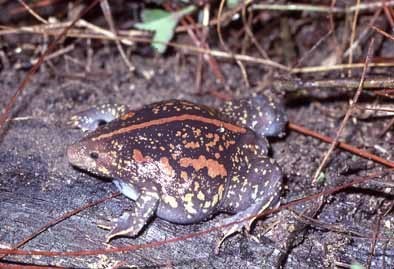
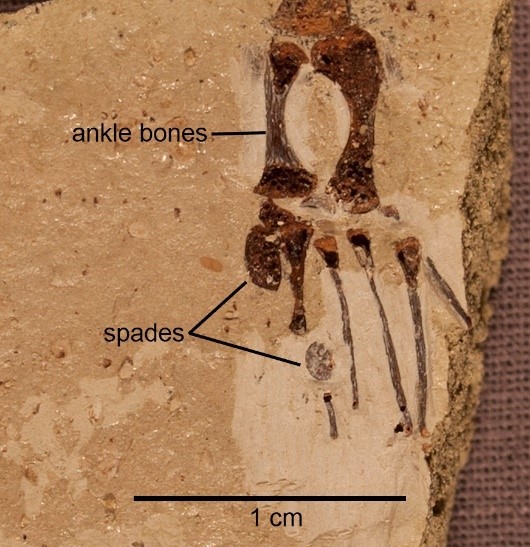
In paleontology, the study of living creatures can inform our understanding of fossils. The Mexican burrowing toad is very unusual in that it spends most of its life underground and only emerges to breed after heavy rain. The species currently inhabits dry tropical to subtropical forests along coastal lowlands in extreme southern Texas southward into Mexico and Central America. It has two bony spades on each hind foot that help it to efficiently dig, hind feet first, into the ground. Once underground, other skeletal specializations enable it to use its front feet and nose to penetrate termite and ant tunnels and then protrude its tongue into the tunnel to catch insects. Chelomophrynus possesses a number of these specializations (though some are not as well developed as in the modern Rhinophrynus), which strongly suggests that it too was able to burrow underground to feed on subterranean insects.

frog on the forest floor
Rhinophrynus dorsalis, the modern Mexican burrowing toad. Image from the CMNH Section of Herpetology.

Partial fossilized frog hind foot with labels for ankle bones and spades.
Partial hind foot of Chelomophrynus bayi, which preserves two bony spades that in life would have been covered in a keratinous sheath and used for digging feet-first into the ground. Photo by the author.

Rhinophrynids once occurred as far north as southwestern Saskatchewan, Canada around 36 million years ago. Their southward retreat to their current range could be because they apparently never developed the ability to hibernate in burrows, which would have protected them from seasonal sub-freezing temperatures which began developing around 34 million years ago.

The oldest rhinophrynid is Rhadinosteus parvus, a frog that lived with dinosaurs. In 1998, I was able to name and describe it based upon several late-stage tadpoles collected earlier from Dinosaur National Monument, Utah, a site where many of the dinosaurs on exhibit in CMNH came from. A cast of Rhadinosteus is displayed in CMNH’s Dinosaurs in Their Time gallery.

Amy Henrici is the Collection Manager in the Section of Vertebrate Paleontology at Carnegie Museum of Natural History. Museum employees are encouraged to share their unique experiences from working at the museum.

Related Content

Super Science Saturday: Scientist Takeover (September 25, 2021)

The Bromacker Fossil Project Part I: Introduction and History

Fossil Matrix Under the Microscope

Carnegie Museum of Natural History Blog Citation Information

Blog author: Henrici, Amy
Publication date: September 17, 2021

Share this post!

  • Share on Twitter Share on Twitter
  • Share on Facebook Share on Facebook
  • Share on Pinterest Share on Pinterest
  • Share on LinkedIn Share on LinkedIn
  • Share on Reddit Share on Reddit
  • Share via Email Share via Email

Share this post!

  • Share on Twitter Share on Twitter
  • Share on Facebook Share on Facebook
  • Share on Pinterest Share on Pinterest
  • Share on LinkedIn Share on LinkedIn
  • Share on Reddit Share on Reddit
  • Share via Email Share via Email

Filed Under: Blog Tagged With: Amy Henrici, Science News, ssstakeover, SWK2, Vertebrate Paleontology

July 30, 2021 by wpengine

Jurassic Days: Icarosaurus

by Zach Lyons-Weiler
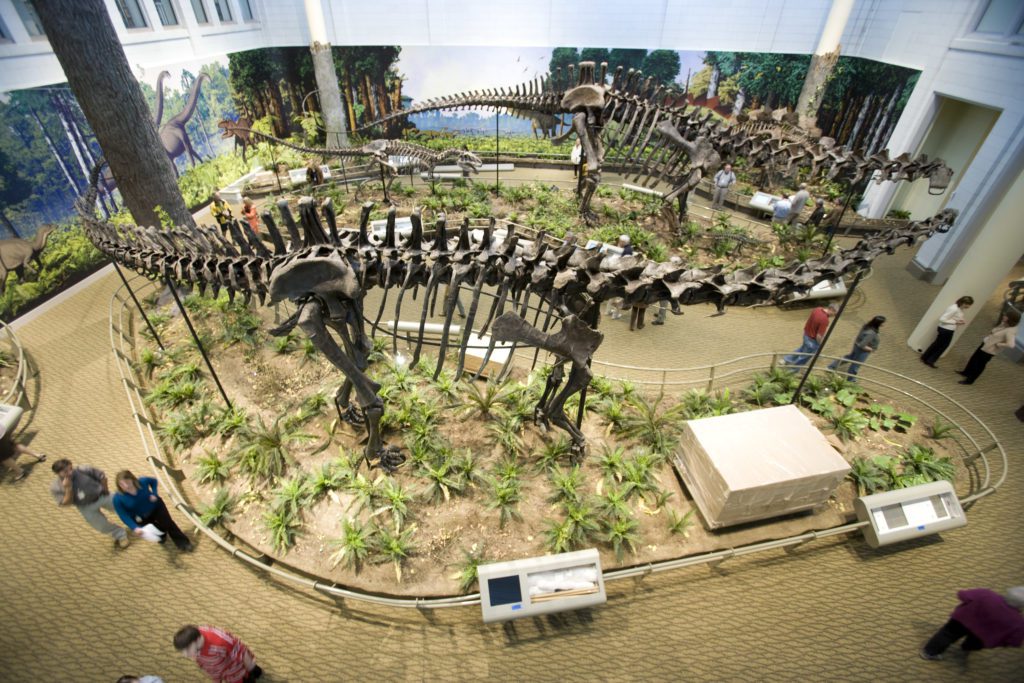
View of Dinosaurs in Their Time exhibition from above
Image credit: Joshua Franzos, Treehouse Media

Both visitors and staff love Carnegie Museum of Natural History’s Dinosaurs in Their Time exhibition for many reasons. For some people, it is the huge dinosaurs such as Tyrannosaurus and Diplodocus that capture the imagination. For others, it is the Quetzalcoatlus that soars above the latest Cretaceous display, or the cute Psittacosaurus with its strange tail ornamentation. But for me, my favorite specimen is a rather obscure fossil replica hidden in plain sight in the Triassic and Early Jurassic area of the hall. Its name is Icarosaurus, and it is quite possibly one of the strangest animals that we have on display. When one first sees it, it looks like a cast of a jumble of bones on a background of dark shale. However, as you will come to realize, Icarosaurus is far more than just that!

The Carnegie Museum’s Icarosaurus (which is a high-quality replica of the only known original fossil) is displayed in a glass case alongside many other casts and fossils from what is known as the Newark Supergroup, a large deposit of rocks that snake their way from South Carolina to New Brunswick and Nova Scotia. These rocks were deposited during the Triassic and early Jurassic periods, or from roughly 230 to 190 million years ago. The sedimentary rocks here are intermittently intruded by younger volcanic rocks, indicating that this area was undergoing tremendous geological change at this time. During the Triassic and Early Jurassic, the supercontinent Pangaea was in the process of splitting up. The eastern coast of North America was rifting from western Africa, opening a furrow that would become the Atlantic Ocean. Before it was ocean, though, the rift was filled with lakes that were similar to Lake Victoria and Lake Tanganyika in today’s Great Rift Valley in Africa. The climate was warmer, too, and so the environment was wet and tropical. Due to climatic changes and natural oscillations in Earth’s orbit, these ancient rift environments would go through stages, from deep lakes to mudflats. Each layer preserved the remains of life that lived during that specific interval. Layers of rock deposited in deep lakes often contain abundant fossils of fishes, invertebrates, and reptiles. Other layers preserve footprints of early dinosaurs and other animals. Still others preserve the remains of cynodonts, which were the forerunners of mammals.

Dating to the late Triassic Period, the remains of Icarosaurus were discovered in one of the deep lake deposits by three teenagers in a quarry near North Bergen, New Jersey, which is just outside New York City. Upon discovering the fossil, they realized its importance and donated it to New York’s American Museum of Natural History, where it was named in 1966 as Icarosaurus siefkeri. This is, to this day, the only known specimen of this reptile, so it is of tremendous scientific value. Other lizard-like reptiles had been found in these deposits, but what made Icarosaurus so unique were the extremely long and unusual ribs that extended from its body. These ribs are similar in form to those of lizards in the extant genus Draco, which have elongated ribs connected by membranes of skin that they extend to glide between trees in their Southeast Asian rainforest homes. Because the rib anatomy of this modern group is so similar to that of Icarosaurus, scientists reasoned that the latter would have glided between trees in a comparable manner.

Icarosaurus was not the first reptile to have evolved this trait, though. During the Permian Period, around 260 million years ago, reptiles such as Coelurosauravus had adapted to a gliding lifestyle. Other extinct reptiles that evolved gliding morphologies include Mecistotrachelos from the Triassic of Virginia and Xianglong from the Cretaceous of China. The extreme similarity between these distantly related reptile groups is a remarkable example of convergent evolution, which is a process where organisms evolve the same traits due to their populations facing similar selective pressures. Other examples of convergent evolution that can be seen in the Triassic and Early Jurassic exhibits in Dinosaurs in Their Time are the phytosaurs Redondasaurus and Rutiodon, which resemble their distant relatives, crocodiles, and ichthyosaurs such as Ichthyosaurus and Stenopterygius, which bear an uncanny resemblance to dolphins.

The high school students that discovered Icarosaurus were lauded for their donation, and the discovery of such an odd animal made headlines in both the local and national news. Unfortunately, though, the fame and unique nature of the fossil caused some issues. The man for whom Icarosaurus siefkeri was named, Alfred Siefker, repossessed the fossil to put it in his personal collection in 1989. It stayed there until 2000, when he tried to sell it at auction. Understandably, the scientific community was upset with this decision, because if the fossil were to be sold into a private collection then it would be unavailable for scientific study. It was bought at the auction for well under its appraised value, and the buyer, Dick Spight, donated it back to the American Museum that same year. The original Icarosaurus specimen is currently on display at that venerable New York institution.

Overall, Icarosaurus is a remarkable little animal that deserves more attention than it gets. Look for it and other unique prehistoric animals the next time you visit the Dinosaurs in Their Time exhibition.

Zach Lyons-Weiler is a Gallery Experience Presenter in CMNH’s Life Long Learning Department. Museum staff, volunteers, and interns are encouraged to blog about their unique experiences and knowledge gained from working at the museum.

Further reading:

Colbert, Edwin Harris. “The Triassic gliding reptile Icarosaurus.” Bulletin of the American Museum of Natural History; v. 143, article 2. (1970). https://www.scientificamerican.com/article/icarosaurus-home-to-roost/

Colbert, Edwin Harris. “Adaptations for gliding in the lizard Draco.” American Museum Novitates; no. 2283. (1967).

Related Content

Folded Forest: Defining the Jurassic Period

Real Dinosaurs vs. Reel Dinosaurs: Film’s Fictionalization of the Prehistoric World

Jurassic Days: Tyrannosaurus rex

Carnegie Museum of Natural History Blog Citation Information

Blog author: Lyons-Weiler, Zach
Publication date: July 30, 2021

Share this post!

  • Share on Twitter Share on Twitter
  • Share on Facebook Share on Facebook
  • Share on Pinterest Share on Pinterest
  • Share on LinkedIn Share on LinkedIn
  • Share on Reddit Share on Reddit
  • Share via Email Share via Email

Share this post!

  • Share on Twitter Share on Twitter
  • Share on Facebook Share on Facebook
  • Share on Pinterest Share on Pinterest
  • Share on LinkedIn Share on LinkedIn
  • Share on Reddit Share on Reddit
  • Share via Email Share via Email

Filed Under: Blog Tagged With: dinosaurs, dinosaurs in their time, sssjurassic, Super Science, Vertebrate Paleontology, Zach Lyons-Weiler

June 24, 2021 by wpengine

What Did Dinosaurs Sound Like?

A Brief Foray into Paleoacoustics in Science and Film

by Niko Borish and Caroline Lee

What sound did t. rex make?

Did Dinosaurs Roar?

When you think about dinosaurs as living animals, what do you think of? Many people imagine them as they are depicted in the Jurassic Park films – giant reptiles, clad in scales, generating reverberating roars that shake the screen. Although this image is certainly entertaining, research in recent years points to unexpected findings that are no less interesting. Evidence suggests that dinosaur vocalizations were not likely to have sounded like roars at all! We’ll explore what’s known about the real voices of dinosaurs with a paleontological source and an interview with an expert who has made relevant discoveries. We’ll also discuss how the sounds you hear in the Jurassic Park films were created!

Paleoacoustics and Dinosaur Vocalizations

We had a chance to interview Dr. Julia Clarke, a paleontologist at the University of Texas, to learn more about paleoacoustics (the study of sound associated with fossils) in non-avian dinosaurs and their evolutionary descendants, birds. In Antarctica in the mid-1990s, Vegavis iaai, an ancient bird dating to around 66 to 68 million years ago, was excavated. Dr. Clarke analyzed the fossil, and in 2013 found evidence that Vegavis had a vocal organ specific to birds, known as a syrinx. In extant (meaning alive today) bird species, the syrinx is responsible for all the vocalizations we identify as bird songs or calls. This means that Vegavis most likely honked (not unlike a goose), owing to an asymmetrical third segment in the syrinx. When we asked why it took about two decades to find the syrinx after the fossil’s original discovery, Dr. Clarke answered that “discovery is not just one moment.” She received the fossil for study in 2008. When she was about to return it in 2012, she went over its computed tomographic (CT) scan images again and noticed something new – a tiny structure that looked like a simple bone fragment or toe bone on the surface of the rock. It turned out to be the syrinx! Clarke and her coauthors noted that we still don’t know when the syrinx evolved because non-avian dinosaur fossils lack this structure. Vegavis is related to extant bird species, and despite searching, no earlier dinosaur syrinxes have so far been found.

Carnivorous dinosaurs are often pictured as chasing prey while letting out intimidating roars. Other new discoveries made from studies of extant birds indicate that this image is a misconception. Dr. Clarke explained that instead of open-mouthed roars, scientists theorize that many dinosaurs may have produced closed-mouth vocalizations. Animals produce closed-mouth vocalizations by inflating their esophagus (the tube that connects the throat and stomach) or tracheal pouches (pouches on their windpipe) while keeping their mouth closed, producing something comparable to a low-pitched swooshing, growling, or cooing sound. These closed-mouth vocalizations differ substantially from open-mouth vocalizations like bird calls. Think of closed-mouth vocalizations as being lower and more percussive, as opposed to bird calls, which are more varied in pitch and almost melodic. Modern examples of closed-mouth vocalizations include crocodilian growls and ostrich booms. As a result, scientists reasoned that many dinosaurs did not perform open-mouth vocalizations, but could have generated closed-mouth vocalizations instead. Although birds evolved from theropods (a group of dinosaurs characterized by, among other attributes, hollow bones and a bipedal stance), theropods likely did not have the ability to make complex sounds similar to those of extant songbirds.

Perhaps sadly, the exciting, blood-curdling roars in the Jurassic Park franchise are not scientifically accurate. Current evidence supports that Tyrannosaurus rex made closed-mouth vocalizations, but in the films, the Tyrannosaurus opens its mouth every time it roars. That begs the question: who or what voiced the Tyrannosaurus and other Jurassic Park dinosaurs? The majority of the sounds used to create the Tyrannosaurus sonic palette came from recordings of elephant bellows. Also used were crocodilian growls, roars from lions and tigers (but not bears), the sound of water coming up from a whale’s blowhole, and even growls from the sound producer’s dog. Some other animals’ sounds that were used to make different dinosaurs’ vocalizations include: hawing donkeys, neighing horses, growling tortoises, whistling dolphins, howling howler monkeys, oinking pigs, barking fennec foxes, and chirping birds! Most of these sounds were edited and pitched up or down to fit their roles.

Another popular misconception initiated by the Jurassic Park franchise was the concept of the “Velociraptor resonating chamber.” In Jurassic Park III, the protagonists search for a “Velociraptor resonating chamber” that allows them to communicate with the Velociraptor pack. However, the possibility of this structure was debunked by Dr. Clarke and Dr. Matt Lamanna, a paleontologist at Carnegie Museum of Natural History. The resonating chamber does not actually exist. If such a chamber existed, it would only amplify the sound (auditory vibrations that travel through the air) made by dinosaurs, not modify its timbre (the tone quality of a sound) or pitch (a measure of how high or low a sound is), which would not allow humans to imitate Velociraptor sounds as shown in the movie. In other words, it would not work like a giant duck call. Additionally, the way that scientists perceive closed-mouth vocalizations to function disproves the whole idea of a resonating chamber to begin with. This is because the organs involved in vocalization include either esophageal or tracheal pouches but no dedicated “resonating chamber.”

What non-avian dinosaurs really sounded like is an enigma currently being uncovered by teams of researchers like that led by Dr. Clarke. All in all, while the movies are certainly helpful for getting people interested in dinosaurs and paleontology, a logical next step is to schedule a visit to Carnegie Museum of Natural History to get the real facts!

We would like to extend a gargantuan thank-you to Dr. Julia Clarke and Dr. Matt Lamanna for generously offering expertise for our blog! Their help evolved our blog to the next level, and for that we are extremely grateful.

Niko Borish and Caroline Lee are Teen Volunteers in the Education Department. Museum employees, volunteers, and interns are encouraged to blog about their unique experiences and knowledge gained from working at the museum.

References

Analysis of fossilized Antarctic bird’s ‘voice box’ suggests dinosaurs couldn’t sing. (2016, October 12). National Science Foundation. Retrieved March 7, 2021, from https://www.nsf.gov/news/news_summ.jsp?cntn_id=189996

Clarke, J. (2016, July 16). New Research Debunks The Dinosaur’s Roar (Interview by L. Wertheimer) [Radio broadcast]. In Weekend Edition Saturday. National Public Radio. https://www.npr.org/2016/07/16/486279631/new-research-debunks-the-dinosaurs-roar

Riede, T., Eliason, C. M., Miller, E. H., Goller, F., & Clarke, J. A. (2016). Coos, booms, and hoots: The evolution of closed-mouth vocal behavior in birds. Evolution, 1734-1746. https://doi.org/10.1111/evo.12988

Taylor, D. (Host), & Nelson, A., & Clarke, J. (n.d.). Tyrannosaurus FX (No. 105) [Audio podcast episode]. In L. Battison (Producer), Twenty Thousand Hertz. Twenty Thousand Hertz. https://www.20k.org/episodes/tyrannosaurusfx

Related Content

Diplodocus carnegii (Dippy) – Dinosaur Spotlight

Mesozoic Monthly: Volaticotherium

Fancy Feathers: An Unexplained Complexity in Evolutionary History

Carnegie Museum of Natural History Blog Citation Information

Blog author: Borish, Niko; Lee, Caroline
Publication date: June 24, 2021

Share this post!

  • Share on Twitter Share on Twitter
  • Share on Facebook Share on Facebook
  • Share on Pinterest Share on Pinterest
  • Share on LinkedIn Share on LinkedIn
  • Share on Reddit Share on Reddit
  • Share via Email Share via Email

Filed Under: Blog Tagged With: Caroline Lee, dinosaurs, dinosaurs in their time, Niko Borish, Vertebrate Paleontology

March 31, 2021 by wpengine

MESOZOIC MONTHLY: Volaticotherium

by Lindsay Kastroll

Once again, spring has sprung. Prepare to see the gorgeous forests of Pennsylvania launch back into action. I, for one, can’t wait to get outside and explore as the weather continues to improve. I was recently reminded of the fact that Pennsylvania is home to two species of flying squirrels, and I am definitely adding them to my list of things to see. But of course, this is Mesozoic Monthly, so flying squirrels can’t be the stars of this article. Instead, the superficially flying squirrel-like “ancient gliding beast” Volaticotherium antiquum is stealing the spotlight!

Although Volaticotherium was about the size of a modern flying squirrel at 5–6 inches (13–15 cm) long, it belonged to a group of early mammals called eutriconodonts that includes some of the largest mammals that lived alongside non-avian dinosaurs. “Eutriconodont” means “true three-coned tooth,” in reference to the three longitudinally aligned cusps on their molars. Although not all mammals today have three-cusped molars, the ancestors of modern mammals did. Does this mean that modern mammals evolved from a eutriconodont? The answer is no, though they did evolve from a mammal with eutriconodont-like teeth.

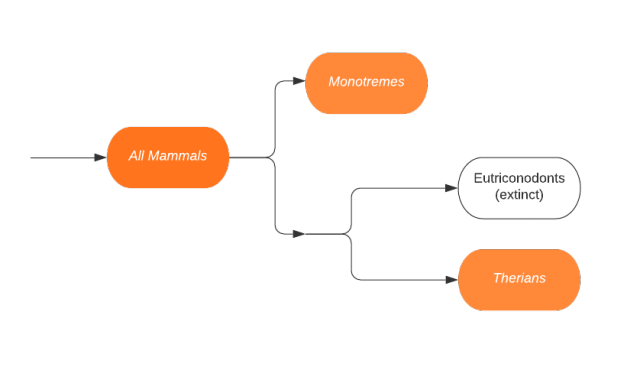
We can split modern mammals into two main groups: the monotremes, which are egg-laying mammals like the platypus, and the therians, which include both marsupial and placental mammals (like kangaroos or humans, respectively). The ancestors of monotremes diverged (meaning, formed their own ‘branch’ of the evolutionary tree) before eutriconodonts and therians evolved. Eutriconodonts and therians share a different, more recent, and as-yet unknown common ancestor. Monotremes, therians, and eutriconodonts actually lived alongside one another for over one hundred million years before eutriconodonts became extinct near the end of the Cretaceous Period (the third and final division in the Mesozoic Era, or ‘Age of Dinosaurs’).


This flowchart represents a simplified phylogeny (aka, evolutionary tree) of the relationships discussed in the previous paragraph. A lot of ‘branches’ and intermediate steps are missing from this phylogeny to make it easier to follow.

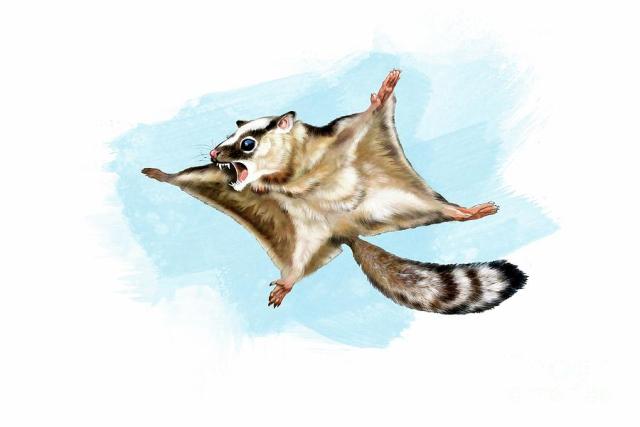
The canines and molars of eutriconodonts were pointy, suggesting that these mammals were carnivores or insectivores. Volaticotherium is no exception, which makes it particularly unique, as most other gliding mammals are herbivores! Because it was so small, Volaticotherium was probably an insectivore, but a larger cousin, Jugulator, could probably eat small vertebrates. As an arboreal glider, Volaticotherium could soar from tree to tree to catch insects in midair. Instead of wings, it had a patagium, a broad flap of skin that stretched between the fore- and hind limbs, creating enough surface area to achieve gliding descents. The various limb adaptations necessary to make Volaticotherium an efficient glider also made it poor at maneuvering on the ground. It can be hard to understand why an animal would evolve features that would hinder its terrestrial movement, and multiple hypotheses have been put forth to try to explain this. Most of these focus on the benefits of leaping out of trees to escape predators or to quickly traverse territory between arboreal food sources, scenarios based on herbivorous mammals. Because Volaticotherium was a gliding predator, perhaps gliding conferred other advantages to this eutriconodont.

Restoration of Volaticotherium in mid-glide by Jose Antonio Peñas, used with permission. Take note of those sharp canine teeth, useful for catching tasty insects! You can find more of Peñas’ art on their DeviantArt, ArtStation, or YouTube.

The fossilized remains of Volaticotherium were found in a layer of rock called the Daohugou Bed in China. This deposit consists of lakebed sediment and volcanic ash compacted into solid rock over millions of years as more heavy sediment was deposited on top of it. There is a debate about how old the Daohugou Bed is, but most estimates place it near the middle or end of the Jurassic Period (the middle period of the Mesozoic). Getting the timing right is important. Because Volaticotherium is among the oldest known gliding mammals, its discovery pushes the origin of mammalian gliding back as much as 70 million years earlier than previously thought!

A variety of factors have led geologists to struggle in determining the age of the Daohugou Bed. In an ideal geologic record, rock layers would be perfectly horizontal, creating a continuous stack with the oldest layers on the bottom and the newest layers on top. However, this is rarely the case. Sediment may be eroded before new layers are deposited, creating a gap of time without record in that sequence of rocks. This phenomenon, where two rock layers do not represent a continuous progression of time and have a gap of data missing between them, is called an unconformity. Other issues with dating rock layers involve the squeezing, stretching, folding, melting, and chemical alteration of rock layers when they’re subjected to geologic processes. These forces can result in old rock layers being placed on top of younger ones, making it hard to determine the actual sequential order of the rocks. Changes can also occur within the minerals that compose the rocks, making radiometric dating much more difficult.

The Daohugou Bed has an unconformity above and below it, and it has been folded, which makes attributing an exact age to it that much harder. When you go out hiking in the beautiful spring weather on the horizon, take a moment to look at the rock outcrops you pass and think about what those layers might have experienced on their journey to where they are today. And if you continue your hike after sunset, be sure to keep your eyes peeled. If you’re lucky, you might just catch a glimpse of a flying squirrel gliding through the forest!

Lindsay Kastroll is a volunteer and paleontology student working in the Section of Vertebrate Paleontology at Carnegie Museum of Natural History. Museum staff, volunteers, and interns are encouraged to blog about their unique experiences and knowledge gained from working at the museum.

Related Content

Mesozoic Monthly: Nasutoceratops

Researchers Announce Surprising Clue in the Evolution of the Mammalian Middle Ear

Ah, Snap! Dino Named for Marvel’s Thanos

Carnegie Museum of Natural History Blog Citation Information

Blog author: Kastroll, Lindsay
Publication date: March 31, 2021

Share this post!

  • Share on Twitter Share on Twitter
  • Share on Facebook Share on Facebook
  • Share on Pinterest Share on Pinterest
  • Share on LinkedIn Share on LinkedIn
  • Share on Reddit Share on Reddit
  • Share via Email Share via Email

Share this post!

  • Share on Twitter Share on Twitter
  • Share on Facebook Share on Facebook
  • Share on Pinterest Share on Pinterest
  • Share on LinkedIn Share on LinkedIn
  • Share on Reddit Share on Reddit
  • Share via Email Share via Email

Filed Under: Blog Tagged With: dinosaurs in their time, Lindsay Kastroll, Science News, Vertebrate Paleontology

  • Page 1
  • Page 2
  • Page 3
  • Interim pages omitted …
  • Page 10
  • Go to Next Page »

sidebar

About

  • Mission & Commitments
  • Directors Team
  • Museum History

Get Involved

  • Volunteer
  • Membership
  • Carnegie Discoverers
  • Donate
  • Employment
  • Events

Bring a Group

  • Groups of 10 or More
  • Birthday Parties at the Museum
  • Field Trips

Powdermill

  • Powdermill Nature Reserve
  • Powdermill Field Trips
  • Powdermill Staff
  • Research at Powdermill

More Information

  • Image Permission Requests
  • Science Stories
  • Accessibility
  • Shopping Cart
  • Contact
  • Visitor Policies
One of the Four Carnegie Museums | © Carnegie Institute | Privacy Policy | Terms of Use | Accessibility
Rad works here logo