• Skip to primary navigation
  • Skip to main content
  • Skip to primary sidebar

Carnegie Museum of Natural History

One of the Four Carnegie Museums of Pittsburgh

  • Visit
    • Buy Tickets
    • Visitor Information
    • Exhibitions
    • Events
    • Dining at the Museum
    • Celebrate at the Museum
    • Powdermill Nature Reserve
    • Event Venue Rental
  • Learn
    • Field Trips
    • Educator Information
    • Programs at the Museum
    • Bring the Museum to You
    • Guided Programs FAQ
    • Programs Online
    • Climate and Rural Systems Partnership
  • Research
    • Scientific Sections
    • Science Stories
    • Science Videos
    • Senior Science & Research Staff
    • Museum Library
    • Science Seminars
    • Scientific Publications
    • Specimen and Artifact Identification
  • About
    • Mission & Commitments
    • Directors Team
    • Museum History
  • Tickets
  • Give
  • Shop

Vertebrate Paleontology

December 9, 2020 by wpengine

The Bromacker Fossil Project Part XII: Tambacarnifex unguifalcatus, the Tambach executioner

New to this series? Read The Bromacker Fossil Project Part I, Part II, Part III, Part IV, Part V, Part VI, Part VII, Part VIII, Part IX, Part X, and Part XI. 

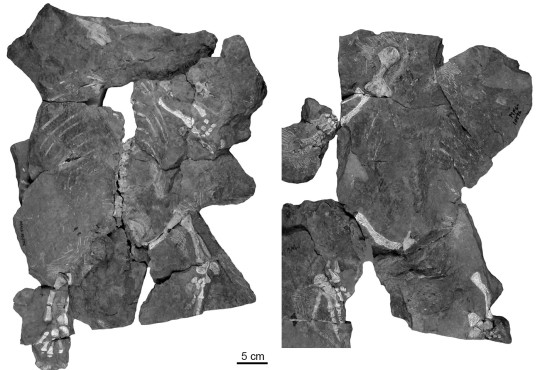
Holotype specimen of Tambacarnifex unguifalcatus, preserved in couterparts. Photographs by Dave Berman, 2010.

Tambacarnifex unguifalcatus was discovered by Thomas Martens and his father Max in 1995 in the same pocket of fossils from which the first-discovered specimen of the herbivorous basal synapsid Martensius bromackerensis was recovered. Because numerous fossil animals were jumbled together, Thomas and Max weren’t able to collect individual specimens from the bone pocket using our standard technique of surrounding a specimen in a plaster and burlap jacket. Instead, they collected all the individual pieces of rock that contained bone or at least appeared to contain bone, as most rock pieces were coated in goopy mud. Thomas cleaned the rock pieces with water to reveal the bone, and then pieced together the various specimens.

He eventually sent us the specimen that became the holotype of Tambacarnifex, along with pieces that he thought might go with it. Dave and I spent hours piecing together the remainder of the skeleton, and we searched the collections at the Museum der Natur, Gotha for missing pieces in subsequent field seasons. The majority of the specimen was recovered, but the skull, a few vertebrae, and distal finger and toe bones are missing. A rock piece with the greater portion of a lower jaw with teeth was also collected from the bone pocket, though it couldn’t be associated with the skeleton and may represent a second individual. A lot of bone was lost from the specimen, but impressions of missing bone were preserved, which proved useful for identifying wrist and ankle bones, among others. Dave used a white pencil to color in the bone impressions so they would stand out for study and in photographs of the specimen. Ultimately, we realized that Martensius and Tambacarnifex were preserved one on top of the other, though separated by several inches of rock.
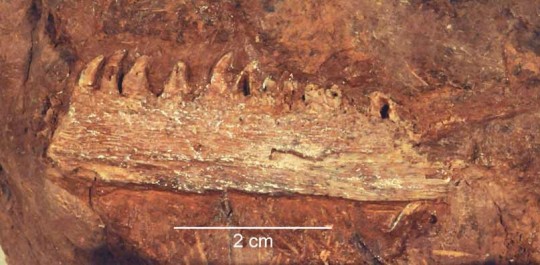
The lower jaw piece of Tambacarnifex unguifalcatus. Photograph by Dave Berman, 2008.

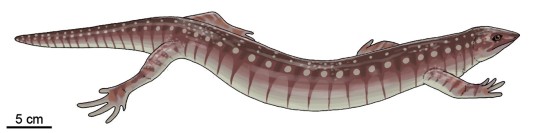
The teeth of Tambacarnifex preserved in the lower jaw are strongly recurved and flattened side-to-side, which, along with other features preserved in the skeleton, indicate it is a member of the basal synapsid group (family) Varanopidae and in the subfamily Varanopinae. The Varanopidae have been likened to the actively predaceous modern monitor lizards in the family Varanidae, hence the similar name. Varanopids were the most diverse and longest-surviving basal synapsids, being known from the Late Carboniferous–Middle Permian (~309–260 million years ago) of North America, Europe, Asia, and Africa. With their sharp, recurved teeth and a gracile skeleton, scientists think varanopids were agile predators, at least compared to other animals of their time. They range from about 12–78 inches in length, with the smallest ones probably being insectivorous and the larger ones carnivorous. Tambacarnifex has an estimated body size of about 35 inches, and as a medium-sized varanopid with gracile limbs it would have been an agile carnivore, preying on on any of the Bromacker vertebrates that it could catch.
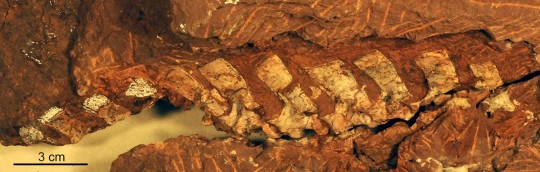
An articulated but incompletely preserved series of 11 vertebrae of Tambacarnifex unguifalcatus. Notice that the neural spines are low and subrectangular, so it is unlikely that they supported a sail, as occurs in some other basal synapsids such as Dimetrodon teutonis. The front of the animal is to the left. Photo by Dave Berman, 2008.

Unlike Dimetrodon teutonis, the other apex predator at the Bromacker, Tambacarnifex has broad, low neural spines that alternate in height. It differs from other varanopines in the shape and anterior inclination of its neural spines and in having greatly elongated and recurved bony claw supports in its hands and feet. The generic name Tambacarnifex was coined in reference to its position in the food chain: “Tamba,” for the Tambach Basin, which the holotype inhabited, and the Latin “carnifex,” meaning executioner, for its role as an apex predator. “Unguifalcatus” was derived from the Latin “unguis,” nail or claw, and “falcatus,” meaning sickle-shaped, in reference to the long, strongly recurved bony claw supports.
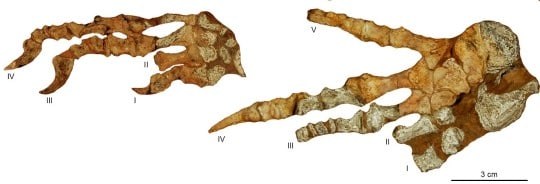
Incomplete front (left) and hind (right) feet of Tambacarnifex unguifalcatus. Notice the extremely long bony claw supports preserved on the first, third, and fourth fingers of the front foot and the fourth toe of the hind foot. I–V refer to finger and toe numbers. Photos by Dave Berman, 2008.
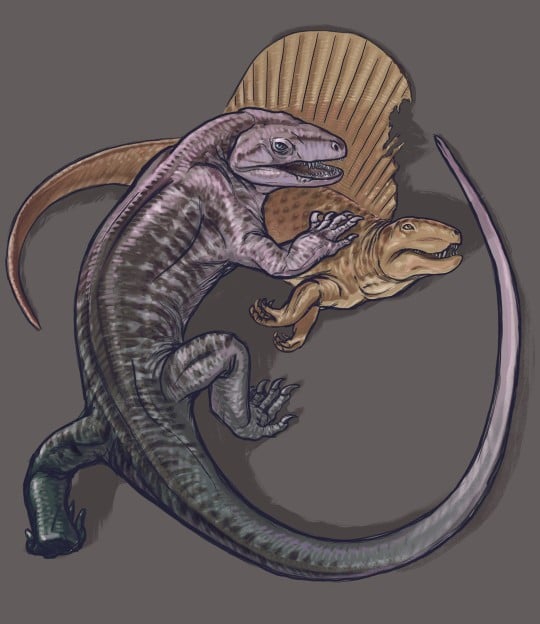
Illustration of Tambacarnifex unguifalcatus consuming a Dimetrodon teutonis carcass. Outline drawing by Matt Celeskey, colored (with permission) by Carnegie Museum of Natural History Vertebrate Paleontology Scientific Illustrator Andrew McAfee.

Stay tuned for the final post of this series, which will summarize what we’ve learned about the Bromacker. Click here if you would like to download your own copy of the outline drawing of Tambacarnifex consuming Dimetrodon to color in. The paper describing Tambacarnifex unguifalcatus can be viewed by clicking here.

Amy Henrici is Collection Manager in the Section of Vertebrate Paleontology at Carnegie Museum of Natural History. Museum employees are encouraged to blog about their unique experiences and knowledge gained from working at the museum.

Related Content

Ask a Scientist: What is it like to discover a new species? 
Mesozoic Monthly: Gargoyleosaurus

Cephalopod Fossils from Lyme Regis, England

Filed Under: Blog Tagged With: Amy Henrici, dinosaurs in their time, Museum from Home, Science News, Vertebrate Paleontology

November 30, 2020 by wpengine

Mesozoic Monthly: Scipionyx

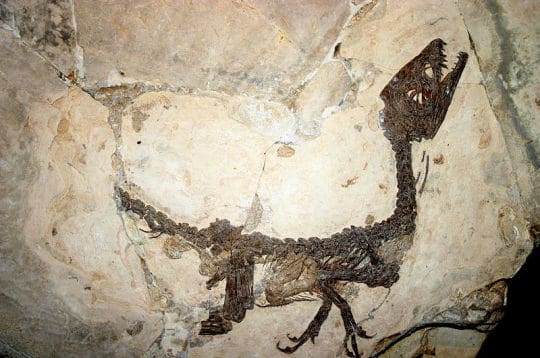
My high school calculus teacher, Mr. Surovchak, once told me about a competition he and his brother had every Thanksgiving. They would weigh themselves before and after dinner to indisputably measure who was able to eat the most. When it comes to dinosaurs, it’s typically much harder to tell what and how much they ate. However, a few fossils give us windows into the guts of dinosaurs – literally! Paleontologists are extremely thankful for spectacular fossils like that of Scipionyx samniticus, a small theropod dinosaur with several internal organs preserved!

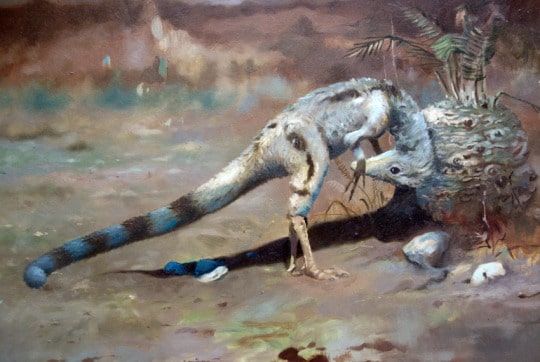
Oil painting of Scipionyx samniticus in its Early Cretaceous environment by Emiliano Troco, used with permission. You can find more of their work on their Tumblr and contact them via their WordPress site.

Theropods, like Scipionyx, are dinosaurs that stand on two legs, usually with only three prominent toes on each hind foot. Some of the most famous dinosaurs are theropods, like Tyrannosaurus, Velociraptor, and previous Mesozoic Monthly honoree Citipati (does that make it famous? I like to think so). Most theropods interacted with the world primarily with their heads rather than their hands, hence why several of them look like they have oversized skulls and relatively underdeveloped forelimbs. Many also had hollow bones, and, as we can see in extremely well-preserved fossils, feathers. Is this all starting to sound familiar? That’s because these are also features of birds! If you’ve ever heard someone say that birds are dinosaurs, that’s because modern birds, which are called Aves or Neornithes, are just one evolutionary subset of theropod dinosaurs! Birds have all these features of theropod dinosaurs, plus others like toothless beaks and wings made partly from fused wrist and hand bones. If you are eating turkey for Thanksgiving dinner, remember that you’re eating a dinosaur!

Scipionyx didn’t look much like a turkey, though. It belonged to a group of theropods called compsognathids, which were long-tailed, slender, and relatively small predators. It wasn’t imposing size or an especially fascinating appearance that made Scipionyx special – it was the way the only known specimen was fossilized. It is so well preserved that many of its internal organs are intact in its body cavity! Petrified tissue from the trachea, small intestine, and even rectum can be seen in the fossil, as well as muscle tissue, blood vessels, and traces of other organs. We can tell from the bones and scales in its digestive tract that it ate several meals of lizards and fish before it died. There is such a wealth of biological information preserved in this single specimen, and we can learn even more when we consider its relatives. Although skin didn’t preserve in Scipionyx, at least one fossil of another compsognathid named Sinosauropteryx has such well-preserved skin and filament-like ‘protofeathers’ that we can even see pigments preserved! Based on Sinosauropteryx, we can assume that Scipionyx had some sort of filamentous or fuzzy covering as well, at least over some parts of its body.

The incredible fossil of Scipionyx preserves the dinosaur’s internal organs in 3D! For example, the sinuous shape of the small intestine is visible immediately behind the right elbow. Photo by Giovanni Dall’Orto on Wikimedia Commons. You can read more about this specimen in a paper by Dal Sasso and Maganuco (2011).

The fossil of Scipionyx is very small because the individual in question was just a hatchling when it died. Paleontologists can tell it was a hatchling, and not a small adult animal, because its proportions are similar to those of other juvenile dinosaur fossils and many of its bones had not yet fused together (you can learn more about how bones fuse as organisms get older in the Nemicolopterus edition of Mesozoic Monthly). The baby Scipionyx individual represented by the fossil would have measured around 18 inches (46 cm) long in life, and estimates based on how other compsognathids grew suggest that its species reached about 7 feet (2.1 meters) in length at adulthood. Not much is known about its habitat, but it was likely one of the largest animals around. Scipionyx was found in deposits laid down in a marine environment in what is now Italy. Back in the early part of the Cretaceous Period (the third and final division of the Mesozoic Era, or ‘Age of Dinosaurs’), when Scipionyx was alive, Italy was mostly under a shallow sea dotted with small islands, and the dinosaur would have lived on one of these. Since then, tectonic activity has dramatically changed the region, creating new mountains and lowering sea level to what it is today.

So, this Thanksgiving, if you’re looking for a conversation starter at the dinner table/family video call (or if you urgently need to divert discussion from a more sensitive topic), here’s an idea: ask your dining partners whether they think non-avian theropods like Scipionyx would have tasted more like turkey or chicken! Or, if your loved ones would rather learn than debate, you could perhaps offer to read them any of the 12 Mesozoic Monthly animal spotlights (that’s right, December makes one whole year of Mesozoic Monthly!). I’d certainly feel honored to make an appearance at your Thanksgiving feast.

Lindsay Kastroll is a volunteer and paleontology student working in the Section of Vertebrate Paleontology at Carnegie Museum of Natural History. Museum staff, volunteers, and interns are encouraged to blog about their unique experiences and knowledge gained from working at the museum.

Related Content

Mesozoic Monthly: Champsosaurus

The Two-Headed Dinosaur

Ask a Scientist: What is still unknown about “The Chicken from Hell?”

Filed Under: Blog Tagged With: dinofest, dinosaurs, dinosaurs in their time, Lindsay Kastroll, Mesozoic Monthly, Science News, Vertebrate Paleontology

November 4, 2020 by wpengine

The Bromacker Fossil Project Part XI: Dimetrodon teutonis, an apex predator

New to this series? Read The Bromacker Fossil Project Part I, Part II, Part III, Part IV, Part V, Part VI, Part VII, Part VIII, Part IX, and Part X. 

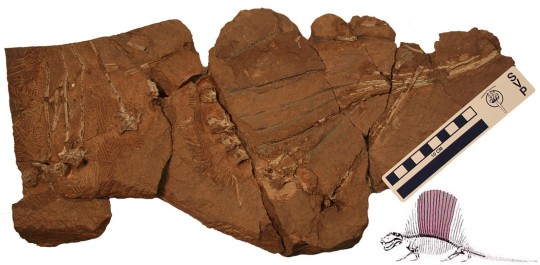
Holotype specimen of Dimetrodon teutonis, which consists of a partial vertebral column. The preserved portion of this vertebral column is highlighted in the reconstruction of Dimetrodon (lower right). Photograph by the author, 2007. Dimetrodon reconstruction modified from Romer and Price, 1940.

Specimens of two top predators have been discovered at the Bromacker quarry. Like Martensius, both are basal members of the group Synapsida, the later members of which gave rise to mammals. You might be familiar with one of them – Dimetrodon, a synapsid sometimes incorrectly portrayed with dinosaurs, which carried a tall sail on its back that was supported by bony spines. The other is a new genus and species that will be presented in my next post.

The fossil pictured above, the first-discovered specimen of Dimetrodon from the Bromacker quarry, may not look like much, but it was the first record of Dimetrodon outside of North America. The circumstances under which it was found were very different from the discovery of other fossils from the Bromacker quarry. Before Dave Berman and I arrived for the 1999 field season, Thomas Martens noticed that someone, possibly a fossil poacher, had been in the quarry overnight and knocked some rocks off the quarry lip. The rocks apparently broke upon hitting the ground, which exposed some bones. Thomas carefully picked them up and took them to his lab at the Museum der Natur, Gotha (MNG). When Dave and I met Thomas at the quarry on our first day of the field season, Thomas mentioned the find and told us that he thought the bones were ribs. We didn’t think much of it, other than horror at learning a fossil poacher might have visited the quarry overnight, one of our worst fears.

As planned, Dave and I spent the last day of the field season in the museum collections, and when Thomas let us in that morning, he reminded us to look at the potential ribs and told us where they were. Shortly after we began examining them, Dave and I simultaneously realized that the “ribs” were actually spines of Dimetrodon. We couldn’t believe our eyes, because of all the Early Permian fossils known from North America, Dimetrodon was Thomas’ favorite. Indeed, he’d used an image of it on signs at the Bromacker and included a model of Dimetrodon in a diorama, once on display in the MNG, that showed models of Bromacker animals in their environment. Thomas jumped for joy later that day when we gave him the news.

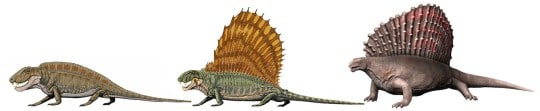
So how did Dave and I so quickly realize that the “ribs” were spines of Dimetrodon? Besides Dimetrodon, some other basal synapsids had sails, the function of which remains unknown, though scientists have speculated they could’ve been used for display or regulating body temperature. The spines (known as neural spines) supporting the sails vary in shape and length, with those of Dimetrodon and its herbivorous relative Edaphosaurus being tall and narrow, and those of another relative, the carnivorous Sphenacodon, being shorter and blade-like. Neural spines of Dimetrodon are easy to distinguish, because in addition to being long they bear fore and aft grooves, which create a dumbbell-shaped cross-sectional outline, and they lack the ‘crossbars’ that occur on the long neural spines of Edaphosaurus. When Dave and I saw the fore and aft grooves, the dumbbell-shaped cross-sectional outline of some broken spine ends, and an absence of crossbars, we knew that the “ribs” were indeed spines of Dimetrodon.

Flesh reconstructions of Sphenacodon sp. (left), Dimetrodon grandis (middle), and Edaphosaurus pogonias (right) to show the differences between their sails. Note that Dimetrodon and Sphenacodon are more closely related to one another than they are to Edaphosaurus, despite their different sail shapes. Reconstructions of Sphenacodon and Dimetrodon by Dmitry Bogdanov and that of Edaphosaurus by Nobu Tamura, all from Wikimedia Commons.

The Bromacker Dimetrodon is considerably smaller than other known species of the genus, and this is one character among other more detailed anatomical features that distinguishes it. For the new species name, Dave selected the Latin “teutonis,” which means an individual of a German tribe, in reference to the geographic origin of the holotype specimen.

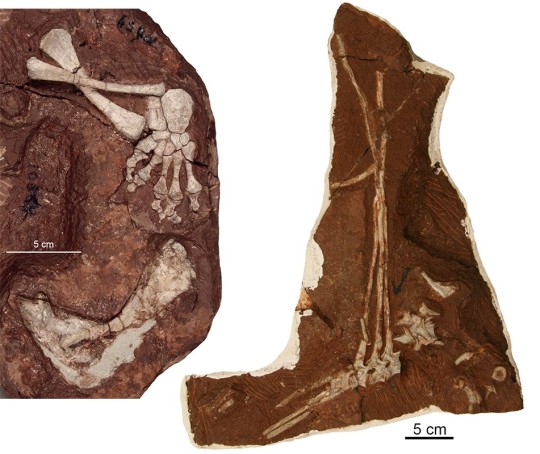
Two additional specimens of Dimetrodon teutonis. Left, hindleg and shoulder girdle bone (fused scapulocoracoid) and right, several vertebrae bearing complete to nearly complete neural spines of an individual that was larger and presumably more mature than the holotype. Photographs by the author, 2007.

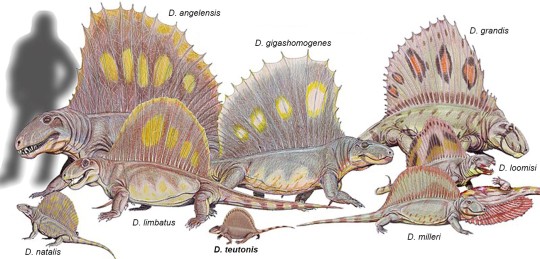
Dave was able to use a mathematical equation involving measurements of the vertebrae to estimate the holotype’s weight as a living animal at 31 pounds. In contrast, other known Dimetrodon species have estimated weights of about 81–550 pounds. We later discovered additional partial specimens of Dimetrodon at the Bromacker quarry, and Dave estimated the weight of the largest specimen with vertebrae at 53 pounds, still considerably less than that of what had previously been the smallest species, D. natalis from Texas. Dimetrodon is otherwise known from numerous species from the American mid-continent and southwest that generally got larger through time.

Reconstructions of various species of Dimetrodon drawn to scale. The diminutive D. teutonis is at bottom center and D. natalis, no longer the smallest species, is at bottom left. Illustration adapted from Dmitry Bogdanov via Wikimedia Commons.

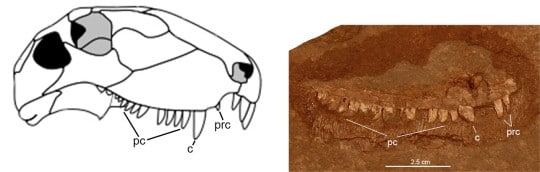
All Dimetrodon species have teeth adapted for meat-eating in being teardrop-shaped with sharp edges for slashing flesh. By size and jaw position these sharp teeth are divided into precanines, canines, and postcanines of varying numbers. Unlike D. teutonis, some species even had fine serrations on their tooth edges. The only known upper jaw bone of Dimetrodon teutonis clearly has two canines, but one is missing and represented by a large gap in the tooth row that would have accommodated this tooth. The second canine is represented only by its broad base, but it too must have been large. Although it was a small animal, the teeth of D. teutonis indicate that it was a meat-eater and as such would have preyed on other vertebrates from the Bromacker, many of which were even smaller.

Diagrammatic drawing of the skull of Dimetrodon (left) and photograph of the maxilla or upper jaw bone (right) of D.teutonis. Abbreviations: c, canine; pc, postcanine; prc, precanine. Photographs by the author, 2007. Drawing of skull from Wikimedia Commons.

Stay tuned for my next post, which will be about the second-known apex carnivore from the Bromacker. In the meantime, here are links to scientific papers on Dimetrodon teutonis:

https://www.researchgate.net/publication/325670232_A_new_species_of_Dimetrodon_Synapsida_Sphenacodontidae_from_the_Lower_Permian_of_Germany_records_first_occurrence_of_genus_outside_of_North_America

https://www.researchgate.net/publication/288544821_New_materials_of_Dimetrodon_teutonis_Synapsida_Sphenacodontidae_from_the_Lower_Permian_of_Germany

Amy Henrici is Collection Manager in the Section of Vertebrate Paleontology at Carnegie Museum of Natural History. Museum employees are encouraged to blog about their unique experiences and knowledge gained from working at the museum.

Keep Reading

The Bromacker Fossil Project Part XII: Tambacarnifex unguifalcatus, the Tambach Executioner 

Filed Under: Blog Tagged With: Amy Henrici, Museum from Home, Science News, Section of Vertebrate Paleontology, The Bromacker Fossil Project, Vertebrate Paleontology

October 29, 2020 by wpengine

Mesozoic Monthly: Gargoyleosaurus

Do you know what you’re going to dress up as for Halloween? This year, I’ll be going to work dressed as Velma Dinkley from Scooby-Doo. For the October edition of Mesozoic Monthly, I’ll be ‘unmasking’ a dinosaur with a monstrous name: Gargoyleosaurus parkpinorum, an armored dinosaur from the Jurassic Period!

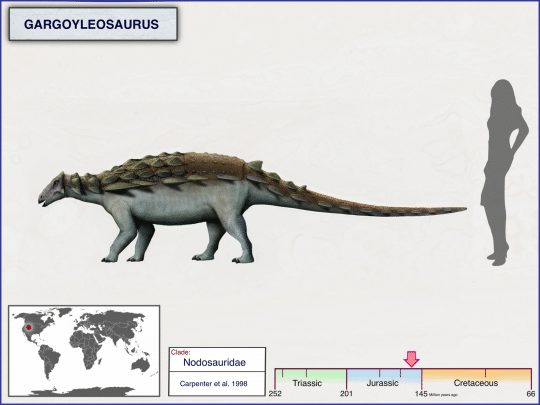
image
Handy infographic of the ankylosaur Gargoyleosaurus parkpinorum showing its appearance, size, geographic and temporal occurrence, and more. Art by cisiopurple on DeviantArt, used with permission.

Gargoyleosaurus belongs to my favorite group of dinosaurs: the ankylosaurs! The group Ankylosauria is comprised of many big-bodied herbivores covered in osteoderms, which are pieces of bone embedded in the skin that act like armor. Their osteoderms came in many shapes and sizes, from tiny ossicles that protected their bellies, to large, fused pieces of bone that formed club-like structures on their tails. In most cases you can easily distinguish between the two major groups of ankylosaurs based on their style of osteoderms (though there are other features that distinguish them as well). Ankylosaurids are famous for their tail clubs: the last vertebrae in their tail overlap to form a rigid ‘handle’ that ends with a mass of fused osteoderms akin to a club. Nodosaurids, their sister group, sported massive osteoderm spikes on their shoulders instead of clubs on their tails. Some paleontologists distinguish a third group of ankylosaurs, called polacanthids, which have a rectangular ‘pelvic shield’ made of fused osteoderms that rests over the hips. There’s a lot of overlap between ‘nodosaurid’ and ‘polacanthid’ characteristics, though, so ankylosaurs with pelvic shields are typically grouped in with the nodosaurids instead of being recognized as their own group.

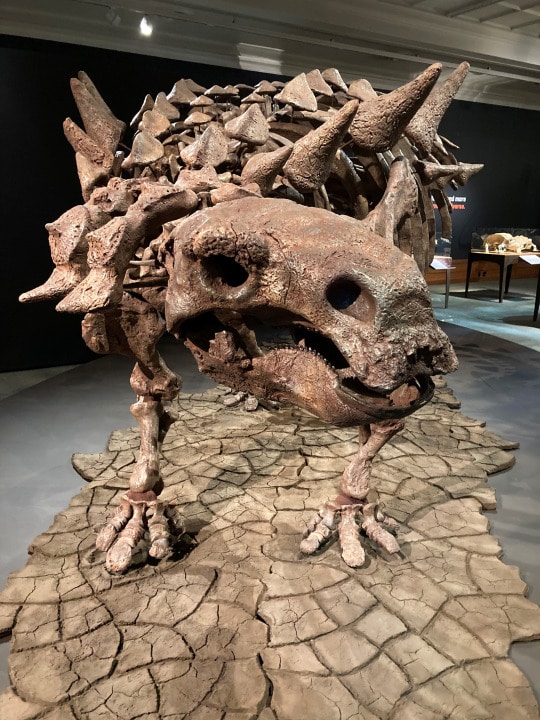
Conveniently, the Dinosaur Armor temporary exhibition at Carnegie Museum of Natural History features representatives of all three (or both, depending on your taxonomic preference!) ankylosaur subgroups: the ankylosaurid Akainacephalus, the nodosaurid Peloroplites, and the polacanthid (= nodosaurid?) Gastonia.

image
The imposing nodosaurid ankylosaur Peloroplites as seen in CMNH’s Dinosaur Armor exhibition. Check out those giant, spike-shaped shoulder osteoderms, a nodosaurid hallmark. Photo by Matt Lamanna.

There’s been some debate over where to place Gargoyleosaurus on the ankylosaur family tree because it displays a range of features from both major groups. It has pointy, horn-like osteoderms on the back of its head, which is a feature of ankylosaurids, but its skeleton lacks evidence of a tail club or other ankylosaurid characteristics. It also has a long snout, shoulder spines, and a pelvic shield, all features of nodosaurid (or polacanthid) ankylosaurs. The best explanation for the mix of features seen in Gargoyleosaurus is that it was one of the most basal nodosaurids, meaning it was one of the earliest nodosaurids to evolve and is therefore located at the base of the group’s evolutionary tree. If Gargoyleosaurus was a basal nodosaurid, that would explain why it still had features similar to those of ankylosaurids: because it had only recently evolved from the common ancestor of ankylosaurids and nodosaurids, not enough time had elapsed for features of that common ancestor (such as ankylosaurid-like skull osteoderms) to be removed by natural selection. This would be in keeping with the status of Gargoyleosaurus as one of the geologically oldest ankylosaurs of any kind discovered to date.

image
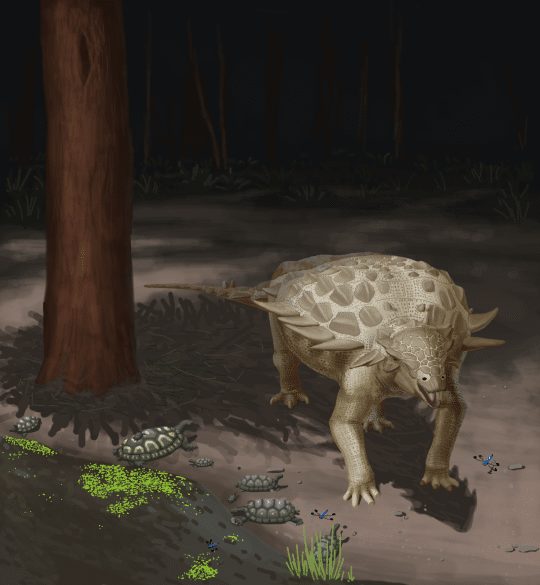
Albany County, Wyoming, ca. 150,000,000 B.P.: a solitary Gargoyleosaurus enjoys a shady spot by a stream in its Morrison Formation ecosystem. Art by Batavotyrannus on DeviantArt, used with permission.

No matter which ankylosaur subgroup Gargoyleosaurus belongs to, everyone can agree that it was a well-armored tank. Armor is a very useful defense against predators, since it generally covers the most vulnerable places on the body, such as the neck. Gargoyleosaurus lived in what is now the Morrison Formation, a famous set of rocks in the western US made of sediment deposited during the late Jurassic Period (the second of three periods in the Mesozoic Era, or Age of Dinosaurs). Most of the Jurassic dinosaurs on display at CMNH come from the Morrison Formation, such as our beloved long-necked sauropod Diplodocus, the even more massive sauropod Apatosaurus, and the forever popular Stegosaurus. But the Morrison ecosystem was home to a horde of formidable carnivores too—Allosaurus, Ceratosaurus, and Torvosaurus among them—so the armor of Gargoyleosaurus undoubtedly came in very handy. Contrary to what certain “Jurassic” franchises would lead you to believe, though, Tyrannosaurus rex did not live during the Jurassic Period, and so it never interacted with Gargoyleosaurus or any other members of the Morrison dinosaur community. That said, if trick-or-treating had been a possibility in the Jurassic, I’d imagine those inflatable T. rex Halloween costumes might have been very popular. Who doesn’t love those silly costumes?!

Lindsay Kastroll is a volunteer and paleontology student working in the Section of Vertebrate Paleontology at Carnegie Museum of Natural History. Museum staff, volunteers, and interns are encouraged to blog about their unique experiences and knowledge gained from working at the museum.

Related Content

Mesozoic Monthly: Protostega

Armored Advantage

Ask a Scientist: What is still unknown about “the chicken from Hell”?

Filed Under: Blog Tagged With: dinofest, dinosaurs in their time, Lindsay Kastroll, Science News, Section of Vertebrate Paleontology, Vertebrate Paleontology

October 13, 2020 by wpengine

Early Bats: Ancient Origins of a Halloween Icon

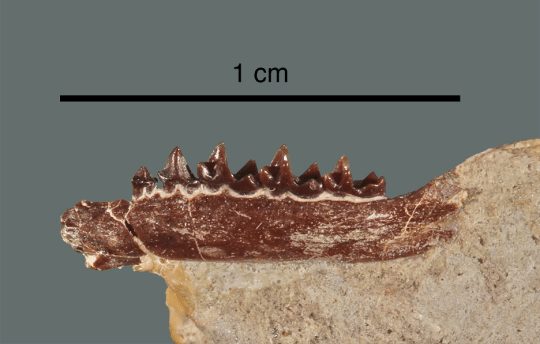
Specimen Carnegie Museum (CM) 62641, the holotypic, or name-bearing, right dentary (lower jaw bone) of the tiny fossil bat Honrovits tsuwape in lingual (= internal) view, still partially encased in ~50-million-year-old rock of the Wind River Formation of west-central Wyoming. Note the length of the scale bar, only 1 cm (less than half an inch)!

Did you know that bats have been around for at least 55 million years? In 1992, several fossils in the Carnegie Museum of Natural History collection, including the lower jaw bone shown above, were described as representing a new genus and species of ancient bat, Honrovits tsuwape—Shoshone for “bat” and “ghost,” respectively—by a team that included two former curators in the museum’s Section of Vertebrate Paleontology, Christopher Beard and Leonard Krishtalka, both now of the University of Kansas. Honrovits dates to the early part of the Eocene Epoch of the Cenozoic Era (the ‘Age of Mammals’), about 50 million years ago, and is a member of a now-extinct bat group called the Onychonycteridae.

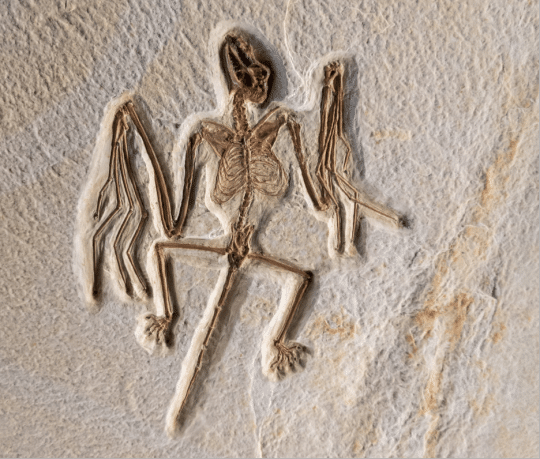
Replica of a beautifully preserved fossil skeleton of Onychonycteris finneyi, a close relative of Carnegie Museum of Natural History’s own Eocene-aged bat Honrovits tsuwape, on display at Fossil Butte National Monument in Wyoming. Photo by Matthew Dillon.

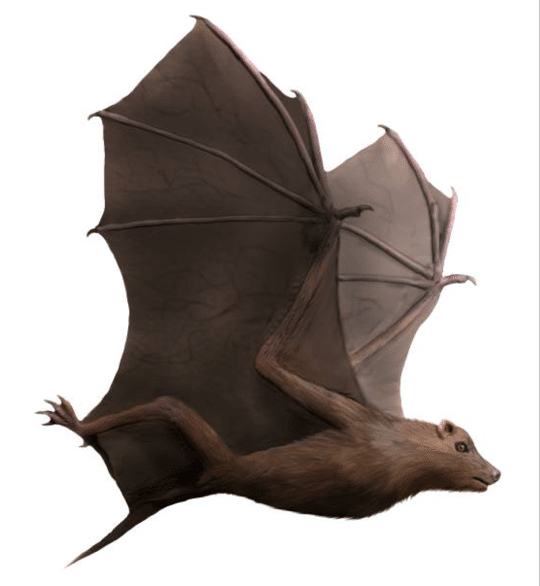
Interestingly, Honrovits shares dental characteristics with a mammal group known as insectivores, which includes today’s hedgehogs, shrews, and moles, and in that sense, it differs from the condition in most other bats. However, bat teeth possess distinctive diagnostic features, so although Honrovits is known only from a few tooth-bearing jaw bones and a skull fragment, there’s no doubt that the diminutive beast was indeed an early bat. The fragmentary nature of its fossils means that we don’t know for sure what Honrovits looked like in life, though it’s a good bet that it bore a close resemblance to other onychonycterid bats, such as Onychonycteris finneyi, which is known from exquisitely preserved skeletons (such as the one shown above).

Flesh reconstruction of the ~50-million-year-old bat Onychonycteris finneyi. There’s an excellent chance that Honrovits tsuwape would have looked like this. Art by Nobu Tamura.

The incompleteness of the Honrovits fossils is, unfortunately, the norm rather than the exception when it comes to prehistoric bats. Fossils of these creatures are exceedingly rare because most bats have very small, light skeletons and achieve their greatest diversity and abundance in areas that have low potential for fossil preservation, such as tropical forests. Occasionally, complete skeletons such as those of Onychonycteris are found, but not nearly as often as fragments.

So, this autumn, if you happen to catch a glimpse of a bat silhouetted against the evening sky, acrobatically wheeling and plunging in pursuit of flying insects, pause and reflect on the history of these extraordinary flying mammals whose ancestry dates nearly to the time of the dinosaurs.

Linsly Church is a Curatorial Assistant in the Section of Vertebrate Paleontology at Carnegie Museum of Natural History. Museum staff, volunteers, and interns are encouraged to blog about their unique experiences and knowledge gained from working at the museum.

Related Content

Halloween and Birds

How Do You Preserve a Giant Pumpkin?

Ask a Scientist: What is the newly discovered “Crazy Beast?”

Filed Under: Blog Tagged With: halloween, Linsly Church, mammals, Science News, Vertebrate Paleontology

October 1, 2020 by wpengine

The Bromacker Fossil Project Part X: Tambaroter carrolli, an amphibian with a wedge-shaped head

New to this series? Read The Bromacker Fossil Project Part I, Part II, Part III, Part IV, Part V, Part VI, Part VII, Part VIII, and Part IX. 

Thomas Martens at the construction site for a new store in Tambach-Dietharz where he found fossils by checking loose pieces of rock on the excavation floor. Photo by Stephanie Martens, 2008.

Paleontologist Thomas Martens has an amazing ability to find fossils. After he discovered the first vertebrate fossils at the Bromacker site in an abandoned commercial quarry in 1974, he and his father Max found additional fossils in the bottom of a deep pit they’d dug with hand tools, an excavation that Dave Berman, Stuart Sumida, and I fondly dubbed the “elevator shaft.” Years later, Thomas used funding from the German federal government to drill rock cores in the field surrounding the Bromacker quarry to help understand the geology of the fossil deposit. Amazingly, at one of the spots Thomas had selected, the drill core penetrated a skeleton of Diadectes absitus. So, it wasn’t surprising that in 2008 Thomas found a skull and partial skeleton of D. absitus and a small skull of a fossil animal new to science at a construction site for a new store in the nearby village of Tambach-Dietharz.

Dave Berman (left) and Stuart Sumida (right) pose with a shopping cart in front of the Netto Discount Store, which was built in the excavation site where Tambaroter was found. Rocks of the Tambach Formation can be seen behind the retaining wall. Photo by the author, 2008.

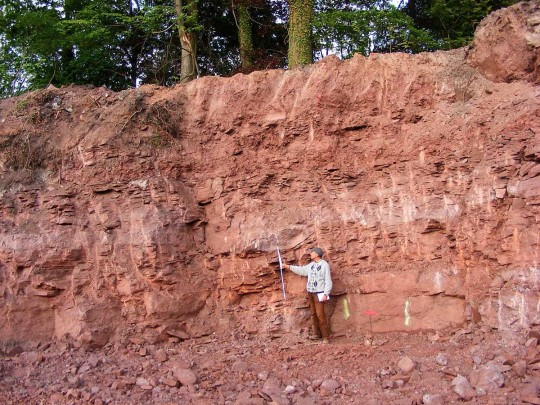
It makes sense, however, that vertebrate fossils were found close to the Bromacker quarry. Fossils from the Bromacker were preserved in the Tambach Formation, a 200–400-foot-thick unit of sediments that were deposited in the small intermontane Tambach Basin about 290—283 million years ago during the Early Permian Epoch. The Tambach Basin covered an area of about 155 square miles and was internally drained; that is, there were no rivers or streams flowing into and out of the basin. During periods of extremely heavy rain, water and mud would flow down the basin sides in what are called sheet floods and pool in the basin center, which is where the present day Bromacker quarry and Tambach-Dietharz are thought to be located. Any animals killed during these events would be carried by the sheet floods to the basin center where they’d have been quickly and deeply buried in mud settling out of the ponded water and later become fossilized. It is assumed that animals captured by the sheet flood events inhabited the Tambach Basin, because carcasses couldn’t have been carried into the basin by rivers and streams.

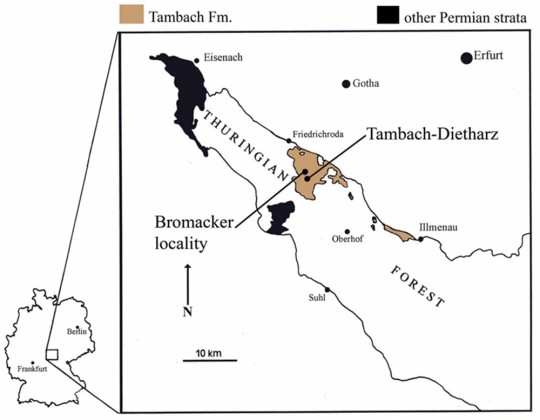
Map of Germany with inset showing the Bromacker locality and the nearby town of Tambach-Dietharz. Although the Tambach Basin in which the Tambach Formation was deposited covers about 155 square miles, outcrops of the Tambach Formation today occur in an area of only about 31 square miles.

While preparing Bromacker fossils, I’d typically read literature related to the fossil I was working on, write notes on what I thought were important features in the fossil, and give my notes to the person leading the project. When Dave was the lead, we’d typically have lots of discussion about certain features preserved in the animal, conversations that often directed the course of preparation. This time, in addition to preparing the new find, I was designated as the lead author for the publication that would name and describe it.

View of the underside of the skull of Tambaroter carrolli before preparation. The shiny area surrounding the skull is glue, which I applied to a crack to stabilize the specimen before preparation could begin. I had to free the skull from the surrounding rock before exposing as much of it as possible through preparation. Photo by the author, 2008.

Tambaroter is a member of the Microsauria, a diverse group of small amphibians that were once thought to be reptiles, a hypothesis that some paleontologists are currently revisiting. Microsaurs inhabited a variety of habitats and exhibited a range of body forms. Some were highly terrestrial with limb proportions similar to those of lizards, whereas others were aquatic and had elongated bodies and reduced girdles and limbs. Still others were adapted for burrowing or rooting through leaf litter. Tambaroter belongs to this latter-most group, which is named Recumbirostra for their recurved snout, in which the front of the mouth is overhung by the snout.

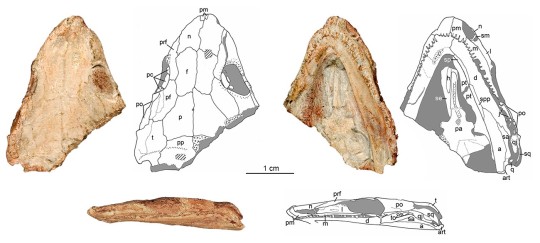
Photographs and line drawings of the skull of Tambaroter carrolli in (clockwise from upper left) dorsal (top), ventral (underside), and left lateral (side) views. Photographs by the author, 2008 and drawings by the author and modified from Henrici et al., 2011.

Tambaroter is member of the recumbirostran subgroup Ostodolepidae. I coined the name Tambaroter, which is derived from “Tamb,” for the Tambach Formation, and the Greek “aroter,” meaning plowman, in reference to the snout shape. Two previously named ostodolepids, Micraroter and Nannaroter, have the “aroter, suffix in their name, so usage of the “aroter” suffix was a continuation of this. The species name, carrolli, honors microsaur expert Robert Carroll (then Curator Emeritus at the Redpath Museum, McGill University, Montreal, Canada).

Skulls of representative ostodolepid microsaurs from geologically oldest (left) to youngest (right). A reconstruction drawing of the skull of Tambaroter was used instead of a photograph for comparison because the original fossil skull is extremely flattened (see previous image). Photographs, except for that of Nannaroter, by the author, 2009. The photograph of Nannaroter was modified from Anderson et al., 2009. Tambaroter skull reconstruction by the author and modified from Henrici et al., 2011. Scale bar of the tiny Nannaroter and other ostodolepids equals 1 cm.

When Tambaroter was published on in 2011, it was the first ostodolepid to be found outside of the USA (the others are from Oklahoma and Texas) and is the oldest one known. Other, possible ostodolepids have since been described from the American Midwest and Germany. All ostodolepids have a wedge-shaped skull and recumbent snout, which is accentuated in Pelodosotis. Based on these features, scientists think that ostodolepids burrowed or searched for worms and other prey in leaf litter. Remarkably, the skull of the tiny Nannaroter is so strongly built that it could have withstood burrowing headfirst into the ground by using its shovel-like snout to loosen dirt and its broad, flat head to push soil against the burrow ceiling. Because the sutures between individual skull bones in the Tambaroter type specimen are not tightly fused together, we think it belonged to a juvenile, so we don’t know if the adult skull would’ve been as strongly built as that of Nannaroter.

Life drawing of the ostodolepid microsaur Pelodosotis elongatum, which is known by a nearly complete specimen. Tambaroter probably had a similar body shape, though its skull would not have been as strongly wedge-shaped. Drawing modified by Carnegie Museum of Natural History Scientific Illustrator Andrew McAfee from outline drawing in Carroll and Gaskill (1978).

Stay tuned for my next post, which will feature one of the Bromacker’s top carnivores. To learn more about Tambaroter, read the publication that described the animal here.

Amy Henrici is Collection Manager in the Section of Vertebrate Paleontology at Carnegie Museum of Natural History. Museum employees are encouraged to blog about their unique experiences and knowledge gained from working at the museum.

Keep Reading

The Bromacker Fossil Project Part XI: Dimetrodon teutonis, an apex predator

Filed Under: Blog Tagged With: Amy Henrici, Museum from Home, Science News, The Bromacker Fossil Project, Vertebrate Paleontology

  • « Go to Previous Page
  • Page 1
  • Page 2
  • Page 3
  • Page 4
  • Page 5
  • Interim pages omitted …
  • Page 10
  • Go to Next Page »

sidebar

About

  • Mission & Commitments
  • Directors Team
  • Museum History

Get Involved

  • Volunteer
  • Membership
  • Carnegie Discoverers
  • Donate
  • Employment
  • Events

Bring a Group

  • Groups of 10 or More
  • Birthday Parties at the Museum
  • Field Trips

Powdermill

  • Powdermill Nature Reserve
  • Powdermill Field Trips
  • Powdermill Staff
  • Research at Powdermill

More Information

  • Image Permission Requests
  • Science Stories
  • Accessibility
  • Shopping Cart
  • Contact
  • Visitor Policies
One of the Four Carnegie Museums | © Carnegie Institute | Privacy Policy | Terms of Use | Accessibility
Rad works here logo