• Skip to primary navigation
  • Skip to main content
  • Skip to primary sidebar

Carnegie Museum of Natural History

One of the Four Carnegie Museums of Pittsburgh

  • Visit
    • Buy Tickets
    • Visitor Information
    • Exhibitions
    • Events
    • Dining at the Museum
    • Celebrate at the Museum
    • Powdermill Nature Reserve
    • Event Venue Rental
    • Gift Cards
  • Learn
    • Field Trips
    • Educator Information
    • Programs at the Museum
    • Bring the Museum to You
    • Guided Programs FAQ
    • Programs Online
    • Climate and Rural Systems Partnership
  • Research
    • Scientific Sections
    • Science Stories
    • Science Videos
    • Senior Science & Research Staff
    • Museum Library
    • Science Seminars
    • Scientific Publications
    • Specimen and Artifact Identification
  • About
    • Mission & Commitments
    • Directors Team
    • Museum History
  • Tickets
  • Give
  • Shop

Vertebrate Paleontology

March 2, 2021 by Erin Southerland

Carnegie Museum of Natural History Adds Five New Specimens to Cretaceous Seaway Display

New specimens include world’s only juvenile skeleton of plesiosaur Libonectes
 
Enhancements made possible with support from The Elijah Straw Memorial Fund 
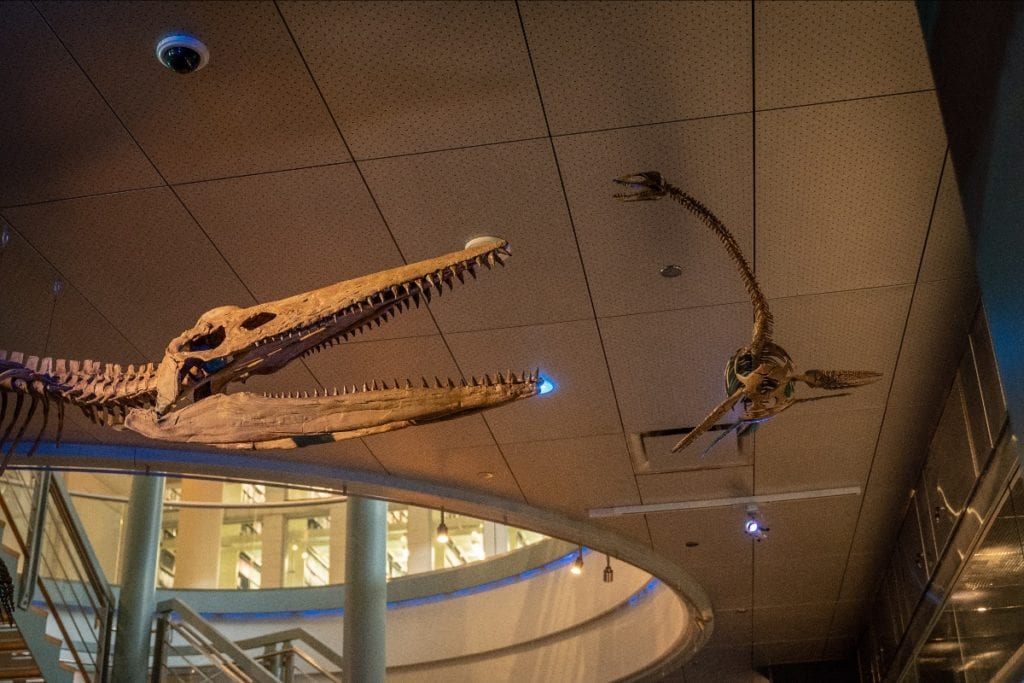
The massive Manitoba pliosaur closes in on its potential prey, a juvenile of the plesiosaur Libonectes morgani. Photo: Tim Evans, Carnegie Museum of Natural History.

Visitors at Carnegie Museum of Natural History may now view five impressive new specimens in the Cretaceous Seaway display of its flagship exhibition Dinosaurs in Their Time. The specimens include a newly restored Tylosaurus mosasaur fossil skull and four replica skeletons (a pliosaur, a plesiosaur, and two fishes) created by Triebold Paleontology, Inc. The freshly updated gallery is now on view. 
 
“Our new Cretaceous Seaway displays put visitors smack dab in the middle of a life-and-death struggle taking place in midwestern North America some 92 million years ago,” says Matt Lamanna, Carnegie Museum of Natural History’s Daniel G. and Carole L. Kamin Co-Interim Director and Mary R. Dawson Associate Curator of Vertebrate Paleontology. “Collectively, our new Seaway beasts tell the story of evolution and extinction in an ancient ocean over the span of more than 30 million years. And they remind us that no species—not even humans—is immune to extinction.”
 
The juvenile plesiosaur Libonectes is the only one of its kind, replica or otherwise, on display anywhere in the world. Lamanna and Triebold Paleontology, Inc. worked closely together to create the specimen. “Nobody’s ever found a baby Libonectes before, so to produce one, the gang at Triebold Paleontology and I had to digitally alter a virtual 3D model of an adult skull and then digitally sculpt other bones using photos of Libonectes skeletons and those of related plesiosaurs,” says Lamanna. “When all the computer work was done, the 3D models were then printed to yield the physical replica. The whole process really opened my eyes to the possibilities of 3D scanning, modeling, and printing in paleontology.”
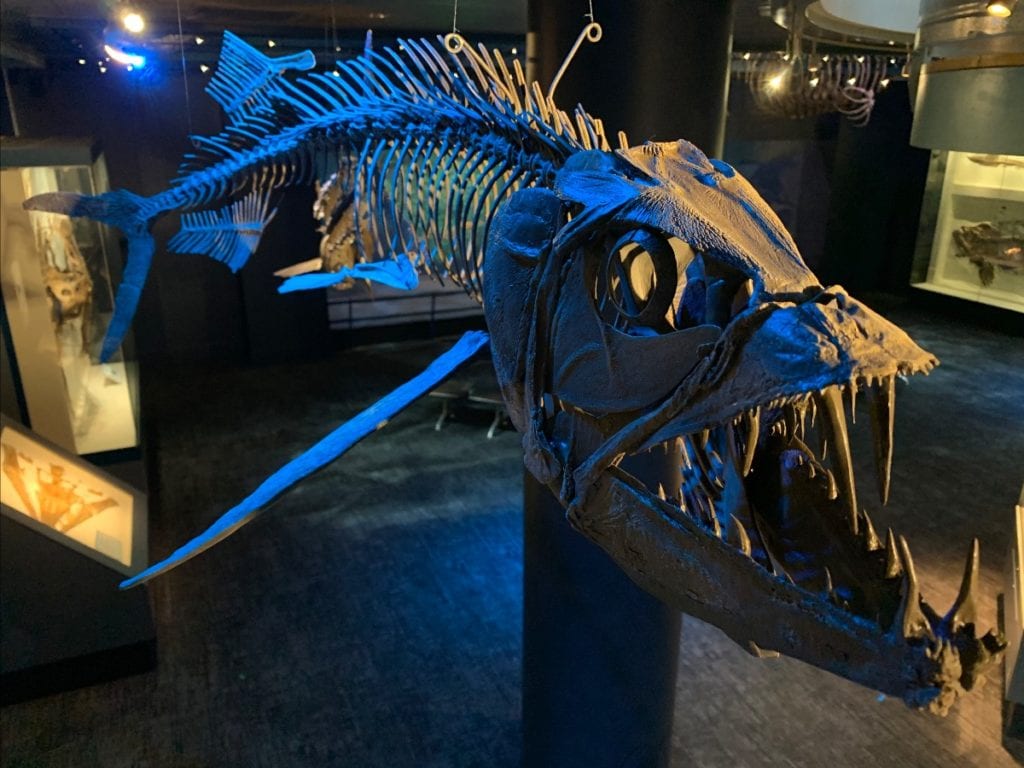
Another of the newly-added specimens, the large Cretaceous predatory fish Enchodus petrosus. Photo: Calder Dudgeon, Carnegie Museum of Natural History.

The new specimens are made possible with support from The Elijah Straw Memorial Fund. According to Tom Straw, Elijah’s father, the natural history museum was a special place for Elijah, and one particular display captured his imagination.  
 
“When Elijah was five years old, he fell in love with the skull cast of Dunkleosteus terrelli, a prehistoric fish,” said Straw. “When that went off view, Elijah was very concerned. I wrote to Dr. Matt Lamanna to ask what was going on,” said Straw, who was surprised when Lamanna responded by inviting them in to see the specimen in the museum’s behind-the-scenes area.
 
That tour, which also included a glimpse of the world’s first T. rex fossil, led to a lasting friendship with the Carnegie Museums.
 
When Lamanna learned of Elijah’s death a year later, he put a plan in motion to honor the little boy and his love of prehistoric life. A few months later, he contacted the family to let them know that the museum had dedicated the Dunkleosteus terrelli cast, now back on display in the museum, to Elijah.
 
The Elijah Straw Memorial Fund has since supported numerous improvements in the Cretaceous Seaway, including lighting, engineering and installation of four new replica skeletons, and the unveiling and display of a real fossil skull of the giant marine reptile Tylosaurus to honor Elijah’s memory. The Tylosaurus fossil skull, collected over a century ago, was newly restored by fossil preparator Dan Pickering, returning the specimen to display after many years stored behind the scenes. Tylosaurus is a member of the mosasaur group, which became famous in recent years for oversized “starring roles” in two Jurassic World movies. The Cretaceous Seaway enhancements were also made possible thanks to the generous support of Dr. Richard W. Moriarty.
Filed Under: Uncategorized Tagged With: Cretaceous Seaway, dinosaurs in their time, Vertebrate Paleontology

February 24, 2021 by wpengine

Mesozoic Monthly: Nasutoceratops

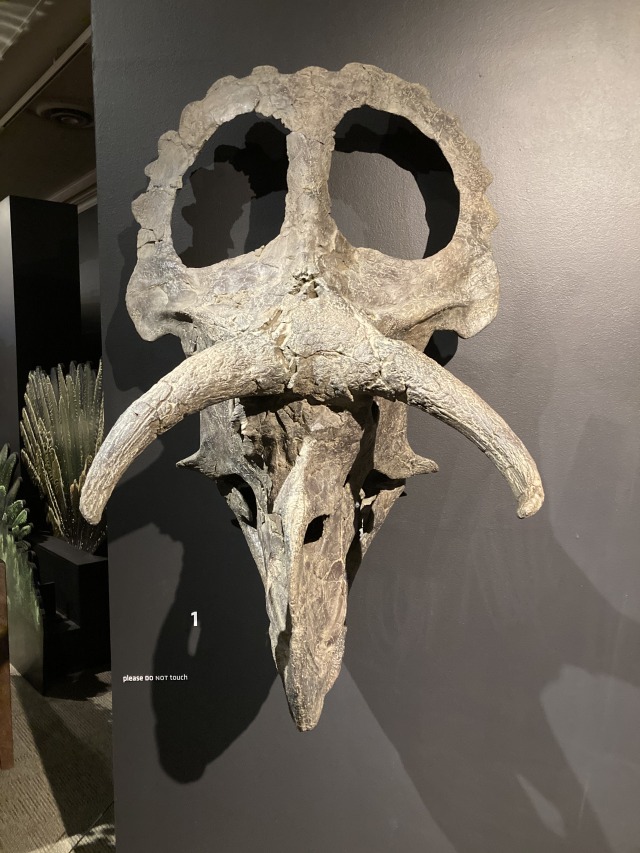
Although much of the Western world recognizes January 1 as the first day of the new year, many other cultures around the globe celebrate Lunar New Year, an alternate calendar system based on the cycles of the moon. Lunar New Year began on February 12 this year, ushering in, according to repeating cycles of the traditional Chinese zodiac, the Year of the Ox. While bovines hadn’t evolved by the Mesozoic Era, there were plenty of dinosaurs that could be compared to an ox. So, in honor of Lunar New Year, this month’s Mesozoic Monthly features Nasutoceratops titusi, a ceratopsian with a rounded nose and curving, bull-like horns!

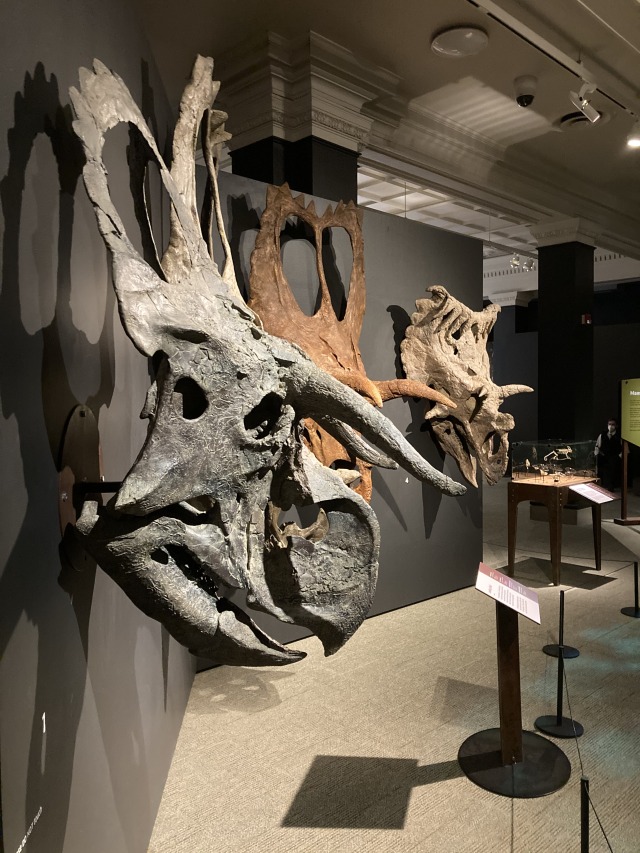
An anterior (head-on) view of the skull of Nasutoceratops, clearly displaying its most iconic features: the frill and horns. You can view this skull in the temporary exhibition Dinosaur Armor at Carnegie Museum of Natural History until July 5, 2021.

Ceratopsian dinosaurs are famous for their huge, elaborate skulls adorned with ornate frills and large horns. Several different bones make up these unique structures. If you haven’t taken an anatomy class, you may not have realized that your skull is made up of several bones that fuse together as you age (fun fact: baby humans have more bones than adults, and this is why!). The horns above a ceratopsian’s eye arise from the postorbitals, bones that sit right behind the eye hole in the skull. The frill is made of two types of bones: the parietals, which make up the central part of the frill, and the squamosals, which act as the corners. Humans actually have both of these bones: the parietal is the large bone at the crown of your head, and the squamosal is fused into the temporal bones above your ears. The bones that form the nose horn of a ceratopsian are aptly named nasals, and we have them too, supporting the cartilage structure of our noses. Of course, our bones are shaped markedly different from those of Nasutoceratops, but the fact that we (and all other vertebrates, aka animals with backbones) have similar skeletal compositions is a feature we inherited from our most recent common ancestor.

Life restoration of a herd of Nasutoceratops providing a convenient perch for a flock of enantiornithine birds in what’s now southern Utah roughly 75 million years ago. Artwork by Harrison Keller Pyle. You can find more of Keller Pyle’s work on DeviantArt under kepyle2055.

The skulls of ceratopsians are huge: they grow as long as one third of their body length! The skull of Nasutoceratops was almost five feet (1.5 meters) long, and although we don’t have many bones from the rest of its body, paleontologists estimate that the animal was almost 15 feet (4.5 meters) long. But Nasutoceratops wasn’t even the largest ceratopsian! The most famous ceratopsian, Triceratops, has a skull that can reach a whopping 8.2 feet (2.5 meters) long, but even that isn’t the largest. The largest skull of all dinosaurs belongs to Pentaceratops (sometimes called Titanoceratops), a ceratopsian with an absolutely massive 8.7 foot (2.7 meter) skull!

You can view the skull of Nasutoceratops (foreground) alongside those of other ceratopsians (including Utahceratops and Kosmoceratops, mentioned below) in the temporary exhibition Dinosaur Armor at Carnegie Museum of Natural History until July 5, 2021.

Nasutoceratops shared its environment with several other species of ceratopsian, including Kosmoceratops richardsoni and Utahceratops gettyi. Each of these had very different-looking headgear. Nasutoceratops, as previously mentioned, had bull-like horns and a big round nose. Kosmoceratops, in contrast, had weird horns at the top of its frill that curled forward and down, almost like it had bangs, and Utahceratops had short postorbital and nasal horns but a large frill surrounded by spikes. Since all these ceratopsian species lived together, it’s likely that the unique skull ornamentation of different species helped with intra-species recognition (in addition to other functions such as sexual signaling or defense from predators). This meant that each animal could regard shared cranial features as a way to tell who was part of their species. These visual cues might have been especially important for ceratopsians born during the Year of the Ox – according to the Chinese zodiac, “oxen” have poor communication skills, so clear and direct signaling is crucial!

Lindsay Kastroll is a volunteer and paleontology student working in the Section of Vertebrate Paleontology at Carnegie Museum of Natural History. Museum staff, volunteers, and interns are encouraged to blog about their unique experiences and knowledge gained from working at the museum.

Related Content

Ask a Scientist: What kind of dinosaur is a megaraptorid?

Mesozoic Monthly: Dreadnoughtus

A Visit to the Mammoth Site, Hot Springs, SD

Filed Under: Blog Tagged With: dinofest, Dinosaur Armor, dinosaurs, Lindsay Kastroll, Science News, Vertebrate Paleontology

February 8, 2021 by wpengine

Mesozoic Monthly: Dreadnoughtus

Last January, we started out hopeful for 2020, but unfortunately it ended up being a very difficult year for almost everyone. After an equally challenging start to 2021, I think it is safe to say our attitudes toward this year are more guarded, but nonetheless brave. We know that more hard times might be approaching, but if we could make it through 2020, we can make it through its successor. It is in this spirit that this edition of Mesozoic Monthly features Dreadnoughtus schrani, a colossal sauropod dinosaur whose genus name literally means “fearer of nothing.”

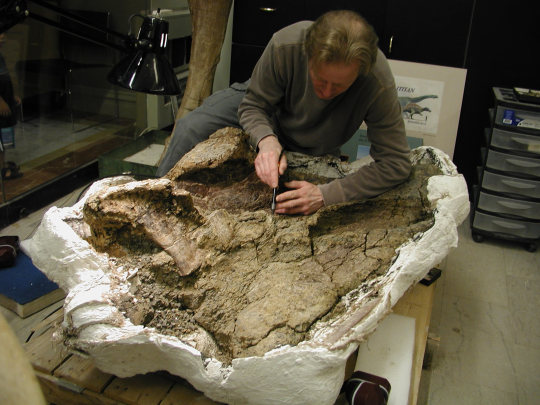
Dreadnoughtus has many connections to Carnegie Museum of Natural History (CMNH). Starting in 2005, a team that included CMNH’s own Dr. Matt Lamanna collected the only known fossil skeletons of the ginormous species in Santa Cruz Province of southern Patagonia, Argentina. Matt was also one of the authors of the paper that officially named the beast in 2014. Furthermore, many of the bones were scientifically prepared by staff and volunteers in the museum’s on-exhibit fossil lab, PaleoLab. Preparation involves freeing the fossils from the rock in which they were preserved (called matrix) using special tools, and then gluing/reinforcing the fossils back together as needed. Next time you visit CMNH, make sure to take a peek in PaleoLab to see our preparators in action!

CMNH Scientific Preparator Dan Pickering carefully removes rock from a gigantic cervical vertebra (neck bone) of Dreadnoughtus, ca. 2012. The top of the vertebra is projecting toward the viewer; the front is toward the left of the image. Photo courtesy Matt Lamanna.

Sauropod dinosaurs such as Dreadnoughtus are easily recognized by their frequently huge size, long necks, and long tails. CMNH’s Dinosaurs in Their Time (DITT) exhibition features real fossil skeletons of three different sauropods: Camarasaurus, Apatosaurus, and Diplodocus. Brachiosaurus, one of the stars of Jurassic Park, is also a sauropod, and is featured in the mural in the Jurassic Period atrium in DITT.

Dreadnoughtus belongs to a group of sauropods called titanosaurs that lived during the following Cretaceous Period, largely in the Southern Hemisphere. Titanosaurs have many interesting features that make them unique, such as simplified front feet with very few bones, extra-wide shoulders and hips, and even (in some species) bony plates called osteoderms embedded in the skin. However, as their name implies, titanosaurs’ primary claim to fame is their generally titanic size. Many titanosaurs were absolutely enormous – the smallest members of the group, such as Magyarosaurus, were outliers likely produced by insular dwarfism, a phenomenon in which typically large-bodied animals evolve smaller sizes that are more sustainable in geographically restricted habitats such as islands. Magyarosaurus lived in what’s now the Transylvania region of Romania, which was part of an island at the end of the Cretaceous. In contrast, Dreadnoughtus, which lived in prehistoric South America, was not restricted by an island habitat, and grew to an estimated 85 feet (26 meters) long. And, based on studies of the microscopic internal structure of its bones, it’s possible that the already-immense name-bearing specimen wasn’t even done growing before it died!

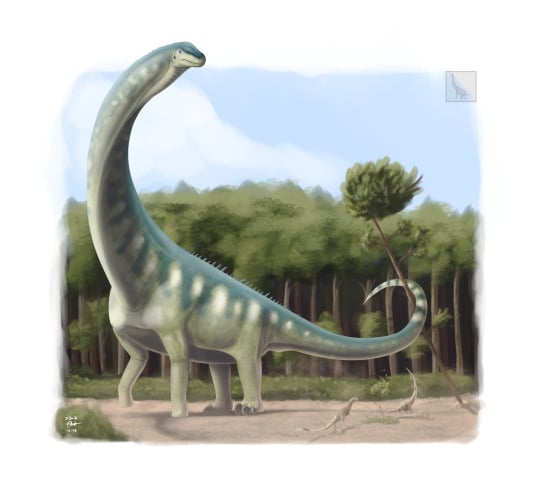
When you’re 85 feet long from head to tail, you tend to dwarf everything around you! I bet you didn’t even notice the two 13-foot-long Talenkauen santacrucensis at the bottom right – ornithischian dinosaurs that lived alongside Dreadnoughtus in the ~75-million-year-old ecosystem of southern Argentina’s Cerro Fortaleza Formation. This digital painting of Dreadnoughtus and company is by artist Charles Nye, used with permission. You can find more of his art under the name @thepaintpaddock on Instagram and Twitter!

As you can imagine, it’s very hard to determine how much a dinosaur would have weighed when it was alive, especially for a dinosaur as large as Dreadnoughtus! Although multiple methods for calculating the weight of an extinct animal have been proposed, one of the most commonly employed techniques is volumetric mass estimation. Paleontologists using this method work with typically incomplete skeletons to first estimate how much of each type of tissue (like muscle or fat) covered the skeleton; afterward, they calculate how much each tissue type (including bone) weighed. It’s a difficult, somewhat speculative process that can result in different researchers producing wildly different estimates for the same animal’s weight. Estimates for Dreadnoughtushave been anywhere between 24.4 and 65.4 US tons (22.1 and 59.3 metric tons), but the most recent estimate was 54.0 US tons (49 metric tons). For comparison, a typical school bus weighs around 12.5 US tons (11.3 metric tons)! Clearly, no matter how you estimate it, Dreadnoughtus was a massive animal.

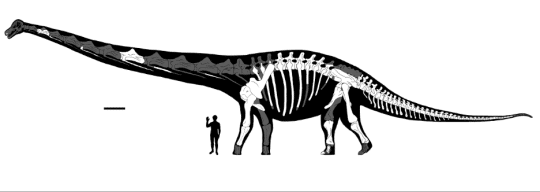
It’s notoriously hard to find complete sauropod skeletons – because their bodies and bones were so large, they tended to break apart and to be at least partially destroyed before they could be buried and preserved. The holotype, or name-bearing, specimen of Dreadnoughtus is among the most complete giant titanosaur skeletons ever found. This reconstruction by scientific illustrator Lindsay Wright (a former volunteer here at CMNH) shows which bones of this titanosaur have been discovered (in white).

Gargantuan size has its drawbacks, but it also brings enormous benefits. It takes an absurd amount of resources to grow this large and power the organs needed to support life. However, if enough food is present to sustain this growth, predators are no longer an issue. Not even the largest meat-eating dinosaurs could pose a threat to something as large as an adult Dreadnoughtus. The only chances predators had to taste this sauropod were to hunt it when it was a small juvenile or to scavenge it when it was dead or dying. That seems to be what happened, too, because teeth of carnivorous dinosaurs were found scattered around the fossils.

So, as we continue our journey through 2021, let us think of ourselves like the unassailable Dreadnoughtus: the challenges of 2020 helped us to grow tremendously resilient, and the trials coming our way will not fracture our resolve. Times may be hard, but we are gigantic dinosaurs with no natural predators. We can do this.

Lindsay Kastroll is a volunteer and paleontology student working in the Section of Vertebrate Paleontology at Carnegie Museum of Natural History. Museum staff, volunteers, and interns are encouraged to blog about their unique experiences and knowledge gained from working at the museum.

Related Content

Dippy in Star Wars? The Krayt Dragon

A Visit to the Mammoth Site, Hot Springs, SD

Winging It: Quetzalcoatlus and the History of Aviation

Filed Under: Blog Tagged With: dinofest, dinosaurs in their time, Lindsay Kastroll, Science News, Vertebrate Paleontology

January 8, 2021 by wpengine

A Visit to the Mammoth Site, Hot Springs, SD

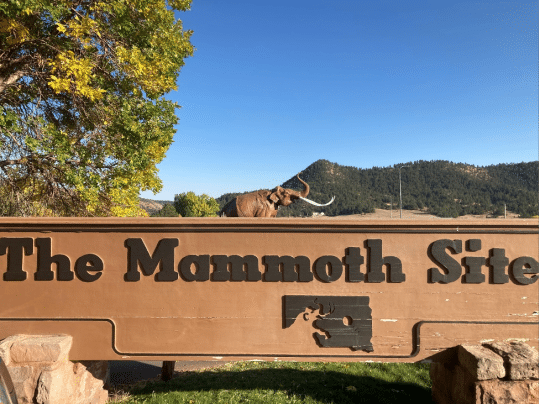
Did you know that not all museums display their fossil specimens mounted in life-like poses? At The Mammoth Site of Hot Springs, South Dakota, visitors view fossils “in situ,” or as they were discovered, and because excavation continues year-round, this unique museum is also an active dig site.

brown sign that says The Mammoth Site
A sign welcomes visitors to The Mammoth Site of Hot Springs, South Dakota.

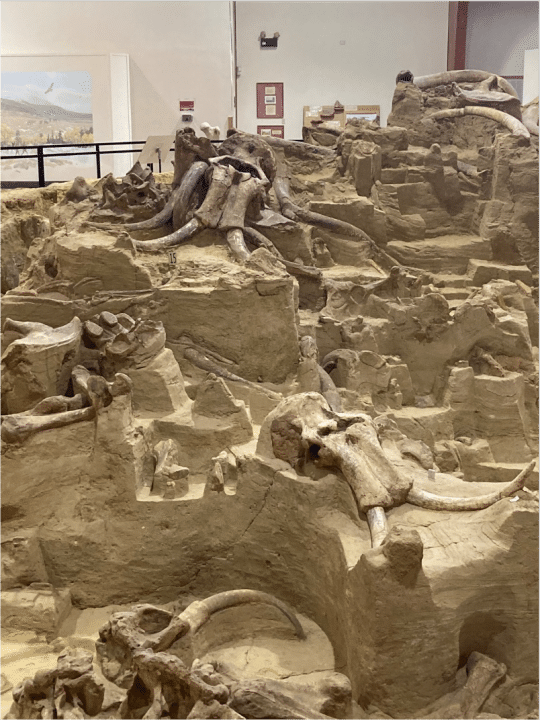
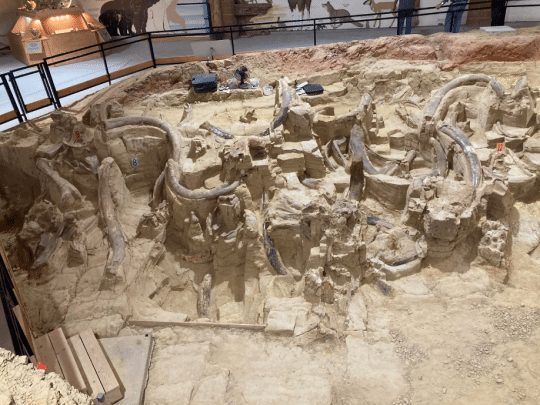
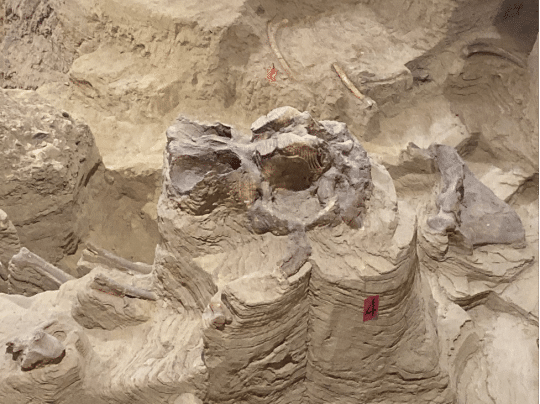
Instead of being held in place by the fabricated support structures that are so crucial to traditional fossil displays, bones at The Mammoth Site rest on sediment and appear in the same orientations in which they were found. The remains of more than 60 Columbian mammoths (Mammuthus columbi) have been documented here to date, comprising the world’s most extensive collection of skeletons of these Ice Age elephant relatives.

The Mammoth Site was discovered in 1974 when the landowner decided to build a housing development on the 14-acre plot. While the heavy machine operator was bulldozing a small hilltop, he found tusks and bone. Construction stopped and officials at four colleges were contacted, but none expressed interest in the find. Fortunately, the son of the heavy machine operator, who had taken geology and archaeology courses in college, was able to gain interest from one of his former professors, who was then conducting fieldwork in Arizona. When the professor arrived at the site a few days later he recognized the exposed bones of four to six individual mammoths and the potential for more nearby. He arranged for a field crew to salvage and stabilize the visible bones, teeth, and tusks, and returned the next summer with a group of students to do more excavating. A complete skull with tusks attached was the prize find of these more organized recovery efforts, and by the end of the summer the landowner had decided the tract’s highest value was as a place for scientific study.

mammoth skulls in situ
Mammoth skulls with tusks attached at The Mammoth Site. Notice the sediment supporting the fossils.

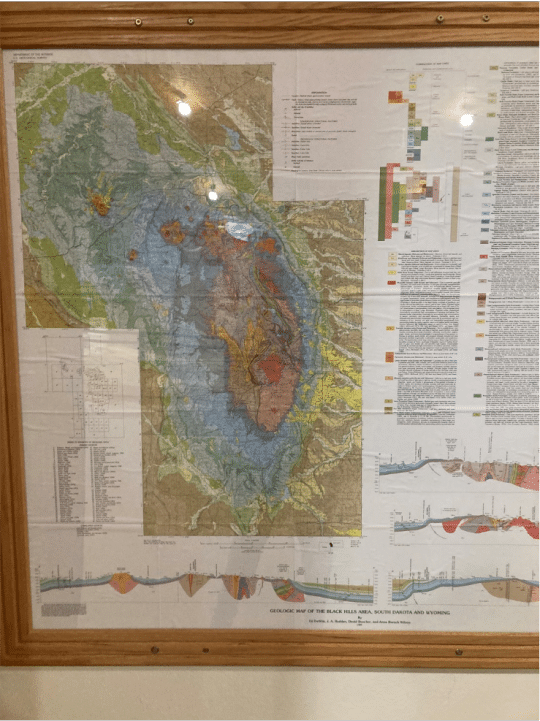
I recently had the opportunity to visit The Mammoth Site, which is located in the Black Hills, a scenic region of green pine trees and deep red earth. Once you purchase your admission, you are directed to a theater where a looped video introduces the relevant geologic history. The site is the result of a sinkhole that developed when groundwater dissolved the limestone layers through which it flowed. Subterranean water-filled caverns were an early product of this process, but as the water table lowered the caverns weakened and collapsed, resulting in a deep sinkhole with a chimney-like shaft, through which a warm artesian spring percolated to the surface. In three phases over a period of 750 years, the sinkhole refilled with sediment and the remains of mammoths and other creatures before it was eventually reduced to a mud wallow.

photo of geologic map
Geologic map of the beautiful Black Hills area of South Dakota and Wyoming.

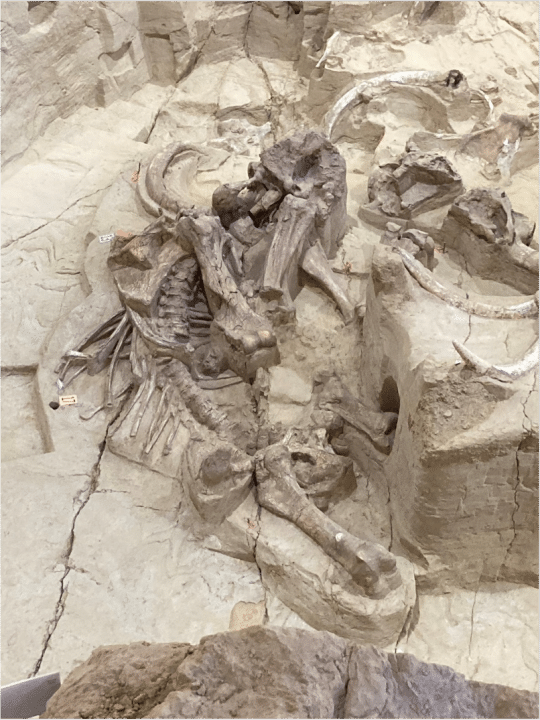
After the theater, the bonebed is the next stop. The museum has a special app that can be listened to with headphones for a tour of the bonebed. The bonebed room is very large and naturally lit and has a high beam ceiling with windows at the top of one wall. There is a crane attached to the rafters that is used to move any specimens that need to be permanently removed from the ground. Because a large tusk can weigh over 100 pounds, and skulls far more than this, this overhead crane is an essential tool.

complete mammoth skeleton
The most complete mammoth skeleton or “model mammoth,” found in the deep end of the bonebed. It is used to compare to the remains of others to determine attributes such as age, size, and sex.

How, you ask, do researchers know there are over 60 individuals in the sinkhole? For every mammoth or person or other critter with a skeleton, there are a certain number of each bone in the body. Because mammoths have two tusks it is possible to count the number of tusks in the bonebed, 123, and divide by two to calculate the presence of at least 62 individuals.

bonebed at Mammoth Site
How many tusks can you find in this section of the bonebed?

Determining the sex of a mammoth is possible when its pelvis is well-preserved with minimal crushing or distortion. By measuring a specific spot on the pelvis and the width of the pelvic canal at a certain area, and comparing these two measurements, it can be determined whether the pelvis belonged to a male or female mammoth. This calculation is possible because males are generally larger than females, and also because females had a proportionally larger pelvic canal to aid in giving birth. Mammoth remains recovered at The Mammoth Site have all been male. Although the presence of more than 60 males but no females at the site may seem surprising, studies have shown that “natural death traps” such as The Mammoth Site captured many more males than females. This may be because, rather than living in herds led by a knowledgeable matriarch, relatively inexperienced male mammoths typically traveled alone, making them more likely to get stuck in these kinds of traps.

It is also possible to age a mammoth using growth rates of bones and the state of fusion of the epiphyses (the ends of the limb bones); however, it is most accurate to age these animals by measuring their teeth. The length and width of the occlusal (= chewing) surface is then used to verify which of their six sets of teeth they were using at the time of death. Generally, a mammoth’s life span could be as long as 60 to 80 years, an age when the animal would be relying upon its sixth set of teeth. When these teeth wore down, starvation would follow. Dental comparisons at The Mammoth Site indicate that most of the remains represent mammoths that were between 15 and 29 years old when they died, with a few in their late forties or early fifties.

mammoth skull fossil in situ
An upside-down mammoth skull shows holes at the front where the tusks attach. Two sets of molars are also visible (I think).

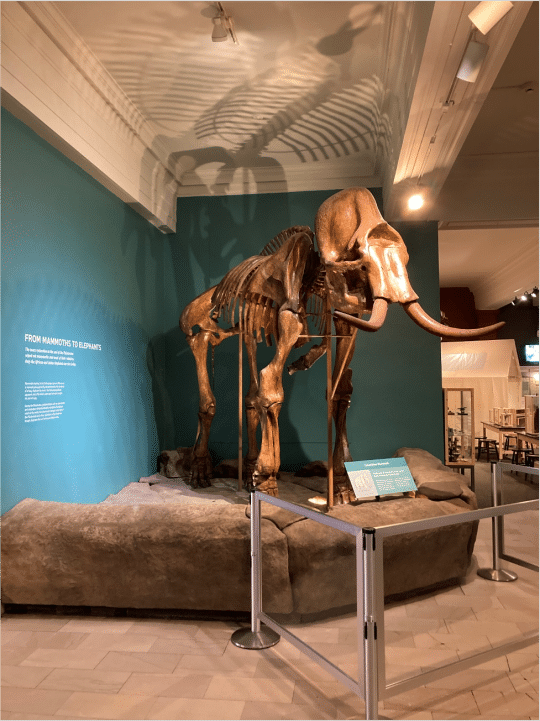
When you next visit Carnegie Museum of Natural History, be sure to head to Pleistocene Hall, where we have our very own mounted Columbian mammoth skeleton on display!

mounted mammoth fossil
The mounted Columbian mammoth at Carnegie Museum of Natural History.
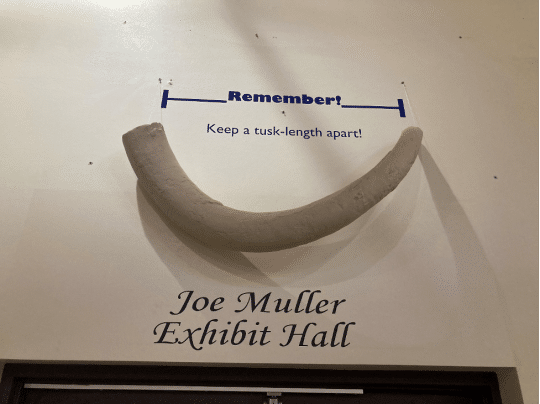
And please remember to keep a tusk-length apart! (Social distancing the mammoth way.)

Linsly Church is a Curatorial Assistant in the Section of Vertebrate Paleontology at Carnegie Museum of Natural History. Museum staff, volunteers, and interns are encouraged to blog about their unique experiences and knowledge gained from working at the museum.

Related Content

Ask a Scientist: What kind of dinosaur is a megaraptorid?

Early Bats: Ancient Origins of a Halloween Icon

Mesozoic Monthly: Vegavis

Filed Under: Blog Tagged With: Linsly Church, Museum from Home, Science News, Vertebrate Paleontology

January 7, 2021 by wpengine

Mesozoic Monthly: Vegavis

Disclaimer: Our dinosaur paleontologist Matt Lamanna typically edits Lindsay Kastroll’s Mesozoic Monthly posts before they go live, but due to some much-needed holiday revelry he was late in getting to this one. As such, it’s being posted in January rather than in December as Lindsay had intended. Matt sends his apologies!

‘Tis the season for eating candy canes, singing Christmas carols, and kicking off a new year of Mesozoic Monthly! That’s right – one year ago, the first Mesozoic Monthly debuted in December 2019, spotlighting the ceratopsian dinosaur with a candy cane-shaped nasal horn, Einiosaurus. This December, we’ll move from candy canes to carols as we feature Vegavis iaai, the first Mesozoic bird known to have had a syrinx (the avian “voice box”)!

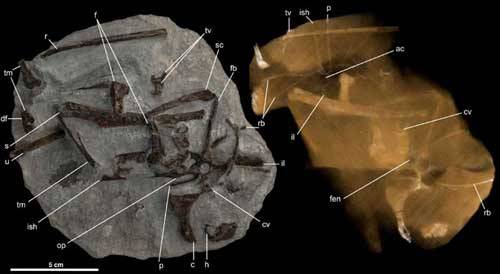
Photo (left) and computed tomographic (CT) scan image (right) of the type, or name-bearing, specimen of Vegavis iaai, a partial skeleton inside a ~70-million-year-old rock concretion from Vega Island, Antarctica. Photo from the Antarctic Peninsula Paleontology Project website.

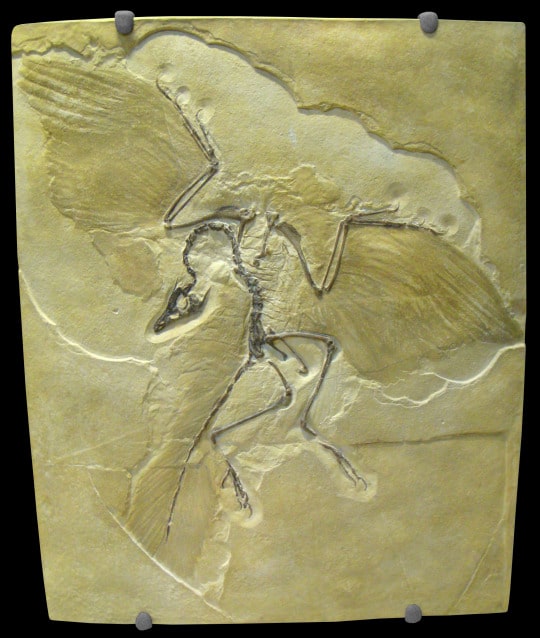
Birds evolved during the Mesozoic Era, the so-called “Age of Dinosaurs,” before non-avian dinosaurs became extinct. Last month, for the November edition of Mesozoic Monthly, we discussed what makes modern birds members of the group of theropod dinosaurs, but what I didn’t mention is that birds lived alongside non-avian dinosaurs! Birds evolved around 165 to 150 million years ago during the Jurassic Period, the second of three time periods in the Mesozoic. The Jurassic dinosaur Archaeopteryx represents a transitional stage between birds and non-avian dinosaurs: its fossils display obvious flight feathers like a bird, but it also has many non-avian dinosaur characteristics such as a toothy mouth, a long bony tail, and even a miniature version of a killing claw like that of Velociraptor.

Replica skeleton of Archaeopteryx lithographica on display here at CMNH. Photo from Wikimedia Commons.

Birds lived and evolved alongside their non-avian relatives for almost 100 million years, and by the end of the Cretaceous Period (the third and final time period of the Mesozoic), the distinct groups of birds that we recognize today were beginning to originate. Vegavis was an ancient relative of ducks and geese discovered on Vega Island, an island off the coast of the Antarctic Peninsula (the part of Antarctica that juts northward towards South America). At that time, Antarctica was warmer than it is now and home to lush temperate forests.

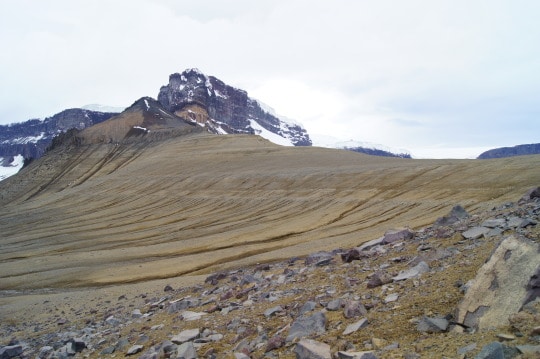
Sandwich Bluff, the site on Vega Island, Antarctica that has produced all known fossils of Vegavis. Photo by Eric Roberts, James Cook University.

With many skeletal features suggesting that it was a diving bird that propelled itself with its feet, Vegavis was probably as well-adapted to life in the water as it was to life in the skies. While it’s certainly incredible that scientists are able to deduce this much information about its behavior from just its skeleton, the story gets better: one specimen of Vegavis includes a fossilized syrinx, the organ that birds use to produce sound! A syrinx’s shape is directly related to the sounds it can make, and the fossilized syrinx of Vegavis was a distinctively goose-like asymmetrical shape. So, this ancient bird may well have honked! If it did, it would have sounded much more like six geese-a-laying than, say, four calling birds, three French hens, two turtle doves, or a partridge in a pear tree.

Lindsay Kastroll is a volunteer and paleontology student working in the Section of Vertebrate Paleontology at Carnegie Museum of Natural History. Museum staff, volunteers, and interns are encouraged to blog about their unique experiences and knowledge gained from working at the museum.

Related Content

Ask a Scientist: What kind of dinosaur is a megaraptorid?

The Bromacker Fossil Project XIII: What We Learned

Pebble or Jaw?

Filed Under: Blog Tagged With: dinosaurs in their time, Lindsay Kastroll, Mesozoic Monthly, Science News, Vertebrate Paleontology

December 30, 2020 by wpengine

The Bromacker Fossil Project Part XIII: What We Learned

New to this series? Need to catch up on your reading? Here are all the previous posts for the Bromacker Fossil Project: Part I, Part II, Part III, Part IV, Part V, Part VI, Part VII, Part VIII, Part IX, Part X, Part XI, and Part XII. 

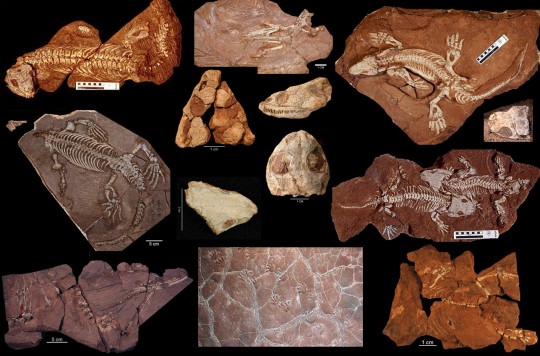
Collage of the fossils highlighted in this series. Images not to scale. Photos by the author, Dave Berman, and Thomas Martens.

The Bromacker quarry is a rare site in that it preserves exquisite, articulated fossils of a unique vertebrate fauna that lived in an atypical or rarely recorded Early Permian (~290 million years ago) setting. Early in our work at the Bromacker, we became aware that the fossil vertebrates we were finding were unknown or extremely rare in Europe but were closely related or identical to species commonly found in North America. Until then, most of the fossil vertebrates found in Europe were discovered in gray to black sediments deposited in ancient lake beds, whereas the fossils from the Bromacker quarry occurred in red beds representing a terrestrial setting. Paleontologists looking for fossils in Europe typically prospected the gray to black sediments where fossils were relatively plentiful rather than red beds, which were thought to represent arid environments not conducive to fossil preservation.

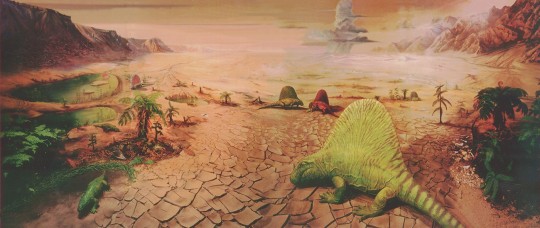
Photograph of a diorama showing the Tambach Basin 290 million years ago, which was once exhibited at the Museum der Natur, Gotha. It was built in 1996, so many of the inhabitants of the basin weren’t yet discovered. One of these is Dimetrodon teutonis, which was inadvertently depicted as being large and numerous. Image provided by Thomas Martens, 2020.

In a collaborative effort to help determine how the fossil deposit at the Bromacker quarry formed and why its vertebrate fauna is unique, Dave Berman invited his colleague David Eberth to join us for the 1998 field season. David is a geologist/vertebrate paleontologist who was then employed by the Royal Tyrrell Museum of Palaeontology in Canada but is now retired. The sediments preserving the Bromacker fossils are part of a rock unit called the Tambach Formation and were deposited in the Tambach Basin. The results of David’s study, built in part upon investigations by other geologists and paleontologists, indicate that the Tambach Basin was situated within an ancient mountain range and isolated from river systems. At the time the fossils were deposited, the basin was internally drained, and as a result, when it rained, water would flow towards the basin center and form ephemeral ponds and lakes. Based on the geology, fossil plant assemblage, and geographic setting of the Tambach Basin, David concluded that the climate was possibly similar to the wet‑and‑dry tropical climate of modern North African savannas, Brazilian Campos, or the Venezuelan Llanos.

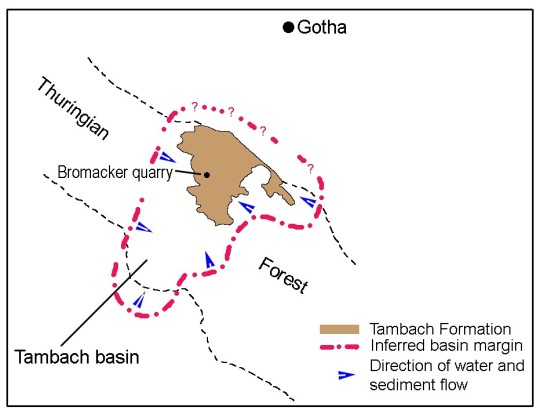
Map showing the areal extent of the Tambach Formation today and the inferred boundary of the Tambach Basin, with arrows indicating direction of water flow. The northern boundary of the basin is not preserved, but it was thought to have been closed when the Bromacker fossil deposit formed. Modified from Eberth et al., 1997.

Most of the fossils discovered at the Bromacker quarry came from two massive units, the more fossiliferous of which is about 21 inches thick, that formed in separate major flooding events. David theorized that these deposits formed when heavy rain caused a sheet-flood of sediment‑laden water to sweep down the sides of the Tambach Basin and across the basin floor, killing any animals that couldn’t escape the flow. The sheet-flood transported the carcasses to the basin center where they were deposited, rapidly buried, and eventually fossilized. These deposits record a unique snapshot of vertebrate life in the Tambach Basin, because only animals inhabiting the basin would have been captured by the sheet-flood.

In contrast, most Early Permian fossil‑bearing deposits in North America formed on coastal or alluvial plains. Carcasses would’ve been transported to the deposition sites by rivers, some of which had a large geographic reach. These types of deposits can accumulate over a long period of time and have potential to mix together fossils from different environments.

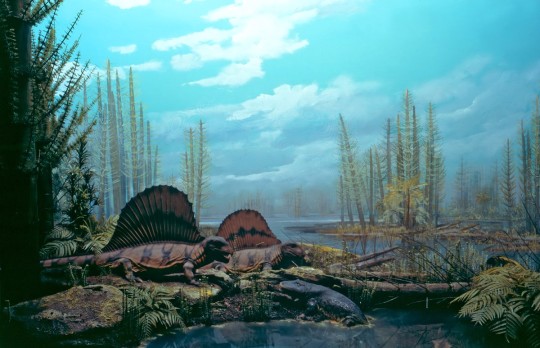
Photograph of a diorama once exhibited at Carnegie Museum of Natural History that shows a typical Early Permian peat swamp or backwater swamp of a major river system. A similar modern environment would be the Okefenokee Swamp, Georgia. Photo by Mindy McNaugher, 2007.

Besides having an atypical geographic setting, the makeup of the Bromacker vertebrate fauna differs from those known from other Early Permian sites. The Bromacker vertebrate fauna has a low diversity of terrestrial tetrapods, but more importantly, it lacks fishes and aquatic to semi‑aquatic constituents. This is probably due to the Tambach Basin’s isolation from regional river systems and because it experienced seasonal to sub‑seasonal drying, making it difficult for water-reliant vertebrates to become established. Based on numeric counts of individual specimens, we determined that the relatively large‑sized herbivores Diadectes, Orobates, and Martensius greatly outnumbered the synapsid apex predators Dimetrodon and Tambacarnifex. We think the rarity and low diversity of synapsid carnivores is probably due to the lack of an aquatic to semi‑aquatic component in the food chain.

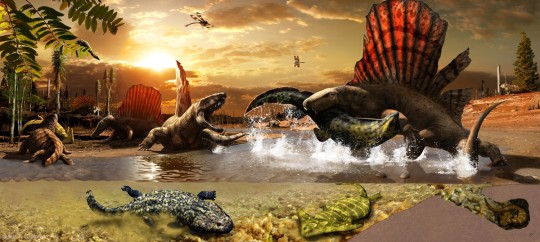
In contrast, most Early Permian North American localities preserve a diverse, mixed aquatic‑terrestrial fauna that either lived in water or was closely associated with water and aquatic food chains. Herbivores were rare in terms of both diversity and numbers, whereas synapsid apex predators were diverse and numerous.

A more dynamic North American Early Permian scene that includes a mixed aquatic‑terrestrial vertebrate fauna. The Dimetrodon on the right has caught a freshwater shark, demonstrating the importance of aquatic animals in the food chain. © Julius Csotonyi/Houston Museum of Natural Science.

The Bromacker is the oldest known terrestrial vertebrate ecosystem in which herbivores greatly outnumber apex carnivores, and in that respect, it resembles terrestrial vertebrate ecosystems of today. A modern example is the African savanna in which large herds of herbivores such as zebra, wildebeest, and buffalo provide a food source for a much smaller number of carnivores including lions, cheetahs, and hyaenas. Indeed, we consider the Bromacker to represent an early stage in the development of the modern terrestrial vertebrate ecosystem and that these early stages were restricted to upland areas isolated from aquatic‑based food chains.

This summary concludes the Bromacker Fossil Project blog post series. I hope that you’ve enjoyed reading it. Cast replicas of many of the fossils described in this series are exhibited in the Fossil Frontiers display case in CMNH’s Dinosaurs in Their Time exhibition, so be sure to look for them on your next visit. I’m grateful to Dave Berman, Albert Kollar, Thomas Martens, and Stuart Sumida, who answered numerous questions and provided photographs, and to Patrick McShea and Matt Lamanna for their editing skills. Click here to read the paper by Eberth et al. 2000.

Amy Henrici is Collection Manager in the Section of Vertebrate Paleontology at Carnegie Museum of Natural History. Museum employees are encouraged to blog about their unique experiences and knowledge gained from working at the museum.

Related Content

Vertebrate Fossils from Bears Ears National Monument, Utah

Mesozoic Monthly: Scipionyx

Ask a Scientist: What is the “Crazy Beast?”

Filed Under: Blog Tagged With: Amy Henrici, dinosaurs in their time, Museum from Home, Science News, Vertebrate Paleontology

  • « Go to Previous Page
  • Page 1
  • Page 2
  • Page 3
  • Page 4
  • Interim pages omitted …
  • Page 10
  • Go to Next Page »

sidebar

About

  • Mission & Commitments
  • Directors Team
  • Museum History

Get Involved

  • Volunteer
  • Membership
  • Carnegie Discoverers
  • Donate
  • Employment
  • Events

Bring a Group

  • Groups of 10 or More
  • Birthday Parties at the Museum
  • Field Trips

Powdermill

  • Powdermill Nature Reserve
  • Powdermill Field Trips
  • Powdermill Staff
  • Research at Powdermill

More Information

  • Image Permission Requests
  • Science Stories
  • Accessibility
  • Shopping Cart
  • Contact
  • Visitor Policies
One of the Four Carnegie Museums | © Carnegie Institute | Privacy Policy | Terms of Use | Accessibility
Rad works here logo