• Skip to primary navigation
  • Skip to main content
  • Skip to primary sidebar

Carnegie Museum of Natural History

One of the Four Carnegie Museums of Pittsburgh

  • Visit
    • Buy Tickets
    • Visitor Information
    • Exhibitions
    • Events
    • Dining at the Museum
    • Celebrate at the Museum
    • Powdermill Nature Reserve
    • Event Venue Rental
  • Learn
    • Field Trips
    • Educator Information
    • Programs at the Museum
    • Bring the Museum to You
    • Guided Programs FAQ
    • Programs Online
    • Climate and Rural Systems Partnership
  • Research
    • Scientific Sections
    • Science Stories
    • Science Videos
    • Senior Science & Research Staff
    • Museum Library
    • Science Seminars
    • Scientific Publications
    • Specimen and Artifact Identification
  • About
    • Mission & Commitments
    • Directors Team
    • Museum History
  • Tickets
  • Give
  • Shop

Vertebrate Paleontology

June 10, 2020 by wpengine

The Bromacker Project Part V: Orobates pabsti, Pabst’s Mountain Walker

New to this series? Read The Bromacker Fossil Project Part I, Part II, Part III, and Part IV. 

In 1995, my first year of field work at the Bromacker quarry, Stuart Sumida discovered a fossil that we initially thought was that of the amphibian Seymouria, based on the size and shape of the exposed vertebrae. This tentative identification made sense, because before our collaboration began, Thomas Martens had discovered in the Bromacker a skull of Seymouria, a creature known from localities in the USA. Months later, while I was preparing the specimen, Dave Berman and I realized the fossil wasn’t Seymouria, and that it belonged to the same unnamed animal that Thomas had collected a partial skeleton of before our collaboration began.
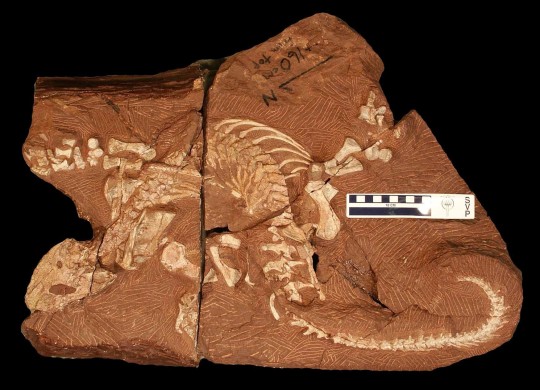
image of orobates pabsti
Specimen of Orobates pabsti collected in the 1995 field season. We determined that it is a juvenile. Photo by Dave Berman.

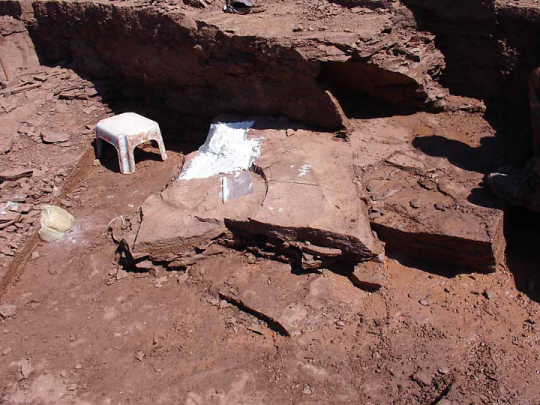
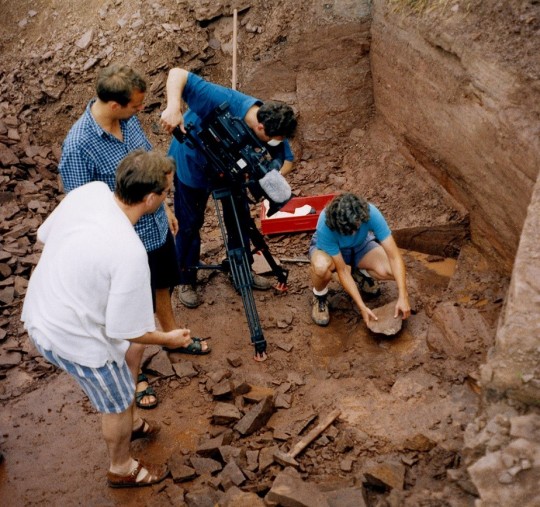
In the 1998 field season I discovered a third specimen, which is by far the most spectacular fossil that I have ever discovered. I found it towards the end of the field season when I pried up a piece of rock from the quarry floor. Upon turning over the rock piece, I saw an articulated foot preserved in it. I couldn’t believe my eyes! I knew that at the Bromacker if an articulated foot was found, the rest of the articulated skeleton should be attached to it. The problem was, we didn’t know if I had discovered a front or a hind foot, so we weren’t sure how the specimen was oriented in the quarry and whether it penetrated the nearby rock wall. Dave carefully lifted another piece of rock and thought the bones exposed in it were part of the shoulder girdle. Unfortunately, closer examination revealed that it was a piece of skull roof—another lobotomy—but, lacking x-ray vision, this is how we find fossil bone at the Bromacker. The good news was that the fossil specimen appeared to parallel the quarry wall.
image
A film crew from the regional MDR television station visited us early on the day of my discovery to interview Dave and Thomas. The discovery was made after they left, so Thomas immediately notified them. They returned and recorded a reenactment of my discovery. The piece of rock I am holding contains the foot. The rest of the fossil lies in the low mound of rocks in front of me. Photo by Dave Berman, 1998.

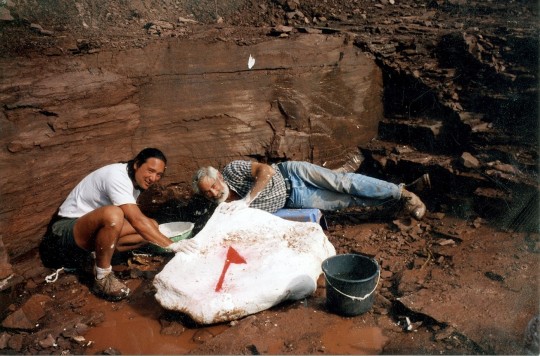
image
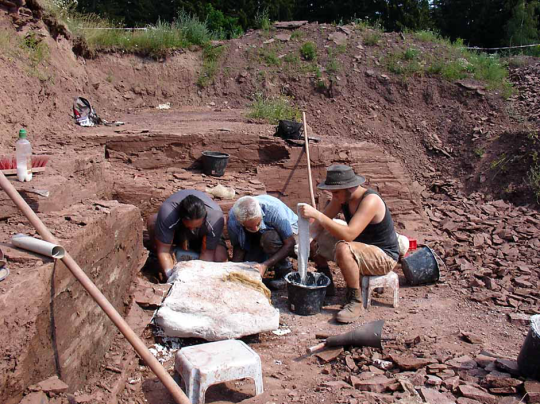
Dave and Stuart finish plastering the block. The red flag is a north arrow to indicate the orientation of the block in the quarry. Photo by the author, 1998.

Dave, Stuart, Thomas, then-graduate student Richard Kissel (University of Toronto, Mississauga), and I named the animal Orobates pabsti, which is from the Greek “oros,” meaning mountain, and “bates,” meaning walker, in reference to the Bromacker fossil environment being an intermontane basin. “Pabsti” is in honor of Professor Wilhelm Pabst for his pioneering work on the Bromacker fossil trackways.

We determined that Orobates is very closely related to Diadectes, and like Diadectes, was herbivorous. Orobates differs from Diadectes and other diadectomorphs in the group Diadectidae in a number of features, some of which are as follows: spade-shaped cheek teeth that are oriented on the jaw at an angle of 30–40° to the jaw line, rather than being close to 90°; narrower and shorter vertebral spines; 26 vertebrae between the head and hip (Diadectes has 21); proportions and shapes of individual toe bones; and digit (finger or toe) length.
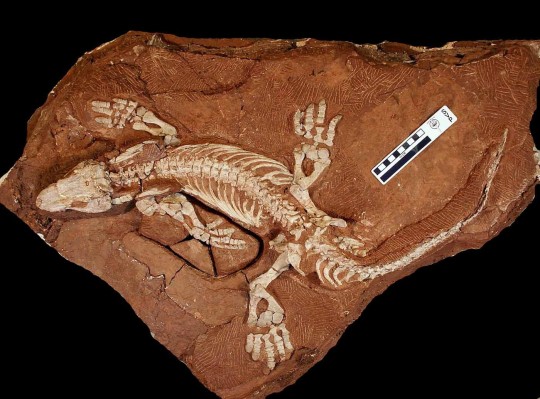
image of orobates pabsti
Holotype specimen of Orobates pabsti, the specimen collected in 1998. If a series of specimens exists of a new species, then the specimen that best represents the species is designated as the holotype. If only one specimen is known, it becomes the holotype by default. Photo by Dave Berman.

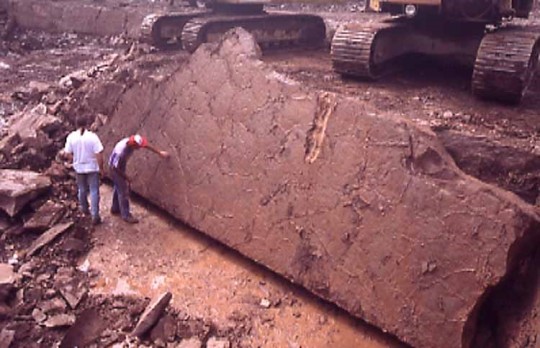
The Bromacker has long been famous for its exquisitely preserved fossil trackways. Identification of the particular fossil animal that made a given trackway is almost always very difficult, because body fossils often lack completely preserved hands and feet and typically are not found in association with trackways. As a result, trackways are given their own set of names, called ichnotaxa (“ichno” means track or footprint), which are typically referred to major groups of animals instead of individual species. The Bromacker is unique, however, because nearly completely preserved body fossils occur in a rock unit above the trackways, indicating they are very nearly contemporaneous. Five ichnotaxa are known from the Bromacker, and one of them, Ichniotherium, has been attributed to Diadectidae.
image
A large slab of rock being inspected for trackways shortly after it was unearthed in the commercial rock quarry. The polygonal patterns in the rock are mudcracks. Photo by the author.

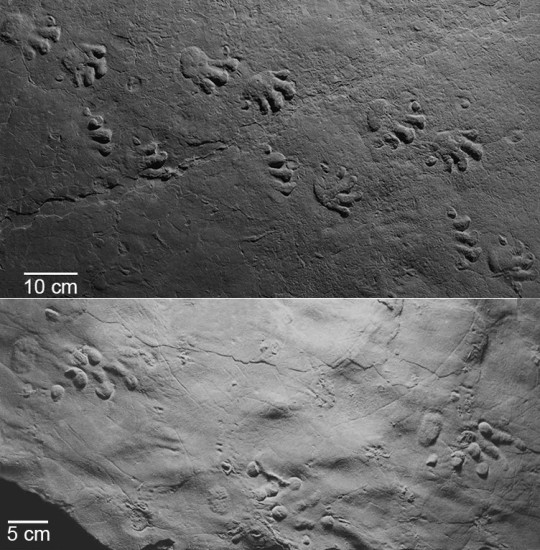
Graduate student and trackway expert Sebastian Voigt (now Director at Urweltmuseum GEOSKOP, Burg Lichtenberg, Germany) often visited us at the Bromacker. In 2000, a time when Diadectes was the only known Bromacker diadectid, Sebastian and his advisor Hartmut Haubold (now emeritus at Martin Luther University Halle-Wittenberg, Germany) proposed that Ichniotherium cottae made two track types, designated as A and B, that differed according to the speed at which the trackmakers moved. This contrasted previous studies that proposed three species of Ichniotherium at the Bromacker.

Once the skeletal anatomy of Orobates became known, Sebastian realized that there were two species of Ichniotherium, and they were made by Diadectes and Orobates, respectively. He invited Dave and me to co-author a paper to present this hypothesis. We supplied Sebastian with information about skeletal differences between Diadectes and Orobates, and Sebastian used these data to firmly establish that Diadectes made Ichniotherium cottae (type B) tracks and Orobates was the trackmaker of trackways formerly identified as I.sphaerodactylum (aka I. cottae type A). Even though the makers of the trackways are now known, the ichnotaxon names are still used when referring to the trackways.
image
Photographs of trackways of Ichniotherium sphaerodactylum made by Orobates pabsti (top) and Ichniotherium cottae made by Diadectes absitus (bottom). Modified from Voigt (2007).

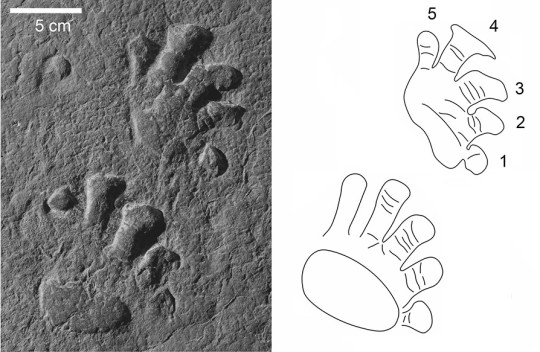
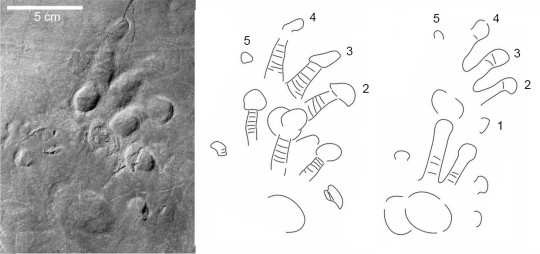
In Diadectes, the fifth digit of the hind foot is relatively shorter than it is in Orobates, which can be seen in the tracks of I. cottae and I. sphaerodactylum, respectively. Furthermore, in I. cottae trackways, the hind foot track overlaps the track of the front foot, whereas in I. sphaerodactylum the hind foot track typically doesn’t overlap the front foot track. This is because Diadectes has less vertebrae between the head and hip (21 vertebrae) than Orobates (26 vertebrae) does.
image
Front and hind foot track pair of Ichniotherium sphaerodactylum. Track made by the front foot is above the hind foot track. Digits 1–5 indicated. Modified from Voigt, 2007.

image
Front and hind foot track pair of Ichniotherium cottae. Track made by the front foot is above the hind foot track. Digits 1–5 indicated. Notice that the hind foot track overlaps the front foot track. Drawings are of different specimens than the one photographed. Modified from Voigt, 2007.

A cast of the holotype skeleton of Orobates pabsti is exhibited in the Fossil Frontiers display case in Carnegie Museum of Natural History’s Dinosaurs in Their Time exhibition. Be sure to look for it once the museum re-opens. And stay tuned for my next post, which will feature the amphibian Seymouria sanjuanensis.

For those of you who would like to learn more about Orobates, you can access the abstract here or contact Amy Henrici here. The publication on the track-trackmaker association can be found here.

Amy Henrici is Collection Manager in the Section of Vertebrate Paleontology at Carnegie Museum of Natural History. Museum staff, volunteers, and interns are encouraged to blog about their unique experiences and knowledge gained from working at the museum.

Keep Reading

The Bromacker Fossil Project Part VI: Seymouria sanjuanensis, the Tambach Lovers
Filed Under: Blog Tagged With: Amy Henrici, Museum from Home, Science News, Section of Vertebrate Paleontology, The Bromacker Fossil Project, Vertebrate Paleontology

May 27, 2020 by wpengine

Mesozoic Monthly: Citipati

The month of May that we’re living in is very different from the one we all anticipated at the start of the year. However, society somehow manages to march on. College students are still graduating, moms are still being celebrated, and Mesozoic Monthly continues! Our honoree for the month of May is known to have been a dedicated parent due to several specimens that show adults guarding eggs. Say hello to Citipati osmolskae!

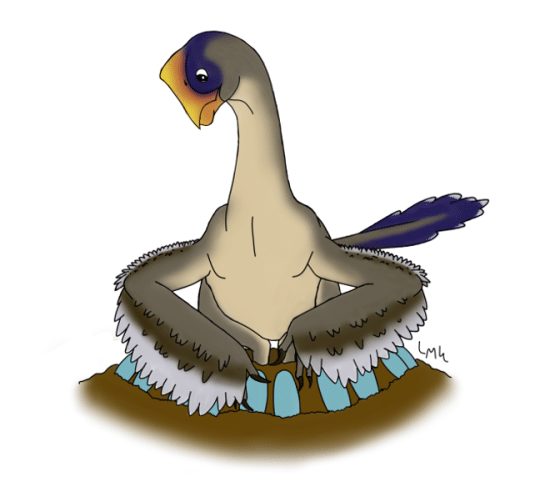
illustration of Citipati, a dinosaur that looks similar to a bird, on a nest of blue eggs

A devoted Citipati parent guarding its nest. Some evidence suggests that the Citipati skeletons found atop nests may have been males (rather than females as was originally thought). Also, recent research indicates that—believe it or not—oviraptorid eggs were blue! Art by ginjaraptor on DeviantArt.

It might not look like it, but Citipati is a theropod, like the more famous dinosaurs Tyrannosaurus, Allosaurus, and Velociraptor. Most theropods were carnivores, sporting skulls with big toothy grins, but not all theropods were ravenous predators! There are several groups of theropods that evolved toothless beaks for specialized diets. One of the stars of Jurassic Park, Gallimimus, was part of a predominantly herbivorous group of beaked theropods called Ornithomimidae. Citipati belongs to another group of beaked theropods called Oviraptoridae. “Oviraptor” means “egg thief,” in reference to an old hypothesis that oviraptorids stole and ate eggs from other dinosaurs’ nests. The discovery of a Citipati skeleton perched in a brooding position atop a nest of eggs was pivotal in changing this idea. We now know that instead of stealing others’ eggs to eat, fossilized oviraptorids preserved near eggs were actually protecting their own eggs! The eggs in an oviraptorid’s nest were arranged in circles with a space in the center for the parent to sit and spread their feathered arms over their incubating young.

photograph of Anzu dinosaur fossil

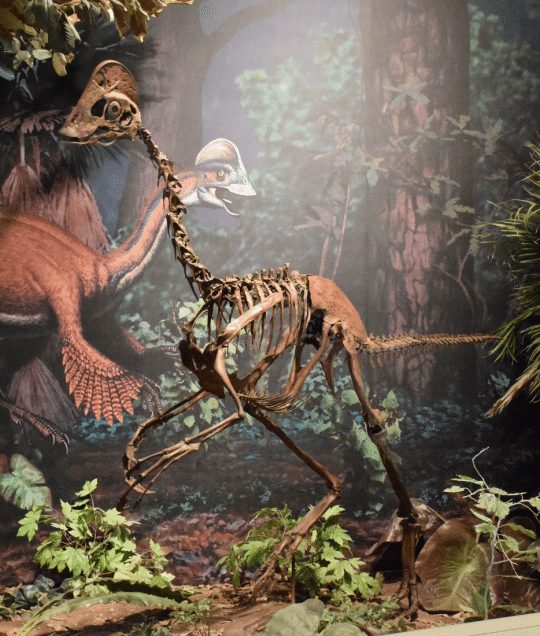
Citipati and other oviraptorids are closely related to one of Carnegie Museum of Natural History’s most bizarre dinosaurs, the ‘Chicken from Hell’ Anzu wyliei, shown here on display in the museum’s Dinosaurs in Their Time exhibition.

So, instead of eggs, what would the toothless beak of Citipati have been used to eat? Because most oviraptorid beaks are very deep, like those of modern parrots, most paleontologists infer that these dinosaurs ate mostly plants. However, this doesn’t necessarily mean that meat was off the menu; it would still have been possible for oviraptorids to have eaten small animals, making them omnivores. On top of its thick skull, Citipati possessed a tall, triangular crest that gave its small head a square-shaped profile. This crest was not as impressive as those on some other dinosaurs, but since Citipati grew to ten feet (three meters) long, the animal would still have been quite imposing. I certainly wouldn’t want to get between a Citipati parent and its eggs!

Citipati fossils are found in the modern Gobi Desert of Mongolia, in rocks known as the Djadokhta Formation. The Djadokhta rocks are made of sediments that were deposited late in the Cretaceous Period, preserving details of the ecosystem that existed there roughly 80–75 million years ago. The name Citipati means “funeral pyre lord,” which is fitting due to the hot environment in which this oviraptorid lived. Also, Citipati shares its name with a Buddhist deity that is believed to protect cemeteries from thieves, which is an appropriate parallel considering how the skeleton of this dinosaur was found guarding its fossilized nest.

Although the habitat Citipati lived in was a desert, like the Gobi Desert that is there today, this prehistoric desert was probably not as dry. In the event of rain, water gathered in temporary streams that drained the water to basins and oases. Since desert rain events are by definition few and far between, any animals that did not live near these oases would have needed to have adaptations for going without water for a long period of time. Some of the animals that lived in this unwelcoming environment alongside Citipati included everyone’s favorite small theropod Velociraptor, the hornless ceratopsian Protoceratops, and the tail-club wielding ankylosaur Pinacosaurus.

Lindsay Kastroll is a volunteer and paleontology student working in the Section of Vertebrate Paleontology at Carnegie Museum of Natural History. Museum staff, volunteers, and interns are encouraged to blog about their unique experiences and knowledge gained from working at the museum.

Filed Under: Blog Tagged With: dinosaurs in their time, Lindsay Kastroll, Mesozoic Monthly, Museum from Home, Science News, Vertebrate Paleontology

May 14, 2020 by wpengine

The Bromacker Fossil Project Part II: The Hunt for Fossils

New to this series? Read The Bromacker Fossil Project Part 1 here.

Finding fossils at the Bromacker quarry was tedious and physically demanding, but it was extremely rewarding when a fossil is discovered. Our annual summer field season generally lasted three and a half weeks. Because the weather usually wasn’t conducive to camping or cooking outdoors, we stayed at the same hotel and dined at the hotel or local restaurants.

The original 1993 fossil quarry was opened using heavy equipment and operators from the nearby commercial quarry, and in the early years we relied on these people to expand the fossil quarry’s boundaries as needed. When the commercial quarry was temporarily shut down due to the lack of contracts for building stone, our collaborator Dr. Thomas Martens fortunately was able to obtain funding to annually rent a Bobcat, which he became skilled at operating. Thereafter, Thomas would use the Bobcat to expand the quarry and remove soil and weathered rock layers, so that we could begin our yearly excavation on unweathered rock.

image
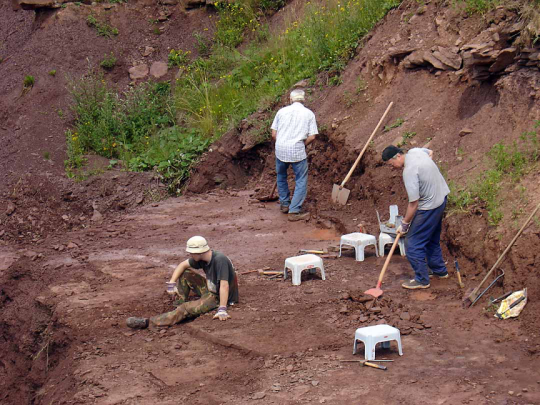
The Bromacker quarry on the first day of fieldwork in the 2006 field season. Shovels were used to clear loose rock from the surface of the quarry. Pictured (counterclockwise from left) graduate student Andrej Čerňanský and Dr. Jozef Klembara (Comenius University, Bratislava, Slovak Republic) and Dr. Dave Berman (Carnegie Museum of Natural History [CMNH]). Photo by the author, 2006.

We would each stake out an area of the quarry to work in and then proceed to work through the rock layers by using a hammer and chisel or pry bar to free a piece of rock. Its surfaces and edges would be checked for fossil bone, and if there was none, the rock piece would be broken into smaller pieces, which were also checked for bone. As is the case at many other fossil sites, the rock tended to split along the plane a fossil was preserved in, because the fossil would create a zone of weakness.

image
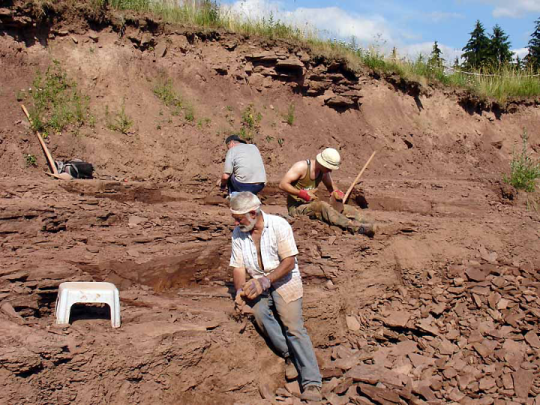
The quarry after a couple days of excavation. Pictured (clockwise from front) are Dave Berman, Jozef Klembara, and Andrej Čerňanský. Photo by the author, 2006.

Once a fossil specimen was discovered—and there were a few frustrating years when this didn’t happen—the hard work of extracting it from the quarry began. Here, I’ll use a fossil discovered during the 2006 field season as an example of how this was done.

image
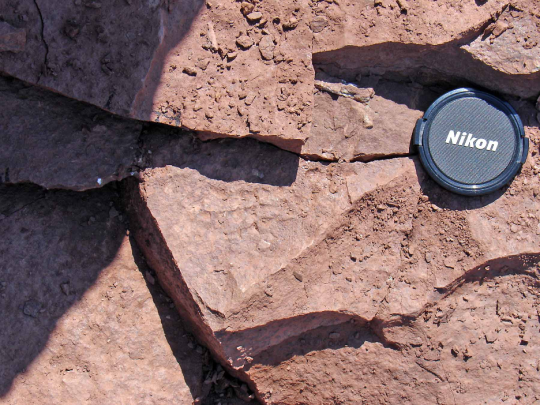
A discovery! Fossil bone and bone impression are exposed to the left of the lens cap. Photo by the author, 2006.

First, we would isolate the fossil specimen from the surrounding rock, exposing as little of the fossil as possible while determining its extent, because it would have been easy to lose pieces of bone in the dirt and mud. Then we would encase the specimen in a plaster and burlap jacket to protect it during extraction, shipping, and preparation.

To make the jacket, we’d coat cut strips of burlap in wet plaster and then spread them across the surfaces of the rock containing the specimen, or block. A layer of plastic (plastic bags worked well) was applied to the top surface of the block to keep plaster from sticking to any exposed bone.

image
The block is partially isolated from surrounding rock. In this case, we decided to encase the top and some sides of the block in plaster and burlap bandages to hold the rock pieces together before we finished isolating the block from surrounding rock. Photo by the author, 2006.

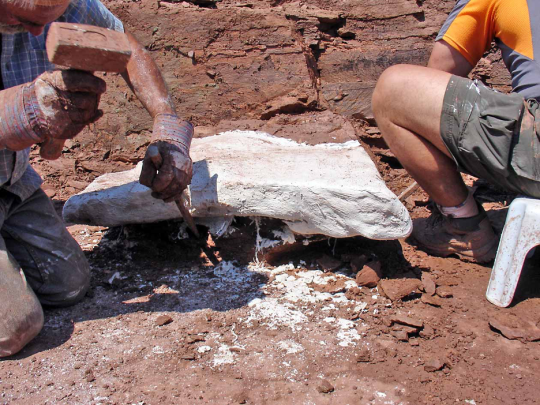
After a couple layers of plaster bandages were applied to the top and sides of the block, the block was undercut, with plaster bandages added periodically to hold the undercut rock in place.

image
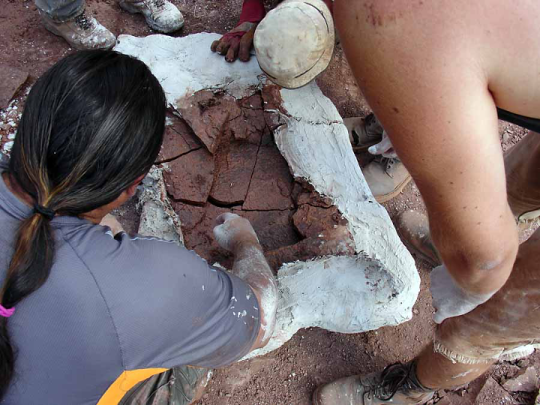
Pictured (left to right) are Dr. Stuart Sumida (California State University, San Bernardino, CA), Dave Berman, and Mr. Jerome Gores (Museum der Natur, Gotha [MNG]). Jerome is holding a plaster and burlap bandage while Dave and Stuart are pressing plaster bandages against the bottom of the block. They must hold the bandages in place until the plaster sets. Photo by the author, 2006.

image
Using hammers and chisels to undercut the block. Photo by the author, 2006.

When deemed safe, we would crack the block free from the quarry floor using hammers and chisels, and flip it over, unless it broke free on its own. Excess rock would be removed from the bottom of the block to make it lighter in weight. Then we would apply burlap and plaster bandages to the bottom of the block. The block would be removed from the quarry and stored at the MNG until it was shipped to Pittsburgh.

image
The block has now been safely flipped over and excess rock is being removed. Photo by the author, 2006.

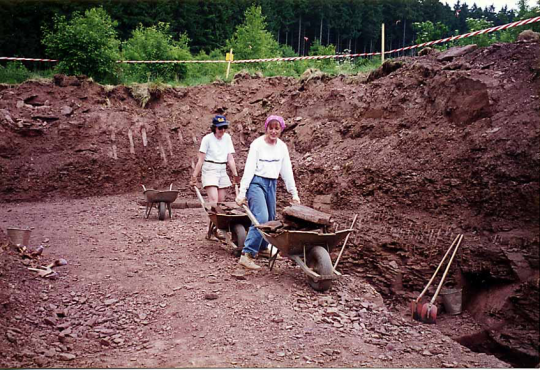
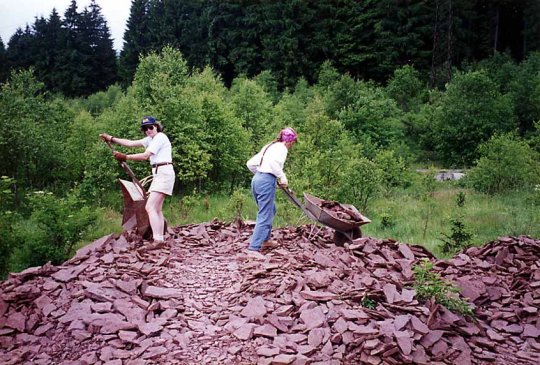
We encountered several problems during our quarry operations over the years. As we worked our way through the rock column in the quarry, processed rock piled up on the quarry floor. In the early years, we tossed or shoveled the processed rock into wheelbarrows and pushed the heavy, unwieldy wheelbarrows out of the quarry to a dump pile. Fortunately, the Bobcat eventually replaced the wheelbarrows for moving processed rock. As we ran out of space outside the quarry to dump processed rock, the rock was used to backfill older portions of the quarry.

image
Former CMNH volunteer Linda Rickets (front, right) and the author (left, rear) line up to push loaded wheelbarrows out of the quarry to the dump pile. Photo by Dave Berman, 1996.

image
At the dump pile. Over time rain and the freeze/thaw cycle would break down the rock and vegetation would grow on it. Photo by Dave Berman, 1996.

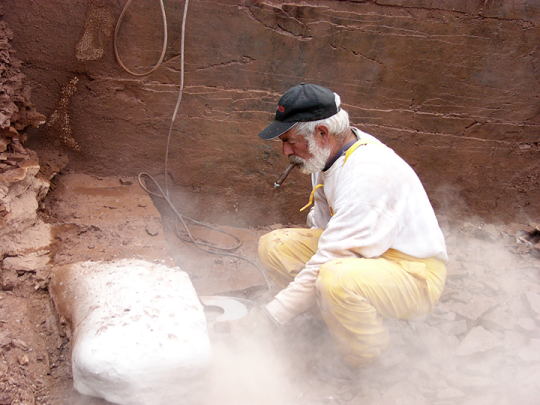
Another problem was that fossils found at the bottom of the quarry were often extremely difficult to undercut because the rock so was hard. Sometimes a well-hit chisel would just bounce off the rock instead of cracking or penetrating it. One year we had to resort to a rock saw to undercut a block.

image
Dave Berman uses a rock saw to undercut a block. Photo by the author, 2004.

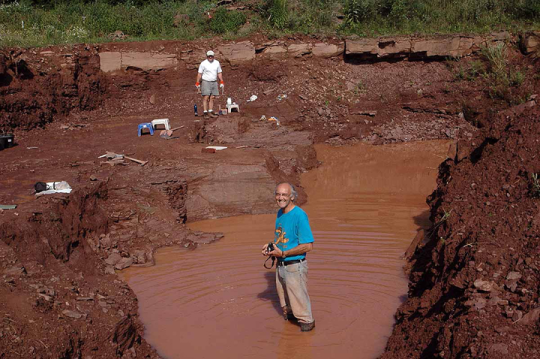
Rain was always a problem. We would shelter in our cars during intervals of rain, or work at the museum if the rain was heavy and persistent. Occasionally heavy rain would flood the quarry, forcing us to work in the ‘dry’ areas of the quarry while a pump drained the water. Of course, we had contests to see who could skip a rock the farthest or make the biggest splash.

image
A flooded quarry greeted us in the morning after heavy overnight rain. Pictured are Thomas Martens (front) and Stuart Sumida (rear). Photo by the author, 2010.

Next week’s post will describe the process of fossil preparation, that is, removing rock to reveal a specimen in the lab. The fossil collected in the 2006 field season will be used as an example.

Here are some videos taken by taken by Thomas Martens’ wife, Steffi, during the 1993 and 2006 field seasons. These show the process of searching for fossils (1993 video) and collecting the fossil highlighted in this post (2006 videos).

Bromacker Quarry 1993

https://youtu.be/DAEG0l1NotE

Bromacker Quarry 2006

https://youtu.be/UNL1s5ycJSM

https://youtu.be/lqYxheOZLQY

https://youtu.be/HrmSBrhde_E

Amy Henrici is Collection Manager in the Section of Vertebrate Paleontology at Carnegie Museum of Natural History. Museum staff, volunteers, and interns are encouraged to blog about their unique experiences and knowledge gained from working at the museum.

Keep Reading

The Bromacker Fossil Project Part III: Fossil Preparation

Filed Under: Blog Tagged With: Amy Henrici, dinosaurs in their time, fossils, Museum from Home, Science News, Vertebrate Paleontology

May 6, 2020 by wpengine

The Bromacker Fossil Project Part I: Introduction and History

If you follow Carnegie Museum of Natural History (CMNH) on social media, then you may have seen a post announcing that Section of Vertebrate Paleontology (VP) Curator Emeritus Dr. Dave Berman and I, along with our collaborators, had recently published a new genus and species of caseid synapsid (a large lizard-like, very distant relative of mammals), Martensius bromackerensis, the specimens of which were discovered at the Bromacker quarry, central Germany. Dave and I are part of an international team from Canada, Germany, Slovakia, and the USA who have discovered, named, and described exquisitely-preserved fossils from the Bromacker quarry over the past 27 years. This recent publication most likely represents the last of the new Bromacker discoveries that Dave and I will publish on, due, in part, to the quarry having been closed to excavation for the past nine years.

With CMNH’s role in the Bromacker project winding down, and much of the world currently staying home and practicing social distancing, I thought this might be a good time to present the project’s highlights as a series of blog posts for you to enjoy. This post will introduce and present the history of the project, while topics of subsequent posts will include the discovery and collection of the fossils, fossil preparation, descriptions of the animals discovered, the geologic history of the quarry, and, finally, a summary of what we learned.

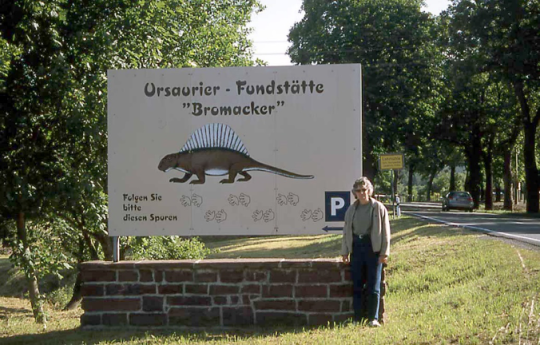
The author (Amy Henrici) standing next to a road sign for the Bromacker quarry in the Thuringian Forest of central Germany. Translation is as follows: “Ursaurier Discovery Site ‘Bromacker.’ Please follow these tracks.” Dr. Thomas Martens coined the term “Ursaurier,” which he translates as “primary saurian,” to indicate that the fossil animals from the Bromacker predate dinosaurs. Photo by Dave Berman.

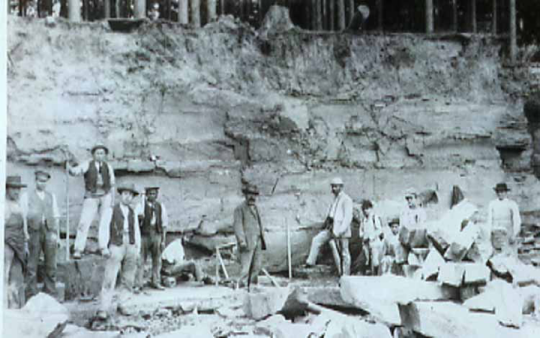
In the Bromacker area of Thuringia, central Germany, a thick rock layer known as the Tambach sandstone has been intermittently quarried for use as a building stone for more than 150 years. Evidence of life preserved in the Tambach sandstone in the form of tetrapod (four-footed backboned animal) footprints was discovered in 1887 and later studied by Professor Wilhelm Pabst from 1890 to 1908. Pabst was an amateur paleontologist who taught high school in the nearby city of Gotha.

Undated photograph showing quarry workers and Professor Pabst (right center in white jacket and hat). Photo provided by Thomas Martens.

Dr. Thomas Martens (now retired Curator, Museum der Natur Gotha [MNG]) discovered the first vertebrate (backboned animal) body fossils at the Bromacker quarry in the summer of 1974. He was trained as an invertebrate paleontologist and was sent there by his major professor to look for fossils of conchostracans (‘clam shrimp’), a type of very small crustacean. After his first discovery, Thomas continued to collect at the Bromacker from 1975 to 1991, finding a variety of early Permian-aged (approximately 290-million-year-old) fossil vertebrates that were otherwise known only from North America. At that time, Thuringia was part of East Germany, so Thomas’ travel to other countries was restricted by his government, but fortunately he could communicate by mail with paleontologists overseas. He eventually began a correspondence with an expert on the types of fossils that he was discovering, CMNH’s Dave Berman (then Associate Curator). In 1992, two years after the reunification of Germany, CMNH sponsored Thomas to come to Pittsburgh to study with Dave for six months, which began a long and productive collaboration.

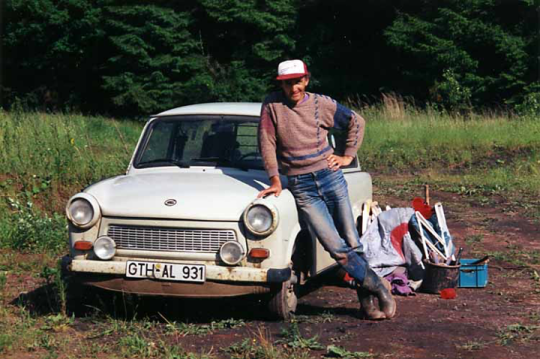
Thomas Martens with his East Germany-produced Trabant automobile. Though Thomas had to endure a long waiting list before he was able to purchase this car, he replaced it shortly after the reunification of Germany in 1990. The Trabant then became his field vehicle. Photo by the author, 1994.

The Bromacker quarry is in the Thuringian Forest near the village of Tambach-Dietharz. It lies in a large field surrounded by thick forest traversed by dirt roads. People from the surrounding villages who regularly visited the Bromacker area to walk, ride their bikes, and pick wild mushrooms would stop to ask us what we were doing. School groups came regularly to learn about the fossil ‘diggings’ and to watch us work.

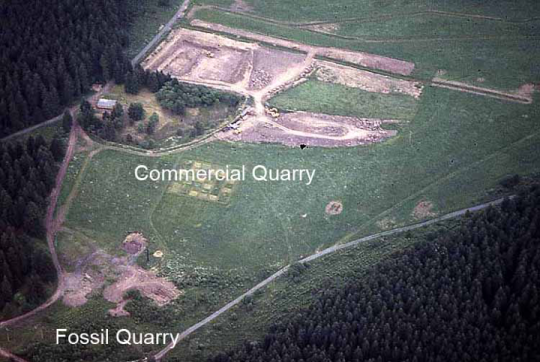
Aerial view of the commercial rock quarry and the fossil quarry at the Bromacker site. Photo provided by Thomas Martens.

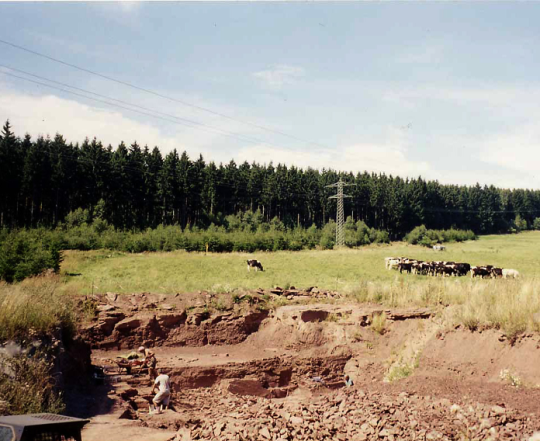
View of the fossil excavation at the Bromacker quarry. Photo by the author.

Field work at the Bromacker was conducted annually from 1993 to 2010 by Dave, Thomas, myself, and our other collaborators, which led to the discovery, collection, and scientific preparation and description of 13 fossil vertebrate species, 12 of which were new to science. Most of the fossils discovered were shipped to CMNH, where I prepared them in the paleontology lab in the museum’s basement. Once the fossils had been published in scientific journals, they would be shipped back to the MNG, because that museum is the legal repository for the Bromacker fossils. CMNH retained cast replicas made by VP staff of some of the more exquisite specimens, and some of these are exhibited in the Fossil Frontiers display case in the Dinosaurs in Their Time exhibition. Be sure to look for these once the museum reopens. And stay tuned for my next post, that will describe how we found and collected the fossils!

Amy Henrici is Collection Manager in the Section of Vertebrate Paleontology at Carnegie Museum of Natural History. Museum staff, volunteers, and interns are encouraged to blog about their unique experiences and knowledge gained from working at the museum.

Keep Reading

The Bromacker Fossil Project Part II: The Hunt for Fossils

Filed Under: Blog Tagged With: Amy Henrici, dinosaurs in their time, Museum from Home, Section of Vertebrate Paleontology, Vertebrate Paleontology

April 29, 2020 by wpengine

Mesozoic Monthly: Sophogramma

Welcome to April! Have you seen any flowers blooming yet? Often, when we think of flowers, we also think of their pollinating buddies, the bees. However, bees are not the only pollinating insects around today, and the same was true during the Mesozoic Era (the ‘Age of Dinosaurs’). One interesting prehistoric pollinator is Sophogramma lii, a beautiful pollen-eating lacewing from the Cretaceous, the third and final time period of the Mesozoic.

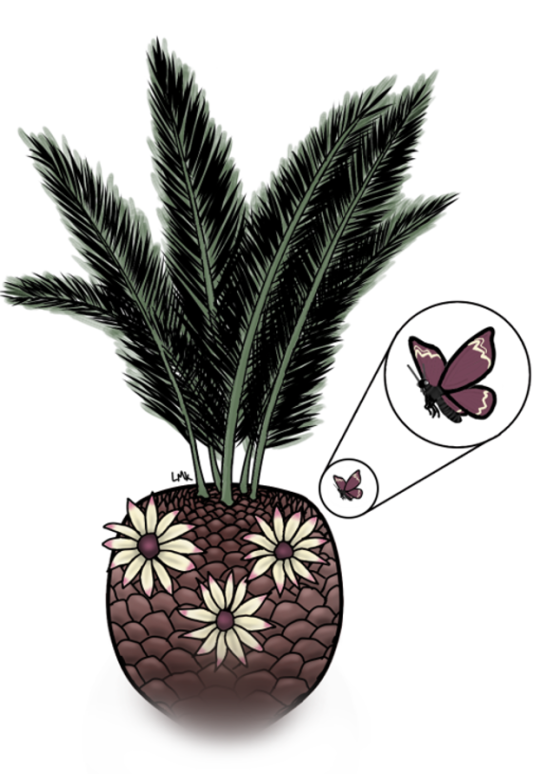
Sketch of Sophogramma lii alongside the Jurassic/Cretaceous seed plant Cycadeoidea by ginjaraptor on DeviantArt. Cycadeoidea was not a flowering plant, even though it looks like one; the flower-like structures are known as strobili and are actually types of cones!

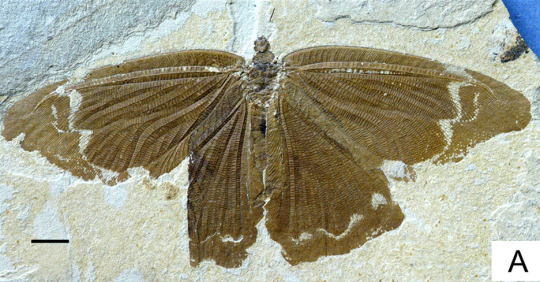
Modern lacewings, for those who aren’t familiar, are a group of small flying insects with two pairs of wings of about equal size. They get their common name from the net-like pattern of veins on their wings. Most of today’s lacewings are predators that eat other small insects. Sophogramma, however, belongs to an extinct group of relatively large lacewings called the Kalligrammatidae, which were not predators but rather pollen eaters and juice drinkers. This group is commonly called the “butterflies of the Jurassic” due to several similarities with modern butterflies: their mouthparts formed long, tube-like siphons for drinking plant juices; their feeding habits resulted in the transference of pollen between plants; and their wings had scales and were distinctly patterned to ward off predators. Astoundingly, we know that kalligrammatids had patterned wings because these patterns are actually preserved in their fossils! Sophogramma lii had whimsical winding stripes along the edges of all four wings. Although we don’t know the exact color of the wings, we do know that these stripes were lighter in color than the rest of the wing. Other kalligrammatids had large eyespots adorning their wings, like many butterflies today.

Beautifully preserved fossil of Sophogramma lii clearly showing the light-colored wavy stripes along the edges of its wings. Image from a research paper by Yang et al. (2014).

The plants that Sophogramma snacked on (and incidentally, pollinated) almost certainly lacked flowers. Flowering plants, technically called angiosperms, didn’t evolve until early in the Cretaceous, roughly 130 million years ago, but kalligrammatids had been around since at least the middle part of the preceding Jurassic Period, about 160 million years ago. So what plants were kalligrammatids eating for all that time? And why did these insects die out just as angiosperms were becoming common? Well, kalligrammatids’ host plants probably consisted of spore-bearing vascular plants such as ferns and non-flowering seed plants including conifers, cycads, ginkgos, and a variety of extinct forms. Before angiosperms burst onto the scene, these types of plants dominated land ecosystems. Despite lacking flowers, these plants would still have used spores and pollen to reproduce, providing kalligrammatids with plenty of food. Once angiosperms evolved their flowers, these plants rapidly diversified and presumably outcompeted the host plants that kalligrammatids such as Sophogramma would have relied upon.

With a wingspan of six inches (15.3 cm), Sophogramma lii was a relatively large insect. Its fossils have been found in the Yixian Formation, an Early Cretaceous-aged rock unit that crops out in northeastern China. The Yixian represents a forested environment that many dinosaurs, archaic birds, pterosaurs, and other hungry critters called home. The distinctive stripes of Sophogramma likely helped it survive attacks by drawing these predators’ attention to its relatively ‘expendable’ wingtips instead of vital parts such as the head or body. I wouldn’t personally be inclined to eat one of these ancient lacewings, but with so many of those polarizing Peeps® on the shelves at this time of year, I think some people might actually prefer a seasonal Sophogramma snack!

Lindsay Kastroll is a volunteer and paleontology student working in the Section of Vertebrate Paleontology at Carnegie Museum of Natural History. Museum staff, volunteers, and interns are encouraged to blog about their unique experiences and knowledge gained from working at the museum.

Filed Under: Blog Tagged With: Mesozoic Monthly, Museum from Home, Science News, Vertebrate Paleontology

April 23, 2020 by Kathleen

NEW GENUS AND SPECIES OF 290-MILLION-YEAR-OLD CASEID DESCRIBED BY CARNEGIE MUSEUM OF NATURAL HISTORY RESEARCHERS AND INTERNATIONAL COLLEAGUES

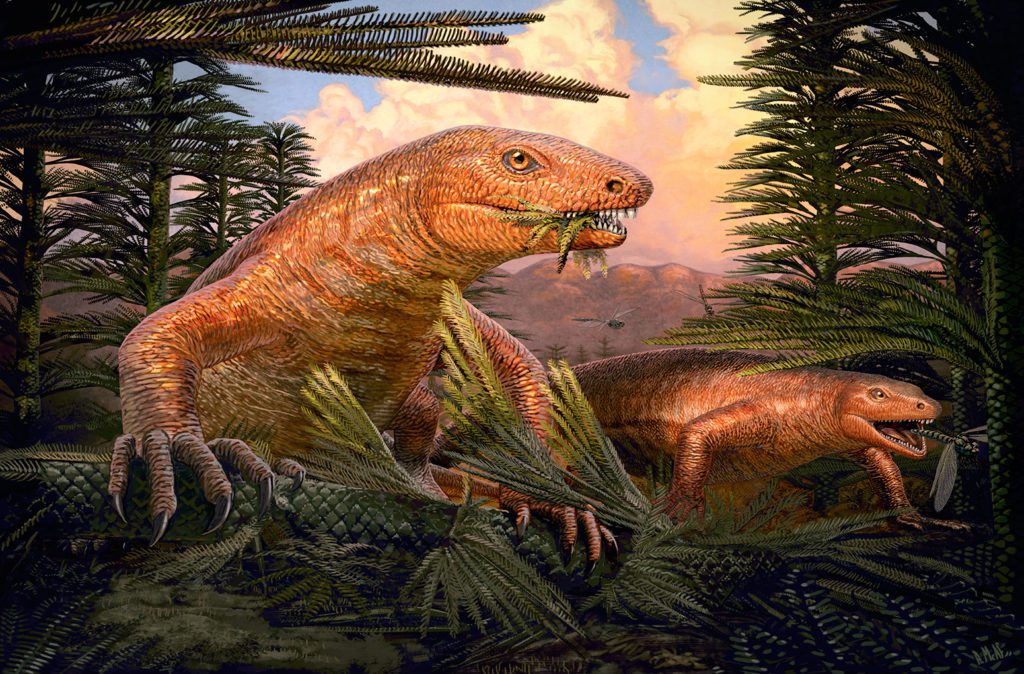
Martensius bromackerensis illustrated by Andrew McAfee.

[Pittsburgh, Pennsylvania, March 31, 2020] — Carnegie Museum of Natural History announces the discovery of Martensius bromackerensis, a basal synapsid from the Late Paleozoic (Early Permain, Artinskian) from 283.5­­ to 290.1 million years ago. The discovery, published today in a paper entitled “New Primitive Caseid (Synapsida, Caseasauria) from the Early Permian of Germany,” names the caseid in honor of Dr. Thomas Martens, retired curator at Germany’s Gotha Museum der Natur and discoverer of the famed Bromacker Quarry, site of many notable fossil discoveries. The paper’s authors include lead author David S Berman, Curator Emeritus at Carnegie Museum of Natural History and colleagues Hillary C. Maddin at Carleton University, Ontario; Amy C. Henrici, Collection Manager at Carnegie Museum of Natural History; Stuart Sumida at California State University, San Bernardino; Diane Scott at University of Toronto at Mississauga, Ontario, and Robert R. Reisz at University of Toronto at Mississauga.

The four well-preserved fossil skeletons, discovered between 1995–2006 at the Bromacker Quarry in Germany’s Thuringian Forest, provide comprehensive knowledge of skeletal morphology, suggesting an insectivorous juvenile dentition that was replaced in adults by a dentition suggestive of an omnivorous diet, though features of the skeleton indicate it was herbivorous. The researchers theorize that a juvenile diet of insects provided a source of bacteria to the gut to aid in processing the presumed adult diet of cellulose-rich, high-fiber plants, roots, and tubers that would have been otherwise difficult to digest. Caseids are an extinct family of pre-dinosaur synapsids, a group that later gave rise to mammals.

“This is an incredible find,” said Amy Henrici, research team member and Collection Manager of Vertebrate Paleontology at the Carnegie. “It has been theorized that among caseids, insectivores evolutionarily preceded herbivores. Martensius suggests this transition may have occurred ontogenetically, or within its lifespan.”

This discovery underscores a 50-year association with Carnegie Museum of Natural History for lead author and Curator Emeritus David Berman, who, along with Henrici, began expeditions to Germany’s Bromacker Quarry in 1993 after the reunification. Another milestone discovery by the team in 2010 led to the describing of Fedexia striegeli, a new genus and species of amphibian found on FedEx property near the Pittsburgh International Airport.

“This has been a highlight of my career as a vertebrate paleontologist,” said Berman. “When the Bromacker excavation was begun in 1993 by an international team of colleagues that included Thomas Martens and me, we never anticipated the great number and variety of discoveries we would make and report on in about three dozen prominent scientific publications. What’s been most personally gratifying are the connections made with the many renowned scientists who have joined Dr. Martens and me to make the Bromacker project so highly successful.”

Filed Under: Press Release Tagged With: Amy Henrici, Vertebrate Paleontology

  • « Go to Previous Page
  • Page 1
  • Interim pages omitted …
  • Page 3
  • Page 4
  • Page 5
  • Page 6
  • Page 7
  • Interim pages omitted …
  • Page 10
  • Go to Next Page »

sidebar

About

  • Mission & Commitments
  • Directors Team
  • Museum History

Get Involved

  • Volunteer
  • Membership
  • Carnegie Discoverers
  • Donate
  • Employment
  • Events

Bring a Group

  • Groups of 10 or More
  • Birthday Parties at the Museum
  • Field Trips

Powdermill

  • Powdermill Nature Reserve
  • Powdermill Field Trips
  • Powdermill Staff
  • Research at Powdermill

More Information

  • Image Permission Requests
  • Science Stories
  • Accessibility
  • Shopping Cart
  • Contact
  • Visitor Policies
One of the Four Carnegie Museums | © Carnegie Institute | Privacy Policy | Terms of Use | Accessibility
Rad works here logo