• Skip to primary navigation
  • Skip to main content
  • Skip to primary sidebar

Carnegie Museum of Natural History

One of the Four Carnegie Museums of Pittsburgh

  • Visit
    • Buy Tickets
    • Visitor Information
    • Exhibitions
    • Events
    • Dining at the Museum
    • Celebrate at the Museum
    • Powdermill Nature Reserve
    • Event Venue Rental
    • Gift Cards
  • Learn
    • Field Trips
    • Educator Information
    • Programs at the Museum
    • Bring the Museum to You
    • Guided Programs FAQ
    • Programs Online
    • Climate and Rural Systems Partnership
  • Research
    • Scientific Sections
    • Science Stories
    • Science Videos
    • Senior Science & Research Staff
    • Museum Library
    • Science Seminars
    • Scientific Publications
    • Specimen and Artifact Identification
  • About
    • Mission & Commitments
    • Directors Team
    • Museum History
  • Tickets
  • Give
  • Shop

Birds

March 9, 2020 by wpengine

Summer Dreaming

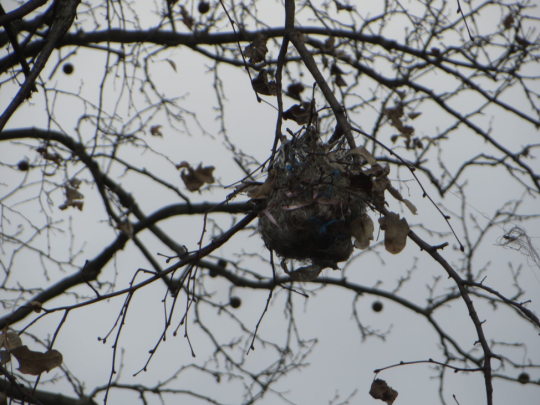
At this time of year, the sight of some battered bird-built structures can trigger summer dreams. Consider the Baltimore Oriole nest dangling from a linden branch above a Flagstaff Hill sidewalk in Pittsburgh’s Schenley Park.  Watch the bundle of plant fiber and ribbon scraps sway in a cold late winter wind and you might be able to imagine the nest partially concealed by bright green leaves and periodically visited by a bird with goldfish-orange feathers.
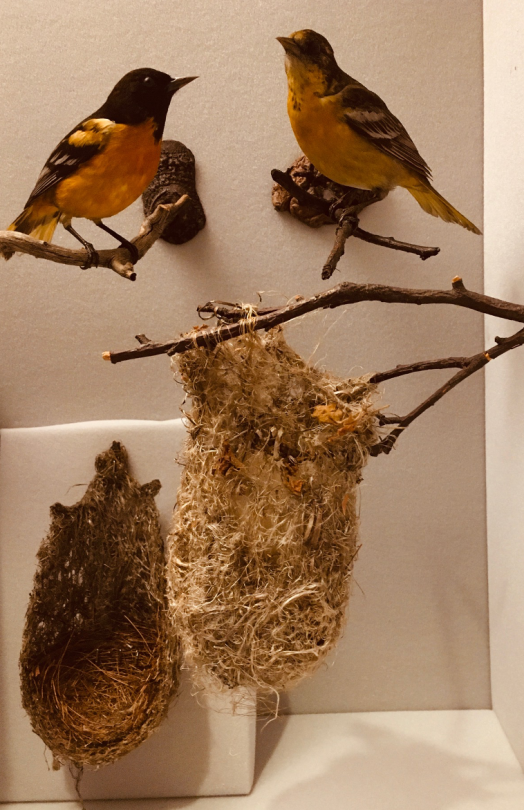
Baltimore Oriole pair in CMNH Bird Hall with nest and nest cross-section.

Such out of season thoughts are far from original. One hundred and sixty-one years ago, and some 500 miles northeast of Pittsburgh, naturalist Henry David Thoreau used a different common name for the species when he referenced the bright and melodic warm season residents in a winter journal entry.

What a reminiscence of summer, a fiery hangbird’s nest dangling from an elm over the road when perhaps the thermometer is down to -20, and the traveler goes beating his arms beneath it! It is hard to recall the strain of that bird then.

Henry David Thoreau – journal entry                                                                                                           December 22, 1859

Patrick McShea works in the Education and Visitor Experience department of Carnegie Museum of Natural History. Museum employees are encouraged to blog about their unique experiences and knowledge gained from working at the museum.
Filed Under: Blog Tagged With: Education, Patrick McShea

March 9, 2020 by wpengine

Big Foot

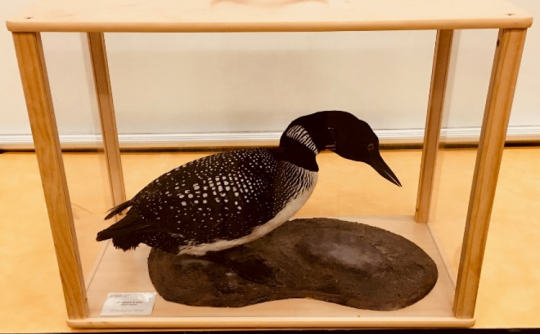
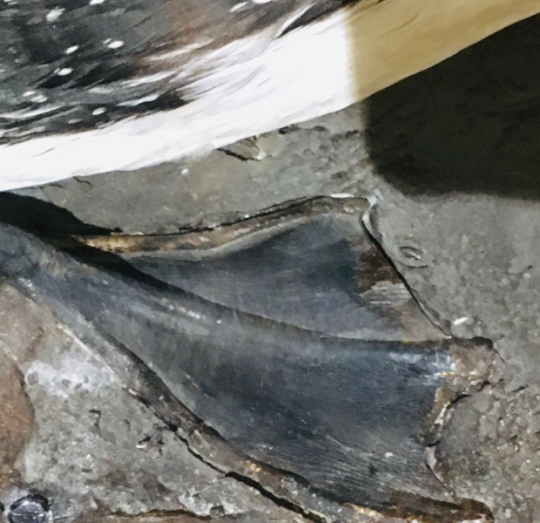
Studying anatomical details on taxidermy mounts can enhance field observations of wildlife. A common loon in the museum’s Discovery Basecamp, offers a great example of this benefit.

Within an acrylic-sided display box, the nearly two-foot long stuffed bird rests on a tiny simulated mud island, as if the spear-billed creature just waddled from the water on its large and widely-spaced webbed feet.

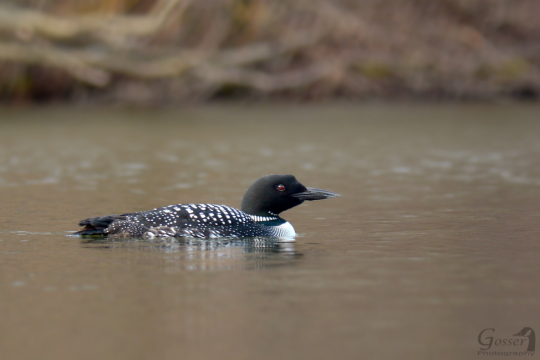
Common loons don’t do much waddling from the water in western Pennsylvania. That behavior occurs much farther north where the species’ summer range includes much of Canada and a northerly strip of the US stretching eastward from the upper Great Lakes to New England. Here the fish-eating birds push themselves from the waters of their home lakes mostly to reach immediately adjacent nests.

Photo by Steve Gosser.

Loons do make seasonal appearances on Pittsburgh area waters during migration rest stops, however. Although their big feet aren’t visible to shore-bound observers during these visits, it’s the hidden actions of the flexible spatula-sized paddles, that makes loon watching such a challenging endeavor.  

Just when you bring a resting loon into binocular focus, the bird can disappear in a minute-long feeding dive and reappear, in an unpredictable direction, many yards from its original location.

The bird’s unseen propulsion is well explained in a 2012 post in Maine Birds, a blog by Colby College biology professor Herb Wilson.

When a loon is first diving from the surface, it breaks the surface by alternating strokes with the left and right leg.  Once underwater, the legs beat synchronously.

The lateral placement of the legs makes for hydrodynamic efficiency.  If the legs were close together, the turbulent eddies created by one leg would interfere with smooth movement through the water of the other leg.  The lateral arrangement allows a loon to generate maximum thrust while minimizing hydrodynamic drag.

The feet of loons are large and webbed.  The real power in swimming is generated by the rearward movement of those webbed feet against the water.  When the loon moves its feet forward during the recovery stroke, the toes are brought together causing the web to collapse and minimizing the effort needed to get the foot ready for the next power stroke.

Spring appearances of migrating loons in western Pennsylvania normally occur between mid-March and early May. Forty miles north of Pittsburgh, common loons are known to visit the deep water sections of Lake Arthur in Moraine State Park.

Patrick McShea works in the Education and Visitor Experience department of Carnegie Museum of Natural History. Museum employees are encouraged to blog about their unique experiences and knowledge gained from working at the museum.
Filed Under: Blog Tagged With: Education, Patrick McShea

February 27, 2020 by wpengine

The Real James Bond and his Connection to CMNH

Bondi. Tyto alba bondi.

Did you know a subspecies of barn owl (Tyto alba bondi) is named after James Bond? James Bond the ornithologist that is.

The holotype specimen of Tyto alba bondi was collected by past Carnegie Museum of Natural History curator Arthur C. Twomey on April 7, 1947 at French Harbor, Isla Roatan, Honduras and later described by Kenneth C. Parkes, another curator at CMNH, together with Allan R. Phillips.

A soon-to-be-released book The Real James Bond: A True Story of Identity Theft, Avian Intrigue and Ian Fleming tells the story of the ornithologist and author of Birds of the West Indies, and how his name became the name of Fleming’s incredibly popular epic thriller series. Fleming, an avid birder himself, admits to lifting the name directly from Birds of the West Indies and acknowledges that the real James Bond’s actions outshine anything the fictional James Bond has done.

Photo credit: Kaylin Martin

The new book includes an image of museum specimen CM P131548, Tyto alba bondi, a subspecies first described in the Annals of the Carnegie Museum. It is endemic to Roatán and Guanaja in the Bay Islands off the coast of Honduras.

Tyto alba bondi is not the only nod to birds that Ian Fleming made in his James Bond stories. Goldeneye is a species of duck, the name of Ian Fleming’s estate in Jamaica, and a 1995 James Bond movie. Not only that, in Die Another Day, 007 goes undercover in Cuba as an ornithologist, a nice little “Easter egg” for those who know the real story of James Bond.

Want to learn more about the James Bond Barn Owl? Consult the December 1978 issue of Annals of the Carnegie Museum, available online here.

Holotype of Tyto alba bondi. Parkes, Kenneth C., and Allan R. Phillips. 1978. Two new Caribbean subspecies of Barn Owl (Tyto alba) with remarks on variation in other populations. Annals Carnegie Museum, 479-492. Page 486, Published 1 December 1978.

Filed Under: Blog Tagged With: Birds

February 27, 2020 by wpengine

What is Bird Banding?

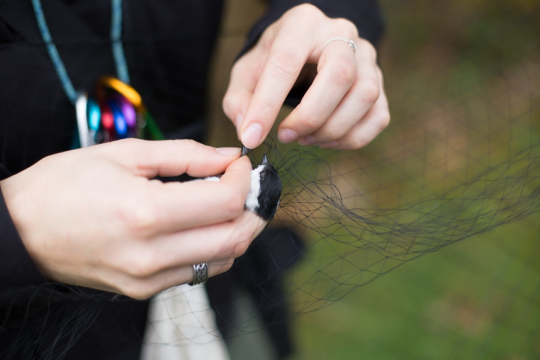
A bird bander extracts a Black-capped Chickadee from a mist net at Powdermill.

What is a bird band?

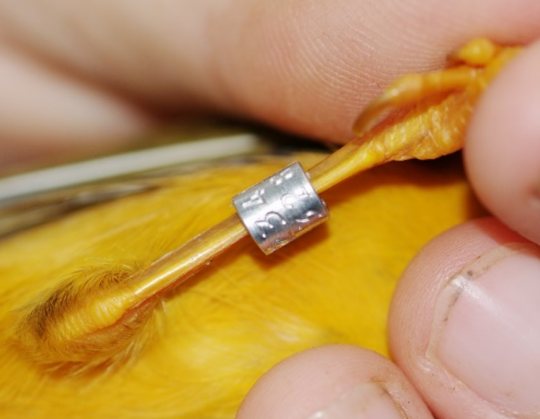
Bird bands are small aluminum rings that are engraved with a series of numbers that identifies individual birds. The bands come in different sizes from a tiny hummingbird band to a “size 9” that fits an eagle. A band fits a bird’s leg like a bracelet: it can spin around the bird’s leg but not slip over ankle or foot joints.

Bird band. Photo credit: John Fraser

How do we band birds?

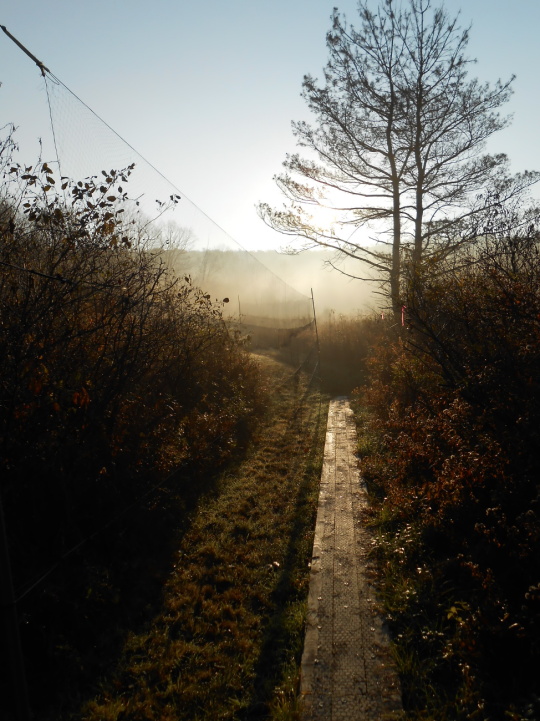
There are different ways to catch birds but at Powdermill, we primarily use mist nets or potter traps. Mist nets are very fine mesh nets that are 12 meters long and about 8 feet high that are suspended between poles in various habitat types. It’s very difficult to see mist nets, so as birds fly through the area they hit the net and gently drop into one of the net’s pockets. An experienced bird bander carefully extracts the bird, places it into a clean cotton bag, and brings it back to a central banding station or lab. In the lab, banders use specially-designed pliers to carefully close the band around the bird’s tarsus, then determine the age and sex of the bird, measure the wing length, quantify fat, weigh the bird, and release it. The banding process is quick: it usually takes less than a minute for each bird!

Who bands birds?

Bird banders operate under a permit from the federal Bird Banding Lab. Banders train as apprentices, often for many years, to learn and perfect the highly-specialized skills necessary to run their own banding stations. High-volume banding stations, usually those that operate during the migration seasons or that can catch hundreds of birds each day, usually have field techs, interns, and volunteers who help while they hone their skills.

Mist net at dawn.

When do we band birds?

Bird banders can band year-round and any time of the day or night, as long as it’s safe for birds! If it’s too hot, too cold, too windy, or too rainy we wait until conditions improve. Of course, the species and number of birds we catch depends on when we band: for example, it’s usually most productive to band songbirds in the mornings and to catch owls at night!

So, what is bird banding?

Bird banding is the process of catching birds, placing a numbered band on their legs, collecting data about each bird, then letting them go. The resulting database can be used to answer all kinds of questions about bird populations. Please stay tuned for our next blog to learn what sorts of questions we can answer from the data we collect during banding!

Annie Lindsay is Banding Program Manager at Carnegie Museum of Natural History’s Powdermill Nature Reserve. Museum employees are encouraged to blog about their unique experiences and knowledge gained from working at the museum.

Filed Under: Blog, Powdermill Tagged With: Powdermill

July 18, 2019 by wpengine

BirdSafe Pittsburgh Makes Museum Windows Visible

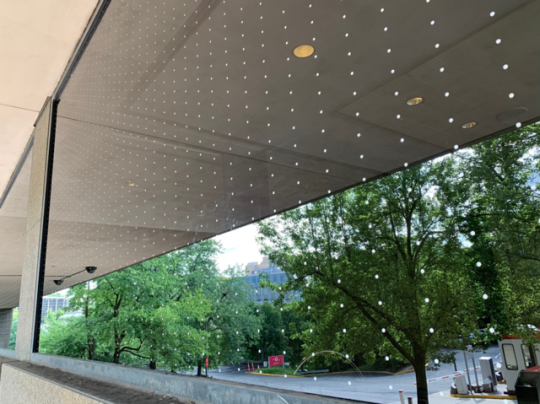
The birds flying around the Carnegie Museums of Art and Natural History are a lot safer now, thanks to Jon Rice, the Urban Bird Conservation Coordinator and leader of BirdSafe Pittsburgh. Over the summer, Jon and his colleagues were able make a deadly wall of windows visible to birds by installing thousands of stylish reflective dots. By breaking up the reflection of the surrounding trees on the East side of the museum, birds are more likely to see the window and avoid impact.

BirdSafe Pittsburgh is a partnership between 8 local conservation organizations working to reduce bird mortality in Pittsburgh. Learn more about how you can become involved at https://birdsafepgh.org/volunteer/.

museum windows with bird proof glass

Windows on the East side of the building have been outfitted with stylish, reflective patterns to make windows visible to birds and reduce collisions.

Chase Mendenhall is Assistant Curator of Birds, Ecology, and Conservation at Carnegie Museum of Natural History. Museum employees are encouraged to blog about their unique experiences and knowledge gained from working at the museum.
Filed Under: Blog Tagged With: Anthropocene, Birds, birdsafe pittsburgh

June 12, 2019 by wpengine

Why Do the King Penguins in Bird Hall Look so Different from Each Other?

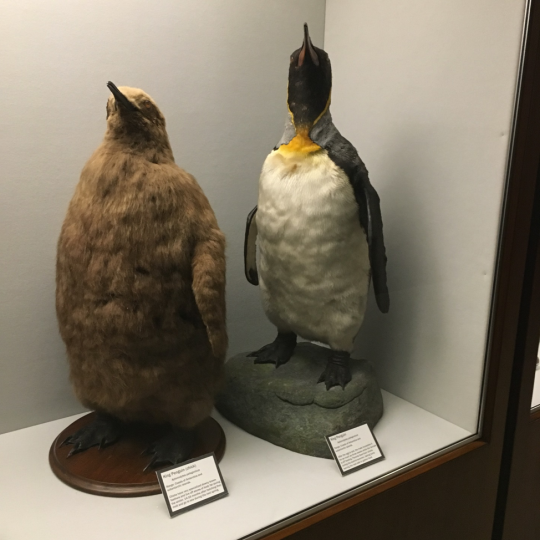
king penguin chick and adult in Bird Hall

Visitor comments often offer insight into the effectiveness of museum displays. The most candid comments are overheard snatches of conversation, some as touching as they are humorous.

The setting: Bird Hall at Carnegie Museum of Natural History, 2:00 p.m. on a summer afternoon.

Three siblings, the oldest about nine, were studying a pair of king penguin taxidermy mounts while their mother, a few display cases away, looked at a different group of birds.

The mother walked toward her children as the nine-year-old explained the birds to his younger brother and sister, “This one is the girl penguin, and this one is the boy penguin. They really look different. The girls are brown and fuzzy, and the boys are black and white.”

The mother quickly surmised the misinterpretation and offered a gentle correction without any trace of ridicule: “The brown one’s a young bird. The label says ‘chick,’ but that doesn’t mean it’s a girl.”

Patrick McShea works in the Education and Visitor Experience department of Carnegie Museum of Natural History. Museum employees are encouraged to blog about their unique experiences and knowledge gained from working at the museum.
Filed Under: Blog Tagged With: bird hall, Birds, Education, Pat McShea, Patrick McShea

  • Page 1
  • Page 2
  • Page 3
  • Interim pages omitted …
  • Page 10
  • Go to Next Page »

sidebar

About

  • Mission & Commitments
  • Directors Team
  • Museum History

Get Involved

  • Volunteer
  • Membership
  • Carnegie Discoverers
  • Donate
  • Employment
  • Events

Bring a Group

  • Groups of 10 or More
  • Birthday Parties at the Museum
  • Field Trips

Powdermill

  • Powdermill Nature Reserve
  • Powdermill Field Trips
  • Powdermill Staff
  • Research at Powdermill

More Information

  • Image Permission Requests
  • Science Stories
  • Accessibility
  • Shopping Cart
  • Contact
  • Visitor Policies
One of the Four Carnegie Museums | © Carnegie Institute | Privacy Policy | Terms of Use | Accessibility
Rad works here logo