• Skip to primary navigation
  • Skip to main content
  • Skip to primary sidebar

Carnegie Museum of Natural History

One of the Four Carnegie Museums of Pittsburgh

  • Visit
    • Buy Tickets
    • Visitor Information
    • Exhibitions
    • Events
    • Dining at the Museum
    • Celebrate at the Museum
    • Powdermill Nature Reserve
    • Event Venue Rental
  • Learn
    • Field Trips
    • Educator Information
    • Programs at the Museum
    • Bring the Museum to You
    • Guided Programs FAQ
    • Programs Online
    • Climate and Rural Systems Partnership
  • Research
    • Scientific Sections
    • Science Stories
    • Science Videos
    • Senior Science & Research Staff
    • Museum Library
    • Science Seminars
    • Scientific Publications
    • Specimen and Artifact Identification
  • About
    • Mission & Commitments
    • Directors Team
    • Museum History
  • Tickets
  • Give
  • Shop

Powdermill Nature Reserve

July 18, 2019 by wpengine

BirdSafe Pittsburgh Makes Museum Windows Visible

The birds flying around the Carnegie Museums of Art and Natural History are a lot safer now, thanks to Jon Rice, the Urban Bird Conservation Coordinator and leader of BirdSafe Pittsburgh. Over the summer, Jon and his colleagues were able make a deadly wall of windows visible to birds by installing thousands of stylish reflective dots. By breaking up the reflection of the surrounding trees on the East side of the museum, birds are more likely to see the window and avoid impact.

BirdSafe Pittsburgh is a partnership between 8 local conservation organizations working to reduce bird mortality in Pittsburgh. Learn more about how you can become involved at https://birdsafepgh.org/volunteer/.
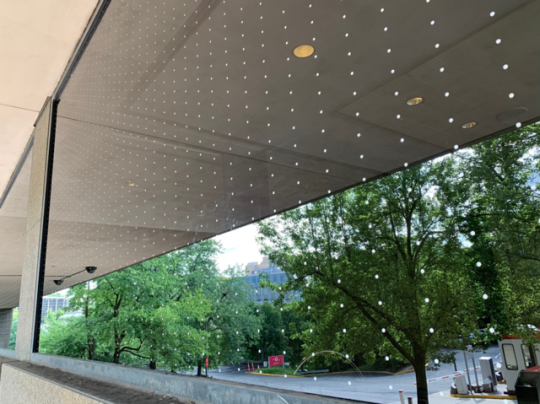
museum windows with bird proof glass

Windows on the East side of the building have been outfitted with stylish, reflective patterns to make windows visible to birds and reduce collisions.

Chase Mendenhall is Assistant Curator of Birds, Ecology, and Conservation at Carnegie Museum of Natural History. Museum employees are encouraged to blog about their unique experiences and knowledge gained from working at the museum.
Filed Under: Blog Tagged With: Anthropocene, Birds, birdsafe pittsburgh

May 9, 2019 by wpengine

Honey Bees Hunt Bargains, Bumble Bees Go Gourmet

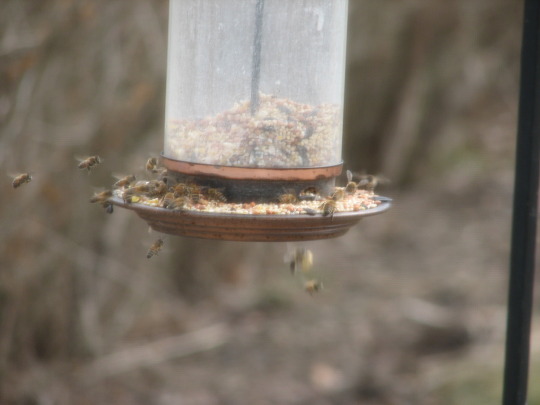
It is rewarding to receive questions and reports from people who turn to the staff at Powdermill Nature Reserve for information on nature in our area. Usually, we have a pretty good idea of what people are asking about, but once in a while visitors ask about something completely new to us. Last year, a visitor asked why he saw honey bees on his bird feeder in great numbers. The feeder was only stocked with bird seed. What were the bees doing?  We had no explanation. Recently, in the February 2019 issue of NY Conservationist, we read the answer. Mr. Gary Ennis provided a photo of the same phenomenon, and had the same question. According to beekeeper Bob Henke, during shipping and handling the seeds rub against each other and produce a fine powder similar to pollen, and the honey bees collect it as if it were pollen.

bees at a bird feeder
Photo credit: Gary Ennis.

But, why don’t we see other bees doing this?  Why are there no bumble bees on the feeder?  Bumble bees and other native bees sample the world one scout at a time, each bee making her own decisions. Researchers at Penn State showed that bumble bees monitor the nutritional value of the pollen they take, trying to keep an appropriate balance of protein versus lipids (fats, oils, and waxes.) If a certain plant produces pollen that has little lipid, then the bumble bee will favor pollen that is richer in lipids on future trips. This effort to balance their diet means that they specifically vary the pollen they harvest. It is as if they go to the grocery store and take a few items from the vegetable section, and a few from the dairy section, and a few from the bakery, creating a balanced plate on a daily basis.

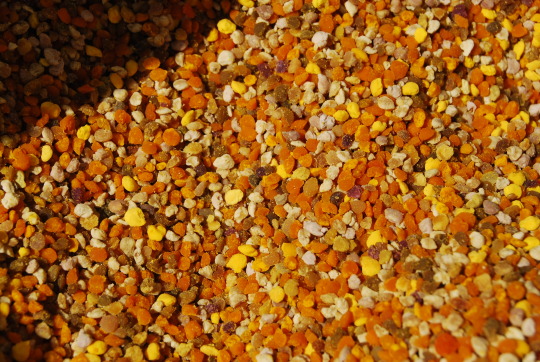
On the other hand, honey bees are well-known for their ability to recruit to a good food source, and marshal large numbers of workers to harvest nectar or pollen. If an experienced scout finds a tree in bloom, she will recruit her sisters to that tree. They will go to that site directly without sampling other flowers on the way, and then return for another load, and another, and another.  This form of shopping is more like discovering that the grocery has potatoes on sale, and then buying 100 pounds of potatoes. Of course, a different scout will find a different resource, and she will recruit workers to harvest that in great numbers. As the weeks go by, the bees collect many different kinds of pollen, providing a broad selection for the nurse bees to feed the larvae. If we collect the separate loads of pollen from each returning bee: we see that each bee collected only one kind of pollen (all the same color), but different bees collected different pollen (many colors among the separate loads.)

pollen
Photo Credit: Jodi Gertz

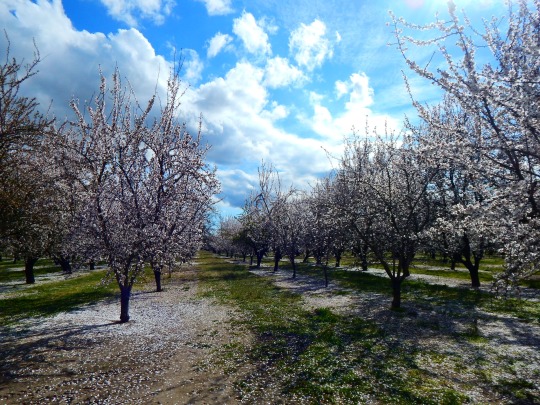
Aside from the importance of recruiting, the scout honey bees also make some effort to balance their diet, particularly regarding the important fatty acids, omega-3 and omega-6. Work by Hebrew University in Jerusalem has shown that if these nutrients are not eaten in an appropriate ratio, the bees learn poorly and do not remember what they learn. For example, bees with adequate omega-3 in their diets are much better at learning to associate an odor with a food reward compared to bees with no omega-3. Further, the bees with good nutrition remember what they learned the next day, whereas those with a poor diet forget. We are only just appreciating what this means for bee pollination of large monoculture crops. When the 1.2 million acres of almonds are in bloom in California, about 3 million commercial bee hives are there to pollinate them for several weeks. During this time, almond pollen is all the bees will get. Almond pollen has almost no omega-3 fatty acids. When these poor bees are moved to other sites, how long will it take them to learn what flowers are good, and will they remember?

almond orchard in bloom

Thanks to NY Conservationist for allowing us to reprint the photo and retell the bird feeder story.

John Wenzel is the Director at Powdermill Nature Reserve, Carnegie Museum of Natural History’s environmental research center. Museum employees are encouraged to blog about their unique experiences and knowledge gained from working at the museum.
Filed Under: Blog Tagged With: Anthropocene, bees, John Wenzel, Powdermill Nature Reserve

October 24, 2018 by wpengine

A Striking Success in Protecting Birds

by John Wenzel

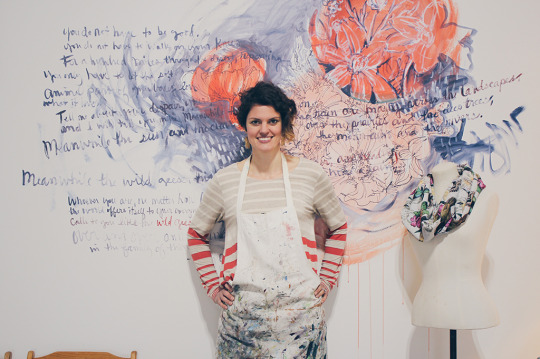
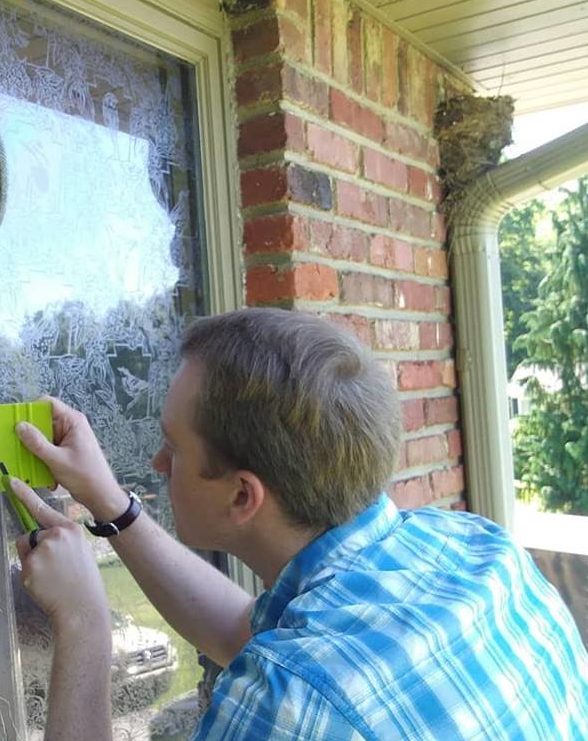
A particular point of pride of our bird research is the BirdSafe Pittsburgh program. A consortium of environmental groups and concerned citizens is working to create a more bird-friendly city, from restoring urban habitat to advising builders and architects on designing structures that will be less dangerous to birds. One of our prime collaborators has been Ashley Cecil, who was Artist in Residence at Carnegie Museum of Natural History. Ashley’s art is bird-themed, including one work that was reproduced on adhesive film that reflects UV light and is highly visible to birds. This film can be applied to windows so that birds will see Ashley’s pattern and avoid collision rather than see a reflection of a distant tree they would approach, striking the window. The film is available in color, making the window look like a stained glass, and in transparent form, resembling lace.

Ashley Cecil in front of her art work

But does the film work? If you put the film on the window, does it reduce bird strikes? As the Director of Powdermill Nature Reserve, I thought I should lead by example and test the film on my own house. I have been monitoring bird strikes at my home since August of 2015. From about 6:00 am to 8:00 am, three or four days a week (at total of six to eight hours a week), I listened for strikes and recorded them. They are not random, nor evenly distributed. Certain windows seem to be a repeated problem, while others never seem to get hit. My house has 15 windows of various dimensions, plus a cathedral window that is 11 feet high and 21 feet wide. No bird has ever hit that window as far as I know. Most strikes occur when migrating birds are coming through, usually April and May, or September and October. When there is a flush of migration, it shows: I had seven strikes from August 27 to 31 in 2015, in only 10 hours of observation. Ignoring seasonal variation, and averaging across the entire data set, a rough estimate is that I observed about one strike for every 20 hours of observation. On June 14, 2018, our Urban Bird Conservation Coordinator, Jon Rice, installed the transparent film on the five most dangerous windows, leaving the others bare.

Jon rice applying birdsafe window

We have had zero bird strikes since the film was installed. To assess the effect of the film, consider that in the same period in 2017 we had seven strikes, in 2016 we had four, and in 2015 we had nine. Years have some random variation, but clearly, there is a reduction from these earlier three years’ average of 6.7 down to 0. More than that, my wife Donna and I became more vigilant since the installation of the film, and we logged about 10 or 12 hours of observation per week rather than six or eight we did for the baseline. If we use the baseline expected frequency of one bird per 20 hours of observation, then with the more thorough observations we would have expected a little more than one bird every two weeks, or about 10 birds in the 18 elapsed weeks, rather than 6.7. Using a simple “chi-square” statistic to estimate the difference between an expectation of 10 birds and an observation of zero, the probability is one in a thousand that we would get zero birds by random variation from an expectation of 10 birds. In other words, if our recent sample differs from our baseline probability purely by chance, we would have to measure 1,000 years to get one year as far from expectation as we got in 2018 following application of Ashley’s film. According to our scientific standards, we reject proposals that have a probability of less than one in 20. Our analysis is less than one in 1,000. We conclude that the film works very well to prevent birds from hitting windows.

You can contact Urban Bird Conservation Coordinator Jon Rice at RiceJ@CarnegieMNH.org.

John Wenzel is the Director at Powdermill Nature Reserve, Carnegie Museum of Natural History’s environmental research center. Museum employees are encouraged to blog about their unique experiences and knowledge gained from working at the museum.
Filed Under: Blog Tagged With: Anthropocene, Ashley Cecil, birdsafe pittsburgh, conservation, John Wenzel, Powdermill Nature Reserve

August 1, 2018 by wpengine

Black Bears at Powdermill

By Andrea Kautz

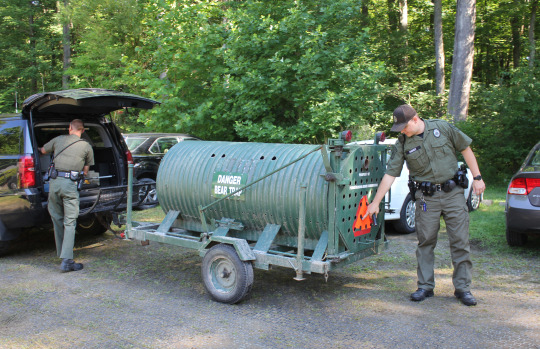
Recently, the PA Game Commission brought a black bear to Powdermill to release in the nearby state forest. It was a healthy, 300-pound male that was relocated because it was becoming a nuisance on a farm more than 30 miles away. Powdermill staff were grateful to have the opportunity to watch as the game wardens sedated and tagged the animal before release. The bear received two ear tags and a lip tattoo for identification. A small milk tooth was extracted which will be used later to determine his age. An infected claw was treated, but otherwise he appeared to be in good health.

Game Wardens arrive at Powdermill
Game Wardens Barron (left) and Harvey (right) arrive at Powdermill with the trap, which is on wheels for easy transport.

The Game Commission estimates the Pennsylvania bear population to be thriving at around 20,000 individuals. Compared to neighboring states, Pennsylvania black bears breed earlier and have more cubs. Bear populations are managed through seasonal harvesting, although only about 2% of those receiving permits are successful hunting a bear. In 2017, the largest bear taken was a 707-pound male from Monroe County!

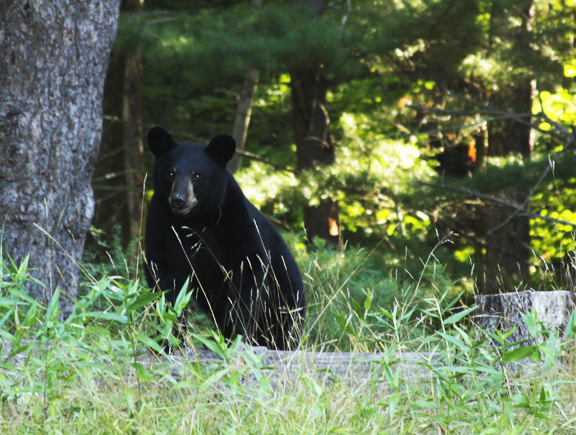
black bear in Pennsylvania
American black bear. Photo credit: George Pankewytch

Hopefully, this male will find another place to call home, but relocating these animals can be tricky as they have a very good sense of direction and can cover long distances. At this time last year, one radio-collared male walked from Johnstown to Grove City to Pittsburgh, then east along the turnpike and up through the Laurel Highlands and back to Johnstown in about a month.  We give special thanks to the game commission for putting so much effort into maintaining a healthy population of bears that can live in harmony with humans and ensuring that Pennsylvania can continue to be a supportive environment for these spectacular beasts.

Andrea Kautz is a Research Entomologist at Carnegie Museum of Natural History’s Powdermill Nature Reserve. Museum employees are encouraged to blog about their unique experiences and knowledge gained from working at the museum.
Filed Under: Blog Tagged With: Andrea Kautz, conservation, mammals, nature, Powdermill, Powdermill Nature Reserve

July 23, 2018 by wpengine

Powdermill Flood Changes the Landscape

By James Whitacre

Here at Powdermill Nature Reserve, the Carnegie Museum of Natural History’s environmental research center, we were reminded of the ever-present forces of nature when a flood recently inundated the Ligonier Valley. Homes and buildings were damaged and numerous people had to be rescued by swift water rescue crews. At Powdermill, a few of our buildings also experienced damage (see the video at the bottom of this post).

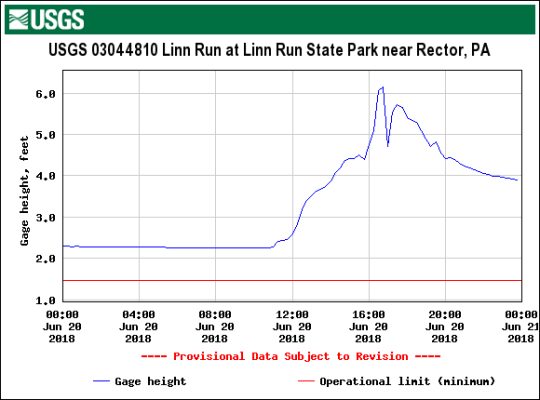
water level chart

On June 20, 2018, over 5.5 inches of rain fell on Powdermill and the surrounding area in about 6 hours. At the nearest USGS stream gauge at Linn Run State Park, the water level rose about four feet in five hours. The force of the flood waters was able to move large boulders, take down trees, and change the course of many streams, including Powdermill Run. The flood levels were so high that we have reason to believe that this was a very significant flood event. But was it a ‘100-year flood’?

The concept of the ‘100-year flood’ is quite familiar, but this concept is a bit misleading. It does not mean that a flood event rated as a ‘100-year flood’ occurs every 100 years. Rather, it means that every year, there is a 1% chance that a flood will reach the annual exceedance probability (AEP) (i.e. the height of the flood waters in a particular area). On average, the AEP will reach that level every 100 years. This definition was established for the National Flood Insurance Program. For more information, see the USGS page The 100-Year Flood—It’s All About Chance.

So the question still stands, was the flood at Powdermill a ‘100-year flood’? Using the power of maps an GPS, the GIS lab at Powdermill decided to compare the FEMA flood zones map to the flood levels observed in the field. As the map shows, it appears that is is very close, though more assessment is needed to be certain.

See the map here.

While the damage was extensive, this event will provide researchers at Powdermill the opportunity to study yet another instance of how natural disasters affect the ecology and landscape of the nature reserve. A similar event six years ago, in June 2012, was when a tornado touched down in the Ligonier Valley and blew down nearly 50 acres of forest in the nature reserve. Powdermill continues to utilize these areas in numerous on-going research projects to track succession and plant-animal interactions after a disturbance. While the flood event may not produce an obvious research project at the moment, Powdermill researchers will be keeping their eyes open to see how we may need to respond.

James Whitacre is the GIS Research Scientist for Carnegie Museum of Natural History, where he primarily manages the GIS Lab at Powdermill Nature Reserve, the Museum’s environmental research center. Museum employees are encouraged to blog about their unique experiences and knowledge gained from working at the museum.
Filed Under: Blog Tagged With: James Whitacre, Powdermill, Powdermill Nature Reserve

May 30, 2018 by wpengine

Lincoln’s Sparrow

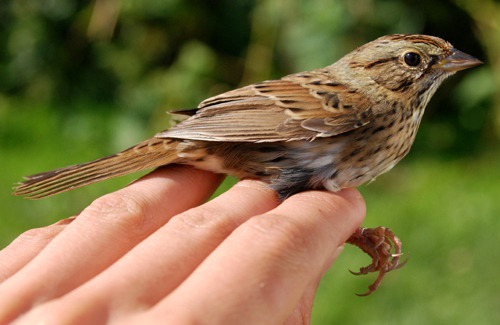
Lincoln's Sparrow

Known to conceal itself, this sparrow sneaks around the ground in wet meadows, rarely making an appearance to humans. John James Audubon coined the species, Lincoln’s Sparrow, after his travel companion Thomas Lincoln, was the only one to capture the bird for study.


Powdermill Nature Reserve’s avian research center is part of Carnegie Museum of Natural History’s biological research station in Rector, Pennsylvania.  The research center operates a bird banding station, conducts bioacoustical research, and performs flight tunnel analysis with the goal of reducing window collisions.


Filed Under: Blog Tagged With: birding, Birds, parc, Powdermill, Powdermill Nature Reserve

  • Page 1
  • Page 2
  • Page 3
  • Page 4
  • Go to Next Page »

sidebar

About

  • Mission & Commitments
  • Directors Team
  • Museum History

Get Involved

  • Volunteer
  • Membership
  • Carnegie Discoverers
  • Donate
  • Employment
  • Events

Bring a Group

  • Groups of 10 or More
  • Birthday Parties at the Museum
  • Field Trips

Powdermill

  • Powdermill Nature Reserve
  • Powdermill Field Trips
  • Powdermill Staff
  • Research at Powdermill

More Information

  • Image Permission Requests
  • Science Stories
  • Accessibility
  • Shopping Cart
  • Contact
  • Visitor Policies
One of the Four Carnegie Museums | © Carnegie Institute | Privacy Policy | Terms of Use | Accessibility
Rad works here logo