• Skip to primary navigation
  • Skip to main content
  • Skip to primary sidebar

Carnegie Museum of Natural History

One of the Four Carnegie Museums of Pittsburgh

  • Visit
    • Buy Tickets
    • Visitor Information
    • Exhibitions
    • Events
    • Dining at the Museum
    • Celebrate at the Museum
    • Powdermill Nature Reserve
    • Event Venue Rental
    • Gift Cards
  • Learn
    • Field Trips
    • Educator Information
    • Programs at the Museum
    • Bring the Museum to You
    • Guided Programs FAQ
    • Programs Online
    • Climate and Rural Systems Partnership
  • Research
    • Scientific Sections
    • Science Stories
    • Science Videos
    • Senior Science & Research Staff
    • Museum Library
    • Science Seminars
    • Scientific Publications
    • Specimen and Artifact Identification
  • About
    • Mission & Commitments
    • Directors Team
    • Museum History
  • Tickets
  • Give
  • Shop

wpengine

July 30, 2021 by wpengine

Jurassic Days: Icarosaurus

by Zach Lyons-Weiler
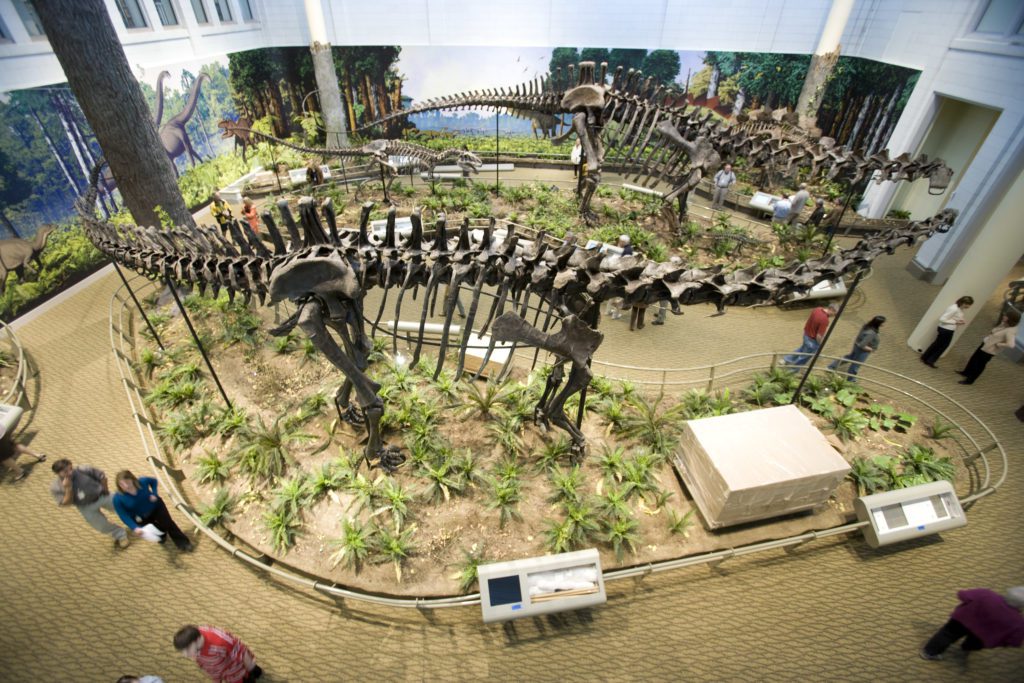
View of Dinosaurs in Their Time exhibition from above
Image credit: Joshua Franzos, Treehouse Media

Both visitors and staff love Carnegie Museum of Natural History’s Dinosaurs in Their Time exhibition for many reasons. For some people, it is the huge dinosaurs such as Tyrannosaurus and Diplodocus that capture the imagination. For others, it is the Quetzalcoatlus that soars above the latest Cretaceous display, or the cute Psittacosaurus with its strange tail ornamentation. But for me, my favorite specimen is a rather obscure fossil replica hidden in plain sight in the Triassic and Early Jurassic area of the hall. Its name is Icarosaurus, and it is quite possibly one of the strangest animals that we have on display. When one first sees it, it looks like a cast of a jumble of bones on a background of dark shale. However, as you will come to realize, Icarosaurus is far more than just that!

The Carnegie Museum’s Icarosaurus (which is a high-quality replica of the only known original fossil) is displayed in a glass case alongside many other casts and fossils from what is known as the Newark Supergroup, a large deposit of rocks that snake their way from South Carolina to New Brunswick and Nova Scotia. These rocks were deposited during the Triassic and early Jurassic periods, or from roughly 230 to 190 million years ago. The sedimentary rocks here are intermittently intruded by younger volcanic rocks, indicating that this area was undergoing tremendous geological change at this time. During the Triassic and Early Jurassic, the supercontinent Pangaea was in the process of splitting up. The eastern coast of North America was rifting from western Africa, opening a furrow that would become the Atlantic Ocean. Before it was ocean, though, the rift was filled with lakes that were similar to Lake Victoria and Lake Tanganyika in today’s Great Rift Valley in Africa. The climate was warmer, too, and so the environment was wet and tropical. Due to climatic changes and natural oscillations in Earth’s orbit, these ancient rift environments would go through stages, from deep lakes to mudflats. Each layer preserved the remains of life that lived during that specific interval. Layers of rock deposited in deep lakes often contain abundant fossils of fishes, invertebrates, and reptiles. Other layers preserve footprints of early dinosaurs and other animals. Still others preserve the remains of cynodonts, which were the forerunners of mammals.

Dating to the late Triassic Period, the remains of Icarosaurus were discovered in one of the deep lake deposits by three teenagers in a quarry near North Bergen, New Jersey, which is just outside New York City. Upon discovering the fossil, they realized its importance and donated it to New York’s American Museum of Natural History, where it was named in 1966 as Icarosaurus siefkeri. This is, to this day, the only known specimen of this reptile, so it is of tremendous scientific value. Other lizard-like reptiles had been found in these deposits, but what made Icarosaurus so unique were the extremely long and unusual ribs that extended from its body. These ribs are similar in form to those of lizards in the extant genus Draco, which have elongated ribs connected by membranes of skin that they extend to glide between trees in their Southeast Asian rainforest homes. Because the rib anatomy of this modern group is so similar to that of Icarosaurus, scientists reasoned that the latter would have glided between trees in a comparable manner.

Icarosaurus was not the first reptile to have evolved this trait, though. During the Permian Period, around 260 million years ago, reptiles such as Coelurosauravus had adapted to a gliding lifestyle. Other extinct reptiles that evolved gliding morphologies include Mecistotrachelos from the Triassic of Virginia and Xianglong from the Cretaceous of China. The extreme similarity between these distantly related reptile groups is a remarkable example of convergent evolution, which is a process where organisms evolve the same traits due to their populations facing similar selective pressures. Other examples of convergent evolution that can be seen in the Triassic and Early Jurassic exhibits in Dinosaurs in Their Time are the phytosaurs Redondasaurus and Rutiodon, which resemble their distant relatives, crocodiles, and ichthyosaurs such as Ichthyosaurus and Stenopterygius, which bear an uncanny resemblance to dolphins.

The high school students that discovered Icarosaurus were lauded for their donation, and the discovery of such an odd animal made headlines in both the local and national news. Unfortunately, though, the fame and unique nature of the fossil caused some issues. The man for whom Icarosaurus siefkeri was named, Alfred Siefker, repossessed the fossil to put it in his personal collection in 1989. It stayed there until 2000, when he tried to sell it at auction. Understandably, the scientific community was upset with this decision, because if the fossil were to be sold into a private collection then it would be unavailable for scientific study. It was bought at the auction for well under its appraised value, and the buyer, Dick Spight, donated it back to the American Museum that same year. The original Icarosaurus specimen is currently on display at that venerable New York institution.

Overall, Icarosaurus is a remarkable little animal that deserves more attention than it gets. Look for it and other unique prehistoric animals the next time you visit the Dinosaurs in Their Time exhibition.

Zach Lyons-Weiler is a Gallery Experience Presenter in CMNH’s Life Long Learning Department. Museum staff, volunteers, and interns are encouraged to blog about their unique experiences and knowledge gained from working at the museum.

Further reading:

Colbert, Edwin Harris. “The Triassic gliding reptile Icarosaurus.” Bulletin of the American Museum of Natural History; v. 143, article 2. (1970). https://www.scientificamerican.com/article/icarosaurus-home-to-roost/

Colbert, Edwin Harris. “Adaptations for gliding in the lizard Draco.” American Museum Novitates; no. 2283. (1967).

Related Content

Folded Forest: Defining the Jurassic Period

Real Dinosaurs vs. Reel Dinosaurs: Film’s Fictionalization of the Prehistoric World

Jurassic Days: Tyrannosaurus rex

Carnegie Museum of Natural History Blog Citation Information

Blog author: Lyons-Weiler, Zach
Publication date: July 30, 2021
Share this post!

  • Share on Twitter Share on Twitter
  • Share on Facebook Share on Facebook
  • Share on Pinterest Share on Pinterest
  • Share on LinkedIn Share on LinkedIn
  • Share on Reddit Share on Reddit
  • Share via Email Share via Email

Share this post!

  • Share on Twitter Share on Twitter
  • Share on Facebook Share on Facebook
  • Share on Pinterest Share on Pinterest
  • Share on LinkedIn Share on LinkedIn
  • Share on Reddit Share on Reddit
  • Share via Email Share via Email

Filed Under: Blog Tagged With: dinosaurs, dinosaurs in their time, sssjurassic, Super Science, Vertebrate Paleontology, Zach Lyons-Weiler

July 29, 2021 by wpengine

Folded Forest: Defining the Jurassic Period

by Jane Thaler

What’s in a Name?

Derived from the words for “middle life” in Greek, the Mesozoic Era consisted of three geological periods: the Triassic, Jurassic, and Cretaceous. While many of us might be aware of all three, the term “Jurassic” has seeped into our everyday lives in a way that the Triassic and Cretaceous have not. We can attribute much of this ubiquity to the wildly popular Jurassic Park books by Michael Crichton and their subsequent film adaptations, but have you ever wondered what “Jurassic” actually means and how scientists define the period’s geological boundaries?

Coining “Jurassic”

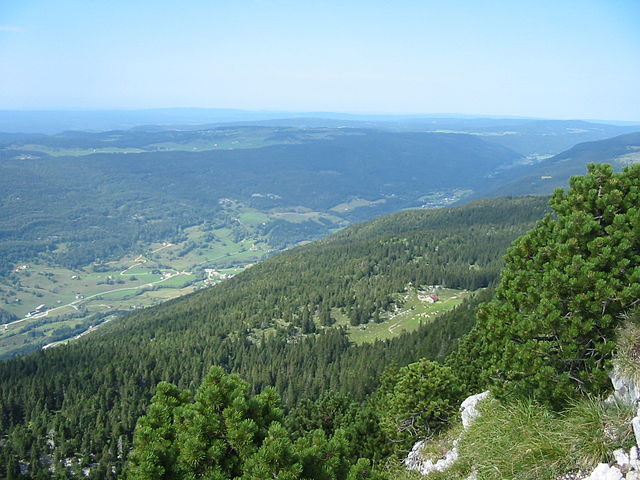
The “Jura” in Jurassic refers to the Jura Mountains that run along a large portion of the Swiss and French border. Named for the ancient Celtic word for forest, the Jura Mountains are known for their tree-covered peaks and the folded rocks that comprise them (Jones, 2020, p. 94).

Mountains covered in a combination of green forests and lush grassy fields.
Jura Mountains from Wikimedia Commons.

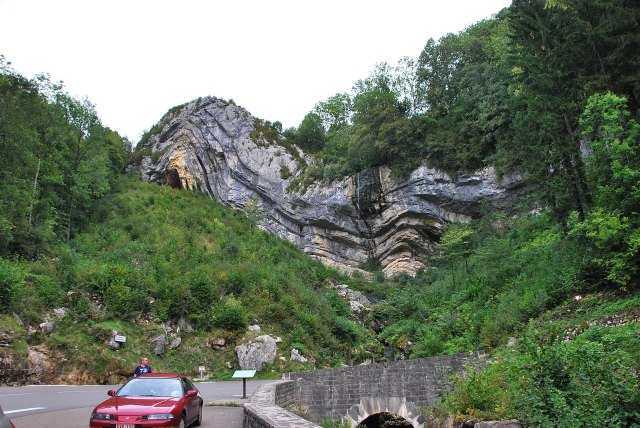
It was here in 1795 that Alexander von Humboldt, a Prussian explorer and naturalist, documented a series of carbonate shelf deposits from the period now known as the Jurassic and dubbed them the “Jura Kalstein.” Alexander Brongniart, a French scientist known for arranging and describing the geologic formations of the Tertiary Period (66.0 to 2.6 million years ago), coined the term “Terrains Jurassiques” to refer to all Jurassic strata in 1829. In 1832, German geologist Leopold von Buch established the three-fold subdivision of epochs based on the folds of limestone in the Jura: the Lias (Early Jurassic), the Dogger (Middle Jurassic), and the Malm (Late Jurassic). This arrangement remains the basic framework for our geological understanding of the Jurassic to this day (Ogg et al., 2012b, p. 732; Encyclopedia Britannica, 2021a).

Car parked in front of rock formation that appears to have folds in it.
Jura Mountain fold known as the “Chapeau de Gendarme” from Wikimedia Commons.

Beginning of the Jurassic

Nestled between the Triassic and Cretaceous periods, the Jurassic spanned from 201.3 million years ago to 145 million years ago (National Park Service, 2020). The end of the Triassic (so named because it is a group of three strata) and the beginning of the Jurassic is marked by the Triassic–Jurassic (Tr–J) extinction event, sometimes called the end-Triassic extinction. The fourth of five major extinction episodes on Earth (or sixth if you count the current, anthropogenic extinction), the Tr–J extinction wiped out around 75 percent of all marine and terrestrial life (Encyclopedia Britannica, 2021b).

Current evidence suggests that the Tr–J extinction was initially set into motion by movements of the Earth’s crust. As the all-encompassing mega-continent Pangea began to break apart, the associated tectonic shifts caused significant volcanic activity that spewed carbon dioxide into the atmosphere. The resulting global warming disrupted the Earth’s carbon cycle and contributed to ocean acidification (Fuge, 2020).

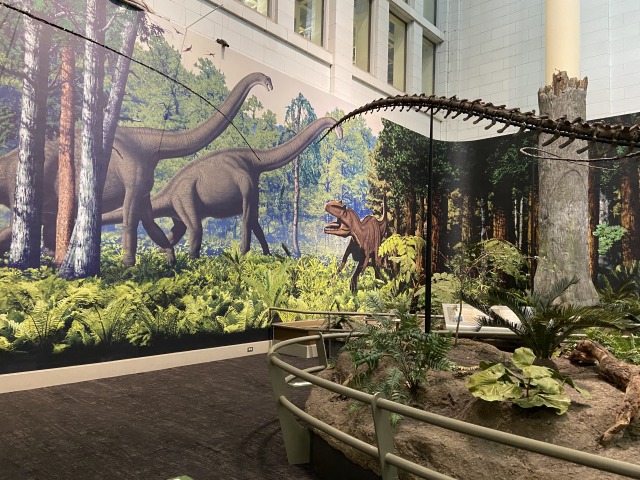
The ecological niches left open by the Tr–J extinction were quickly filled by remaining species of pterosaurs, crocodilians, turtles, mammals, many species of plants and invertebrates, marine life, and dinosaurs. Though many species died out during the extinction event, the wet and warm climate of the Jurassic in many places encouraged the growth of lush vegetation along with the proliferation and diversification of fauna. Oceans teemed with life, forests flourished, and dinosaurs became the dominant forms of backboned animal life on land during this time (Encyclopedia Britannica, 2021b).

Mural of dinosaurs during the Jurassic Period.
Jurassic landscape in the Dinosaurs in Their Time exhibition at Carnegie Museum of Natural History.

End of the Jurassic Period

The end of the Jurassic is a bit of a mystery as the geological boundary between it and the Cretaceous Period (the latter name derived from the Latin for “chalk”) remains formally undefined. In fact, the Cretaceous is the only period in the Phanerozoic Eon (541 million years ago to present day) that “does not yet have an accepted global boundary definition” (Ogg et al., 2012a, p. 795). This definitional challenge is due to a number of factors but is mostly attributed to the concept of provincialism or provinciality, which means that plant or animal populations were restricted to a particular area or group of areas (Gale et al., 2020). This resulted in endemic populations, particularly of ammonites, which left uneven or unclear fossil markers in the stratigraphic record (Wimbledon, 2017; see Énay, 2019 for more detail on the J/K boundary debates).

We do know that the end of the Jurassic was marked by the Tithonian–early Barremian cool interval, which began 150 million years ago and continued well into the Early Cretaceous (Ogg et al., 2012a). During this time, some groups of animals did go extinct or become less diverse, like the dinosaurian subgroup Stegosauria that included Stegosaurus, while others increased in abundance, like some ammonite subgroups who survived the Tr–J event. Plants were also developing in important ways during this time. Around 130 million years ago, angiosperms (flowering plants) began to diversify, and they became increasingly dominant throughout the Cretaceous (Friis et al., 2010). Taking the unknowns and variables into account, the end of the Jurassic is currently placed at 145 million years ago.

Naming Geological Periods

Many of the names we still use for geological periods went through a similar process to that of the Jurassic: a scientist named a phenomenon based on the strata they were studying and the nomenclature (the system of names) developed from there. Nowadays, defining and naming geological units is left to the International Commission on Stratigraphy of the International Union of Geological Sciences. The process by which this happens feels about as long as the geologic periods themselves, at least to those of us watching from outside the commission. This is, of course, an exaggeration, but it does take years of work and rounds of voting to arrive at an official stratigraphic boundary designation.

Check out https://stratigraphy.org for the latest updates on humanity’s understanding of geologic time.

Jane Thaler is a Gallery Experience Presenter and Floor Captain in CMNH’s LifeLong Learning Department. Museum staff, volunteers, and interns are encouraged to blog about their unique experiences and knowledge gained from working at the museum.

References:

enay, Raymond (2019). The Jurassic/Cretaceous System Boundary is at an impasse: Why not go back to Oppel’s 1865 original and historic definition of the Tithonian? Cretaceous Research. https://doi.org/10.1016/j.cretres.2019.104241.

Encyclopedia Britannica (2021a). Alexandre Brongniart. https://www.britannica.com/biography/Alexandre-Brongniart

Encyclopedia Britannica (2021b). End-Triassic extinction. https://academic-eb-com.pitt.idm.oclc.org/levels/collegiate/article/end-Triassic-extinction/474417

Fuge, L. (2020). Volcano link to end of Triassic extinction. Cosmos. https://cosmosmagazine.com/history/palaeontology/volcano-link-to-end-of-triassic-extinction/

Friis E. M., Pedersen K. R., Crane P. R. (2010). Diversity in obscurity: fossil flowers and the early history of angiosperms. Philosophical Transactions of the Royal Society B, 365. https://doi.org/10.1098/rstb.2009.0227

Gale, A. S., Mutterlose, J., Batenburg, S., Gradstein, F. M., Agterberg, F. P., Ogg, J. G., Petrizzo, M. R. (2020). The Cretaceous Period. In The Geologic Time Scale 2020 (Gradstein, F. M., Ogg, J. G., Schmitz, M. D., & Ogg, G. M., Eds.). Elsevier. https://doi.org/10.1016/B978-0-12-824360-2.00027-9

Gore, R. (n.d.), The rise of mammals. In National Geographic. https://www.nationalgeographic.com/science/article/rise-mammals

Ogg, J. G., Hinnov, L. A., Huang, C. (2012a). Cretaceous. In The Geologic Time Scale 2012 (Gradstein, F. M., Ogg, J. G., Schmitz, M. D., & Ogg, G. M., Eds.). Elsevier.

Ogg, J. G., Hinnov, L. A., Huang, C. (2012b). Jurassic. In The Geologic Time Scale 2012 (Gradstein, F. M., Ogg, J. G., Schmitz, M. D., & Ogg, G. M., Eds.). Elsevier.

Jones, P. (2020). Jura Mountains, France/Switzerland. In Around the World in 80 Words. University of Chicago Press. https://doi.org/10.7208/9780226682822-026

National Park Service (2020). Geologic time scale. https://www.nps.gov/subjects/geology/time-scale.htm

Pfiffner, O. A. (2006). Thick-skinned and thin-skinned styles of continental contraction. Special Paper of the Geological Society of America, 414.

Sauquet, H., von Balthazar, M., Magallón, S. et al. (2017). The ancestral flower of angiosperms and its early diversification. Nature Communications, 8. https://doi.org/10.1038/ncomms16047

Scotese, C. R., Song, H., Mills, B. J. W., van der Meer, D. G. (2021). Phanerozoic paleotemperatures: the Earth’s changing climate during the last 540 million years. Earth-Science Reviews, 215. https://doi.org/10.1016/j.earscirev.2021.103503

Wimbledon, W. A. P. (2017). Developments with fixing a Tithonian/Berriasian (J/K) boundary. Volumina Jurassica, XV. https://doi.org/10.5604/01.3001.0010.7467

Related Content

Super Science Saturday: Jurassic Day (July 31, 2021)

Real Dinosaurs vs. Reel Dinosaurs: Film’s Fictionalization of the Prehistoric World

What Did Dinosaurs Sound Like?

Carnegie Museum of Natural History Blog Citation Information

Blog author: Thaler, Jane
Publication date: July 29, 2021

Share this post!

  • Share on Twitter Share on Twitter
  • Share on Facebook Share on Facebook
  • Share on Pinterest Share on Pinterest
  • Share on LinkedIn Share on LinkedIn
  • Share on Reddit Share on Reddit
  • Share via Email Share via Email

Share this post!

  • Share on Twitter Share on Twitter
  • Share on Facebook Share on Facebook
  • Share on Pinterest Share on Pinterest
  • Share on LinkedIn Share on LinkedIn
  • Share on Reddit Share on Reddit
  • Share via Email Share via Email

Filed Under: Blog Tagged With: dinosaurs, Jane Thaler, sssjurassic, Super Science

July 29, 2021 by wpengine

Real Dinosaurs Versus Reel Dinosaurs: Film’s Fictionalization of the Prehistoric World

by Shelby Wyzykowski

What better way can you spend a quiet evening at home than by having a good old-fashioned movie night? You dim the lights, cozily snuggle up on your sofa with a bowl of hot, buttery popcorn, and pick out a movie that you’ve always wanted to see: the 1948 classic Unknown Island. Mindlessly munching away on your snacks, your eyes are glued to the screen as the story unfolds. You reach a key scene in the movie: a towering, T. rex-sized Ceratosaurus and an equally enormous Megatherium ground sloth are locked in mortal combat. And you think to yourself, “I’m pretty sure something like this never actually happened.” And you know what? Your prehistorically inclined instincts are correct.

From the time that the first dinosaur fossils were identified in the early 1800s, society has been fascinated by these “terrible lizards.” When, where, and how did they live? And why did they (except for their modern descendants, birds) die out so suddenly? We’ve always been hungry to find out more about the mysteries behind the dinosaurs’ existence. The public’s hunger for answers was first satisfied by newspapers, books, and scientific journals. But then a whole new, sensational medium was invented: motion pictures. And with its creation came a new, exciting way to explore the primeval world of these ancient creatures. But cinema is art, not science. And from the very beginning, scientific inaccuracies abounded. You might be surprised to learn that these filmic faux pas not only exist in movies from the early days of cinema. They pervade essentially every dinosaur movie that has ever been made.

One Million Years B.C.

Another film that can easily be identified as more fiction than fact is 1966’s One Million Years B.C. It tells the story of conflicts between members of two tribes of cave people as well as their dangerous dealings with a host of hostile dinosaurs (such as Allosaurus, Triceratops, and Ceratosaurus). However, neither modern-looking humans nor dinosaurs (again, except birds) existed one million years ago. In the case of dinosaurs, the movie was about 65 million years too late. Non-avian dinosaurs disappeared 66 million years ago during a mass extinction known as the K/Pg (which stands for “Cretaceous/Paleogene”) event. An asteroid measuring around six miles in diameter and traveling at an estimated speed of ten miles per second slammed into the Earth at what is now the Yucatán Peninsula in Mexico. The effects of this giant impact were so devastating that over 75% of the world’s species became extinct. But the dinosaurs’ misfortunes were a lucky break for Cretaceous Period mammals. They were able to gain a stronger foothold and flourish in the challenging and inhospitable post-impact environment.

Cut to approximately 65 million, 700 thousand years later, when modern-looking humans finally arrived on the chronological scene. Until recently, the oldest known fossils of our species, Homo sapiens, dated back to just 195,000 years ago (which is, in geological terms, akin to the blink of an eye). And for many years, these fossils have been widely accepted to be the oldest members of our species. But this theory was challenged in June of 2017 when paleoanthropologists from the Max Planck Institute for Evolutionary Anthropology reported that they had discovered what they thought may be the oldest known remains of Homo sapiens on a desert hillside at Jebel Irhoud in Morocco. The 315,000-year-old fossils included skull bones that, when pieced together, indicated that these humans had faces that looked very much like ours, but their brains did differ. Being long and low, their brains did not have the distinctively round shape of those of present-day humans. This noticeable difference in brain shape has led some scientists to wonder: perhaps these people were just close relatives of Homo sapiens. On the other hand, maybe they could be near the root of the Homo sapien lineage, a sort of protomodern Homo sapien as opposed to the modern Homo sapien. One thing is for certain, the discovery at Jebel Irhoud reminds us that the story of human evolution is long and complex with many questions that are yet to be answered.

The Land Before Time

Another movie that misplaces its characters in the prehistoric timeline is 1988’s The Land Before Time. The stars of this animated motion picture are Littlefoot the Apatosaurus, Cera the Triceratops, Ducky the Saurolophus, Petrie the Pteranodon, and Spike the Stegosaurus. As their world is ravaged by constant earthquakes and volcanic eruptions, the hungry and scared young dinosaurs make a perilous journey to the lush and green Great Valley where they’ll reunite with their families and never want for food again. In their on-screen imagined story, these five make a great team. But, assuming that the movie is set at the very end of the Cretaceous (intense volcanic activity was a characteristic of this time), the quintet’s trip would have actually been just a solo trek. Ducky and Petrie’s species had become extinct several million years earlier, and Littlefoot and Spike would have lived way back in the Jurassic Period (201– 145 million years ago). Cera alone would have had to experience several harrowing encounters with the movie’s other latest Cretaceous creature, the ferocious and relentless Sharptooth, a Tyrannosaurus rex.

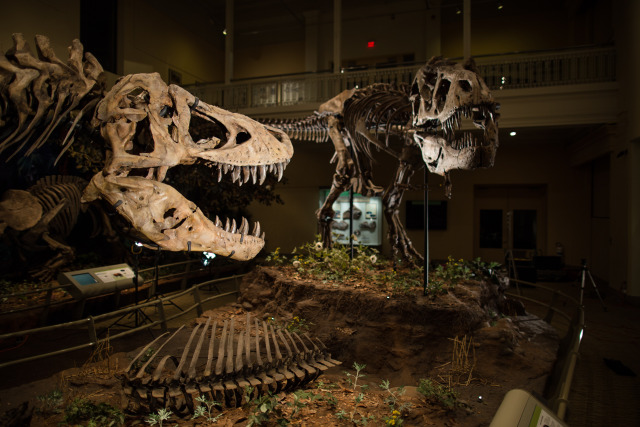
Speaking of Sharptooth, The Land Before Time’s animators made a scientifically accurate choice when they decided to draw him with a two-fingered hand, as opposed to the three fingers traditionally embraced by other movie makers. For 1933’s King Kong, the creators mistakenly modeled their T. rex after a scientifically outdated 1906 museum painting. Many other directors knowingly dismissed the science-backed evidence and used three digits because they thought this type of hand was more aesthetically pleasing. By the 1920s, paleontologists had already hypothesized that these predators were two-fingered because an earlier relative of Tyrannosaurus, Gorgosaurus, was known to have had only two functional digits. Scientists had to make an educated guess because the first T. rex (and many subsequent specimens) to be found had no hands preserved. It wasn’t until 1988 that it was officially confirmed that T. rex was two-fingered when the first specimen with an intact hand was discovered. Then, in 1997, Peck’s Rex, the first T. rex specimen with hands preserving a third metacarpal (hand bone), was unearthed. Paleontologists agree that, in life, the third metacarpal of Peck’s Rex would not have been part of a distinct, externally visible third finger, but instead would have been embedded in the flesh of the rest of the hand. But still, was this third hand segment vestigial, no longer serving any apparent purpose? Or could it have possibly been used as a buttressing structure, helping the two fully formed fingers to withstand forces and stresses on the hand? Peck’s Rex’s bones do display evidence that strongly supports arm use. You can ponder this paleo-puzzle yourself when you visit Carnegie Museum of Natural History’s Dinosaurs in Their Time exhibition, where you can see a life-sized cast of Peck’s Rex facing off with the holotype (= name-bearing) T. rex, which was the first specimen of the species to be recognized (by definition, the world’s first fossil of the world’s most famous dinosaur!).

Two T. rex skeletons displayed in a museum exhibit.
T. rex in Dinosaurs in Their Time. Image credit: Joshua Franzos, Treehouse Media

Jurassic Park

One motion picture that did take artistic liberties with T. rex for the sake of suspense was 1993’s Jurassic Park. In one memorable, hair-raising scene, several of the movie’s stars are saved from becoming this dinosaur’s savory snack by standing completely still. According to the film’s paleontological protagonist, Dr. Alan Grant, the theropod can’t see humans if they don’t move. Does this theory have any credence, or was it just a clever plot device that made for a great movie moment? In 2006, the results of ongoing research at the University of Oregon were published in the Journal of Vertebrate Paleontology, providing a surprising answer. The study involved using perimetry (an ophthalmic technique used for measuring and assessing visual fields) and a scale model T. rex head to determine the creature’s binocular range (the area that could be viewed at the same time by both eyes). Generally speaking, the wider an animal’s binocular range, the better its depth perception and overall vision. It was determined that the binocular range of T. rex was 55 degrees, which is greater than that of a modern-day hawk! This theropod may have even had visual clarity up to 13 times greater than a person. That’s extremely impressive, considering an eagle only has up to 3.6 times the clarity of a human! Another study that examined the senses of T. rex determined that the dinosaur had unusually large olfactory bulbs (the areas of the brain dedicated to scent) that would have given it the ability to smell as well as a present-day vulture! So, in Jurassic Park, even if the eyes of T. rex had been blurred by the raindrops in this dark and stormy scene, its nose would have still homed-in on Dr. Grant and the others, providing the predator with some tasty midnight treats.

Now, it may seem that this blog post might be a bit critical of dinosaur movies. But, truly, I appreciate them just as much as the next filmophile. They do a magnificent job of providing all of us with some pretty thrilling, edge-of-your-seat entertainment. But, somewhere along the way, their purpose has serendipitously become twofold. They have also inspired some of us to pursue paleontology as a lifelong career. So, in a way, dinosaur movies have been of immense benefit to both the cinematic and scientific worlds. And for that great service, they all deserve a huge round of applause.

Shelby Wyzykowski is a Gallery Experience Presenter in CMNH’s Life Long Learning Department. Museum staff, volunteers, and interns are encouraged to blog about their unique experiences and knowledge gained from working at the museum.

Related Content

Super Science Saturday: Jurassic Day (July 31, 2021)

What Did Dinosaurs Sound Like?

Diplodocus carnegii (Dippy) – Dinosaur Spotlight (Video)

Carnegie Museum of Natural History Blog Citation Information

Blog author: Wyzykowski, Shelby
Publication date: July 29, 2021

Share this post!

  • Share on Twitter Share on Twitter
  • Share on Facebook Share on Facebook
  • Share on Pinterest Share on Pinterest
  • Share on LinkedIn Share on LinkedIn
  • Share on Reddit Share on Reddit
  • Share via Email Share via Email

Share this post!

  • Share on Twitter Share on Twitter
  • Share on Facebook Share on Facebook
  • Share on Pinterest Share on Pinterest
  • Share on LinkedIn Share on LinkedIn
  • Share on Reddit Share on Reddit
  • Share via Email Share via Email

Filed Under: Blog Tagged With: dinosaurs, sssjurassic, Super Science

July 23, 2021 by wpengine

Eating Shipworms to Save the World

by Timothy A. Pearce

Shipworms, which bore into the wood of ships and the pilings of docks have been a menace to mariners for centuries. Recently, however, some sustainable food advocates are pointing to the disreputable creatures as a key to feeding the growing human population.

Black and white illustration of a shipworm.
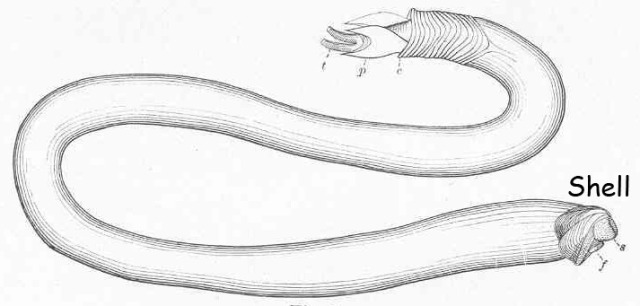
Figure 1. Body of a shipworm showing the tiny shell at the lower right. Image from Wikimedia Commons taken from Goode (1884).

Surprisingly, shipworms are not worms at all, but are a type of clam in the family Teredinidae whose bivalved shells have been reduced to small rasp-like structures at one end of a worm-like body (Fig. 1). Some shipworms grow exceptionally fast, reaching 30 cm (12 inches) in six months. The small shells, which are roughly 5% of the creature’s body length, function as excavators. The shipworm uses the tiny pair to dig into wood, forming a burrow to protect its soft body, and digesting the excavated bits of wood as food. Symbiotic bacteria in the clam’s gills provide the necessary enzymes to digest the wood.

wood damaged by shipworms
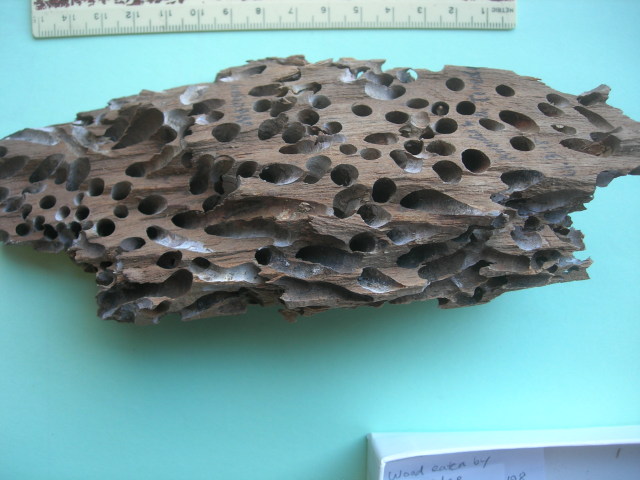
Figure 2. Wood bored by the shipworm Lyrodus pedicellatus. Image by T.A. Pearce.

Sailors and stevedores (dock workers) have battled shipworms over the centuries because the holes created by the tiny mollusks weaken the wood, eventually causing ships to sink and docks to collapse (Fig. 2). Consequently, instead of causing yawns, these boring mollusks caused people to take notice. And while the shipworms’ wood-eating regime continues to plague sea-faring people who rely upon wooden vessels, other people are now taking note for a culinary reason.

From baddy to buddy, from scourge to supper, shipworms are undergoing a reputation transformation. As we look to the future, we see staring back at us both the hungry, growing human population and the threat of climate change. We understand the need to produce more food sustainably, including more protein, while reducing our greenhouse gas emissions. As an alternative to methane-belching cattle, some experts have advised eating sustainable protein sources such as insects and shipworms.

Among the advantages of shipworms as food are their exceptionally fast growth, their ability to thrive on a diet of waste wood or sustainable microalgae, and their high protein and omega-3 fatty acids content. (Willer & Aldridge 2020).

Today, shipworms are eaten primarily in parts of southeast Asia. But because they show great promise as a sustainable protein source, they are being considered for aquaculture to help feed the growing human population. In the not-so-distant future, you might be spicing up your meals by including (not so) boring clams!

Keep clam and carry on.

Timothy A. Pearce is the head of the Section of Mollusks at Carnegie Museum of Natural History. Museum employees are encouraged to blog about their unique experiences and knowledge gained from working at the museum.

Literature Cited

Goode, G.B. 1884. Fisheries and Fishery Industries of the United States: Section I, Natural History of Useful Aquatic Animals, Plates. Washington, DC: Government Printing Office.

Willer, D.F. & Aldridge, D.C. 2020. From pest to profit—the potential of shipworms for sustainable aquaculture. Frontiers in Sustainable Food Systems, 4: 575416. doi: 10.3389/fsufs.2020.575416

Related Content

Cuttlefish Pass Marshmallow Test

Vampire Squid: Cutest Dracula

Ask a Scientist: How did snails evolve from living in water to living on land?

Carnegie Museum of Natural History Blog Citation Information

Blog author: Pearce, Timothy A.
Publication date: July 23, 2021

Share this post!

  • Share on Twitter Share on Twitter
  • Share on Facebook Share on Facebook
  • Share on Pinterest Share on Pinterest
  • Share on LinkedIn Share on LinkedIn
  • Share on Reddit Share on Reddit
  • Share via Email Share via Email

Share this post!

  • Share on Twitter Share on Twitter
  • Share on Facebook Share on Facebook
  • Share on Pinterest Share on Pinterest
  • Share on LinkedIn Share on LinkedIn
  • Share on Reddit Share on Reddit
  • Share via Email Share via Email

Filed Under: Blog Tagged With: mollusks, Science News, Tim Pearce, We Are Nature 2

July 21, 2021 by wpengine

Meet Our Animal Husbandry Team

by Leslie Wilson

Each year, animal care professionals from zoos, aquariums and yes, sometimes even museums, across the country celebrate National Zookeepers Week. What exactly is a “zookeeper?”

A zookeeper is a person who provides highly specialized care to animals. Did you know that Carnegie Museum of Natural History (CMNH) has a living collection that includes 15 animal ambassadors, representing 12 species from all over the world? At Carnegie Museum of Natural History, we have a team of five “animal husbandry specialists” that perform the day-to-day care for the collection. Zookeepers go by a range of titles at different organizations; here at CMNH, “animal husbandry specialist” is what fits our team best.

Animals need highly specialized care every day of the year. Even when the museum is closed. Even on holidays. Even during a pandemic. As animal husbandry specialists, we provide loving and high-quality care to the living collection every single day of the year. Daily feedings, habitat cleaning, behavioral observation, enrichment, training, and record keeping are all part of hard day’s work for an animal husbandry specialist. Animal husbandry specialists have deep rapport and strong, trusting relationships with the animals in our care. From any animal ambassador’s first day at CMNH to their last days on this earth, the animal husbandry staff support each unique ambassador through all stages of life, including the final step of saying good-bye, which to most, is the hardest part about working with animals. Being a “zookeeper” requires emotional fitness in addition to physical fitness; both are necessary for a happy, healthy “zookeeper.”

It’s not all poop-scooping, though! “Zookeepers” do SO MUCH MORE than “clean up” after animals. Another large area of focus for “zookeepers” is education. Every member of the CMNH animal husbandry team works directly with our audiences to share the rich natural history and unique personalities of our animal ambassadors. Creating empathy for the plight of wild animals in wild spaces, animal ambassadors are a powerful force in helping the museum achieve its mission of advocating for a sustainable future.

Animal Husbandry During a Global Pandemic

The last year presented unique challenges, including caring for the animals during CMNH’s Covid-related closures and adapting programs for social distancing and virtual environments once we re-opened. Team members found new ways to support each other and the animals through the disruption of our normal routines and designed creative new enrichment opportunities to make sure that every animal was (and is) healthy and happy. Meet the CMNH animal husbandry team below and learn how they’ve risen to the challenges of the last year!

Each team member was asked: “How did you improvise, adapt, persist: Keep on keepin’ on?”

Person holding a bird during a live animal show in a theater.

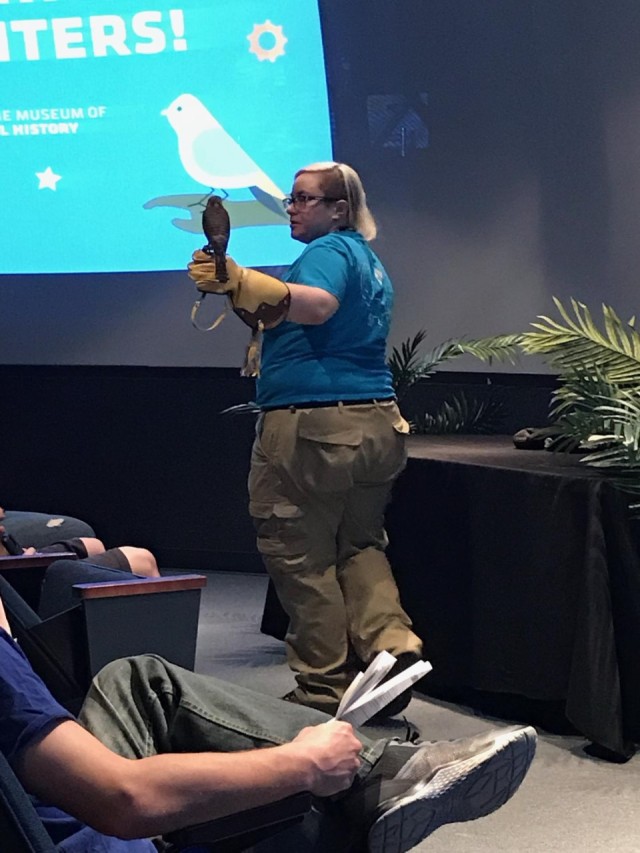
Meet Jo, the collection’s registrar! As the registrar, Jo is responsible for maintaining all records for the animals. Jo also is a frequent host of our weekly virtual Live Animal Encounters.

“The challenge for me was supporting the team, both human and animal, while being unable to be there in person. Transitioning animal programming to a virtual space was a unique challenge that afforded me the ability to still be present for our ambassador animals, support the humans on the husbandry team, and keep our audience engaged. I also found ways to guide my coworkers through animal husbandry challenges from home, connecting virtually to troubleshoot minor medical issues and enclosure overhauls.”

Person holding a skunk in her arms.

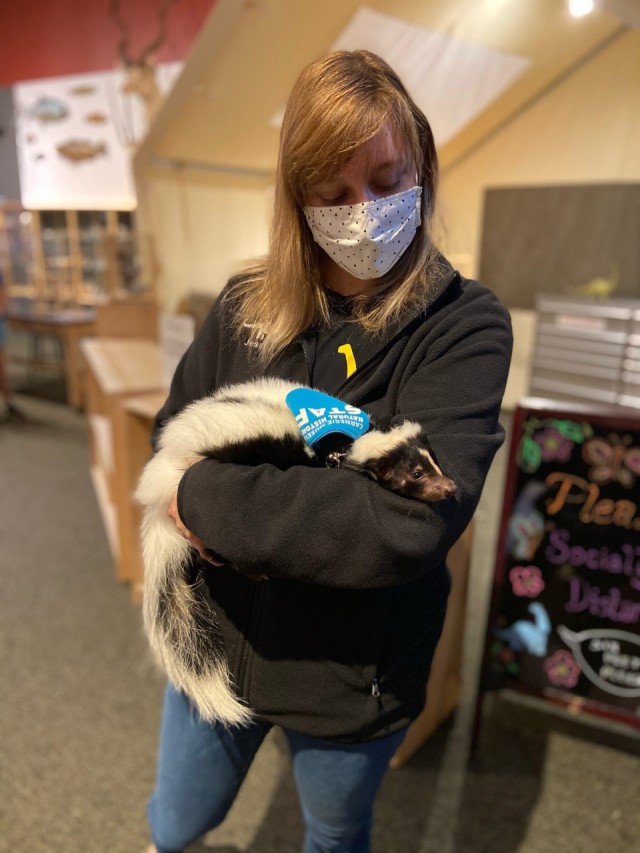
Meet Jess, the lead animal husbandry specialist! Jess is responsible for managing animal-related inventory, training husbandry staff and crafting animal enrichment for our sun conure, Mango. Jess often presents the animals from the museum during Wild Wednesdays: Virtual Live Animal Encounters.

“Being away from the animals and other staff members was a struggle, especially in the beginning of our closure. It was hard to go from seeing the animals and staff who cared for them every day to not being able to offer direct support or guidance. One way I wanted to help boost morale in the beginning was to create coloring sheets to cheer up our staff members who were missing the animals. I drew our animal ambassadors in funny scenarios including our coati cooking or painting like Bob Ross; our sun conure flying as an astronaut in space; our pied crow dressed up as his Game of Thrones namesake, Jon Snow. I feel that I’ve been given a great opportunity not only to learn more about animal education and how I can better myself in this field, but also to connect with the animal husbandry staff who are dedicated to providing our animal ambassadors with unique life experiences and exceptional care.”

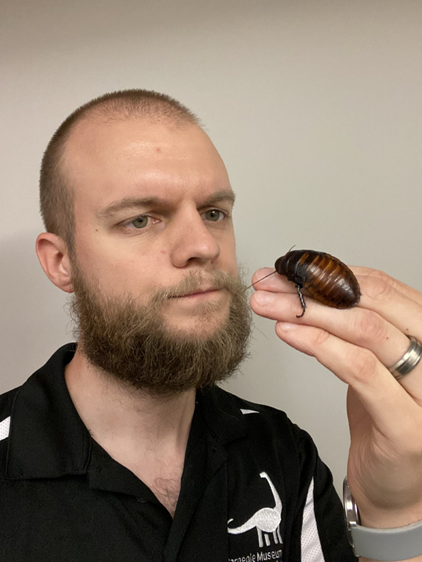
Man holding a cockroach.

Meet Aaron, an animal husbandry specialist! Aaron plays a role in ambassador training, particularly with the birds in the collection. He also is great at building fun toys or furniture items for many of the animals, often from recycled materials, including expired fire hoses.

“I was fortunate to be one of the animal care team members to share in the daily care of our animal ambassadors during the museum closures. I relied a lot on the experience and skill of my human coworkers as I learned on-the-go. While the job was often difficult and dirty (at times literally poopy), I feel grateful that I had the opportunity to get to know my furry, scaly, and feathery coworkers more intimately. I still have a lot to learn about our animal ambassadors as we train and educate together. We’re constantly working to build trust and confidence in our relationships.”

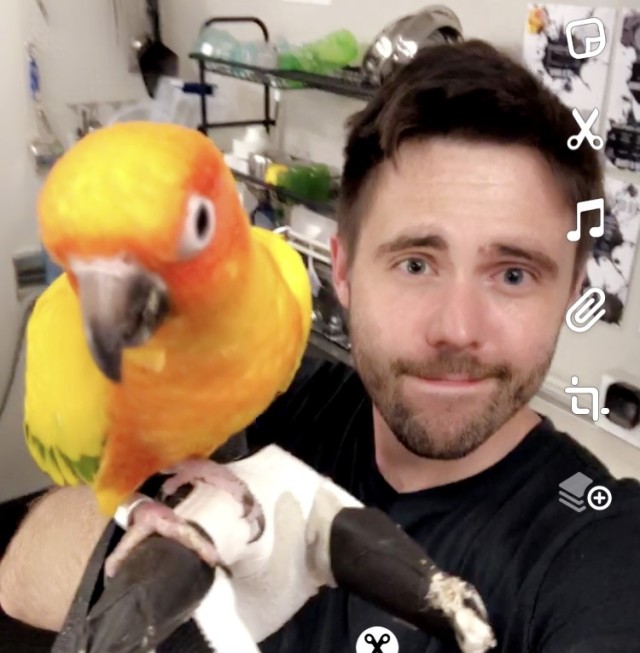
Man holding a sun conure.

Meet John, an animal husbandry specialist! John serves as an animal husbandry specialist in addition to his role of managing CMNH’s outreach programming. Many of the outreach programs incorporate live animal ambassadors, so this is a perfect match!

“Before the pandemic, my primary relationship with our animals was through programming, and I did more teaching with our animals than I did animal care. Due to COVID, I started to focus more on animal husbandry. Learning to better care for the day-to-day needs of our Living Collection has 100% made me a better teacher. I have a stronger relationship with our birds, I understand the needs and mannerisms of our mammals better, and I’ve been able to answer questions about our reptiles that I just plain didn’t know the answers to before!”

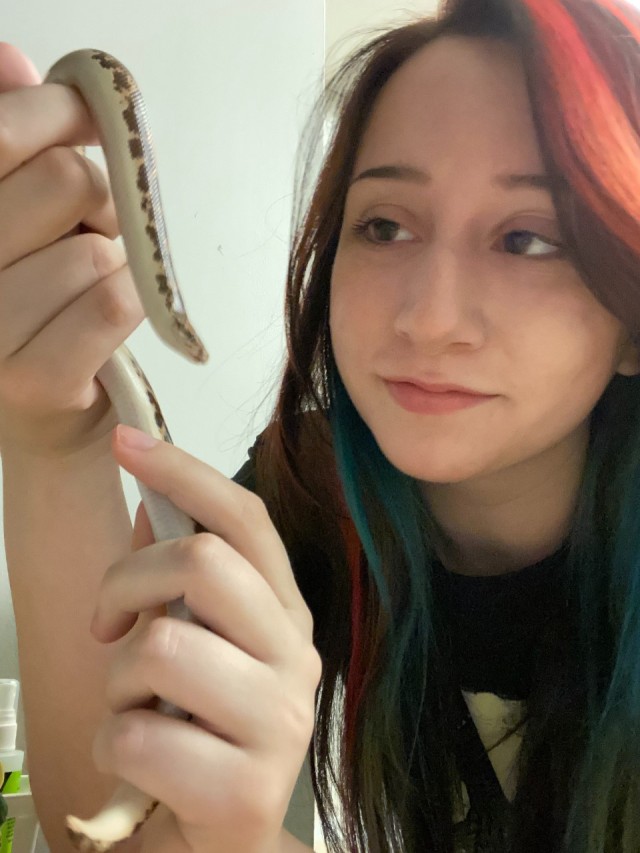
Person holding a snake.

Meet Emma, an animal husbandry specialist! Emma is our newest animal husbandry specialist on our team. Emma works closely with Jon Snow, the African pied crow. Sometimes, it’s hard to tell the difference between their voices!

“The last year has been full of challenges when it comes to making sure that every animal here at the museum is getting the best possible care while also ensuring that we are following correct safety protocol. I owe a lot of my ability to adapt to the amazing connections that I and the other animal husbandry specialists have made with our education ambassadors. Something that sticks out to me specifically is the improvisation needed to ensure that the enrichment we provide every single day is just as impactful as the live programming that we were unable to do; every day proved to be a fun challenge when it came to creating a variety of new activities for the animals. Although it took some time to get into a new rhythm, I feel that our connections with our animal ambassadors are stronger than ever before.”

National Zookeepers Week

Zookeepers play an important role both in the specialized care of the collection and in educating our audiences about the plight of wild animals and wild spaces. This dedicated team of animal professionals seeks to generate empathy for all living things as part of the museum’s greater mission to find inspiration in our collections and advocate for a sustainable future. And that’s worth celebrating!

Thank you for celebrating National Zookeepers Week (July 18-24th) by reading this blog to learn more about “zookeepers” and the CMNH animal husbandry team. Other ways you can celebrate National Zookeeper’s Week include visiting your local zoo/aquarium/aviary/museum or sending a card to your local organization’s animal staff thanking them for their dedication to the animals in their care. If you know a “zookeeper” in your life, be sure to thank them for the important work they do!

“In the end, we will conserve only what we love;

we will love only what we understand;

and we will understand only what we are taught.”

-Baba Dioum

Related Content

Live Animal Encounters

Super Science Coloring Pages

Russian Tortoise Named Natasha (Video)

Carnegie Museum of Natural History Blog Citation Information

Blog author: Wilson, Leslie
Publication date: July 21, 2021

Share this post!

  • Share on Twitter Share on Twitter
  • Share on Facebook Share on Facebook
  • Share on Pinterest Share on Pinterest
  • Share on LinkedIn Share on LinkedIn
  • Share on Reddit Share on Reddit
  • Share via Email Share via Email

Share this post!

  • Share on Twitter Share on Twitter
  • Share on Facebook Share on Facebook
  • Share on Pinterest Share on Pinterest
  • Share on LinkedIn Share on LinkedIn
  • Share on Reddit Share on Reddit
  • Share via Email Share via Email

Filed Under: Blog Tagged With: behind the scenes, Leslie Wilson, live animals, Museum Employees

July 12, 2021 by wpengine

Interpreting Museum Exhibits Virtually

by Patrick McShea

Natural History Interpreters are a corps of educators charged with presenting the museum’s exhibits to audiences in a way that encourages the collective development of emotional and intellectual connections to the topics being discussed. During the past eight months, a small, but growing number of Interpreters have pursued this mission by guiding school groups on virtual tours of Dinosaur Armor.

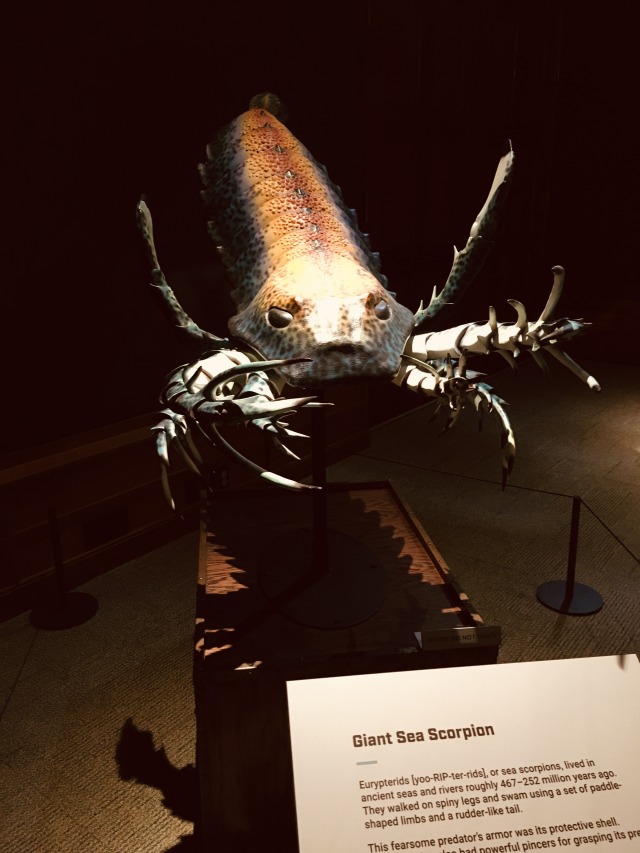
Replica giant sea scorpion museum display
Details such as the sharp claws of this sea scorpion were clearly visible to students who participated in virtual tours of Dinosaur Armor.

The visually striking objects in the world premiere exhibition retain much of their captivating power when presented over electronic screens, and cell phone cameras, when paired with hand-held stabilizer units, have proven to be fully capable of live streaming all the required video.

During the recently completed school year 54 virtual tours of Dinosaur Armor reached an estimated student audience of 3,450, with classes in first to fourth grades accounting for the greatest number of those individuals. The geographical reach of the program has been particularly impressive, with schools in 13 states participating.

The Interpreters developed a team-based strategy for delivering their presentations as cohesive interactive lessons. Standard team positions, which rotate as necessary, include a camera operator in the exhibit, an accompanying narrator who occasionally appears on camera, and a director who participates via a computer link to both provide occasional commentary and facilitate communication between the audience, camera operator, and narrator.

According to Interpreter Joann Wilson the development was an easier-said-than-done proposition. “When I started virtual tours, I thought that it would be like my old in-person tour role with a few minor adjustments.  How wrong I was!   What I have discovered after over 8 months is that although the goal is the same, how we get there is very different.”

On June 8, I had the opportunity to observe a virtual Dinosaur Armor tour for a combined pre-school and kindergarten class. My computer screen displayed the same images the children watched on a large monitor at the front of their classroom. When the colorful image of a frightening looking Eurypterid, or sea scorpion filled the screen, audience excitement was transmitted back to the Interpreter team via the “oohs” and “ahhs” of young voices. Just as the Interpreters would do for any in-person audience, they quickly transformed student curiosity into a learning experience through the careful use of questions.

Students were initially asked to describe what they observed, and their responses (“The claws are sharp.” “The eyes are big ovals.”) provided immediate feedback about the clarity of the transmission. In this case the routine compilation of student observations was remarkable because of the distance involved. The pre-school and kindergarten class was in Bali, Indonesia.

As Program Manager Mandi Lyon explains, “It was 9:30 a.m. for us in Pittsburgh, and 9:30 p.m. for them in Bali. They came back to their school in their pjs for a pajama party so they could participate in the tour together.”

In most cases, however, the same COVID-19 restrictions that led to the development of Virtual Tours also placed many students in viewing conditions far less comfortable than the classroom in Bali. Whenever a Virtual Tour served a class in a school operating under a remote learning mandate, the Interpreter team faced the challenge of engaging dozens of students watching separately from their homes.

By supplying teachers with relevant digital resources, including video clips, blog posts, and work sheets, weeks before their students participated in a Virtual Tour, the Interpreters hoped to initiate teaching partnerships that made each live 60-minute program both instructive and enjoyable. The success of such efforts is currently being accessed through the review of post-Virtual Tour evaluations, several of which included heartening testimony. One teacher noted how the virtual tour had expanded the range of possible teaching resources: “I am so excited we had the opportunity to visit through Zoom. After doing this, it seems we could reach so many places and let the students have such a varied experience in the classroom.” Another teacher was particularly pleased with a potential career thread woven into the tour: “The idea of anyone becoming a scientist was evident in your presentation.”

Outside of the formal evaluations, one wholly positive real-time measurement stands out. Several times teachers remarked that students who kept their cameras off though weeks of regular remote classes turned their cameras on to watch and participate in the Virtual Tour.

CMNH Interpreters have also provide Virtual Tours exploring Ecosystems, Ancient Egypt, and Gems and Minerals. Besides Indonesia, other particularly distant schools served by the program were in Qatar, and the U.S. Virgin Islands. Training is currently underway to expand the number of Interpreters who are able to participate on Virtual Tour teams.

The development and implementation of Virtual Tour Program was generously supported with funding from the Buncher Foundation and the Scaife Family Foundation.

Patrick McShea works in the Education and Visitor Experience department of Carnegie Museum of Natural History. Museum employees are encouraged to blog about their unique experiences and knowledge gained from working at the museum.

Related Content

Virtual Field Trips & Activities

Teacher Profile: Emmanuelle Wambach

Alaskan Brown Bears Spotlight (Video)

Carnegie Museum of Natural History Blog Citation Information

Blog author: McShea, Patrick
Publication date: July 12, 2021

Share this post!

  • Share on Twitter Share on Twitter
  • Share on Facebook Share on Facebook
  • Share on Pinterest Share on Pinterest
  • Share on LinkedIn Share on LinkedIn
  • Share on Reddit Share on Reddit
  • Share via Email Share via Email

Share this post!

  • Share on Twitter Share on Twitter
  • Share on Facebook Share on Facebook
  • Share on Pinterest Share on Pinterest
  • Share on LinkedIn Share on LinkedIn
  • Share on Reddit Share on Reddit
  • Share via Email Share via Email

Filed Under: Blog Tagged With: Education, Educator Resources, Educators, Pat McShea

  • « Go to Previous Page
  • Page 1
  • Page 2
  • Page 3
  • Page 4
  • Page 5
  • Page 6
  • Interim pages omitted …
  • Page 206
  • Go to Next Page »

sidebar

About

  • Mission & Commitments
  • Directors Team
  • Museum History

Get Involved

  • Volunteer
  • Membership
  • Carnegie Discoverers
  • Donate
  • Employment
  • Events

Bring a Group

  • Groups of 10 or More
  • Birthday Parties at the Museum
  • Field Trips

Powdermill

  • Powdermill Nature Reserve
  • Powdermill Field Trips
  • Powdermill Staff
  • Research at Powdermill

More Information

  • Image Permission Requests
  • Science Stories
  • Accessibility
  • Shopping Cart
  • Contact
  • Visitor Policies
Stay in the loop! Sign up for our newsletter(s).
One of the Four Carnegie Museums | © Carnegie Institute | Privacy Policy | Terms of Use | Accessibility
Rad works here logo