• Skip to primary navigation
  • Skip to main content
  • Skip to primary sidebar

Carnegie Museum of Natural History

One of the Four Carnegie Museums of Pittsburgh

  • Visit
    • Buy Tickets
    • Visitor Information
    • Exhibitions
    • Events
    • Dining at the Museum
    • Celebrate at the Museum
    • Powdermill Nature Reserve
    • Event Venue Rental
    • Gift Cards
  • Learn
    • Field Trips
    • Educator Information
    • Programs at the Museum
    • Bring the Museum to You
    • Guided Programs FAQ
    • Programs Online
    • Climate and Rural Systems Partnership
  • Research
    • Scientific Sections
    • Science Stories
    • Science Videos
    • Senior Science & Research Staff
    • Museum Library
    • Science Seminars
    • Scientific Publications
    • Specimen and Artifact Identification
  • About
    • Mission & Commitments
    • Directors Team
    • Museum History
  • Tickets
  • Give
  • Shop

wpengine

June 21, 2021 by wpengine

The Power of the Falcon in Ancient Egypt

by Raina Holt

I have always been super curious about how the natural environment influences people’s beliefs and rituals. As I learned about ancient Egyptian religion, I found elements that fascinated me. My curiosity led me to build a replica of a pyramid in 5th grade with a secret trapdoor inside. In college, I learned about mummification and continued to discover how and why the ancient Egyptians’ belief in an afterlife was so extensive. My recent internship with Carnegie Museum of Natural History gave me the opportunity to dig deep into my interest in Egypt using research to explore the significance of birds in ancient Egyptian religion.

Research involves asking questions and searching for answers by finding facts and information to explain the unknown. My research allowed me to explore how birds, including vultures, ibises, and even owls, were a big part of Egyptian culture and religion. In ancient Egypt, birds were very commonly associated with different gods. For example, the falcon represented the god Horus. In a comprehensive compilation of related essays titled, Between Heaven and Earth: Birds in Ancient Egypt (University of Chicago Press, 2012), the culture-wide association of gods with birds is partially explained as people’s perception that birds could fly and therefore be closer to the gods. Some birds of prey such as falcons, hawks, and owls are particularly skilled flyers, owing to physical adaptations such as long wings, relatively short tails, and powerful chest muscles. These features, when combined with others, including keen eyesight, sharp, curved talons, and sturdy, razor-edged bills, enable them to capture and kill prey. In some predator-prey encounters, speed is also a vital part of the killing equation. Lanner Falcons, for example, a species well-represented in ancient Egyptian art works, can reach diving speeds of up to 90 miles-per-hour in pursuit of smaller flying birds. Their strength, speed, and beauty made them ideal representatives for certain Egyptian gods.
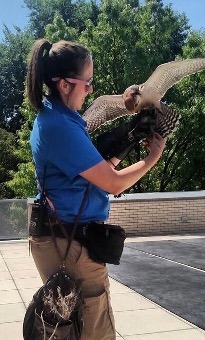
Staff member at the National Aviary training a Lanner Falcon (photo by author).

In the Summer of 2017, I participated in a program called Soar! On Skydeck at the National Aviary on Pittsburgh’s North Side. I signed up, along with a handful of other Aviary visitors, because I knew I could learn at a deeper level through firsthand observation of live birds of prey. The highly skilled trainer, who worked with a Lanner Falcon during the presentation, relied upon a thick leather glove so her left hand could serve as a suitable and talon-proof resting perch for the bird.

The highlight of the presentation was a hunting demonstration. The trainer first let the falcon circle above us for a short while. Then the bird saw a chunk of meat placed for it and dove quickly, spreading its wings at the last moment to slow down and grab the food with its sharp talons. The falcon, as I could see with my own eyes, was fast, fierce, and powerful, which is why it was used to represent a god in ancient Egypt.

The god Horus, represented as a falcon or a human with a falcon head, was a sun god as well as the ancient Egyptian god of kingship, representing the living king of Egypt. Falcons, along with other birds, could have easily been seen by everyone in ancient Egypt. The sight of a falcon soaring overhead near the sun would have been a particularly striking scene. The pharaoh was believed to be not merely a powerful ruler, but to be the embodiment of the god, Horus. The job of Horus was to protect Egyptians in their daily lives, just like the pharaoh. In recognition of Horus’s important role, people would decorate their tombs with falcons. In later periods the ancient Egyptians offered mummified falcons to Horus, gifts which were sometimes placed in a small coffin with a bronze falcon on top.
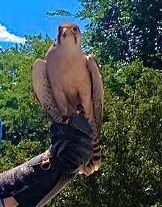
Lanner falcon
Lanner Falcon at National Aviary (photo by author)

Pittsburgh currently offers several falcon viewing opportunities. You can see Lanner Falcons, as I did at the National Aviary, but you can also watch the livestream of the Peregrine Falcon pair and their offspring in their nest on a high ledge of the Cathedral of Learning in Oakland! Because the feeding territory of these birds extends far beyond this University of Pittsburgh landmark, Peregrine Falcons can also be seen flying high above Schenley Park, and much of the University of Pittsburgh Campus. Occasionally the birds can even be heard screeching loudly near Carnegie Museum of Natural History and Carnegie Museum of Art!

Raina Holt is currently an intern for Carnegie Museum of Natural History’s Section of Anthropology. Museum staff, volunteers, and interns are encouraged to blog about their unique experiences and knowledge gained from working at the museum.

Related Content

Cats: The Archeological Site!

Wooden Sokar Falcon

Weighing She-Ra the American Kestrel

Carnegie Museum of Natural History Blog Citation Information

Blog author: Holt, Raina
Publication date: June 21, 2021
Share this post!

  • Share on Twitter Share on Twitter
  • Share on Facebook Share on Facebook
  • Share on Pinterest Share on Pinterest
  • Share on LinkedIn Share on LinkedIn
  • Share on Reddit Share on Reddit
  • Share via Email Share via Email

Share this post!

  • Share on Twitter Share on Twitter
  • Share on Facebook Share on Facebook
  • Share on Pinterest Share on Pinterest
  • Share on LinkedIn Share on LinkedIn
  • Share on Reddit Share on Reddit
  • Share via Email Share via Email

Filed Under: Blog Tagged With: ancient egypt, anthropology, archaeology, Egypt on the Nile, Raina Holt

June 15, 2021 by wpengine

Getting Started: a high school intern’s experience in the herp section

by Jaylynn Smith

Curator note: We currently have an intern from a local high school working with us for ten weeks. The goal of the internship is to gain experience working on collections care and maintenance, learn about amphibian and reptile biology and taxonomy, and to create social media content related to this experience. Look for more content from our intern in the coming weeks!

The first week of my internship was completed! So far it has been a very enjoyable experience. The opportunity to be behind the scenes and learn hands-on about the different specimens that are held in the Alcohol House, and the way they are separated into their taxonomic families has been exciting.

Before my first week I had no knowledge of how these animals were classified or the way they were preserved. However, after the first few days I gained a bit more information on them, like the way they’re stored in 70% ethanol and how there are sections for each major group (frogs, snakes, turtles, etc.). This was very fun since I got more insight and learned more about the reptiles and amphibians I’d be working with. I also learned a bit about how to maintain and take care of the collection, such as testing the concentration levels in the jars and making sure it is at 70%, and also that each jar is filled all the way to the top so the specimens won’t dry out.

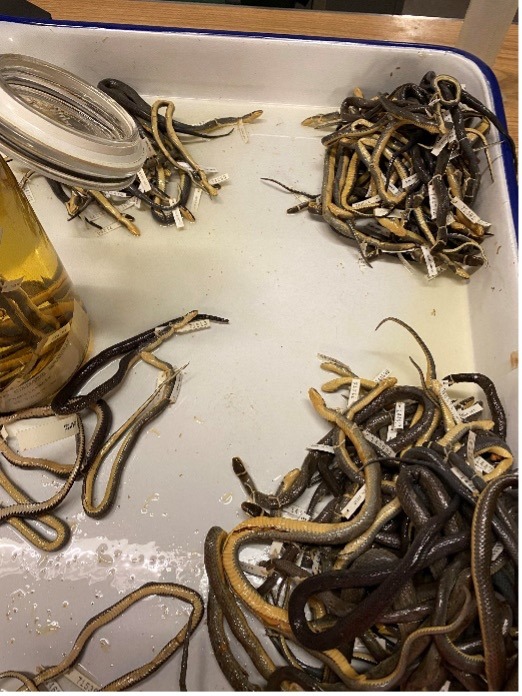
Figure 1. Counting and sorting a loan of ring-necked snakes (Diadophis punctatus).

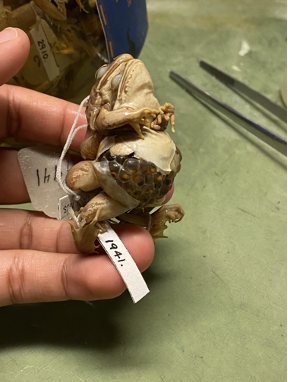
Additionally, we dove into checking the status of loans, a museum service which is very similar to the way libraries loan books. A researcher may borrow specimens for comparative study or to learn more about that specific animal. Once the borrowed materials are back in our care, we have to make sure every one of them has been returned safely. This sometimes means taking the specimens out of their jars and counting them all! (Figure 1) Doing this routine work gave me the chance to be up close with the specimens and more hands-on. I found it very interesting being able to touch the animals and see how different they are from each other, like the way patterns may differ on certain snakes or even seeing frog mating behavior (Figure 2)!

Figure 2. A male wood frog (Rana sylvatica) holding onto the female during amplexus, a mating position of frogs and toads.

Not only do I have this great opportunity through this internship, I also can share much of the museum experience with my family as well with the benefits that come along with it. Over the weekend I went to the museum with my younger siblings, allowing them to learn more and broaden their knowledge of different animals from both the past and present. While we were there, we came across the Alcohol House Interactive exhibit in Discovery Basecamp, a display featuring information, images, and even actual specimens from the Alcohol House. This gave me the chance to tell my younger siblings about what I do in the Alcohol House. I was able to talk about the specimens I worked with so far and how fascinating it all has been just in the first week. Moving forward my goal is to learn even more about the animals that I’m working with and the process that goes into taking care of them. I also hope to do my own research on them and find answers to questions I may have. But at this point in time I am very optimistic and thrilled about the future of being an intern at the Carnegie Museum of Natural History.

Jaylynn Smith is an intern in the Section of Amphibians and Reptiles. Museum employees are encouraged to blog about their unique experiences and knowledge gained from working at the museum.

Related Content

Ask a Scientist: What is the creepiest specimen in the Alcohol House?

Do Snakes Believe in the Tooth Fairy?

An Illuminating Tale of Tracking Turtles

A Summer Internship at Powdermill

Carnegie Museum of Natural History Blog Citation Information

Blog author: Smith, Jaylynn
Publication date: June 15, 2021

Share this post!

  • Share on Twitter Share on Twitter
  • Share on Facebook Share on Facebook
  • Share on Pinterest Share on Pinterest
  • Share on LinkedIn Share on LinkedIn
  • Share on Reddit Share on Reddit
  • Share via Email Share via Email

Share this post!

  • Share on Twitter Share on Twitter
  • Share on Facebook Share on Facebook
  • Share on Pinterest Share on Pinterest
  • Share on LinkedIn Share on LinkedIn
  • Share on Reddit Share on Reddit
  • Share via Email Share via Email

Filed Under: Blog Tagged With: amphibians and reptiles, behind the scenes, herpetology, Jaylynn Smith, Museum Employees

June 14, 2021 by wpengine

Who put the Smile in Smilax?

by John Wenzel

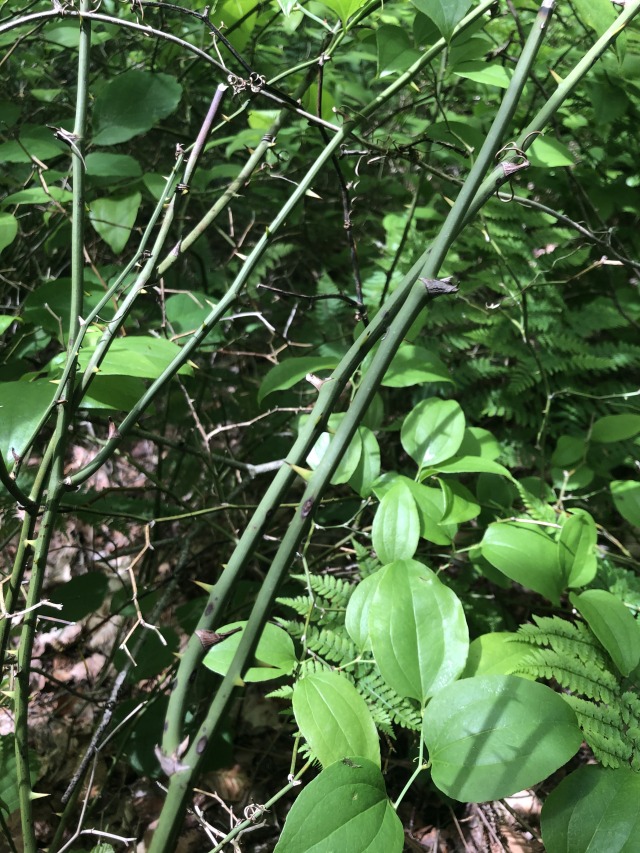
Smilax plants

The genus Smilax is one of our most common woodland plants. Known as greenbriar, sweetbriar, or catbriar, there are about 20 species in North America, and about 300 world-wide. Technically, the plant is defended by “prickles,” which are outgrowths of the outer tissue of the stem, and not “thorns,” which are modified woody branches, as are found on hawthorn or locust trees. By contrast, “spines,” as found in cactuses, are actually modified leaves. Male and female Smilax flowers occur on different plants, with females producing dense bunches of showy black, blue, or red berries. Some species are deciduous and some are evergreen. Light loving, they are typical of disturbed habitats, and will climb up and over shrubs, up to 30 feet high. The green stems have chlorophyll, meaning that even if deer eat all the leaves, the plants will continue to photosynthesize and survive.

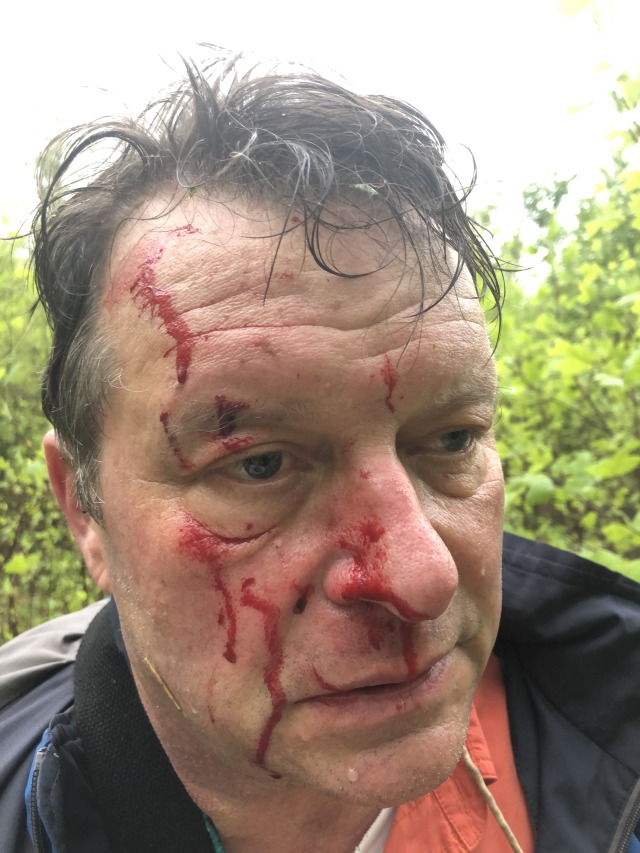
Thickets of briars that have their tops bitten off are an indication of severe browsing by deer. When deer densities are high, other plants may be browsed out entirely, leaving behind an understory composed of only briars and a few plants deer do not eat, such as ferns. Briars may provide good cover for small mammals to escape from larger predators, as is related in Uncle Remus’ African folktales of Bre’r Rabbit. The stout prickles have different orientations along a stem and can be difficult to remove if more than one pierces the skin at the same time. Getting into (and out of!) a briar thicket is a very sticky situation, as we have inadvertently demonstrated after a minor slip-and-fall in the woods!

Close up of man's face with blood on it after injury from briar prickles.

John Wenzel is the Director at Powdermill Nature Reserve, Carnegie Museum of Natural History’s environmental research center. Museum employees are encouraged to blog about their unique experiences and knowledge gained from working at the museum.

Related Content

Can’t Touch This

Expanding the Scope of Environmental Education

Called On This Day in 1982: One Specimen Isn’t Always Enough

Carnegie Museum of Natural History Blog Citation Information

Blog author: Wenzel, John
Publication date: June 14, 2021

Share this post!

  • Share on Twitter Share on Twitter
  • Share on Facebook Share on Facebook
  • Share on Pinterest Share on Pinterest
  • Share on LinkedIn Share on LinkedIn
  • Share on Reddit Share on Reddit
  • Share via Email Share via Email

Share this post!

  • Share on Twitter Share on Twitter
  • Share on Facebook Share on Facebook
  • Share on Pinterest Share on Pinterest
  • Share on LinkedIn Share on LinkedIn
  • Share on Reddit Share on Reddit
  • Share via Email Share via Email

Filed Under: Blog Tagged With: John Wenzel, Powdermill Nature Reserve

June 10, 2021 by wpengine

New Anthropocene Publication: Stemming the Tide

by Nicole Heller

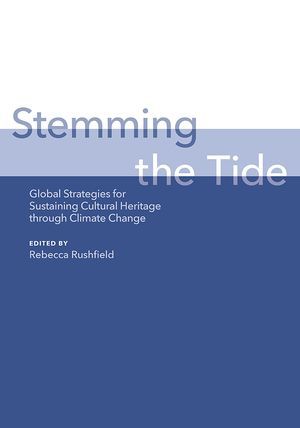
Blue and white cover of a book. Title: Stemming the Tide: Global Strategies for Sustaining Cultural Heritage Through Climate Change. Edited by Rebecca Rushfield.

I am pleased to share this Smithsonian Scholarly Press publication, Stemming the Tide: Global Strategies for Sustaining Cultural Heritage Through Climate Change. The e-book, edited by Rebecca Rushfield, is available online and freely available to read and download. It is the product of an international symposium organized and hosted by the Smithsonian Institution, Washington DC, March 5 – 6, 2020. According to Amber Kerr, Chief of Conservation, Smithsonian American Art Museum “The objective of the symposium was to empower cultural heritage authorities, managers, and advocates to pursue more ambitious engagement with, and collaborative approaches to, the climate crisis,” and “250 registrants and 1,100 live web stream viewers representing 33 states and 25 countries ranging from the United Kingdom, Spain, and Greece to Canada, Mexico, and Trinidad and Tobago” took part.

I was honored to be invited to participate and frame remarks about museums and climate change. Looking back, the symposium was at the beginning of difficult times. The crisis of the coronavirus pandemic was just becoming a known reality. I recall forgoing handshakes and hugs, and instead bumping elbows, with the awesome group of global professionals assembled.

Perhaps for this reason, seeing this volume published now gives me extra pause, and feels especially symbolic of the interconnections between people and planet – past, present and future – and the risks we face in the early 21st century. As Lonnie G. Bunch III, Secretary of the Smithsonian Institution, writes in the forward “This publication invites us to put our heads together and lead the cultural heritage sector in addressing the most pressing issue of our time.”

My chapter, “Museums Facing Climate Change. All Hands On Deck: Moving Past Climate Science and Into Culture,” is about the special opportunity for museums to lead on climate change action and education in their communities, and draws on the good works started at the Carnegie Museum of Natural History with We Are Nature: Living in the Anthropocene and Climate Systems Partnerships. Other chapters explore a wide range of issues. For example, there are chapters on adapting cultural heritage sites and historic buildings to increased risks from extreme weather and sea level rise, ensuring the preservation of collections and archeological sites, supporting resilience of displaced communities, sustaining and respecting Indigenous knowledge and storytelling, as well as tools for mitigating greenhouse gases and improving sustainability practices in collections and exhibition practices.

While intended for a professional audience, I imagine this book will be relevant to anyone concerned about human-caused climate change and interested in the diverse opportunities and challenges it presents. I commend the Smithsonian Institute for leadership in organizing the symposium and publishing this valuable resource. I look forward to using it with my colleagues at the Carnegie Museums and here in Pittsburgh toward pursuing more ambitious engagement and collaborative approaches to the climate crisis.

Read Stemming the Tide: Global Strategies for Sustaining Cultural Heritage Through Climate Change free online.

Nicole Heller is Curator of Anthropocene Studies at the Carnegie Museum of Natural History. Museum employees are encouraged to blog about their unique experiences working at the museum.

Related Content

Warmer Springs and Earlier Birds

Cities Are Not Biological Deserts

Pittsburgh’s Moths Reflect Environmental Impacts of Industry

Carnegie Museum of Natural History Blog Citation Information

Blog author: Heller, Nicole
Publication date: June 10, 2021

Share this post!

  • Share on Twitter Share on Twitter
  • Share on Facebook Share on Facebook
  • Share on Pinterest Share on Pinterest
  • Share on LinkedIn Share on LinkedIn
  • Share on Reddit Share on Reddit
  • Share via Email Share via Email

Share this post!

  • Share on Twitter Share on Twitter
  • Share on Facebook Share on Facebook
  • Share on Pinterest Share on Pinterest
  • Share on LinkedIn Share on LinkedIn
  • Share on Reddit Share on Reddit
  • Share via Email Share via Email

Filed Under: Blog Tagged With: Anthropocene, Anthropocene Studies, Nicole Heller, Science News

June 9, 2021 by wpengine

Student of the World; Part 2: Stearns and Bayet

by Joann Wilson and Albert Kollar

“His [Frederick Stearns] love for that which was beautiful and useful, led him to collect a vast amount of material covering so many fields of human effort…”

Detroit Free Press, January 15, 1907

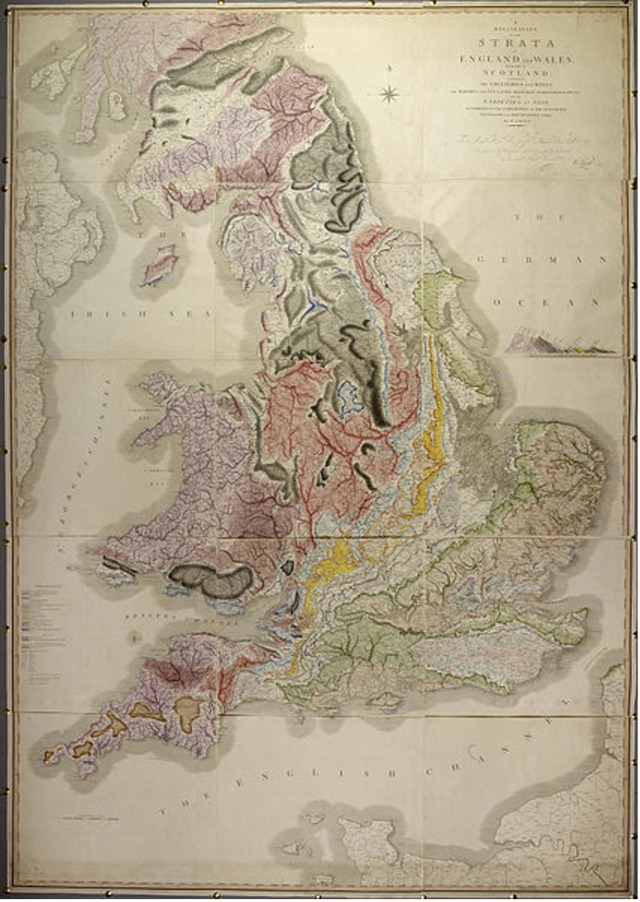
Fossils pass through many hands. Some hands hold discoveries, some buy and sell, others study and organize. Behind every fossil is a story and hopefully, for those in museum collections, a specimen label. With luck, the geology and paleontology of the label script is accurate. Beginning with the creation of the first color geological map by William Smith in 1815 and the subsequent organizing of the Geologic Time Scale in 1823, paleontologists worked to validate stratigraphy by collecting and describing new species from exposed strata in Europe and North America. It was not until the publication of Charles Darwin’s The Origin of Species in 1859 that paleontological work shifted to include studying evolution as documented by fossil evidence.

Today we understand that many hands aided fossil discovery, often in anonymity. Thanks to technology and through a focus shift to the individuals behind the specimens, we can now provide a fuller picture of the past that acknowledges the roles of collectors, dealers, indigenous cultures, women, quarry workers, and all who aided in the pursuit of fossils.

In the basement of Carnegie Museum of Natural History, behind a set of gray steel doors in the Section of Invertebrate Paleontology, is an astonishing assembly of archival documents from the Bayet Collection. Andrew Carnegie made front page news in 1903 by purchasing an estimated 130,000 fossils from Ernest Bayet of Brussels. Along with the fossils, the museum also received hundreds of documents written primarily in French, German, and Italian. Most of it has remained untranslated, until now.

Thanks to volunteer Lucien Schoenmakers of the Netherlands, details of fossil trades and purchases from over 100 years ago provide links to narratives that have yet to be told. Join us as we start the journey. Our series, which began with an examination of correspondence between fossil collector Frederick Stearns and his client, Bayet, continues here with a deeper profile of Stearns.

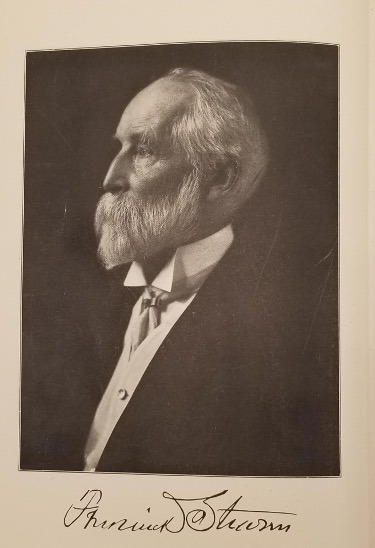
Sepia tone profile photo of a white man wearing a suit. Underneath the photo is his signature: Frederick Stearns.
Frederick Stearns, date unknown. Permission of the University of Michigan Stearns Collection.

Frederick Stearns of Detroit was a man not born into wealth, but with a passion for education, art, and science. His early life revolved around diligence, not fossils. Born in Lockport, New York in 1831, Stearns quit school at age 14 to find a job. Within a year, he found work as an apprentice to a pharmacist in Buffalo, New York. Of his early life, he later said, “one of my earliest memories is looking into the windows Dr. Merchant’s Gargling Oil Drug store and wondering at the mystery of the white squares of magnesia and the round balls of chalk.” Eventually, Stearns moved to another pharmacy, and became partner, but he was not convinced that Buffalo, New York was his ticket to success.

On a frosty New Year’s Day in 1855, Stearns, newly married and just 24 years of age, crossed the frozen Detroit River by foot to start anew. Of that period, he later said, “little money, fair credit, high hope.” He opened a retail pharmacy in Detroit. To reach customers, he made short trips to the surrounding area, leaving samples of his products. Over time, his business expanded to the manufacture of pharmaceuticals. In 1877, he made history by installing the first telegraph line in the city of Detroit. But despite the success, Stearns dreamed of the education lost to him when he left school at the age of 14. In 1887 at age 56, he turned the business over to his sons and he began to travel the world. Over the next twenty years, he collected many items, including fossils.

William Smith’s 1815 Color Geological Map.

Stearns pursuits led him to Africa, Europe, and Asia. In the late 1800’s, a voyage to Japan required weeks of travel as compared to a current 14-hour flight from New York to Tokyo. In the early 1890’s, Stearns travelled to Japan twice for the purpose of studying mollusks and other marine life. In a book published in 1895 titled, “Catalog of the Marine Mollusks of Japan,” Stearns credits Japanese fisherman Morita Seto for assisting in the collection of over “1000 forms of marine life.”

But Stearns interest did not stop with mollusks. He also collected fossils, art, and musical instruments. His collection of musical instruments at the Stearns Collection of Musical Instruments at the University of Michigan, in Ann Arbor Michigan, is considered one of the finest in the world.

For a short time, Stearns also collected fossils. Between 1888-1889, he wrote two letters to Ernest Bayet about a trade deal. Stearns first letter offers a clue as to how they met. Both men appear to have known fossil dealer Lucien Stilwell of Deadwood, South Dakota. The trade between Stearns and Bayet did not go smoothly, but it does have a happy ending.

Stearns was a student of the world until the very end. In 1907, just days before he was scheduled to sail for Egypt, he became ill and died. At his passing, the Detroit Free Press wrote, “A remarkable phase of Mr. Stearns’s activities as a collector was their diversity… and all of this for the simple love of learning things that he might tell them to others without price.”

Many thanks to the generous contributions of Carol Stepanchuk, Outreach and Academic Projects at the U-M Stearns Collection of Musical Instruments Lieberthal-Rogers Center for Chinese Studies and Joseph Gascho, Associate Professor at the University of Michigan School of Music and Director of the Stearns Collection of Musical Instruments. Many thanks to volunteer Lucien Schoenmakers’ ongoing effort to translate archival Bayet documents written in French and German.

Joann Wilson is an Interpreter in the Education Department at Carnegie Museum of Natural History and Albert Kollar is Collections Manager for the Section of Invertebrate Paleontology. Museum employees are encouraged to blog about their unique experiences and knowledge gained from working at the museum.

Related Content

Stearns and Bayet Part 1: The Dispute

Understanding Fossil Fuels Through Carnegie Museums Exhibits

From Collector to Director

Carnegie Museum of Natural History Blog Citation Information

Blog author: Wilson, Joann; Kollar, Albert
Publication date: June 9, 2021

Share this post!

  • Share on Twitter Share on Twitter
  • Share on Facebook Share on Facebook
  • Share on Pinterest Share on Pinterest
  • Share on LinkedIn Share on LinkedIn
  • Share on Reddit Share on Reddit
  • Share via Email Share via Email

Share this post!

  • Share on Twitter Share on Twitter
  • Share on Facebook Share on Facebook
  • Share on Pinterest Share on Pinterest
  • Share on LinkedIn Share on LinkedIn
  • Share on Reddit Share on Reddit
  • Share via Email Share via Email

Filed Under: Blog Tagged With: Albert Kollar, fossils, invertebrate paleontology, Joann Wilson, Science News

June 7, 2021 by wpengine

Expanding the Scope of Environmental Education

by Patrick McShea

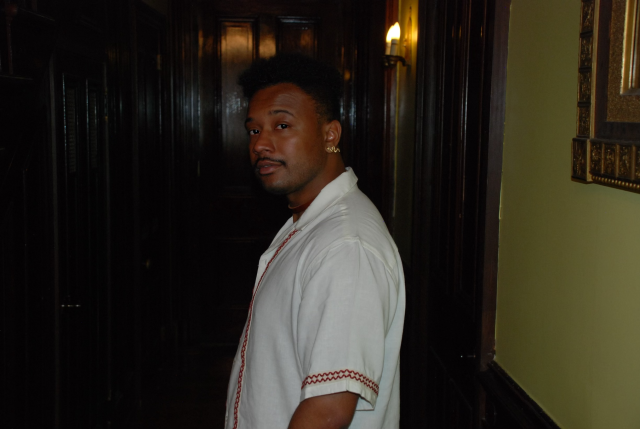
Black man in a white collared shirt standing in front of a wooden door indoors.

Seven years after he graduated from Allegheny College with a degree in Environmental Studies, Will Tolliver Jr. accepted responsibility for teaching some aspects of that discipline at the 206-year-old liberal arts institution. As an adjunct professor, he presented an overview of environmental education’s foundations and its intersection with anti-bias and anti-racist education for 22 juniors and seniors during a recent semester-long course. As a Pittsburgh native, Will brought a hometown focus to some course work at the Meadville college by leading his students in developing lesson plans for Hilltop Urban Farm, an eight-year-old initiative that is transforming 108 acres of the former St. Clair Village housing complex into a national model of community food production.

“I think the relatively short interval between being a student and being a teacher worked to my advantage.” Will explains. “The course was taught remotely because of the pandemic, and during this time of continued civic and social unrest. l was mindful of the students’ situations, concerned about elements effecting their mental health and well-being that were beyond the bounds of the course.”

Will’s out-of-school experience prepared him well for the challenge. His resume includes current work as a consultant to the Public Broadcasting Service, and various teaching, training, grant-writing, and administrative roles for the Pittsburgh Parks Conservancy, Pennsylvania Association for the Education of the Young Child, Grow Pittsburgh, and the Children’s Museum of Pittsburgh. During each phase of his career CMNH helped Will to use authentic objects in his public presentations by providing him with a toolbox of touchable objects including feathers, mammal skulls, preserved plants, and fossils.

If there’s a theme to date in Will’s career, it might be expanding the vocabulary of the people he engages. He explains his first professional challenge, as a Pittsburgh Parks Conservancy naturalist, as “closing the word gap” for three- to five-year-old children in the city’s Homewood neighborhood. In a grant-supported program called “Buzzword Pittsburgh,” he used storytelling, play, guided hikes, songs, and museum objects to explore the meanings of individual words and build vocabulary related to science, math, art, and even local plants and wildlife.

Expanding the working environmental education vocabulary of college students in 2021 involved a greater level of sharing. As Will summarizes, “I wanted to be that better teacher, who covered the core principles and ideas, but also honestly shared what it has been like for me as a Black man working in this field.” His students explored the undeniable connections between environmental health and social justice. Their understanding of the history and importance of such collaborative community initiatives as Hilltop Urban Farm, for example was tied to understanding potentially new terms like urban food deserts, and red-lined neighborhoods.

Patrick McShea works in the Education and Visitor Experience department of Carnegie Museum of Natural History. Museum employees are encouraged to blog about their unique experiences and knowledge gained from working at the museum.

Related Content

Stage and Screen Sharing

Pittsburgh’s Moths Reflect Environmental Impacts of Industry

Teaching About Local Wildlife with the City Nature Challenge

Carnegie Museum of Natural History Blog Citation Information

Blog author: McShea, Patrick
Publication date: June 7, 2021

Share this post!

  • Share on Twitter Share on Twitter
  • Share on Facebook Share on Facebook
  • Share on Pinterest Share on Pinterest
  • Share on LinkedIn Share on LinkedIn
  • Share on Reddit Share on Reddit
  • Share via Email Share via Email

Share this post!

  • Share on Twitter Share on Twitter
  • Share on Facebook Share on Facebook
  • Share on Pinterest Share on Pinterest
  • Share on LinkedIn Share on LinkedIn
  • Share on Reddit Share on Reddit
  • Share via Email Share via Email

Filed Under: Blog Tagged With: Education, Educator Loan Program, Educator Resources, Pat McShea, We Are Nature 2

  • « Go to Previous Page
  • Page 1
  • Interim pages omitted …
  • Page 4
  • Page 5
  • Page 6
  • Page 7
  • Page 8
  • Interim pages omitted …
  • Page 206
  • Go to Next Page »

sidebar

About

  • Mission & Commitments
  • Directors Team
  • Museum History

Get Involved

  • Volunteer
  • Membership
  • Carnegie Discoverers
  • Donate
  • Employment
  • Events

Bring a Group

  • Groups of 10 or More
  • Birthday Parties at the Museum
  • Field Trips

Powdermill

  • Powdermill Nature Reserve
  • Powdermill Field Trips
  • Powdermill Staff
  • Research at Powdermill

More Information

  • Image Permission Requests
  • Science Stories
  • Accessibility
  • Shopping Cart
  • Contact
  • Visitor Policies
Stay in the loop! Sign up for our newsletter(s).
One of the Four Carnegie Museums | © Carnegie Institute | Privacy Policy | Terms of Use | Accessibility
Rad works here logo