• Skip to primary navigation
  • Skip to main content
  • Skip to primary sidebar

Carnegie Museum of Natural History

One of the Four Carnegie Museums of Pittsburgh

  • Visit
    • Buy Tickets
    • Visitor Information
    • Exhibitions
    • Events
    • Dining at the Museum
    • Celebrate at the Museum
    • Powdermill Nature Reserve
    • Event Venue Rental
    • Gift Cards
  • Learn
    • Field Trips
    • Educator Information
    • Programs at the Museum
    • Bring the Museum to You
    • Guided Programs FAQ
    • Programs Online
    • Climate and Rural Systems Partnership
  • Research
    • Scientific Sections
    • Science Stories
    • Science Videos
    • Senior Science & Research Staff
    • Museum Library
    • Science Seminars
    • Scientific Publications
    • Specimen and Artifact Identification
  • About
    • Mission & Commitments
    • Directors Team
    • Museum History
  • Tickets
  • Give
  • Shop

January 13, 2023 by

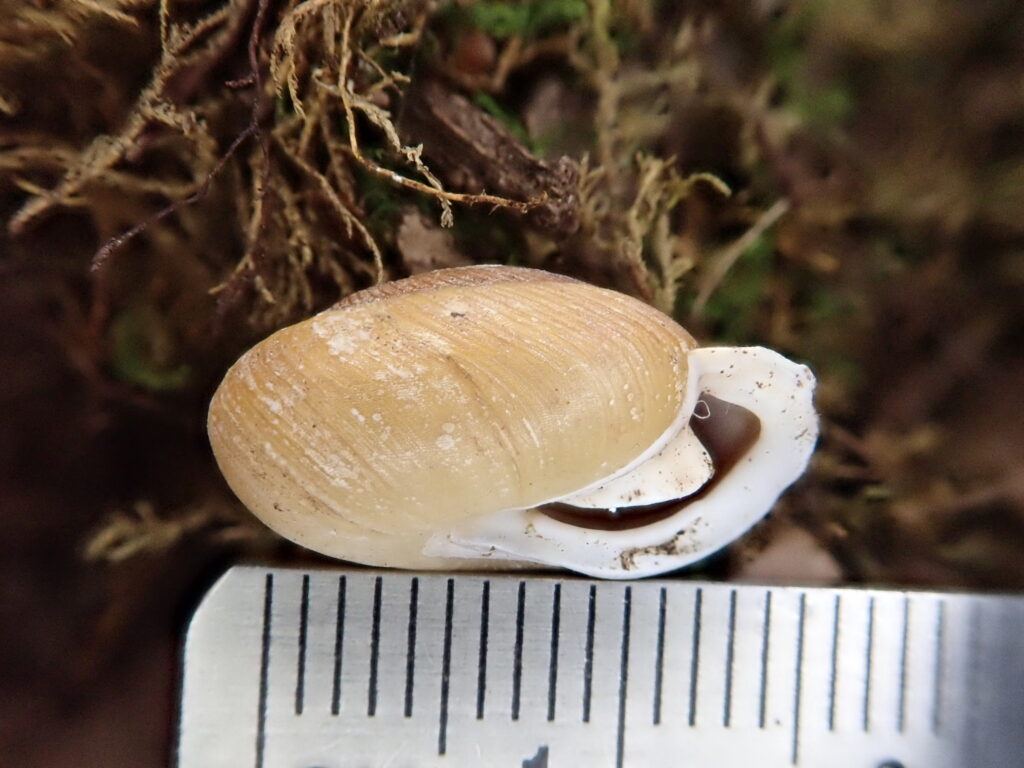
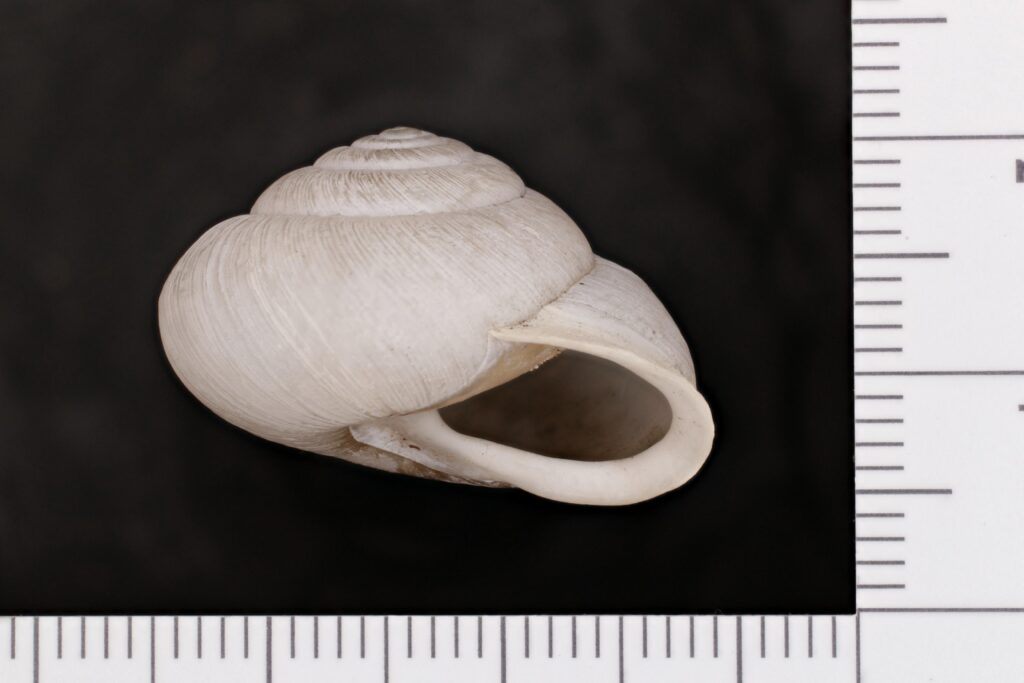
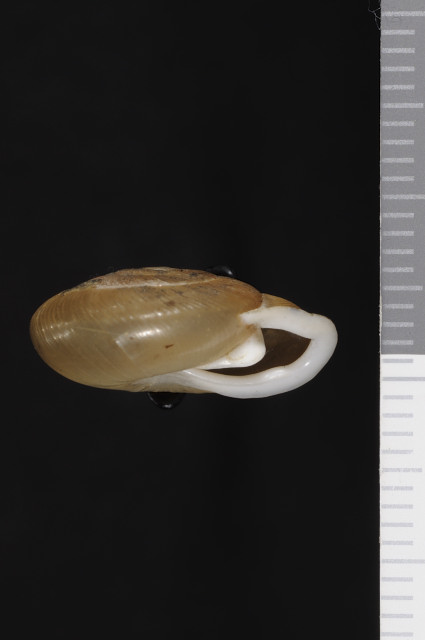
Patera laevior

Image Usage Information

  • The Academy of Natural Sciences of Philadelphia
  • CC BY-NC 4.0 DEED
  • For additional information about this specimen: Gary Rosenberg (rosenberg.ansp@drexel.edu)

Family: Polygyridae

Common name: Smooth Bladetooth

Discovery: Pilsbry, 1940

Identification

Width: 15-18 mm
Height: 7-8 mm
Whorls: ~5

The glossy shell of Patera laevior is less angular at the periphery than P. appressa, and bears weaker microsculpture. As in P. appressa, the aperture is wide and rounded, with a broad lip and a sharp rim inside the basal part of the opening.

Ecology

Patera laevior inhabits primarily rocky places in both rural and urban areas. It may occasionally be found near logs, river bluffs, and on the slopes of ravines (Hubricht, 1985).

Taxonomy

Patera laevior has also been known as Mesodon appressus laevior and M. laevior.

Distribution

This snail has a confusing distribution – concentrated on the western side of the Appalachian Mountains in Kentucky, Tennessee, and Alabama but also reported at scattered locations to the East as far as the Chesapeake Bay and North Carolina coast, where it is apparently introduced (Hubricht, 1985). In Virginia it is reported only from Pittsylvania and Dinwiddie Counties, though we did not find museum records for the latter.

Conservation

NatureServe Global Rank: G4
NatureServe State Rank: S2S4
Virginia’s wildlife action plan: Tier IV
January 13, 2023 by

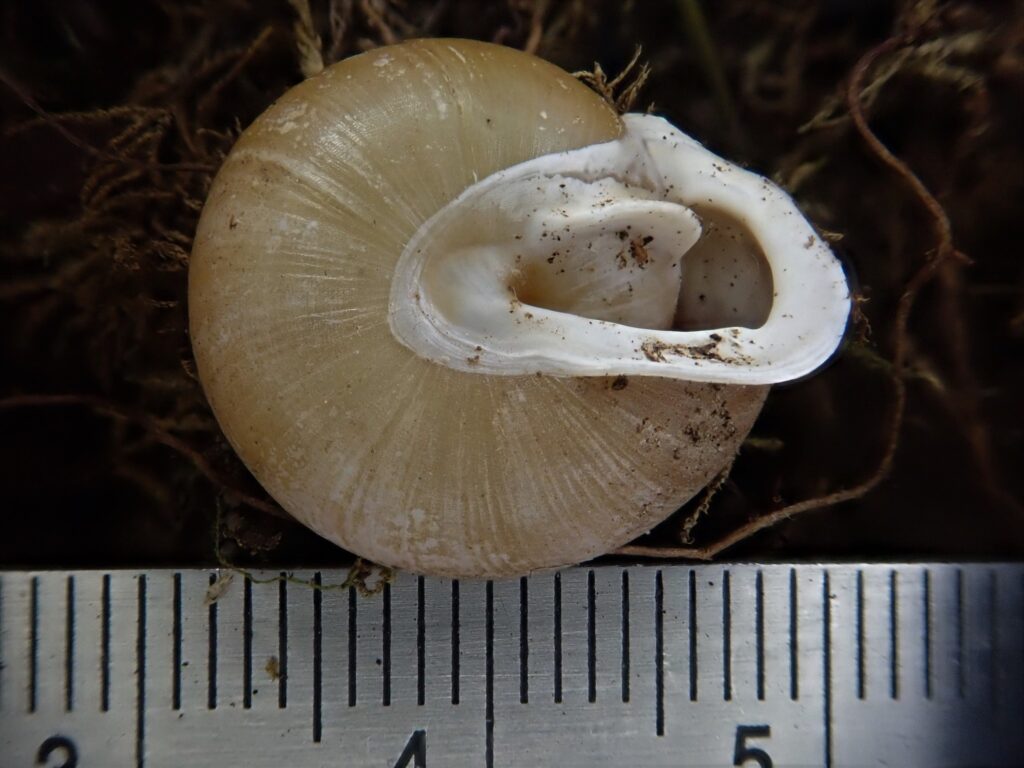
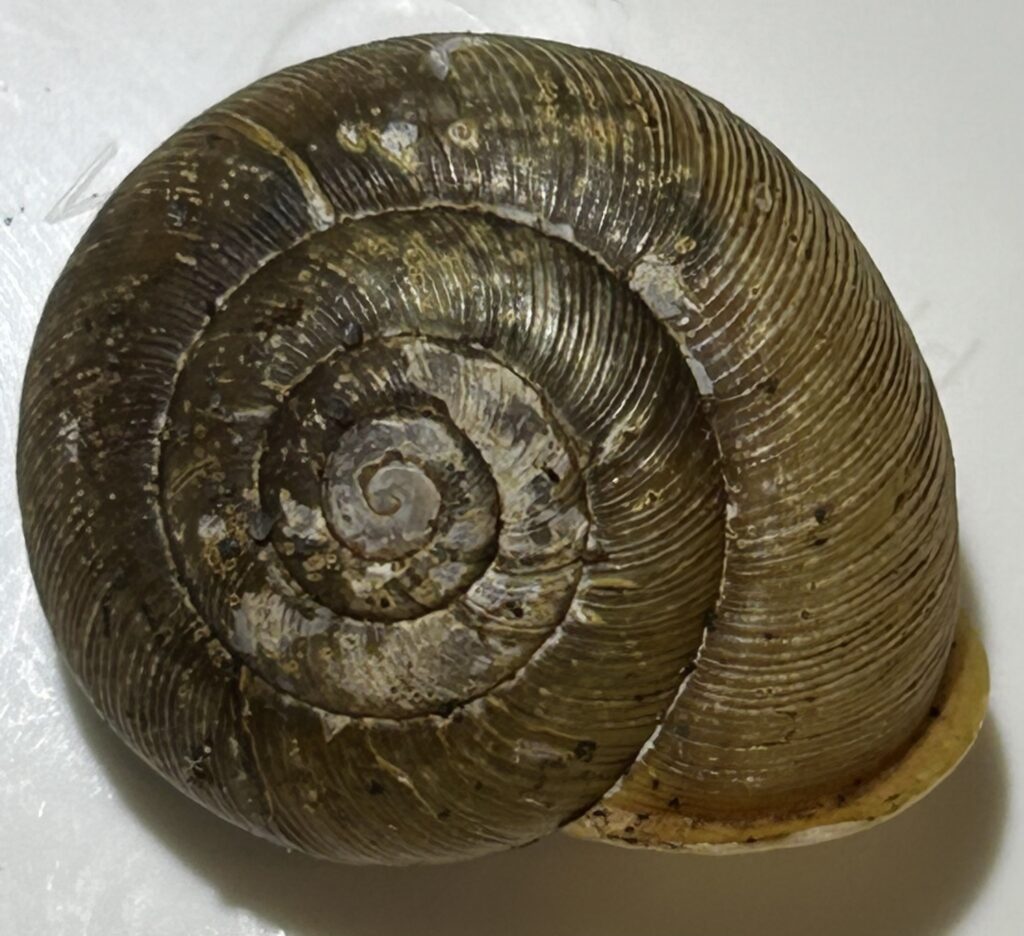
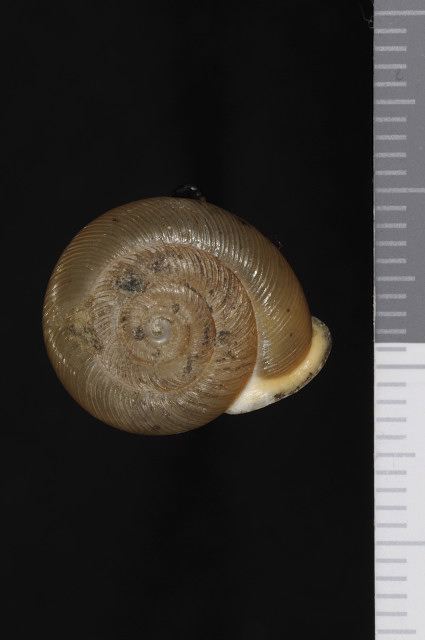
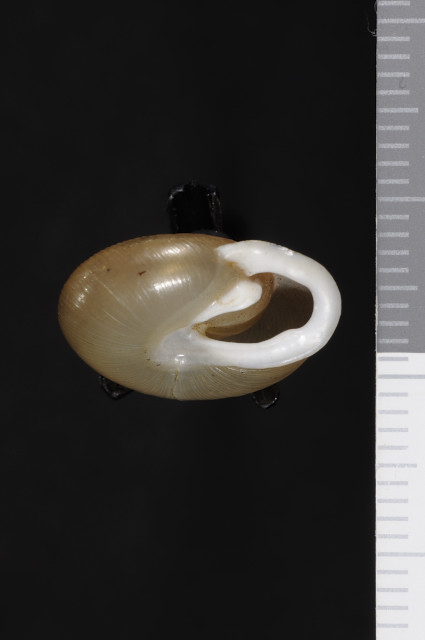
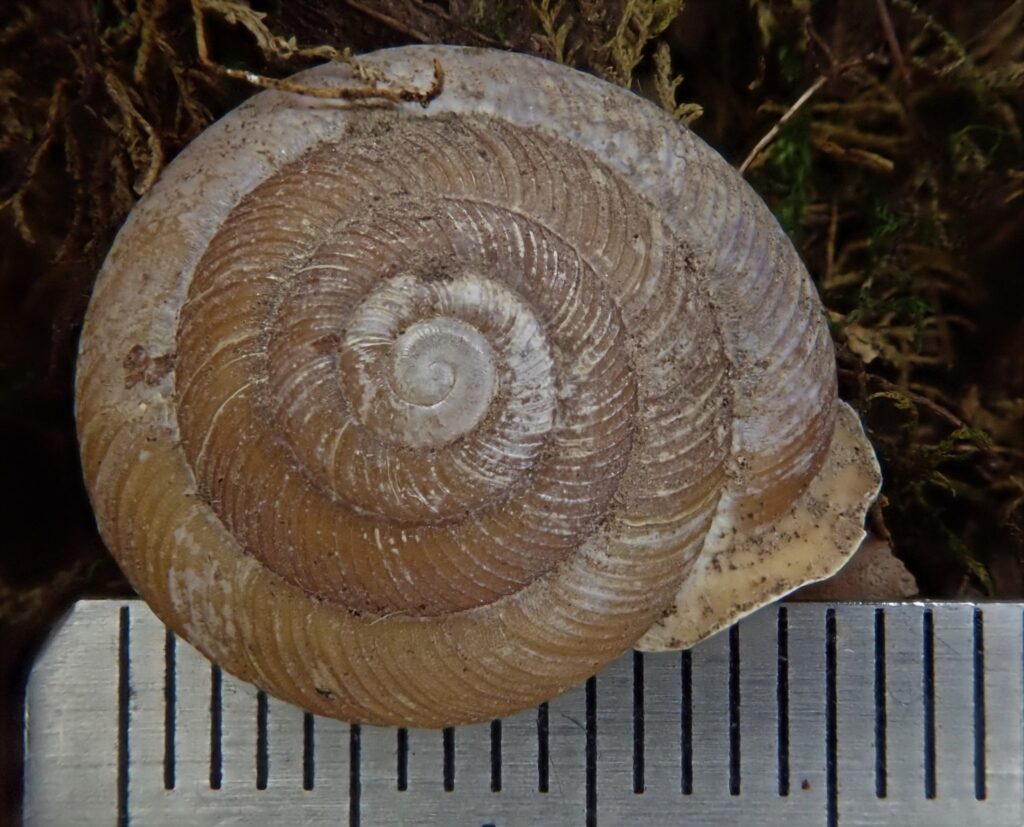
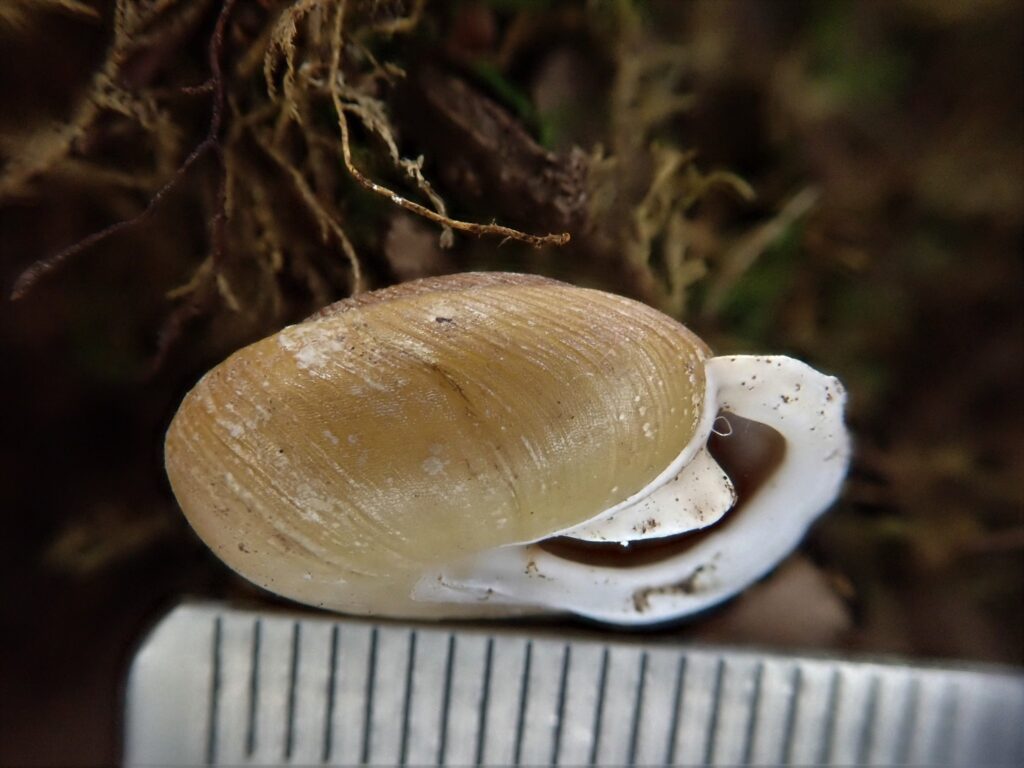
Patera appressa

Image Usage Information

  • Barb Graham
  • CC BY-NC 4.0 DEED
  • Additional information about this specimen

Family: Polygyridae

Common name:  Flat Bladetooth

Discovery: Say, 1821

Identification

Width: 15-20 mm
Height: 7-9 mm
Whorls: 4+

The flattened shell of Patera appressa is decorated with coarse, radial striae beginning at the second whorl, and some scattered, microscopic papillae. Fine striae on the inner whorls are spaced at wide intervals. The shell comes to a sharp angle at the front periphery, but is less acute at the back. The aperture is wide and rounded, with a broad lip and a sharp rim inside the basal part of the opening. The umbilicus is covered.

Ecology

Patera appressa inhabits rocky areas of hardwood forests and river bluffs. It may also be found along roads and on urban terrain (Hubricht 1985). Its flattened shell is believed to be an adaptation for crawling among rocks.

Taxonomy

Synonyms for P. appressa include Helix appressa, H. linguifera, H. sancta georgiensis, Mesodon appressus, Polygyra appressa, P. a. extrema, P. a. linguifera, P. a. sculptior, and Triodopsis appressa.

Distribution

This is primarily a southern Appalachian species, reaching Ohio in the north and northern Alabama in the south (Hubricht, 1985). This snail is reported from central and southern Virginia.

Conservation

NatureServe Global Rank: G5
NatureServe State Rank: S4

January 13, 2023 by

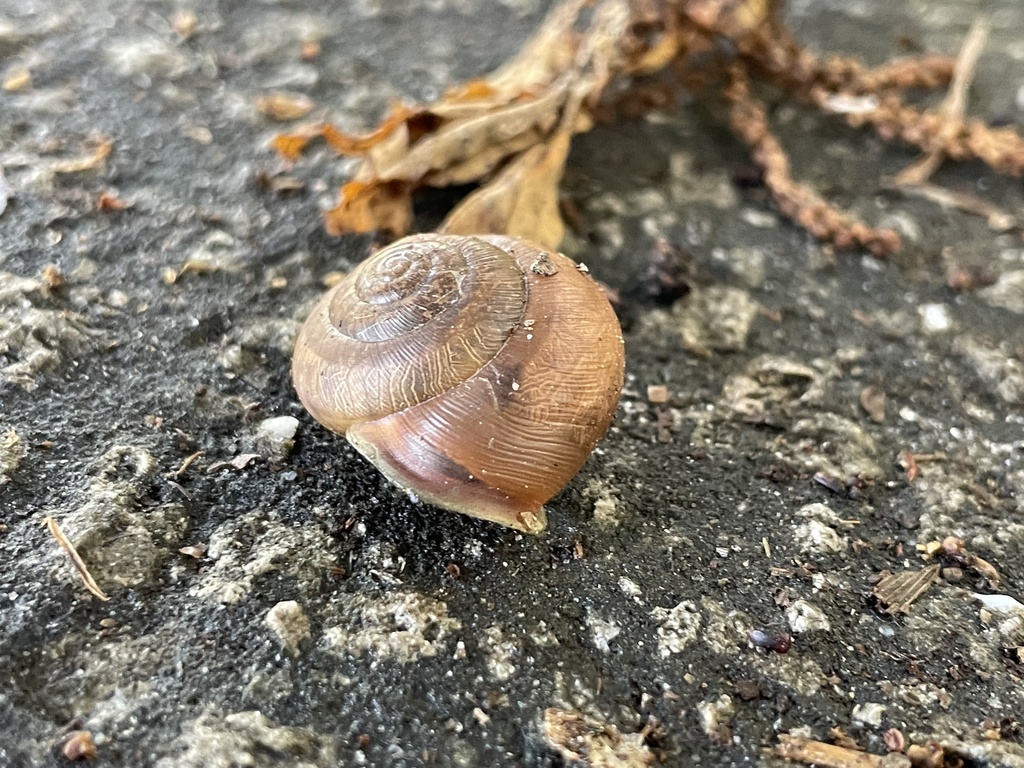
Neohelix solemi

Image Usage Information

  • Larry Chen
  • CC BY-NC 4.0 DEED
  • Additional information about this specimen

Family: Polygyridae

Common name: Coastal Whitelip

Discovery: Emberton, 1988

Identification

Width: 23-35 mm
Height: 15-25 mm
Whorls: 5-6

The large, globe-shaped shell of Neohelix solemi has a closed umbilicus and a simple reflected lip. The shell microsculpture is fine radial ridges. The shell is usually darker brown and has a slightly taller shell (relative to its width) with a narrower lip, in comparison to its look-alike congeners N. albolabris and N. major (Emberton, 1988).

Ecology

This species is one of three large whitelip snails in Virginia, and the least-known. Only recently described as a unique species, its habitat preferences have not been distinguished from those of N. albolabris, which is a forest-dweller, often in leaf litter and sometimes on woody debris, but also found in open habitats. Neohelix solemi may be stunted in size when living on very sandy soils (Triodopsis albolabris form traversensis [maritima]; Pilsbry, 1940).

Taxonomy

Synonyms for N. solemi include Helix albolabris var. maritima and T.a. form traversensis.

Distribution

Neohelix solemi is an animal of the Atlantic Coastal Plain, from South Carolina perhaps as far north as Maine (material north of New York has not been thoroughly studied; Emberton, 1988). In Virginia, specimens are reported from several coastal counties.

Conservation

NatureServe Global Rank: G5, Secure

January 13, 2023 by

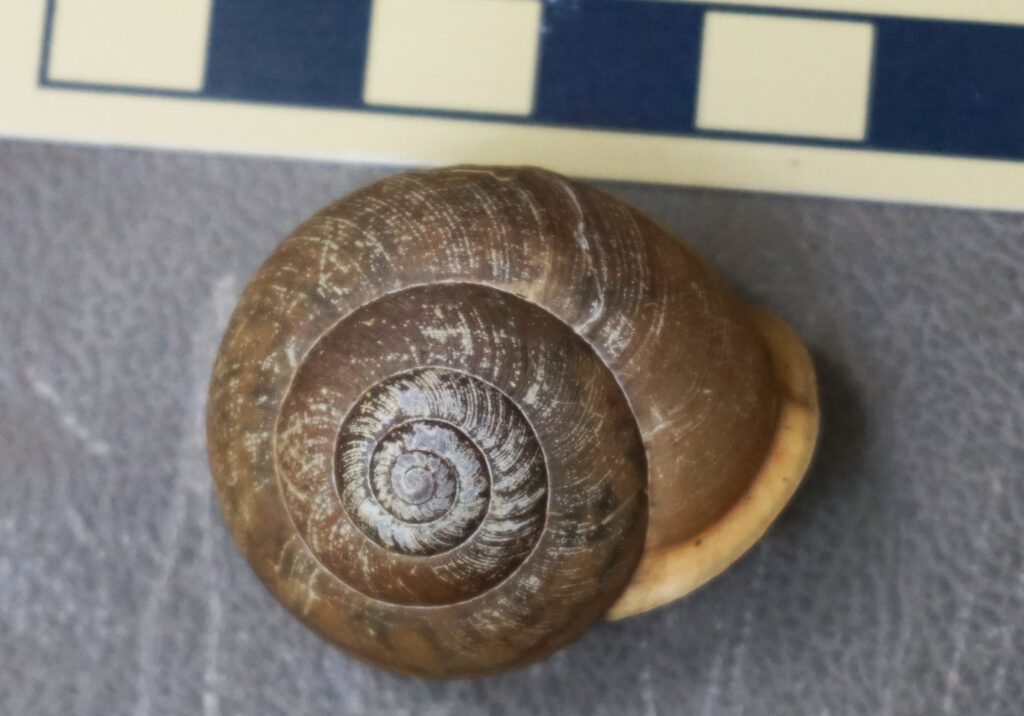
Neohelix major

Image Usage Information

  • Benjamin Schwartz
  • CC BY-NC 4.0 DEED
  • Additional information about this specimen

Family: Polygyridae

Common name: Southeastern Whitelip

Discovery: A. Binney, 1837

Identification

Width: 28-42 mm
Height: 30-32 mm
Whorls: 5.5+

The big, sturdy, globe-like shell of Neohelix major has a closed umbilicus and a simple reflected lip. Its shell sculpture has stronger radial ridges that give it a coarser texture and less glossy appearance than N. albolabris. It tends to be a bit larger as well, although there is an overlap in sizes (Emberton, 1988). Though no parietal tooth is present, some may have a low, bump-like denticle on the columellar margin of the aperture.

Ecology

Neohelix major hides in leaf litter or among rocks or logs in forested areas. It is usually found in damp, rich habitats, often on lower forest slopes with coarse woody debris. In some cases it may be found in grassy areas such as roadsides. Although it frequents the same habitats as N. albolabris, the two species are not found together (Hubricht, 1985).

Taxonomy

Synonyms for N. major include: Helix major, Mesodon major, Polygyra albolabris major, Triodopsis major, and T. albolabris major.

Distribution

Neohelix major’s range extends from the New York and the Middle Atlantic states south to Alabama and Georgia, though there are few museum records of this difficult-to-distinguish snail. Historic records may be confused with N. albolabris and the more coastal species N. solemi.

Conservation

NatureServe Global Rank: G5, Secure

January 13, 2023 by

Neohelix dentifera

Image Usage Information

  •  Marla Coppolino
  • CC BY-NC 4.0 DEED
  • Additional information about this specimen

Family: Polygyridae

Common name: Big-tooth Whitelip

Discovery: A. Binney, 1837

Identification

Width: 20-28 mm
Height: 11-17 mm
Whorls: 5+

This large heliciform snail is somewhat flattened. It has a widely reflected lip with a callus that also covers its umbilicus, and a single parietal tooth. It is more flattened than Neohelix albolabris, and often more brown-colored. It, too, has a shell finely textured with radial ridges and grooves. The animal is grayish to light brown, with dark antennae.

Ecology

Neohelix dentifera occurs in upland forests, especially damp, rocky habitats on slopes near streams or periglacial talus. It prefers acidic soils (Hubricht, 1985) and may be found on hillsides or in coves beneath rhododendron “hells”.

Taxonomy

Synonyms for N. dentifera include: Helix dentifera, Mesodon dentifera, M. dentiferus, Polygyra dentifera, and Triodopsis dentifera.

Distribution

Neohelix dentifera is an Appalachian Mountain forest animal found inland from southeastern Canada and Maine to North Carolina. It does not extend into Ohio or the Midwest.

Conservation

NatureServe Global Rank: G5, Secure

January 13, 2023 by

Neohelix albolabris

Image Usage Information

  • jerryreynolds, iNaturalist
  • Public Domain
  • Additional information about this specimen

Family: Polygyridae

Common name: Whitelip

Discovery: Say, 1817

Identification

Width: 25-31 mm
Height: 16-19 mm tall
Whorls: 5+

Neohelix albolabris is one of the largest and most familiar native Eastern land snails. The aperture of its large shell has a reflected edge which extends underneath into a callus that covers the umbilicus. The shell is covered with a sculpture of fine ridges and there are no denticles or “teeth” in the aperture.

Ecology

This species hides in leaf litter or among rocks or logs in forests. It is most often found in mesic habitats, often on mid-to-lower forest slopes with coarse woody debris, but can be frequent near calcareous outcrops as well. It can be found in streamside hemlock stands in northern New England, and is especially fond of rotten sugar maple or beech logs in hardwood or mixed forest. It is also found at forest edges and in some cases occurs in grassy areas such as roadsides (Hubricht, 1985).

In a field study of N. albolabris distribution in an Ohio hardwood forest, this animal was found near larger rocks and was most active in periods of warmer temperatures and rainfall (Emberton, 1980). A field experiment in Michigan discovered that young N. albolabris had slower growth rates in the presence of adults, due to competition for food or water (Pearce, 1997). In a beech-hemlock stand in New York, Calosoma sp. beetles were a common predator of this snail (Ingram, 1950).

Taxonomy

Neohelix albolabris profile – taxonomy: start with new paragraph: Once considered a single widespread species, this animal has recently been divided into a few cryptic “sister species” based upon reproductive anatomy and genetic analysis (Emberton, 1988). In Virginia, typical N. albolabris is generally found in most of the state, while the subtly rounder-shelled Neohelix solemi is on the coast and the slightly larger-shelled Neohelix major lives in the far west. Older reports of N. albolabris may no longer be accurate.

Synonyms for N. albolabris include: Helix albolabris, H. rufa,Mesodon albolabris, M. a. var. dentate, Polygyra albolabris, P. a. goodrichi, P. a. var. minor, P. redii, and Triodopsis albolabris.

Distribution

The global range of Neohelix albolabris was generally considered to be from southern Canada, through Wisconsin to northern Mississippi, east to the high elevations of Georgia, and north to Maine. However, the recent discovery of cryptic “sister” species along the Atlantic Coast and to the south-west (as distinguished by mating anatomy and protein analysis; Emberton, 1988), suggests its range may be primarily the upper Midwest, north, northeast, and inland east. In Virginia it is apparently the whitelip snail of the state’s central-to-western counties.

Conservation

NatureServe Global Rank: G5, Secure

  • « Go to Previous Page
  • Page 1
  • Interim pages omitted …
  • Page 11
  • Page 12
  • Page 13
  • Page 14
  • Page 15
  • Interim pages omitted …
  • Page 53
  • Go to Next Page »

sidebar

About

  • Mission & Commitments
  • Directors Team
  • Museum History

Get Involved

  • Volunteer
  • Membership
  • Carnegie Discoverers
  • Donate
  • Employment
  • Events

Bring a Group

  • Groups of 10 or More
  • Birthday Parties at the Museum
  • Field Trips

Powdermill

  • Powdermill Nature Reserve
  • Powdermill Field Trips
  • Powdermill Staff
  • Research at Powdermill

More Information

  • Image Permission Requests
  • Science Stories
  • Accessibility
  • Shopping Cart
  • Contact
  • Visitor Policies
Stay in the loop! Sign up for our newsletter(s).
One of the Four Carnegie Museums | © Carnegie Institute | Privacy Policy | Terms of Use | Accessibility
Rad works here logo