• Skip to primary navigation
  • Skip to main content
  • Skip to primary sidebar

Carnegie Museum of Natural History

One of the Four Carnegie Museums of Pittsburgh

  • Visit
    • Buy Tickets
    • Visitor Information
    • Exhibitions
    • Events
    • Dining at the Museum
    • Celebrate at the Museum
    • Powdermill Nature Reserve
    • Event Venue Rental
    • Gift Cards
  • Learn
    • Field Trips
    • Educator Information
    • Programs at the Museum
    • Bring the Museum to You
    • Guided Programs FAQ
    • Programs Online
    • Climate and Rural Systems Partnership
  • Research
    • Scientific Sections
    • Science Stories
    • Science Videos
    • Senior Science & Research Staff
    • Museum Library
    • Science Seminars
    • Scientific Publications
    • Specimen and Artifact Identification
  • About
    • Mission & Commitments
    • Directors Team
    • Museum History
  • Tickets
  • Give
  • Shop

activities

August 3, 2020 by Kathleen

Meowfest: Why Do Cat Eyes Glow in the Dark?

Have you ever walked around a dark corner only to be surprised by glowing eyes staring back at you? The glowing eyes of a cat at night can sometimes be shocking and even a little scary if unexpected. Ancient Egyptians believed cats captured the glow of the setting sun in their eyes and kept it safe until morning. Ancient Greeks believed there was a light source inside the eyes that was like a gleaming fire. We now know that cat’s eyes appear to glow because they, along with the eyes of many other nocturnal animals, reflect light.

All eyes reflect light, but some eyes have a special reflective structure called a tapetum lucidum that create the appearance of glowing at night. The tapetum lucidum (Latin for “shining layer”) is essentially a tiny mirror in the back of many types of nocturnal animals’ eyeballs. It basically helps these animals see super-well at night. It is also what causes the glowing eye phenomenon known as “eyeshine.”

How Does It Work?

When light enters a cat’s eye, it can take a few routes. Some of the light directly hits the retina, a layer at the back of the eyeball containing cells that are sensitive to light. These photoreceptor cells trigger nerve impulses that pass via the optic nerve to the brain, where a visual image is formed.

Some of the light passes through or around the retina and hits the tapetum lucidum. The tapetum lucidum reflects visible light back through the retina, increasing the light available to the photoreceptors. This allows cats to see better in the dark than humans.

In the last route, some of the light that bounces off the tapetum lucidum, misses the retina, and bounces back out of the cat’s eyes. This reflected light, or eyeshine, is what we see when a cat’s eyes appear to be glowing.

Do Humans Have a Tapetum Lucidum?

Though our eyes have much in common with cats’ eyes, humans do not have this tapetum lucidum layer. If you shine a flashlight in a person’s eyes at night, you don’t see any sort of reflection.

The flash on a camera is bright enough, however, to cause a reflection off of the retina itself. This is the infamous “red-eye” in photographs. What you see is the red color from the blood vessels nourishing the eye.

Activity

In this two-part activity, you will be able to see how the tapetum lucidum works and then simulate how this reflective layer helps cats see well at night.

Materials Needed

  • Flashlight
  • Mirror (or a shiny/reflective surface)
  • Thick paper or cardboard
  • Pencil (or an object you can poke a hole with) REMEMBER TO ASK A GROWN-UP FOR HELP!

Directions

  1. Make about a hole in your paper or cardboard using a pencil or pen. It does not have to be perfect! If using a thinner paper, try folding it a few times before making the hole (the harder it is to see light through, the better!).
  2. Hold the cardboard about 6 inches away from a blank wall and shine the flashlight through the hole toward the wall.
  3. Without looking directly into the light, glance at the side of the cardboard facing the wall. Take note of what you see.
  4. Repeat steps 2 and 3 while using your mirror instead of a wall. Again, avoid looking directly into the light or its reflection in the mirror! Note the difference in light on the side of the cardboard facing the mirror.

Imagine that the cardboard is a retina and the mirror is a reflective layer like the tapetum lucidum. What happened to the “retina” when the mirror was used instead of the wall?

This experiment shows how the amount of light from a singular light source is doubled when a reflective layer is present. Thus, it shows us how having a reflective layer—like a tapetum lucidum—increases the amount of light information available.

Materials Needed

  • Flashlight
  • Clear Glass container (jar or cup work well!)
  • Water

Directions

1. Place your glass container about 6 inches away from a wall.

2. Shine your flashlight through the glass toward the wall and observe how the light appears on the wall.

3. Fill the container with water and place in the same spot as before.

4. Shine your flashlight through the glass toward the wall and observe how the light now appears on the wall.

Imagine that the wall is the retina and the water is a reflective layer like the tapetum lucidum. How does the reflective layer change the presence of light on the retina?

While this experiment is technically showing how light refraction works in water, it can also show us how having a reflective layer—like a tapetum lucidum—increases the amount of light available to cats’ eyes. Also, that the extra reflective light is not as clear as the original light input.
Filed Under: Blog Tagged With: activities, Crafts, Super Science Days, Super Science Meowfest

July 20, 2020 by wpengine

A Bumble’s Blog and Bumble “Weee” Catapult Craft

Wander outside in the spring and summer and I bet you will bump into a busy bumble bee bumbling among the wildflowers. Bumble bees (Bombus sp.) are rather rotund, fuzzy bees usually with black and yellow-orange stripes. Unlike the famous honey bee that hails from Europe and Asia, most bumble bee species are native to our area. Bumble bees have small underground colonies with a loose social system, compared to that of a honey bee. While bumble bees produce honey, it is in small quantities and certainly not enough to share on an industrial scale. Still, these fuzzy bumbles play an important role as pollinators of local wildflower populations and are even adapted to pollinate certain flowers!

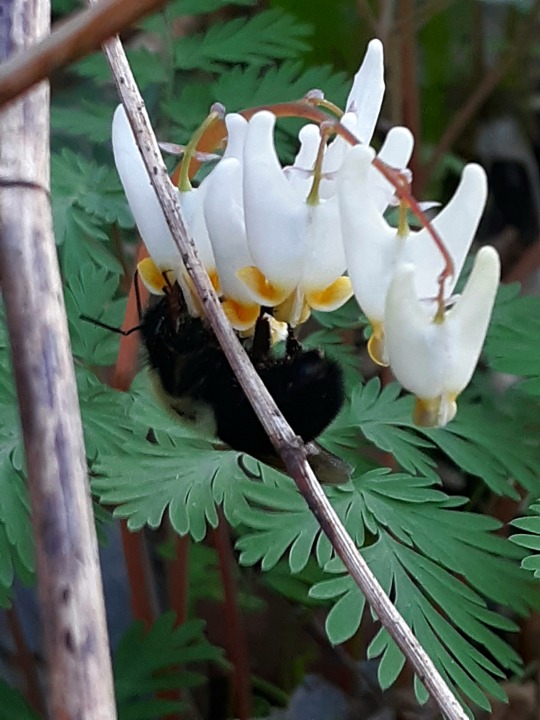
photo of Dutchman's breeches flower

This fashionable bumble bee is trying to squeeze into a little pair of white breeches! Duchman’s breeches (Dicentra cucullaria) to be exact. A bumble bee’s proboscis (tongue) is long enough to reach the nectaries within the nectary spurs or “pant leg” and the bee is strong enough to push open the flower petals to collect pollen.

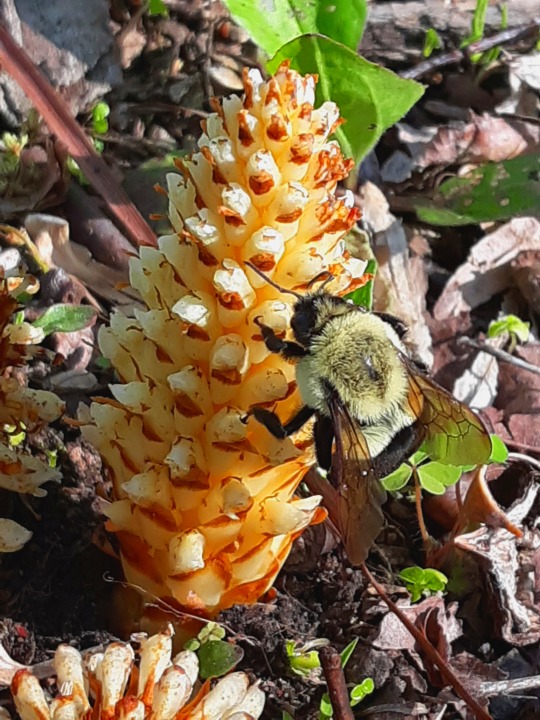
bumblebee on squawroot

This bumble bee is sipping nectar from squawroot (Conopholis americana). Bumble bees and flies are the typical visitors of this parasitic plant! Fun fact: bumble bees “buzz” pollenate, which means they vibrate their bodies, effectively knocking pollen down into the flowers they visit.

Upon observing the flight of a bumble bee, I have noticed that while they are strong flyers, they are not the most graceful. Sometimes they miss their mark and land on a chunk of moss instead of the flower. However, they just take that moment to rest their wings before firing up their little motor and buzzing off into, hopefully, the next flower. Their rather clunky flight pattern gave me an idea for a fun activity to help young children learn about pollinators (and sneak in a STEM activity): The Bumble “Weee” Catapult! See below for assembly instructions:

Materials

      3 pipe cleaners

      Paper

      Pen or pencil

      Coloring supplies

      Scissors

      Recycled egg carton

      Recycled plastic spoon

      4-5 large Rubber bands

Let’s dismiss the idea of launching real bumble bees and begin building the bee puppet 😉. Pick 3 different colors of pipe cleaner. Feel free to go with traditional bee colors or mix it up!

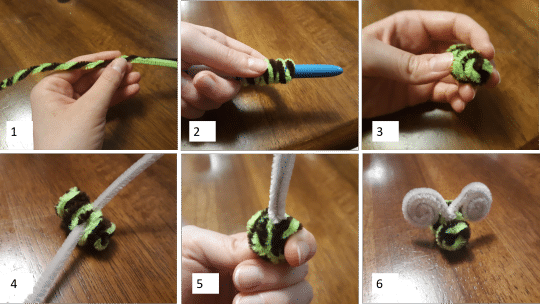
1.     For the body, twist together two pipe cleaners.

2.     Wrap the twisted pipe cleaners tightly around a pen or pencil and slide it off.

3.     Tuck the loose ends inward and tighten up the coils on the end you would call the head.

4.     For the wings, shorten the remaining pipe cleaner by 1/3, then loop it under one of the coils of the bee’s body.

5.     Adjust the pipe cleaner for equal length on either side and twist at the base.

6.     Roll in the loose ends to finish forming your wings, thus completing the bumble bee.

step by step photos of creating a bee from pipe cleaners

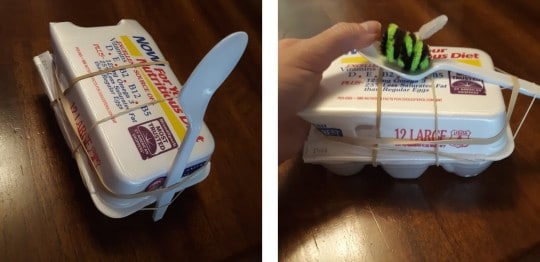
Next, build the catapult to help your bee puppet fly. The catapult consists of half of an egg carton, 4-5 rubber bands, and a recycled spoon. Tension energy is generated when the spoon is pulled back. The arm stores that energy as potential energy. Upon release, that potential energy is transferred to the object as kinetic energy, moving the object away from the arm. Pictured is the simplest catapult design with rubber bands holding the spoon, or arm of the catapult, in place. Feel free to design something more elaborate!

photo of catapult made from egg carton, plastic spoon, and rubber bands

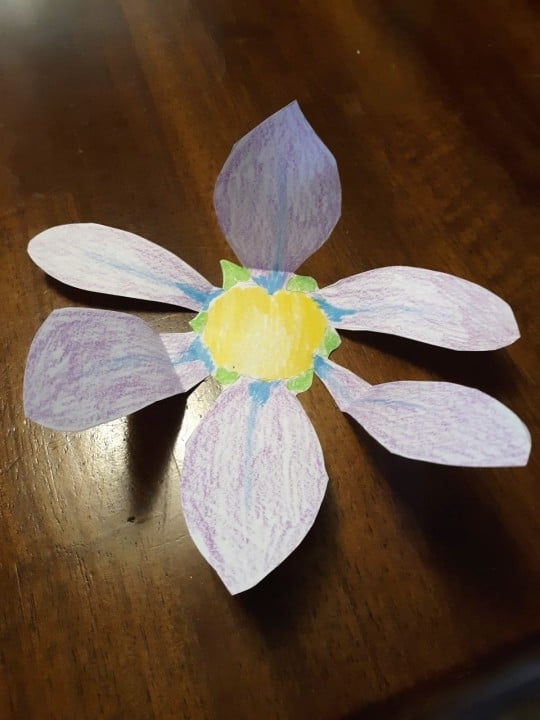
Finally, the bumble bee needs a flower to land in! Draw a flower of your choice on a piece of paper and color it in. Many bees are able to see UV light, which means they are able see colors and patterns invisible to the human naked eye. Some flowers have nectar guides that really stand out to bees, so feel free to draw some nectar guides, or lines that point to the center on your flower targets to help guide your bumble bee!

photo of paper flower

Feel free to create as many flowers as you like and propel your little bumble bee into as many flowers as you can. Happy pollinating!

Sara Klingensmith an educator at Powdermill Nature Reserve, Carnegie Museum of Natural History’s environmental research center. Museum employees are encouraged to blog about their unique experiences and knowledge gained from working at the museum.

Related Content

Jumping Spiders with Sebastian

Pittsburgh Dinosaur Driving Tour

Photogenic Fungi

Filed Under: Blog Tagged With: activities, Crafts, Museum from Home, Nature 360, Nature Lab, Powdermill, Powdermill Nature Reserve, Sara Klingensmith

July 9, 2020 by Kathleen

Jurassic Days: Cookie Excavation

Materials Needed

  • Paper towel
  • Paint brush/small brush of some type
  • Tooth picks
  • Paper and pencil
  • Chocolate chip cookie (or any type of cookie with bits like raisins, fruit, or other ingredients)

Filed Under: Blog Tagged With: activities, Crafts, Jurassic Days

July 8, 2020 by Kathleen

Jurassic Days: Dino Statue Driving Tour

Dinosaurs became extinct 65 million years ago, but Pittsburgh is still a city of dinosaurs.  The giants still roam the city’s hills even outside of the museum.  In fact, you might see dinosaurs in your own neighborhood!

Carnegie Museum of Natural History released 100 dinosaur statues during DinoMite Days in the summer of 2003. Some of these dinosaurs have roamed far away, but others remain within the Pittsburgh area.  These aren’t ordinary dinosaurs, they’re spectacularly colorful and creative!  Designed by local artists and imaginative students, these dinosaurs are representative of the vibrant spirit of Pittsburgh and some of the ‘Burgh’s amazing local legends.

To commemorate the city’s dinosaurs this summer, consider visiting a few on a Dino Statue Driving Tour, or hunt for the elusive dinosaur statues not listed here.  The tour takes roughly two hours—timed with a stop for a photo at each dinosaur, but I’d recommend adding a snack break—and includes 15 dinosaurs. The DinoMite Days dinosaurs released in 2003 came in three standard shapes—Tyrannosaurus, Stegosaurus, and Torosaurus.  The dinosaurs were auctioned as part of a fundraiser for several local charities, including Carnegie Museum of Natural History’s Dinosaurs in Their Time exhibition.  They are currently privately owned and may be publicly displayed or kept indoors.  The dinosaurs have even ended up as part of other museums including the John Heinz History Center.  Some dedicated dinosaur hunters are trying to locate all 100 dinosaurs!

Note: While many of these dinosaurs are displayed as public art, some are owned by private individuals and should be approached with respect.  Please, be courteous when taking photographs and ask permission when necessary.  You may be required to wear a mask or participate in a health screening at some of these stops for public health safety precautions.

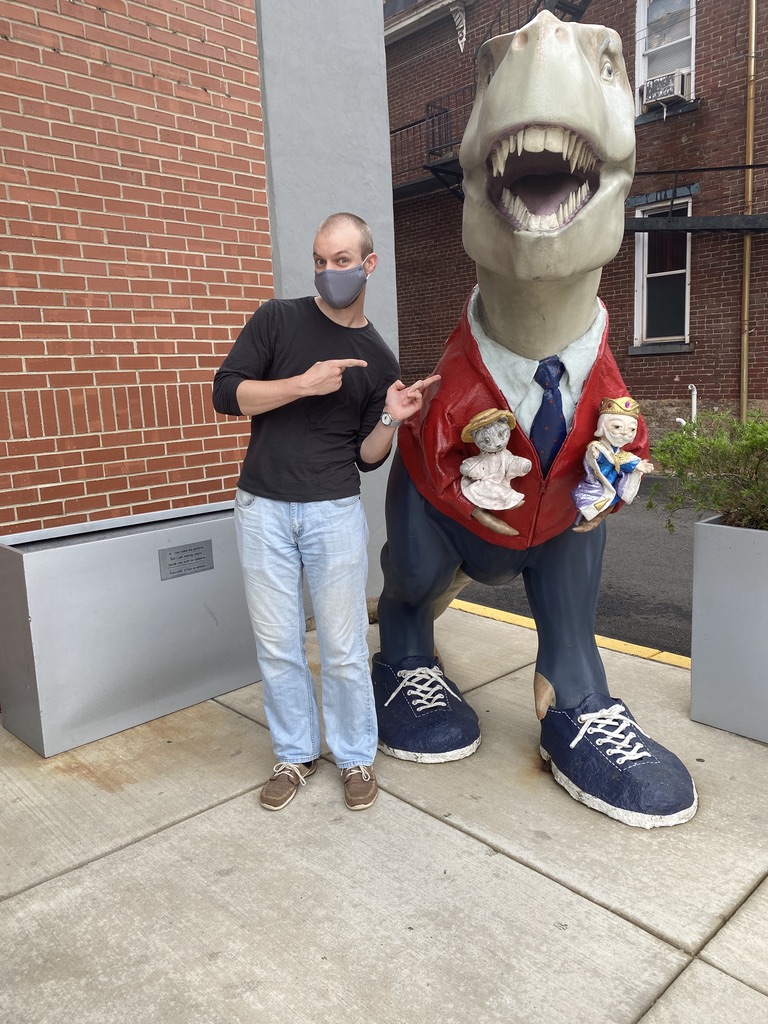
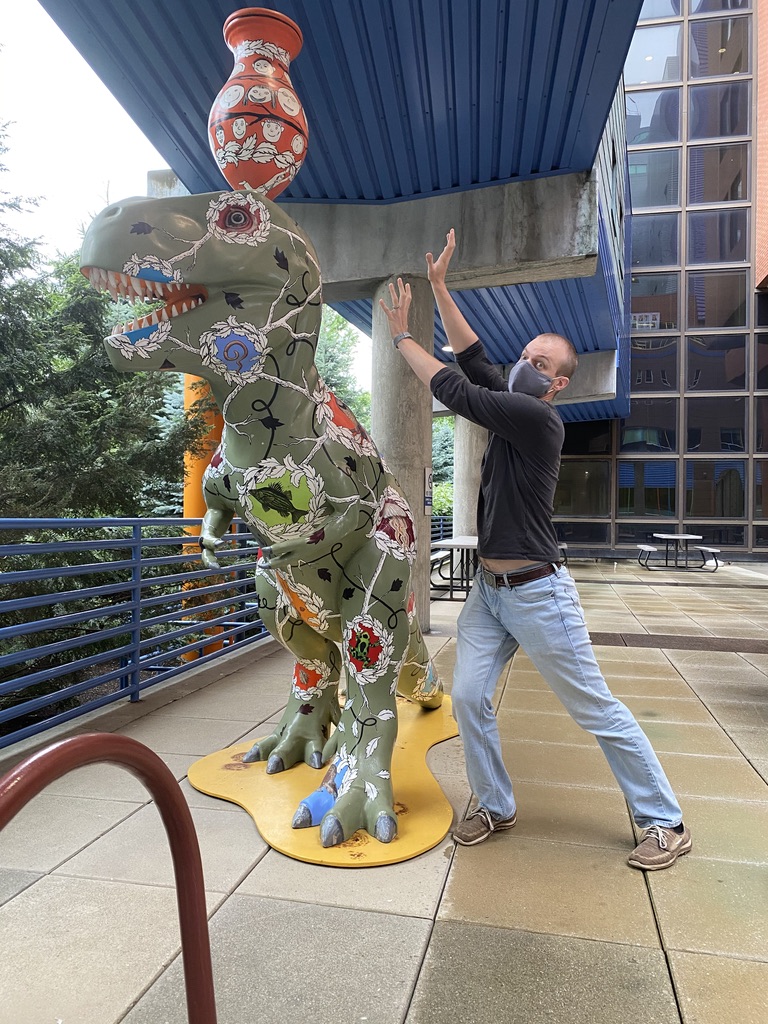
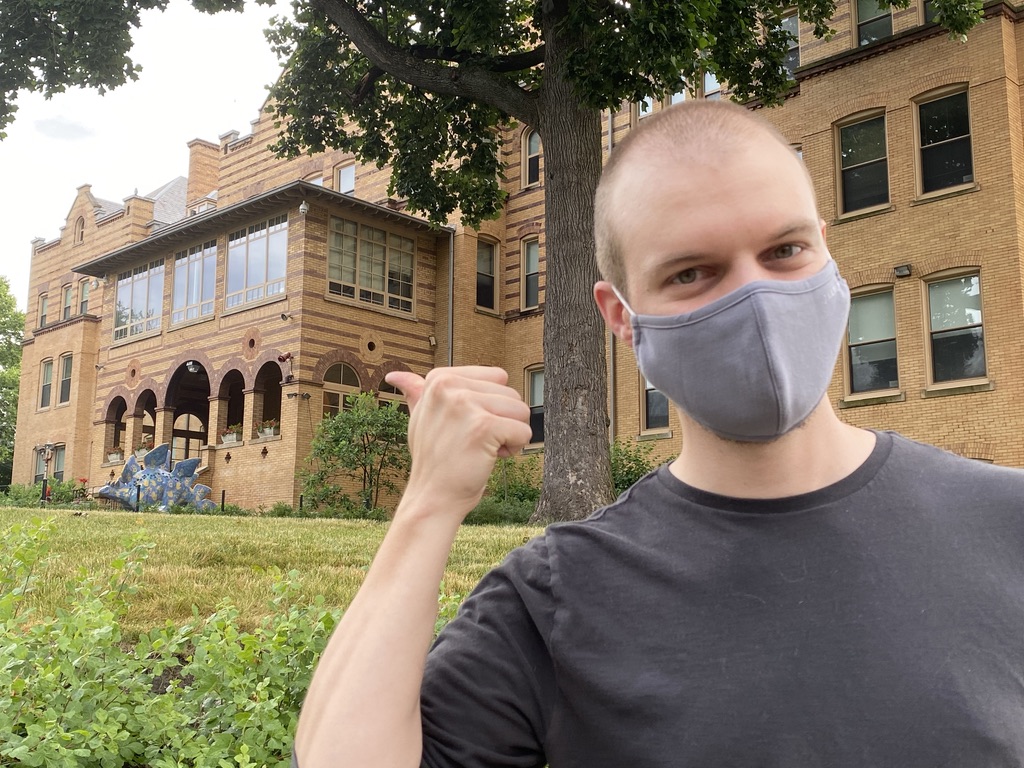
Aaron with Fredosaurus Rex Friday XIII

First Stop: Fredosaurus Rex Friday XIII
Coordinates: 40.429910, -79.975938

This king of the dinosaurs is dedicated to the friendliest neighbor, Mr. Rogers, and is conveniently located at the WQED headquarters on the South Side.  Another Mr. Rogers’ Neighborhood dino lives at the Fred Rogers Center in Latrobe, PA.

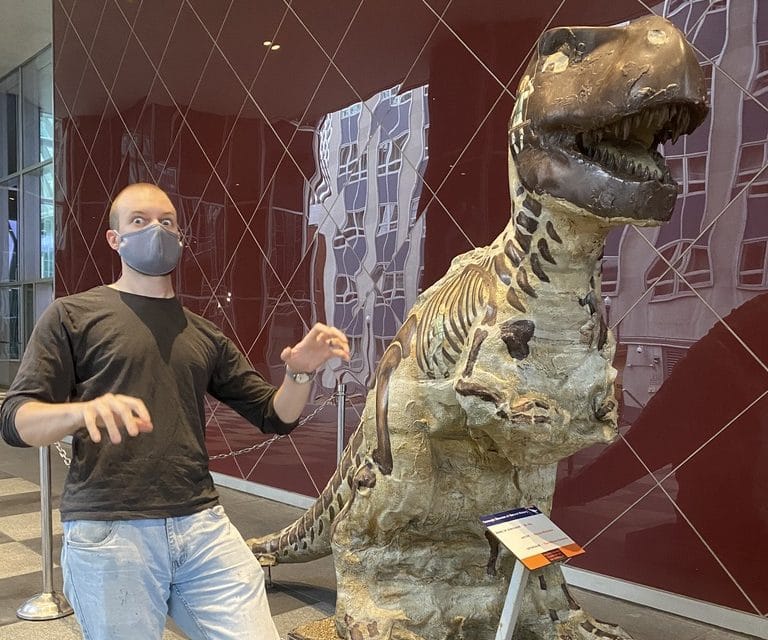
Aaron with Mr. Dig
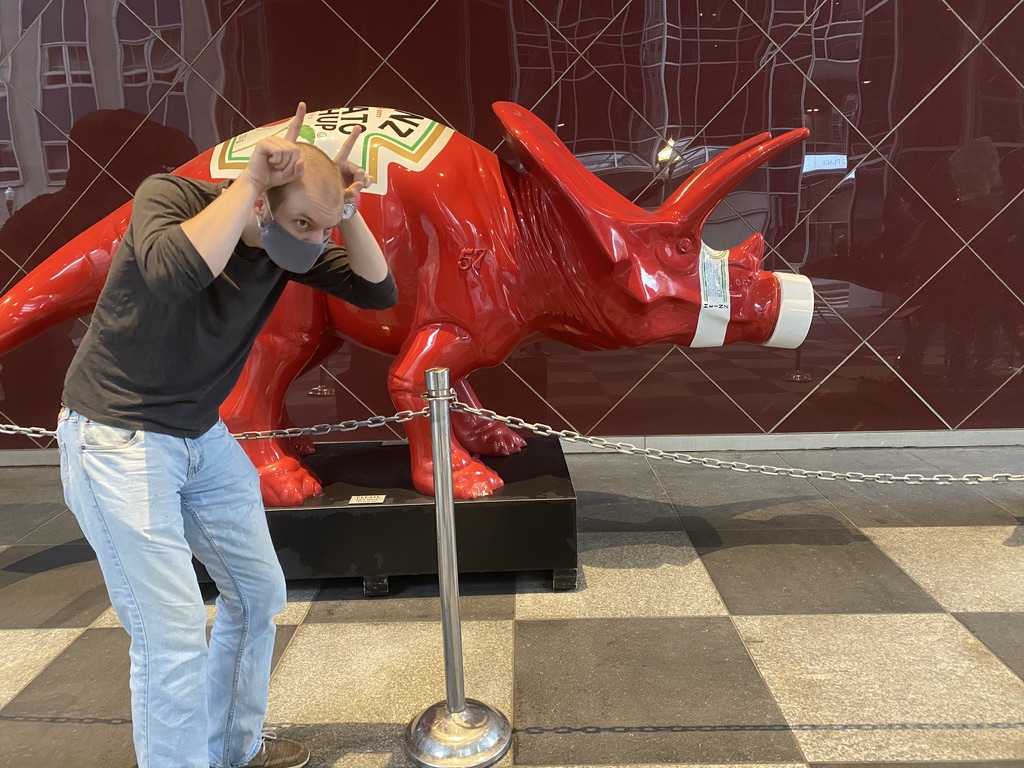
Ketchupsaurus
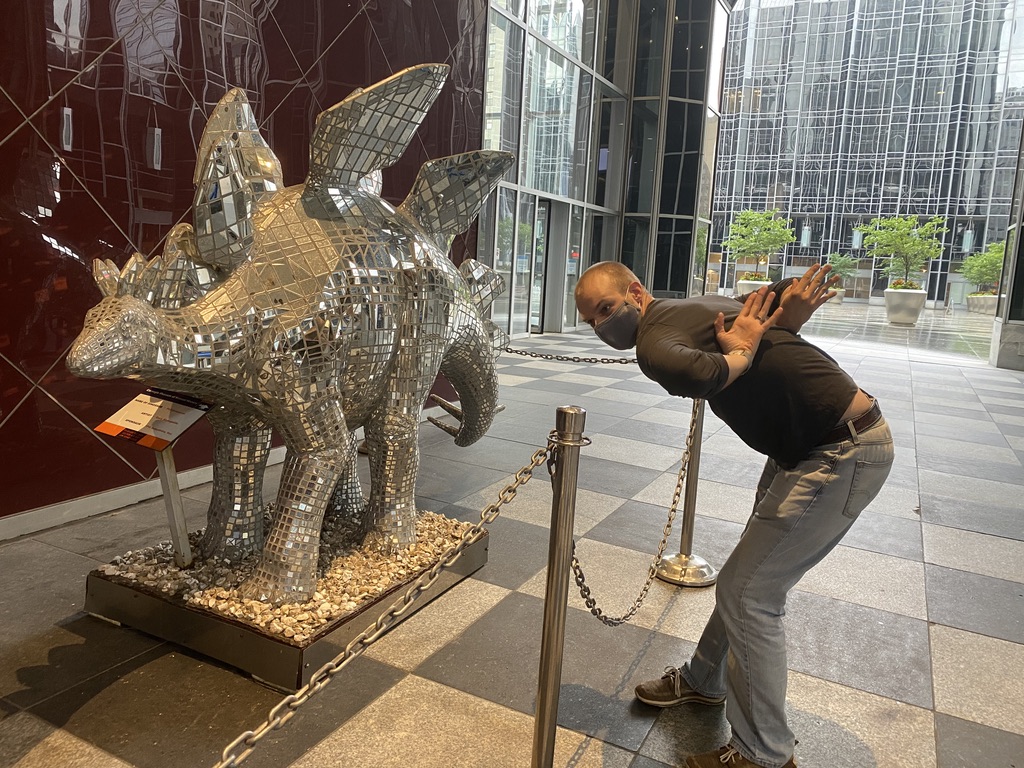
Philliposaurus

Second stop: PPG Plaza Dino Parade
Coordinates: 40.439766, -80.003858

The second stop has all three dinosaur models!  This dino parade is in PPG Plaza and includes Mr. Dig (T. Rex), Ketchupsaurus (Torosaurus), and Philliposaurus (Stegosaurus).  Philliposaurus is named for Phillip Johnson, one of the architects of the PPG Place building.

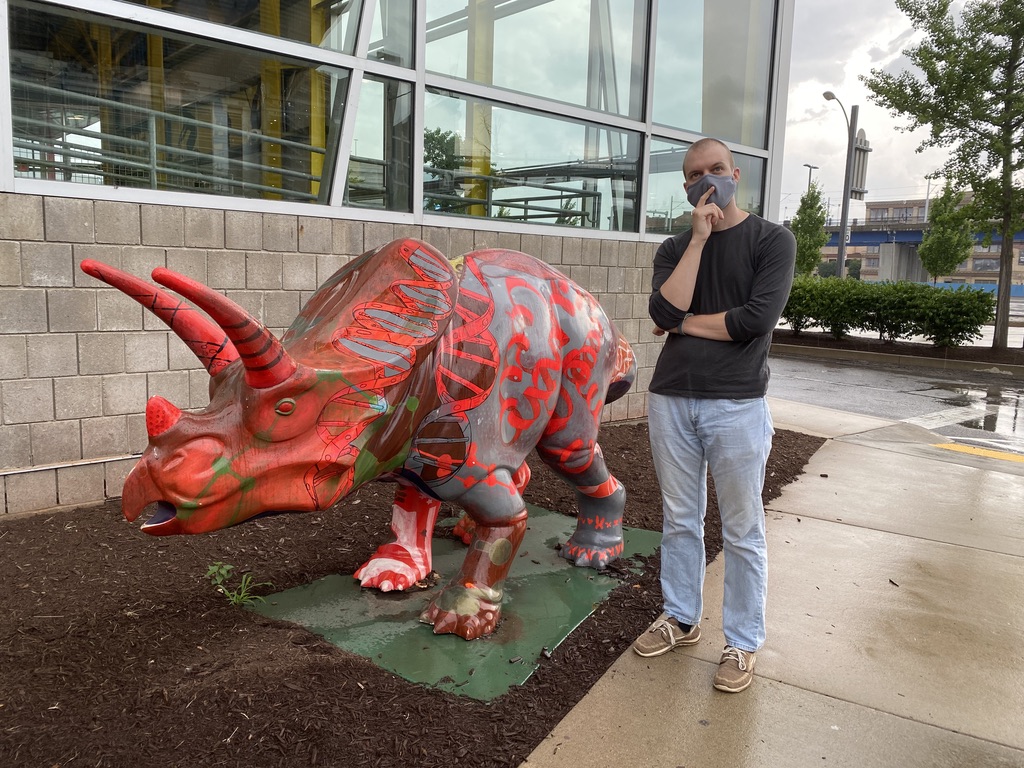
DNAsaurus

Third Stop: DNAsaurus
Coordinates: 40.446468, -80.018495


Our friends at the Carnegie Science Center host DNAsaurus, which is appropriately decorated with DNA strands and chromosomes. Bingo! Dino DNA!

Fourth Stop: Prehistoric Printasaurus
Coordinates: 40.460458, -79.980679

Located on Herrs Island, Printasaurus is a collage of patterns and geometric shapes that make one stylin’ dino.  You can park at Herrs Island North Park and take the Three Rivers Heritage Trail to find this dinosaur placed in a garden at the opposite end of the island.

Connections dinosaur statue

Fifth Stop: Connections
Coordinates: 40.466769, -79.952309

Children’s Hospital has a few dinosaurs, but Connections the T. Rex is visible from the outside.  This dinosaur celebrates the interconnectedness of all life.

Sixth Stop: Formerly Cogitatio Aeterna
Coordinates: 40.458010, -79.930777

This remodeled skeletal dinosaur is appropriately located at the Greater Pittsburgh Orthopaedic Associates building on Centre Avenue.

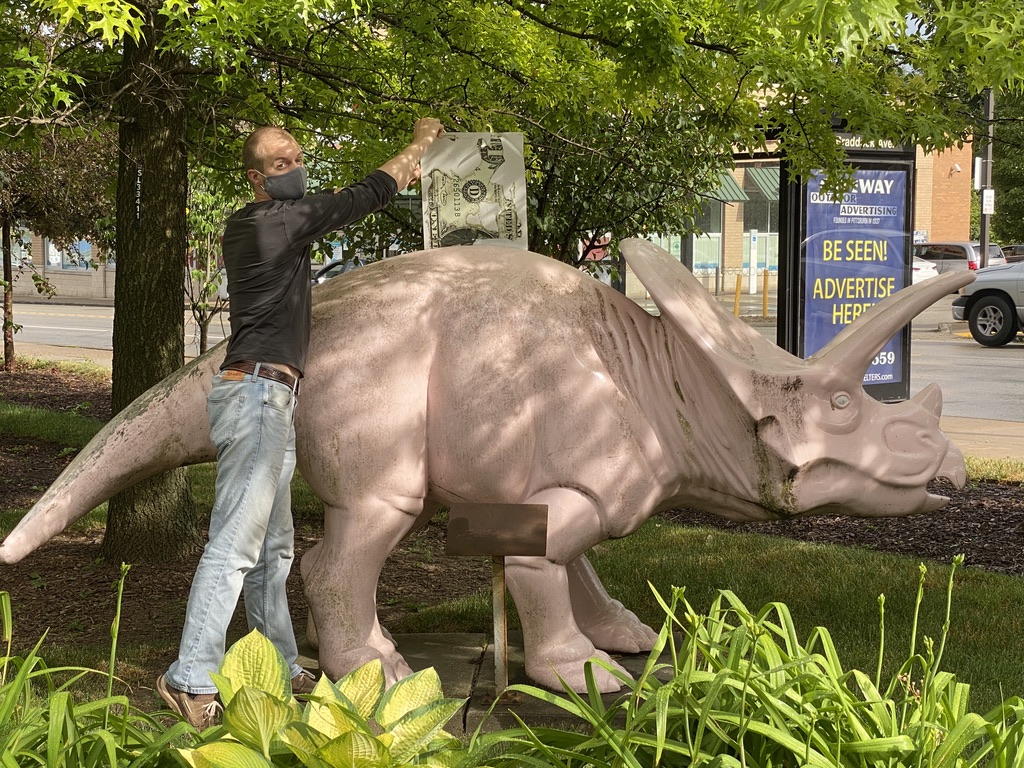
Bill Dollarsaurus

Seventh Stop: Bill Dollarsaurus
Coordinates: 40.447218, -79.894962

On the corner at the Shady Lane School you can find Bill Dollarsaurus.  Bill has a sister named Dolly who lives somewhere in the city.

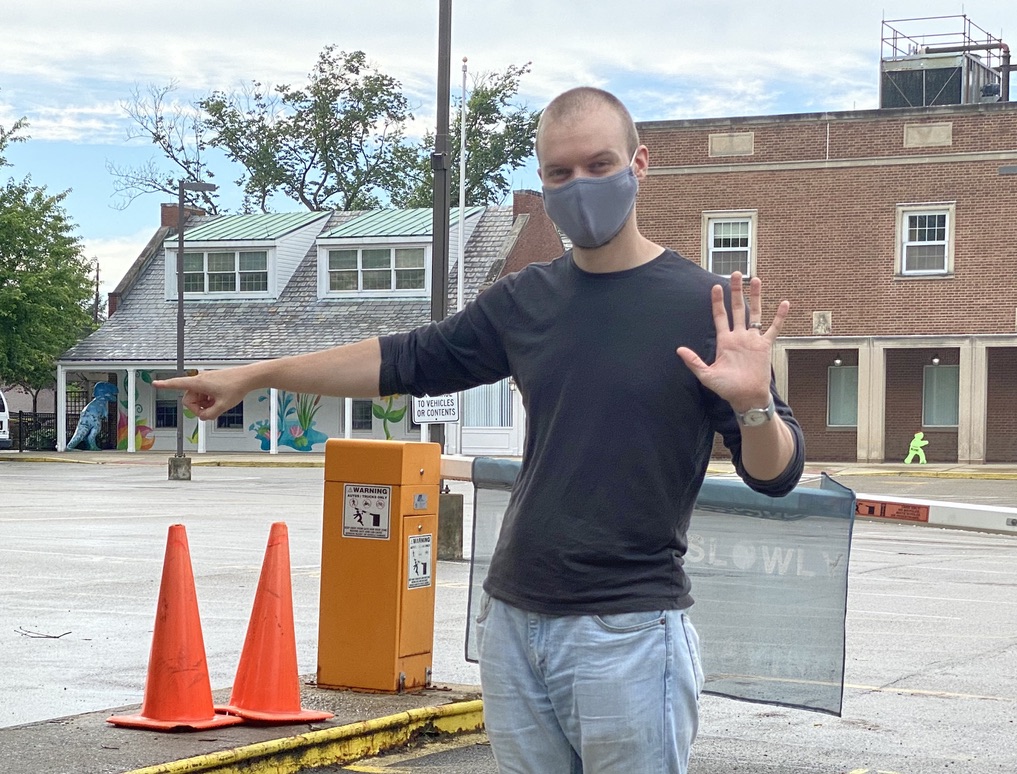
Amazing Hands Dinosaur Statue

Eighth Stop: Amazing Hands
Coordinates: 40.442526, -79.919394

An awesome garden-inspired dinosaur created by children at the Children’s Institute lives at the Squirrel Hill location.  Wave hello to this dinosaur from across the parking lot off of Northumberland Street.

The Children's Institute
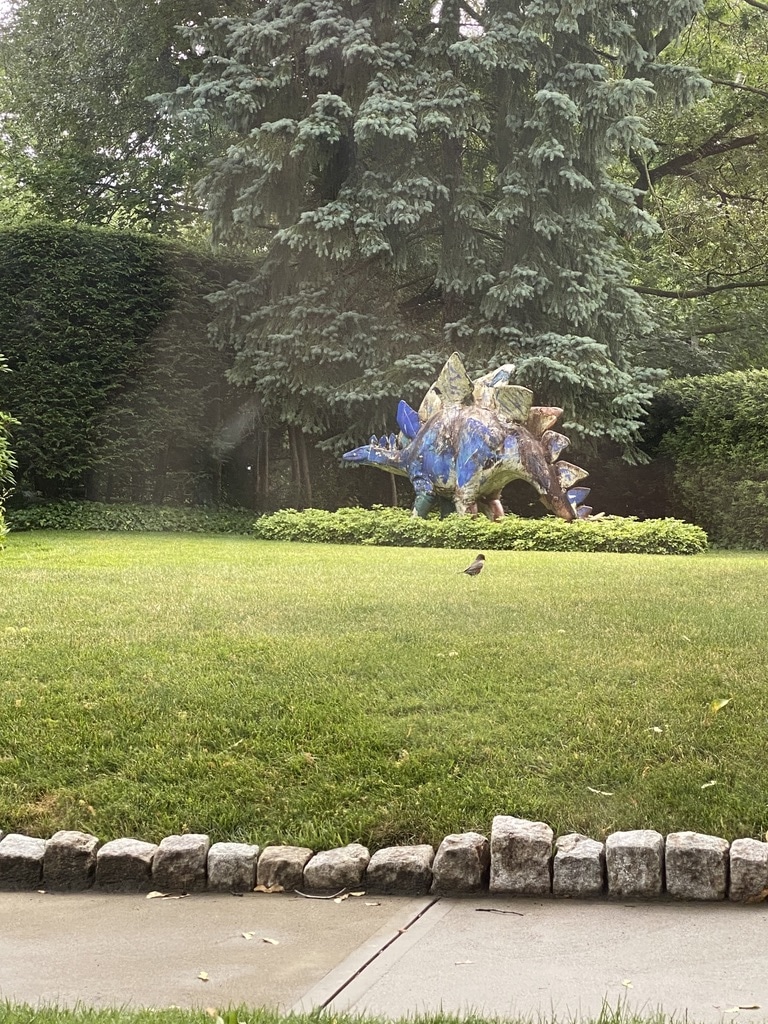
Spectrasaurus

Ninth Stop: Spectrasaurus
Coordinates: 40.450149, -79.945179

This dinosaur is located on private property at the corner of Ellsworth and Devonshire in Squirrel Hill.  Easily visible from the sidewalk, this colorful dinosaur was designed to mimic the bright warning colors of poisonous tree frogs.

Seymour-Sparklesaurus-aka-Sparky

Tenth Stop: Seymour Sparklesaurus “Sparky”
Coordinates: 40.448522, -79.953038

Located at and designed by the Western Pennsylvania School for Blind Children, Sparky features handprints and an oversized braille message: “stegosaurus.”

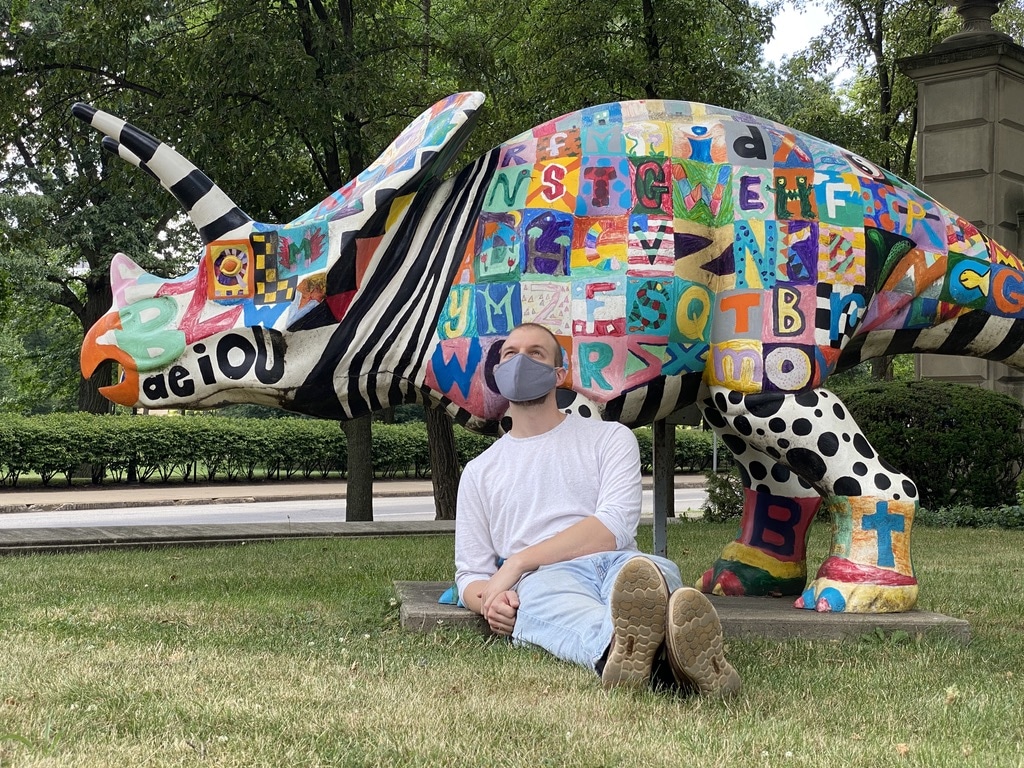
Alphabetosaurus
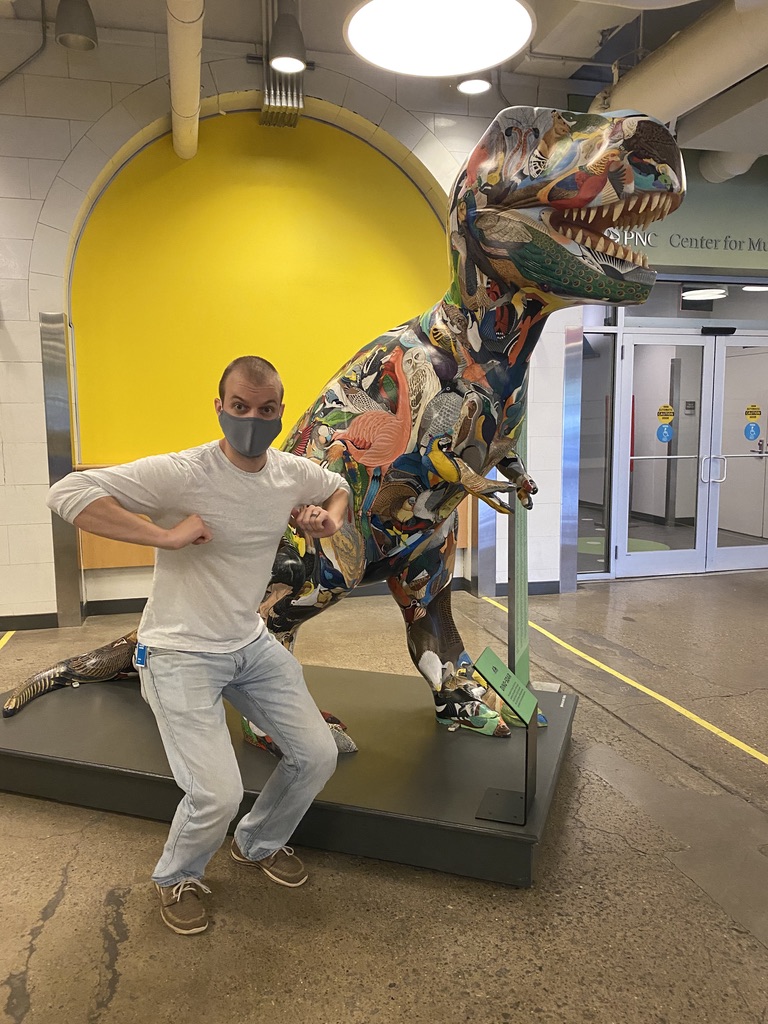
Dino-soar

Last Stop!
Coordinates: 40.443159, -79.949601

The final three dinosaurs on our tour happen to reside near the Carnegie Museum of Natural History (where else would dinosaurs be?).  Alphabetosaurus is across Forbes Avenue from the museum.  Dino-soar is inside of the Portal Entry to the museum and features many beautiful birds including Archaeopteryx, one of the first birds.

And our very last stop is Dippy the Diplodocus.  Though not a part of DinoMite Days, Dippy is a very special life-size model of a Diplodocus and is certainly an inspiring dinosaur statue.  Although all black, Dippy occasionally wears scarves, ties, and hats to fit in with the changing attitude of Pittsburgh.  Right now, Dippy is wearing a mask to help keep everyone safe.

Make sure to tag the Carnegie Museum of Natural History in photos you post to social media!

Written by: Aaron Young, Museum Educator

Filed Under: Blog Tagged With: activities, Jurassic Days

June 18, 2020 by Kathleen

Sensory Bin Idea – Safari Bin

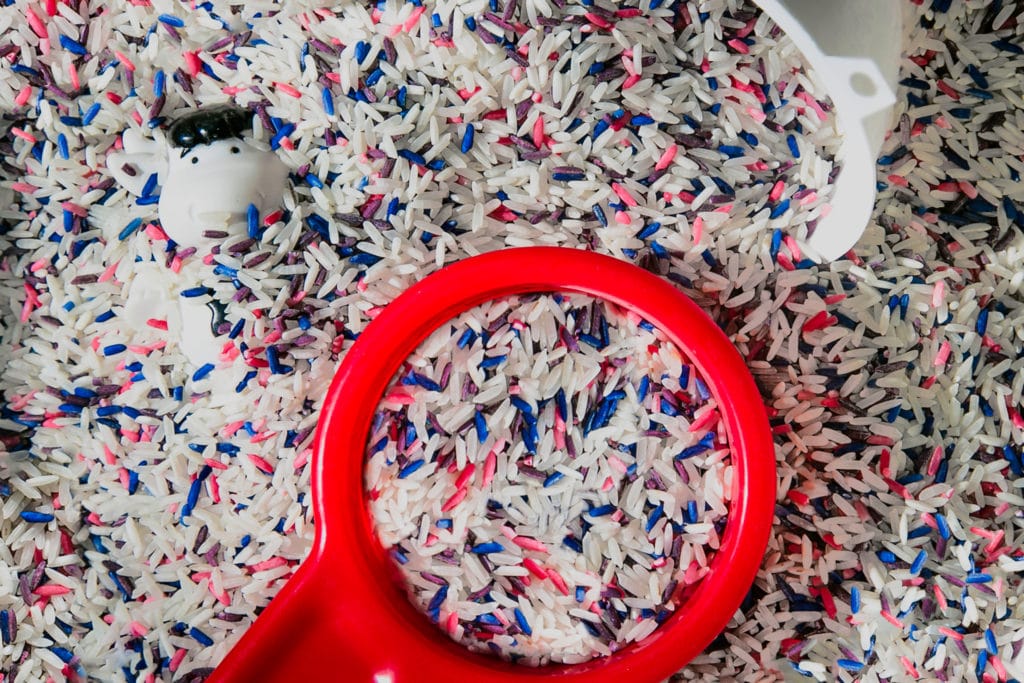
We have a great sensory bin idea for you–create a Safari themed Sensory Bin with materials you have at home!

What is a Sensory Bin?

Sensory bins are great tools for younger children or children who might have sensory processing disorders to experience some relaxed sensory learning activities. For example, a sensory bin might include textures that encourage fun or textures that you might want your child to get used to (like sand perhaps) as well as goaled learning activities, like foam letters or numbers. In this activity, we suggest including toy animals to learn more.

Make a Sensory Bin that resembles the Sahara and fill it with any desert-like materials that may stimulate the senses. This craft lists material examples but you can design a sensory bin to be themed around anything!

Materials Recommended

  • 1 small/medium-sized bin
  • Tongs or measuring cups
  • Rice (different colors/varieties)
  • Small Pebbles/Rocks
  • Fake plants or flowers
  • Any sort of pasta (penne, rigatoni, and elbow work great!)
  • Green or brown play-doh
  • Stuffed animals or small animal toys to recreate your own animal safari
  • A few drops of essential oil that you find pleasant
sensory bin

Directions

  1. Find a medium size bin that can be you can fill with your materials
  2. Fill it with your base, which could be pasta or rice.
  3. Fill with any materials listed above, whatever you think your child would get most excited over! 
  4. Once your bin is filled, use the tongs and measuring cups to help them pick our specific materials like the rocks or pieces of pasta! Pretend you are on a safari and learn about your animals. Get Creative and have fun! 

We’ll be working on more sensory friendly content as soon as we can, find it on our Sensory Friendly Saturdays Page.

Sensory Friendly Saturday

For more activities to complete with your household, check our our Super Science Saturday Page.

Super Science Saturday

Filed Under: Blog Tagged With: activities, Stuffed Animal Safari

June 16, 2020 by Kathleen

Stuffed Animal Safari: Map Activity

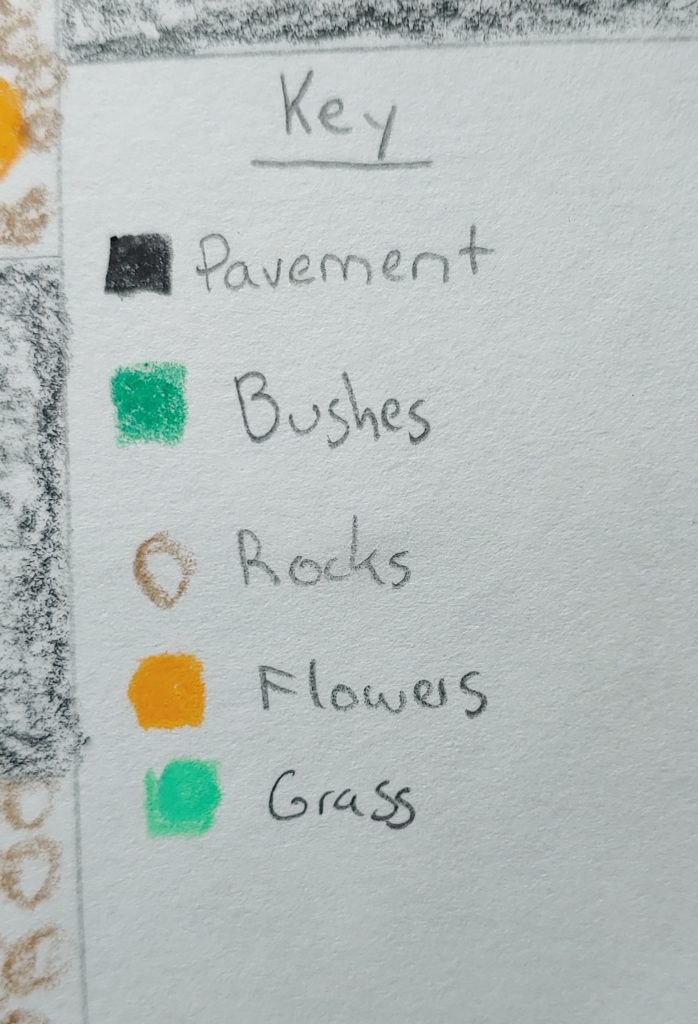
Map Key

key for map of backyard

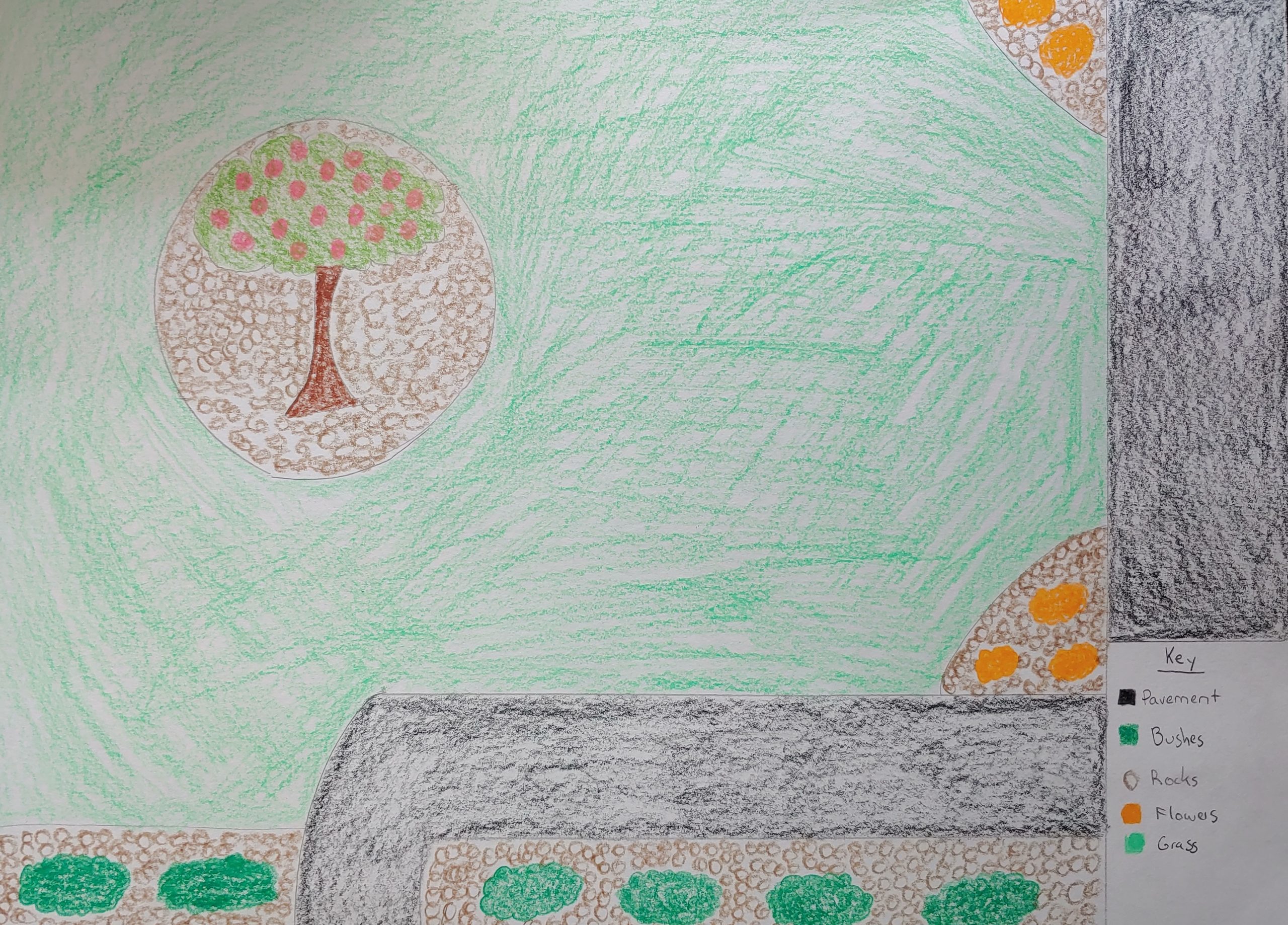
map of backyard
Click on the image to enlarge our example of our backyard map!

Materials Needed:

  • Paper
  • Something to write with
  • Something to color with
  • Scissors (optional)

Use those materials to create a map of an outside space. It can be your yard, your neighborhood, even your city, or state! You can draw your map from memory or by exploring outside.

You can make your map interactive! If your environment changes you can update your map. Or if you want to track when and where animals are visiting, try drawing and cutting out a symbol that you can attach or remove!

A map key will help you, and others, understand your map. A key is a little guide that explains what the different symbols or colors represent.

Why is mapping important?

Mapping increases your understanding of your own environment and improves your sense of place. Sense of place is the attachment you feel to your surroundings. By sitting down to map out what is around you, you are using your senses to experience the world and thinking about what you are experiencing.

Maps can often reveal what is most important to you. For example, my map features the cherry tree in my front yard because I love watching birds land on it and squirrels climb it. Even though it isn’t in bloom this late in the year, I drew cherry blossoms because I love seeing the pretty flowers. Your map may include your sandbox, swingset, or whatever is most important to you!

Participatory Mapping

For a different challenge, you can work together as a family or household to make one map that everyone creates together. Just like a map you create by yourself, a map made by a group can show what is important to everyone. Participatory maps are even used by cities and towns to discover what their citizens find most important about their environment!

What do maps mean for safaris?

Safari guides will use maps to navigate as they take people to explore. Those maps may show where animals are typically found, what areas are dangerous and should be avoided, and other important landmarks. Those maps will exist because someone explored or remembered their environment and created them, just like your map!


Filed Under: Blog Tagged With: activities, Crafts, Stuffed Animal Safari, Super Science Days

  • « Go to Previous Page
  • Page 1
  • Page 2
  • Page 3
  • Page 4
  • Page 5
  • Go to Next Page »

sidebar

About

  • Mission & Commitments
  • Directors Team
  • Museum History

Get Involved

  • Volunteer
  • Membership
  • Carnegie Discoverers
  • Donate
  • Employment
  • Events

Bring a Group

  • Groups of 10 or More
  • Birthday Parties at the Museum
  • Field Trips

Powdermill

  • Powdermill Nature Reserve
  • Powdermill Field Trips
  • Powdermill Staff
  • Research at Powdermill

More Information

  • Image Permission Requests
  • Science Stories
  • Accessibility
  • Shopping Cart
  • Contact
  • Visitor Policies
One of the Four Carnegie Museums | © Carnegie Institute | Privacy Policy | Terms of Use | Accessibility
Rad works here logo