• Skip to primary navigation
  • Skip to main content
  • Skip to primary sidebar

Carnegie Museum of Natural History

One of the Four Carnegie Museums of Pittsburgh

  • Visit
    • Buy Tickets
    • Visitor Information
    • Exhibitions
    • Events
    • Dining at the Museum
    • Celebrate at the Museum
    • Powdermill Nature Reserve
    • Event Venue Rental
  • Learn
    • Field Trips
    • Educator Information
    • Programs at the Museum
    • Bring the Museum to You
    • Guided Programs FAQ
    • Programs Online
    • Climate and Rural Systems Partnership
  • Research
    • Scientific Sections
    • Science Stories
    • Science Videos
    • Senior Science & Research Staff
    • Museum Library
    • Science Seminars
    • Scientific Publications
    • Specimen and Artifact Identification
  • About
    • Mission & Commitments
    • Directors Team
    • Museum History
  • Tickets
  • Give
  • Shop

Blogs about the Anthropocene

Scientists use fossils and other traces to understand how the planet changed over time. In the past these changes were caused by forces like volcanic eruptions and shifts in oceans currents. Now there’s a new force of nature shaping the planet: humans. The effects on air, land, and water are significant enough that scientists propose we are a new geological time – the Anthropocene – or age of Humans.

These blogs are about the many facets of human impact on the Earth, documenting this new age.

October 27, 2022 by

We Are Nature Podcast

Season two out now!

We Are Nature thumbnail in black and yellow

The We Are Nature podcast features stories about natural histories and livable futures presented by Carnegie Museum of Natural History. Host Michael Pisano, a Science Storyteller, and invited guests discuss how humans can create–and are already working towards–a livable, just, and joyous future. 

Season one, which premiered in October 2022, centers on collective climate action through 30 interviews with museum researchers, organizers, policy makers, farmers, and science communicators about climate action in Southwestern Pennsylvania. Guests include Radiolab’s Jad Abumrad, US Representative Summer Lee, and Daniel G. and Carole L. Kamin Director of Carnegie Museum of Natural History Gretchen Baker, among others. 

Season two delves deep into Carnegie Museum of Natural History’s collection of more than 22 million objects and specimens. Fourteen Carnegie Museum of Natural History experts as well as special guests from Three Rivers Waterkeeper and the Royal Ontario Museum discuss collection items as windows into the science and ethics of the Anthropocene, a term for our current age, defined by human activity that is reshaping Earth’s climate and environments. What’s more, museum visitors will have the chance to hear clips from and see some of the objects discussed in episodes from season two inside our newest exhibition, The Stories We Keep: Bringing the World to Pittsburgh. 

Listen to Season 1 and Season 2 of the podcast below or on major podcast platforms including Apple and Spotify.


Season 1

Episode 1: This is an Emergency, Not an Apocalypse (with Jad Abumrad)

Release date: October 26, 2022

Why is it so hard to talk about climate change without plunging into an anxious doomscroll? How can we change the ways that we talk about the story of life on earth to emphasize hope over despair, and collaboration over competition? Featuring Radiolab’s Jad Abumrad and Nicole Heller, Associate Curator of Anthropocene Studies for Carnegie Museum of Natural History.


Bonus Episode: We Can Fix This

Release date: October 31, 2022

A behind-the-scenes chat between Taiji Nelson, Senior Program Manager for the museum’s Climate and Rural Systems Partnership (CRSP) and podcast producer, and Michael about effective climate change communication, plus our goals, hopes, dreams, and terrors for this first season.


Episode 2: Steel City (with Summer Lee)

Release date: November 4, 2022

Why should Pittsburghers care about climate change? What’s happening in our backyard, and how does it connect to the big picture? U.S. Representative Summer Lee joins us to talk about environmental racism, intersectional climate justice, and much more. Host Michael pops in and out with the natural history (and livable future?) of steel.


Episode 3: Carbon and Cattle

Release date: November 11, 2022

Monoculture is messing up the climate. Befriending biodiversity–especially in the soil– can help! Featuring interviews with Michael Kovach (Regenerative Farmer & President of the PA Farmers Union) and Dr. Bonnie McGill (an Ecosystem Ecologist).


Episode 4: Coal Country

Release date: November 18, 2022

There are less than 5,000 coal jobs left in the state of Pennsylvania, and that number is shrinking. That’s good news for the climate, but what’s next for the commonwealth’s coal communities? Join organizers from the Mountain Watershed Association for insight on building community, protecting public health, and creating new opportunities. Plus, the natural history of coal, water quality watchdogging, and much, much more! Featuring Ashley Funk, Executive Director of Mountain Watershed Association; Stacey Magda, Community Organizer with Mountain Watershed Association; and Eric Harder, Youghiogheny Riverkeeper with Mountain Watershed Association.


Episode 5: Mining and Microbes

Release date: November 25, 2022

Carla Rosenfeld, Assistant Curator of Earth Sciences at Carnegie Museum of Natural History, studies how pollutants and nutrients behave in environments like abandoned minelands, of which Pennsylvania has many. We chat about interspecies collaboration, soil science, the importance of diversity, and much more.


Episode 6: Bridges and Bivalves

Release date: December 2, 2022

Some freshwater mussels can live for over 100 years! During that time, they filter water and improve aquatic ecosystems. Today’s episode is about how aquatic life intersects with the human world. We’ll learn about everything from mussel charisma to climate-proofing infrastructure. Featuring Eric Chapman, Director of Aquatic Science at the Western PA Conservancy.


Episode 7: Food is Nature

Release date: December 9, 2022

Our globalized food system is already feeling the impacts of climate change. Today’s episode shows how decentralizing that food system can help us both be more resilient to extreme weather, and lessen industrial agriculture’s harmful effects. Featuring interviews with urban farmers at Braddock Farms.


Episode 8: Teens in the Wild

Release date: December 16, 2022

By taking care of greenspace, we care for ourselves. Hear about best practices for getting young people involved in land stewardship, and about how fostering a relationship with the outdoors is essential climate action. Featuring Naturalist Educator Nyjah Cephas and two of her students from the Pittsburgh Parks Conservancy’s Young Naturalists program.


Episode 9: Empowerment, Employment, Environment

Release date: January 6, 2023

How are labor and climate related? Today’s episode is all about supporting workers as the climate changes, and about work that supports climate action. Learn about labor history, a just transition, doughnuts and degrowth. Featuring Landforce’s Executive Director Ilyssa Manspeizer and Site Supervisor Shawn Taylor.


Episode 10: Greenways

Release date: January 13, 2023

Tiffany Taulton is a climate policy expert, community organizer, professor of environmental justice, and one of the authors of Pittsburgh’s Climate Action Plan. She joins the show to talk about how our region is preparing for climate change, how that resilience benefits public health, and how climate action can embrace justice and equity.


Episode 11: A Conservation Conversation

Release date: January 20, 2023

Biodiversity is key to our resilience as the climate changes. Our guest today is Conservation Biologist Charles Bier, Senior Director of Conservation Science at the Western Pennsylvania Conservancy. Charles has nurtured a deep relationship with Pennsylvanian nature since he was a six-year-old walking around with snakes in his pockets, and has spent his career trying to preserve our wonderful woods, wetlands and waterways.


Episode 12: Bee Kind

Release date: January 27, 2023

Bugs make the world go around. Well, bugs and fungi. And bacteria. And algae. And…ok, it’s all important. We humans rely on many tiny neighbors, and now more than ever, their future relies on us. Come along on a visit to Pittsburgh’s Garfield Community Farm, and travel back to the Cretaceous to learn about the origins of flowers. Featuring the farm’s Community Engagement Coordinator AJ Monsma, youth farmer Israel, and Israel’s friend Tommy the Bee.


Episode 13: We Are the Future

Release date: February 10, 2023

On today’s show, the last episode of Season 1, we look ahead at possible futures. Join us in imagining a planet with space and dignity for all earthlings. Featuring Daniel G. and Carole L. Kamin Director of Carnegie Museum of Natural History Gretchen Baker, Curator of Anthropocene Studies Nicole Heller, and Educator Taiji Nelson from Carnegie Museum of Natural History.


Season 2

Episode 1: A Thin Dusting of Plutonium

Release date: November 7, 2025

What is the Anthropocene, and when might it have started? What is the great acceleration? Can we expect, or engineer, a great deceleration? What can we learn from nuclear history about nuclear futures? Featuring Travis Olds, Assistant Curator of Minerals at Carnegie Museum of Natural History, and Nicole Heller, Associate Curator of Anthropocene Studies at Carnegie Museum of Natural History. Encounter Trinitite glass, mentioned in this episode, in the exhibition The Stories We Keep: Bringing the World to Pittsburgh.


Episode 2: Experimental Archaeology

Release date: November 14, 2025

What do we know about the early peopling of our continent and our region? What was the landscape and the climate like then? What can we learn from this natural history about interacting with the land and water today, and moving forward as good stewards? Featuring Amy Covell-Murthy, Archaeology Collection Manager and Head of the Section of Anthropology at Carnegie Museum of Natural History, and Kristina Gaugler, Anthropology Collection Manager at Carnegie Museum of Natural History.


Episode 3: The Institute of Insect Technology

Release date: November 21, 2025

What surprising biodiversity lives alongside us here in Pittsburgh? How can we befriend bugs? What could be awesome about having humans as neighbors? Featuring Ainsley Seago, Associate Curator of Invertebrate Zoology at Carnegie Museum of Natural History, and Kevin Keegan, Collection Manager of Invertebrate Zoology at Carnegie Museum of Natural History.


Episode 4: Hell Chicken Extinction

Release date: December 5, 2025

What dinosaurs and mammals survived the end of the Cretaceous, and why? What can we learn about resilience from survivors of past extinctions? What can we learn about adapting our culture and cities from the story of evolution? Featuring Matt Lamanna, Mary R. Dawson Curator of Vertebrate Paleontology at Carnegie Museum of Natural History, and John Wible, Curator of Mammals at Carnegie Museum of Natural History.


Episode 5: Loss in Lutruwita

Release date: December 12, 2025

A second serving of bone banter with two of the museum’s veteran vertebrate virtuosos. How are charisma, colonialism, and extinction linked? What is de-extinction, and will cloning mammoths save the tundra? Featuring Matt Lamanna, Mary R. Dawson Curator of Vertebrate Paleontology at Carnegie Museum of Natural History, and John Wible, Curator of Mammals at Carnegie Museum of Natural History.


Episode 6: Herbaria for Humanity

Release date: December 19, 2025

How do humans support some plants and endanger others? What do herbaria teach about climate change? How can people and plants collaborate towards livable futures? Featuring Mason Heberling, Curator of Botany at Carnegie Museum of Natural History, and Bonnie Isaac, Collection Manager of Botany at Carnegie Museum of Natural History.


Episode 7: A Real Good Slime

Release date: December 26, 2025

What would a snail scientist do with a blank check? What can we learn from snails and their kin? Why is the ocean getting more acidic, how do we know, and why does that matter? Featuring Tim Pearce, Curator of Mollusks at Carnegie Museum of Natural History.


Episode 8: Dirty Birds

Release date: January 2, 2026

How does urbanization impact nonhumans? What can we learn from Pittsburgh’s past and present air quality challenges? How do we make space for biodiversity in cities? Featuring Serina Brady, Collection Manager of Birds at Carnegie Museum of Natural History, and Jon Rice, Urban Bird Conservation Coordinator at Carnegie Museum of Natural History.


Episode 9: Jar of Frogs

Release date: January 9, 2026

Why is the museum hoarding alcoholic pickle jars? What kinds of research are made possible by the museum’s herpetology collection? How are organisms changing because of climate change, urbanization, and other anthropogenic pressures? Featuring Jennifer Sheridan, Associate Curator of Amphibians and Reptiles at Carnegie Museum of Natural History. Encounter frog specimens from Borneo mentioned in this episode in the exhibition The Stories We Keep: Bringing the World to Pittsburgh.


Episode 10: A Very Important Popsicle

Release date: January 16, 2026

What can we learn from lakes about livable futures? How can people in the Anthropocene find optimism and be moved to climate action? Featuring Soren Brothers, the Allan and Helaine Shiff Curator of Climate Change at the Royal Ontario Museum.


Episode 11: Pellets, Pellets Everywhere

Release date: January 23, 2026

What are plastics and how are they made? How do they get into our waterways? How do novel materials like plastics define the age we live in? What materials might replace them? Featuring Nicole Heller, Curator of Anthropocene Studies at Carnegie Museum of Natural History, and Heather Hulton VanTassel, Executive Director of Three Rivers Waterkeeper. Encounter nurdles, small plastic pellets, mentioned in this episode in the exhibition The Stories We Keep: Bringing the World to Pittsburgh.

Credits

Host, Writer, and Editor: Michael Pisano
Assistant Editor: Garrick Schmitt
Audio Recording: Matthew Unger and Garrick Schmitt
Voice Talent: Mackenzie Kimmel
Music: DJ Thermos
Producer: Nicole Heller
Producer: Sloan MacRae
Producer and Co-host (season one): Taiji Nelson
Field Reporters (season one): Di-ay Battad, David Kelley, and Jamen Thurmond
Filed Under: Uncategorized Tagged With: Anthropocene, climate, climate action, climate change, conservation, justice, nature, podcast, We Are Nature

July 8, 2022 by Erin Southerland

Messages in Tardigrade Plastic Time Capsules

by Asia Ward
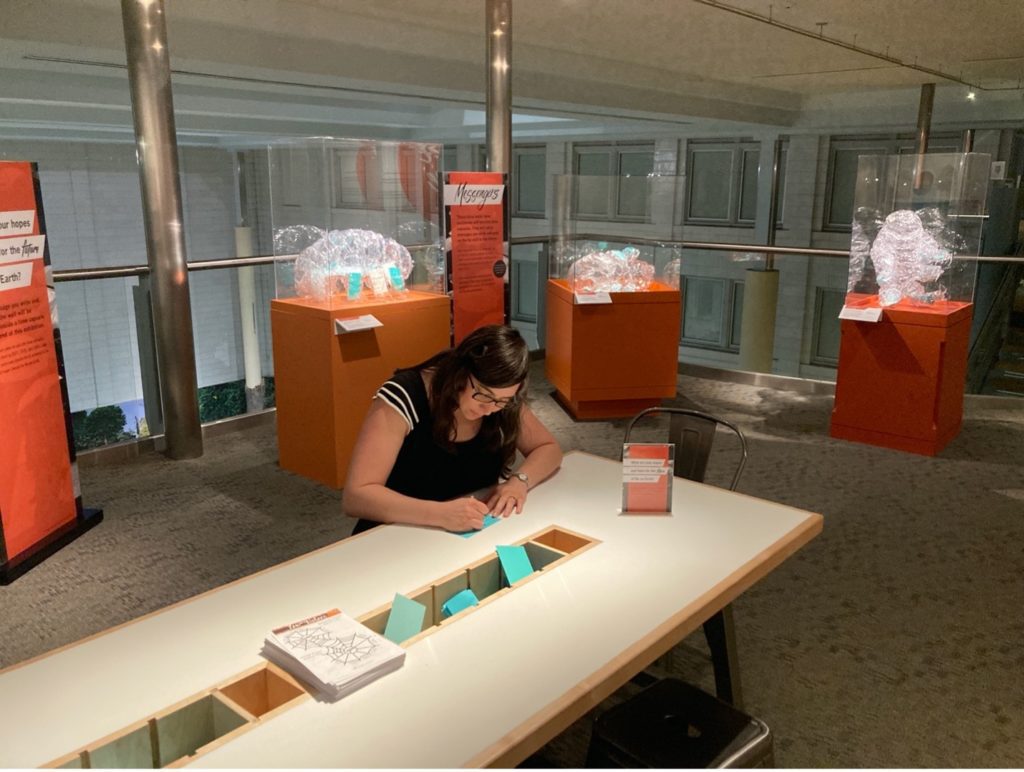
Person sitting at a table writing
Messengers, time capsule installation by Asia Ward. Photo by Joe Grigar. 2022

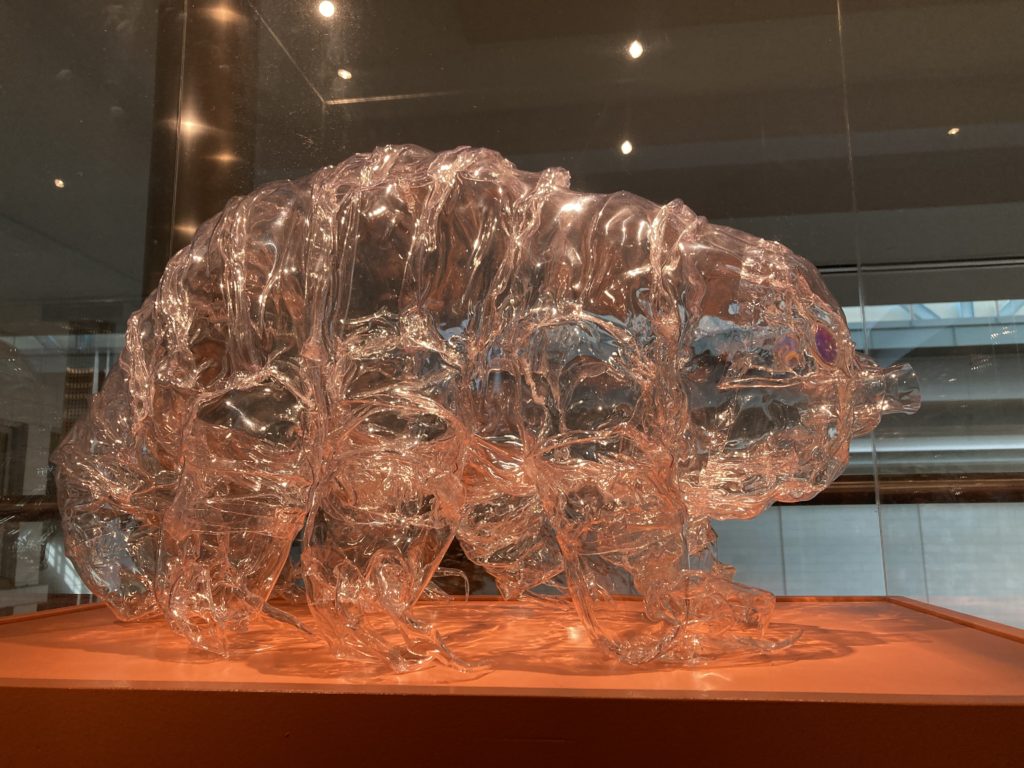
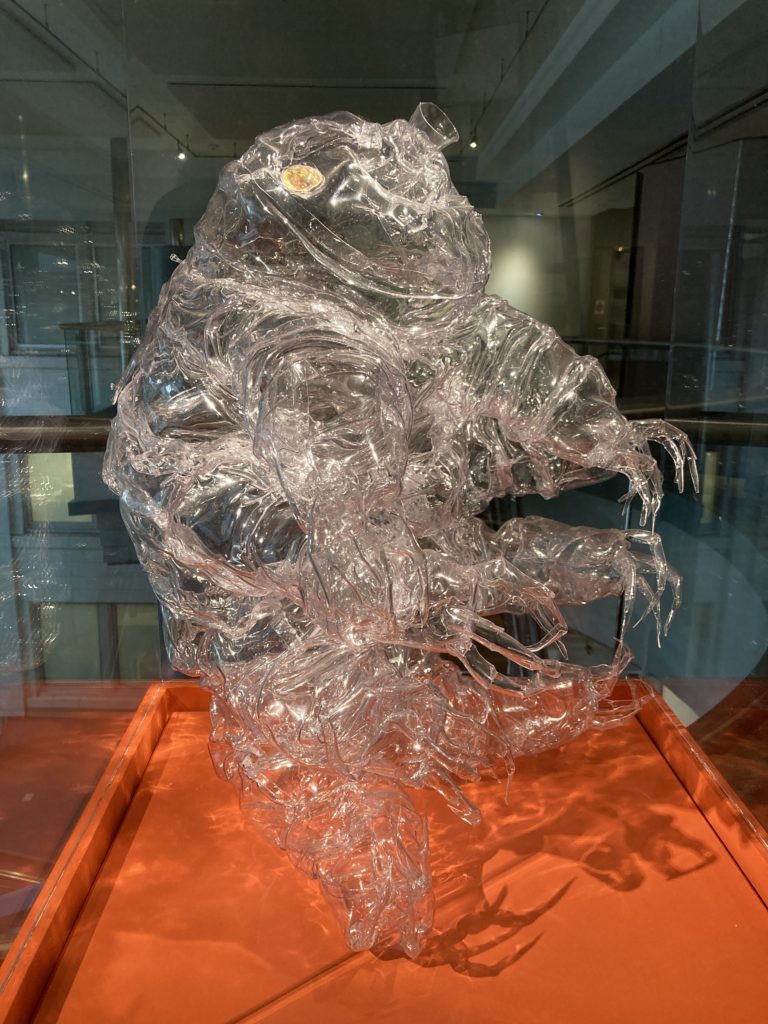
Have you seen the Tardigrade-shaped time capsule installation titled Messengers on the third-floor balcony in the Carnegie Museum of Natural History? I am the artist who fabricated those for the We Are Nature: A New Natural History exhibit experience.  My name is Asia Ward, and I’m a social practice and public sculpture artist who is also the Project Manager and Science Communicator for the We Are Nature project. 

Sometimes my two careers combine, as occurred during the time capsule interactive art installation. I was invited to contribute an art installation for the exhibition by Nicole Heller, the Associate Curator for Anthropocene Studies, and director of the We Are Nature project.

In my 14-year career as a science communicator for other organizations, I have worked with museums on prototyping interactive exhibits. The experience of contributing an art piece to a project I was also managing allowed me to get supporting departments involved in thinking about what an art installation could be. I generated the ideas for an interactive exhibit, and through group discussions and brainstorming with colleagues in the Education, Exhibition, Anthropology, and Anthropocene Studies departments, the final project concept was shaped. I then went to work sculpting large versions of Tardigrades out of recycled thermal plastic. Three time capsules were created as repositories for visitors’ thoughts about conditions in 2027, 2025, and 2095, years chosen for their potential to be a time of major change for life on Earth.

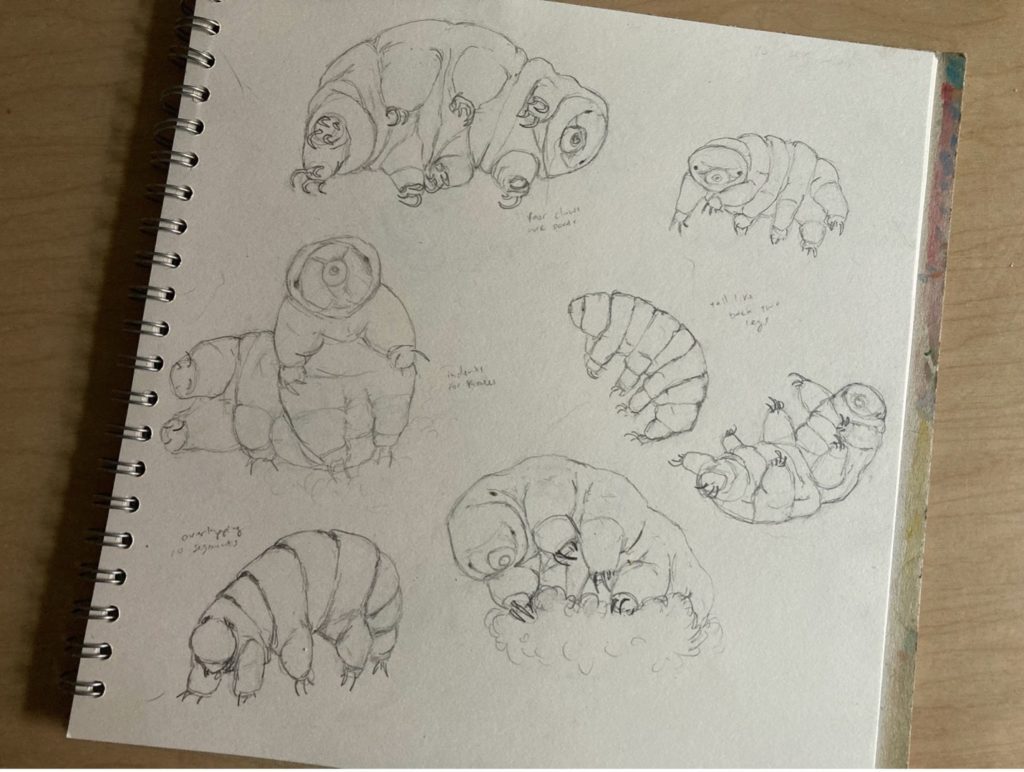
I created the Tardigrades to be transparent and hollow, with doors for the deposit of visitor messages. The installation runs from November 2021 until November 2022, and so far, out of all the interactive installations I have created, this has proven to be the most successful and the most surprising. 

sketches of tardigrades
Tardigrade sketches for Messengers, by Asia Ward. Photo by Asia Ward. 2022

Why Tardigrades? 

Tardigrades, otherwise known as “Water bears” or “Moss Piglets” because of their 8-legged chubby resemblance of key features on bears or pigs, are well known around the globe for their survival skills. I can’t seem to do research on them without finding some new fantastic feat they’ve conquered, like being frozen for 30 years and brought back to life, or failing to survive impact from a crashed rocket on the moon. 

Tardigrades, which compare in size with a tiny rice grain, are microscopic creatures found almost everywhere on Earth, from your backyard to the top of a volcano or the ocean. 

I’ve found them by gathering some lichen from my backyard, soaking a section of lichen in water, and then examining the fluid under a microscope, and BAM! There they are, crawling around eating and pooping. I think they’re weirdly cute and very accessible. If you’re interested, there are some instructions online for doing your own research. 

I think what’s most inspiring about Tardigrades is how they have evolved to go into what is termed a tun state, becoming a dehydrated looking blob in a state of suspended animation in order to survive harsh environmental change, and then rehydrating when the environment is more to their liking. For these creatures, whose average life span is three to four months for some species, and a little more than 2 years for others, the ability to press “Pause” when things get tough, is unique. From my interpretation, the tardigrade’s time traveling ability makes them perfect messengers for future Earth. 

tardigrade sculpture
Two of three Tardigrades in Messengers, by Asia Ward. Photo by Asia Ward. 2022

Time Capsules as an Interactive Exhibit to Process the Anthropocene

Before the time capsules were fabricated, the installation required some thought as to how visitors could best approach the time capsules and feel invited to contribute a message for the future. I worked with the Exhibitions staff for a year to prototype different prompts and test their effectiveness on the floor with visitors. In collaborating with different departments, we realized that the Hub, where Messengers is located, should be a space where visitors can process what they’ve learned and express their feelings about the Anthropocene. The term Anthropocene is the name of the proposed current geological epoch when human activities dominate the functioning of the planetary system. This distinct geological time period is what We Are Nature: A New Natural History explores, using new interpretive panels in 15 existing exhibit areas and related art installations as focus points to help visitors learn more about the topic. 

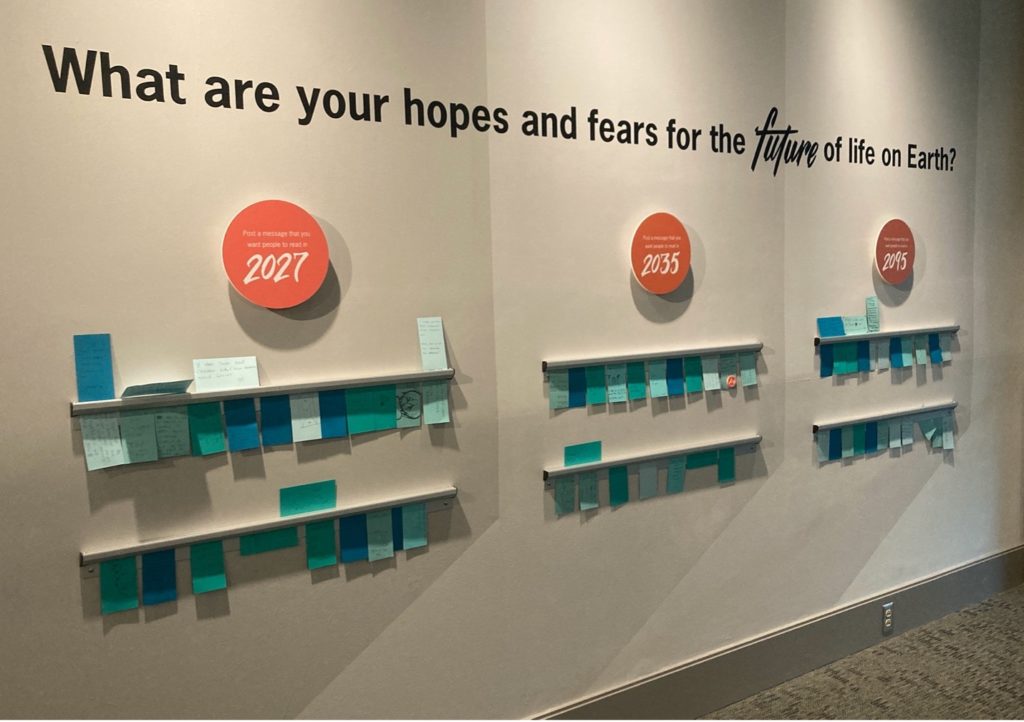
The final prompts and labels for the Messengers installation were part of what made it so successful. Every week, we get an average of 200-300 messages, many of them very serious, heartfelt, and earnest. An additional factor in its success is the message wall, where visitors can place their messages under the different year headers. During my observations, most visitors go directly to the message wall, reading from left to right every single message. The visitors might have come into the space because of the shiny and interesting looking Tardigrade sculptures, but they stay in the space and contribute because of the prompts and the messages that others have left. 

wall with handwritten messages for time capsules
Messenger prompts and visitor message wall, photo by Asia Ward. 2022

Message wall prompt: 

What are your hopes and fears for the future of life on Earth? 

Each Tardigrade has a designated year: 

  • Many climate scientists say we have until 2027 to take bold action to avoid climate disaster. If humans can keep global warming under 1.5°C (2.7° F), we reduce the risk of catastrophic heat and drought, food scarcity, flooding, and more. 
  • The United States set a goal to have 100% carbon-free energy production by 2035. Achieving this goal will require a major overhaul of the energy system, changing the way we power homes, businesses, and transportation to reduce pollution. 
  • Seven decades separate use from the 1950s, and seven decades separate us from the 2090s. The 1950s are known as the Great Acceleration. Some researchers look back at those years as a turning point when human activities and population growth became unsustainable, putting all life on Earth at risk. 

Visitors’ Feelings About the Future as Part of the Anthropocene Collection 

After reading thousands of messages, photographing and scanning them for documentation, some themes have emerged. 

2027 is within close reach, and messages intended for this time capsule tend to mention pop culture, current events, or personal daily events, worries, or desires. There are references to Netflix series, The Simpsons, comic book-based movies, shootings, the war in Ukraine, Biden, Trump, current unusual weather, COVID-19, the Roe v. Wade Supreme Court case, hashtags, and social media handles. Additionally, the same hopes and fears as well as advice from the other years are mentioned. 2027 also leans more into the hopeful. 

2035 contains more hopeful messages, with down to earth fears listed. In the hopeful range, messages list policy or government changes they would like to see and act towards, environmental and social justice, environmental regulation, being rich and famous, completing college and following their dreams, renewable energy and technology reversing Climate Change, climate disaster averted, no more species going extinct, and some general advice as to ‘be kind, compassionate, loving, accepting’ and to vote a certain way, recycle, pray, ‘believe in God.’ In the fear zone, messages list worry about having kids, kids’ future, escalating tension between countries and continued war, more deadly pandemics, natural environment extracted and wasted, too much government control, not enough regulation, and injustice for those with disabilities, women, and people of color. 

ten handwritten messages
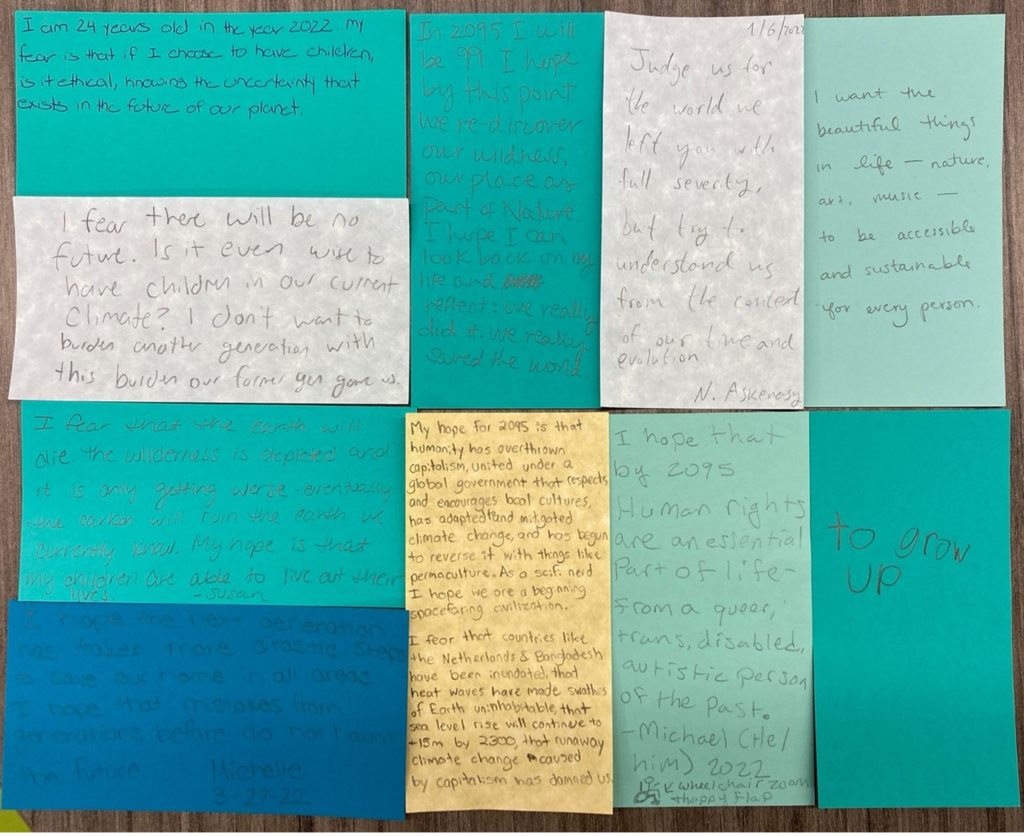
Sample of visitor messages for 2095 for Messengers. Photo by Asia Ward, 2022. 

The year with the most messages is 2095. That, for most of us, is far enough in the future where we will be dead, and the following generations will be the ones to read the messages. This batch tends to lead into the fantastical, but perhaps possible? (Dinosaurs coming back, flying cars, interplanetary colonies), the super hopeful (world peace, climate disaster averted, human and non-human rights as norm, world hunger solved) or super fatalistic (humans have killed themselves off with most of the planet’s life, the robots take over Matrix-style, suffocating capitalism or government control, poison by pollution and heightened injustice). There’s also advice about ‘being the change you want to see’ and apologies ‘for screwing you over.’ Personally, I think the reason 2095 has the most messages is because it’s far enough away that it’s easier to remove oneself from the complicated day to day systems we’re involved in (like politics, culture, ethics, and current events), and to see the systems from a bird’s eye view. 

What’s incredible about the messages, is that they come from all ages. From misspelled messages from kids just learning how to write and process the world around them, to older generations thinking back on their life and thinking forward for their grandkids. 

Observing visitors interacting and reading their messages has been the most rewarding experience I could have asked for as an artist and project manager. Visitors spend so much time there, reading others’ messages, then sitting to write down their thoughts. Families come in and it becomes a family activity, sitting around the table, silent in their writing. I’m glad they feel invited to share their thoughts about the future of life on Earth. I read through every message and prepare them for documentation so they can be included in our collection. There isn’t one reading session where I don’t leave both laughing and crying. 

Think about what your life will be like in 5, 13, 73 years. 

What are your hopes and fears for the future of life on Earth? 

If you would like to contribute to the time capsules, please visit before the We Are Nature: A New Natural History exhibit experience ends in November 2022. The message you write and post to the wall will be sealed inside a time capsule at the end of the exhibition. The capsules and all the messages will be preserved in the museum’s collection and opened in 2027, 2035, and 2095.

Thanks to the Gallery Experience Presenter Staff, the Natural History Interpreters, Events, Visitor Services, Education, Exhibitions, Anthropology, Anthropocene Studies, We Are Nature team, and the volunteers for your help making this installation possible. 

Asia Ward is a social practice artist. You can learn more about her work on her website AsiaWard.com.

References

Asia Ward website. Accessed June 2, 2022.

https://asiaward.com/

Bordenstein, Sarah. “Tardigrades (Water Bears).” Microbial Life Educational Resources. Accessed June 2, 2022. 

https://serc.carleton.edu/microbelife/topics/tardigrade/index.html

Carnegie Museum of Natural History website, Nature Crawl June 10th 2022 registration webpage. Accessed June 2, 2022 https://carnegiemnh.org/event/nature-crawl-21-june/

Carnegie Museum of Natural History website, We Are Nature: A New Natural History webpage. Accessed June 2, 2022. https://carnegiemnh.org/explore/we-are-nature-a-new-natural-history/#:~:text=Carnegie%20Museum%20of%20Natural%20History%20follows%20up%20its%20groundbreaking%202017,time%20to%20our%20own%20times.

Megumu Tsujimoto, Satoshi Imura, Hiroshi Kanda.  “Recovery and reproduction of an Antarctic tardigrade retrieved from a moss sample frozen for over 30 years.” Cryobiology. February 2016. Accessed June 2, 2022

https://www.sciencedirect.com/science/article/pii/S0011224015300134

Myriam Richaud, Emilie Le Goff, Chantal Cazevielle, Fumihisa Ono, Yoshihisa Mori, Naurang L. Saini, Pierre Cuq, Stephen Baghdiguian, Nelly Godefroy, Simon Galas. “Ultrastructural analysis of the dehydrated tardigrade Hypsibius exemplaris unveils an anhydrobiotic-specific architecture.” PubMed Central. March 9th, 2020. Accessed June 2, 2022.

https://www.ncbi.nlm.nih.gov/pmc/articles/PMC7062702/

O’Callaghan, Jonathan. “Hardy water bears survive bullet impacts- up to a point.” Science. March 18, 2021. Accessed June 2, 2022.

https://www.science.org/content/article/hardy-water-bears-survive-bullet-impacts-point

Waldman, Ariel. “Tested From Home: How to Find Tardigrades in Your Backyard!” YouTube Adam Savage’s Tested, Accessed June 2, 2022. https://www.youtube.com/watch?v=ccmnSXJG3QE

Wianecki, Shannon. “Hawaii’s mysterious water bears.” BBC, Travel. August 21st, 2016. Accessed June 2, 2022. 

https://www.bbc.com/travel/article/20160602-hawaiis-mysterious-water-bears

Wright, Jeremy. “Tardigrada water bears (Also: moss piglets).” Animal Diversity Web. Accessed June 2, 2022. 

https://animaldiversity.org/accounts/Tardigrada/#lifespan_longevity

Related Content

Water Bears: Why My Yard is Like the Moon

Hip and “Trashy” Ice Cream

Wonderment Returns

Carnegie Museum of Natural History Blog Citation Information

Blog author: Ward, Asia
Publication date: July 8, 2022

Share this post!

  • Share on Twitter Share on Twitter
  • Share on Facebook Share on Facebook
  • Share on Pinterest Share on Pinterest
  • Share on LinkedIn Share on LinkedIn
  • Share on Reddit Share on Reddit
  • Share via Email Share via Email

Filed Under: Blog Tagged With: Anthropocene, Asia Ward, Science News, We Are Nature 2

April 6, 2022 by Erin Southerland

Reckoning with Indigenous sovereignty and US public lands through place names in national parks

by Dr. Bonnie McGill
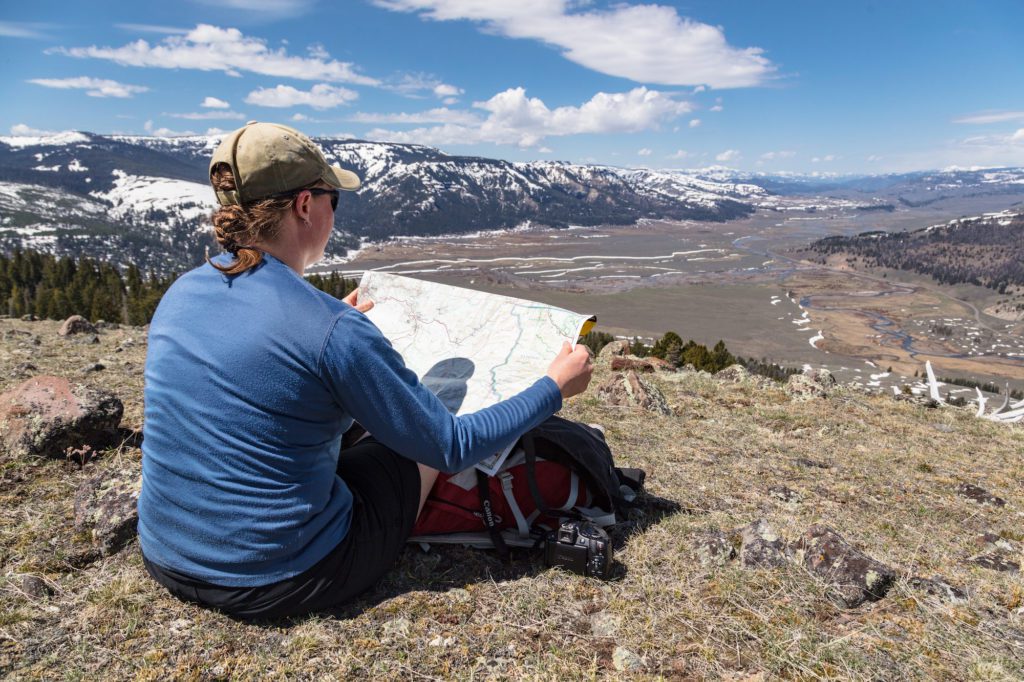
A person looking at a park map is seated on a mountainside overlooking a river valley with snow capped mountains in the background
A hiker at Yellowstone National Park. Public domain photo by the National Park Service / Jacob W. Frank.

US Secretary of the Interior Deb Haaland (a member of the Laguna Pueblo) recently initiated a task force to address derogatory place names on federal lands, including names using “squaw.” As the first Native American to serve in her cabinet-level post, Haaland has a deep understanding of the importance of the task force’s work, but is everyone on board?

Why are place names important? According to a recent study I led, addressing place names could be a starting point for reckoning with the US history of dispossession of Indigenous nations from their homelands. The study, published this spring in People and Nature, demonstrates the dual impacts of problematic place names, e.g., commemorating racial violence while simultaneously erasing longstanding and often spiritually connected Indigenous names for landscape features.

The study: “Words are monuments: Patterns in US national park place names perpetuate settler colonial mythologies including white supremacy”

Many consider national parks our nation’s “best idea”i but don’t realize how park place names cover up the parks’ violent histories. Among the 16 studied national parks and their over 2,200 place names we found: 

  • 52 places named for settlers who committed acts of violence against groups, often populations of Indigenous peoples. For example, Mount Doane in Yellowstone National Park, and Harney River in Everglades National Park, both homelands of Indigenous nations, commemorate individuals who led massacres of Indigenous peoples, including women and children.

  • 205 settler place names replacing recorded traditional Indigenous place names. (This count of replacement names is surely an underestimate because written records are biased toward settler histories, much Indigenous knowledge is maintained through oral traditions, and Indigenous knowledge keepers were rarely consulted when settler maps were made.)

  • 10 racial slurs

  • 214 examples of appropriation from Indigenous languages

  • 107 natural features retaining traditional Indigenous place names

Making meaning

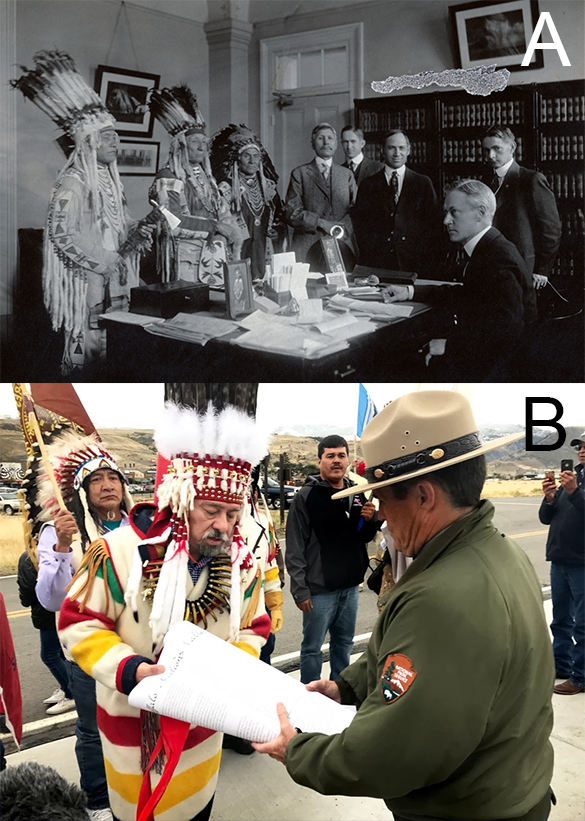
Native American groups including the Blackfeetii and Lakota have called for changing place names at national parks and national monuments for over a century (see pictures below). The research my five co-authors and I conducted was in service to such local and national name-changing campaigns. Place names have been used by colonizers and later settlers as a “technology of power” to justify their occupation of Indigenous lands and hierarchical social structuresiii. In the words of Indigenous scholar Linda Tuhiwai Smith (Ngāti Awa and Ngāti Porou Māori) “renaming the landscape [as part of the colonial project] was probably as powerful ideologically as changing the land”iv. To me, the study’s findings demonstrate how place names in the parks contribute, at a system-wide scale, to the erasure of Indigenous sovereignty over their homelands. Reconciling this wrong will require a system-wide response, such as Secretary Haaland’s task force and future task forces to address more than just derogatory names.

Top image is a historic black and white photo showing three Blackfeet leaders traditionally dressed including feathered headdresses and four white men standing around the desk of Stephen Mather, seated. Bottom image is a color photo showing Chief Grier in traditional dress handing a document to a man dressed in national park uniform and ranger hat with men standing behind Chief Grier, including Lee Juan Tyler wearing a traditional feathered headdress. This photo takes place outdoors with Yellowstone National Park in the background.
Native Americans resist settler colonial place names in national parks. Top: Blackfeet leaders Bird Rattler (far left), Curly Bear (second from left) and Wolf Plume (third from left) meet with Stephen Mather, soon-to-be Park Service director (sitting), and others in Washington, DC in 1915 to protest the use of English-language names in Glacier National Park. Photo courtesy of the National Park Service, Harpers Ferry Center. Bottom: In 2018 Chief Stanley Charles Grier of the Piikani Nation gives a Yellowstone National Park deputy superintendent a declaration from several Indigenous Nations demanding a change to the place names Mount Doane and Hayden Valley. Lee Juan Tyler (Shoshone-Bannock Tribes) and Brandon Sazue, Sr. (Crow Creek Sioux) stand in solidarity with Chief Grier. Individuals shown have given the authors permission to use their image. Photo courtesy of Nate Hegyi of Mountain West News Bureau.

In discussions with Kiaayo Tamisoowo (Bear Returning over the Hill) Chief Stanley Grier (Fig. 1B) of the Piikani Nation and Blackfoot Confederacy, he said that our study has 

shed important light on the true spirit and facts pertaining to National Park Place Names which were in place since time immemorial by our ancestors. To give Place Names [such as Mt. Doane in Yellowstone] to persons who authorized and who carried out the massacre of approximately 173 of my ancestors in 1870 on the Marias River, Montana is an atrocity that only perpetuates the illegitimate honor of persons that would be classified as War Criminals. Hayden Valley ought to be changed to Buffalo Nations Valleyv and Mount Doane to First Peoples’ Mountain.

I also recently spoke with Chief Arvol Looking Horse, spiritual leader of the Lakota, Dakota, and Nakota Great Sioux Nation. For decades Chief Looking Horse has sought to change the name of Devils Tower, the enormous, landscape-dominating igneous rock formation in northeastern Wyoming that is the namesake of Devils Tower National Monument. His proposal to change the name of the geologic feature to Bear Lodge has sat with the US Board of Geographic Names since 2015 due to stalling by congressional representatives from Wyoming. Bear Lodge is a sacred site to many native nations including the Lakota, Dakota, and Nakota. The site’s current name originated from the mistaken settler belief that Native religious rituals conducted there were forms of devil worship. 

When I asked Chief Looking Horse why returning traditional place names is meaningful to him he said, 

We as a people of the Earth are connected to Mother Earth, the source of life. Our history is spiritually connected to the Earth. We take care of the Black Hills, the heart of Mother Earth, through ceremony. Returning place names is needed more than ever because of the global disasters. The name of sacred sites came from the spirit, through ceremony, through prayer. For example, Mato Tipila, Bear Lodge is where the White Buffalo Calf Woman brought us the sacred pipe. I am the 19th generation keeper of the sacred pipe. And yet a soldier can just, out of anger and hatred to our people, rename such a sacred place Devils Tower. In our sacred language we don’t even have a word for devil. Returning Mato Tipila, Bears Lodge is the most important derogatory name for Deb Haaland to address.

Some readers might label this study and its attention to place names as a part of cancel culture. To me, that is a red herring that distracts from the need for the dominant US culture to reckon the US history and living legacies of land dispossession and genocide of Native American peoples, a long process repeatedly marked by instances where peoples were separated from their lands. 

Reckoning with the past is necessary for all peoples to move forward together into a future that is more equitable and sustainable. This concept is a guiding principle for the work we do in the Anthropocene Studies Section at Carnegie Museum of Natural History. Part of my motivation for this work was to understand the kind of restorative actions involved with the reckoning of US history and on-going harms of settler colonialism. 

A closing thought on “wilderness”

In popular US culture, our national parks and wilderness areas are thought of as places to escape; places to be out there with “real nature”. But settlers had to first make national parks and wilderness areas free of human occupation. Much of the awe that current national park lands inspired among European colonizers was in part the result of active ecosystem management by Indigenous peoples living with the land. Many national park ecosystems were dramatically changed with the loss of Native American stewardship (e.g. preventing forest fires)vi. 

As the first and now second edition of “We Are Nature” demonstrate for museum visitors, humans are part of, not separate from, nature. In fact, most of terrestrial Earth has been stewarded for thousands of years by Indigenous peoples. So the idea of an uninhabited “wilderness” is less ecological science and more of a settler colonial myth. That doesn’t mean national parks haven’t come to play an important role in conservation of biodiversity or that we shouldn’t visit national parks. I suggest, however, that we visit with greater awareness of park history and of the peoples for whom those lands are their homelands. I also suggest environmentalists use the term wilderness with care and understand it’s social-cultural implicationsvii.

Get involved

People can take action by getting involved with a national campaign launched at WordsAreMonuments.org by the social justice pop-up museum, The Natural History Museum. Also, check out this new guide on how individuals, community groups, and Tribal Nations can change place names. The public is also invited to comment on potential replacements for derogatory names on federal lands by April 25.

Bonnie McGill, Ph.D. is a science communication fellow for the Climate and Rural Systems Partnership and based in the Anthropocene Studies Section at Carnegie Museum of Natural History. Museum staff, volunteers, and interns are encouraged to blog about their unique experiences and knowledge gained from working at the museum.

Notes


[i] From an essay by Wallace Stegner: “The Best Idea We Ever Had” in Wilderness magazine, Spring 1983 p4-13.

[ii] A note on Blackfeet vs. Blackfoot: The nation in what is now Montana is Aamskapi Pikuni (Blackfeet Nation, including individuals shown in Fig. 1A), a member of Siksikaitsitapi (Blackfoot Confederacy), which also includes the Kainai-Blood Tribe, Siksika, Peigan-Piikani (including Chief Grier in Fig. 1B). 

[iii] Rose-Redwood, R., Alderman, D., & Azaryahu, M. (2017). The urban streetscape as political cosmos. In R. Rose-Redwood (Ed.), The Political Life of Urban Streetscapes: Naming, Politics, and Place (pp. 1–24). London: Routledge. doi: 10.4324/9781315554464

 Alderman, D. H. (n.d.). Commemorative Place Naming: To Name Place, To Claim the Past, ToRepair Futures. In F. Giraut & M. Houssay-Holzschuch (Eds.), Naming Places. London:ISTE-Wiley. Retrieved from https://www.researchgate.net/publication/341412389

[iv] Smith, L. T. (2012). Decolonizing Methodologies: Research and Indigenous Peoples (2nd Ed.). 1025 London: Zed Books Ltd.

[v] The sovereign Tribal Nations of Yellowstone formally requested the Yellowstone Superintendent to support changing Hayden Valley to Buffalo Nations Valley (see Fig. 1B). Ferdinand Hayden was a geologist who led the first federally funded geological survey of Yellowstone in 1871. His report was essential in persuading Congress to establish the national park. His report also called for the forced assimilation or, failing that, extermination of Native Americans. Other writings of his also demonstrate his white supremacist worldview, a tool used by settler colonizers to justify dispossessing Native Americans from their lands.

[vi] Read more about this in: 

Anderson, M. K. (2013). Tending the Wild: Native American Knowledge and the Management of California’s Natural Resources. Oakland: University of California Press; Kimmerer, R. W., & Lake, F. K. (2001). 

Maintaining the Mosaic: The role of indigenous burning in land management. Journal of Forestry, 99(11), 36–41. doi: 10.1093/jof/99.11.36

Kimmerer, Robin W. (2012). Braiding Sweetgrasss : Indigenous Wisdom, Scientific Knowledge and the Teachings of Plants. (1st ed.). Minneapolis: Milkweed Editions

[vii] Fletcher et al. 2021. Indigenous knowledge and the shackles of wilderness. PNAS https://doi.org/10.1073/pnas.2022218118

Related Content

What Does It Mean To Be For a Place?

Climate Change Myth Busting at the Museum

Celebrating Indigenous Peoples’ Day

Carnegie Museum of Natural History Blog Citation Information

Blog author: McGill, Bonnie
Publication date: April 6, 2022

Share this post!

  • Share on Twitter Share on Twitter
  • Share on Facebook Share on Facebook
  • Share on Pinterest Share on Pinterest
  • Share on LinkedIn Share on LinkedIn
  • Share on Reddit Share on Reddit
  • Share via Email Share via Email

Filed Under: Blog Tagged With: Anthropocene, Bonnie McGill, We Are Nature 2

June 10, 2021 by wpengine

New Anthropocene Publication: Stemming the Tide

by Nicole Heller

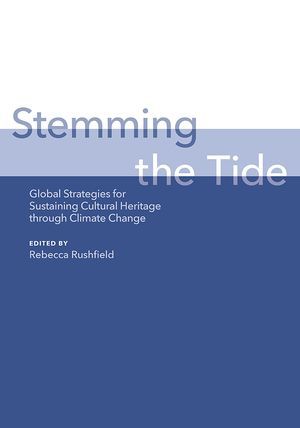
Blue and white cover of a book. Title: Stemming the Tide: Global Strategies for Sustaining Cultural Heritage Through Climate Change. Edited by Rebecca Rushfield.

I am pleased to share this Smithsonian Scholarly Press publication, Stemming the Tide: Global Strategies for Sustaining Cultural Heritage Through Climate Change. The e-book, edited by Rebecca Rushfield, is available online and freely available to read and download. It is the product of an international symposium organized and hosted by the Smithsonian Institution, Washington DC, March 5 – 6, 2020. According to Amber Kerr, Chief of Conservation, Smithsonian American Art Museum “The objective of the symposium was to empower cultural heritage authorities, managers, and advocates to pursue more ambitious engagement with, and collaborative approaches to, the climate crisis,” and “250 registrants and 1,100 live web stream viewers representing 33 states and 25 countries ranging from the United Kingdom, Spain, and Greece to Canada, Mexico, and Trinidad and Tobago” took part.

I was honored to be invited to participate and frame remarks about museums and climate change. Looking back, the symposium was at the beginning of difficult times. The crisis of the coronavirus pandemic was just becoming a known reality. I recall forgoing handshakes and hugs, and instead bumping elbows, with the awesome group of global professionals assembled.

Perhaps for this reason, seeing this volume published now gives me extra pause, and feels especially symbolic of the interconnections between people and planet – past, present and future – and the risks we face in the early 21st century. As Lonnie G. Bunch III, Secretary of the Smithsonian Institution, writes in the forward “This publication invites us to put our heads together and lead the cultural heritage sector in addressing the most pressing issue of our time.”

My chapter, “Museums Facing Climate Change. All Hands On Deck: Moving Past Climate Science and Into Culture,” is about the special opportunity for museums to lead on climate change action and education in their communities, and draws on the good works started at the Carnegie Museum of Natural History with We Are Nature: Living in the Anthropocene and Climate Systems Partnerships. Other chapters explore a wide range of issues. For example, there are chapters on adapting cultural heritage sites and historic buildings to increased risks from extreme weather and sea level rise, ensuring the preservation of collections and archeological sites, supporting resilience of displaced communities, sustaining and respecting Indigenous knowledge and storytelling, as well as tools for mitigating greenhouse gases and improving sustainability practices in collections and exhibition practices.

While intended for a professional audience, I imagine this book will be relevant to anyone concerned about human-caused climate change and interested in the diverse opportunities and challenges it presents. I commend the Smithsonian Institute for leadership in organizing the symposium and publishing this valuable resource. I look forward to using it with my colleagues at the Carnegie Museums and here in Pittsburgh toward pursuing more ambitious engagement and collaborative approaches to the climate crisis.

Read Stemming the Tide: Global Strategies for Sustaining Cultural Heritage Through Climate Change free online.

Nicole Heller is Curator of Anthropocene Studies at the Carnegie Museum of Natural History. Museum employees are encouraged to blog about their unique experiences working at the museum.

Related Content

Warmer Springs and Earlier Birds

Cities Are Not Biological Deserts

Pittsburgh’s Moths Reflect Environmental Impacts of Industry

Carnegie Museum of Natural History Blog Citation Information

Blog author: Heller, Nicole
Publication date: June 10, 2021

Share this post!

  • Share on Twitter Share on Twitter
  • Share on Facebook Share on Facebook
  • Share on Pinterest Share on Pinterest
  • Share on LinkedIn Share on LinkedIn
  • Share on Reddit Share on Reddit
  • Share via Email Share via Email

Share this post!

  • Share on Twitter Share on Twitter
  • Share on Facebook Share on Facebook
  • Share on Pinterest Share on Pinterest
  • Share on LinkedIn Share on LinkedIn
  • Share on Reddit Share on Reddit
  • Share via Email Share via Email

Filed Under: Blog Tagged With: Anthropocene, Anthropocene Studies, Nicole Heller, Science News

May 17, 2021 by wpengine

The Story of Oil in Western Pennsylvania: What, How, and Why?

by Hannah Smith

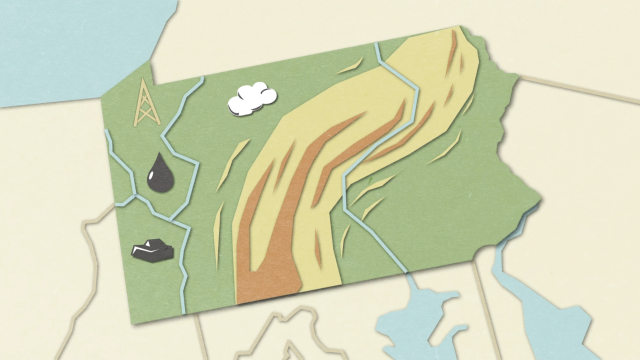
State of Pennsylvania in green with illustrations of coal, oil, rivers, clouds, forest, and an electrical tower.

I am a fries-on-salad, haluski dinner, dairy farm heritage kind of Western Pennsylvanian. I grew up near Venango and Crawford County and had a rural childhood. I went to a small school with about 300 kids in K-6th grade. Around 4th grade, I remember taking a field trip to Titusville, Pennsylvania. I remember seeing the familiar road signs and buildings as our bus gassed along the back roads. I had family in the Titusville and Oil City area, so it was a familiar route to take with my parents. I remember thinking, even at that young age, that the area looked worn and just, well, tired. But I was too young to grasp how this tired little town’s geology had changed the global economy and course of human history. When I was older, I pursued a degree in geology and began to understand more about my local community.

Our field trip took us to Titusville, Pennsylvania to visit Drake’s Well, the first commercial oil well in the United States. The site is named after the well’s driller, Edwin L. Drake who in 1859 struck oil outside of Titusville for the Seneca Oil Company. The company took the name from the Seneca Nation, one of the original Five Nations of the Haudenosaunee or Iroquois Confederacy, who had long made use of the resource Drake sought by skimming naturally-occurring slicks of petroleum, or unrefined oil, from the surface of local waters. These Indigenous people, who were removed from their native lands in the 1700s, 1800s, and 1900s, did not benefit from the Seneca Oil Company.

In the early 1800s oil was an unwanted by-product from salt wells (wells used to mine salt), and before that, a traditional medicine. In small doses, oil was used to treat respiratory diseases, epilepsy, scabies, and other ailments¹. Even today, chemicals made from the refining of petroleum are responsible for many of our modern medicines. Ointments, antihistamines, antibacterials, cough syrups, and even aspirin are created from chemical reactions created from petrochemicals².

However, the purpose of Drake’s Well was to produce oil for refining into kerosene for lamps, and thereby provide an alternative to the whale oil then used to illuminate homes and workplaces. Salt wells used water to dissolve salt source rock, and then carry the resulting brine through piping to the surface where it would be evaporated to leave salt as a solid residue. Although this method works for producing salt, it was far less efficient for producing oil. Productive oil drilling required new techniques, and one of Drake’s most important innovations was the “drive pipe,” sections of cast iron pipe driven into the shaft to protect the drill bit from water and cave-ins. Through experimentation and innovation, on August 27, 1859, Drake struck oil when his drill reached a depth of 69.5 feet.

While Drake’s Well was not the most productive, or largest oil well, the Titusville site is globally significant because it kick-started the petroleum drilling revolution that eventually changed global economies and environments. While Edwin Drake lived a hard life even after his discovery, he is still considered the father of the modern petroleum practices and industry³.

When my field trip class arrived at the Drake’s Well Museum I remember seeing an odd looking wooden building with an awkward chimney-like structure on one side. We were led through single-file so everyone could get a look at the steel machinery used in the drill, and the pipes that dispersed oil into wooden barrels clustered in the building. In my 10-year-old brain there is no way I could properly fathom that this discovery was related to many of the comforts and conveniences I took for granted in my life, such as cars, heating, electricity, plastics, medicines, and even the asphalt roads that we drove on. Why was Titusville special? More specifically, why did western Pennsylvania have oil in the ground?

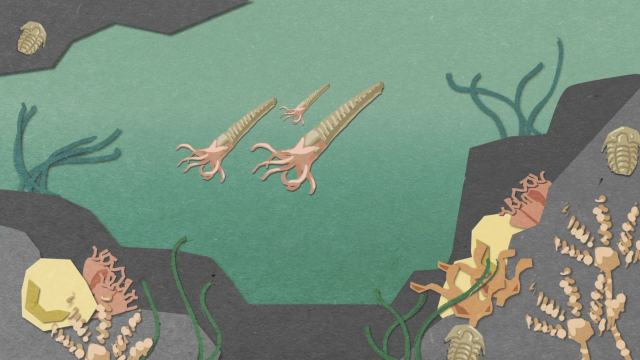
Illustration of the sea floor with various sea creatures including coral and ammonites.

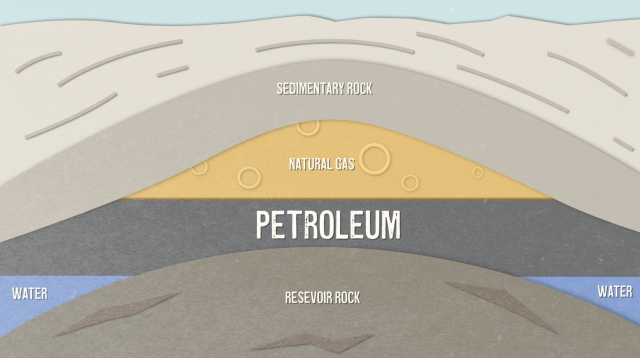
From about 490 to 360 million years ago, during the span of geological time known as the Ordovician Period and Devonian Period, most of what is now Pennsylvania was an ocean basin teeming with life. Pre-Appalachian Mountains systems eroded over time and deposited sediment of sand, silt, and mud that mixed on the seafloor with the dead plant material.  Currents at the ocean bottom were minimal, leaving the accumulating sediments and organic material relatively undisturbed and oxygen-free.  Without oxygen, bacteria that normally break down organic material could not act.  A thick, black, anoxic ooze formed, preserving the organic material.  Over millions of years, forces caused by plate tectonics generated enough heat and pressure to compact the sediments into rock and “cook” the organic material into petroleum.

If you’re from western Pennsylvania, you’ve probably heard of the Marcellus and Utica shales. The natural gas extracted from these rock units formed in a similar way to petroleum but was subjected to a much longer period of heat and pressure.

Illustration of rock layers labeled from top to bottom: sedimentary rock, natural gas, petroleum, reservoir rock. Water is labeled to the left and right of the reservoir rock.

With Edwin Drake’s success, and layers of oil-bearing rock relatively close to the surface, Titusville boomed. The year Drake drilled his first oil well, Titusville only had 250 residents. However, by 1865 the population increased to 10,000. Nearby Pithole City, now a ghost town, had 50 hotels during the oil peak of the area around 1866. This boom was short lived as other drilling companies began operations in the area and excess production lowered oil prices. Companies picked up to look elsewhere almost as quickly as they appeared⁵. While Titusville boomed and busted, the oil industry itself was growing. Drake drilled for a product to compete with whale oil, but the oil industry underwent phenomenal growth because the demand for its product grew as a lubricant for engines and many other types of machines, a resource for heating on a distributed scale, and as a refined fuel for developing motorized vehicles. Two World Wars during the first half of the 20th Century and the population explosion of the 1950s further increased demand for petroleum. During the Century’s latter half advancements in oil drilling technology made ocean drilling platforms a reality, and with them an increase in oil production as well as an increase in negative impacts due to devastating oil spills.

As of 2016, the world consumed over 97 million barrels daily⁶. So what does combusting 97 million barrels of oil a day, a resource from below the surface, mean for the Earth’s atmosphere? The burning of fossil fuels produces greenhouse gases such as carbon dioxide, methane, nitrous oxide, and fluorinated gases. Greenhouse gases absorb heat from the sun that the earth’s surface reflects back out into the atmosphere, similar to how a blanket traps in body heat. Burning fossil fuels causes climate change by increasing the total amount of greenhouse gases in the atmosphere, thickening the “blanket” around the earth, and increasing the global average temperature. According to the International Energy Agency (IEA), in 2019 greenhouse gas CO₂ emissions totaled 33 gigatons, or 1 billion metric tons, or about the weight of 1.5 billion school buses⁸. Climate change is responsible for increased frequency and severity of weather disasters, wildfires, and flooding, to name a few negative impacts. The abundant CO₂ in our atmosphere equilibrates with and diffuses into our oceans, causing the water to become more acidic and eroding the calcium carbonate structures of coral and other marine organisms. Climate change does not just affect wildlife, it also affects the lives of Pennsylvanians. In Pennsylvania climate change is likely to lead to increasing home insurance rates, higher taxes to replace infrastructure, longer allergy seasons, increasing heat stroke rates in citizens, rising food costs due to crops damaged by erratic weather and higher temperatures, and decreasing water quality and availability due to large storms causing water contamination⁷.

Early organisms were buried by sediment 488 to 360 million years ago and altered into petroleum by heat and pressure. For thousands of years, Earth’s petroleum reserves were largely untouched. Innovator Edwin Drake changed petroleum’s role by successfully drilling the first commercial oil well in North America that August day in 1859. Petroleum became a global commodity, eventually fueling a fast paced modern life. Now in the 21st century, the burning of fossil fuels, such as petroleum, is causing worldwide rapid climate change.

illustration of wheel with three images on the edges: a drop of oil, a cloud, and a lump of coal.

When I was on that field trip to Drake’s Well in 4th grade, we did not discuss the global or local implications of petroleum. This resource is responsible for many of the  day to day conveniences that have come to define contemporary life, but it also feeds environmental change  that is forcing  a “new normal,” and will cause an existential threat to humanity. I could not have fathomed that this global resource had its start in my own family’s backyard. I think that Drake’s Well is a good reminder that Earth-changing innovations can happen anywhere. I don’t think Drake could have predicted the scale to which his discovery would change society and the environment over the next 160 years, in the same way that most people do not realize how their small individual actions are affecting the larger social-ecological systems, and sustainability of all life on Earth. Although individual actions can negatively affect Earth, they can also be positive. Who knows, the next innovation to combat anthropogenic climate change may be happening in your backyard. Wind and solar farms have been developing and growing throughout Pennsylvania since 2007, providing an alternative option for electric energy use.

I started having more appreciation for the Earth Sciences as I got older. This eventually led me to obtaining a bachelor’s degree in geology, interning with the National Park Service at the Hagerman Fossil Beds in Idaho, and working in mapping for a few years before returning to school for illustration and design in hopes to marry the sciences and arts together. While obtaining my geology degree I met my now husband who has a Master’s in Structural Geology, and worked in the natural gas field for five years before making the switch to environmental geology. Our family’s income was supported by the fossil fuels industry for a time, and therefore we understand a decent amount of the ethics and controversy that is in the industry. However we are both very invested in the earth sciences and look forward to more sustainable tech preserving a better environment for the future.

Hannah Smith is an intern in the Section of Anthropocene Studies. Museum employees are encouraged to blog about their unique experiences and knowledge gained from working at the museum.

References:

1 Early Medicinal Uses of Petroleum 2015 https://daily.jstor.org/petroleum-used-medicine/

2 Modern Uses for Petroleum in Medicine 2019 https://context.capp.ca/articles/2019/feature_petroleum-in-real-life_pills

3 Drake’s Well History of Petroleum 2016 https://www.aoghs.org/petroleum-pioneers/american-oil-history/

4 Description of petroleum formation 2014 http://elibrary.dcnr.pa.gov/GetDocument?docId=1752503&DocName=ES8_Oil-Gas_Pa.pdf

5 The boom and bust cycle of the oil industry 2015 https://www.nytimes.com/2015/04/23/business/energy-environment/oil-makes-a-comeback-in-pennsylvania.html

6 World Oil Statistics 2016-Current https://www.worldometers.info/oil/

7 List of the Effects of Climate Change on People and how to protect yourself 2019 https://blogs.ei.columbia.edu/2019/12/27/climate-change-impacts-everyone/

8 International Energy Agency 2019 https://www.iea.org/articles/global-co2-emissions-in-2019

9 Drake’s Well Museum https://www.drakewell.org/

10 Seneca-Iroquois National Museum https://www.senecamuseum.org/

11 Seneca Nation Oil Process in New York State https://nyhistoric.com/2013/10/seneca-oil-spring/

Related Content

Understanding Fossil Fuels through Carnegie Museums’ Exhibits

What Does Climate Change Mean for Western PA Farmers?

Is Plastic Natural?

Carnegie Museum of Natural History Blog Citation Information

Blog author: Smith, Hannah
Publication date: May 17, 2021

Share this post!

  • Share on Twitter Share on Twitter
  • Share on Facebook Share on Facebook
  • Share on Pinterest Share on Pinterest
  • Share on LinkedIn Share on LinkedIn
  • Share on Reddit Share on Reddit
  • Share via Email Share via Email

Share this post!

  • Share on Twitter Share on Twitter
  • Share on Facebook Share on Facebook
  • Share on Pinterest Share on Pinterest
  • Share on LinkedIn Share on LinkedIn
  • Share on Reddit Share on Reddit
  • Share via Email Share via Email

Filed Under: Blog Tagged With: Anthropocene, Hannah Smith, Science News, stewardship

April 30, 2021 by wpengine

Warmer Springs and Earlier Birds

by Bonnie McGill

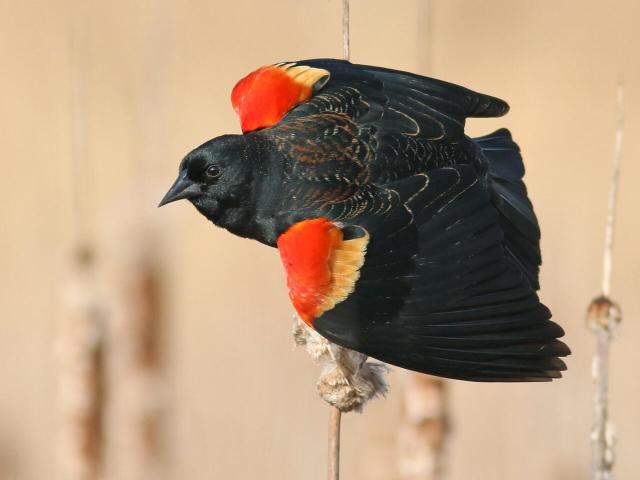
Male Red-winged Blackbird (Agelaius phoeniceus) by Jonathan Eckerson via Macaulay Library.

Male Red-winged Blackbirds! For me, their calls and bright red shoulders are one of the signs that spring is really here. Mind you, this is no subtle sign of spring that takes an expert naturalist to notice. No, this is a sign of spring that slaps you across the face, as if spring is calling, “I’m here! CONK-A-REE! Look at me!” Next time you drive past a wetland area with cattails, there is a good chance you’ll see one or more showing off their red shoulders (the brown females are beautiful too). Red-winged Blackbirds have been back in western PA and announcing their territorial claims since March. Whether you live in the country or the city, bird watching is a great way to observe the change in seasons and connect with the nature around you (and in you).

As a member of the Climate and Rural Systems Partnership (CRSP) team I’ve been gathering evidence-based stories of how climate change is impacting natural processes in western PA. Since this week is the City Nature Challenge, folks might be paying closer attention to birds, creating an opportunity for museum scientists to explain what migratory songbirds in our region can teach us about climate change.

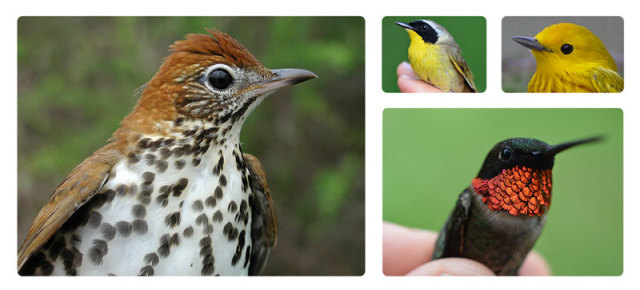
Since 1961 scientists at the museum’s Powdermill Avian Research Center (PARC) in Pennsylvania’s Laurel Highlands have been monitoring birds. In that time they have captured, studied, marked, and released almost 800,000 birds! This week, for example, PARC’s mist nets are temporarily capturing birds like the Common Yellowthroat, Yellow Warbler, House Wren, Ruby-throated Hummingbird, American Redstart, and Wood Thrush.

Migratory birds that are part of the PARC long term dataset (clockwise from left): Wood Thrush, Common Yellowthroat, Yellow Warbler, and Ruby-throated Hummingbird. All of these species are breeding earlier in the year in response to climate change that has already occured. Photos courtesy of Powdermill Avian Research Center.

All of these species are migratory–spending the winter in the southern US, the Caribbean, Central America, and/or South America. Many fly across the Gulf of Mexico (!) on their way north in the spring. All of these birds share another trait–they are nesting earlier in the year than they once did. We will follow the Wood Thrush as an example of how many birds are responding to the warming climate.

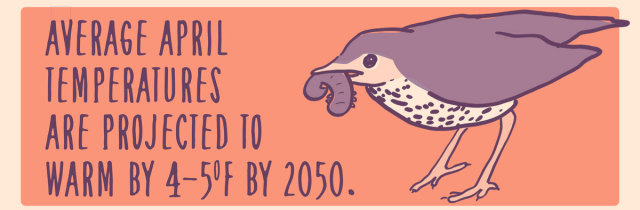
on the right side, text reads "Average April temperatures are projected to warm by four to five degrees Fahrenheit by 2050." On the left, there's an illustration of a bird holding a worm in its beak.
The artwork in this blog post is by the author and part of an infographic depicting the information written here.

PARC’s unique 50 year dataset allows scientists to study how birds respond to long term changes, including the warming climate. Average April temperatures in the Laurel Highlands have already increased by two degrees Fahrenheit since the 1960s, and are projected to warm by another four to five degrees Fahrenheit by 2050. Warmer springs trigger earlier plant budburst. Insects, especially caterpillars, feast on buds and young leaves, which have less toxins than mature leaves. Caterpillars are the breakfast of champions (among birds). So, migratory songbirds, including the Wood Thrush, need to synchronize their northward movement with the budburst. This means an earlier arrival, according to the calendar, at points all along their migration route.

Wood Thrushes arrive from Central America five days earlier than they did in the 1960s. Research suggests that migratory birds respond to temperature cues along their migration route and speed up (warmer temperatures) or slow down (cooler temperatures). Birds may be responding to temperature directly or indirectly via other temperature-dependent cues such as wind speed and direction and spring leaf out.

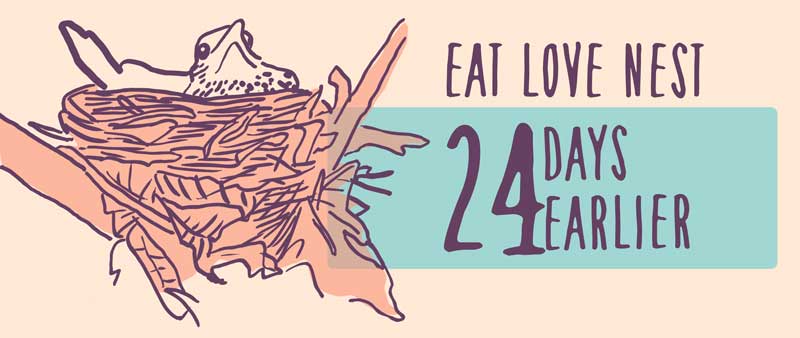
Eat, Love, Nest, 24 days earlier

Early arrival is not the only adjustment Wood Thrushes are making, however. The birds are also making their nests and hatching young earlier. Wood Thrushes are nesting 24 days earlier than they did in the 1960s. All four of the  bird species in the photo above are breeding earlier. Within the web of organisms that supplies food for birds, May 19 of the present feels like June 11 of the 1960s. The earlier nesting in response to a warming climate means birds that normally hatch and rear multiple broods per breeding season, such as House Wrens and Northern Cardinals, may  have greater reproductive capacity. PARC research shows that Gray Catbirds and Northern Cardinals are having more young in warmer springs, but other multi-brood species such as House Wrens and Common Yellowthroats are not.

While birds seem to be keeping pace with climate change now, they may not be able to in the future. Their capacity to adjust migratory and reproductive behavioral traits in response to climate change is finite. Also, we’ve already lost an estimated 3 billion North American birds since 1970 due to factors including habitat loss, insect declines, pesticide use, and predation by domestic cats. Now climate change is making bird survival even more difficult. The capacity of bird populations to evolve in response to climate change is also limited – climate change in the Anthropocene is happening much more rapidly than climate change in past epochs, many times faster than evolution can keep up. The good news is we can help birds, ecosystems, and ourselves by taking action to reduce the severity of climate change.

illustration of two birds flying with the text "You can help birds and climate"

Here are three ways individuals and communities can help birds by mitigating climate change:

1) Conserve habitat: Habitats like forests, wetlands, and prairies provide food and shelter for birds while the plants and soils remove and store carbon away from the atmosphere. These habitats are needed throughout birds’ migratory ranges. Create habitat by reducing lawns and planting native plants. For example, many birds enjoy eating the fruits of spicebush, elderberry, and black cherry, which are native to western Pennsylvania. You can find more bird-friendly plants native to your area at https://www.audubon.org/plantsforbirds.

2) Renewable energy: A just transition to renewable energy sources like properly-sited wind* and solar will reduce greenhouse gas emissions, provide local jobs, improve air quality, and help protect birds and people from climate change. *The National Audubon Society supports properly-sited wind energy.

3) Eat your vegetables: A more plant-based diet is an impactful way to reduce greenhouse gas footprints. Also, choosing food that is grown with less pesticides, and using less pesticides in the stewardship of your garden, helps support the survival of insects that are food for birds. Reductions in demand for pesticides also reduces their manufacture, which further reduces greenhouse gas emissions. Learn more from Project Drawdown.

So get out there, find the signs of spring that are gentle (Trout Lilies) and not-so-gentle (Red-winged Blackbirds), log them in iNaturalist for the City Nature Challenge, and talk with your family and your community about how you can implement one or two (or three!) of the actions suggested above!

You can also read this as an infographic here.

Thank you to the many folks who helped with the development of this blog post and infographic: Luke DeGroote, Mary Shidell, and Annie Lindsay at PARC; the Laurel Highlands network of the Climate and Rural Systems Partnership; Nicole Heller; Taiji Nelson; and Sarah Crawford.

Bonnie McGill, Ph.D. is a science communication fellow for the Climate and Rural Systems Partnership and based in the Anthropocene Studies Section at Carnegie Museum of Natural History. Museum employees are encouraged to blog about their unique experiences and knowledge gained from working at the museum.

Related Content

Teaching About Local Wildlife with the City Nature Challenge

Water Bears: Why My Yard is Like the Moon

Botanists Use Data Collected By Thoreau to Uncover Unexpected Effects of Climate Change

Carnegie Museum of Natural History Blog Citation Information

Blog author: McGill, Bonnie
Publication date: April 30, 2021

Share this post!

  • Share on Twitter Share on Twitter
  • Share on Facebook Share on Facebook
  • Share on Pinterest Share on Pinterest
  • Share on LinkedIn Share on LinkedIn
  • Share on Reddit Share on Reddit
  • Share via Email Share via Email

Share this post!

  • Share on Twitter Share on Twitter
  • Share on Facebook Share on Facebook
  • Share on Pinterest Share on Pinterest
  • Share on LinkedIn Share on LinkedIn
  • Share on Reddit Share on Reddit
  • Share via Email Share via Email

Filed Under: Blog Tagged With: Anthropocene, Anthropocene Living Room, Anthropocene Studies, Bonnie McGill, City Nature Challenge, climate change, CRSP

  • « Go to Previous Page
  • Page 1
  • Page 2
  • Page 3
  • Page 4
  • Interim pages omitted …
  • Page 16
  • Go to Next Page »

sidebar

About

  • Mission & Commitments
  • Directors Team
  • Museum History

Get Involved

  • Volunteer
  • Membership
  • Carnegie Discoverers
  • Donate
  • Employment
  • Events

Bring a Group

  • Groups of 10 or More
  • Birthday Parties at the Museum
  • Field Trips

Powdermill

  • Powdermill Nature Reserve
  • Powdermill Field Trips
  • Powdermill Staff
  • Research at Powdermill

More Information

  • Image Permission Requests
  • Science Stories
  • Accessibility
  • Shopping Cart
  • Contact
  • Visitor Policies
One of the Four Carnegie Museums | © Carnegie Institute | Privacy Policy | Terms of Use | Accessibility
Rad works here logo