• Skip to primary navigation
  • Skip to main content
  • Skip to primary sidebar

Carnegie Museum of Natural History

One of the Four Carnegie Museums of Pittsburgh

  • Visit
    • Buy Tickets
    • Visitor Information
    • Exhibitions
    • Events
    • Dining at the Museum
    • Celebrate at the Museum
    • Powdermill Nature Reserve
    • Event Venue Rental
  • Learn
    • Field Trips
    • Educator Information
    • Programs at the Museum
    • Bring the Museum to You
    • Guided Programs FAQ
    • Programs Online
    • Climate and Rural Systems Partnership
  • Research
    • Scientific Sections
    • Science Stories
    • Science Videos
    • Senior Science & Research Staff
    • Museum Library
    • Science Seminars
    • Scientific Publications
    • Specimen and Artifact Identification
  • About
    • Mission & Commitments
    • Directors Team
    • Museum History
  • Tickets
  • Give
  • Shop

Blogs about Birds

Birds are incredibly important to Carnegie Museum of Natural History. The museum's Section of Birds contains nearly 190,000 specimens of birds. The most important of these are the 555 holotypes and syntypes. The Section of Birds staff also cares for approximately 196 specimens of extinct birds as well as specimens of many rare species collected decades—if not more than a century—ago.

July 18, 2019 by wpengine

BirdSafe Pittsburgh Makes Museum Windows Visible

The birds flying around the Carnegie Museums of Art and Natural History are a lot safer now, thanks to Jon Rice, the Urban Bird Conservation Coordinator and leader of BirdSafe Pittsburgh. Over the summer, Jon and his colleagues were able make a deadly wall of windows visible to birds by installing thousands of stylish reflective dots. By breaking up the reflection of the surrounding trees on the East side of the museum, birds are more likely to see the window and avoid impact.

BirdSafe Pittsburgh is a partnership between 8 local conservation organizations working to reduce bird mortality in Pittsburgh. Learn more about how you can become involved at https://birdsafepgh.org/volunteer/.
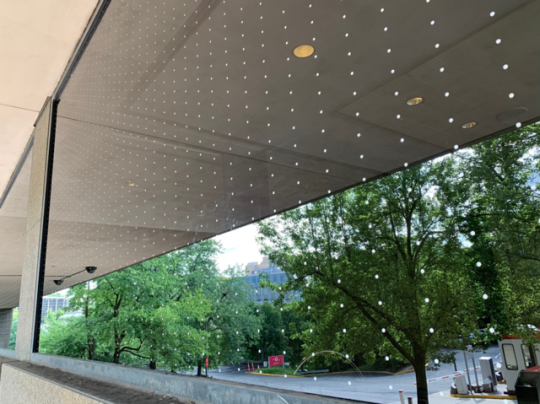
museum windows with bird proof glass

Windows on the East side of the building have been outfitted with stylish, reflective patterns to make windows visible to birds and reduce collisions.

Chase Mendenhall is Assistant Curator of Birds, Ecology, and Conservation at Carnegie Museum of Natural History. Museum employees are encouraged to blog about their unique experiences and knowledge gained from working at the museum.
Filed Under: Blog Tagged With: Anthropocene, Birds, birdsafe pittsburgh

June 12, 2019 by wpengine

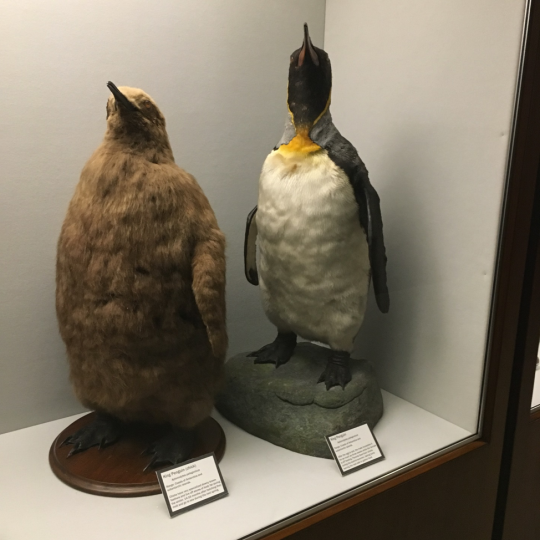
Why Do the King Penguins in Bird Hall Look so Different from Each Other?

king penguin chick and adult in Bird Hall

Visitor comments often offer insight into the effectiveness of museum displays. The most candid comments are overheard snatches of conversation, some as touching as they are humorous.

The setting: Bird Hall at Carnegie Museum of Natural History, 2:00 p.m. on a summer afternoon.

Three siblings, the oldest about nine, were studying a pair of king penguin taxidermy mounts while their mother, a few display cases away, looked at a different group of birds.

The mother walked toward her children as the nine-year-old explained the birds to his younger brother and sister, “This one is the girl penguin, and this one is the boy penguin. They really look different. The girls are brown and fuzzy, and the boys are black and white.”

The mother quickly surmised the misinterpretation and offered a gentle correction without any trace of ridicule: “The brown one’s a young bird. The label says ‘chick,’ but that doesn’t mean it’s a girl.”

Patrick McShea works in the Education and Visitor Experience department of Carnegie Museum of Natural History. Museum employees are encouraged to blog about their unique experiences and knowledge gained from working at the museum.
Filed Under: Blog Tagged With: bird hall, Birds, Education, Pat McShea, Patrick McShea

April 23, 2019 by wpengine

Broken Egg Evidence

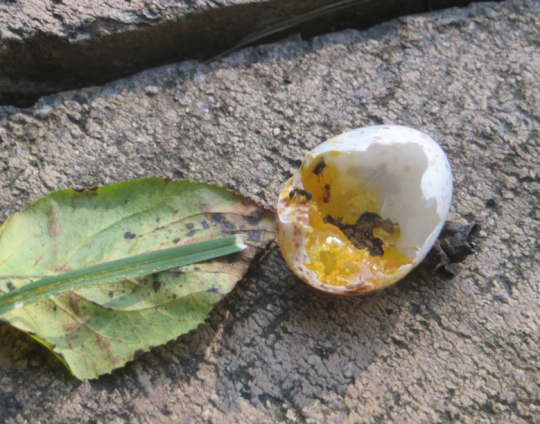
Challenges involving eggs aren’t limited to the Easter season. The pictures below are of songbird egg shells I came across in early July of 2018. Each fragment hints at a different outcome for the developing bird that once occupied the structure. My speculation about those outcomes is mainly informed by details about the places where the shells were found, critical information not captured in the photographs.

broken egg on the ground

This northern cardinal egg shell fragment rested on a brick sidewalk near a forsythia bush where a pair of the birds had been observed nesting. Blue jays frequented the area, as did eastern chipmunks. Either could have removed an egg from the nest, broken the shell, eaten much of the contents, and left drying yolk for ants to scavenge.

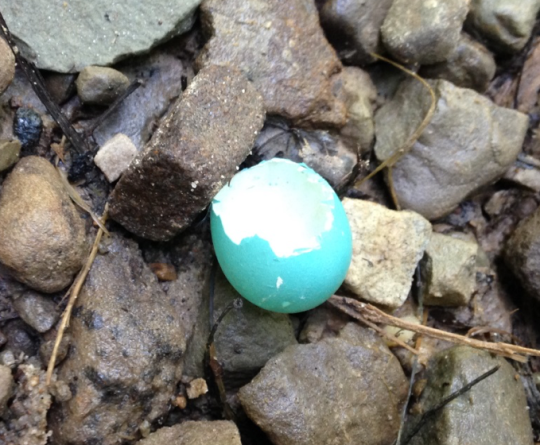
broken blue egg among rocks

It’s likely this wood thrush egg fragment was deliberately dropped by a parent bird as part of routine post-hatch nest-keeping duties. The blue shell rested on a gravel State Game Lands road inMercer County, a place that echoed with flute-like Wood Thrush song. The fragment’s spotless interior was evidence that this egg had almost certainly been opened by its occupant rather than a nest visitor.

Patrick McShea works in the Education and Visitor Experience department of Carnegie Museum of Natural History. Museum employees are encouraged to blog about their unique experiences and knowledge gained from working at the museum.
Filed Under: Blog Tagged With: Birds, Education, eggs, Pat McShea, Patrick McShea

March 18, 2019 by wpengine

New Zealand, Realm of Birds

I recently returned from three weeks’ vacation on New Zealand’s South Island. I had expected to see bazillions of sheep (I heard there were 7 sheep for every person in New Zealand), but I found that New Zealand is characterized by birds and ferns (and although we saw lots of sheep, many farmers are turning to dairy). In this post, I’ll touch on the birds of New Zealand.

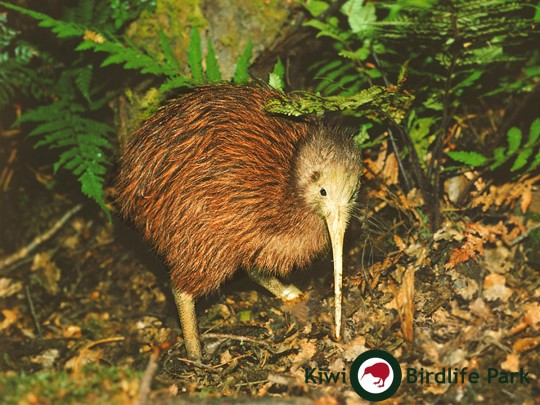
Kiwi bird. Photo courtesy of Kiwi Birdlife Park.

Before humans arrived, the only land mammals on New Zealand were two species of bats and a now-extinct mouse. That left birds to radiate into numerous niches, and without ground-based predators, many birds became flightless and fearless. (The fearsome Haast eagle, with a wingspan up to 3 m or 10 ft, hunted from the air, but is now extinct.)

42% of the bird species have become extinct since year 1300. New Zealand was colonized by humans comparatively recently: Polynesians, who became the Maori people, arrived about year 1300 AD and brought the Polynesian rat, or kiore, which started to harm ground-nesting birds, and the Maori wiped out the large, herbivorous moa birds (evidently, they were tasty). Europeans colonized in the 1800s and brought mammals that further devastated the bird fauna: Norway rats, cats, and stoats (relatives of weasels).

The New Zealand Department of Conservation traps and poisons the mammals, which helps some birds recover. Mammal lovers who oppose the control efforts don’t offer an alternate plan, but without control, even more birds would now be extinct. There is a move toward complete eradication of the introduced mammalian predators by 2050.

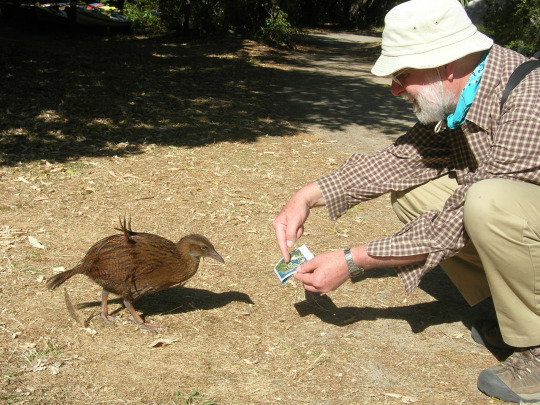
One of the widespread and friendly flightless birds is the weka. It is a member of the rail family and is roughly the size of a chicken. I tried to show one weka how to read a map, but I think it had trouble understanding my U.S. accent (see photo).

weka bird and man with a map
Weka, one of the flightless birds of New Zealand. Photo by Alice W. Doolittle.

Thanks to conservation efforts, five species of kiwi birds still live in New Zealand. They are primarily nocturnal, and we were fortunate to see some at Kiwi Birdlife Park (see photo). The mother kiwi lays an unusually large egg that is about a quarter of her mass (I imagine her saying ouch at egg laying). Recent DNA evidence suggests the kiwi is more closely related to the (extinct) elephant bird of Madagascar than to the (extinct) moa of New Zealand. I believe the large size of the kiwi’s egg relative to its body size could be from evolution shrinking the adult size faster than it shrank the egg size. Kiwis have a very long proboscis, and the Maori name for one of the kiwi species translates to weka with a walking stick. Kiwis are the only bird with nostrils at the end of its proboscis. Given that bill length is measured from the nostrils to the tip, despite its prodigious nasal protuberance, technically the kiwi has the shortest bill of any bird!

Timothy A. Pearce is Curator of Collections, Section of Mollusks at Carnegie Museum of Natural History. Museum employees are encouraged to blog about their unique experiences and knowledge gained from working at the museum.
Filed Under: Blog Tagged With: Anthropocene, Birds, Tim Pearce

March 11, 2019 by wpengine

A Match Made by Coevolution

Darwin once predicted the existence of a pollinator after examining the star-shaped flower of the orchid Angraecum sesquipedale, a flower whose nectar is at the end of a 30 cm tube. Darwin wrote that “in Madagascar there must be moths with probosces capable of extension to a length of between ten and eleven inches [25.4–27.9cm].” Twenty years after Darwin’s death, his prediction was proven correct with the discovery of a moth, Xanthopan morganii praedicta, which boasted a proboscis 20 cm in length. In 1992, natural history observations of the moth feeding on the extreme flower and transferring pollen provided even more evidence that this plant and insect were tangled in a coevolution that resulted in their extreme morphology.

Coevolution is now a cornerstone of biology and has been well developed through examples of flowering plants and insects, parasites and hosts, predators and prey, and even gut microbiomes and human health. In fact, the influence of closely associated species on each other in their evolution is so ubiquitous one could argue that evolution is coevolution—as the boundary between what is an individual versus a consortia of different species blends as we dive deeper into the units that natural selection is acting upon. The microbiome and human health example helps illustrate the problem of defining an individual, specifically because scientists now think that microbial cells outnumber human cells in your body. Moreover, there is growing evidence this diversity of symbionts on our bodies complete metabolic pathways and serve other physiological functions. Coevolution crisscrosses the natural histories of organisms, creating nuances that sometimes complicate things.

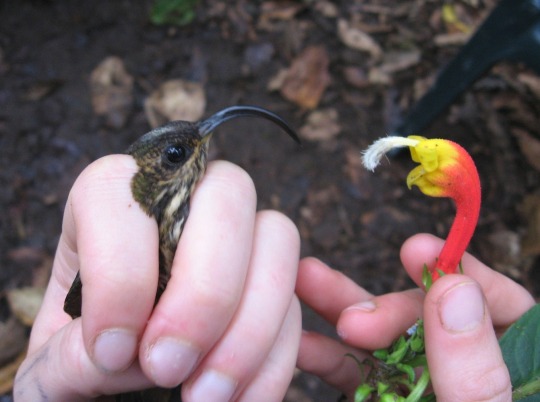
With so much excitement and work surrounding coevolution, it is romantic to stumble across an example of coevolution fit for a kindergarten class. In the collection of birds at the Carnegie Museum of Natural History, we recently finished an analysis of 24 Costa Rican hummingbirds and the pollen types found on their bodies and were reminded of Darwin’s predictions of coevolution over 100 years ago with orchids and moths. The White-tipped Sicklebill (Eutoxeres aquila) is a hummingbird with an extreme bill curve, with an appearance that would remind kindergarteners of Jim Henson’s Gonzo Muppet. Putting this bird next to its favorite food, Centropogon granulosus, illustrates coevolution in an exciting way that doesn’t tangle you up in learning about microbes or imagining other complex ecological relationships. Like Darwin’s orchid and moth, this hummingbird and its preferred flower allow us to see coevolution is all around us.

sicklebill hummingbird and its preferred flower

In an ongoing study at the Carnegie Museum of Natural History’s Section of Birds, we were reminded of the natural history observations and predictions that led to an explosion in the field of coevolution. By studying pollen types collected from hummingbirds in Costa Rica we confirmed that the White-tipped Sicklebill (Eutoxeres aquila) feeds mostly on Centropogon granulosus, a match made by coevolution.

Chase Mendenhall is Assistant Curator of Birds, Ecology, and Conservation at Carnegie Museum of Natural History. Museum employees are encouraged to blog about their unique experiences and knowledge gained from working at the museum.
Filed Under: Blog Tagged With: bird hall, Birds, Botany, Chase Mendenhall, evolution, Section of Birds

March 11, 2019 by wpengine

The Symbol of the Anthropocene in Preparation at the Carnegie Museum

black question mark on white background

As an intern in the Anthropocene section at the Carnegie Museum, I had the privilege of exploring some of its treasures, either preserved in the collections or displayed for the public, and reflecting on how objects can help us consider the planetary changes underway in the Anthropocene.

During my explorations, I was asked what was my highlight, or what object best exemplifies the Anthropocene to me?

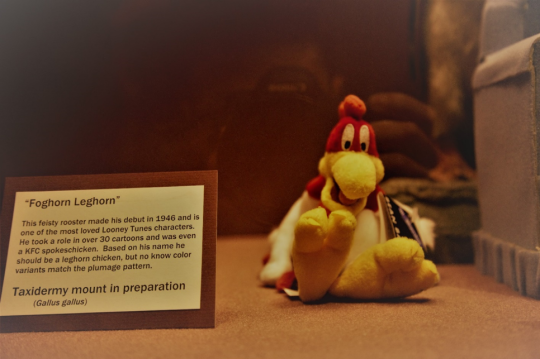
Picture from case in Bird Hall. Taxidermy mount in preparation because Steve Rogers, collections manager of Birds, is still waiting to find a specimen that looks like the Foghorn Leghorn.

Turns out – my most vivid symbol of the Anthropocene is absent. It is not found in either the collections, or in the gallery halls (although it is found in the cafeteria)!

Yes indeed, my favorite symbol is the commercial broiler chicken, likely one of the most common birds in the world because it reaches slaughter weight in less than half the time of other domestic or wild chickens! Surprised? Disappointed? Let me explain…

Last year, the director of the museum, Dr. Eric Dorfman, wrote a compelling blog titled Counting Your Chickens: The World’s Most Numerous Bird. Chickens are likely the most numerous bird in the world. In light of the Anthropocene, we could even say in Earth history. There are about 23 billion chickens alive at any given time. By comparison, the second most numerous bird reported is the red-billed quelea, which lives across the continent of Africa, with an estimated population of 1.5 billion.

You probably wonder how the chicken conquered the world. Its long journey began around 7,000 years ago when it was first domesticated from the red junglefowl (Gallus gallus), native to south-east Asia. But the bird’s trajectory radically changed in the second half of the 20th century, during what is now called “The Great Acceleration.” With changes in farming practice and the intensive production of broilers, the chicken population exploded. Meat-chicken consumption is still on the rise with more than 65 billion chickens consumed globally in 2016.

The commercial broiler chicken is even more radically different from its ancestors and other kinds of chickens. The change is about their shape, genes, and chemistry. Their genes, for instance, have been altered so that the birds are constantly hungry. In other words, they have been bred for a specific purpose: to gain weight rapidly (and they do it five times faster than chickens from the mid-20th century). It is a perfect example of what Richard Pell, director of the Center for PostNatural History and Associate Professor of Art at Carnegie Mellon University, means by the term “postnatural,” that is an organism that has been intentionally and heritably altered by humans.

The commercial broiler chicken is the direct result of human intervention. One could argue that selective breeding practices are not new. However, the Anthropocene captures a very recent rupture in Earth’s history by highlighting rapid and unprecedented changes at a planetary scale. Commercial broiler chickens and their biology shaped by humans, created in just a few decades, symbolize the transformation of the Earth’s biosphere. And new research suggests that the commercial broiler chicken’s distinctive bones could become fossilized markers of the Anthropocene. Perhaps it would be more appropriate to talk about the Gallucene.

Stories like this show how the Anthropocene offers an opportunity to rethink how we view natural history and what we put in our collections. The Carnegie Museum of Natural History is undertaking this ambitious and necessary shift in order to understand what it means to live in this new epoch.

Gil Oliveira is an intern in the Section of the Anthropocene. Museum employees are encouraged to blog about their unique experiences and knowledge gained from working at the museum.

Filed Under: Blog Tagged With: Anthropocene, bird hall, Birds, Gil Oliviera

  • « Go to Previous Page
  • Page 1
  • Interim pages omitted …
  • Page 6
  • Page 7
  • Page 8
  • Page 9
  • Page 10
  • Interim pages omitted …
  • Page 20
  • Go to Next Page »

sidebar

About

  • Mission & Commitments
  • Directors Team
  • Museum History

Get Involved

  • Volunteer
  • Membership
  • Carnegie Discoverers
  • Donate
  • Employment
  • Events

Bring a Group

  • Groups of 10 or More
  • Birthday Parties at the Museum
  • Field Trips

Powdermill

  • Powdermill Nature Reserve
  • Powdermill Field Trips
  • Powdermill Staff
  • Research at Powdermill

More Information

  • Image Permission Requests
  • Science Stories
  • Accessibility
  • Shopping Cart
  • Contact
  • Visitor Policies
One of the Four Carnegie Museums | © Carnegie Institute | Privacy Policy | Terms of Use | Accessibility
Rad works here logo