• Skip to primary navigation
  • Skip to main content
  • Skip to primary sidebar

Carnegie Museum of Natural History

One of the Four Carnegie Museums of Pittsburgh

  • Visit
    • Buy Tickets
    • Visitor Information
    • Exhibitions
    • Events
    • Dining at the Museum
    • Celebrate at the Museum
    • Powdermill Nature Reserve
    • Event Venue Rental
    • Gift Cards
  • Learn
    • Field Trips
    • Educator Information
    • Programs at the Museum
    • Bring the Museum to You
    • Guided Programs FAQ
    • Programs Online
    • Climate and Rural Systems Partnership
  • Research
    • Scientific Sections
    • Science Stories
    • Science Videos
    • Senior Science & Research Staff
    • Museum Library
    • Science Seminars
    • Scientific Publications
    • Specimen and Artifact Identification
  • About
    • Mission & Commitments
    • Directors Team
    • Museum History
  • Tickets
  • Give
  • Shop

Blogs about Birds

Birds are incredibly important to Carnegie Museum of Natural History. The museum's Section of Birds contains nearly 190,000 specimens of birds. The most important of these are the 555 holotypes and syntypes. The Section of Birds staff also cares for approximately 196 specimens of extinct birds as well as specimens of many rare species collected decades—if not more than a century—ago.

January 21, 2021 by wpengine

Are You Pishing at Me? Winter Birding in Pennsylvania


Leaves have fallen and so has snow, low clouds shroud the blue sky in a drop-ceiling effect, and the frigid air either sits still or stings in gusty winds.  Winter can be a bleak and unforgiving season, yet some birds stick around the Pittsburgh area for the coldest months while others arrive here from more northern climates to spend the winter.  Why not head to the warmer south like other birds?  What food is there among the leafless trees?  Who are these hardy little things with wings?

In the forest, the birds work throughout the day.  Moving in mixed flocks high up in skeletal trees, chickadees and titmice often lead a band of woodpeckers and nuthatches.  The flock probes crevices in tree bark or lingering brown leaves on trees for overwintering insects as eggs, pupae, larvae, or adults.  Spiders are also important food items.  These invertebrate morsels are fat and protein-rich foods especially important for tiny birds to survive cold nights.
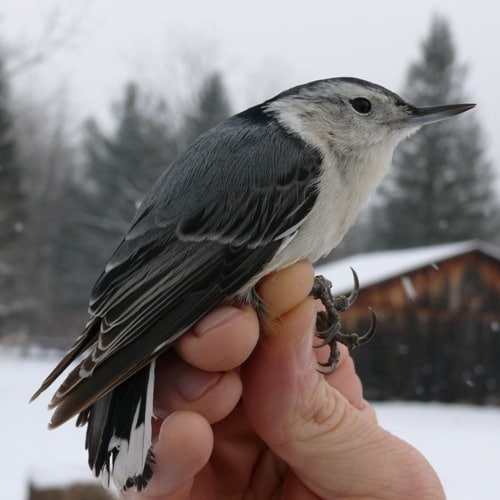
White-breasted Nuthatches are notable for scaling down tree trunks head-first.  Listen for a nasal “yank” call.

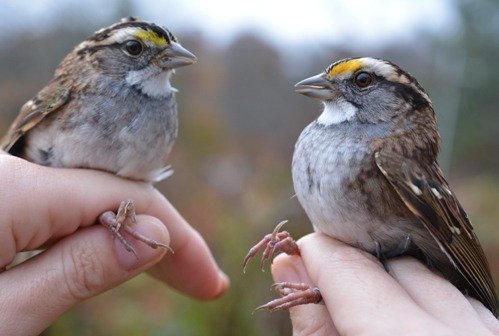
Two white-throated sparrows, with namesake white throats, but also notice the differing yellow and orange lores on these two birds.

The curious and taunting titmice and chickadees are agile fliers and keep watch for hunting hawks and owls, sending out warning calls to alert the foraging party of danger.  On the ground in protected thickets, a different flock searches for food in the forest’s leafy floor.  Resident song sparrows and tree sparrows are joined by white-throated sparrows and dark-eyed juncos from the boreal forests.  These birds avoid a long migration and the enormous energy toll it takes, choosing instead to scavenge for seeds and insects during the short winter days.  Their reward is first dibs on prime summer breeding territory—surely a distant memory to keep them warm during the long, cold winter nights.
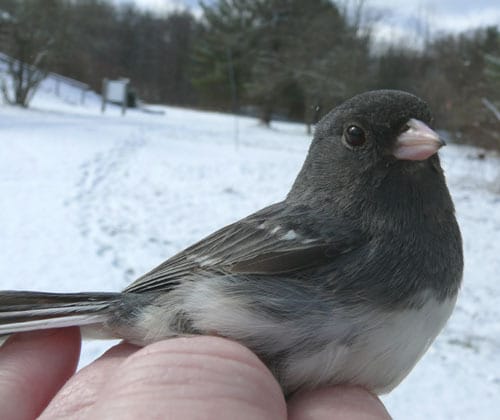
Dark-eyed Juncos are small birds with a gray back and white belly.  Also, notice the pink bill.

When Carolina wrens join these flocks, their trilling and warning calls are distinct.  For the naturalist, imitating the warning call of a bird like the wren can lure in a mixed winter flock for easier observation.  Relying on a type of voice distortion to lure birds is called “pishing.” It is a great skill for birders to master, and it’s useful year-round.  Pishing varies for the bird you want to attract, but usually has a short, staccato “p” straight into a loud “shhh” with variable inflections.  The idea of pishing is to attract birds with a warning call, a sort of call-to-arms which then triggers the formation of a tiny bird gang ready to chase off a predator.  The birds will often join in with their own warning calls and flit about nervously on nearby branches.  Observing the diversity of mixed flocks in the winter demonstrates the unique way these amazing animals work together to survive.
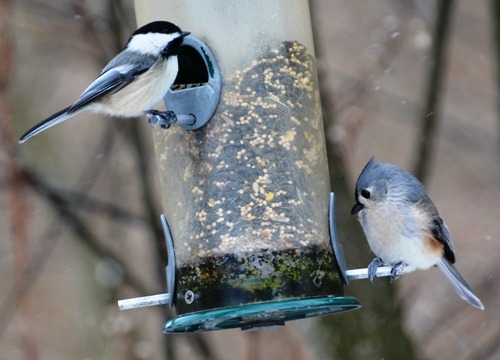
A Black-capped Chickadee (left) and Tufted Titmouse (right) at a feeder.  These two species often travel together.

Fall and winter are also the seasons for bird feeders, where hungry foragers can reliably find a banquet of millet, sunflower, and thistle seeds—even better when caked in suet.  Under some conditions feeding stations become colorful places.  The dull reddish-purple feathers of house finches and purple finches glow against a backdrop of snow, while goldfinches and cardinals ornament nearby trees.  Sparrows, titmice, wrens, and blue jays dip in and out at a feeder to fill up on seeds.  Chickadees come and peck at empty feeders, calling in a squeaky chant for a refill.

Aaron Young is a museum educator on Carnegie Museum of Natural History’s Outreach team. Museum staff, volunteers, and interns are encouraged to blog about their unique experiences and knowledge gained from working at the museum. Images from Powdermill Nature Reserve’s bird banding highlights. 

Related Content

Bird Safe Glass Installed at Carnegie Museums in Oakland
2020 Rector Christmas Bird Count

The Crows Are Back in Town

Filed Under: Blog Tagged With: Aaron S. Young, Birds, Educators, Museum from Home

January 11, 2021 by wpengine

2020 Rector Christmas Bird Count Results

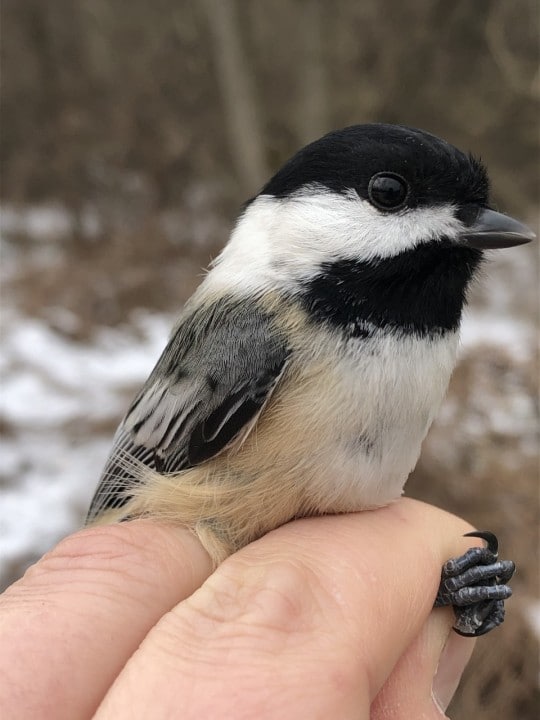
Black-capped Chickadee

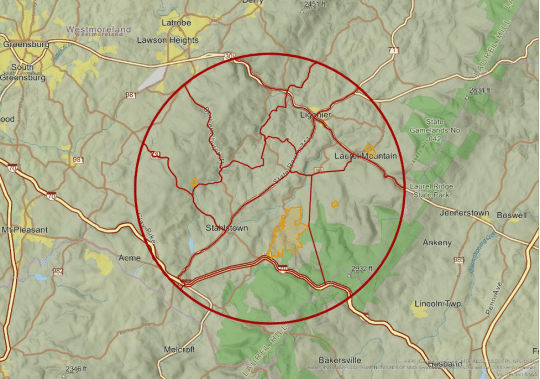
On December 20, 2020, 34 intrepid birders braved a wintry mix to count birds in assigned sectors within a 15-mile diameter circle centered just northwest of Powdermill Nature Reserve. Another eight, who lived within designated territory, closely watched their bird feeders and yards for avian visitors. Why would so many birders be out in less-than-ideal weather conditions? They were all participating in the Rector Christmas Bird Count.

Map of the Rector Christmas Bird Count circle with each count sector outlined with red, created by James Whitacre, GIS Research Scientist at Powdermill Nature Reserve.

Christmas Bird Count (CBC) is an annual event sponsored by the National Audubon Society that happens in mid-December through early January, with the compiler of each count circle choosing a specific count date within that timeframe. This year marks the 121st anniversary of the activity. The count started on Christmas day in 1900 with the purpose of censusing birds by counting them in the field using optics rather than by using shotguns. Although there were only 25 count circles in the first CBC, it has grown into an international event with nearly 2900 circles spread across the Western Hemisphere and even to Pacific Islands as far away as Guam and the Northern Mariana Islands.

Today, the CBC is a fun day for birders and bird watchers of all skill levels to head outside with the goal of identifying and counting every bird they see and hear within their count areas. The data gathered though this citizen science initiative contributes to both long-term and short-term population studies. To date, more than 200 peer-reviewed scientific publications have used CBC data in their analyses.

Although the count was a bit different this year with COVID-19 precautions keeping counters in different germ pools separate, we had an excellent turnout of both advanced and beginner birders, including some young birders.

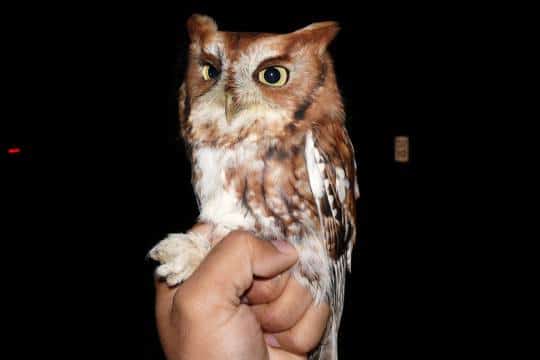
Eastern Screech Owl

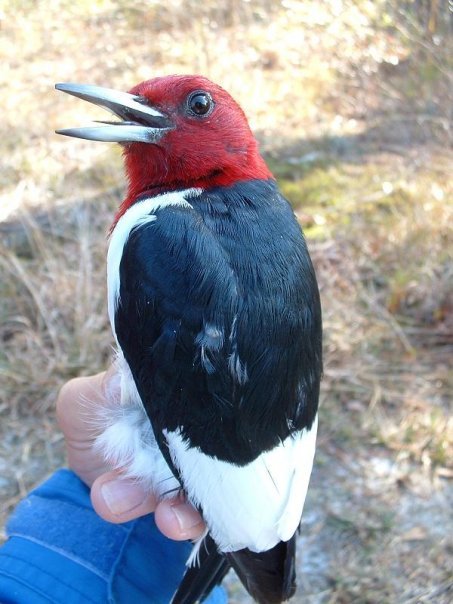
Red-headed Woodpecker

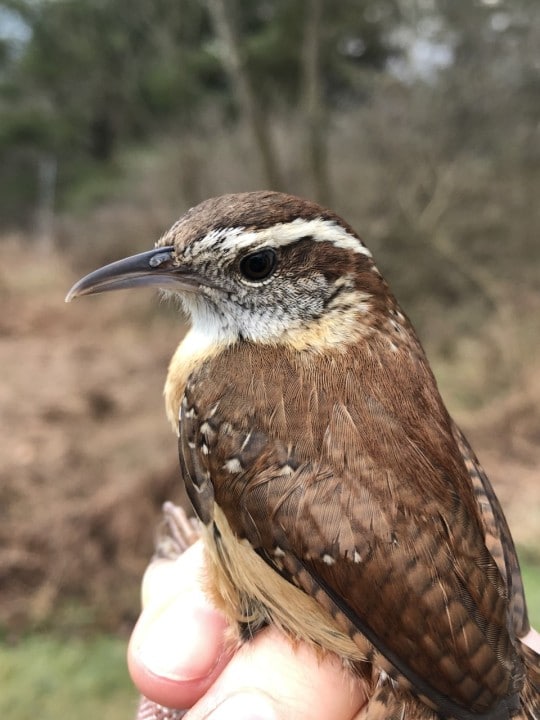
And what a count it was! This winter is an irruption year (for more info on irruptive migration, please see this blog.) for many species, and although we didn’t find hordes of these birds during the count, we did see Pine Siskins, Purple Finches, Red-breasted Nuthatches, higher-than-average numbers of Black-capped Chickadees, and the much sought after Evening Grosbeak. The counters recorded many interesting and less common species this year, including the count’s third ever Snow Goose, third ever Eastern Phoebe, and fifth ever Common Yellowthroat. Both the phoebe and Common Yellowthroat are species that winter in the southeastern US. Counting efforts that began an hour before dawn produced exceptional owl numbers (eight Eastern Screech-Owls, one Great Horned Owl, and two Barred Owls). Additionally, the birders recorded high counts for several species including Ruddy Duck, Black Vulture, Bald Eagle, Red-shouldered Hawk, Red-bellied Woodpecker, Common Raven, Carolina Wren, and Song Sparrow. Most notably, the group counted a record-setting seven Red-headed Woodpeckers, a species that is uncommon in southwestern Pennsylvania and can be reliably found in only one spot of suitable habitat within the count circle.

Carolina Wren

We thank all of the participants for a wonderful count this year! In all, we tallied 4361 birds of 69 species, a remarkable result thanks to the valiant effort of all of the counters. We look forward to hosting the Rector count next year!

Annie Lindsay is the Bird Banding Program Manager at Carnegie Museum of Natural History’s Powdermill Nature Reserve. Museum employees are encouraged to blog about their unique experiences and knowledge gained from working at the museum.

Related Content

Ask a Scientist: Ravens and crows, what’s the difference?

Oh deer, that’s a lot of parasites!

Snowflakes and Snow Fleas

Filed Under: Blog Tagged With: Annie Lindsay, Birds, Powdermill Nature Reserve, Science News

December 8, 2020 by wpengine

The Christmas Bird Count During an Irruption Year

Since 1900, the National Audubon Society has hosted the Christmas Bird Count (CBC), a fun day for birders and bird watchers of all skill levels to get outside and count everything they see and hear within a designated count circle. The CBC was started with the purpose of creating a new way of censusing winter birds. Before binoculars and optics were widely available, people used shotguns during a competition to see who could bring back the biggest pile of birds and mammals. In 1900, conservationists developed a non-destructive way to tally what they saw, and the Christmas Bird Count was born. The CBC’s initial 25 count circles have blossomed into coverage across the continent, in Central and South America, and to the Pacific Islands.

Each year, Powdermill Nature Reserve sponsors the Rector, PA Christmas Bird Count. This year, with some extra pandemic-related safety precautions, an intrepid group of local birders will canvass a 15-mile diameter circle centered just a bit north of Powdermill on Sunday, December 20. Upcoming counts promise to be interesting and exciting locally and across much of North America due to the irruption of many species of “winter finches.”

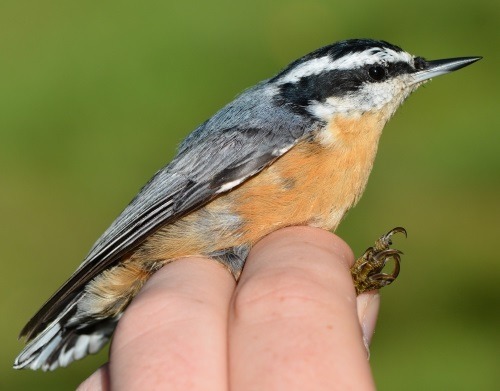
So, what is an irruption and what birds might we expect to see during an irruption year? Irruptive migration happens most often when there’s a change in food availability over much of a species’ normal range. It’s less predictable than the annual migration that we observe every spring and fall, and often happens in a cyclical pattern, reflecting normal changes in abundance of food items. Species that breed in the far north and winter generally farther north than Pennsylvania are those most likely to be irruptive migrants. When there is a poor seed crop, birds that eat things like conifer seeds, such as Pine Siskins, Red-breasted Nuthatches, and Evening Grosbeaks, as well as birds that prey upon small seed-eating animals, such as Snowy Owls, are often seen south of their typical range. This year has already proven to be a major irruption year and the season has barely begun!

image
Red-breasted nuthatch

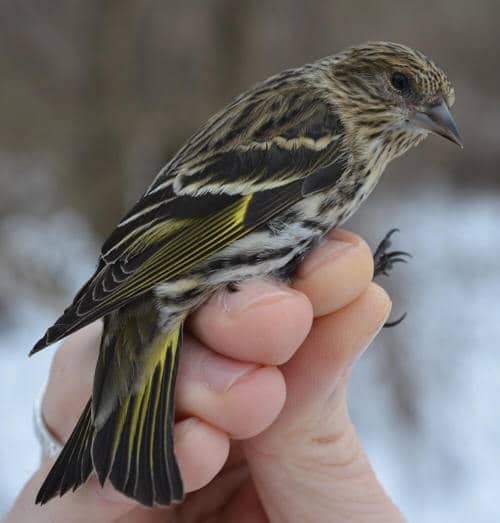
At the beginning of September, we started to see Red-breasted Nuthatches at Powdermill in higher numbers than in previous years. They were followed in early October by large flocks of Pine Siskins, small finches that look a bit like streaky goldfinches. Although many remain in the area, quite a few siskins continued south and are currently flocking to feeders in the Carolinas and beyond! Even more exciting was the influx of Evening Grosbeaks, which first appeared in mid-October. This species’ population is in steep decline: these birds used to be commonly seen here in the winter until about 30-35 years ago, but now visit during only the biggest irruption years.

image
Pine Siskin

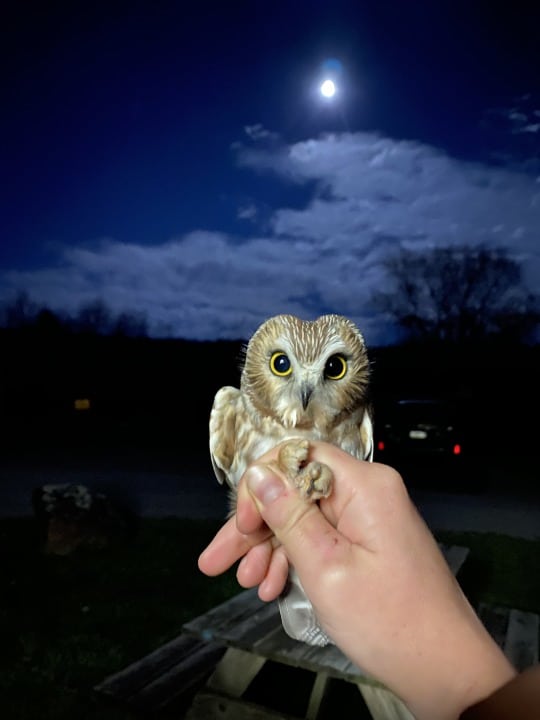
Northern Saw-whet Owl. Photo credit: Catherine Werth

Northern Saw-whet Owls are a species that we generally see each year, but this year banders are catching more than usual. One evening at Powdermill the team caught eight individuals, three of which were foreign recaptures! (This term refers to birds that were banded and recaptured at different banding stations. The three owls from that evening came from northeastern Pennsylvania, southeastern Ontario, and, for a bird initially banded four years ago, western Virginia.) Even familiar and common species that we see year-round but that have ranges that extend far north, such as Black-capped Chickadees and Purple Finches, are being seen in higher numbers this year.

image
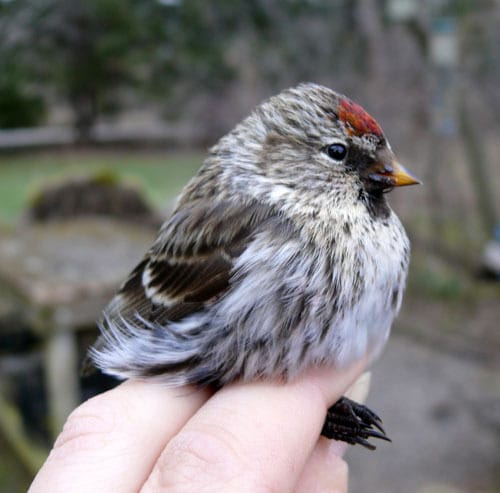
Common Redpoll

What species can we expect next? Red Crossbills and Common Redpolls haven’t been reported in the Powdermill area yet but are creeping ever closer, and if we’re really lucky perhaps we may even spot White-winged Crossbills, Pine Grosbeaks, or Hoary Redpolls. So, keep your eyes peeled, your ears primed for unfamiliar calls, your binoculars polished, and a field guide nearby, and you may have a spectacular Christmas Bird Count season!

For more information about the Christmas Bird Count, please visit: https://www.audubon.org/conservation/join-christmas-bird-count

And for a fun kickoff to the Christmas Bird Count season, Powdermill avian researchers, along with colleagues and a very special guest, will be hosting a watch party of the movie The Big Year the evening of December 18. For more information and to register: https://carnegiemnh.org/event/the-big-year-watch-party/

Annie Lindsay is the Bird Banding Program Manager at Carnegie Museum of Natural History’s Powdermill Nature Reserve. Museum employees are encouraged to blog about their unique experiences and knowledge gained from working at the museum.

Related Content

Bird Safe Glass Installed at Carnegie Museums

Camouflage in Your Yard?

One Man’s Trash is Another Man’s Weather Instrument

Filed Under: Blog Tagged With: Annie Lindsay, Birds, parc, Powdermill Nature Reserve

November 24, 2020 by wpengine

Holiday Stowaway: Northern Saw-whet Owl

Northern Saw-whet Owls have a reputation for showing-up in surprising places. The late November news that one of these small predators accompanied a 75-foot Norway spruce on a 200 mile journey from Oneonta, New York, where the 11-ton tree was cut, to Mid-town Manhattan, where the massive evergreen was installed in a place of honor at Rockefeller Center, fits the species’ profile.

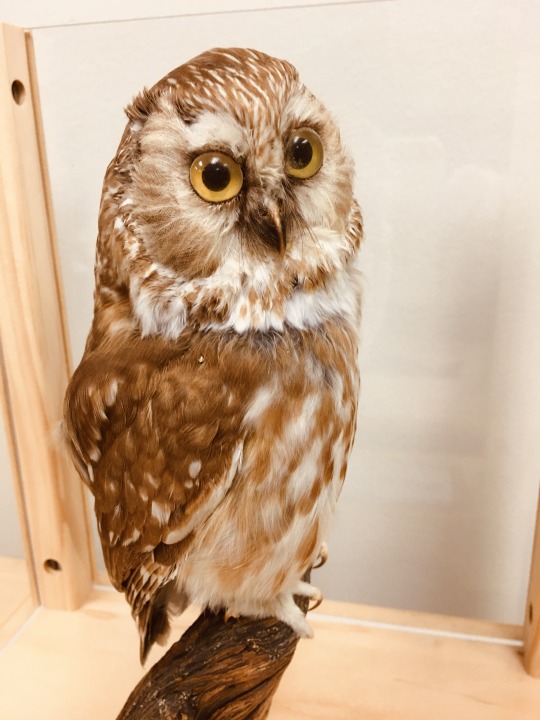
The 8-inch high birds, whose common name reflects the resemblance of one of their calls to the sound of a saw being sharpened with a whet stone, are the smallest owl found in the mid-Appalachian region. As recently as 30 years ago infrequent sightings of the owls were interpreted as evidence of the species’ decline. That assumption began to change in the 1990s with the establishment of Project Owlnet, an ongoing multi-state field study that now consists of more than 100 owl migration banding sites where on late nights every fall researchers rely on recordings of the reclusive bird’s too-too-too breeding call to lure and temporarily capture owls in mist nets. These nocturnal labors have documented healthy populations of the owls in suitable habitats, although this good news is leavened with cautions that the species’ association with higher elevation forests could make it susceptible to the effects of climate change in the coming decades.

The individual owl getting attention as a holiday tree stow-away was driven back upstate to a wildlife rehabilitation facility in the town of Saugerties, where caregivers reported the bird seemed unharmed by its odyssey. The owl, according to reports, was quickly approaching condition for release back into the wild. Back in New York City, however, a counter explanation has developed for how and when the owl arrived in the Rockefeller Center Tree. According to some interested parties, the owl could have been in the city ahead of the tree’s arrival, and sought refuge in the big spruce before it was unloaded.

A taxidermy mount of a Northern Saw-whet Owl is a popular attraction in Discovery Basecamp.

A relatively recent experience leads me to view this explanation as within the realm of possibility. One fall day four years ago, while I was rolling a cart bearing owl taxidermy mounts into a basement classroom, a visitor stopped me by pointing directly at the smallest bird in the set. “Might I have seen this bird last week?” he asked excitedly. “At a bus stop??  On the Northside???” He then explained how the owl had been perched motionless at eye-level within leafy bushes beside a bus shelter, and that, “The owl was still there when I got on my bus.”

The museum basement, I later learned, has a direct claim to an even more remarkable sighting of species now being widely celebrated for cuteness and resilience on social media. In Birds of Western Pennsylvania, the encyclopedic 1940 volume written by the museum’s then Curator of Ornithology, W.E. Clyde Todd, the account for Northern Saw-whet Owl includes this note:

“A curious instance of a young bird found alive in one of the basement storerooms of the Carnegie Museum in June, 1927, was duplicated in July, 1932. There must have been a nesting pair in the immediate vicinity, although one would scarcely expect this owl within the city limits.”

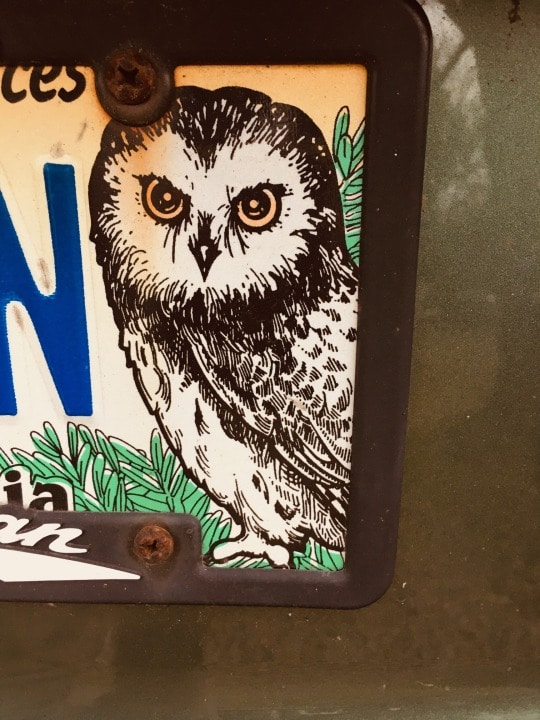
Because the Saw-whet was the original mascot of PA’s Wild Resources Conservation Program, some vehicles still carry license plates bearing ¾ size images of the owl.

For the past seven years, proof of the owl’s seasonal movements through the Pittsburgh area has been found in Sewickley Heights Borough Park where Bob Mulvihill, ornithologist at the National Aviary, has operated a Project Owlnet banding station during the late fall. Information about this important local research can be found on the National Aviary website.

To see a video of a Northern Saw-whet Owl recently banded at Powdermill Nature Reserve, please visit the museum’s TikTok.

Patrick McShea works in the Education and Visitor Experience department of Carnegie Museum of Natural History. Museum employees are encouraged to blog about their unique experiences and knowledge gained from working at the museum.

Related Content

Fraser Fir

Extinct Ornaments

Weighing She-Ra the American Kestrel

Filed Under: Blog Tagged With: Birds, Educators, Museum from Home, Pat McShea

November 3, 2020 by wpengine

Turkeys

by Stephen Rogers

November is the month best known for the holiday celebrated on the fourth Thursday of the month, Thanksgiving, which revolves around one of the classiest of birds in Pennsylvania, the Wild Turkey. Most people are familiar with the local, reasonably tame, birds that roam around Pittsburgh, but few know the history of this noble bird. By the early 1900s habitat loss and over-hunting had left the species in dire shape. Wild turkeys disappeared at one point from Ohio, New York, as well as 16 other states of its original range. The Pennsylvania Game Commission (PGC) can be credited with bringing back the species in the state. The birds became more common field and forest scenery beginning in the mid-1980’s as the agency abandoned a turkey farm that produced captive-bred birds for stocking, and focused restorations efforts on trapping wild turkeys from the areas with sustainable populations, notably northcentral PA and the mountainous areas of Somerset and Westmoreland counties, and re-locating them to areas with suitable habitat. The PGC continues to set the hunting seasons within the state, expanding or restricting both the time periods and locations for hunting to maintain a healthy wild turkey population.

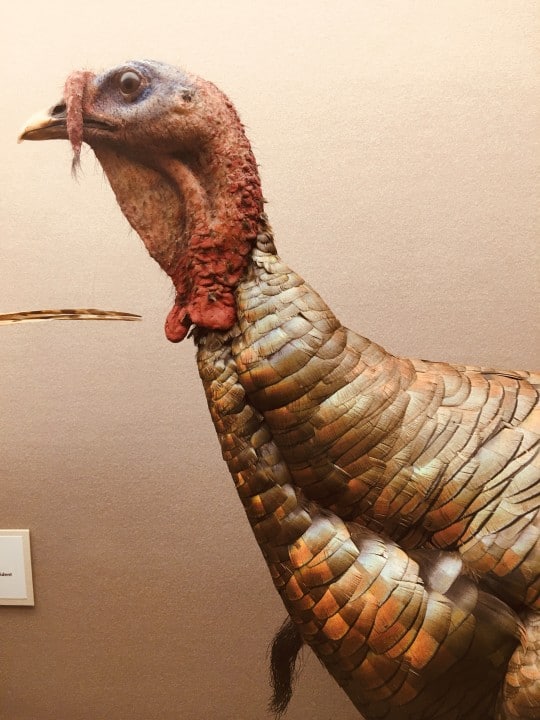
close up of turkey taxidermy mount

Carnegie Museum of Natural History has wild turkey egg sets, skeletons, study skins, taxidermy mounts, and some fluid-preserved specimens from eight states as well as a couple from the failed PGC turkey farm. I was raised in northcentral PA and have contributed two turkey specimens to the collection over my years of working for the museum. One of these, a preserved fluid head, had the distinction of being dissected to study its brain by an ornithologist at the Smithsonian Institution who worked with a CMNH curator, Brad Livezey. They studied higher-level phylogeny and their publication can be seen here.

In recent years the PGC has brought back turkey hunting for two days around Thanksgiving throughout that state as an addition to regional seasons that vary depending on population levels. Because we are encouraged to blog, I thought I would relate a Thanksgiving Turkey tale here.

Among my most memorable Thanksgivings was the holiday 49 years ago, in 1971, when our family had the family of my mother’s twin sister over for dinner. Hunting was what occupied most of my waking thoughts in those days, but my hunting partner, my dad, had to work that morning and it became my task to take my Uncle John and cousin Ronnie out in four inches of new snow that had fallen the day before. My aunt, who was undergoing breast cancer treatment, wanted to spend time with her twin to celebrate perhaps their last holiday together. For these sisters and their daughters, getting the “menfolk” out of the way seemed to be the best way to create the proper atmosphere.

I had never hunted with Uncle John or Ronnie before, but I knew where to find a turkey flock.  After a mile-long hike we busted up a flock and John promptly missed one of the scattering big birds. At this point we split up, hoping to run into lone turkeys as they tried to regroup. I headed in the direction of some of the fleeing birds to use a turkey call, while John and Ronnie sat amid the large laurel thicket we had rousted the flock from.

After a period of time, Uncle John had to do what bears are notoriously known for doing in the woods. An experienced hunter would always keep his shotgun handy anywhere while hunting, but John leaned his gun against a tree and went a few feet away to do his business. Of course, out came a few turkeys into a clearing just yards away from him, looking at him with apparent wonder at what he was doing with his pants down.

We never got a turkey that day, but among the many Thanksgivings I have experienced it was the most memorable. As we all ate turkey around the ping-pong table in the basement that evening, Uncle John took his ribbing with great humility, and the banter took my aunt’s thoughts away from the cancer which was late stage at that time.

As we commemorated Breast Cancer Awareness last month, it should be on everyone’s mind that mammograms should still be done in this era of COVID.

I hope to take my gun out for a walk this Thanksgiving, but I imagine the turkeys will socially distance from me. Shooting a bird isn’t the end all of a hunt, it’s the memories we make afield.

For more history on the wild turkey see:

History of the Wild Turkey in North America

A Look Back at Wild Turkeys

Stephen Rogers is Collection Manager in the Section of Birds at Carnegie Museum of Natural History. Museum employees are encouraged to blog about their unique experiences and knowledge gained from working at the museum.

Related Content

Ravens and Crows, What’s the Difference? 

Powerlifting Poultry and Mallards That Marathon

Bard Birds

Carnegie Museum of Natural History Blog Citation Information

Blog author: Rogers, Stephen
Publication date: November 3, 2020

Share this post!

  • Share on Twitter Share on Twitter
  • Share on Facebook Share on Facebook
  • Share on Pinterest Share on Pinterest
  • Share on LinkedIn Share on LinkedIn
  • Share on Reddit Share on Reddit
  • Share via Email Share via Email

Filed Under: Blog Tagged With: bird hall, Birds, Hall of Birds, Section of Birds, Stephen Rogers

October 7, 2020 by wpengine

Halloween and Birds

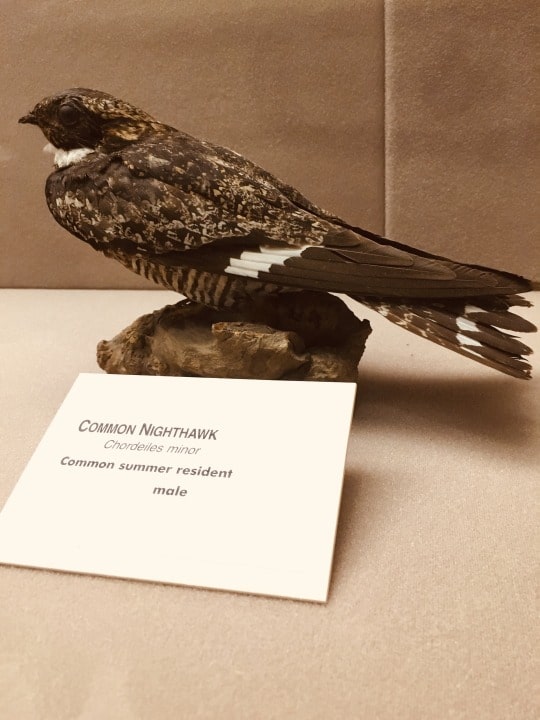
Birds, being the happy creatures they are, don’t seem to me to connect with Halloween. Sure, death scenes in old movies, or exaggerated depictions of nighttime itself, are often populated with vultures, owls and corvids (crows and ravens), but Halloween itself, not so much. About the only “scary” term I can think of relating to birds is the group popularly referred to as “GOATSUCKERS.”

Early stories about goatsuckers can be credited to Aristotle and Pliny over 2000 years ago. Rumors about a group of birds now classified Caprimulgids, indicated they would suck the milk out of goats, and afterwards the goats would go blind. Of course, the stories are false, but the persistence the common group name might very well continue to frighten young children.

The 70 species of Caprimulgids remain saddled with a Family name, and in some cases a Genus name, that translates from Latin, “capra” for nanny goat, and “mulgēre” to milk, as “milker of goats,” or considering how a bird might attempt such a feat, “goatsucker.”

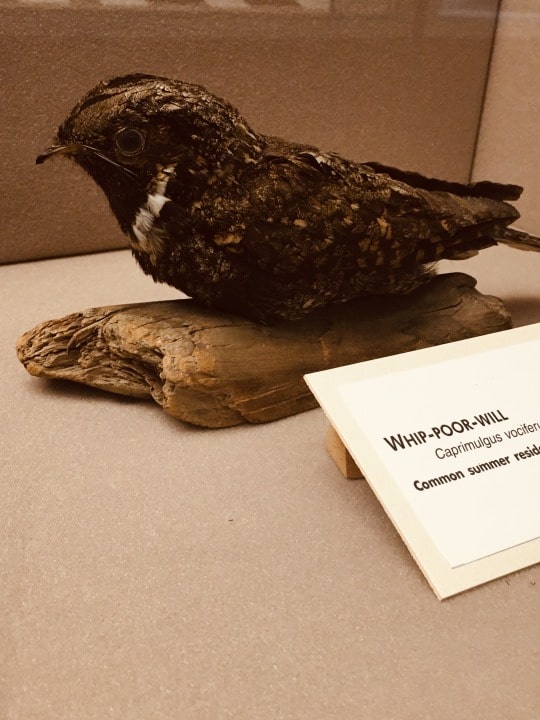
taxidermy mount of whip-poor-will
Image credit: Pat McShea

The family Caprimulgidae is a nocturnal group of birds referred to as nightjars or nighthawks that live worldwide except in New Zealand and on some islands in Oceania. In Pennsylvania the only birds of this group seen routinely are the Common Nighthawk and the Whip-poor-will, and both species are declining in numbers. Both are insectivorous birds with what appears to be small mouths that can actually open extremely wide to swallow insects in flight. The sounds of Whip-poor-wills can be haunting to those unfamiliar with them. For an image of the bird and a recording of their distinctive sound click this YouTube link.

taxidermy mount of common nighthawk
Image credit: Pat McShea

The CMNH Section of Birds collection, with nearly 207,000 records, includes only three “goatsuckers” collected on Halloween. Two are Pauraques (Nyctidromus albicollis yucatanensis) from Veracruz, Mexico collected in 1963, and a single Common Nighthawk (Chordeiles minor minor) found dead by former Amphibian and Reptiles Curator Jack McCoy in Schenley Park on Halloween night 1989. Migration should have happened long before that date – in fact this fall Pittsburgh’s estimated peak occurred September 14, when an estimated flight of 50,000 birds of various species passed overhead overnight.

Stephen Rogers is Collection Manager in the Section of Birds at Carnegie Museum of Natural History. Museum employees are encouraged to blog about their unique experiences and knowledge gained from working at the museum.

Related Content

Sympathy For the Devil

Collected on This Day in 1967: Fall Blooms Rival Those of Spring

Ask a Scientist: How do you tell the difference between a raven and a crow?

Filed Under: Blog Tagged With: Birds, Hall of Birds, halloween, Science News, Section of Birds, Stephen Rogers

  • « Go to Previous Page
  • Page 1
  • Interim pages omitted …
  • Page 4
  • Page 5
  • Page 6
  • Page 7
  • Page 8
  • Interim pages omitted …
  • Page 20
  • Go to Next Page »

sidebar

About

  • Mission & Commitments
  • Directors Team
  • Museum History

Get Involved

  • Volunteer
  • Membership
  • Carnegie Discoverers
  • Donate
  • Employment
  • Events

Bring a Group

  • Groups of 10 or More
  • Birthday Parties at the Museum
  • Field Trips

Powdermill

  • Powdermill Nature Reserve
  • Powdermill Field Trips
  • Powdermill Staff
  • Research at Powdermill

More Information

  • Image Permission Requests
  • Science Stories
  • Accessibility
  • Shopping Cart
  • Contact
  • Visitor Policies
One of the Four Carnegie Museums | © Carnegie Institute | Privacy Policy | Terms of Use | Accessibility
Rad works here logo