• Skip to primary navigation
  • Skip to main content
  • Skip to primary sidebar

Carnegie Museum of Natural History

One of the Four Carnegie Museums of Pittsburgh

  • Visit
    • Buy Tickets
    • Visitor Information
    • Exhibitions
    • Events
    • Dining at the Museum
    • Celebrate at the Museum
    • Powdermill Nature Reserve
    • Event Venue Rental
    • Gift Cards
  • Learn
    • Field Trips
    • Educator Information
    • Programs at the Museum
    • Bring the Museum to You
    • Guided Programs FAQ
    • Programs Online
    • Climate and Rural Systems Partnership
  • Research
    • Scientific Sections
    • Science Stories
    • Science Videos
    • Senior Science & Research Staff
    • Museum Library
    • Science Seminars
    • Scientific Publications
    • Specimen and Artifact Identification
  • About
    • Mission & Commitments
    • Directors Team
    • Museum History
  • Tickets
  • Give
  • Shop

Blogs about Birds

Birds are incredibly important to Carnegie Museum of Natural History. The museum's Section of Birds contains nearly 190,000 specimens of birds. The most important of these are the 555 holotypes and syntypes. The Section of Birds staff also cares for approximately 196 specimens of extinct birds as well as specimens of many rare species collected decades—if not more than a century—ago.

March 11, 2019 by wpengine

The Symbol of the Anthropocene in Preparation at the Carnegie Museum

black question mark on white background

As an intern in the Anthropocene section at the Carnegie Museum, I had the privilege of exploring some of its treasures, either preserved in the collections or displayed for the public, and reflecting on how objects can help us consider the planetary changes underway in the Anthropocene.

During my explorations, I was asked what was my highlight, or what object best exemplifies the Anthropocene to me?
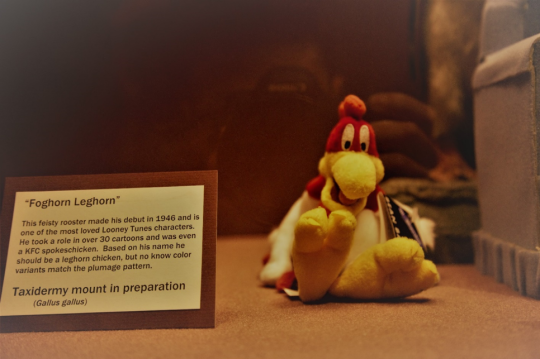
Picture from case in Bird Hall. Taxidermy mount in preparation because Steve Rogers, collections manager of Birds, is still waiting to find a specimen that looks like the Foghorn Leghorn.

Turns out – my most vivid symbol of the Anthropocene is absent. It is not found in either the collections, or in the gallery halls (although it is found in the cafeteria)!

Yes indeed, my favorite symbol is the commercial broiler chicken, likely one of the most common birds in the world because it reaches slaughter weight in less than half the time of other domestic or wild chickens! Surprised? Disappointed? Let me explain…

Last year, the director of the museum, Dr. Eric Dorfman, wrote a compelling blog titled Counting Your Chickens: The World’s Most Numerous Bird. Chickens are likely the most numerous bird in the world. In light of the Anthropocene, we could even say in Earth history. There are about 23 billion chickens alive at any given time. By comparison, the second most numerous bird reported is the red-billed quelea, which lives across the continent of Africa, with an estimated population of 1.5 billion.

You probably wonder how the chicken conquered the world. Its long journey began around 7,000 years ago when it was first domesticated from the red junglefowl (Gallus gallus), native to south-east Asia. But the bird’s trajectory radically changed in the second half of the 20th century, during what is now called “The Great Acceleration.” With changes in farming practice and the intensive production of broilers, the chicken population exploded. Meat-chicken consumption is still on the rise with more than 65 billion chickens consumed globally in 2016.

The commercial broiler chicken is even more radically different from its ancestors and other kinds of chickens. The change is about their shape, genes, and chemistry. Their genes, for instance, have been altered so that the birds are constantly hungry. In other words, they have been bred for a specific purpose: to gain weight rapidly (and they do it five times faster than chickens from the mid-20th century). It is a perfect example of what Richard Pell, director of the Center for PostNatural History and Associate Professor of Art at Carnegie Mellon University, means by the term “postnatural,” that is an organism that has been intentionally and heritably altered by humans.

The commercial broiler chicken is the direct result of human intervention. One could argue that selective breeding practices are not new. However, the Anthropocene captures a very recent rupture in Earth’s history by highlighting rapid and unprecedented changes at a planetary scale. Commercial broiler chickens and their biology shaped by humans, created in just a few decades, symbolize the transformation of the Earth’s biosphere. And new research suggests that the commercial broiler chicken’s distinctive bones could become fossilized markers of the Anthropocene. Perhaps it would be more appropriate to talk about the Gallucene.

Stories like this show how the Anthropocene offers an opportunity to rethink how we view natural history and what we put in our collections. The Carnegie Museum of Natural History is undertaking this ambitious and necessary shift in order to understand what it means to live in this new epoch.

Gil Oliveira is an intern in the Section of the Anthropocene. Museum employees are encouraged to blog about their unique experiences and knowledge gained from working at the museum.
Filed Under: Blog Tagged With: Anthropocene, bird hall, Birds, Gil Oliviera

March 4, 2019 by wpengine

Make Your Own Pinecone Bird Feeder!

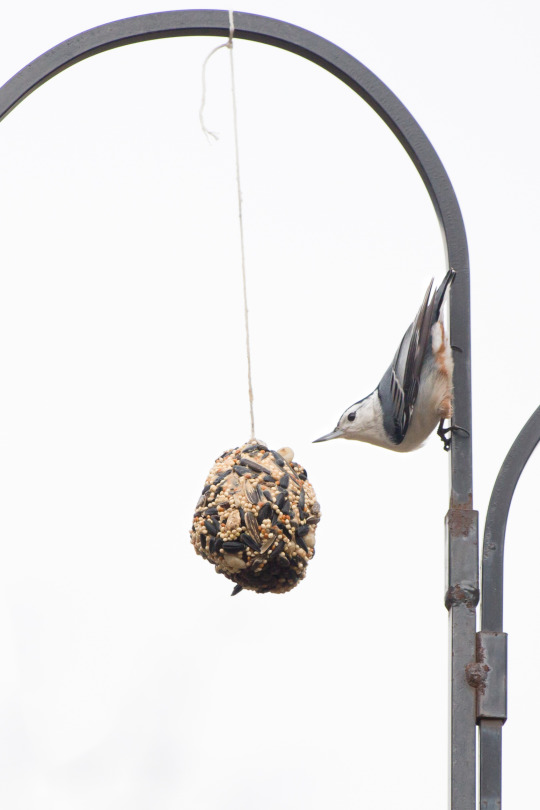
bird with pinecone bird feeder

Homemade bird feeders are a great way to attract many birds to your yard this winter…even when it seems like all the animals have disappeared!

What You’ll Need:

·      Large pinecones

·      String, wire, or pipe cleaners

·      Peanut butter or vegetable shortening

·      2 plates

·      Scissors

·      Butter knife

·      Store-bought or homemade* birdseed

*We recommend visiting https://feederwatch.org/learn/feeding-birds/#food-types for pointers on what seeds to use or avoid.

Directions:

1.    Gather large pinecones with open scales. Explore your backyard or find a nearby hiking trail.  This is a great opportunity to go on an adventure with your friends or family!

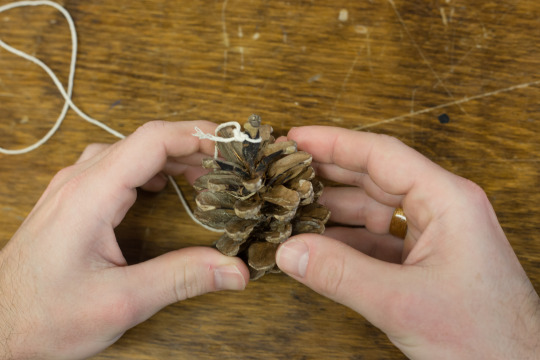
2.    Attach string, wire, or pipe cleaner to the top of the pinecone.  Make sure your string or wire is long enough to tie and hang from a high point.  You can use one attachment around the tip of the cone or you can tie two attachments to two different scales below the tip of the pinecone.  Do this first!  Your cone will get very messy and it will be hard to attach anything after you’ve rolled your pinecones in seed.

two hands holding pinecone

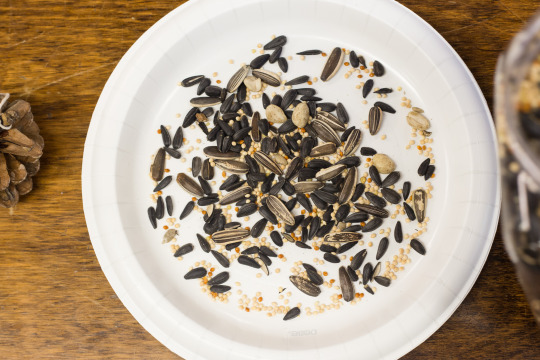
3.    Pour your bird seed onto a plate.  If you’re using a homemade mix, try mixing the different nuts and seeds together in a bowl before you pour them onto a plate.

birdseed on a plate

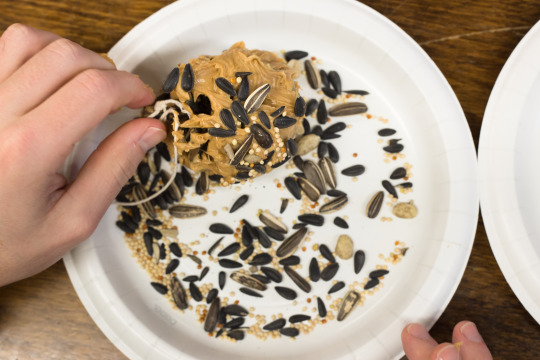
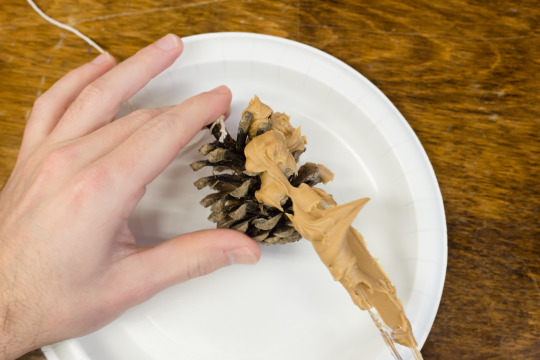
4.    Get ready to get messy!  Spread peanut butter or shortening all over a pinecone using a butter knife.  Make sure you get your “glue” in all the creases and crannies.

spreading peanut butter on pinecone with a knife

5.    Next, roll your sticky pinecone on your plate of seeds.  Press down and roll back and forth until the pinecone is mostly covered in your seed mixture.  Sprinkle more seeds in any areas that have been missed and roll one more time.

rolling peanut butter covered pinecone in bird seed

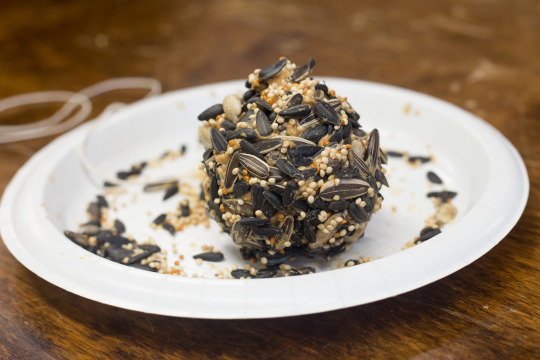
6.    When you’re happy with how the pinecone looks, place it on a plate to rest while you finish the rest of your pinecones. Repeat steps 4 and 5 with all the pinecones you want to make.

pinecone bird feeder on a plate

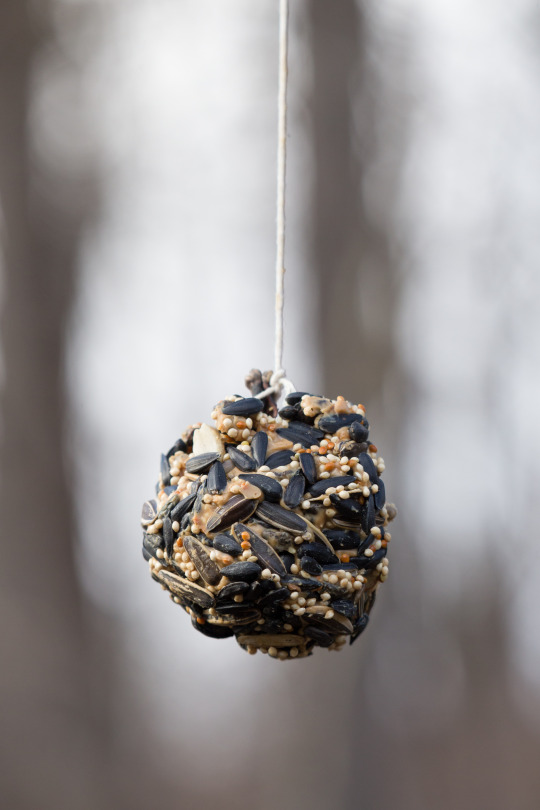
7.    Finally, go outside and look for places to hang your new birdfeeders!  Good places to hang your cones are on tree branches, the edges of buildings, or poles. It might be impossible to keep squirrels away from your pinecone, but hang your feeder high enough so that cats, dogs, and other animals can’t reach it.  You may need to tie extra string, wire, or pipe cleaners to your feeder to reach high enough.  Pick places that are easy for you to observe but are far enough away from a window that birds don’t hurt themselves by flying into windows!

finished pinecone bird feeder hanging

After you’ve made and hung your homemade bird feeders, take time every day to watch and see what kinds of birds come to snack! Make observations and sketches in your handy nature notebook. Are different birds visiting at different times of the day?  What birds are attracted to the type of seed you used?  What birds do you see more often than others?  When you see a bird you don’t recognize, use a bird guide like the Merlin ID mobile app and, if you can, take a picture!

Visit https://feederwatch.org/ to see how sharing your observations can help scientists learn more about birds visiting feeders.

Now You See(d) It:  The type of seeds you use in your birdfeeder can determine how many birds come to visit and what kinds.  Over 20 different types of seeds are often sold as birdseed!  To attract a diverse population of birds, try using a wide assortment of seeds.

Explore nature together.  Visit Nature 360 for activities and information.

Blog post by Melissa Cagan and Rachel Carlberg.

Filed Under: Blog Tagged With: Birds, Crafts, nature, Nature 360

February 25, 2019 by wpengine

Bugs on Bugs on Bugs…on Birds

Big fleas have little fleas

Upon their backs to bite ‘em;

And little fleas have lesser fleas

And so, ad infinitum.

-Ogden Nash

Flat flies, louse flies, keds. The distinctive members of the fly family Hippoboscidae go by many names. All are obligate blood feeders found on mammals or birds and have a flattened body shape suitable for sliding in between the feathers and fur of their hosts. Their life history is as strange as their appearance, I assure you. While the vast majority of flies and other insects lay numerous eggs to reproduce, female hippoboscids prefer a more mammalian strategy. A single fertilized egg hatches within the female, and the developing larva is nourished within the mother through specialized “milk” glands until it is fully grown. The hugely swollen female then gives birth to a mature larva which immediately pupates, and later emerges as a winged adult hungry for a blood meal.

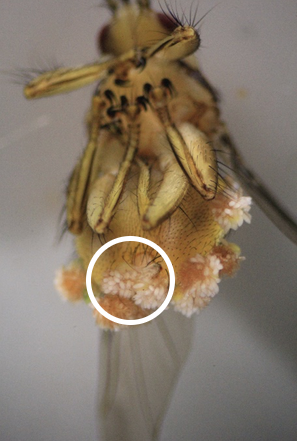
Hippoboscids are frequently encountered at the banding station at Powdermill Nature Reserve. Last year, most of the birds that were processed here were checked for these parasites, which were collected. Not much is known about these flies on songbirds as most of the research conducted deals with raptors. While identifying the flies under a microscope, we discovered these flies were often carrying some smaller bugs with them on their abdomens. These hitchhikers were bird lice and avian skin mites (see photos).

fly with white circle drawn around bird lice on abdomen
Dorsal view of a hippoboscid fly with several bird lice hitching a ride on its abdomen.


fly with white circle drawn around mites
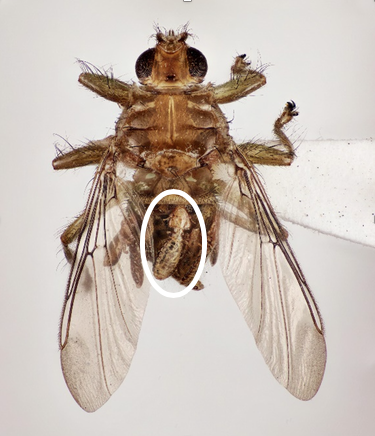
Ventral view of a hippoboscid fly carrying several female avian skin mites (Epidermoptidae), each surrounded by a cluster of white eggs.

Both of these small parasites are wingless and poor dispersers, but can conveniently get from bird to bird by riding on the hippoboscid flies, a strategy called phoresy. In the case of the skin mites, the females actually require a hippoboscid to reproduce. They attach themselves to the body of the fly and lay their eggs all around them in a clump. To add to the craziness, sometimes the mites attach to the lice which attach to the fly, which you find on birds. So there you have it. Bugs on bugs on bugs… on birds!

Andrea Kautz is a Research Entomologist at Carnegie Museum of Natural History’s Powdermill Nature Reserve. Museum employees are encouraged to blog about their unique experiences and knowledge gained from working at the museum.
Filed Under: Blog Tagged With: Andrea Kautz, avian research, Birds, bugs, Powdermill Nature Reserve

February 14, 2019 by wpengine

Getting Ready for the Great Backyard Bird Count

So you want to take part in the Great Backyard Bird Count? You’ve got your nature notebook ready and you’ve found the perfect spot to birdwatch.  What do you do next?  The Great Backyard Bird Count website has a lot of resources to help you organize your bird counts and submit your information, so you should check those out before the bird count starts.  This post will give you a basic picture of how to document the birds you see and submit your observations properly.

Make a List, Check it Twice

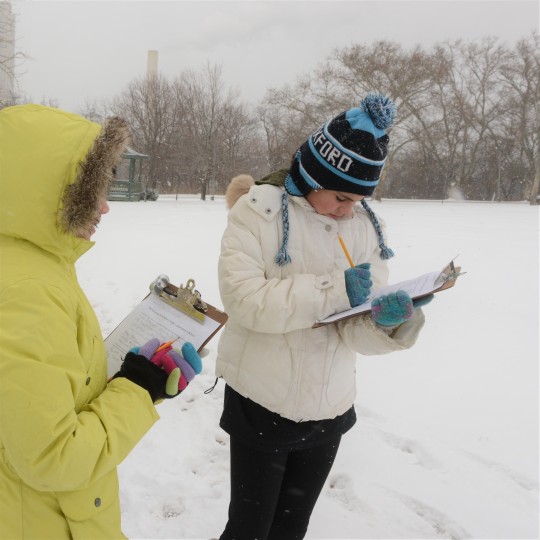
two people taking notes outside in winter
Photo credit: Jim Judkis

Creating a checklist before you start birdwatching will be really helpful in organizing your research.  You can print out this template, enter your location on the count’s website to create a checklist, or create your own guide using a list of birds found in your area.  When you enter your observations online, you will submit a “checklist” for each different session of birdwatching. These lists will document where and when you observed, what species you noticed, and how many individual birds you estimated per species.  A bird guide like the Merlin Bird ID app can help you identify birds you see.

You will want to make a new checklist for each new day, new location, or new time that you look for birds.  For example, you’ll need two checklists if you observe in the same location on two different days, in two different locations on the same day, or in the same location but at two separate times.  When you go to submit your observations, you will be asked to enter the location, date, time, and duration of your expedition.  You will also be asked whether you were walking, standing, sitting, or even riding in a car while you were counting.  Now go forth and count those birds!

Data Ready

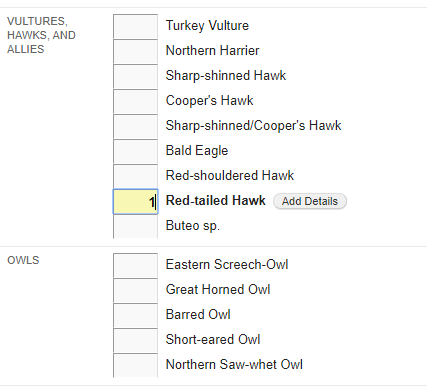
Once you have collected your data, all you need to do is go online and enter in the number of birds you saw next to the name of the birds you noticed!  You can also add details about each bird species and if you were able to take pictures of any birds, you can include them as well.

excerpt of data from bird count

Keep in Mind

The submission form will have a question at the end, “Are you submitting a complete checklist of the birds you were able to identify?” which can be confusing to some.  You should only click “no” if you are deliberately excluding a species from your list (for example you counted everything except crows).

Explore nature together. Visit Nature 360 for more activities and information.

Blog post by Melissa Cagan. 

Filed Under: Blog Tagged With: bird banding, bird hall, birding, Birds, Nature 360, Powdermill

February 7, 2019 by wpengine

Bird is the Word

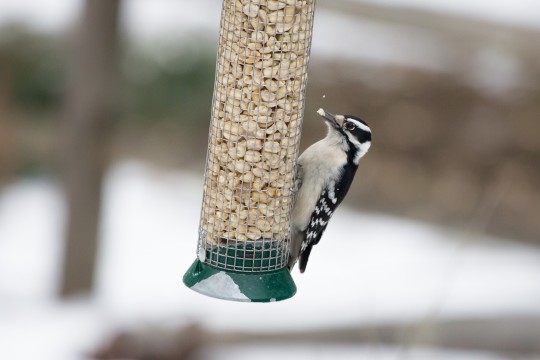
bird at bird feeder

February’s here and you know what that means… it’s time for the Great Backyard Bird Count!  Since 1998, people all over the world have participated annually in the Great Backyard Bird Count to collect information on wild birds by observing areas in their own neighborhoods.  Last year people from over 100 countries participated!  The Great Backyard Bird Count gathers data to help scientists figure out what is happening to bird populations around the globe.  That means YOU can contribute to science just by taking time to look outside your windows.  Scientists can’t be everywhere, and that’s where you come in!

Birds, Birds, Everywhere

The best part about the bird count is… it’s really easy (and free) to join in!  All you need is a way to note your observations (a task perfect for your handy nature notebook), access to the internet, and your enthusiasm!  You can look at a local park, your yard, or anywhere you want to go — data from everywhere is useful!

Ready, Set, Count!

bird on a branch

Before you start looking for birds, you’ll want to set up an online account through the Great Backyard Bird Count’s website.  Once that is ready, all you have to do is spend at least 15 minutes looking outside at any time between February 15th and February 18th.  Count the number of birds and different species you see, and then submit your observations through your online account. Scientists will use the data, and you can use the information to explore what kinds of birds other people have seen nearby.

Some questions you might help scientists answer are:

-“How does weather and climate change affect bird populations?

-“How are diseases that birds can catch, like the West Nile virus, affecting birds in different areas?”

-“Are there bird species that only live in certain locations such as cities or rural areas?”

Lord of the Wings

The Christmas Bird Count, which happens at the end of December, found over 24,000 birds in Pittsburgh in 2018.  There were 71 different species represented in the total count.  Let’s see if we can find even more birds this February!  Follow this link to get ready!

Explore nature together. Visit Nature 360 for more activities and information.

Blog post written by Melissa Cagan and Rachel Carlberg.

Filed Under: Blog Tagged With: Anthropocene, bird hall, birding, Birds, Education, Melissa Cagan, Nature 360, Rachel Carlberg

February 6, 2019 by wpengine

Red Bird

By Patrick McShea

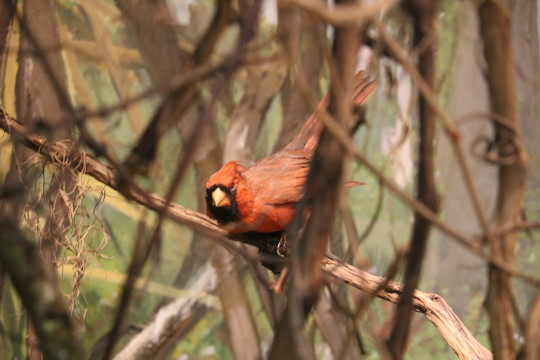
cardinal diorama

A detail in a Hall of Botany diorama can add much to our understanding of a popular songbird. Pictured above is a male Northern Cardinal, a species widely portrayed on cards and calendars amid snowy scenery.

Cardinals are certainly noticeable under winter conditions. The bright red of the male’s feathers and the reddish-brown plumage of the female stand out in snow covered landscapes. The range for this non-migratory species is enormous, however, and includes tropical regions.

The Hall of Botany bird, for example, adds color to a three-dimensional recreation of a tiny patch of Florida Everglades. Northern Cardinals have also long occupied suitable habitat much further south in Mexico and Guatemala.

The species, which has been deemed the official avian representative for seven U.S. states, was rarely seen anywhere in Pennsylvania until the 1890s. In Birds of Western Pennsylvania, the encyclopedic volume published in 1940 by the museum’s then Curator of Ornithology, W.E. Clyde Todd, growth of the local cardinal population is noted:

In recent years it has invaded the parks and residential sections of Pittsburgh in gradually increasing numbers, and it is seemingly as much at home there as it is in the wooded ravines in the vicinity of the city.”

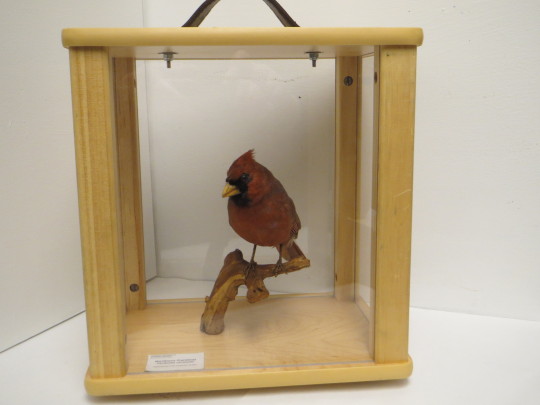
cardinal diorama
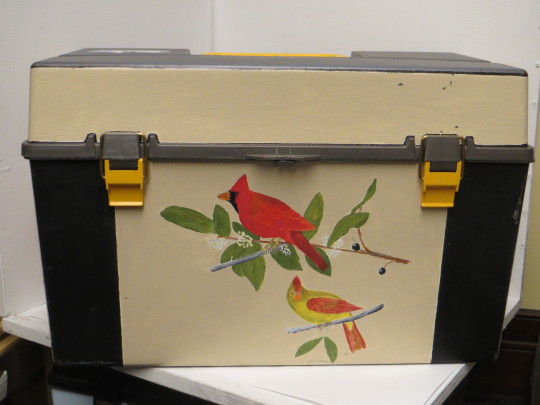
tool box with painted cardinals

One measure of the Northern Cardinal’s continued popularity is requests by elementary teachers to borrow taxidermy mounts of the species from the museum’s Educator Loan Collection. Pictured above are a taxidermy mount and the “toolbox” it travels in. The illustration on the box is a recreation of John James Audubon’s cardinal portrait by Museum Educator Assistant John Franc.

Patrick McShea works in the Education and Visitor Experience department of Carnegie Museum of Natural History. Museum employees are encouraged to blog about their unique experiences and knowledge gained from working at the museum.
Filed Under: Blog Tagged With: bird hall, Birds, botany hall, Education, Educator Loans, Hall of Botany, Patrick McShea, pennsylvania, western pennsylvania

  • « Go to Previous Page
  • Page 1
  • Interim pages omitted …
  • Page 7
  • Page 8
  • Page 9
  • Page 10
  • Page 11
  • Interim pages omitted …
  • Page 20
  • Go to Next Page »

sidebar

About

  • Mission & Commitments
  • Directors Team
  • Museum History

Get Involved

  • Volunteer
  • Membership
  • Carnegie Discoverers
  • Donate
  • Employment
  • Events

Bring a Group

  • Groups of 10 or More
  • Birthday Parties at the Museum
  • Field Trips

Powdermill

  • Powdermill Nature Reserve
  • Powdermill Field Trips
  • Powdermill Staff
  • Research at Powdermill

More Information

  • Image Permission Requests
  • Science Stories
  • Accessibility
  • Shopping Cart
  • Contact
  • Visitor Policies
One of the Four Carnegie Museums | © Carnegie Institute | Privacy Policy | Terms of Use | Accessibility
Rad works here logo