• Skip to primary navigation
  • Skip to main content
  • Skip to primary sidebar

Carnegie Museum of Natural History

One of the Four Carnegie Museums of Pittsburgh

  • Visit
    • Buy Tickets
    • Visitor Information
    • Exhibitions
    • Events
    • Dining at the Museum
    • Celebrate at the Museum
    • Powdermill Nature Reserve
    • Event Venue Rental
    • Gift Cards
  • Learn
    • Field Trips
    • Educator Information
    • Programs at the Museum
    • Bring the Museum to You
    • Guided Programs FAQ
    • Programs Online
    • Climate and Rural Systems Partnership
  • Research
    • Scientific Sections
    • Science Stories
    • Science Videos
    • Senior Science & Research Staff
    • Museum Library
    • Science Seminars
    • Scientific Publications
    • Specimen and Artifact Identification
  • About
    • Mission & Commitments
    • Directors Team
    • Museum History
  • Tickets
  • Give
  • Shop

collected on this day

March 15, 2021 by wpengine

Collected on this Day in 1957

Spring at Powdermill.

An early bloomer.
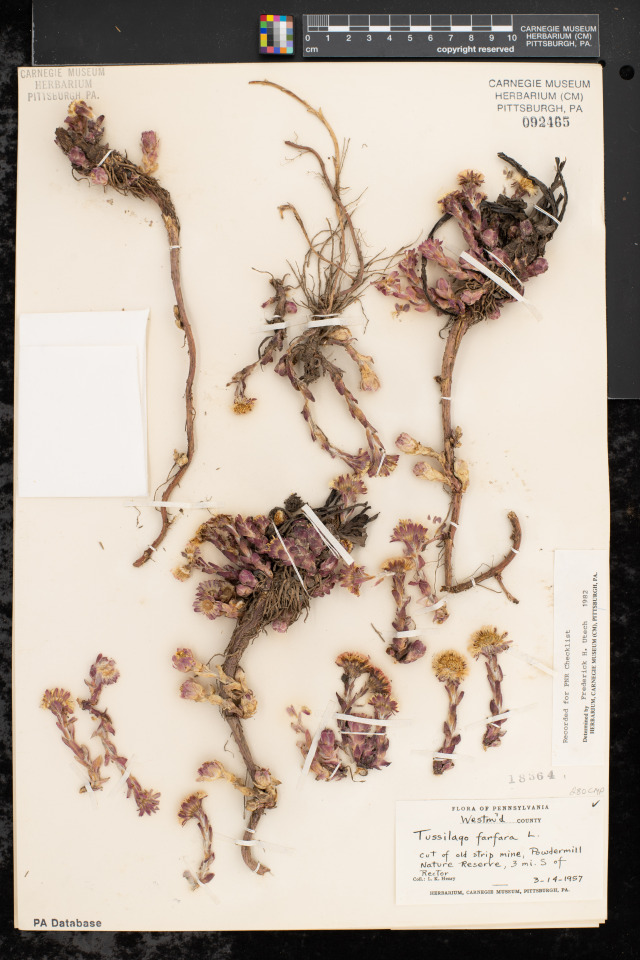
dried specimen of coltsfoot on an herbarium sheet

This specimen of coltsfoot (Tussilago farfara) was collected at Powdermill Nature Reserve, the field station of Carnegie Museum of Natural History in 1957, just one year after the facility was established. It was collected by Leroy Henry, a Curator of Botany at the museum from 1937 until 1972 (though he was also affiliated with the museum before and after this period). Henry is an important collector for our region, with >36,000 specimens in the Carnegie Museum herbarium.
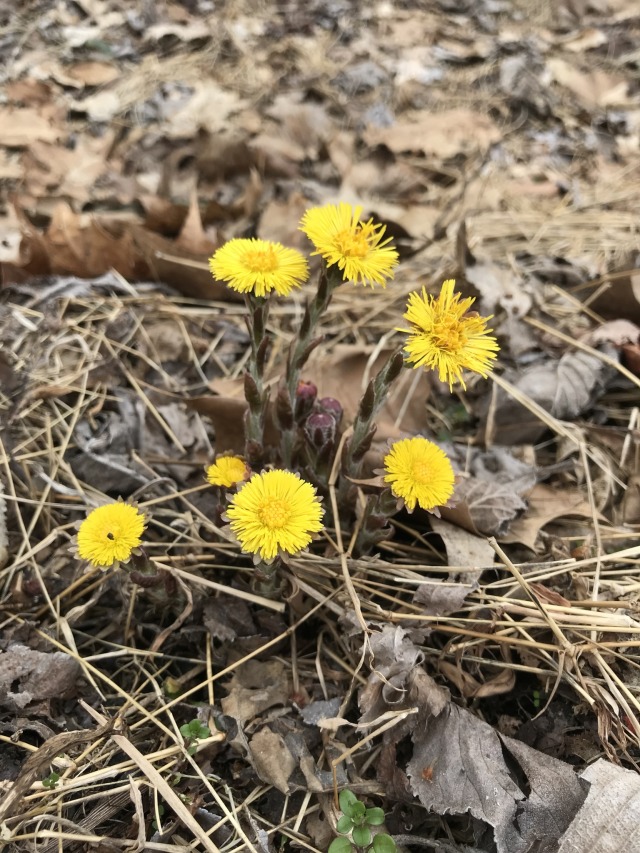
coltsfoot flowering in spring

At first look, the plant may be confused with your common dandelion. It has definite similarities, as it is in the same plant family, Asteraceae, and bears yellow flowers. But, as you’ll notice from the specimen – flowering coltsfoot doesn’t have leaves!

Coltsfoot, which is native to Europe, was introduced to Pennsylvania, and is quite unique in our state’s flora. The plant blooms very early in the spring, with dandelion-like flowers frequently poking through the soil of otherwise barren slopes. The leaves soon follow, and they are shaped like – well – a colt’s foot! Quite different than the familiar serrated edge shape of dandelion leaves.

Coltsfoot’s early appearance also makes it a great species to track changes in bloom time using herbarium specimens. The species was among the first to be used in a pioneering study published in 2006 using herbarium specimens by Claud Lavoie and Daniel Lachance. In Southern Quebec, they found coltsfoot bloomed 15-31 days earlier in recent decades, compared to pre-1950. Earlier blooming was strongly linked to climate change in the region. The plants also showed a clear signal of flowering earlier in the city (due to a phenomenon known as urban heat island effect).
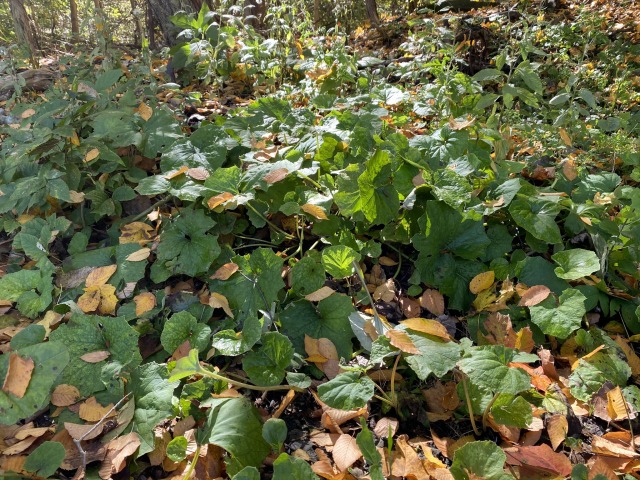
coltsfoot leaves in the fall

We have plenty of spring ephemerals that bloom early, but unlike these plants, coltsfoot doesn’t die off by summer. The plant keeps its leaves well after it blooms, into late fall.

This strategy is interesting, and I can’t think of many plants in our flora with similar growth patterns. Is the plant on to something?

Keep an eye out for coltsfoot, especially along wooded roadsides. Once you see a big bloom, check the same site later in the year. The leaves can grow to a surprisingly large size.

Find this specimen and more here.

Check back for more! Botanists at the Carnegie Museum of Natural History share digital specimens from the herbarium on dates they were collected. They are in the midst of a three-year project to digitize nearly 190,000 plant specimens collected in the region, making images and other data publicly available online. This effort is part of the Mid-Atlantic Megalopolis Project (mamdigitization.org), a network of thirteen herbaria spanning the densely populated urban corridor from Washington, D.C. to New York City to achieve a greater understanding of our urban areas, including the unique industrial and environmental history of the greater Pittsburgh region. This project is made possible by the National Science Foundation under grant no. 1801022.

Mason Heberling is Assistant Curator of Botany at Carnegie Museum of Natural History. Museum employees are encouraged to blog about their unique experiences and knowledge gained from working at the museum.

Related Content

Collected on this Day in 1998: Common chickweed

Spring is in the Air, Botanists are in the Field

Ask a Scientist: What is biogeochemistry? 

Carnegie Museum of Natural History Blog Citation Information

Blog author: Heberling, Mason
Publication date: March 14, 2021
Share this post!

  • Share on Twitter Share on Twitter
  • Share on Facebook Share on Facebook
  • Share on Pinterest Share on Pinterest
  • Share on LinkedIn Share on LinkedIn
  • Share on Reddit Share on Reddit
  • Share via Email Share via Email

Share this post!

  • Share on Twitter Share on Twitter
  • Share on Facebook Share on Facebook
  • Share on Pinterest Share on Pinterest
  • Share on LinkedIn Share on LinkedIn
  • Share on Reddit Share on Reddit
  • Share via Email Share via Email

Filed Under: Blog Tagged With: Botany, collected on this day, Mason Heberling, Science News

March 8, 2021 by wpengine

Collected on this Day in 1998

Spring is springing as we speak.

In the city and beyond.

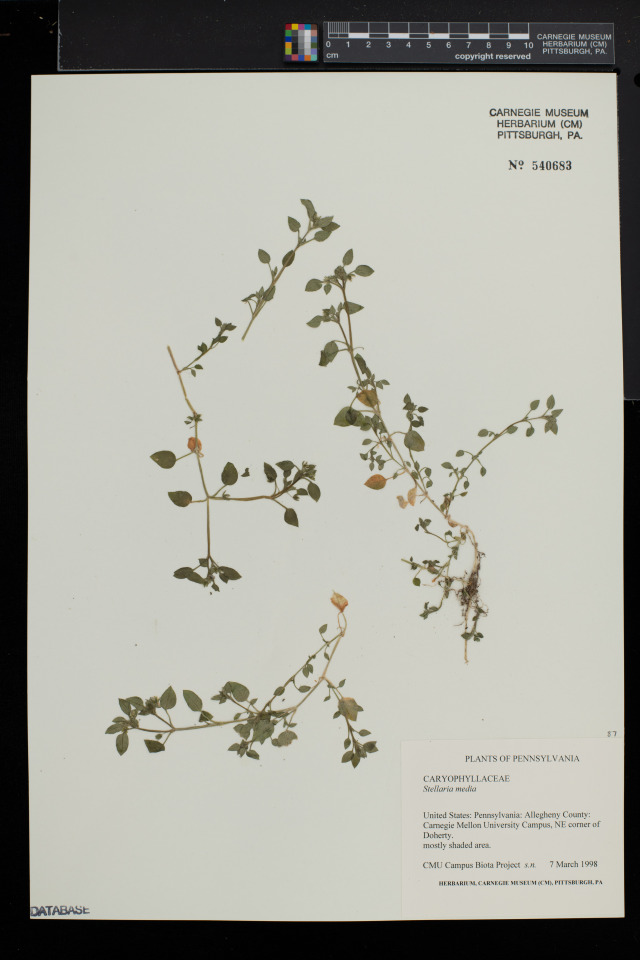
dried common chickweed specimen on herbarium sheet

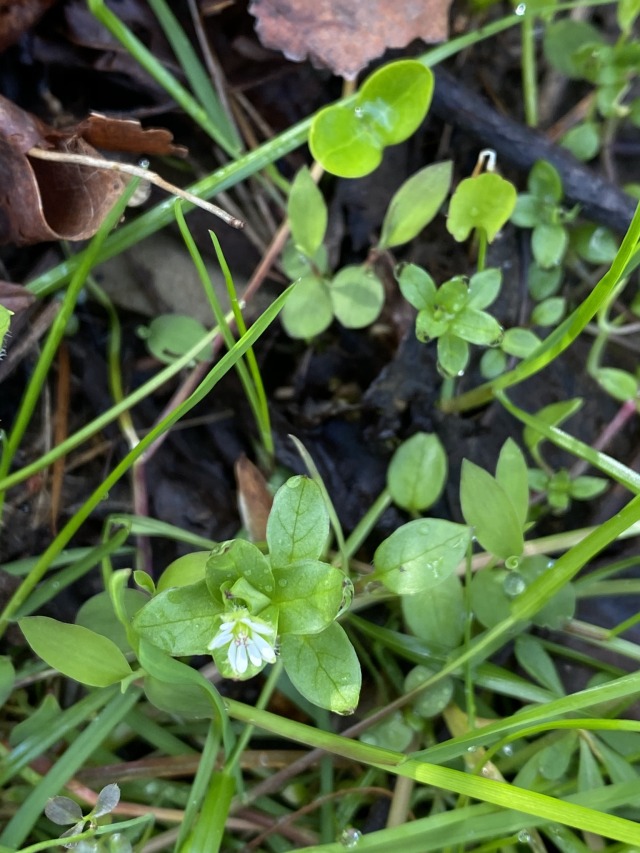
This specimen of common chickweed (Stellaria media) was collected on the campus of Carnegie Mellon University, in Pittsburgh, in a “mostly shady area.” Though small, if you look closely you’ll encounter a charismatic tiny flower. Common chickweed is a familiar plant across the world, found in every continent (except perhaps Antarctica?). Like many cosmopolitan lawn weeds, it is native to “Eurasia.” The plant’s exact native range is unclear, but it is considered not native to North America.

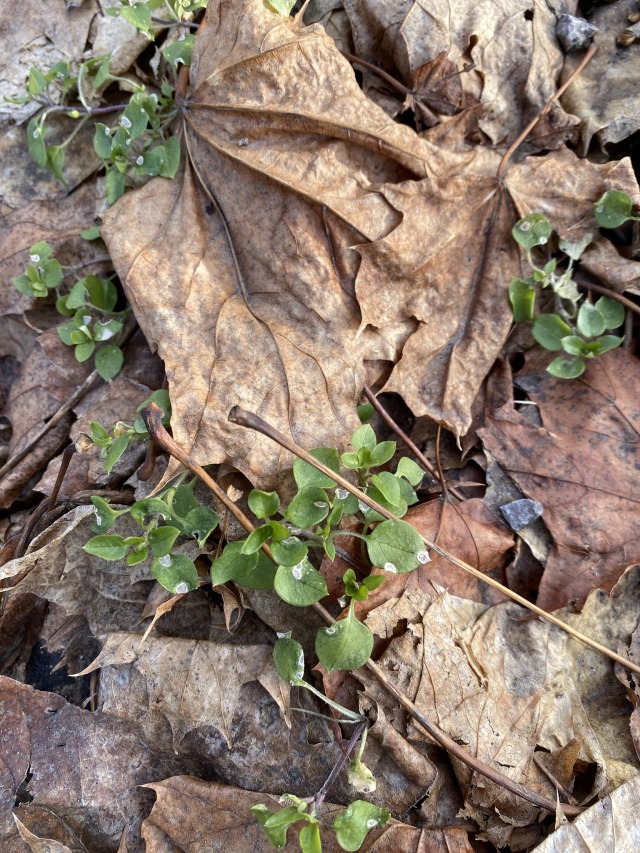
In Pennsylvania, common chickweed can be found in habitat ranging from urban lawns to forests. In some locations dense growth of the plant can form a mat along the ground. Common chickweed can be found just about year-round when snow isn’t on the ground, and like dandelion, the plant flowers throughout the year.

Stellaria media on January 30 in southwest Pennsylvania.

The tiny flowers now are also sending a signal – spring is on the way. For some plants, such as skunk cabbage and red maple, spring has already sprung.

Stellaria media on April 24 in southwest Pennsylvania.

This species is a good one to look out for during the upcoming City Nature Challenge!

Find this specimen and more here.

Check back for more! Botanists at the Carnegie Museum of Natural History share digital specimens from the herbarium on dates they were collected. They are in the midst of a three-year project to digitize nearly 190,000 plant specimens collected in the region, making images and other data publicly available online. This effort is part of the Mid-Atlantic Megalopolis Project (mamdigitization.org), a network of thirteen herbaria spanning the densely populated urban corridor from Washington, D.C. to New York City to achieve a greater understanding of our urban areas, including the unique industrial and environmental history of the greater Pittsburgh region. This project is made possible by the National Science Foundation under grant no. 1801022.

Mason Heberling is Assistant Curator of Botany at Carnegie Museum of Natural History. Museum employees are encouraged to blog about their unique experiences and knowledge gained from working at the museum.

Related Content

Collected On This Day in 1949: Honeysuckle

Collected On This Day in 1940: Plants with bladders?

Looking for Bugs in Your Yard! 

Share this post! 

  • Share on Twitter Share on Twitter
  • Share on Facebook Share on Facebook
  • Share on Pinterest Share on Pinterest
  • Share on LinkedIn Share on LinkedIn
  • Share on Reddit Share on Reddit
  • Share via Email Share via Email

Carnegie Museum of Natural History Blog Citation Information

Blog author: Heberling, Mason
Publication date: March 8, 2021

Share this post!

  • Share on Twitter Share on Twitter
  • Share on Facebook Share on Facebook
  • Share on Pinterest Share on Pinterest
  • Share on LinkedIn Share on LinkedIn
  • Share on Reddit Share on Reddit
  • Share via Email Share via Email

Filed Under: Blog Tagged With: Botany, City Nature Challenge, collected on this day, Mason Heberling, Science News

March 2, 2021 by wpengine

Collected on this Day in 1949

Honeysuckles will be back soon.

But this one never really left for the winter.

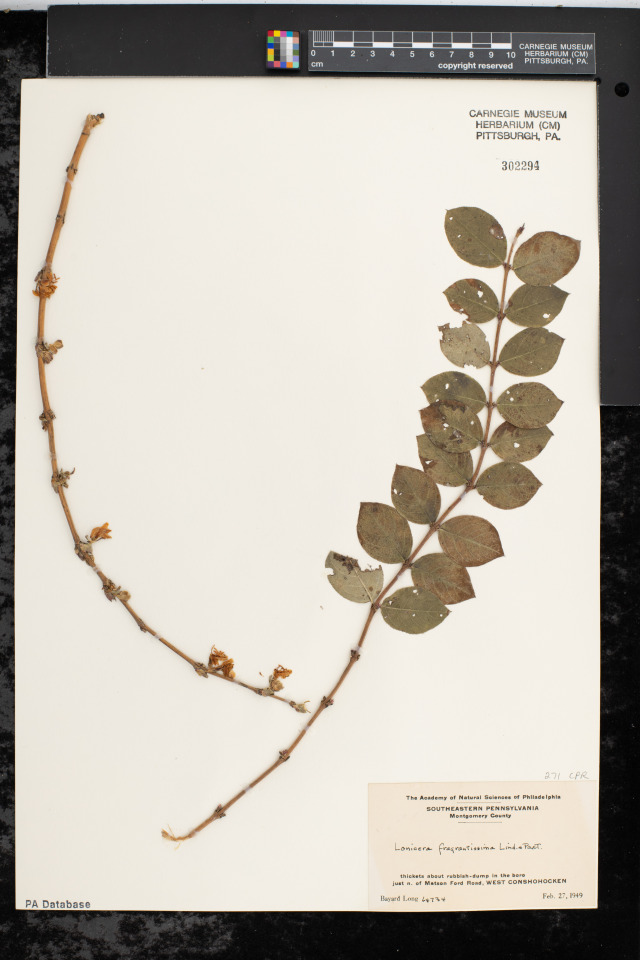
This specimen of winter honeysuckle (Lonicera fragrantissima) was collected in West Conshohocken, PA near the Schuylkill River outside of Philadelphia by Bayard Long. Collected flowering in a “rubbish-dump,” no less! Bayard Long (1885-1969) was a Philadelphia-area botanist and an active member of the Philadelphia Botanical Club (founded in 1891 and still exists today). He was a prolific collector and served as Curator of the Club’s Local Herbarium for 56 years (housed at the Academy of Natural Sciences). About 982 specimens collected by Long are preserved for the long haul in the Carnegie Museum herbarium.

Winter honeysuckle not only has a fun scientific name to say (“fragrantissima” rolls off the tongue) but is easy to identify among the many species in the honeysuckle genus (Lonicera in plant family Caprifoliaceae). That is, it has almost evergreen, thick leaves that partly persist into the winter, unlike any of the other shrub honeysuckles in Pennsylvania. (Emphasis on shrub, because the invasive vine Japanese honeysuckle – Lonicera japonica– also has persistent leaves through much or all of winter).

It is also known as “sweet breath of spring” for its aromatic flowers (hence its specific epithet, fragrantissima – think Bath and Body Works scent), which appear in late winter (and in this specimen!).

Introduced from China as an ornamental and often planted for its foliage, this species is now invasive in many states in the US. I must admit I don’t see it very often “escaped” outside of plantings in Western PA, but that doesn’t mean it doesn’t exist, or won’t escape in time, especially given it is problematic in other areas of the US.

So, you really shouldn’t plant it. Though Pennsylvania has native honeysuckles, the most abundant and common ones are introduced, affecting native vegetation and wildlife.

Find this specimen (and search for more) here.

Check back for more! Botanists at the Carnegie Museum of Natural History share digital specimens from the herbarium on dates they were collected. They are in the midst of a project to digitize nearly 190,000 plant specimens collected in the region, making images and other data publicly available online. This effort is part of the Mid-Atlantic Megalopolis Project (mamdigitization.org), a network of thirteen herbaria spanning the densely populated urban corridor from Washington, D.C. to New York City to achieve a greater understanding of our urban areas, including the unique industrial and environmental history of the greater Pittsburgh region. This project is made possible by the National Science Foundation under grant no. 1801022.

Mason Heberling is Assistant Curator of Botany at Carnegie Museum of Natural History. Museum employees are encouraged to blog about their unique experiences and knowledge gained from working at the museum.

Related Content

Ask a Scientist: How do you find rare plants?

Do Plants Have Lips? No, But One Genus Sure Looks Like it Does! 

How Do Trees Survive the Winter?

Filed Under: Blog Tagged With: Botany, collected on this day, Mason Heberling, Science News

December 23, 2020 by Erin Southerland

Collected on this Day in 1934

Has your Charlie Brown tree lost its needles yet?

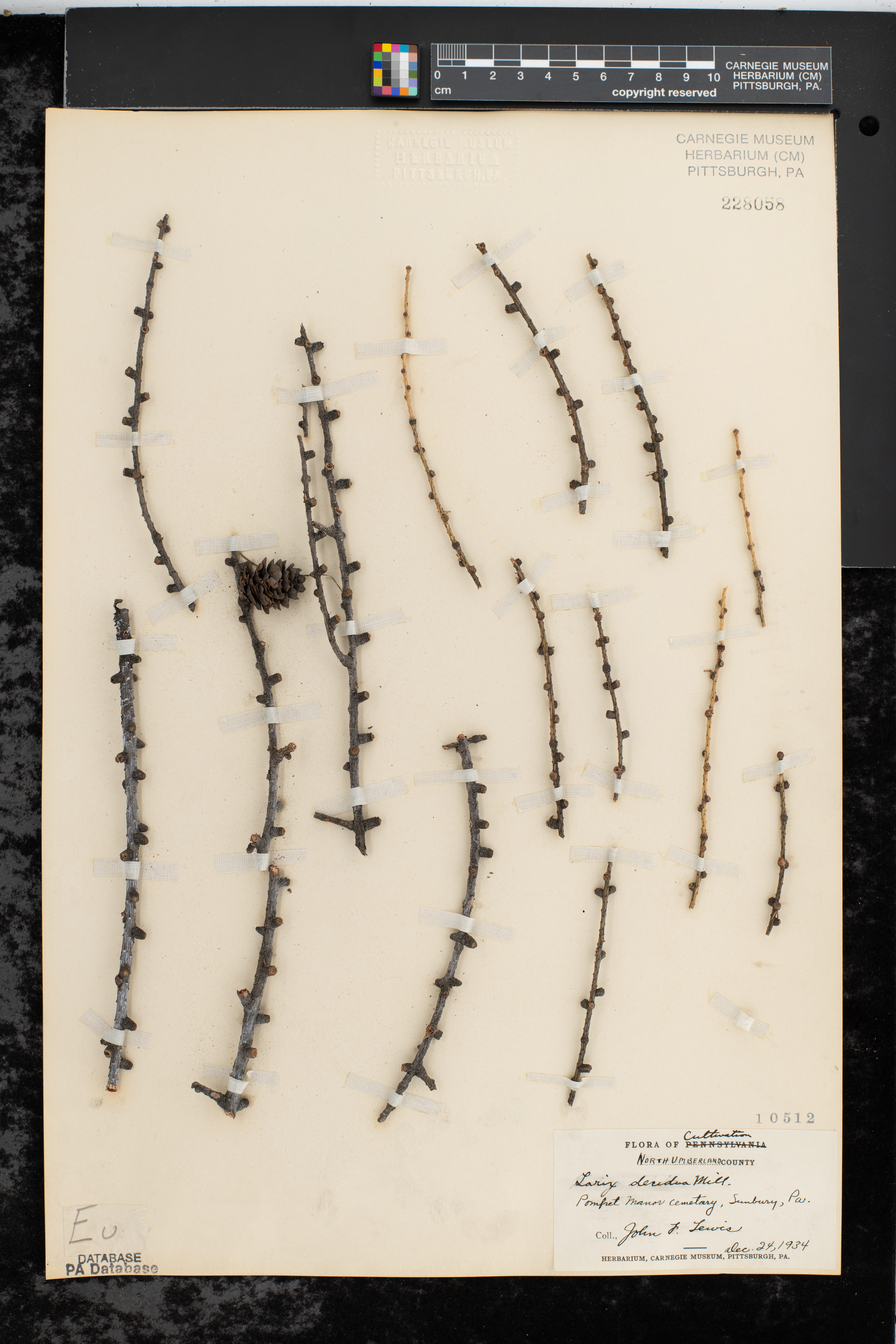
dried specimen of larch on an herbarium sheet

Not all needled-leaved trees are evergreen! Yes, there are deciduous species in the Pine family (Pinaceae).  That is, unlike most needle-leaved trees that retain their leaves all year long (evergreen), there are several conifer species that shed their leaves each year for the winter. Perhaps most famous are a group of species called larches.

No, this needle-free specimen of twigs and a cone wasn’t collected by Charlie Brown on Christmas Eve. Rather, this humble yet festive specimen of European larch (Larix decidua) was collected by J.F. Lewis on December 24, 1934.  Native to the mountains of central Europe, this species was planted in a cemetery in Northumberland county (central Pennsylvania).  It is highly likely the tree is still there – many decades later – as European larches can live for many hundreds of years (perhaps even a thousand years!).  

The herbarium at California University of Pennsylvania is named for the person who collected this specimen – John Franklin Lewis.

European larch recently made the big time news too, featured in a new study published in the scientific journal Science. The researchers used leaf out and leaf fall data collected from across Europe since the late 1940s for four tree species (including European larch). Surprisingly they found that trees may drop their leaves much earlier than expected with ongoing climate change.  In other words, as spring temperatures warm, deciduous trees produce leaves earlier in the spring, but this also causes trees to drop their leaves earlier in the fall.  This means that climate change may not result in longer growing seasons, as has been previously predicted.  You can read more about this study here.

Find this Charlie Brown larch specimen (and more) here.

Check back for more! Botanists at the Carnegie Museum of Natural History share digital specimens from the herbarium on dates they were collected. They are in the midst of a three-year project to digitize nearly 190,000 plant specimens collected in the region, making images and other data publicly available online. This effort is part of the Mid-Atlantic Megalopolis Project (mamdigitization.org), a network of thirteen herbaria spanning the densely populated urban corridor from Washington, D.C. to New York City to achieve a greater understanding of our urban areas, including the unique industrial and environmental history of the greater Pittsburgh region. This project is made possible by the National Science Foundation under grant no. 1801022.

Mason Heberling is Assistant Curator of Botany at Carnegie Museum of Natural History. Museum employees are encouraged to blog about their unique experiences and knowledge gained from working at the museum.

RELATED CONTENT

Collected on This Day in 1884: Beech Drops

Peppermint: A Hybrid Herb for the Holidays

Ask a Scientist: What makes poinsettias so special?

Filed Under: Blog Tagged With: Botany, collected on this day, Mason Heberling, Science News

November 13, 2020 by wpengine

Collected on this Day 105 years ago

So long, leaves.

Autumn has fallen.

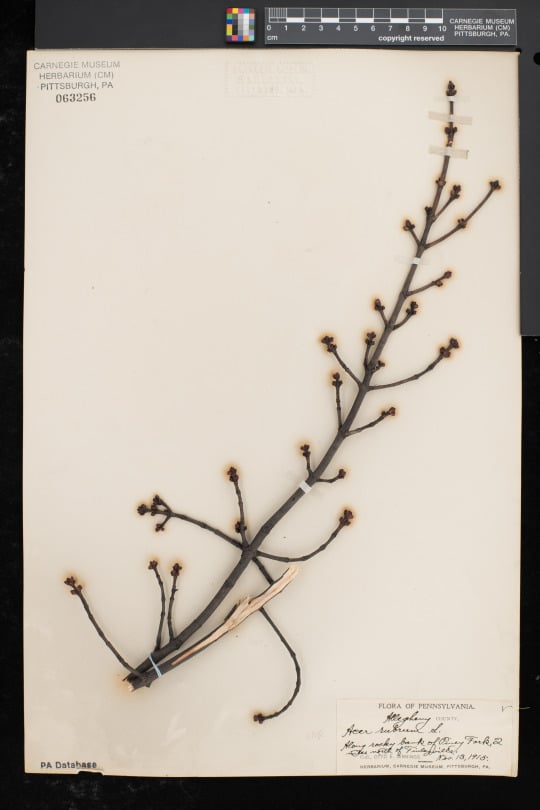
specimen of red maple on herbarium sheet

This specimen of red maple (Acer rubrum) was collected on November 13, 1915 by Otto Jennings near Finleyville, Pennsylvania (about 30 miles south of Pittsburgh).  Jennings was an influential botany curator (and biology professor at University of Pittsburgh and director of Carnegie Museum, among many other roles through his many decades career at the museum).

Just imagine how beautifully red these leaves must have been.   And you’ll have to imagine because this specimen is just twigs!

But upon closer look, the twigs have a lot to admire.  As with other deciduous trees in Pennsylvania, the buds are primed and ready.  In spring (as early as March for red maple!), these buds will swell and flowers will emerge.  Leaves will follow.

But first, we wait it out through winter.

Pay attention to tree buds this winter. They have a lot to say.

Find this red maple specimen here (along with 512 others!).

Check back for more! Botanists at the Carnegie Museum of Natural History share digital specimens from the herbarium on dates they were collected. They are in the midst of a three-year project to digitize nearly 190,000 plant specimens collected in the region, making images and other data publicly available online. This effort is part of the Mid-Atlantic Megalopolis Project (mamdigitization.org), a network of thirteen herbaria spanning the densely populated urban corridor from Washington, D.C. to New York City to achieve a greater understanding of our urban areas, including the unique industrial and environmental history of the greater Pittsburgh region. This project is made possible by the National Science Foundation under grant no. 1801022.

Mason Heberling is Assistant Curator of Botany at Carnegie Museum of Natural History. Museum employees are encouraged to blog about their unique experiences and knowledge gained from working at the museum.

Related Content

Collected On This Day 98 Years Ago (Chestnuts)

Who Likes Teaberry? Collected 56 Years Ago

Ask a Scientist: How do you find rare plants?

Filed Under: Blog Tagged With: Botany, botany hall, collected on this day, Hall of Botany, Mason Heberling, Museum from Home, Science News

October 21, 2020 by wpengine

Collected on This Day 98 Years Ago

Chestnuts (used to be) on Chestnut Ridge

And across the entire state of Pennsylvania.


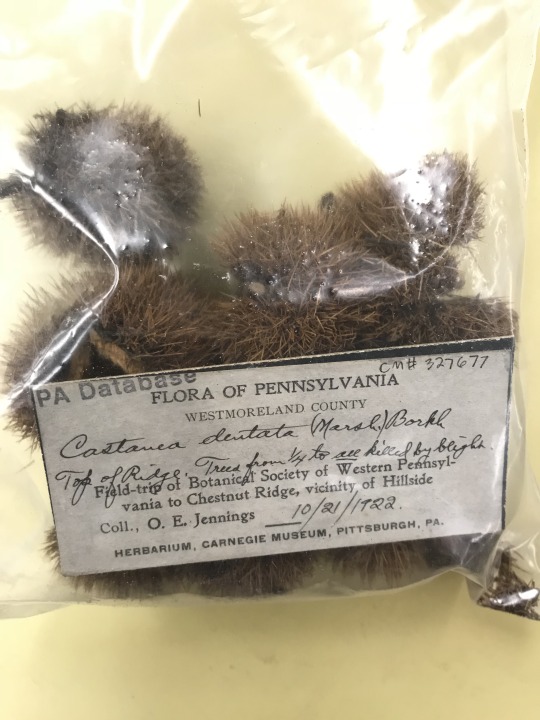
bag of chestnut seeds

American chestnut (Castanea dentata) was once a very common tree, native from Maine to Mississippi. In the heart of the Appalachians, the historical range covered the entire state of Pennsylvania. I say “historical” and “once a very common tree” because it is no longer.  You may occasionally stumble upon an American chestnut tree, especially small trees and saplings persisting as sprouts from the large trees that graced our landscape a century ago. Older trees, with mature fruits, are quite rare.  

In fact, some estimates suggest American chestnut accounted for one in four trees in some forests!  So, what happened?  In the early 1900s, a disease caused by a pathogenic fungus (Cryphonectria parasitica) was accidentally introduced with imported Asian trees. It was first recorded in New York City in 1904.  In a matter of decades, American chestnut was nearly decimated by this disease known as Chestnut blight.

The Carnegie Museum of Natural History herbarium captures this change in our forests.  

American chestnut specimen on herbarium sheet

This specimen of American chestnut was collected by influential Carnegie Museum curator Otto Jennings on October 21, 1922 on a field trip of the Botanical Society of Western Pennsylvania to Chestnut Ridge, near Derry Township, Pennsylvania.  Chestnut Ridge is a ridge of the Allegheny Mountains, presumably named for its (once) many American chestnuts.  

This specimen is from the fruit collection of the herbarium.  These specimens are different than the “standard” pressed flat specimens on paper.  Instead, they are stored to maintain their three-dimensional structure.

Note the note made by Jennings on the label on this specimen: “Trees from ¼ to all killed by blight.”

The case of the American chestnut is an interesting one.  It served important cultural and ecological roles; some even calling it a “keystone” species.  There is no doubt that the functional extinction of American chestnut ricocheted through the ecosystem, causing long-term biological changes. Many of these changes we may not know.  Yet, at the same time, despite the species importance, our forests continue.  Presumably other species have filled the functional and physical space of American chestnut.  

Disease and pest outbreaks in Pennsylvania’s forests continue.  Many of our critical tree species are likely to decline in coming years and decades.  Some iconic species have already declined or are at risk.  These include our ash species (mortality caused by introduced Emerald Ash Borer), American beech (Beech leaf disease, Beech bark disease caused by an introduced scale insect), and eastern hemlock (mortality caused by introduced sap sucking bug, the hemlock woolly adelgid)…to name only a few threats.

What will Penn’s woods look like in another 100 years?  

Our collections document the past and present to inform our decisions for the future.

Find this American chestnut specimen here (along with 268 others!): https://midatlanticherbaria.org/portal/collections/list.php?db=328&includecult=1&taxa=Castanea+dentata&usethes=1&taxontype=2

Check back for more! Botanists at the Carnegie Museum of Natural History share digital specimens from the herbarium on dates they were collected. They are in the midst of a three-year project to digitize nearly 190,000 plant specimens collected in the region, making images and other data publicly available online. This effort is part of the Mid-Atlantic Megalopolis Project (mamdigitization.org), a network of thirteen herbaria spanning the densely populated urban corridor from Washington, D.C. to New York City to achieve a greater understanding of our urban areas, including the unique industrial and environmental history of the greater Pittsburgh region. This project is made possible by the National Science Foundation under grant no. 1801022.

Mason Heberling is Assistant Curator of Botany at Carnegie Museum of Natural History. Museum employees are encouraged to blog about their unique experiences and knowledge gained from working at the museum.

Related Content

Our Eureka Moment! 

Super Science: Goldenrod

A Day Late, But Thanks for Your Impatiens! 

Filed Under: Blog Tagged With: Botany, collected on this day, Hall of Botany, Mason Heberling, Science News, Section of Botany

  • « Go to Previous Page
  • Page 1
  • Page 2
  • Page 3
  • Page 4
  • Interim pages omitted …
  • Page 8
  • Go to Next Page »

sidebar

About

  • Mission & Commitments
  • Directors Team
  • Museum History

Get Involved

  • Volunteer
  • Membership
  • Carnegie Discoverers
  • Donate
  • Employment
  • Events

Bring a Group

  • Groups of 10 or More
  • Birthday Parties at the Museum
  • Field Trips

Powdermill

  • Powdermill Nature Reserve
  • Powdermill Field Trips
  • Powdermill Staff
  • Research at Powdermill

More Information

  • Image Permission Requests
  • Science Stories
  • Accessibility
  • Shopping Cart
  • Contact
  • Visitor Policies
Stay in the loop! Sign up for our newsletter(s).
One of the Four Carnegie Museums | © Carnegie Institute | Privacy Policy | Terms of Use | Accessibility
Rad works here logo