• Skip to primary navigation
  • Skip to main content
  • Skip to primary sidebar

Carnegie Museum of Natural History

One of the Four Carnegie Museums of Pittsburgh

  • Visit
    • Buy Tickets
    • Visitor Information
    • Exhibitions
    • Events
    • Dining at the Museum
    • Celebrate at the Museum
    • Powdermill Nature Reserve
    • Event Venue Rental
  • Learn
    • Field Trips
    • Educator Information
    • Programs at the Museum
    • Bring the Museum to You
    • Guided Programs FAQ
    • Programs Online
    • Climate and Rural Systems Partnership
  • Research
    • Scientific Sections
    • Science Stories
    • Science Videos
    • Senior Science & Research Staff
    • Museum Library
    • Science Seminars
    • Scientific Publications
    • Specimen and Artifact Identification
  • About
    • Mission & Commitments
    • Directors Team
    • Museum History
  • Tickets
  • Give
  • Shop

conservation

October 27, 2022 by

We Are Nature Podcast

Season two out now!

We Are Nature thumbnail in black and yellow

The We Are Nature podcast features stories about natural histories and livable futures presented by Carnegie Museum of Natural History. Host Michael Pisano, a Science Storyteller, and invited guests discuss how humans can create–and are already working towards–a livable, just, and joyous future. 

Season one, which premiered in October 2022, centers on collective climate action through 30 interviews with museum researchers, organizers, policy makers, farmers, and science communicators about climate action in Southwestern Pennsylvania. Guests include Radiolab’s Jad Abumrad, US Representative Summer Lee, and Daniel G. and Carole L. Kamin Director of Carnegie Museum of Natural History Gretchen Baker, among others. 

Season two delves deep into Carnegie Museum of Natural History’s collection of more than 22 million objects and specimens. Fourteen Carnegie Museum of Natural History experts as well as special guests from Three Rivers Waterkeeper and the Royal Ontario Museum discuss collection items as windows into the science and ethics of the Anthropocene, a term for our current age, defined by human activity that is reshaping Earth’s climate and environments. What’s more, museum visitors will have the chance to hear clips from and see some of the objects discussed in episodes from season two inside our newest exhibition, The Stories We Keep: Bringing the World to Pittsburgh. 

Listen to Season 1 and Season 2 of the podcast below or on major podcast platforms including Apple and Spotify.


Season 1

Episode 1: This is an Emergency, Not an Apocalypse (with Jad Abumrad)

Release date: October 26, 2022

Why is it so hard to talk about climate change without plunging into an anxious doomscroll? How can we change the ways that we talk about the story of life on earth to emphasize hope over despair, and collaboration over competition? Featuring Radiolab’s Jad Abumrad and Nicole Heller, Associate Curator of Anthropocene Studies for Carnegie Museum of Natural History.


Bonus Episode: We Can Fix This

Release date: October 31, 2022

A behind-the-scenes chat between Taiji Nelson, Senior Program Manager for the museum’s Climate and Rural Systems Partnership (CRSP) and podcast producer, and Michael about effective climate change communication, plus our goals, hopes, dreams, and terrors for this first season.


Episode 2: Steel City (with Summer Lee)

Release date: November 4, 2022

Why should Pittsburghers care about climate change? What’s happening in our backyard, and how does it connect to the big picture? U.S. Representative Summer Lee joins us to talk about environmental racism, intersectional climate justice, and much more. Host Michael pops in and out with the natural history (and livable future?) of steel.


Episode 3: Carbon and Cattle

Release date: November 11, 2022

Monoculture is messing up the climate. Befriending biodiversity–especially in the soil– can help! Featuring interviews with Michael Kovach (Regenerative Farmer & President of the PA Farmers Union) and Dr. Bonnie McGill (an Ecosystem Ecologist).


Episode 4: Coal Country

Release date: November 18, 2022

There are less than 5,000 coal jobs left in the state of Pennsylvania, and that number is shrinking. That’s good news for the climate, but what’s next for the commonwealth’s coal communities? Join organizers from the Mountain Watershed Association for insight on building community, protecting public health, and creating new opportunities. Plus, the natural history of coal, water quality watchdogging, and much, much more! Featuring Ashley Funk, Executive Director of Mountain Watershed Association; Stacey Magda, Community Organizer with Mountain Watershed Association; and Eric Harder, Youghiogheny Riverkeeper with Mountain Watershed Association.


Episode 5: Mining and Microbes

Release date: November 25, 2022

Carla Rosenfeld, Assistant Curator of Earth Sciences at Carnegie Museum of Natural History, studies how pollutants and nutrients behave in environments like abandoned minelands, of which Pennsylvania has many. We chat about interspecies collaboration, soil science, the importance of diversity, and much more.


Episode 6: Bridges and Bivalves

Release date: December 2, 2022

Some freshwater mussels can live for over 100 years! During that time, they filter water and improve aquatic ecosystems. Today’s episode is about how aquatic life intersects with the human world. We’ll learn about everything from mussel charisma to climate-proofing infrastructure. Featuring Eric Chapman, Director of Aquatic Science at the Western PA Conservancy.


Episode 7: Food is Nature

Release date: December 9, 2022

Our globalized food system is already feeling the impacts of climate change. Today’s episode shows how decentralizing that food system can help us both be more resilient to extreme weather, and lessen industrial agriculture’s harmful effects. Featuring interviews with urban farmers at Braddock Farms.


Episode 8: Teens in the Wild

Release date: December 16, 2022

By taking care of greenspace, we care for ourselves. Hear about best practices for getting young people involved in land stewardship, and about how fostering a relationship with the outdoors is essential climate action. Featuring Naturalist Educator Nyjah Cephas and two of her students from the Pittsburgh Parks Conservancy’s Young Naturalists program.


Episode 9: Empowerment, Employment, Environment

Release date: January 6, 2023

How are labor and climate related? Today’s episode is all about supporting workers as the climate changes, and about work that supports climate action. Learn about labor history, a just transition, doughnuts and degrowth. Featuring Landforce’s Executive Director Ilyssa Manspeizer and Site Supervisor Shawn Taylor.


Episode 10: Greenways

Release date: January 13, 2023

Tiffany Taulton is a climate policy expert, community organizer, professor of environmental justice, and one of the authors of Pittsburgh’s Climate Action Plan. She joins the show to talk about how our region is preparing for climate change, how that resilience benefits public health, and how climate action can embrace justice and equity.


Episode 11: A Conservation Conversation

Release date: January 20, 2023

Biodiversity is key to our resilience as the climate changes. Our guest today is Conservation Biologist Charles Bier, Senior Director of Conservation Science at the Western Pennsylvania Conservancy. Charles has nurtured a deep relationship with Pennsylvanian nature since he was a six-year-old walking around with snakes in his pockets, and has spent his career trying to preserve our wonderful woods, wetlands and waterways.


Episode 12: Bee Kind

Release date: January 27, 2023

Bugs make the world go around. Well, bugs and fungi. And bacteria. And algae. And…ok, it’s all important. We humans rely on many tiny neighbors, and now more than ever, their future relies on us. Come along on a visit to Pittsburgh’s Garfield Community Farm, and travel back to the Cretaceous to learn about the origins of flowers. Featuring the farm’s Community Engagement Coordinator AJ Monsma, youth farmer Israel, and Israel’s friend Tommy the Bee.


Episode 13: We Are the Future

Release date: February 10, 2023

On today’s show, the last episode of Season 1, we look ahead at possible futures. Join us in imagining a planet with space and dignity for all earthlings. Featuring Daniel G. and Carole L. Kamin Director of Carnegie Museum of Natural History Gretchen Baker, Curator of Anthropocene Studies Nicole Heller, and Educator Taiji Nelson from Carnegie Museum of Natural History.


Season 2

Episode 1: A Thin Dusting of Plutonium

Release date: November 7, 2025

What is the Anthropocene, and when might it have started? What is the great acceleration? Can we expect, or engineer, a great deceleration? What can we learn from nuclear history about nuclear futures? Featuring Travis Olds, Assistant Curator of Minerals at Carnegie Museum of Natural History, and Nicole Heller, Associate Curator of Anthropocene Studies at Carnegie Museum of Natural History. Encounter Trinitite glass, mentioned in this episode, in the exhibition The Stories We Keep: Bringing the World to Pittsburgh.


Episode 2: Experimental Archaeology

Release date: November 14, 2025

What do we know about the early peopling of our continent and our region? What was the landscape and the climate like then? What can we learn from this natural history about interacting with the land and water today, and moving forward as good stewards? Featuring Amy Covell-Murthy, Archaeology Collection Manager and Head of the Section of Anthropology at Carnegie Museum of Natural History, and Kristina Gaugler, Anthropology Collection Manager at Carnegie Museum of Natural History.


Episode 3: The Institute of Insect Technology

Release date: November 21, 2025

What surprising biodiversity lives alongside us here in Pittsburgh? How can we befriend bugs? What could be awesome about having humans as neighbors? Featuring Ainsley Seago, Associate Curator of Invertebrate Zoology at Carnegie Museum of Natural History, and Kevin Keegan, Collection Manager of Invertebrate Zoology at Carnegie Museum of Natural History.


Episode 4: Hell Chicken Extinction

Release date: December 5, 2025

What dinosaurs and mammals survived the end of the Cretaceous, and why? What can we learn about resilience from survivors of past extinctions? What can we learn about adapting our culture and cities from the story of evolution? Featuring Matt Lamanna, Mary R. Dawson Curator of Vertebrate Paleontology at Carnegie Museum of Natural History, and John Wible, Curator of Mammals at Carnegie Museum of Natural History.


Episode 5: Loss in Lutruwita

Release date: December 12, 2025

A second serving of bone banter with two of the museum’s veteran vertebrate virtuosos. How are charisma, colonialism, and extinction linked? What is de-extinction, and will cloning mammoths save the tundra? Featuring Matt Lamanna, Mary R. Dawson Curator of Vertebrate Paleontology at Carnegie Museum of Natural History, and John Wible, Curator of Mammals at Carnegie Museum of Natural History.


Episode 6: Herbaria for Humanity

Release date: December 19, 2025

How do humans support some plants and endanger others? What do herbaria teach about climate change? How can people and plants collaborate towards livable futures? Featuring Mason Heberling, Curator of Botany at Carnegie Museum of Natural History, and Bonnie Isaac, Collection Manager of Botany at Carnegie Museum of Natural History.


Episode 7: A Real Good Slime

Release date: December 26, 2025

What would a snail scientist do with a blank check? What can we learn from snails and their kin? Why is the ocean getting more acidic, how do we know, and why does that matter? Featuring Tim Pearce, Curator of Mollusks at Carnegie Museum of Natural History.


Episode 8: Dirty Birds

Release date: January 2, 2026

How does urbanization impact nonhumans? What can we learn from Pittsburgh’s past and present air quality challenges? How do we make space for biodiversity in cities? Featuring Serina Brady, Collection Manager of Birds at Carnegie Museum of Natural History, and Jon Rice, Urban Bird Conservation Coordinator at Carnegie Museum of Natural History.


Episode 9: Jar of Frogs

Release date: January 9, 2026

Why is the museum hoarding alcoholic pickle jars? What kinds of research are made possible by the museum’s herpetology collection? How are organisms changing because of climate change, urbanization, and other anthropogenic pressures? Featuring Jennifer Sheridan, Associate Curator of Amphibians and Reptiles at Carnegie Museum of Natural History. Encounter frog specimens from Borneo mentioned in this episode in the exhibition The Stories We Keep: Bringing the World to Pittsburgh.


Episode 10: A Very Important Popsicle

Release date: January 16, 2026

What can we learn from lakes about livable futures? How can people in the Anthropocene find optimism and be moved to climate action? Featuring Soren Brothers, the Allan and Helaine Shiff Curator of Climate Change at the Royal Ontario Museum.


Episode 11: Pellets, Pellets Everywhere

Release date: January 23, 2026

What are plastics and how are they made? How do they get into our waterways? How do novel materials like plastics define the age we live in? What materials might replace them? Featuring Nicole Heller, Curator of Anthropocene Studies at Carnegie Museum of Natural History, and Heather Hulton VanTassel, Executive Director of Three Rivers Waterkeeper. Encounter nurdles, small plastic pellets, mentioned in this episode in the exhibition The Stories We Keep: Bringing the World to Pittsburgh.

Credits

Host, Writer, and Editor: Michael Pisano
Assistant Editor: Garrick Schmitt
Audio Recording: Matthew Unger and Garrick Schmitt
Voice Talent: Mackenzie Kimmel
Music: DJ Thermos
Producer: Nicole Heller
Producer: Sloan MacRae
Producer and Co-host (season one): Taiji Nelson
Field Reporters (season one): Di-ay Battad, David Kelley, and Jamen Thurmond
Filed Under: Uncategorized Tagged With: Anthropocene, climate, climate action, climate change, conservation, justice, nature, podcast, We Are Nature

May 31, 2019 by wpengine

Poison Ivy – Collected on This Day

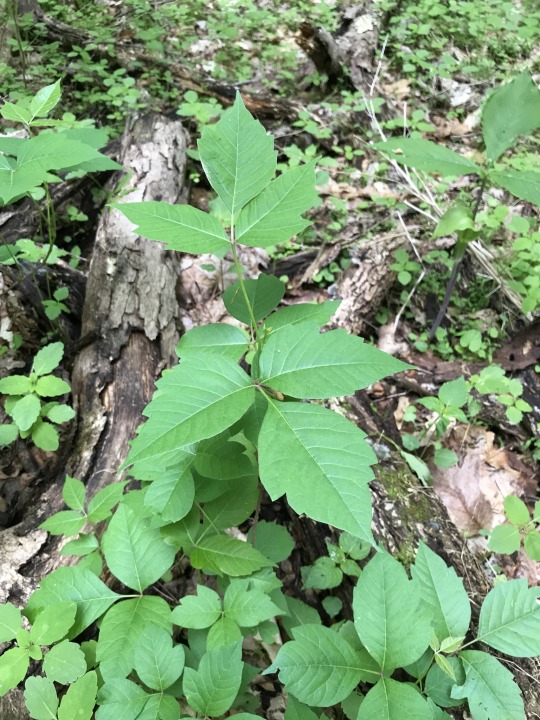
poison ivy growing as a shrub

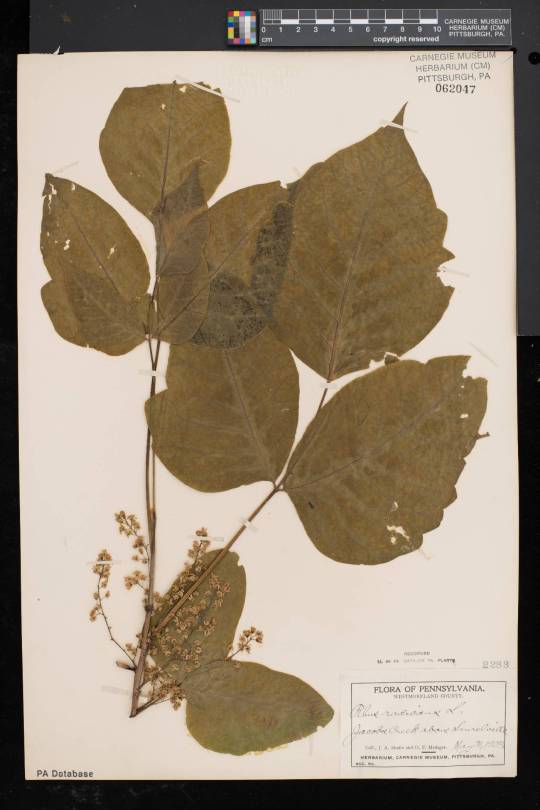
Watch out for poison ivy!  It is a fascinatingly cool plant but can also be dangerous.  This flowering specimen of poison ivy was collected on May 31, 1903 by John Shafer (the first curator of botany at Carnegie Museum) and O.P. Medsger in the Laurel Highlands of southwestern PA.

poison ivy herbarium sheet

What is Poison Ivy?

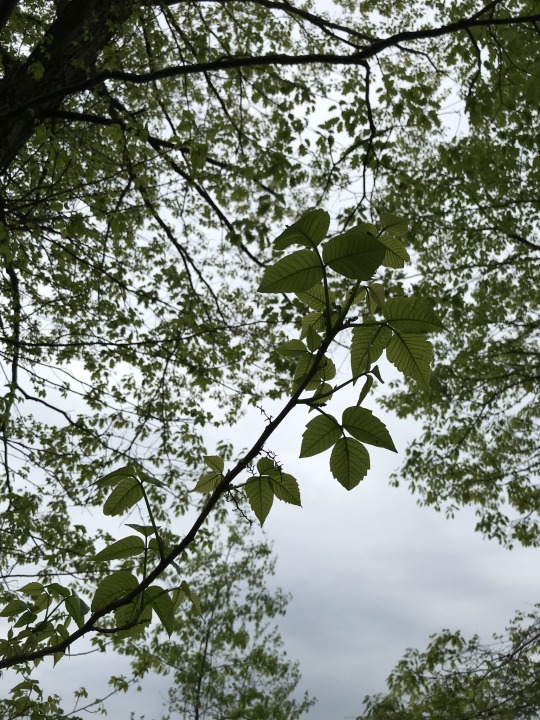
Poison ivy (Toxicodendron radicans) is a woody vine found in forest understories, but does especially well on forest edges. It is very common in urban and suburban areas. It takes many forms, climbing high up a tree, along the ground, or even a short shrubby thing. The leaves take a range of shapes, but as the adage goes (“leaves of 3, let it be”), it has three leaflets.

poison ivy in a tree

Poison Ivy Chemistry – What Causes the Rash?

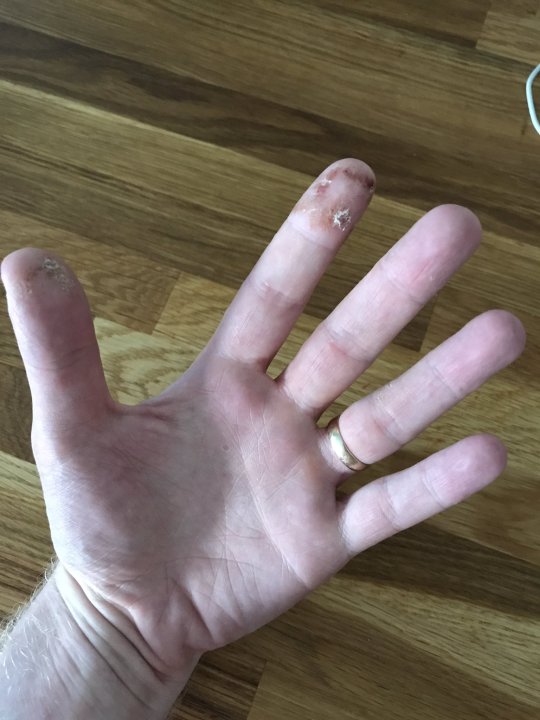
Poison ivy is known for its chemistry, producing a class of organic compounds call urushiol. These are found in the plant’s sap and on leaves/stems/roots. Urushiol causes a nasty rash to those who touch it. Not all people have a reaction (but most are sensitive). Don’t be too confident if you haven’t had a rash before – it can develop with repeated exposure.  Incredibly itchy, the rash can become a serious health issue if infected, especially if its oils get in contact with your eyes, face, or throat.  The rash can appear days after exposure and can last for weeks.

poison ivy rash

Research indicates poison ivy will get more poisonous with climate change, both in terms of growth and producing higher quantities of forms of urushiol particularly toxic to humans.

Is Poison Ivy a Weed?

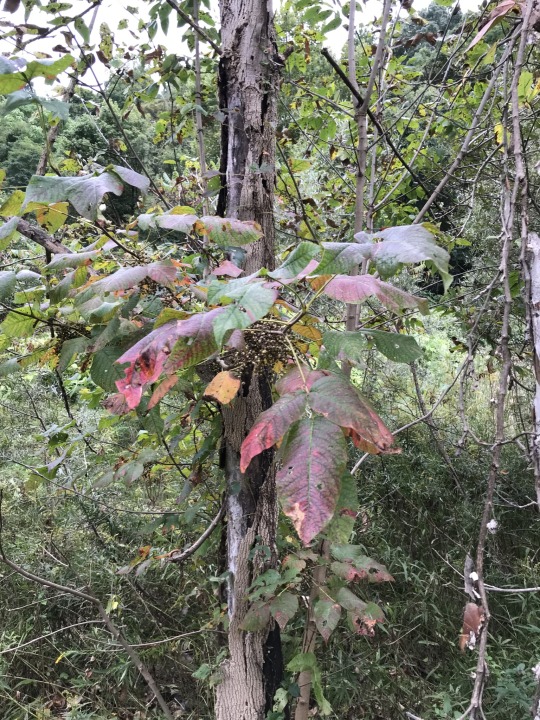
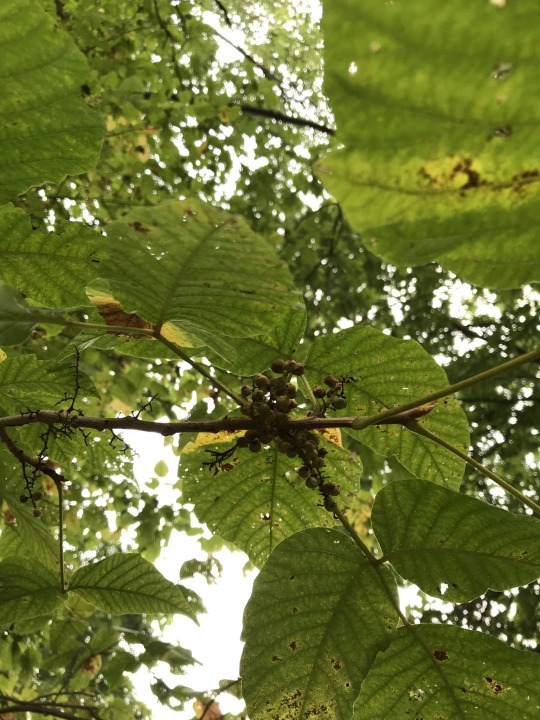
Some people call Poison ivy because of its fear-causing rash, but it is native to eastern North America.  The species has a wide distribution across our region, and across the world (native subspecies in China). Although native, the species seems to be getting more common as we create more forest edge habitat.   The colorful foliage can be quite beautiful in the fall, and the berries are a food source for birds and other animals. Humans seem to be the only ones allergic to it.

poison ivy colored foliage in autumn
poison ivy berries

Plants Similar to Poison Ivy

Poison ivy is often confused with other non-poisonous and poisonous plants.

Some common confusions:

  1. Virginia creeper (Parthenocissus quinquefolia), a vine in the grape but different leaves, and not with leaves of three
  2. Box elder maple (Acer negundo), a tree that has compound leaves unlike most stereotypical maples,  but with samaras (aka “helicopter” seeds)

Poison ivy and some other rash-causing plants are in the cashew family (Anacardiaceae) – which also includes poison oak (not found in Pennsylvania, but in western USA), staghorn sumac (not rash causing), poison sumac (rash causing, but you likely won’t come across it unless in very wet habitats)….and even a few familiar species like  pistachio,  cashew, and mango (some people are allergic).

What an amazing plant.

This specimen image is now publicly available online: http://midatlanticherbaria.org/portal/collections/individual/index.php?occid=12232529&clid=0

Check back for more! Botanists at the Carnegie Museum of Natural History share digital specimens from the herbarium on their collection dates. They have embarked on a three-year project to digitize nearly 190,000 plant specimens collected in the region (like Poison ivy!) making images and other data publicly available online. This effort is part of the Mid-Atlantic Megalopolis Project (mamdigitization.org), a network of thirteen herbaria spanning the densely populated urban corridor from Washington, D.C. to New York City to achieve a greater understanding of our urban areas, including the unique industrial and environmental history of the greater Pittsburgh region. This project is made possible by the National Science Foundation under grant no. 1801022.  

Mason Heberling is Assistant Curator of Botany at the Carnegie Museum of Natural History. Museum employees are encouraged to blog about their unique experiences and knowledge gained from working at the museum.

Filed Under: Blog Tagged With: Botany, conservation, herbarium, Mason Heberling, pennsylvania, plants

November 28, 2018 by wpengine

Field Time in Borneo

By Jennifer Sheridan

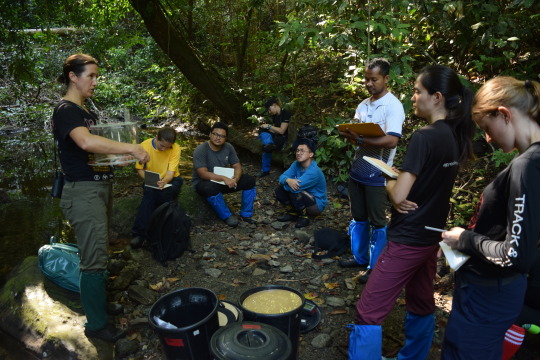
Jennifer Sheridan and students in Borneo

As some of you know, my main field research takes place in Malaysian Borneo, in the state of Sabah. I travel there frequently for work (ecological fieldwork), and I was lucky enough to be asked to serve as an instructor for a graduate field course held at one of my main field sites in October of this year. This particular site, Danum Valley Conservation Area, is one of the largest expanses of lowland primary forest remaining in Borneo, and because I have been going there regularly since 2010, it holds special meaning for me. Thus, I was very eager to share my enthusiasm for and knowledge of this place and its herpetological inhabitants with students.

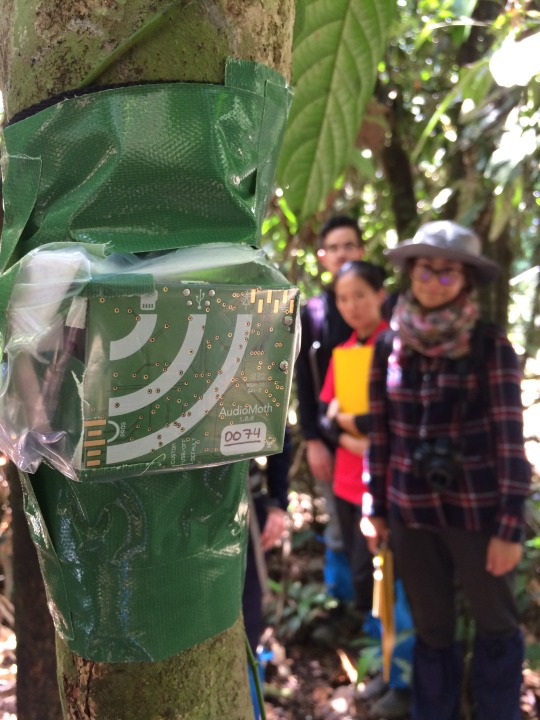
AudioMoth on a tree and students in the background

This particular field course is run by the Tropical Biology Association, based out of Cambridge (UK). TBA courses are wonderful for many reasons, but one of my favorite features is that they are an even mix of students from Europe and, in the case of the Danum course, Southeast Asia. Because students in SE Asia don’t always have the same opportunities for continued graduate education as do students in Europe and the US, this course provides much-needed capacity building in a region that suffers from the highest rate of deforestation (and thus biodiversity loss) in the world. This year’s course featured students from 12 countries, and was nearly 2/3 female—another important capacity-building measure, given that women remain underrepresented in the sciences.

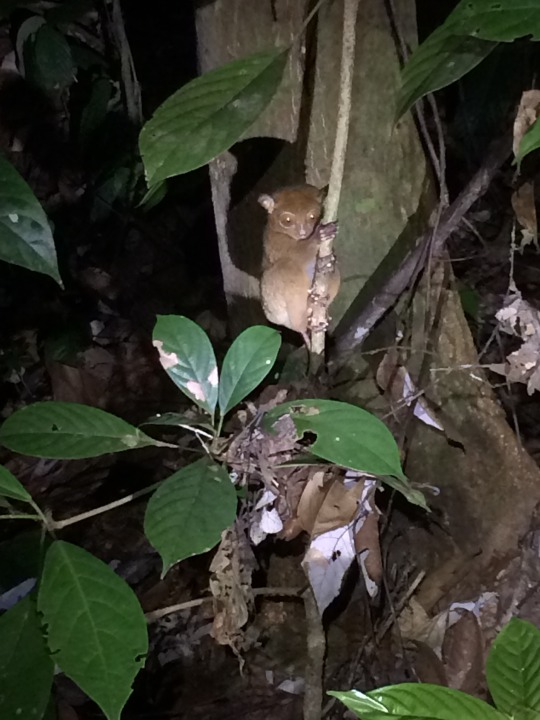
tarsier in a tree at night

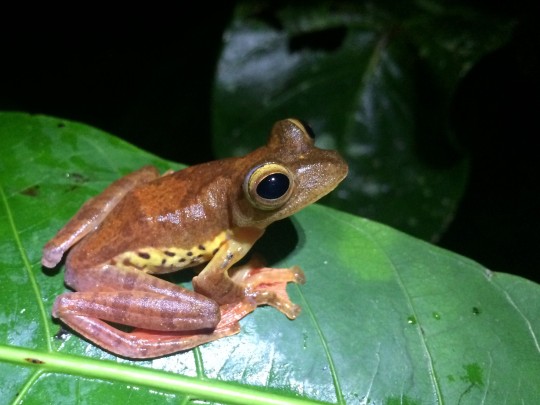
The structure of the course is also one that I think works well: two weeks of detailed field instruction and exercises, introducing students to methods of surveying and studying multiple taxonomic groups, followed by two weeks of students working in small groups to design, execute, and present original research projects. For me, as a scientist working at the site long-term, this structure also allows me to test new methods or gather pilot data for potential future projects. This year I supervised two groups who chose to work on frogs: one group who radiotracked a species of frog that had never been tracked before, and one group who measured the biomass of frogs on three different streams. The former project was intended to serve as pilot data for future radiotracking studies in primary and disturbed forest areas, to determine whether movement patterns and dispersal of amphibians are impacted by fragmentation. The latter project was partly because I had never measured this before and was curious what the biomass of frogs on these streams was, and partly because knowing biomass, in addition to abundance and diversity, can help ecologists like me better understand how loss of species or communities (multiple species of frogs, for example) impacts ecosystem function. Both of these projects, though small, will be written up by myself and the students who conducted them, and submitted to regional peer-reviewed journals for publication. In science, publications such as this are important both for me as curator, as well as for students just beginning their careers.

frog on a leaf at night

In addition to the wonderful educational and research opportunities this course afforded all of us, I happen to just love being in the field. I wake up to the sound of gibbons or birds calling. I get to hike through the jungle to get to my pristine streams (most frogs in Borneo are stream-breeders), which are so beautiful. I can talk shop with other researchers, like the fellow instructor I met who studies carbon stocks of Sabah forests, and who will now collaborate with me on my long-term research project. I look for frogs along streams at night, and in doing so I get to see loads of other wildlife, like snakes, sleeping lizards and birds, fluorescent caterpillars, glow-in-the-dark fungi, mouse deer, civets, slow loris, tarsier, and clouded leopard, just to name a few. The dual nature of my job—sitting at my desk analyzing data, managing the section of amphibians & reptiles, and writing papers, then going out and living and working in the jungle—is one of the greatest things about being a scientist, and one of the reasons I love being a curator. This was one of the greatest field months of my life thanks to the amazing students, my fellow instructors, and the luck of seeing so much great wildlife, and now I get the pleasure of sharing the results of that trip with the public as well as the scientific community, while exploring other projects with our expansive museum collections. I really can’t imagine doing anything else.

Jennifer A. Sheridan is the Assistant Curator in the Section of Herpetology at the Carnegie Museum of Natural History. Museum employees are encouraged to blog about their unique experiences and knowledge gained from working at the museum.

Filed Under: Blog Tagged With: amphibians, Borneo, conservation, herpetology, Jennifer Sheridan, reptiles

October 24, 2018 by wpengine

A Striking Success in Protecting Birds

by John Wenzel

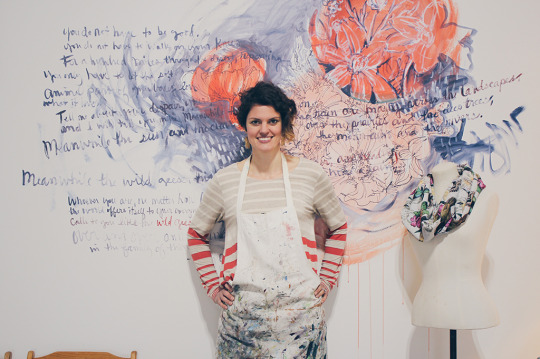
A particular point of pride of our bird research is the BirdSafe Pittsburgh program. A consortium of environmental groups and concerned citizens is working to create a more bird-friendly city, from restoring urban habitat to advising builders and architects on designing structures that will be less dangerous to birds. One of our prime collaborators has been Ashley Cecil, who was Artist in Residence at Carnegie Museum of Natural History. Ashley’s art is bird-themed, including one work that was reproduced on adhesive film that reflects UV light and is highly visible to birds. This film can be applied to windows so that birds will see Ashley’s pattern and avoid collision rather than see a reflection of a distant tree they would approach, striking the window. The film is available in color, making the window look like a stained glass, and in transparent form, resembling lace.

Ashley Cecil in front of her art work

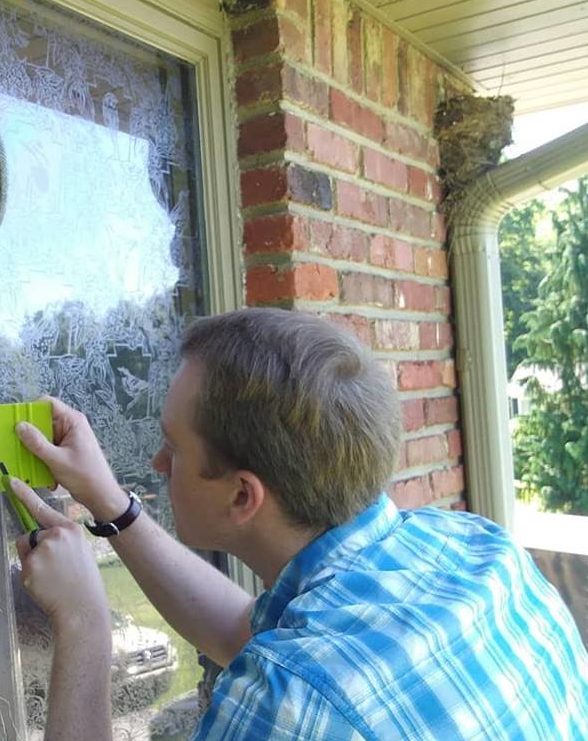
But does the film work? If you put the film on the window, does it reduce bird strikes? As the Director of Powdermill Nature Reserve, I thought I should lead by example and test the film on my own house. I have been monitoring bird strikes at my home since August of 2015. From about 6:00 am to 8:00 am, three or four days a week (at total of six to eight hours a week), I listened for strikes and recorded them. They are not random, nor evenly distributed. Certain windows seem to be a repeated problem, while others never seem to get hit. My house has 15 windows of various dimensions, plus a cathedral window that is 11 feet high and 21 feet wide. No bird has ever hit that window as far as I know. Most strikes occur when migrating birds are coming through, usually April and May, or September and October. When there is a flush of migration, it shows: I had seven strikes from August 27 to 31 in 2015, in only 10 hours of observation. Ignoring seasonal variation, and averaging across the entire data set, a rough estimate is that I observed about one strike for every 20 hours of observation. On June 14, 2018, our Urban Bird Conservation Coordinator, Jon Rice, installed the transparent film on the five most dangerous windows, leaving the others bare.

Jon rice applying birdsafe window

We have had zero bird strikes since the film was installed. To assess the effect of the film, consider that in the same period in 2017 we had seven strikes, in 2016 we had four, and in 2015 we had nine. Years have some random variation, but clearly, there is a reduction from these earlier three years’ average of 6.7 down to 0. More than that, my wife Donna and I became more vigilant since the installation of the film, and we logged about 10 or 12 hours of observation per week rather than six or eight we did for the baseline. If we use the baseline expected frequency of one bird per 20 hours of observation, then with the more thorough observations we would have expected a little more than one bird every two weeks, or about 10 birds in the 18 elapsed weeks, rather than 6.7. Using a simple “chi-square” statistic to estimate the difference between an expectation of 10 birds and an observation of zero, the probability is one in a thousand that we would get zero birds by random variation from an expectation of 10 birds. In other words, if our recent sample differs from our baseline probability purely by chance, we would have to measure 1,000 years to get one year as far from expectation as we got in 2018 following application of Ashley’s film. According to our scientific standards, we reject proposals that have a probability of less than one in 20. Our analysis is less than one in 1,000. We conclude that the film works very well to prevent birds from hitting windows.

You can contact Urban Bird Conservation Coordinator Jon Rice at RiceJ@CarnegieMNH.org.

John Wenzel is the Director at Powdermill Nature Reserve, Carnegie Museum of Natural History’s environmental research center. Museum employees are encouraged to blog about their unique experiences and knowledge gained from working at the museum.

Filed Under: Blog Tagged With: Anthropocene, Ashley Cecil, birdsafe pittsburgh, conservation, John Wenzel, Powdermill Nature Reserve

October 17, 2018 by wpengine

The Haunted Walton Hall of Ancient Egypt and the Mystery of the Blob

by Erin Peters

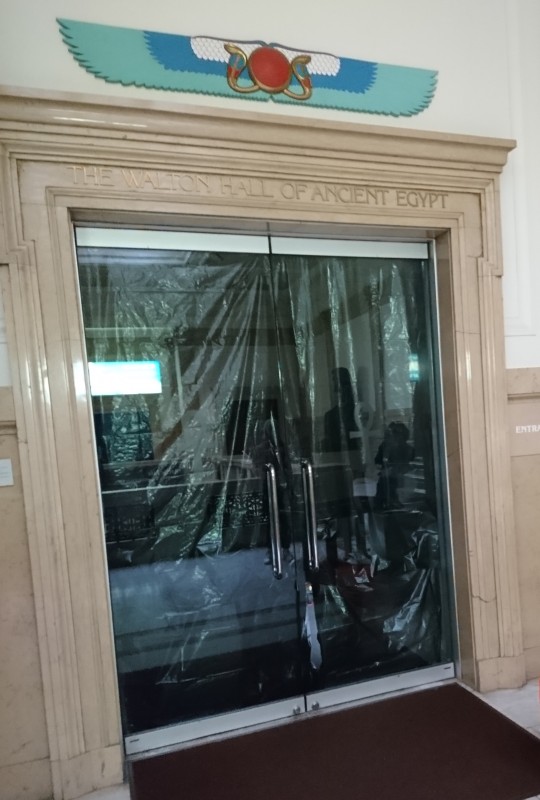
If you visited our Walton Hall of Ancient Egypt in the last few weeks, you may have seen the windows and doors blocked so you couldn’t see inside. With this dramatic drapery, perhaps we were preparing a haunted Walton Hall for our October 26 After Dark? Alas, this is not the year of the mummy, but something mysterious was happening inside!

Walton Hall of Ancient Egypt with door blocked to light

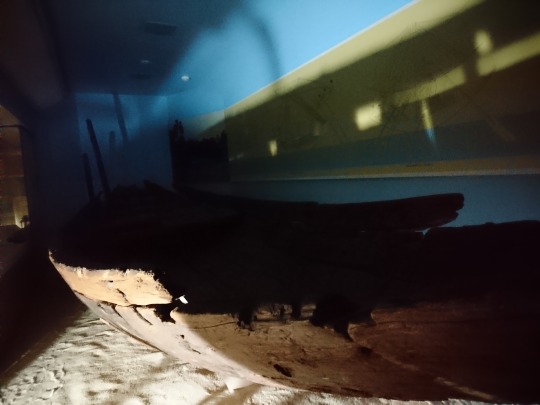
We are on the search for something missing from our Dynasty 12 funerary boat buried at the pyramid complex of Senwosret III. Even from this very spooky photo taken when we had the gallery blocked from light, you can see the boat is made of wood – cedar of Lebanon – a luxury good in the ancient world.

funerary boat in Walton Hall of Ancient Egypt

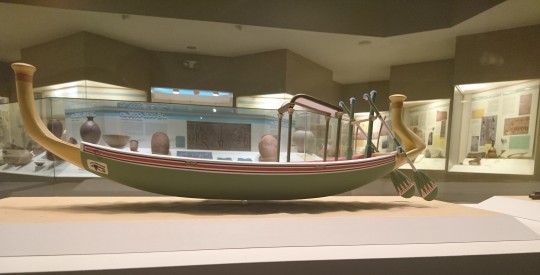
We know the boat was also painted because scholars that studied it in the 1980s noted small fragments of paint remaining on the wood surface. From these notes, they theorized it could have looked something like this model on display in the gallery.

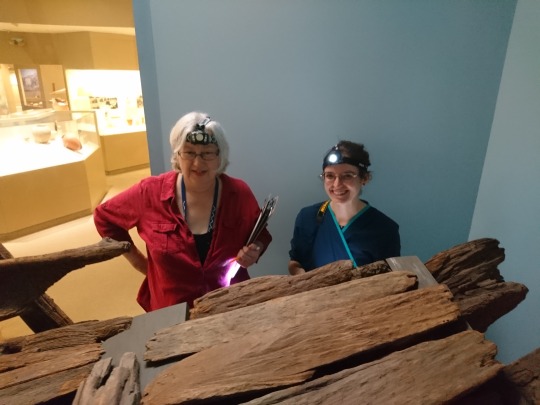
We have new technology in the field of conservation that can reveal trace amounts of pigments that are not visible to the naked eye. To capitalize on this new technology, I invited my conservator colleague, Dawn Kriss, to work with CMNH’s conservator, Gretchen Anderson, to carry out Multi-Band Imaging on the boat.

Gretchen Anderson and Dawn Kriss in Walton Hall of Ancient Egypt

With other sources of light blocked out, Multi-Band Imaging can reveal a number of elements on a surface including pigments, binders, and treatments, even if they aren’t easy to see. I am most excited about the pigment Egyptian blue, which can luminesce through Visible Induced Luminescence Imaging (VIL).

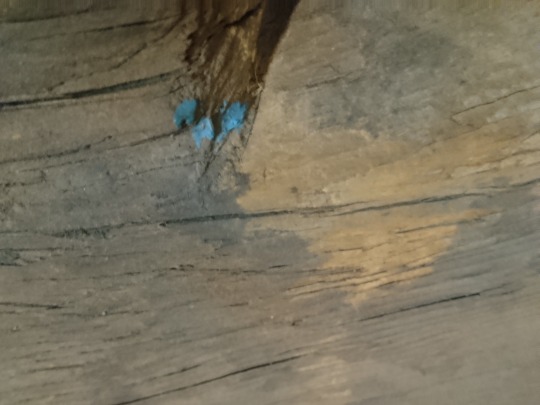
detail of boat with blue pigment

When Dawn found this mysterious blob – we thought we definitely had Egyptian blue!

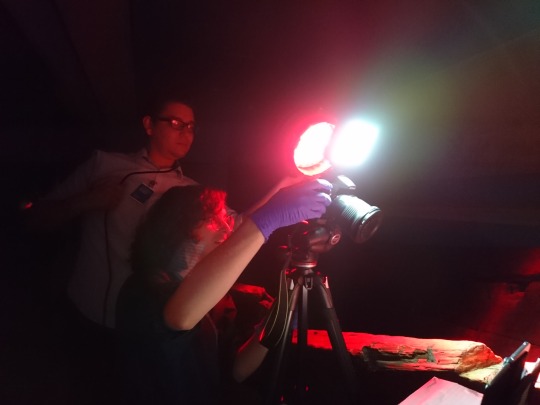
imaging work in progress

In her analysis of the boat, Dawn first looked at the blob (with help from Chase Mendenhall, CMNH’s Assistant Curator of Birds, Ecology, and Conservation – moonlighting as an Egyptologist). Dawn carried out the whole range of Multi-Band Imaging on the blob, including VIL. Surprisingly, it did not luminesce like we all thought it would.

Michael Belman testing the blob with X-ray fluorescence

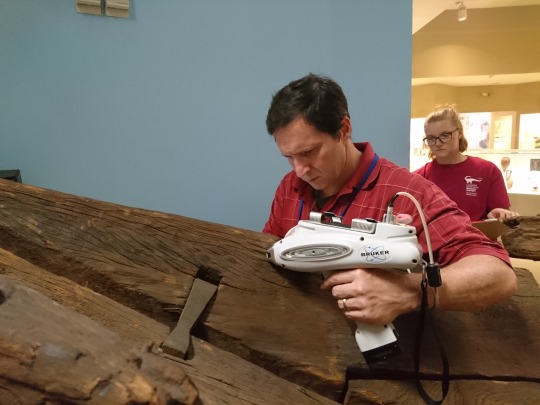
We invited our colleague, Michael Belman, CMOA’s Object Conservator, to join our hunt for information about pigments, binders, and treatments on the boat. My ultimate priority was the blob! When Michael tested it with XRF (X-Ray Fluorescence) technology, he found what seemed to be trace amounts of copper, which is what we would expect with Egyptian blue. Yet, there didn’t seem to be enough to suggest it was the primary element in the pigment…

This initial analysis has prompted us to continue our study of it, and search for other pigments, binding material, and treatments. Keep tuned for updates on the Carnegie Boat and the mystery of the blob!

Erin Peters is an assistant curator of science and research at Carnegie Museum of Natural History. Museum employees are encouraged to blog about their unique experiences and knowledge gained from working at the museum.

Filed Under: Blog Tagged With: ancient egypt, conservation, Erin Peters, Walton Hall of Ancient Egypt

August 21, 2018 by wpengine

Saddle Cleaning

by Ruth Fauman-Fichman

In the Section of Collection Care and Conservation at the Carnegie Museum of Natural History there are thousands of artifacts that silently scream for treatment. They wait patiently for their turn to be noticed. Some have been waiting for close to a hundred years, having gathered dirt and soot from their years ago acquisition by the museum. If it weren’t for Conservator Gretchen Anderson’s dogged dedication, many would still be waiting. They all harbor secrets, some easier to figure out than others. Many came to the museum long ago with limited information about themselves, tucked into dark corners.

At the “Annex” (the informal name for the O’Neill Research Center) one afternoon I found myself sitting in front of a sawhorse covered over with degrading plastic.  I had seen and moved around four of these sawhorses over the last year, always hearing from Ms. Anderson: “we can’t deal with these yet, but soon!” Now, as a result of a successful grant proposal to the National Endowment for the Humanities to upgrade the storage capabilities of the Anthropology holdings, I would finally be able to inspect and conduct a light cleaning of the contents underneath.

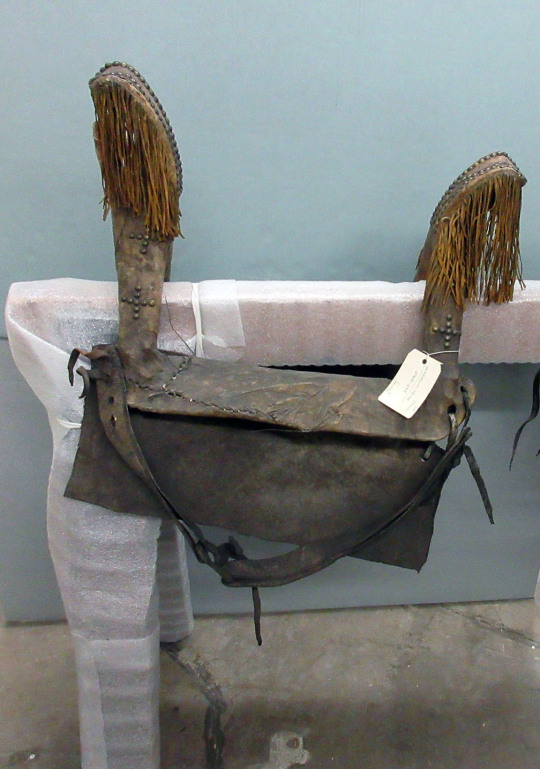
Woman’s saddle, before treatment.  
Woman’s saddle, before treatment.

With its non-archival plastic cover now discarded, the sawhorse hid a soot-black North American Indian woman’s saddle. What an ugly disappointment, I initially thought. What was it made of? Animal, vegetable, mineral? The only way to know was to carefully begin, using soft brushes. Almost immediately a surprise surfaced. This saddle was not just some indistinct blob! It was made of a combination of wood, antler, leather, brass ornaments and COLOR!

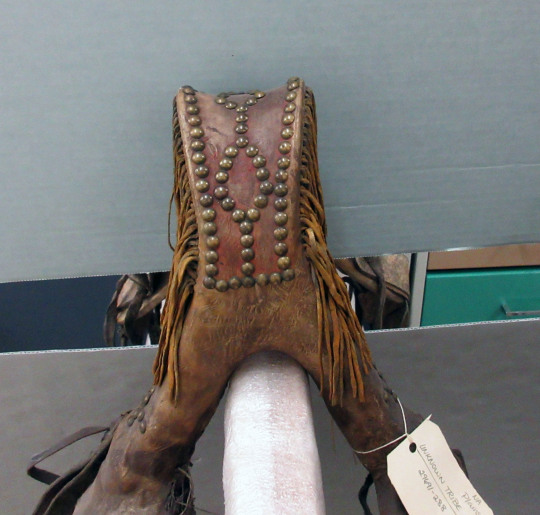
Brushing the top of the front tasseled pommel suddenly revealed intentional red ochre staining around the decoratively placed brass studs embedded in a cross pattern. Further careful cleaning changed the grey suede tassels to a luminous mustard-color. The same was revealed on the back pommel. Suddenly this non-descript saddle had personality and power! No longer disappointing, the rest of the six hours I spent cleaning this piece made me feel connected to the person who might have used it.

I carefully cleaned the rest of the piece over several sessions with soot sponges.  The seat and pommels were made of wood and antler, covered in leather sewn together with sinew. I noticed the tanned leather thongs used to tie each piece of the saddle together and attach to leather cinches placed around the belly of the small pony or horse.  The thongs were degrading practically to a powder with even limited handling from what Anderson and Collections Manager Deborah Harding called “red rot.” The woman who sat on this pony or horse shielded her thighs from being rubbed raw by rectangular pieces of leather attached to the saddle body with leather thongs. The “leathered” side of the rectangular piece rested against the pony and the suede side against the rider. Careful cleaning on the suede side revealed red stains. Red ochre? Horse blood? Something else?

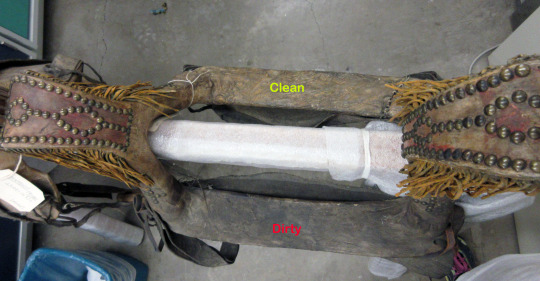
Half-cleaned saddle
Half of the saddle has been cleaned.  Note the color difference between the dirty side and cleaned side.  The majority of this is soot from years of exposure to Pittsburgh air pollution.


saddle horn after cleaning
Close-up of the saddle horn after cleaning.  The red ochre color was completely obliterated by soot.


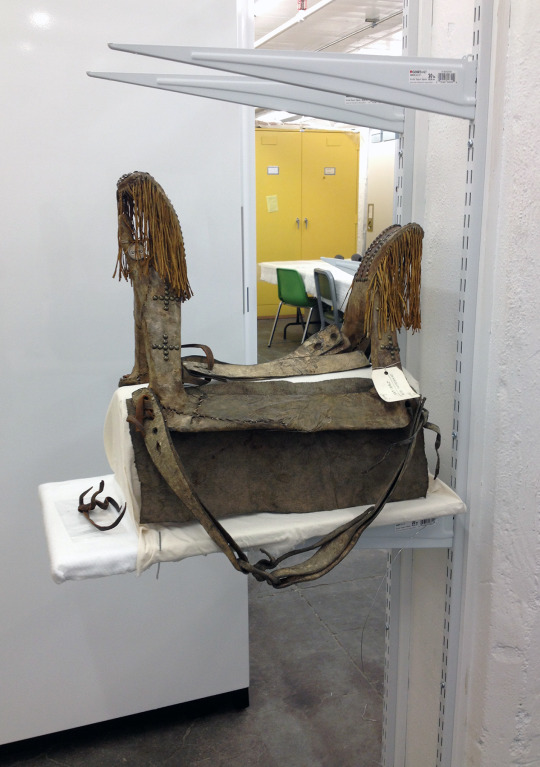
While there is little information in the accession record to tell us anything about the original owner of this saddle, from cleaning it carefully I was able to determine that this saddle was well used. It was a privilege to handle it and let it speak to me for a little while. In its cleaner state, it now rests on a horse-like bed of archival materials that will not further degrade its fragile materials and I will be making a cover for it and its three other saddle companions in the near future.

saddle in storage
The saddle on its new storage mount.

Ruth Fauman-Fichman is a volunteer at the Carnegie Museum of Natural History.

Filed Under: Blog Tagged With: anthropology, conservation, Pittsburgh

  • Page 1
  • Page 2
  • Page 3
  • Page 4
  • Go to Next Page »

sidebar

About

  • Mission & Commitments
  • Directors Team
  • Museum History

Get Involved

  • Volunteer
  • Membership
  • Carnegie Discoverers
  • Donate
  • Employment
  • Events

Bring a Group

  • Groups of 10 or More
  • Birthday Parties at the Museum
  • Field Trips

Powdermill

  • Powdermill Nature Reserve
  • Powdermill Field Trips
  • Powdermill Staff
  • Research at Powdermill

More Information

  • Image Permission Requests
  • Science Stories
  • Accessibility
  • Shopping Cart
  • Contact
  • Visitor Policies
One of the Four Carnegie Museums | © Carnegie Institute | Privacy Policy | Terms of Use | Accessibility
Rad works here logo