• Skip to primary navigation
  • Skip to main content
  • Skip to primary sidebar

Carnegie Museum of Natural History

One of the Four Carnegie Museums of Pittsburgh

  • Visit
    • Buy Tickets
    • Visitor Information
    • Exhibitions
    • Events
    • Dining at the Museum
    • Celebrate at the Museum
    • Powdermill Nature Reserve
    • Event Venue Rental
  • Learn
    • Field Trips
    • Educator Information
    • Programs at the Museum
    • Bring the Museum to You
    • Guided Programs FAQ
    • Programs Online
    • Climate and Rural Systems Partnership
  • Research
    • Scientific Sections
    • Science Stories
    • Science Videos
    • Senior Science & Research Staff
    • Museum Library
    • Science Seminars
    • Scientific Publications
    • Specimen and Artifact Identification
  • About
    • Mission & Commitments
    • Directors Team
    • Museum History
  • Tickets
  • Give
  • Shop

Educator Resources

October 5, 2020 by wpengine

Changing Seats in Changing Times

desk with cloth mask and hand sanitizer

If only classroom seating changes were the biggest disruption facing teachers and students this fall. During a recent interview Ellen Sanin, Post-Secondary Coordinator for St. Anthony School Programs, mentioned the switch from group tables to tray tables as an example of a physical COVID-19 adjustment. Within the pair of classrooms at Duquesne University’s Fisher Hall that serve as her home base, the flexibility of individual seating allows for social distancing. Like every other teacher, the far bigger adjustment she’s currently dealing with involves the drastic reduction in enrichment opportunities for her students.

At eight locations in the Pittsburgh area, St. Anthony School Programs offer inclusive education for students age 5 -21 with primary diagnosis of Autism Spectrum Disorder, Down Syndrome, and Intellectual Disabilities. At the Duquesne University site where she has worked for the past five years, Ellen is responsible for teaching gym, technology skills, and job preparedness to 29 students between the ages of 18 and 21.

Although the disruptions she and her students faced in the wake of the mid-March lock down are hard to imagine, Ellen’s summary of the turbulent time is understated. “Like everyone else, we went to remote learning, but with a population with particular challenges to using the technology – some who can’t read, and some who are nonverbal.” This fall, in-person teaching has resumed, with instruction for three of her students restricted to on-line.

In former years, post-secondary students and instructors in the St. Anthony Program routinely visited as many as 20 different Pittsburgh sites as part of job preparedness training. Current COVID-19 restrictions, Ellen explained, have reduced these field trip destinations to a handful of locations on the Duquesne University campus, the Allegheny County Court House, and a life skills and home skills training apartment in Squirrel Hill. “We made regular visits to Carnegie Library locations, but libraries, like lots of other places are operating under new guidelines.”

Because Ellen in also a veteran museum educator, with deep experience teaching summer camp programs, the interview closed with a question about her insight into parallels between the students she works with on a daily basis and those she has taught during summer. “The main difference is age, of course, but the similarities in interests are remarkable. One of my current students is fascinated with dinosaurs. He would have loved being in a dinosaur class.”

Patrick McShea works in the Education and Visitor Experience department of Carnegie Museum of Natural History. Museum employees are encouraged to blog about their unique experiences and knowledge gained from working at the museum.

Related Content

Harriet Tubman Was a Naturalist
When Perspective Meets Research

Frontier History Wizards

Filed Under: Blog Tagged With: Educator Resources, Educators, Pat McShea, Patrick McShea

September 4, 2020 by wpengine

Teaching in a Changed World

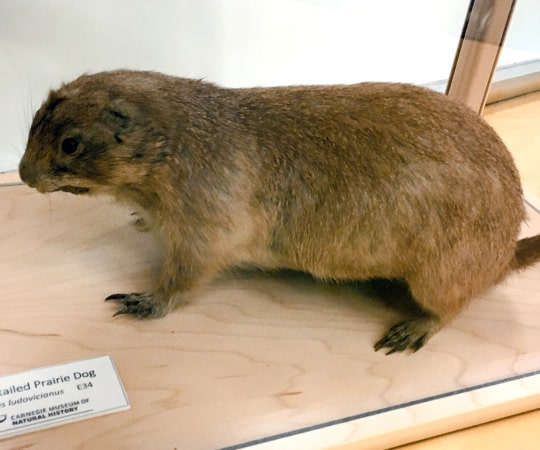
prairie dog taxidermy mount

For several years Leslie Vandegrift has used materials from the Educator Loan Collection to enhance reading lessons for kindergarten through third grade students. As the librarian for West Hills Primary School in the Armstrong School District, she’s put authentic objects to use in building vocabulary, sparking curiosity about the ideas conveyed through ever longer strands of words and sentences, and promoting the reading of all kinds of books. In the library of West Hills Primary, materials from the museum illustrating topics ranging from nocturnal animals to the wildlife discoveries of the Lewis and Clark Expeditions have helped diminish the 44 highway miles separating the two buildings.

When reached by phone a dozen days before the start of in-person classes, the 24 year veteran educator expressed concern about how the school year would proceed and whether her library could function as it did in the past. As she summarized, “The most challenging part of this new normal, is that the students will be unable to check out books for at least the first semester of school.  There is zero sharing of materials in our school building in order to keep our students as safe as possible.  It’s disheartening to engage students in new topic areas and authors, but not be able to allow them to pursue it independently.”   Student well-being was her utmost priority, and she expressed pride in knowing that was also the case for every one of her co-workers.

If the spread of COVID-19 pushes her school to on-line instruction, Leslie expressed confidence that the transition would be far smoother than what occurred across the country back in mid-March. Days of in-service training in August were devoted to mastering the intricacies and capabilities of a digital learning management platform called “Canvas,” and the first order of business after the opening day of school will be getting the students comfortable interacting with the electronic interface.

Leslie’s description of the learning platform’s flexibility leads me to remind more teachers about the Educator Loan Program’s continued importance as a resource. Materials can be borrowed to create digital products. Cell phone still images or brief videos of authentic objects can improve lessons presented on learning platforms. Your productions don’t have to meet the standards of the library displays at West Hill Primary School for learning to occur.

Patrick McShea works in the Education and Visitor Experience department of Carnegie Museum of Natural History. Museum employees are encouraged to blog about their unique experiences and knowledge gained from working at the museum.

Related Content

Cats: The Original Social Distancers

First-ever American Malacological Society Virtual Meeting

CMNH Hosts Science Bowl

Filed Under: Blog Tagged With: Education, Educator Loan Program, Educator Resources, Educators, Pat McShea, Patrick McShea

August 24, 2020 by wpengine

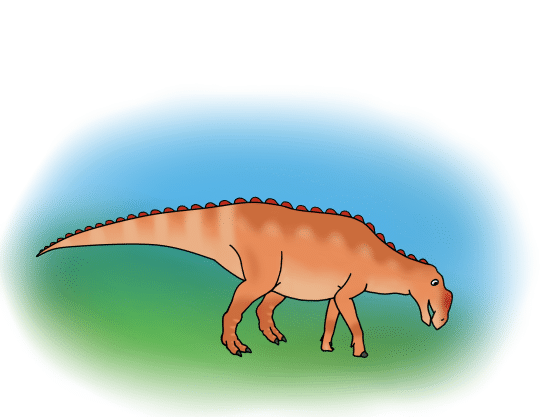
Mesozoic Monthly: Gryposaurus

The Late Cretaceous-aged (~75 million-year-old) large-nosed North American hadrosaur (aka duck-billed dinosaur) Gryposaurus by ginjaraptor on DeviantArt.

Anyone who frequents the Pittsburgh area is familiar with ‘Pittsburghese,’ the regional dialect given full voice in what was once voted America’s ugliest accent (a fact that does not diminish our pride for it). One of my personal favorite Pittsburghese words is “nebby,” which translates to “nosy” for any non-local readers. “Nebby” can be used in a variety of contexts: the distant relative asking prying questions about your love life at Thanksgiving dinner is nebby, the pet cat trying to crawl under the bathroom door to see what you’re doing is nebby, and even the statue of Carnegie Museum of Natural History mascot Dippy the Diplodocus, silently judging your driving on Forbes Avenue, is nebby. We can assume other dinosaurs were nebby too, since so many had huge noses to stick into things. One of the biggest noses in the fossil record belongs to Gryposaurus notabilis, the star of this edition of Mesozoic Monthly.

Gryposaurus belongs to a group of dinosaurs called hadrosaurs, which are commonly referred to as duck-billed dinosaurs. Hadrosaurs were herbivores that got their nickname from the flat, toothless, somewhat duck-like beaks at the tips of their jaws. These beaks were used to bite through tough vegetation so that it could be ground up by the numerous teeth embedded in the rear half of the jaws. There are two main groups of hadrosaurs, both of which are featured in CMNH’s Dinosaurs in Their Time exhibition. Probably the more famous group is the Lambeosaurinae, known for their distinctive head crests that housed extra-long nasal passages. Virtually everyone can recognize the incredible backward-curving crest of Parasaurolophus (featured multiple times in the Jurassic Park franchise), and visitors to CMNH will also know the helmet-like crest of Corythosaurus. The second group is the Saurolophinae (traditionally known as the Hadrosaurinae), which typically lack bony crests. You can find a simulated carcass of the saurolophine Edmontosaurus (lovingly known to those of us in CMNH’s Section of Vertebrate Paleontology as “Dead Ed”) between the two imposing Tyrannosaurus skeletons in Dinosaurs in Their Time.

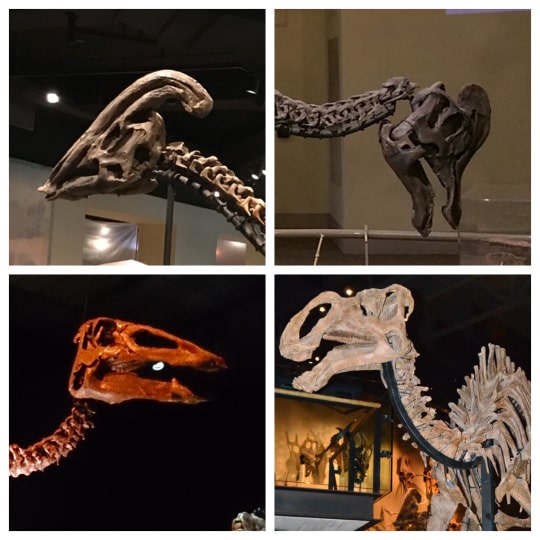
A gallery of hadrosaur heads. Top left: the lambeosaurine Parasaurolophus at the Field Museum of Natural History in Chicago (photo by the author). Top right: the lambeosaurine Corythosaurus at Carnegie Museum of Natural History (photo from Wikimedia Commons). Bottom left: the saurolophine Edmontosaurus at the Houston Museum of Natural Science (photo from Wikimedia Commons). Bottom right: the saurolophine Gryposaurus at the Natural History Museum of Utah in Salt Lake City (photo from Wikimedia Commons).

As a crestless hadrosaur, Gryposaurus was a saurolophine. Despite its lack of crest, its skull still had pizzazz: its nasal bone arched dramatically, giving the impression of a ‘Roman nose’ (which is very noticeable if you compare the skulls of Edmontosaurus and Gryposaurus in the image above). The name Gryposaurus notabilis means “notable hooked-nose lizard” in homage to this feature. G. notabilis is the type species of Gryposaurus; type species are typically the first ones to be named in a genus, and therefore become the reference to which all new specimens that may belong to that genus are compared. The other species (such as G. monumentensis, shown in the photo montage above) are similar enough to the type species that they can be referred to the genus Gryposaurus, but they differ in too many ways to be assigned to G. notabilis itself.

Occasionally, paleontologists will revisit a fossil species or genus and decide that it is either too similar to another to justify its own name or that certain specimens are too different to be grouped under the same name. Kritosaurus, another saurolophine with a ‘Roman nose,’ has fallen victim to both of these circumstances. It was originally considered its own genus, but was subsequently revisited by paleontologists who decided that it was so similar to Gryposaurus that the two genera were lumped together under the name Gryposaurus (when combining taxonomic groups, the first name that was published is the one that gets used). However, later paleontologists reviewed the evidence again and split a single species of Kritosaurus back out of Gryposaurus. The famous sauropod (giant long-necked herbivorous dinosaur) Brontosaurus underwent a similar series of changes over the years: originally, it and Apatosaurus were considered different animals, but after a review they were lumped together under Apatosaurus. Recently, the two were split apart again and the name Brontosaurus was revived (to the delight of fans of that name around the world).

It is not uncommon in paleontology for species to be lumped or split based on new or revisited evidence. When you consider that the decision to name new fossil species is often based on fragmentary, highly incomplete skeletons, you can see why it might be difficult to get things right the first time! These changes sometimes give people the impression that paleontologists “can’t make up their minds” or “contradict themselves,” but we must remember two things. First, that science is meant to change based on new evidence. Second, there have been thousands of paleontologists over the course of history, and every one of them is an individual person who can draw their own conclusions based on the same evidence. Although the resulting changes can disappoint fans of a specific animal or hypothesis, revision is normal and beneficial for the field as a whole. Scientists are supposed to be nebby – it’s how we make new discoveries!

Lindsay Kastroll is a volunteer and paleontology student working in the Section of Vertebrate Paleontology at Carnegie Museum of Natural History. Museum staff, volunteers, and interns are encouraged to blog about their unique experiences and knowledge gained from working at the museum.

Related Content

Mesozoic Monthly: Aspidorhynchus

Ah, Snap! Dino Named for Marvel’s Thanos

Jurassic Days: Specimen Scavenger Hunt

Filed Under: Blog Tagged With: dinosaurs in their time, Educator Resources, Lindsay Kastroll, Mesozoic Monthly, Museum from Home, Science News, Section of Vertebrate Paleontology

August 5, 2020 by wpengine

Meowfest: Sabertooth Tiger

sabertooth tiger and dire wolf museum exhibit

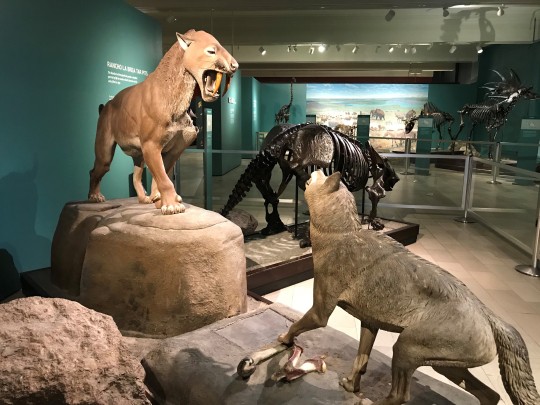
If you ever think you’ve found yourself in a sticky situation, it doesn’t compare to what this sabertooth tiger found itself in. This specimen of Smilodon, otherwise known as a sabertooth tiger, the Dire Wolf, and Harlan’s Ground Sloth at the museum were recovered from excavations at the La Brea Tar Pits.

Smilodon itself is the general name for three separate related species: Smilodon populator, Smilodon fatalis, and Smilodon gracilis. Despite their name, they’re not closely related to tigers or other big cats in the genus Panthera, which also includes lions, leopards, and jaguars. The three species mostly differ in size—while Smilodon gracilis typically weighed in at around 55-100 kg (100-220 lbs), Smilidon fatalis tipped the scales at 160-280 kg (350-600 lbs); approximately the same weight as a Siberian tiger.

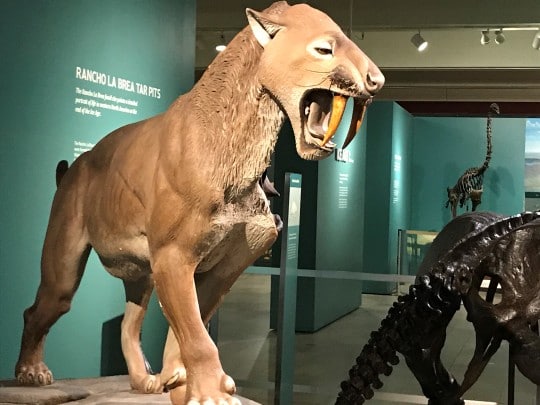
All three species of Smilodon have elongated canine teeth. Some specimens have teeth measuring up to 11 centimeters (4.33 in.). However, these teeth are incredibly fragile. If the Smilodon were to hunt the same way as modern cats, they would have broken their canine teeth. Instead, it’s thought Smilodons would use their upper body strength to tackle the intended prey and then use their canines to puncture and tear away meat. Due to the distribution of fossils found, it is believed that they were most likely pack hunters.

Carnegie Museum of Natural History is proud to feature a Smilodon fatalis specimen, which had a roundabout journey 2,000 miles and approximately 11,000 years in the making.

close up of sabertooth tiger model

It all began at the La Brea Tar Pits—a series of naturally occurring asphalt pits where petroleum oozes from the ground. What makes the pits at La Brea unique is the fact they have been continuously active for 50,000 years. As history has progressed, modern-day Los Angeles has grown around them. The pits are now one of the only paleontological sites located inside of a major city in the world.

The Rancho La Brea Tar Pits are a virtual treasure-trove for fossils from the Ice Age. Over 100 excavations since the early 1900s have resulted in the recovery of over 3.5 million fossils from all manner of species, including over 2,000 individual sabre tooth tigers. This is due to the unique fossilizations process created by the pits themselves. As the tar oozes, pools, and warms on the ground, it becomes sticky; prey mammals can easily become stuck in as little as four centimeters (1.57 in.) and unable to move. A strong and healthy animal might be able to escape, but for the majority trapped in the tar, it was only a matter of time until they succumbed. Sometimes, a passing predator would hear a stuck animal and try to seize them first (such as Smilodon). This would often result in the predator becoming stuck as well, and both predator and prey would be found well-preserved thousands of years later.

Even today, the Rancho La Brea site is still actively producing fossils. A variety of flora and fauna have been preserved here, allowing us to have an unparalleled look at species from the end of the last major Ice Age. By studying these fossils from the past, scientists in turn can learn how things like climate change may affect us in the future.

Andrew Huntley is a Gallery Presenter in CMNH’s Lifelong Learning Department, as well as part of the Animal Husbandry staff for the Living Collection. Museum staff, volunteers, and interns are encouraged to blog about their unique experiences and knowledge gained from working at the museum.

Related Content

Big Cats, Big Personalities

Meowfest: DIY Cat Toy

Cats: The Archeological Site!

Filed Under: Blog Tagged With: Educator Resources, ice age mammals, Museum from Home, Super Science Days, Super Science Meowfest

August 4, 2020 by wpengine

Big Cats, Big Personalities

You may have heard the phrase “big cat” before. No, it doesn’t refer to a particularly large house cat, but rather to a category of cats. “Big cat” is a term typically used to describe any member of the genus Panthera, though it can mean different things to different people.

Some consider every member of the larger subfamily Pantherinae to be big cats—for example, clouded leopards (genus Neofelis). Sometimes, the phrase “big cat” just refers to any member of the cat family (Felidae) that is large, such as the cougar (genus Puma), the cheetah (genus Acinonyx), and the Eurasian lynx (genus Lynx, species lynx).

Tigers, Lions, Jaguars, Leopards, and Snow Leopards are the extant (or currently living) members. You may be wondering how leopards and snow leopards are members of genus Panthera but clouded leopards are not. Clouded leopards are not true leopards—they branched off into their own genus roughly six million years ago; they are in the larger subfamily of Pantherinae, but not Panthera specifically.

One feature sometimes used to distinguish big cats from other cats is the ability to roar, but that ability is only found in the Panthera genus, not the additional species. Roaring itself is an important vocalization, but it isn’t a surefire way to distinguish what a “big cat” is. For example, snow leopards, in the family Panthera, cannot roar.

So, big cat can mean something different to everyone, but let’s learn a little bit more about each of the cats listed above:

Tigers

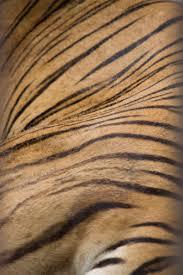
Tigers are the largest cat species on the planet! There are several subspecies and they are easily recognized by their orange color with black stripes (though Bengal tigers are occasionally white with black stripes).

close up of tiger stripes

They are solitary and territorial animals; cubs (big cat offspring are not called kittens) stay with their mother for 2 years. These cats are found throughout Asia—although they are endangered—and their population is dwindling.

Lions

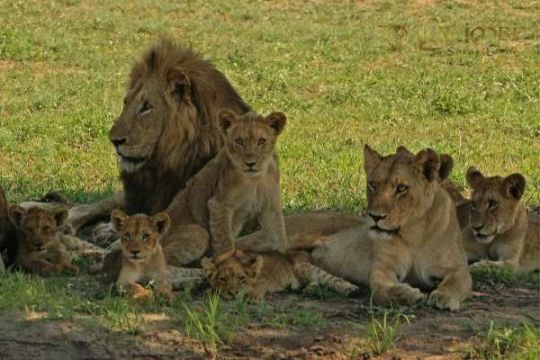
photo of a family of lions

Lions are a social species of large cats found in the grasslands and savannas of Africa. Males are recognizable by their long hair surrounding their necks, called manes. Lionesses do the hunting for the pride (social group of lions), which is comprised of several adult males, related females, and cubs. These animals are listed as vulnerable, which means they are close to becoming endangered.

Jaguars

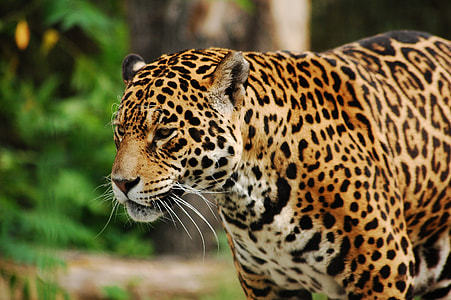
photo of a jaguar

Jaguars are the only member of the Panthera genus found in the Americas. Individual cats can be found in the Western United States, but they have had a reduced range in Central and South America since the early 20th century. They are solitary animals and ambush predators, hunting in tropical and subtropical forests and swamps. They are recognizable by their spots, which are black rosettes with spots in the middle. However, melanistic (or all black) jaguar occasionally appear; these cats are informally known as black panthers—although they are not a separate species—and the phrase “black panther” has been used to describe melanistic leopards as well. Jaguars are near-threatened, which means their numbers are decreasing and their populations are being closely monitored.

Leopards

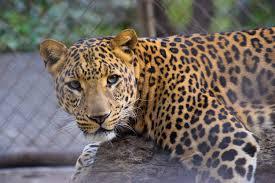
photo of a leopard

Leopards have a wide range and are found in Sub-Saharan Africa, in parts of Western and Central Asia and on the Indian subcontinent. They are recognizable by their spots; they look like jaguars with their spotted fur, but leopards are shorter with a smaller head, and their rosette-shaped spots do not have dots in the middle. Leopards are opportunistic hunters, hunting mostly on the ground at night; though in the Serengeti, they are known for attacking prey by leaping from trees. Leopards are listed as vulnerable, meaning they are potentially on their way to the endangered species list.

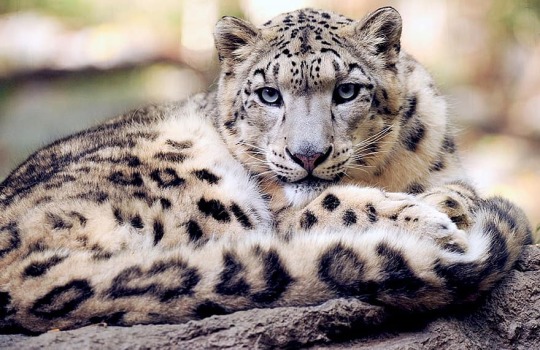
Snow leopards

photo of a snow leopard

Snow leopards live in the mountain regions of Central and South Asia, living at elevations from 3,000 to 4,500 feet. Their fur is whitish grey, with black rosettes, distinguishing them from other leopards which are yellow or brown in color. Snow leopards have large nasal passages which helps warm the cold, dry air they breathe. Their tails are covered thickly with fur and provide fat storage; sleeping snow leopards use their warm tails like blankets to protect their faces when they sleep. They are listed as vulnerable, meaning they may appear on the endangered species list in the future.

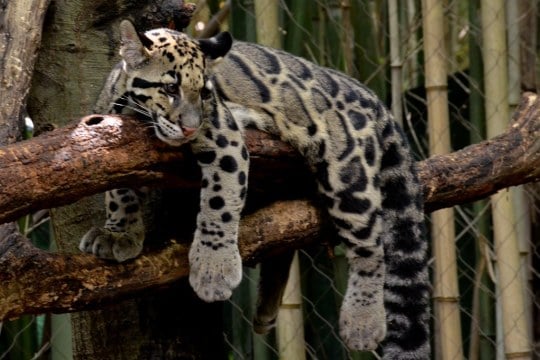
Clouded leopards

photo of a clouded leopard lounging on a branch

There are two species of clouded leopards—the mainland clouded leopard (Neofelis nebulosa) and the Sunda clouded leopard (Neofelis diardi). The mainland clouded leopard is found in the Himalayan foothills in Southeast Asia and southern China and the Sunda clouded leopard is found in Borneo and Sumatra. They are considered an evolutionary link between two cat families Pantherinae and Felinae. Their fur is dark grey with a black blotched pattern. Clouded leopards are solitary and hunt by stalking or ambushing prey. They are excellent climbers and use trees as rest sites.  Both species of clouded leopards are listed as vulnerable, meaning they can potentially end up on the endangered species list.

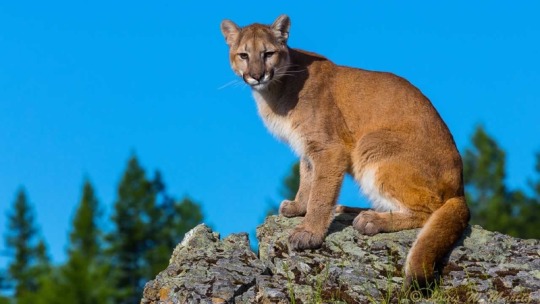
Cougar

photo of a cougar sitting on a rock

The cougar (also known as a puma, mountain lion, red tiger, or catamount) is the only cat on this list that you may see in the wild around Pittsburgh; however, their populations are severely reduced in the eastern half of North America. These cats are adaptable to a wide variety of habitats, which is why they are found all throughout North and South America. This wide range is the reason people living in different regions have different names for them. They are ambush predators, preferring to hunt deer, though they will eat insects and rodents. While cougars are large, they are not always the apex (or top) predator and will occasionally give food they caught away to jaguars, grizzly bears, or even alligators! Cougars are listed as least concern, meaning their population is holding steady, though their range has shrunk.

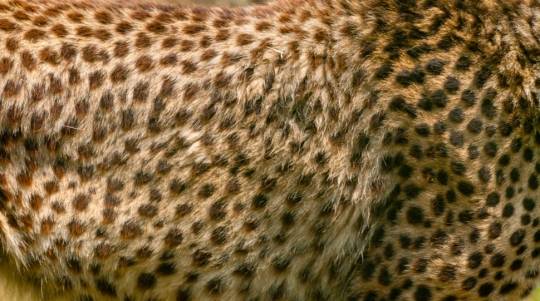
Cheetah

close up of a cheetah's spotted fur

Cheetahs are known for their speed; as the fastest land animal, they are capable of running up to 80 miles per hour! Cheetahs can be found in the Serengeti, Saharan mountain ranges, and in hilly areas of Iran. Cheetahs separate into three kinds of social groups—females with cubs, all-male groups, and solitary males. Females are more likely to travel further distances while males will establish and stay in smaller territories. They are active during the day and spend most of their time hunting for things like impala or springbok. Cheetahs are listed as vulnerable, with one of the main threats being a lack of genetic diversity, which makes it difficult for the species to adapt and evolve over generations, reducing the chance for individual animals to survive.

Eurasian lynx

photo of a Eurasian lynx

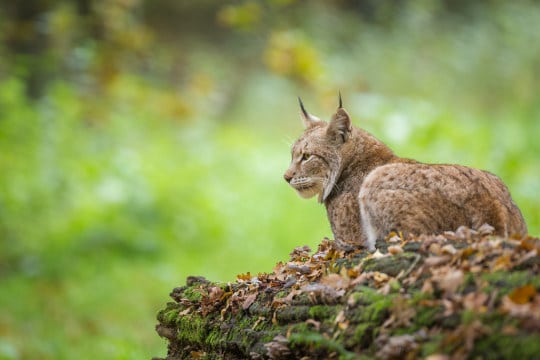
The Eurasian lynx is found from Europe into Central Asia and Siberia, living in temperate or boreal (snow or Taiga) forests. They have short, red-brown coats, and are more colorful than most animals sharing their habitat. In the winter, their fur grows in thicker and greyer. These cats have relatively long legs and large webbed and furred paws that act like snowshoes, allowing them to walk on top of the snow. They have bobbed (or short) tails, much like one of their cousins you might see around Pittsburgh—the bobcat. They hunt small mammals and birds but will occasionally take down young moose or deer. The Eurasian lynx is listed as least concern, with a stable population.

Jo Tauber is the Gallery Experience Coordinator for CMNH’s Life Long Learning Department, as well as the official Registrar for the Living Collection. Museum staff, volunteers, and interns are encouraged to blog about their unique experiences and knowledge gained from working at the museum.

Related Content

Cats: The Archeological Site!

Meowfest: Museum Scavenger Hunt

Why Do Cat Eyes Glow in the Dark?

Filed Under: Blog Tagged With: cats, Educator Resources, Hall of African Wildlife, Hall of North American Wildlife, Jo Tauber, Museum from Home, Super Science Days, Super Science Meowfest

August 14, 2019 by wpengine

Frontier History Wizards

white snakeroot plant
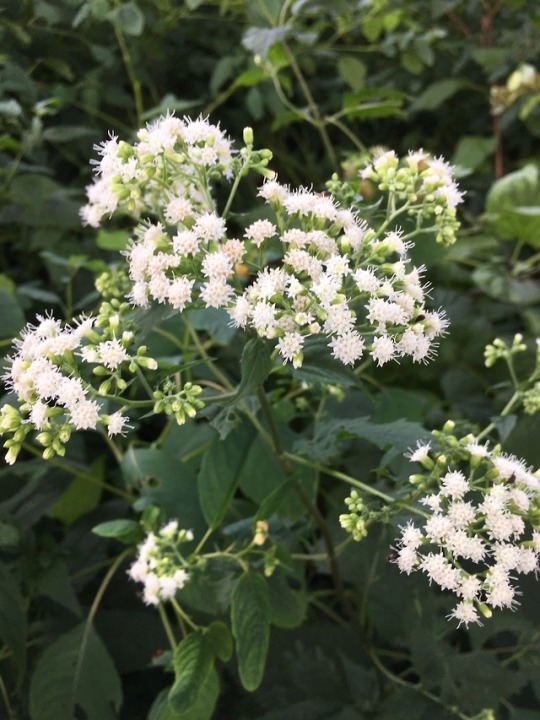
White snakeroot blooming along the Allegheny River shoreline in early August.

Written descriptions for Carnegie Museum of Natural History summer camp, Wizard Academy, invite 8 – 10-year-old participants to experience a collision between “magic and science.” Based upon my recent experience with campers in the popular Harry Potter-themed program, the advertised subject could also include “history.”

During a discussion of poisonous plants with two dozen want-to-be wizards in the Hall of Botany, I drew the group’s attention to a display labeled “LOCAL SPECIES TO AVOID.”

The focus for my remarks was white snakeroot (Ageratina altissima) a straight-stemmed and flower-topped species in the display’s front row. I explained how the plant’s common name is an historic reference to its alleged value in treating snake bites, and that its designation as a plant to avoid was based upon on its connection to an often-fatal illness know as milk sickness.

The disease, which occurred when people drank milk from cows that had fed upon white snakeroot, was a scourge of pioneer life during the early nineteenth century, the decades-long period when settlement across what was then the American frontier dramatically altered vast forests west of the Appalachians.

One of the campers assisted my narration by reading from a handout about how Abraham Lincoln’s mother, Nancy Hanks Lincoln, died from milk sickness. When another camper asked how the plant-to-cow connection was “figured-out,” I confessed ignorance but promised to find out.

herbarium sheet of white snakeroot
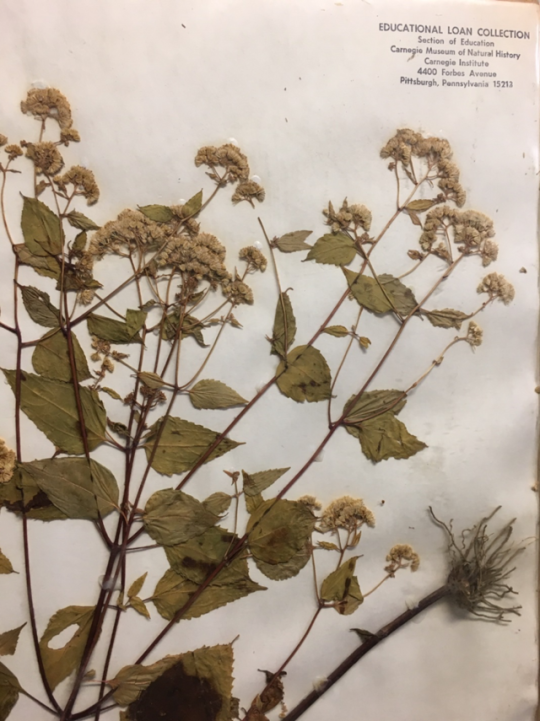
White snakeroot herbarium sheet, part of the Educator Loan Collection’s “Poisonous Plants of Pennsylvania” box.

Much of the life-saving credit, I learned, belongs to a pair of women whose friendship crossed conflicting cultures of 1820’s Illinois; a frontier doctor, and an elderly fugitive of the federal government’s forced relocation of the Shawnee to territory further west. The doctor, Anna Pierce, lost family members to milk sickness and, based upon observations of disease occurrence, promoted the avoidance of milk drinking between June and the plant-killing frosts of autumn. The relocation resister, known to settlers as Aunt Shawnee, took Dr. Pierce into the woods to show her white snakeroot and explain the plant’s lethal properties. Pierce then conducted experiments to confirm the plant’s toxicity and shared her findings with other doctors.

More than 70 years later carefully controlled scientific studies documented year-to-year and geographic variations in the toxicity levels of white snakeroot, but it wasn’t until 1928 that the plant’s toxic chemical, an alcohol termed tremetol was isolated in a laboratory. Today, largely because of better pasture management, milk sickness is not a concern in commercial dairy operations.

The takeaway lesson, kindled when a ten-year-old camper’s question illuminated a nearly 200-year-old ethnobotany story, is to more fully value the indigenous knowledge of the vibrant Native cultures that continue to exist across our country.

(Information source: Natural History, July 1990, “Land of Milk and Honey” by David Duffy Cameron)

Patrick McShea works in the Education and Visitor Experience department of Carnegie Museum of Natural History. Museum employees are encouraged to blog about their unique experiences and knowledge gained from working at the museum.

Filed Under: Blog Tagged With: Education, Educator Loan Program, Educator Loans, Educator Resources, Pat McShea, Patrick McShea

  • « Go to Previous Page
  • Page 1
  • Page 2
  • Page 3
  • Page 4
  • Page 5
  • Go to Next Page »

sidebar

About

  • Mission & Commitments
  • Directors Team
  • Museum History

Get Involved

  • Volunteer
  • Membership
  • Carnegie Discoverers
  • Donate
  • Employment
  • Events

Bring a Group

  • Groups of 10 or More
  • Birthday Parties at the Museum
  • Field Trips

Powdermill

  • Powdermill Nature Reserve
  • Powdermill Field Trips
  • Powdermill Staff
  • Research at Powdermill

More Information

  • Image Permission Requests
  • Science Stories
  • Accessibility
  • Shopping Cart
  • Contact
  • Visitor Policies
One of the Four Carnegie Museums | © Carnegie Institute | Privacy Policy | Terms of Use | Accessibility
Rad works here logo