• Skip to primary navigation
  • Skip to main content
  • Skip to primary sidebar

Carnegie Museum of Natural History

One of the Four Carnegie Museums of Pittsburgh

  • Visit
    • Buy Tickets
    • Visitor Information
    • Exhibitions
    • Events
    • Dining at the Museum
    • Celebrate at the Museum
    • Powdermill Nature Reserve
    • Event Venue Rental
  • Learn
    • Field Trips
    • Educator Information
    • Programs at the Museum
    • Bring the Museum to You
    • Guided Programs FAQ
    • Programs Online
    • Climate and Rural Systems Partnership
  • Research
    • Scientific Sections
    • Science Stories
    • Science Videos
    • Senior Science & Research Staff
    • Museum Library
    • Science Seminars
    • Scientific Publications
    • Specimen and Artifact Identification
  • About
    • Mission & Commitments
    • Directors Team
    • Museum History
  • Tickets
  • Give
  • Shop

Educators

December 7, 2020 by wpengine

Teaching About Teeth

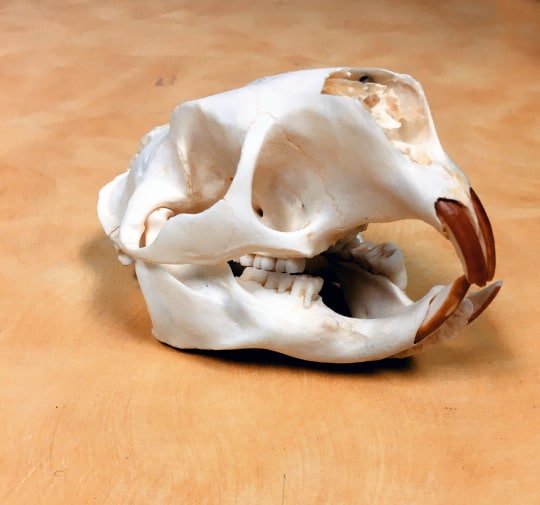
Porcupine skull from the Educator Loan Collection

The term “teachable moment” doesn’t accurately capture the opportunity first grade teachers have to guide their students in making observations about dental structure and function. “First graders are all about teeth,” explains Carolyn Mericle of the University of Pittsburgh’s Falk Laboratory School. The 29-year teaching veteran has long noted how the shared experience of tooth loss and replacement among these young students creates a high level of interest in all things dental that lasts for months, not moments.

Carolyn shared these observations during a recent phone conversation about how the mammal skulls she recently borrowed from the museum’s Educator Loan Collection would enhance student learning. Ideally, she explained, the students’ observations of the diversity of dental arrangements represented in the dozen skulls (a set which included black bear, white-tailed deer, striped skunk, and porcupine), would help them make connections to each creature’s diet. This experience would in turn lead to a better understanding of related classification terms such as, carnivore, herbivore, and omnivore.

Like every educator who is teaching through the COVID-19 pandemic, however, Carolyn is facing the necessity of modifying and adapting established plans. “Everything is hard this year.” she summarized, citing a school year that began with some of her students in her classroom and others at home, before a recent transformation to all remote instruction.

In the past, her students encountered the skulls firsthand by circulating among classroom tables where the objects were displayed. Each table included enough adjacent elbow room for students to make tooth-focused observational drawings. This week Carolyn plans to photograph the skulls and share the resulting images electronically to create a similar observational opportunity. “You have to re-think everything,” she adds, “because we’re working with a different set of tools.”

When the conversation concluded with a question about hope, Carolyn’s answer came without any hesitation. “The resilience of children gives me hope. They make the best of it. They’re powered by curiosity.”

Patrick McShea works in the Education and Visitor Experience department of Carnegie Museum of Natural History. Museum employees are encouraged to blog about their unique experiences and knowledge gained from working at the museum.

Related Content

A Gorilla for Our Imagination

Holiday Stowaway: Northern Saw-whet Owl 

Ask a Scientist: What is one of the more unique mammals of western PA?
Filed Under: Blog Tagged With: Educator Loan Program, Educators, Museum from Home, Pat McShea

November 24, 2020 by wpengine

Holiday Stowaway: Northern Saw-whet Owl

Northern Saw-whet Owls have a reputation for showing-up in surprising places. The late November news that one of these small predators accompanied a 75-foot Norway spruce on a 200 mile journey from Oneonta, New York, where the 11-ton tree was cut, to Mid-town Manhattan, where the massive evergreen was installed in a place of honor at Rockefeller Center, fits the species’ profile.

The 8-inch high birds, whose common name reflects the resemblance of one of their calls to the sound of a saw being sharpened with a whet stone, are the smallest owl found in the mid-Appalachian region. As recently as 30 years ago infrequent sightings of the owls were interpreted as evidence of the species’ decline. That assumption began to change in the 1990s with the establishment of Project Owlnet, an ongoing multi-state field study that now consists of more than 100 owl migration banding sites where on late nights every fall researchers rely on recordings of the reclusive bird’s too-too-too breeding call to lure and temporarily capture owls in mist nets. These nocturnal labors have documented healthy populations of the owls in suitable habitats, although this good news is leavened with cautions that the species’ association with higher elevation forests could make it susceptible to the effects of climate change in the coming decades.

The individual owl getting attention as a holiday tree stow-away was driven back upstate to a wildlife rehabilitation facility in the town of Saugerties, where caregivers reported the bird seemed unharmed by its odyssey. The owl, according to reports, was quickly approaching condition for release back into the wild. Back in New York City, however, a counter explanation has developed for how and when the owl arrived in the Rockefeller Center Tree. According to some interested parties, the owl could have been in the city ahead of the tree’s arrival, and sought refuge in the big spruce before it was unloaded.

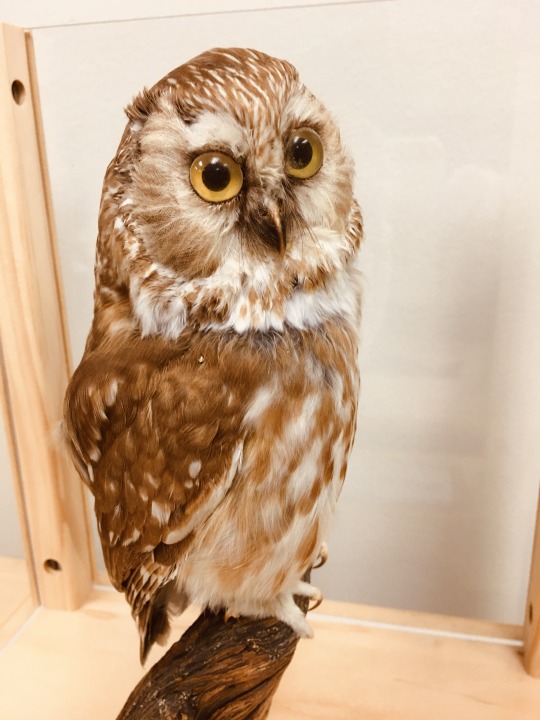
A taxidermy mount of a Northern Saw-whet Owl is a popular attraction in Discovery Basecamp.

A relatively recent experience leads me to view this explanation as within the realm of possibility. One fall day four years ago, while I was rolling a cart bearing owl taxidermy mounts into a basement classroom, a visitor stopped me by pointing directly at the smallest bird in the set. “Might I have seen this bird last week?” he asked excitedly. “At a bus stop??  On the Northside???” He then explained how the owl had been perched motionless at eye-level within leafy bushes beside a bus shelter, and that, “The owl was still there when I got on my bus.”

The museum basement, I later learned, has a direct claim to an even more remarkable sighting of species now being widely celebrated for cuteness and resilience on social media. In Birds of Western Pennsylvania, the encyclopedic 1940 volume written by the museum’s then Curator of Ornithology, W.E. Clyde Todd, the account for Northern Saw-whet Owl includes this note:

“A curious instance of a young bird found alive in one of the basement storerooms of the Carnegie Museum in June, 1927, was duplicated in July, 1932. There must have been a nesting pair in the immediate vicinity, although one would scarcely expect this owl within the city limits.”

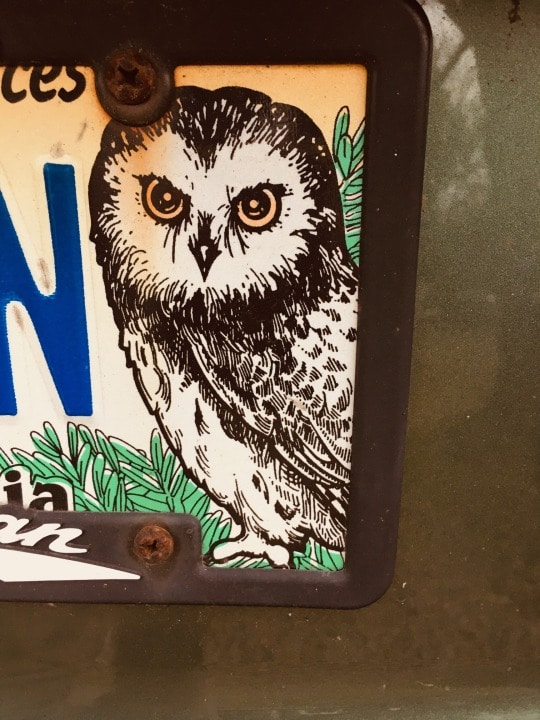
Because the Saw-whet was the original mascot of PA’s Wild Resources Conservation Program, some vehicles still carry license plates bearing ¾ size images of the owl.

For the past seven years, proof of the owl’s seasonal movements through the Pittsburgh area has been found in Sewickley Heights Borough Park where Bob Mulvihill, ornithologist at the National Aviary, has operated a Project Owlnet banding station during the late fall. Information about this important local research can be found on the National Aviary website.

To see a video of a Northern Saw-whet Owl recently banded at Powdermill Nature Reserve, please visit the museum’s TikTok.

Patrick McShea works in the Education and Visitor Experience department of Carnegie Museum of Natural History. Museum employees are encouraged to blog about their unique experiences and knowledge gained from working at the museum.

Related Content

Fraser Fir

Extinct Ornaments

Weighing She-Ra the American Kestrel

Filed Under: Blog Tagged With: Birds, Educators, Museum from Home, Pat McShea

November 20, 2020 by wpengine

Camouflage in YOUR yard?

When most people think of camouflage occurring in nature, they think of exotic frogs blending into vivid plants and jaguars’ spots helping them melt into the shadows. However, did you know that there are lots of examples of camouflage you can find in your backyard or a park?  Here are some fun examples I have personally found in nature, and I hope you can find some, too!

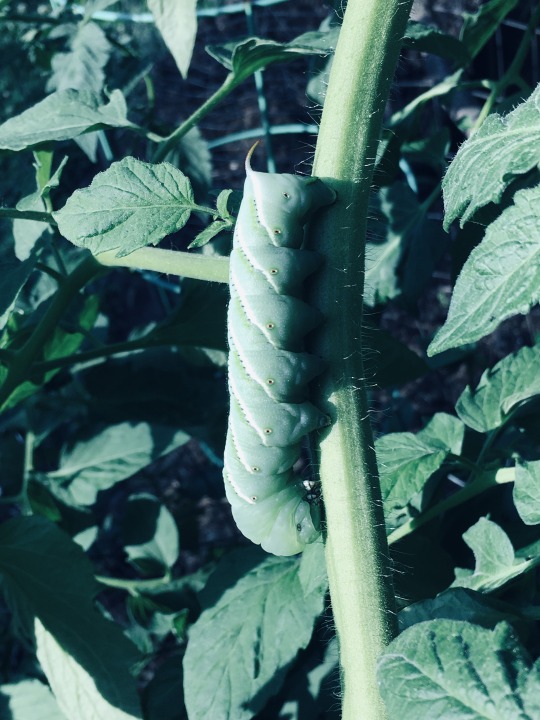
An impressive example of camouflage is the tobacco hornworm (Manduca sexta)! Unless you are looking carefully, tobacco hornworms will blend right in with your tomato plant. These caterpillars are viewed by gardeners as pesky tomato munchers, but they have AMAZING camouflage! Tobacco hornworms, which can be four to five inches long, are the same shade of green as a tomato plant. Tobacco hornworms also have white stripes to help break up their outline, almost appearing like a part of the tomato stalk. Sometimes their camouflage doesn’t always work. In one of the photos, the caterpillar has parasitic wasp larvae on it! The wasps naturally control tobacco hornworm populations by using a few unlucky caterpillars as both nursery and food source for their young. I thought this method of predation was really neat!

tobacco hornworm on a stalk
tobacco hornworm covered in larvae on a tomato plant

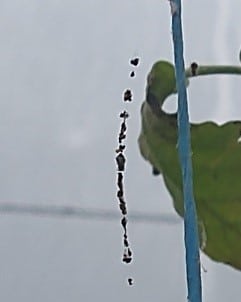
Noteworthy camouflage often goes unnoticed! Everyone knows of spiders, but do you know about the group known as trashline orbweavers (Cyclosa sp.)? A trashline orbweaver will arrange desiccated insect carcasses in a line on their orb web and then sit among them, waiting for the next victim. To the average pair of eyes, the spider’s “trash” will not look any different from the spider itself, so both predators and prey of the spider will not be able to find the concealed hunter. Trashline webs are actually very common; I’ve found more than 15 in my garden, and so far have not been able to find the actual spider. My garden and especially tomato plants are full of them!

trash line orb weaver

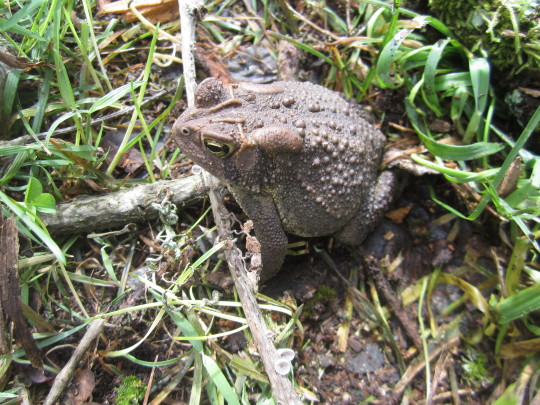
One of the most impressively camouflaged creatures is the common toad (Bufo sp.). If a toad is not moving, it can be one of the hardest creatures to spot. Walking through my garden, I have had many experiences of only noticing a toad when it suddenly jumps away from my approach. The toad might have been just as startled as I!  Toads are often found in the woods, on grass, or perhaps in a garden tucked under some soil. Toads come in many colors, sizes, and shapes, with those I’ve noticed typically being gray with speckled spots. It’s hard to beat a toad’s camouflage.

toad in muddy grass
Image credit: Charles and Martha Oliver

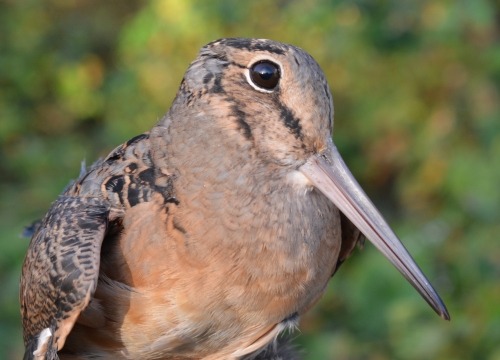
The American Woodcock (Scolopax minor) is a bird with various shades of brown, white, and beige to blend into thickets and woods.  They blend into grass thickets so well that my father almost stepped on one on the ground! Woodcocks are an interesting bird because they have a long beak to help probe for worms. A fun fact about woodcocks is that they do a strange but cute dance to help bring worms to the surface. If you are interested about learning more about woodcocks, I recommend watching their dance on YouTube.

woodcock bird
Image credit: Powdermill Nature Reserve

Make sure to look carefully on your tomato plants for tobacco hornworms and a very similar caterpillar known appropriately as the tomato hornworm. Also, investigate strange orb webs with what seems to be a line of dead bodies on it, look carefully when a toad-like rock moves, and make sure to not step on any woodcocks. I chose these four creatures because I thought they were some of the coolest examples that are native, but they are also common to areas surrounding Carnegie Museum of Natural History. On personal reflection, I will definitely choose to write about something that’s easier to take pictures of next time.  Thanks for reading, I hope you enjoyed my impressions and learned something new, and finally, I hope you can find some of these in your yard or at a local park.

Caroline Lee is a Teen Volunteer in the Education Department. Museum employees, volunteers, and interns are encouraged to blog about their unique experiences and knowledge gained from working at the museum.

Related Content

Biomimicry is Real World Inspiration

Big Foot

Looking for Bugs in Your Yard

Filed Under: Blog Tagged With: Educators, Museum from Home

November 9, 2020 by wpengine

Teaching in a Pandemic

Full immersion in a different culture was the plan back in August 2019, when Rika Opio signed a yearlong contract to teach English in the port city of Busan, South Korea. The museum educator and Pittsburgh Public School substitute teacher could never have imagined that her adventure would include experiencing another nation’s response to a global pandemic.

Rika has been back in Pittsburgh since early September, engaging remotely with students at Sunnyside Elementary on a daily basis as part of her regular assignment to the Stanton Heights school. During a recent interview she offered striking examples of how, earlier this year, daily life in Busan differed from what we experienced in the Pittsburgh area.

photograph of bridge over a river with mountains in the background at sunset
Busan, South Korea

In response to the public health threat of COVID-19, South Korea went into lockdown at the end of February, with everyone strictly at home for two weeks. Schools, including the English language hagwon, or private academy, where Rika taught, remained closed through May. An enormous amount of effort was put into contract tracing. Anyone who had a Korean phone number would get the emergency alerts about those with confirmed cases. The alerts would say where that person lived and the places they may have been in contact with others. People who had direct contact with confirmed cases could get tested for free, and treated for free if they did have COVID. As Rika explains, “There were times when I would be awakened at night by my phone ringing with alerts for three minutes straight.”

Although Rika now recalls the weeks of lockdown and school closure as “a time when I tried to pick-up hobbies,” she summarized the nation-wide policies as “sensible rules that treated the pandemic as the serious threat it is.” Daily life began returning to normal in Busan by late spring. Rika’s English language hagwon operated at 50% capacity during its re-opening month, and attendance climbed steadily as the weeks passed.

Face mask wearing remained a key virus reduction strategy, and as Rika explains, “It was never a problem for students to wear masks. Korea has something of a culture of wearing masks to reduce disease transmission. The mindset is simply, you don’t want to infect other people.”

The teacher’s first hint that her life back in Pittsburgh would proceed under different circumstances occurred on her flight home. “On the International flight from Seoul to Dallas passengers sat in widely spaced seats, and everyone wore face masks. On the domestic flight from Dallas to Pittsburgh every seat was occupied, and most passengers didn’t wear masks.”

Patrick McShea works in the Education and Visitor Experience department of Carnegie Museum of Natural History. Museum employees are encouraged to blog about their unique experiences and knowledge gained from working at the museum.

Related Content

Changing Seats in Changing Times

Ask a Scientist: What does a museum science director do?

Sounds of Science

Filed Under: Blog Tagged With: Education, Educators, Pat McShea

October 29, 2020 by wpengine

Did Neanderthals Make Musical Instruments?

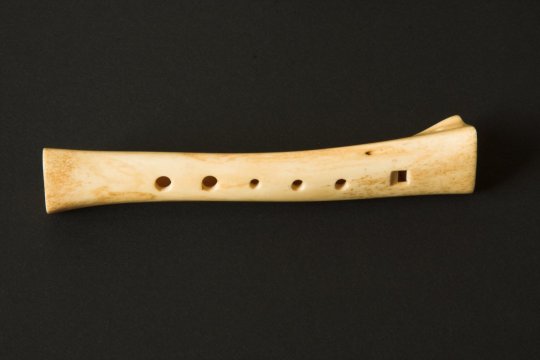
bone flute on black background

Do you like to listen to music? Have you ever admired the skill of a musician? Maybe you even know how to play an instrument yourself. Unsurprisingly, humans (Homo sapiens) have enjoyed this rewarding art for all of recorded history. In fact, the earliest evidence of musical instrument construction dates back to the great unknown ages of prehistory.

In 1995, researchers excavating deposits thought to be between 40,000 and 60,000 years old in a cave called Divje Babe (which translates to “Witch Cave”) in Slovenia found the femur (a leg bone) of a juvenile cave bear with an unusual line of small holes perforating one side. The find was recognized as being a fragment of a flute-like musical instrument. Due to the age and location of the discovery, the manufacture of the flute was attributed to Homo neanderthalensis (the Neanderthals) rather than Homo sapiens!

This discovery was extremely important in shaping our view of the Neanderthals, another species of hominid with which we share a common ancestor. Prior to this, they were often viewed as brutish, animalistic, and wholly incapable of aesthetic sensibilities. However, if they made musical instruments and played them for entertainment or ritual purposes, these activities mean that the Neanderthals were creating a complex culture reminiscent of our own when they went extinct around 40,000 years ago for reasons still unclear. The ability to modify a material so that it can then be used to create a variety of pitches implies, in the minds of some researchers, greater motor ability and a higher capacity for abstract thought.

There are many skeptics, however. Some posit that the holes in the bones are the result of hyenas making a meal of a juvenile cave bear, while others point to uncertainty about exactly when the perforations in the bone were created. Perhaps the interpretation of a modified bone as a musical instrument is all exaggeration brought on by our desire to relate to those who came so long before us. As of this writing, the scientific community is still undecided about how the holes into the bone were created and when it happened. There are two things we can all agree on, though: we hope someday to uncover the true origin of the Divje Babe bone flute, and musical instruments certainly rank among the greatest inventions of members of the genus Homo.

Niko Borish is a Teen Volunteer in the Education Department. Museum employees, volunteers, and interns are encouraged to blog about their unique experiences and knowledge gained from working at the museum.

Works Cited

Montagu, J. (2017, June 20). How Music and Instruments Began: A Brief Overview of the Origin and Entire Development of Music, from Its Earliest Stages (A. Nikolsky, Ed.). Frontiers in Sociology. Retrieved September 5, 2020, from https://www.frontiersin.org/articles/10.3389/fsoc.2017.00008/full

National Museum of Slovenia (Ed.). (n.d.). Neanderthal flute. Narodni Muzej Slovenije. Retrieved September 5, 2020, from https://www.nms.si/en/collections/highlights/343-Neanderthal-flute

The Royal Society. (2015, April 9). Are Neanderthal bone flutes the work of Ice Age hyenas? Phys.org. Retrieved September 5, 2020, from https://phys.org/news/2015-04-neanderthal-bone-flutes-ice-age.html

University of Wisconsin (Ed.). (2017). Neanderthal jam. The Why Files. Retrieved September 5, 2020, from https://whyfiles.org/114music/4.html

Related Content

Ancient Egypt Through its Pottery

Archaeology Merit Badge: Who Had More Fun, Me or the Boy Scouts?

History of Teddy Bears

Filed Under: Blog Tagged With: anthropology, Education, Educators, volunteers

October 16, 2020 by wpengine

Superstitions and Black Cats

The number 13, four-leaf clovers, walking under an open ladder, stepping on a crack in the sidewalk, and opening an umbrella inside are just a few of the superstitions that I learned about as a child—either from my own family or from friends. As an adult, it might be easy to laugh off superstitions or look at data to “disprove” them, but there is no denying that superstitions are present in cultures across the globe. And they have a real impact on the way people experience the world.

A study published in the International Journal of Psychology and Behavioral Sciences describes the possible origin of superstitions as a way of creating the perception of “having control over outer conditions” (1). This means that superstitions are used to create understanding and exert control over aspects of our lives that we may have little to no control over, like the weather. Additionally, in an interview with the British Psychological Society psychologist Stuart Vyse explains there is evidence that performance in skills-based activities may be improved when “luck-enhancing” superstitions are employed (2). His statement suggests that superstitious behavior has a psychological benefit or reduction in anxiety for the individual.

Now that we have a small understanding of the origin and impact of superstitions, I’d like to look specifically at one object of superstition that often appears around this time of year: black cats.

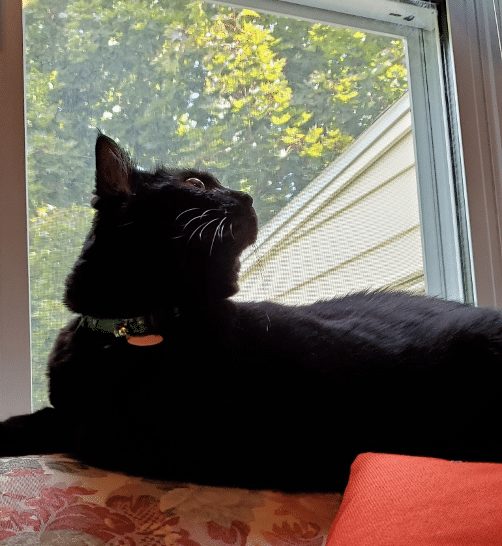
Figure 1: Black cat in front of a window. Credit: @daykittymeow on Instagram, used with permission.

Before taking the time to learn more about the superstitious history of black cats, I thought that they were only considered a sign of bad luck, but I quickly discovered that this is not the case! Black cats appear in the folklore of many more cultures as both good and bad omens. In some European folklore, black cats are considered common companions of witches and bringers of misfortune if they happened to cross your path. In contrast, Welsh folklore depicts black cats would bring luck to a home and could even be a reliable weather predictor (3).

Did you know of these superstitions about black cats? Are there any other superstitions or other lucky rituals that you practice?

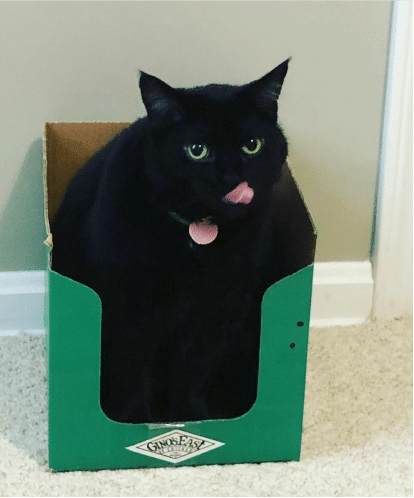
Figure 2: Black cat sitting in a green box. Credit: @daykittymeow on Instagram, used with permission.

If this post inspired you to adopt a black cat of your own, don’t forget to check out our Cat Adoption Guide!

Riley A. Riley is a Gallery Experience Presenter in CMNH’s Life Long Learning Department. Museum staff, volunteers, and interns are encouraged to blog about their unique experiences and knowledge gained from working at the museum.

Sources:

1.     Mandal, F. (2018). Superstitions: A Culturally Transmitted Human Behavior. http://article.sapub.org/10.5923.j.ijpbs.20180804.02.html

2.     Fradera, A. (2016, November). The everyday magic of superstition. https://thepsychologist.bps.org.uk/volume-29/november-2016/everyday-magic-superstition

3.      Owen, E. (2006). WELSH FOLK-LORE: A collection of the folk-tales and legends of north wales. Project Gutenberg. http://www.gutenberg.org/ebooks/20096

Related Content

The Jack-o’-Lantern’s Origins

How-to Make Hatch-able Dinosaur Eggs! 

Scientist Takeover: Measuring Leaves

Filed Under: Blog Tagged With: booseum, Educator Resources, Educators, Riley A. Riley, Super Science Days

  • « Go to Previous Page
  • Page 1
  • Page 2
  • Page 3
  • Page 4
  • Page 5
  • Page 6
  • Page 7
  • Go to Next Page »

sidebar

About

  • Mission & Commitments
  • Directors Team
  • Museum History

Get Involved

  • Volunteer
  • Membership
  • Carnegie Discoverers
  • Donate
  • Employment
  • Events

Bring a Group

  • Groups of 10 or More
  • Birthday Parties at the Museum
  • Field Trips

Powdermill

  • Powdermill Nature Reserve
  • Powdermill Field Trips
  • Powdermill Staff
  • Research at Powdermill

More Information

  • Image Permission Requests
  • Science Stories
  • Accessibility
  • Shopping Cart
  • Contact
  • Visitor Policies
One of the Four Carnegie Museums | © Carnegie Institute | Privacy Policy | Terms of Use | Accessibility
Rad works here logo