• Skip to primary navigation
  • Skip to main content
  • Skip to primary sidebar

Carnegie Museum of Natural History

One of the Four Carnegie Museums of Pittsburgh

  • Visit
    • Buy Tickets
    • Visitor Information
    • Exhibitions
    • Events
    • Dining at the Museum
    • Celebrate at the Museum
    • Powdermill Nature Reserve
    • Event Venue Rental
  • Learn
    • Field Trips
    • Educator Information
    • Programs at the Museum
    • Bring the Museum to You
    • Guided Programs FAQ
    • Programs Online
    • Climate and Rural Systems Partnership
  • Research
    • Scientific Sections
    • Science Stories
    • Science Videos
    • Senior Science & Research Staff
    • Museum Library
    • Science Seminars
    • Scientific Publications
    • Specimen and Artifact Identification
  • About
    • Mission & Commitments
    • Directors Team
    • Museum History
  • Tickets
  • Give
  • Shop

Hall of North American Wildlife

September 9, 2019 by wpengine

Don’t Overlook the Lichens

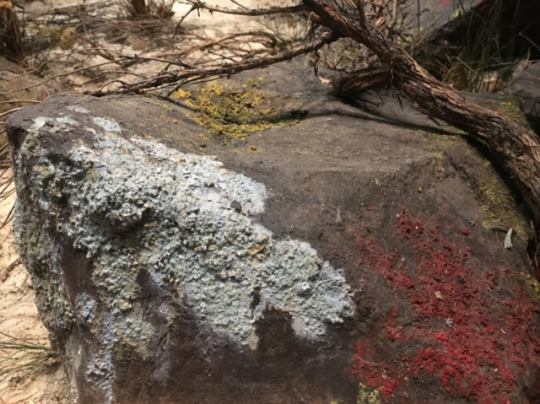
various lichen on rock

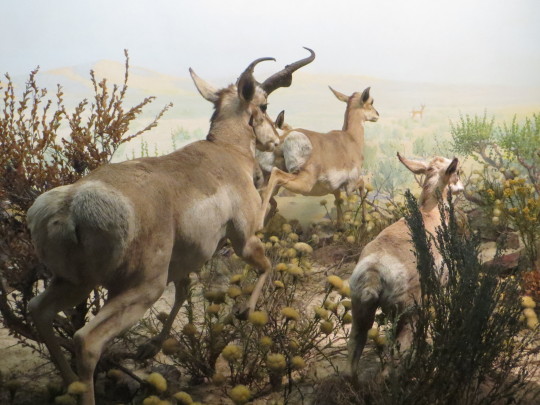
Lichens are scenery elements in many museum dioramas. Within the Pronghorn Antelope diorama in the Hall of North American Wildlife, for example, these frequently overlooked organisms coat a foreground boulder with irregular patches of gray, red, and gold.
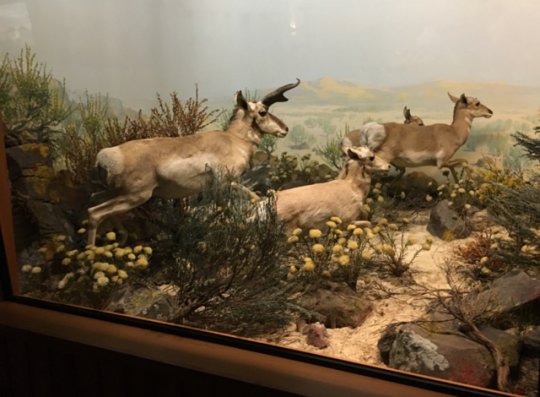
pronghorn antelope diorama

If you approach this artfully recreated western scene with a little background information about lichens, you might find the colorful cluster of immobile organisms in the bottom right corner just as interesting as the four galloping centerpieces.

Lichens are found on every continent and estimates of their global diversity range from 13,000 to more than 17,000 species. Every lichen is a partnership of two different organisms, a fungus whose tissue provides the physical structure to support a second organism capable of photosynthesis. For most lichens the partner with the solar energy power is some form of green algae.  The fungus/algae partnership is a living arrangement in which separate identities fade while combined abilities allow for survival in locations where neither organism could live alone.
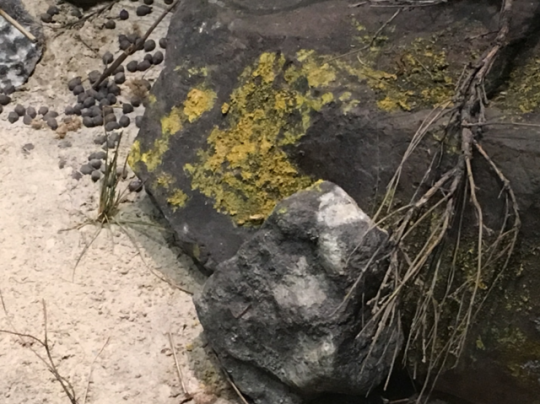
Crustose or curst-like lichen and pronghorn antelope scat.

Three distinctive growth forms provide a means for categorizing lichen. The colorful trio sharing the pronghorn antelope diorama are termed “crustose” or crust-like lichens. Lichens with a leaf-like appearance and structure are termed “foliose,” and those with shrubby upright or dangling strands are termed “fruticose.”

Because lichens absorb so much of their nourishment from the air and rainfall, they serve as living air quality indicators. By monitoring a region’s changing balance of pollution sensitive species and pollution tolerant species, a researcher can visually chart the build-up or decrease of pollutants such as sulfur dioxide and nitrogen dioxide.

For more detailed information about lichen ecology, including information about local research efforts, please visit the site maintained by Point Park University Professor Matthew Opdyke.

Patrick McShea works in the Education and Visitor Experience department of Carnegie Museum of Natural History. Museum employees are encouraged to blog about their unique experiences and knowledge gained from working at the museum.
Filed Under: Blog Tagged With: Botany, Hall of North American Wildlife, Pat McShea, Patrick McShea, plants

February 20, 2019 by wpengine

Doubly Dead: Taxidermy Challenges in Museum Dioramas

pronghorn antelope diorama

A visit to the wildlife dioramas at Carnegie Museum of Natural History is an opportunity to repeatedly admire the illusions created by teams of skilled taxidermists. None of the featured creatures are alive, but many of them appear to have just paused. Some, such as the pronghorn antelope, pictured above, even seem to be frozen in motion.

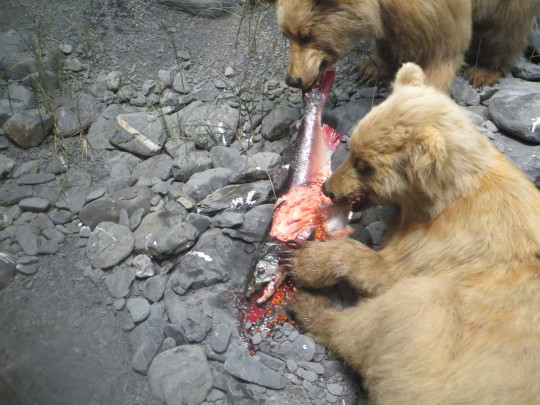
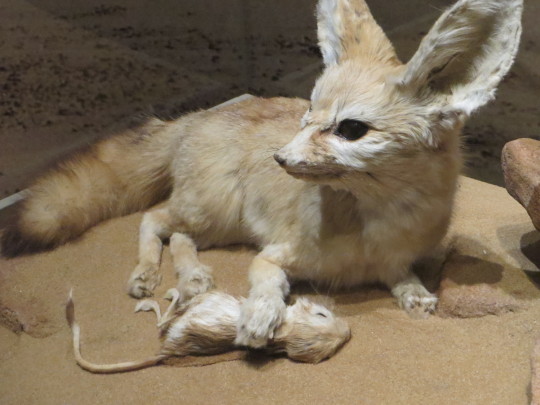
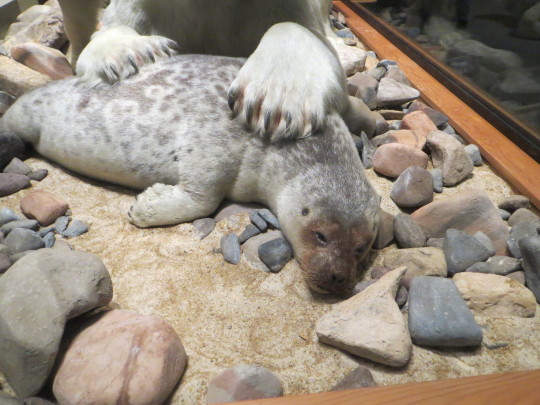
In several three-dimensional scenes, where the animal subjects are predators or scavengers, the taxidermists involved in creating the exhibit faced another challenge – presenting the preserved remains of a dead animal as a dead animal. The task, as the somewhat gory details in the pictures below attest, is undoubtedly more difficult than it sounds.

brown bear eating salmon taxidermy diorama

A dead salmon is front and center in the Alaskan Brown Bear diorama, and the pink flesh the cubs are consuming doesn’t look much different than what’s available at supermarket fish counters.

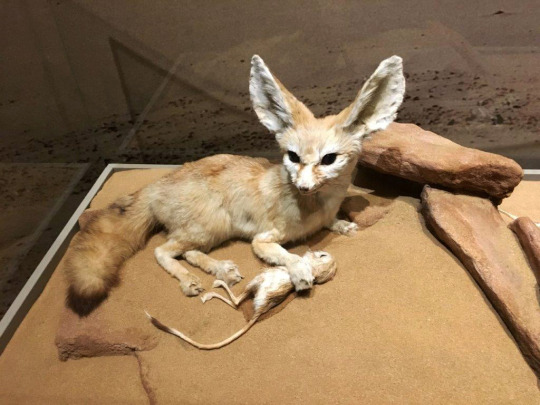
fennec fox and jerboa taxidermy

In the Hall of African Wildlife there’s no blood visible on the Lesser Egyptian Jerboa under fennec’s paw. The curled position of the prey’s feet and back legs indicate the struggle with the big-eared fox is over.

seal taxidermy under paw of polar bear taxidermy

In creating life-like mounts, taxidermists use glass eyes of the proper shape, size, and color.  The glass eyes appear to have lost their luster for the seal that serves as a prey detail in a Polar Bear diorama.

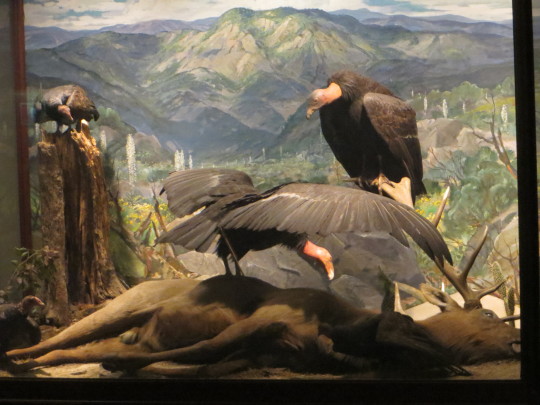
bull elk with large birds in diorama

In one of the oldest dioramas within the Hall of North American Wildlife, the centerpiece presence of a dead bull elk indicates the role of both California Condors and Turkey Vultures as scavengers.

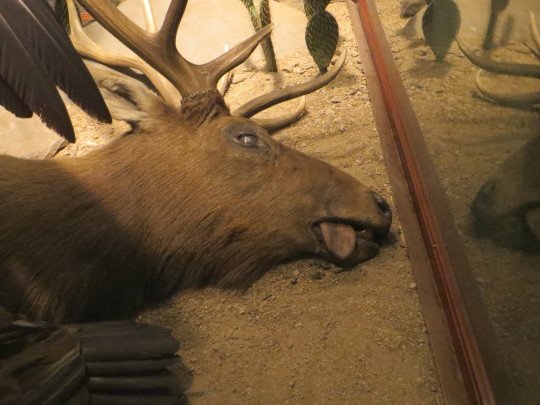
detail of bull elk taxidermy

Taxidermy details that indicate the elk’s browsing days are over include dull eyes and a lolling tongue. The tricks of taxidermists are important when they help to explain the role of predators and scavengers, the bedrock biological principle of life from death.

Patrick McShea works in the Education and Visitor Experience department of Carnegie Museum of Natural History. Museum employees are encouraged to blog about their unique experiences and knowledge gained from working at the museum.
Filed Under: Blog Tagged With: diorama, Hall of African Wildlife, Hall of North American Wildlife, mammals, Pat McShea, Patrick McShea, taxidermy

January 28, 2019 by wpengine

F is for Fox

For inhabitants of Western Pennsylvania, the word ‘fox’ as applied to an animal is usually reserved for the red fox (Vulpes vulpes) because if you have seen a fox in an urban area, that is the most likely one you would have seen. Although chiefly nocturnal in its habits, red foxes do venture out during daylight hours. But the red fox is only one of 23 different species of foxes. In fact, 61% of all species in the canid or dog family are foxes; the remainder are dogs, wolves, and jackals.

You might be wondering, what exactly is a fox? A fox is a canid that is distinguished by its pointy snout and bushy tail. In fact, fox comes from an old Germanic word for tail. The collective noun for a group of foxes is a skulk, a leash, or an earth. Males foxes can be referred to as dogs, reynards, or tods, females as vixens, and young as kits, pups, or cubs.

Not all foxes are closely related to each other. There are three main groups. One group is found exclusively in South America and includes eight species; a second group of two species is found in the Americas; and the third and largest group, which includes the red fox, is found all over the world except in South America and Antarctica.

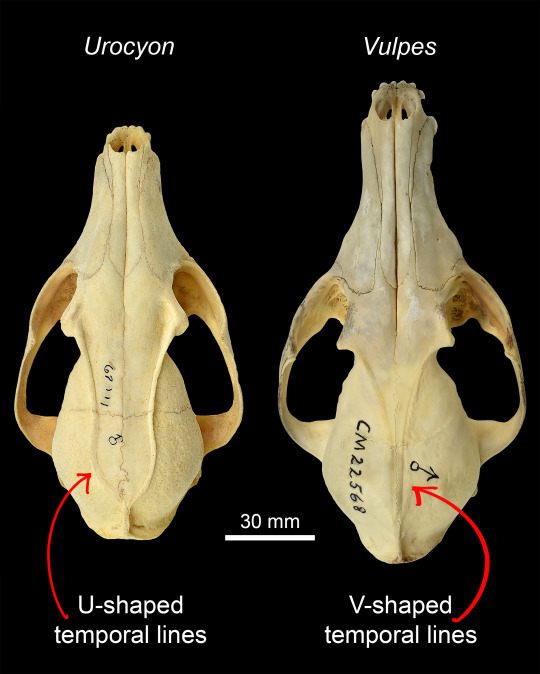
All foxes look like foxes, but they display a remarkable array of behaviors and lifestyles depending on where they live. The two species found in Western Pennsylvania are the red fox (Vulpes vulpes) and gray fox (Urocyon cinereoargentatus). These two are distinguished by their coats, as well as a useful feature on their skulls. Mammals that have strong chewing muscles have prominent ridges on their skulls for muscle attachment. These are called temporal lines. As seen in the photo below, the gray fox has U-shaped temporal lines (i.e., U for Urocyon) and the red fox has V-shaped temporal lines (i.e., V for Vulpes). A convenient coincidence for biologists!

two fox skulls on a black background
Skulls of a gray fox (Urocyon) and red fox (Vulpes) from the Section of Mammals collection, Carnegie Museum of Natural History.

One of our favorite foxes is the Fennec fox (Vulpes zerda). This is the smallest living fox weighing in at less than two kilograms but despite its diminutive size it has the greatest ear size to body size ratio of any fox (see picture below). This little fox is a true survivor, living in one of the harshest environments on the planet: the shifting sand dunes of the Sahara Desert. Their huge ears act as amplifiers providing them with acute hearing for hunting and capturing prey at night. Their ears have an additional purpose – temperature regulation (quite important when you live in one of the hottest environments on Earth). Fennec foxes use the large surface area of their ears to cool their blood. Like dogs, Fennec foxes also have another adaptation for regulating their temperature – they pant. They only start to pant when temperatures reach 95°F, and their breathing rate can increase from 23 breaths per minute to 690 breaths per minute! Get a closer look at a Fennec fox in the Hall of African Wildlife on the second floor of the Carnegie Museum of Natural History.

Photograph of a Fennec fox and a jerboa from the Hall of African Wildlife, Carnegie Museum of Natural History.

Sarah Shelley is a postdoctoral research fellow and John Wible is Curator in the Section of Mammals at the Carnegie Museum of Natural History. Museum employees are encouraged to blog about their unique experiences working at the museum.

Filed Under: Blog Tagged With: Hall of African Wildlife, Hall of North American Wildlife, Sarah Shelley

December 18, 2018 by wpengine

Are Santa’s Reindeer Real Mammals?

by Suzanne B. McLaren

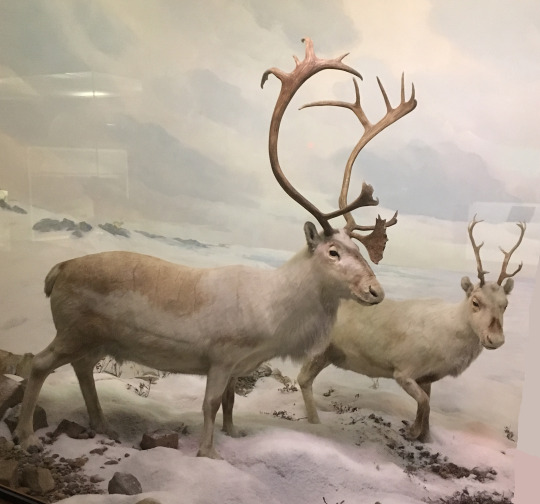
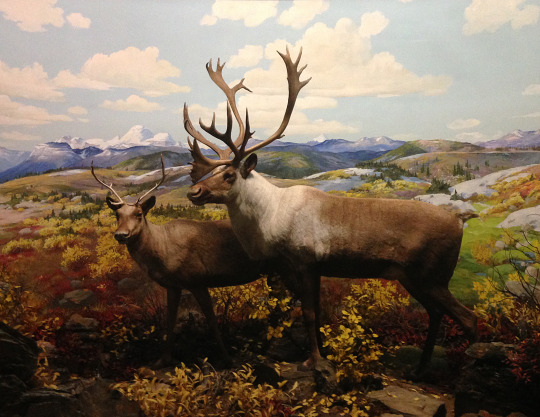
Yes! Reindeer are real mammals. In fact, reindeer are the same species as caribou (Rangifer tarandus). The species is widespread throughout northern parts of the Northern Hemisphere. In North America, the wild subspecies are called “caribou.” In Eurasia, both wild and domesticated animals are called reindeer.

The First Nations People of Canada have depended upon caribou in the same way that tribes of the North American plains depended upon the bison – for meat, and as a source of clothing and various household goods cleverly derived from the animal’s bones, tendons, horns, and fur. However, there was never an attempt to domesticate the animals in North America. In parts of Eurasia, people began to domesticate reindeer about 2,000 years ago. The domesticated animals have evolved to be shorter and stockier than the wild animals. North American subspecies of caribou by contrast, are about as large an elk. There are several subspecies found in Canada, such as the barren-ground caribou living in the tundra, which is known to migrate as much as 800 miles from one seasonal feeding ground to another. At Carnegie Museum of Natural History, visitors can observe the barren-ground caribou and the mountain caribou in dioramas that show their natural habitats in the Hall of North American Wildlife. There is additional information about caribou in Polar World: Wykoff Hall of Arctic Life.

Barren-ground caribou in snow diorama
Barren-ground caribou in snow, Hall of North American Wildlife
Mountain caribou diorama
Mountain caribou, Hall of North American Wildlife

The domesticated reindeer of Eurasia are herded by people living in Arctic regions. These reindeer provide food, clothing, and even shelter for the people with whom their lives are intertwined. Clement Moore’s famous story, ‘Twas the Night Before Christmas’ was written in 1837 at a time when the people of Lapland, in northern Finland, would have been using reindeer to draw large sleighs or sledges, just as other people might use horses.

Unlike other members of the deer family, both male and female caribou and/or reindeer have antlers during part of the year. Large bucks begin developing antlers in March. The antlers of adult males may reach lengths of three to four feet and will be dropped by early November. Young males develop much smaller racks, which are occasionally retained as long as the following February. The antlers of adult females are of similar size to those of young males. A doe will begin to develop her antlers in June and carry them until the following April or May. Timing of antler loss in females usually coincides with the birth of their young. Based on this timing, it is clear that Santa’s reindeer must either be young males or adult females rather than adult males, because the larger males do not have antlers by Christmas time!

Reindeer can move at different speeds from the most common slow trot to a rapid gallop that can reach speeds of up to forty-nine miles per hour over short bursts. A unique characteristic of this animal is a clicking sound that is made by tendons moving over bones in the feet. They are excellent swimmers but have never been known to fly.

Suzanne B. McLaren is the Collection Manager in the Section of Mammals at Carnegie Museum of Natural History. She lives on the Northside with her husband Andy. Museum employees are encouraged to share their unique experiences from working at the museum.

Related Content

A Perfect Mineral for the Christmas Season

A Deeper Look at Dioramas

Snow White Bird Search

Carnegie Museum of Natural History Blog Citation Information

Blog author: McLaren, Suzanne B.
Publication date: December 18, 2018

Share this post!

  • Share on Twitter Share on Twitter
  • Share on Facebook Share on Facebook
  • Share on Pinterest Share on Pinterest
  • Share on LinkedIn Share on LinkedIn
  • Share on Reddit Share on Reddit
  • Share via Email Share via Email

Filed Under: Blog Tagged With: Christmas, Hall of North American Wildlife, mammals, Polar World, Sue McLaren

May 10, 2018 by wpengine

Plant Blindness

By Patrick McShea

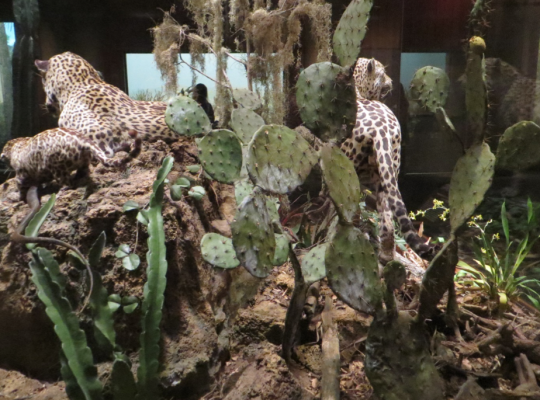
Cactus

Plant Blindness refers to the inability to see or notice the plants in one’s own environment. The term was coined twenty years ago by two botanists, Elizabeth Schussler, of the Ruth Patrick Science Educator Center in Aiken, South Carolina, and James Wandersee, of Louisiana State University in Baton Rouge. The common condition, according to the pair, results in a chronic inability to recognize the importance of plants in the biosphere and in human affairs.

Fortunately, not all of us are afflicted. As evidence, CMNH Conservator Gretchen Anderson recounts a touching interaction she observed while conducting exhibit restoration work within the museum’s second floor Hall of North American Wildlife. From a just-opened elevator door a five-year old made a headlong dash to the diorama featuring a pair of mature jaguars and their three cubs. “LOOK Dad!” he called back to his father while pointing into the display, “CACTUS!”

For additional information about Plant Blindness, visit: https://plantsocieties.cnps.org/index.php/about-main/plant-blindness

Patrick McShea works in the Education and Visitor Experience department of Carnegie Museum of Natural History. Museum employees are encouraged to blog about their unique experiences and knowledge gained from working at the museum.
Filed Under: Blog Tagged With: Botany, cactus, Hall of North American Wildlife, Patrick McShea

March 16, 2018 by wpengine

Geographic coverage of mammalian species is worldwide but…

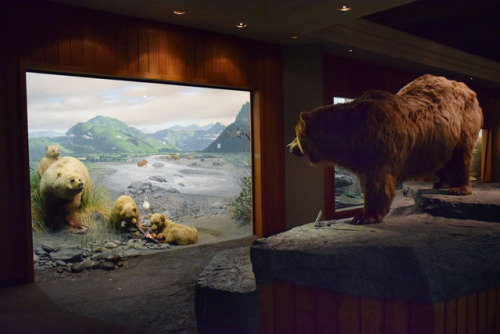
bears in the hall of North American wildlife

Geographic coverage of mammalian species is worldwide but Carnegie Museum of Natural History’s collection’s strength is in North American material.

The collections from Pennsylvania and West Virginia are among the best in the world, and there are mammals from all 50 states. Holdings from the eastern Arctic are the best of any United States museum and include the holotype (specimen used to describe a new species) of a freshwater seal.

Recent acquisitions from Belize, Bonaire, Curaçao, Costa Rica, Dominica, El Salvador, Grenada, St. Vincent and the Grenadines, Guatemala, Honduras, Jamaica, Mexico, Puerto Rico, and Trinidad and Tobago augment historical specimens from Central America.

Filed Under: Blog Tagged With: collections, Hall of North American Wildlife, mammals

  • « Go to Previous Page
  • Page 1
  • Page 2
  • Page 3
  • Page 4
  • Go to Next Page »

sidebar

About

  • Mission & Commitments
  • Directors Team
  • Museum History

Get Involved

  • Volunteer
  • Membership
  • Carnegie Discoverers
  • Donate
  • Employment
  • Events

Bring a Group

  • Groups of 10 or More
  • Birthday Parties at the Museum
  • Field Trips

Powdermill

  • Powdermill Nature Reserve
  • Powdermill Field Trips
  • Powdermill Staff
  • Research at Powdermill

More Information

  • Image Permission Requests
  • Science Stories
  • Accessibility
  • Shopping Cart
  • Contact
  • Visitor Policies
One of the Four Carnegie Museums | © Carnegie Institute | Privacy Policy | Terms of Use | Accessibility
Rad works here logo