• Skip to primary navigation
  • Skip to main content
  • Skip to primary sidebar

Carnegie Museum of Natural History

One of the Four Carnegie Museums of Pittsburgh

  • Visit
    • Buy Tickets
    • Visitor Information
    • Exhibitions
    • Events
    • Dining at the Museum
    • Celebrate at the Museum
    • Powdermill Nature Reserve
    • Event Venue Rental
    • Gift Cards
  • Learn
    • Field Trips
    • Educator Information
    • Programs at the Museum
    • Bring the Museum to You
    • Guided Programs FAQ
    • Programs Online
    • Climate and Rural Systems Partnership
  • Research
    • Scientific Sections
    • Science Stories
    • Science Videos
    • Senior Science & Research Staff
    • Museum Library
    • Science Seminars
    • Scientific Publications
    • Specimen and Artifact Identification
  • About
    • Mission & Commitments
    • Directors Team
    • Museum History
  • Tickets
  • Give
  • Shop

Blogs by Mason Heberling

Mason Heberling is the assistant curator in the Section of Botany and co-chair of collections at Carnegie Museum of Natural History. Heberling is a plant ecologist and botanist whose research explores plant functional strategies in deciduous forest understories, especially in the context
of environmental change. Much of his current research focuses on the ecology
and evolution of non-native, invasive plants in the eastern United States, the ecophysiological strategies of the herbaceous layer in deciduous forests, and the impacts of climate change on the timing of leafing out and flowering in temperate deciduous forests.

August 18, 2017 by wpengine

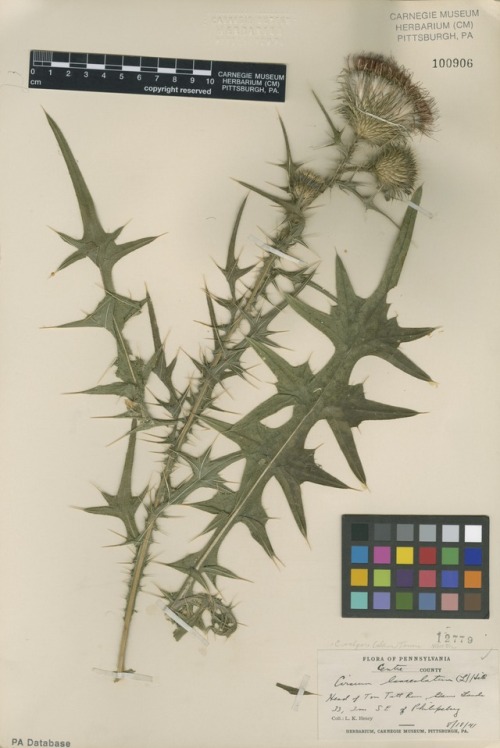
Collected on this Day in 1941

herbarium specimen of Bull thistle

Collected on August 18, 1941, this specimen was found just outside of Philipsburg, Pennsylvania by Leroy Henry.  Bull thistle (Cirsium vulgare) is a European plant introduced in Pennsylvania, commonly found in disturbed sites, roadsides, and fields. As the species is unpalatable to most grazing livestock, bull thistle is often in abundance in grazed fields. It is not uncommon to find an American goldfinch pecking at thistle flower heads and eating the seeds. Recognizable by their spiny stems and flowers (usually purple), thistles are in the sunflower family (Asteraceae), many of which are native to the United States.


Botanists at Carnegie Museum of Natural History share pieces of the herbarium’s historical hidden collection on the dates they were discovered or collected. Check back for more!
Filed Under: Blog Tagged With: Botany, Mason Heberling

August 3, 2017 by wpengine

Collected on this Day in 1952

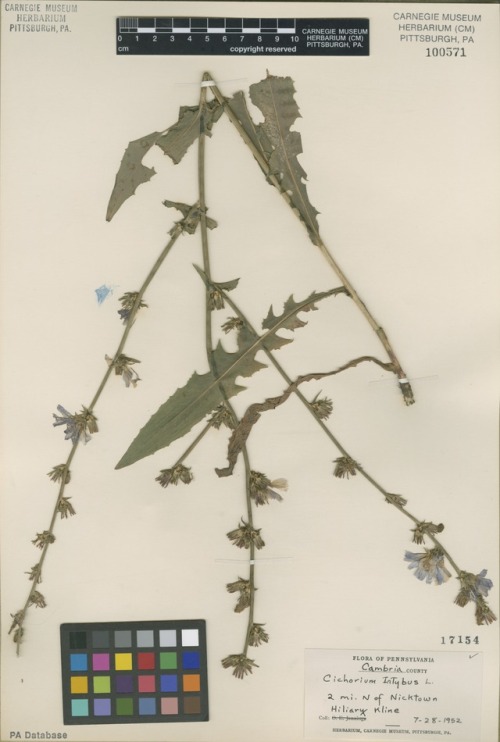
herbarium specimen of chicory (Cichorium intybus)

Collected on this Day in 1952

Collected on July 28, 1952, this specimen was found near Nicktown, Cambria County by Hiliary Kline. Chicory (Cichorium intybus) was introduced from Eurasia and is a common roadside plant in Pennsylvania. Its bright blue flowers open in the morning and close by the afternoon. Chicory has a long history as a food source for humans, and there are several domesticated varieties. One such example is radicchio, which you can find in many grocery store salad mixes. Chicory roots have also been used as a coffee substitute or an additive to coffee grounds, and they are sold at some grocery stores.  Chicory was famously used as a coffee substitute by Confederate soldiers during the American Civil War.


Botanists at Carnegie Museum of Natural History share pieces of the herbarium’s historical hidden collection on the dates they were discovered or collected. Check back for more!
Filed Under: Blog Tagged With: Botany, Mason Heberling

July 26, 2017 by wpengine

Collected on this Day in 1904

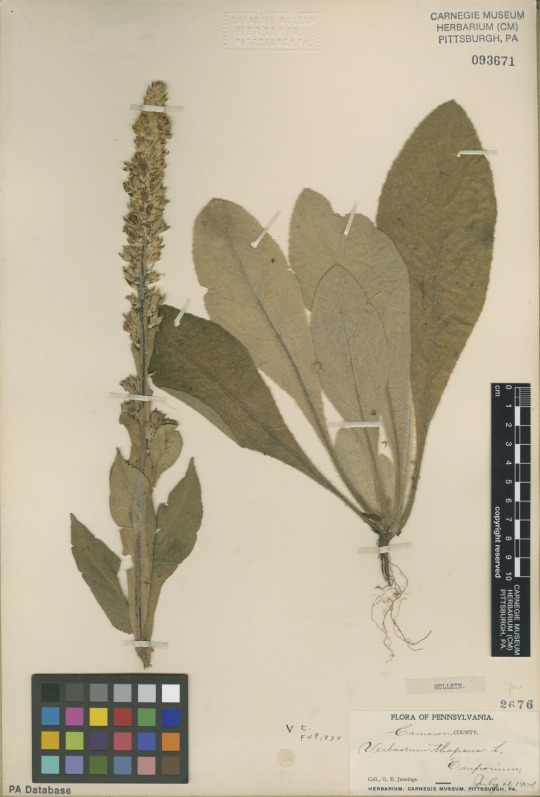
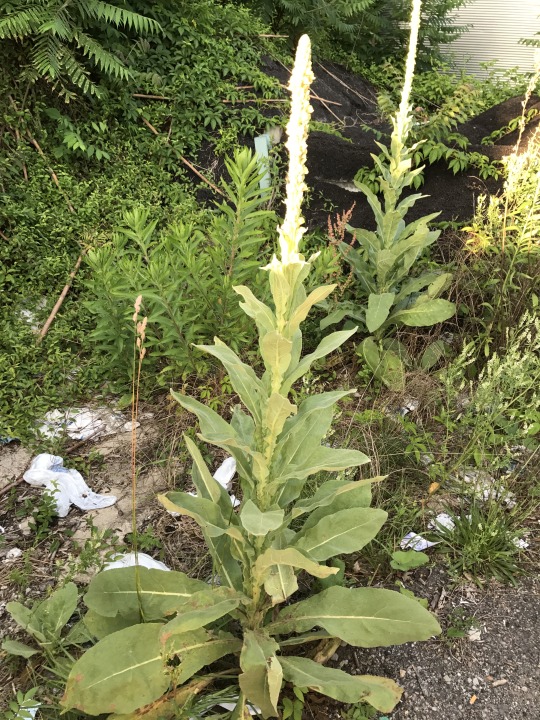
Herbarium specimen Common mullein (Verbascum thapsus)

Collected on July 21, 1904, this specimen was found by Otto Jennings (a former curator of botany at Carnegie Museum of Natural History) in Cameron County, Pennsylvania. Common mullein (Verbascum thapsus) is a weedy species from Eurasia and is now common in roadsides and disturbed fields across the United States.

When you know to look for it, it is hard to miss at up to 6 feet tall with bright yellow flowers and velvety leaves. It was introduced at least 230 years ago, cultivated by early European colonists for use as a fish poison (the seeds contain several compounds deadly to fish).

Throughout history, the plant has had many medicinal uses—one Greek botanist recommended it for pulmonary diseases over 2,000 years ago. It can be found in herbal products for this purpose, but many of these products have not yet been tested for safety or effectiveness.

Common mullein (Verbascum thapsus)

Botanists at Carnegie Museum of Natural History share pieces of the herbarium’s historical hidden collection on the dates they were discovered or collected. Check back for more!
Filed Under: Blog Tagged With: Botany, herbarium, Mason Heberling, pennsylvania

July 10, 2017 by wpengine

Collected on this Day in 2001

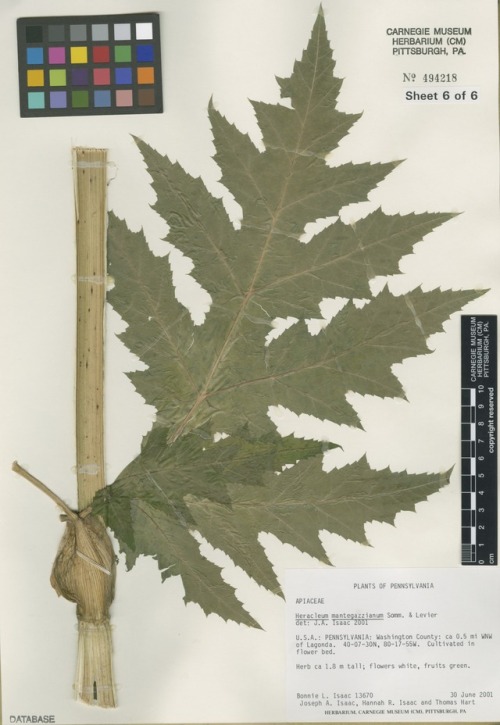
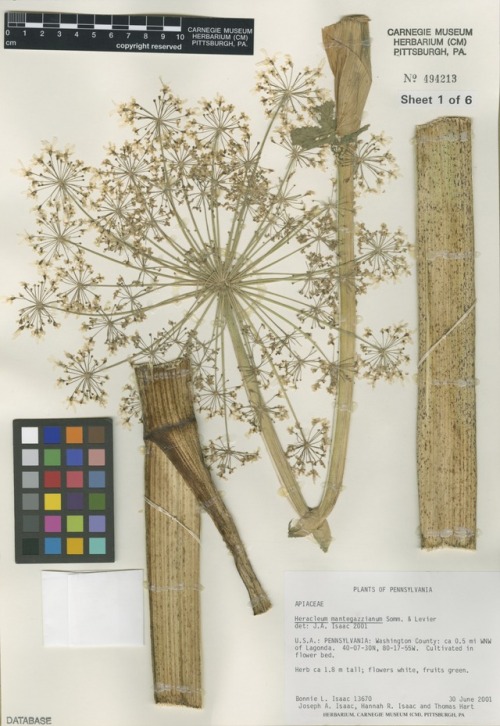
herbarium sheet 6 of 6 showing the leaf and stock of a giant hogweed
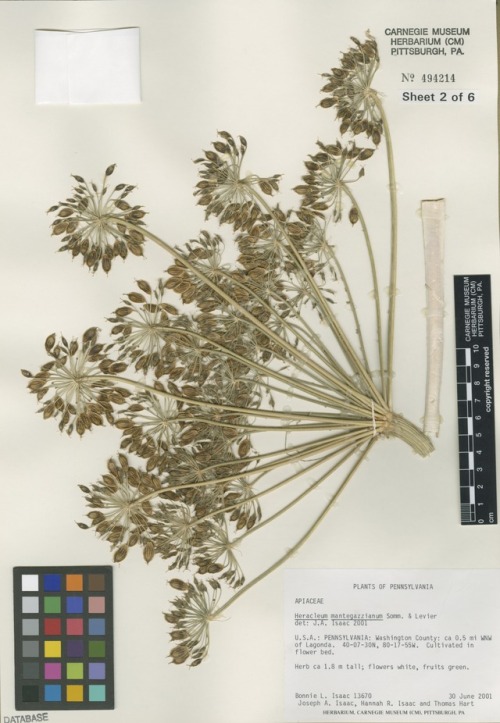
herbarium sheet 2 of 6 showing the flower after turning to seed
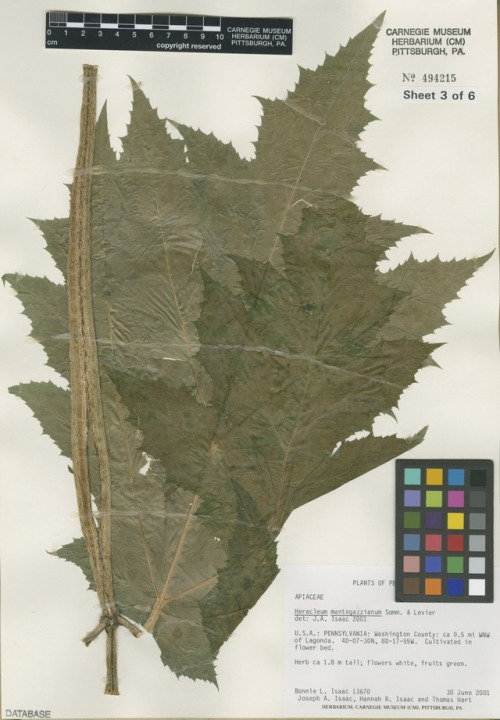
herbarium sheet 3 of 6 showing the leaf and stem of a giant hogweed
herbarium sheet 1 of 6 showing the flower of a giant hogweed
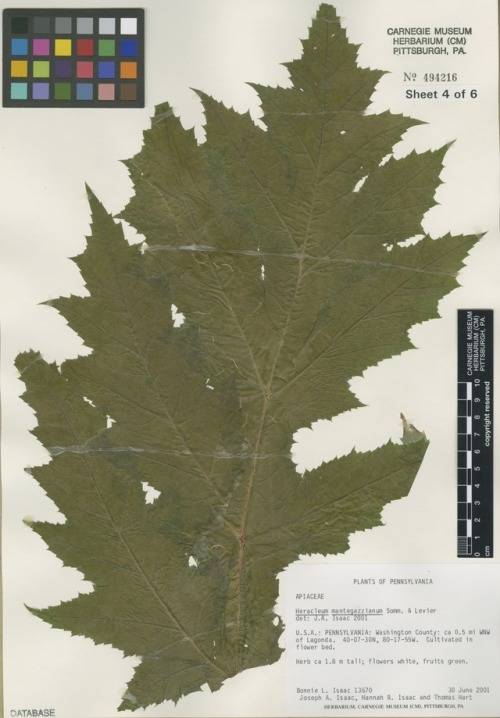
herbarium sheet 4 of 6 showing the leaf of a giant hogweed

Collected on this Day in 2001

Giant hogweed (Heracleum mantegazzianum) is considered a significant public human health concern. This non-woody plant can be 8–20 feet tall with leaves up to 5 feet wide!

In fact, it took six separate herbarium sheets to capture the characteristics of this species. This specimen was collected from a garden, where it was intentionally grown for the purposes of educating the public about this plant. Native to central and southwest Asia, this plant can now be found in parts of Europe, Australia, New Zealand, and North America. It is thought to be eradicated in Pennsylvania.

This plant is highly poisonous and designated as a federal noxious weed. The sap of giant hogweed causes “phytophotodermatitis,” meaning serious skin inflammation occurs when contacted skin is exposed to sunlight. Skin rashes can be very severe. The sap is also said to cause blindness.

Giant hogweed, like poison hemlock and Queen Anne’s lace, is in the carrot family (Apiaceae).  It might be confused with the related native plant, cow parsnip (Heracleum lanatum), but giant hogweed is noticeably larger in height and flower size.


Botanists at Carnegie Museum of Natural History share pieces of the herbarium’s historical hidden collection on the dates they were discovered or collected. Check back for more!
Filed Under: Blog Tagged With: Botany, Mason Heberling

June 27, 2017 by wpengine

Collected on this Day in 1959

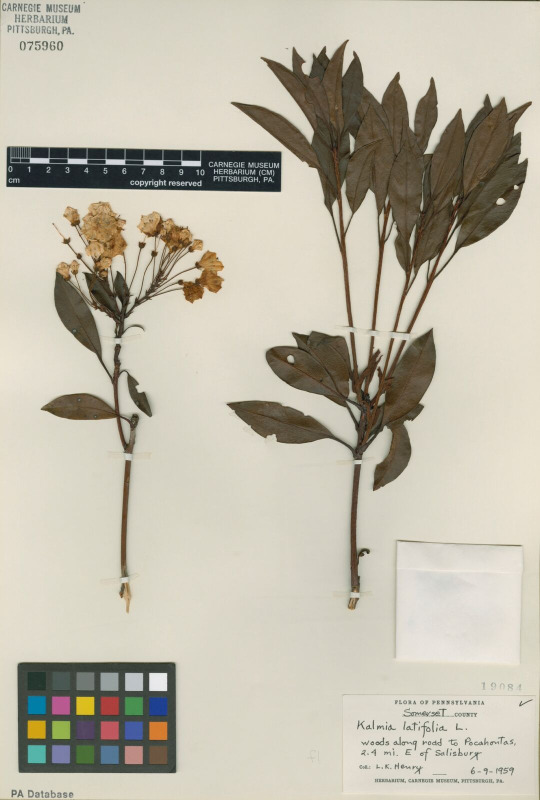
Herbarium specimen of Mountain laurel (Kalmia latifolia)

Collected on June 9, 1959, this specimen was found in the woods in Somerset County by Leroy Henry, a past curator of botany at the museum. Mountain laurel (Kalmia latifolia) is the state flower of Pennsylvania. It is a broadleaved evergreen shrub native across the eastern United States, especially in forests of mountainous areas. This specimen was collected not too far from the highest point in Pennsylvania and the Maryland border. It is often mistaken for rhododendron because rhododendron
and mountain laurel are found in similar habitats and belong to the heath family (Ericaceae). Despite its beauty, mountain laurel has a dark side—all parts contain toxins that are poisonous to humans, pets, horses, and cattle.

Ingesting this plant can cause vomiting, diarrhea, impaired vision, convulsion, cardiovascular distress, and death. Honey made by bees from mountain laurel can also cause medical problems to humans. Benjamin Smith Barton (an American botanist in the late 1700s) wrote that in the autumn and winter of the year 1790, many people died in Pennsylvania from the effects of wild
honey, collected from Kalmia plants.


Botanists at Carnegie Museum of Natural History share pieces of the herbarium’s historical hidden collection on the dates they were discovered or collected. Check back for more!
Filed Under: Blog Tagged With: Botany, Mason Heberling

June 26, 2017 by wpengine

Collected on this Day in 1993

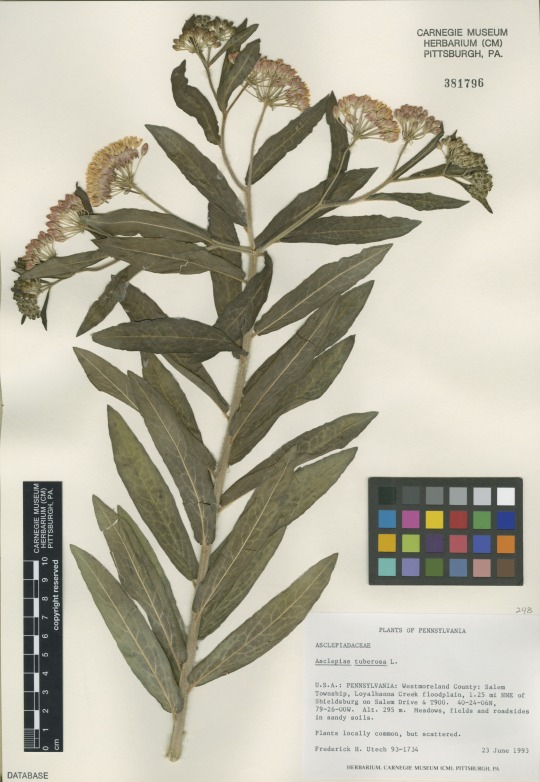
herbarium specimen of the milkweed plant

Collected on June 23, 1993, this specimen was found by Fred Utech near the Loyalhanna Creek in Salem Township, Pennsylvania.

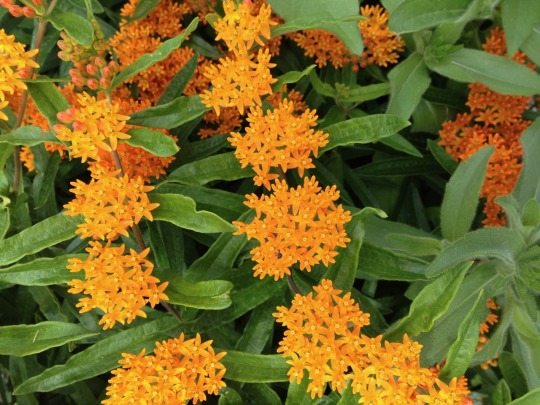
Do not let the common name affect your opinion of this plant! Butterfly weed (Aclepias tuberosa) is a beautiful plant, and the pollinators love the bright orange flowers. Native to eastern North America, it can be found in dry, full sun conditions. It is a great plant to add to your garden!

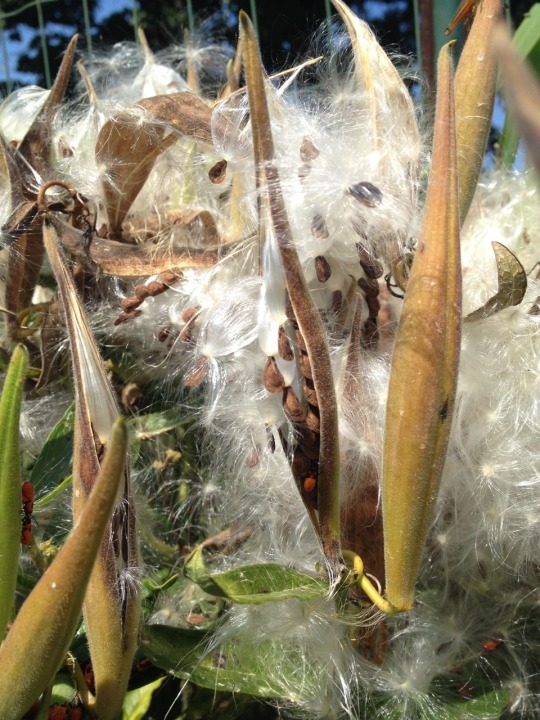
Like other milkweeds (butterfly weed is in the milkweed genus), butterfly weed flower clusters mature into seed pods, which eventual dry up to release airborne seeds in the late summer. The long, silk-like hairs (called pappi) have been used by Native Americans to make textiles.

Despite its looks, butterfly weed is poisonous to ingest. Like other milkweeds, this plant contains defensive chemicals called cardiac glycosides, which are poisonous to humans, livestock, and pets.  Milkweeds vary in their toxicity depending on species and age of plant. Symptoms can include weakness, difficulty breathing, kidney damage, cardiac distress, pupil dilation, loss of muscle control, and respiratory paralysis.

vibrant orange milkweed flowers
open seed pods of a milkweed

Botanists at Carnegie Museum of Natural History share pieces of the herbarium’s historical hidden collection on the dates they were discovered or collected. Check back for more!
Filed Under: Blog Tagged With: Botany, Mason Heberling

  • « Go to Previous Page
  • Page 1
  • Interim pages omitted …
  • Page 15
  • Page 16
  • Page 17
  • Page 18
  • Page 19
  • Interim pages omitted …
  • Page 21
  • Go to Next Page »

sidebar

About

  • Mission & Commitments
  • Directors Team
  • Museum History

Get Involved

  • Volunteer
  • Membership
  • Carnegie Discoverers
  • Donate
  • Employment
  • Events

Bring a Group

  • Groups of 10 or More
  • Birthday Parties at the Museum
  • Field Trips

Powdermill

  • Powdermill Nature Reserve
  • Powdermill Field Trips
  • Powdermill Staff
  • Research at Powdermill

More Information

  • Image Permission Requests
  • Science Stories
  • Accessibility
  • Shopping Cart
  • Contact
  • Visitor Policies
Stay in the loop! Sign up for our newsletter(s).
One of the Four Carnegie Museums | © Carnegie Institute | Privacy Policy | Terms of Use | Accessibility
Rad works here logo