• Skip to primary navigation
  • Skip to main content
  • Skip to primary sidebar

Carnegie Museum of Natural History

One of the Four Carnegie Museums of Pittsburgh

  • Visit
    • Buy Tickets
    • Visitor Information
    • Exhibitions
    • Events
    • Dining at the Museum
    • Celebrate at the Museum
    • Powdermill Nature Reserve
    • Event Venue Rental
  • Learn
    • Field Trips
    • Educator Information
    • Programs at the Museum
    • Bring the Museum to You
    • Guided Programs FAQ
    • Programs Online
    • Climate and Rural Systems Partnership
  • Research
    • Scientific Sections
    • Science Stories
    • Science Videos
    • Senior Science & Research Staff
    • Museum Library
    • Science Seminars
    • Scientific Publications
    • Specimen and Artifact Identification
  • About
    • Mission & Commitments
    • Directors Team
    • Museum History
  • Tickets
  • Give
  • Shop

Mesozoic Monthly

January 7, 2021 by wpengine

Mesozoic Monthly: Vegavis

Disclaimer: Our dinosaur paleontologist Matt Lamanna typically edits Lindsay Kastroll’s Mesozoic Monthly posts before they go live, but due to some much-needed holiday revelry he was late in getting to this one. As such, it’s being posted in January rather than in December as Lindsay had intended. Matt sends his apologies!

‘Tis the season for eating candy canes, singing Christmas carols, and kicking off a new year of Mesozoic Monthly! That’s right – one year ago, the first Mesozoic Monthly debuted in December 2019, spotlighting the ceratopsian dinosaur with a candy cane-shaped nasal horn, Einiosaurus. This December, we’ll move from candy canes to carols as we feature Vegavis iaai, the first Mesozoic bird known to have had a syrinx (the avian “voice box”)!
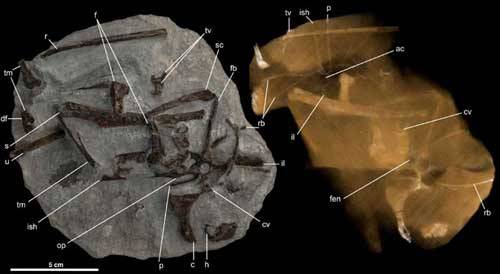
Photo (left) and computed tomographic (CT) scan image (right) of the type, or name-bearing, specimen of Vegavis iaai, a partial skeleton inside a ~70-million-year-old rock concretion from Vega Island, Antarctica. Photo from the Antarctic Peninsula Paleontology Project website.

Birds evolved during the Mesozoic Era, the so-called “Age of Dinosaurs,” before non-avian dinosaurs became extinct. Last month, for the November edition of Mesozoic Monthly, we discussed what makes modern birds members of the group of theropod dinosaurs, but what I didn’t mention is that birds lived alongside non-avian dinosaurs! Birds evolved around 165 to 150 million years ago during the Jurassic Period, the second of three time periods in the Mesozoic. The Jurassic dinosaur Archaeopteryx represents a transitional stage between birds and non-avian dinosaurs: its fossils display obvious flight feathers like a bird, but it also has many non-avian dinosaur characteristics such as a toothy mouth, a long bony tail, and even a miniature version of a killing claw like that of Velociraptor.
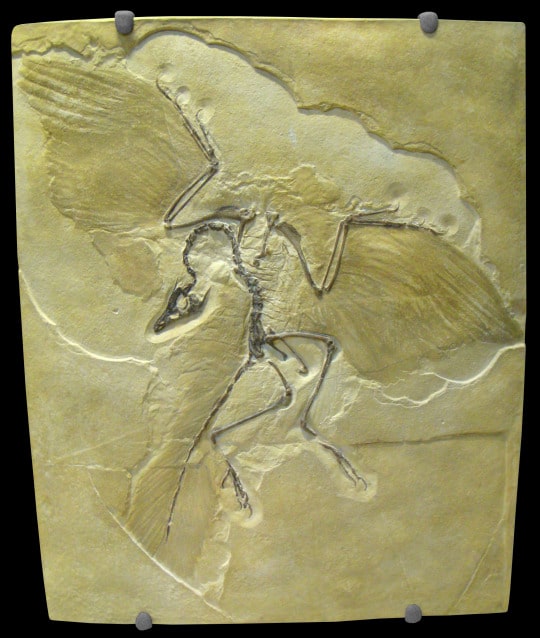
Replica skeleton of Archaeopteryx lithographica on display here at CMNH. Photo from Wikimedia Commons.

Birds lived and evolved alongside their non-avian relatives for almost 100 million years, and by the end of the Cretaceous Period (the third and final time period of the Mesozoic), the distinct groups of birds that we recognize today were beginning to originate. Vegavis was an ancient relative of ducks and geese discovered on Vega Island, an island off the coast of the Antarctic Peninsula (the part of Antarctica that juts northward towards South America). At that time, Antarctica was warmer than it is now and home to lush temperate forests.
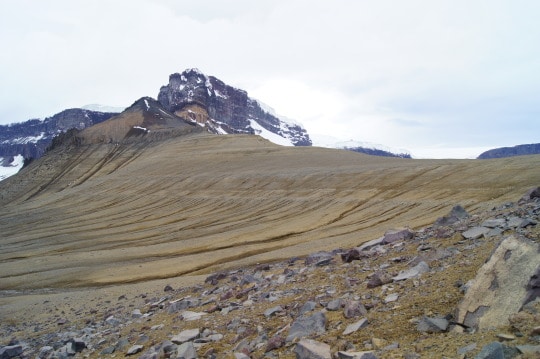
Sandwich Bluff, the site on Vega Island, Antarctica that has produced all known fossils of Vegavis. Photo by Eric Roberts, James Cook University.

With many skeletal features suggesting that it was a diving bird that propelled itself with its feet, Vegavis was probably as well-adapted to life in the water as it was to life in the skies. While it’s certainly incredible that scientists are able to deduce this much information about its behavior from just its skeleton, the story gets better: one specimen of Vegavis includes a fossilized syrinx, the organ that birds use to produce sound! A syrinx’s shape is directly related to the sounds it can make, and the fossilized syrinx of Vegavis was a distinctively goose-like asymmetrical shape. So, this ancient bird may well have honked! If it did, it would have sounded much more like six geese-a-laying than, say, four calling birds, three French hens, two turtle doves, or a partridge in a pear tree.

Lindsay Kastroll is a volunteer and paleontology student working in the Section of Vertebrate Paleontology at Carnegie Museum of Natural History. Museum staff, volunteers, and interns are encouraged to blog about their unique experiences and knowledge gained from working at the museum.

Related Content

Ask a Scientist: What kind of dinosaur is a megaraptorid?
The Bromacker Fossil Project XIII: What We Learned

Pebble or Jaw?

Filed Under: Blog Tagged With: dinosaurs in their time, Lindsay Kastroll, Mesozoic Monthly, Science News, Vertebrate Paleontology

November 30, 2020 by wpengine

Mesozoic Monthly: Scipionyx

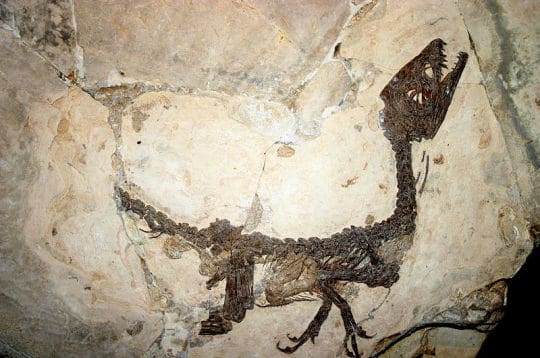
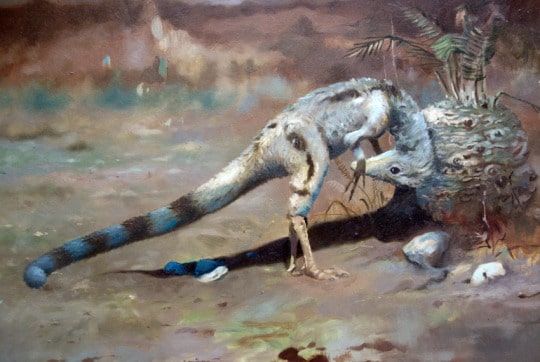
My high school calculus teacher, Mr. Surovchak, once told me about a competition he and his brother had every Thanksgiving. They would weigh themselves before and after dinner to indisputably measure who was able to eat the most. When it comes to dinosaurs, it’s typically much harder to tell what and how much they ate. However, a few fossils give us windows into the guts of dinosaurs – literally! Paleontologists are extremely thankful for spectacular fossils like that of Scipionyx samniticus, a small theropod dinosaur with several internal organs preserved!

Oil painting of Scipionyx samniticus in its Early Cretaceous environment by Emiliano Troco, used with permission. You can find more of their work on their Tumblr and contact them via their WordPress site.

Theropods, like Scipionyx, are dinosaurs that stand on two legs, usually with only three prominent toes on each hind foot. Some of the most famous dinosaurs are theropods, like Tyrannosaurus, Velociraptor, and previous Mesozoic Monthly honoree Citipati (does that make it famous? I like to think so). Most theropods interacted with the world primarily with their heads rather than their hands, hence why several of them look like they have oversized skulls and relatively underdeveloped forelimbs. Many also had hollow bones, and, as we can see in extremely well-preserved fossils, feathers. Is this all starting to sound familiar? That’s because these are also features of birds! If you’ve ever heard someone say that birds are dinosaurs, that’s because modern birds, which are called Aves or Neornithes, are just one evolutionary subset of theropod dinosaurs! Birds have all these features of theropod dinosaurs, plus others like toothless beaks and wings made partly from fused wrist and hand bones. If you are eating turkey for Thanksgiving dinner, remember that you’re eating a dinosaur!

Scipionyx didn’t look much like a turkey, though. It belonged to a group of theropods called compsognathids, which were long-tailed, slender, and relatively small predators. It wasn’t imposing size or an especially fascinating appearance that made Scipionyx special – it was the way the only known specimen was fossilized. It is so well preserved that many of its internal organs are intact in its body cavity! Petrified tissue from the trachea, small intestine, and even rectum can be seen in the fossil, as well as muscle tissue, blood vessels, and traces of other organs. We can tell from the bones and scales in its digestive tract that it ate several meals of lizards and fish before it died. There is such a wealth of biological information preserved in this single specimen, and we can learn even more when we consider its relatives. Although skin didn’t preserve in Scipionyx, at least one fossil of another compsognathid named Sinosauropteryx has such well-preserved skin and filament-like ‘protofeathers’ that we can even see pigments preserved! Based on Sinosauropteryx, we can assume that Scipionyx had some sort of filamentous or fuzzy covering as well, at least over some parts of its body.

The incredible fossil of Scipionyx preserves the dinosaur’s internal organs in 3D! For example, the sinuous shape of the small intestine is visible immediately behind the right elbow. Photo by Giovanni Dall’Orto on Wikimedia Commons. You can read more about this specimen in a paper by Dal Sasso and Maganuco (2011).

The fossil of Scipionyx is very small because the individual in question was just a hatchling when it died. Paleontologists can tell it was a hatchling, and not a small adult animal, because its proportions are similar to those of other juvenile dinosaur fossils and many of its bones had not yet fused together (you can learn more about how bones fuse as organisms get older in the Nemicolopterus edition of Mesozoic Monthly). The baby Scipionyx individual represented by the fossil would have measured around 18 inches (46 cm) long in life, and estimates based on how other compsognathids grew suggest that its species reached about 7 feet (2.1 meters) in length at adulthood. Not much is known about its habitat, but it was likely one of the largest animals around. Scipionyx was found in deposits laid down in a marine environment in what is now Italy. Back in the early part of the Cretaceous Period (the third and final division of the Mesozoic Era, or ‘Age of Dinosaurs’), when Scipionyx was alive, Italy was mostly under a shallow sea dotted with small islands, and the dinosaur would have lived on one of these. Since then, tectonic activity has dramatically changed the region, creating new mountains and lowering sea level to what it is today.

So, this Thanksgiving, if you’re looking for a conversation starter at the dinner table/family video call (or if you urgently need to divert discussion from a more sensitive topic), here’s an idea: ask your dining partners whether they think non-avian theropods like Scipionyx would have tasted more like turkey or chicken! Or, if your loved ones would rather learn than debate, you could perhaps offer to read them any of the 12 Mesozoic Monthly animal spotlights (that’s right, December makes one whole year of Mesozoic Monthly!). I’d certainly feel honored to make an appearance at your Thanksgiving feast.

Lindsay Kastroll is a volunteer and paleontology student working in the Section of Vertebrate Paleontology at Carnegie Museum of Natural History. Museum staff, volunteers, and interns are encouraged to blog about their unique experiences and knowledge gained from working at the museum.

Related Content

Mesozoic Monthly: Champsosaurus

The Two-Headed Dinosaur

Ask a Scientist: What is still unknown about “The Chicken from Hell?”

Filed Under: Blog Tagged With: dinofest, dinosaurs, dinosaurs in their time, Lindsay Kastroll, Mesozoic Monthly, Science News, Vertebrate Paleontology

September 25, 2020 by wpengine

Mesozoic Monthly: Champsosaurus

Good news everyone: it’s September! We’ve made it to month nine of 12! Sometimes it feels like this year will never end. I take comfort in the idea that if life can survive the traumatic Cretaceous-Paleogene (K-Pg) extinction that killed the non-avian dinosaurs, I can make it through 2020. One of the survival champs of the K-Pg extinction was Champsosaurus, a superficially crocodile-like reptile belonging to the extinct group Choristodera.

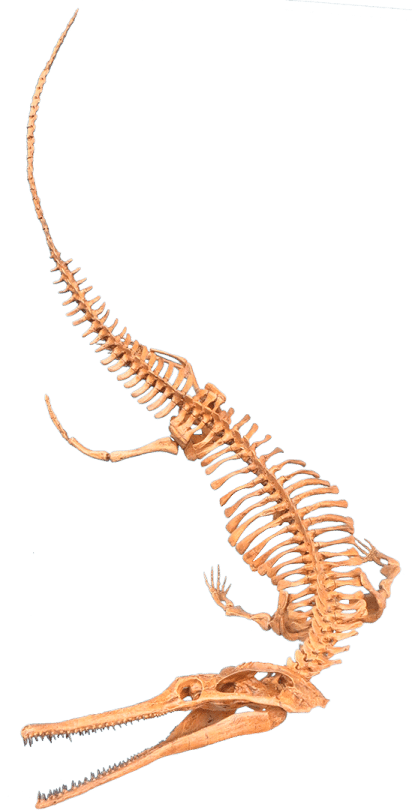
The skeleton of Champsosaurus laramiensis looks superficially like that of a crocodilian, but this is the result of convergent evolution. Choristoderes (like Champsosaurus) and crocodilians lived contemporaneously for at least 150 million years, until the choristoderes said “after a while, crocodile!” and went extinct. Photo by Triebold Paleontology, Inc., used with permission.

The class Reptilia encompasses an incredible variety of animals: lizards, snakes, turtles, crocodilians, pterosaurs, dinosaurs, and even birds are just a few of its members. In addition to the familiar reptiles that live today, many other reptile groups thrived for millions of years before eventually going extinct. It’s easy to think of dinosaurs like Tyrannosaurus or Triceratops when we talk about extinct reptile groups, but in reality, many extinct groups of animals with no living relatives escape the public eye. Choristodera, an order within the class Reptilia, is one of these groups. Choristoderes were semi-aquatic or aquatic carnivorous reptiles that evolved during the Mesozoic Era (the Age of Dinosaurs) and died out in the Cenozoic Era (the Age of Mammals). Just because they went extinct does not mean they were unsuccessful; the group survived for at least 150 million years! Like many animals, a rapidly shifting environment was probably the source of their demise. Until that point, choristodere evolution was able to ‘keep up’ with the changing times, including the monumental global changes that came with the K-Pg extinction. The combination of a massive asteroid impact in what’s now Mexico, extensive volcanic activity in India, and worldwide climatic shifts resulted in the extinction of over 75% of all species. Research on choristodere teeth suggests that they beat the odds by adapting to new prey.

When you think of an aquatic carnivorous reptile, you probably think of a crocodilian – and that’d be right! The crocodilian body plan is a very successful build for hunting prey in the water. As another aquatic carnivorous reptile, Champsosaurus evolved similar traits. This is an example of convergent evolution, in which unrelated species develop similar characteristics to deal with comparable circumstances. (You can read about more examples of convergent evolution in the January edition of Mesozoic Monthly about the sauropodomorph dinosaur Ledumahadi.) Some of the shared features between Champsosaurus and crocodilians include long, muscular jaws for catching fish, eyes at the top of the head for peering out of the water, and a flattened tail that was paddled side-to-side for propulsion. Of course, Champsosaurus and the rest of the choristoderes had many features that set them apart as well. Unlike crocodilians, which have bony armor called osteoderms embedded in their skin, choristoderes just had skin covered with tiny scales. In addition, crocodilians have nostrils on top of their snouts so that they can breathe while lurking beneath the surface of the water; choristodere nostrils were at the end of their snouts, so that they could stick the tip of their nose out of the water like a snorkel and breathe from down below.

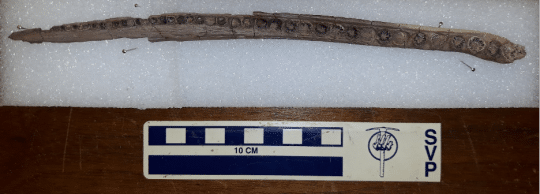
A right dentary (tooth-bearing lower jaw bone) of Champsosaurus sp. from the Upper Cretaceous of Wyoming in Carnegie Museum of Natural History’s Vertebrate Paleontology collection (specimen number CM 96509). The bone is facing upwards, so you’re looking down on the teeth. Check out the dark ‘stripes’ on the enamel of each tooth. These unusual enamel striations are a hallmark of neochoristoderes, the particular choristodere subgroup to which Champsosaurus belongs. Photo by Joe Sawchak.

The traits we see in the skeleton of Champsosaurus help paleontologists paint a picture of its behavior. Instead of lurking at the surface of the water, Champsosaurus would wait on the bottom of a shallow lake or stream for prey to come close, lifting the tip of its snout out of the water to breathe. When a tasty fish approached, it would spring off the bottom with its powerful legs and snatch it with its toothy jaws. Despite having strong legs, Champsosaurus was not adapted to a terrestrial lifestyle. In fact, adult males may not have been able to leave the water at all! Fossils attributed to females have more robust hips and hind limbs, allowing them to crawl onto land to lay eggs. According to this hypothesis, the less-robust males would have been restricted to an aquatic-only lifestyle.

Some of the freshwater environments that Champsosaurus inhabited were relatively cold, but that wasn’t a big deal; choristoderes may have been able to regulate their body temperature (a talent known as endothermy or ‘warm-bloodedness’). Crocodilians, by contrast, live in warm, tropical habitats because they are not capable of regulating their body temperature and rely on the sun to warm their bodies (aka ectothermy or ‘cold-bloodedness’). This would explain why choristoderes were able to live further north than crocodilians. However, it seems that crocodilians had the right idea; temperatures around the tropics change less during cooling and warming periods than those at higher latitudes. So, when the current Antarctic ice sheets began to form and the planet started cooling, the temperate choristoderes had to deal with more environmental change than the tropical crocodilians, and finally went extinct. I think the moral of the story is, we would all be handling 2020 better if we lived in the tropics!

Lindsay Kastroll is a volunteer and paleontology student working in the Section of Vertebrate Paleontology at Carnegie Museum of Natural History. Museum staff, volunteers, and interns are encouraged to blog about their unique experiences and knowledge gained from working at the museum.

Related Content

In the Field: Following the Work of a Paleontologist

Jurassic Days: Camptosaurus

Behind the Scenes of Dinosaur Armor

Filed Under: Blog Tagged With: dinosaurs in their time, Lindsay Kastroll, Mesozoic Monthly, Museum from Home, Science News, Vertebrate Paleontology

August 24, 2020 by wpengine

Mesozoic Monthly: Gryposaurus

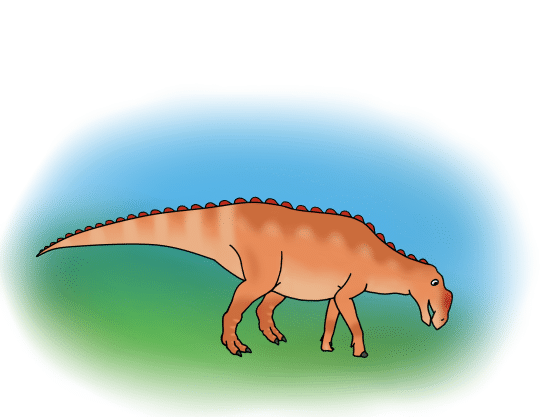
The Late Cretaceous-aged (~75 million-year-old) large-nosed North American hadrosaur (aka duck-billed dinosaur) Gryposaurus by ginjaraptor on DeviantArt.

Anyone who frequents the Pittsburgh area is familiar with ‘Pittsburghese,’ the regional dialect given full voice in what was once voted America’s ugliest accent (a fact that does not diminish our pride for it). One of my personal favorite Pittsburghese words is “nebby,” which translates to “nosy” for any non-local readers. “Nebby” can be used in a variety of contexts: the distant relative asking prying questions about your love life at Thanksgiving dinner is nebby, the pet cat trying to crawl under the bathroom door to see what you’re doing is nebby, and even the statue of Carnegie Museum of Natural History mascot Dippy the Diplodocus, silently judging your driving on Forbes Avenue, is nebby. We can assume other dinosaurs were nebby too, since so many had huge noses to stick into things. One of the biggest noses in the fossil record belongs to Gryposaurus notabilis, the star of this edition of Mesozoic Monthly.

Gryposaurus belongs to a group of dinosaurs called hadrosaurs, which are commonly referred to as duck-billed dinosaurs. Hadrosaurs were herbivores that got their nickname from the flat, toothless, somewhat duck-like beaks at the tips of their jaws. These beaks were used to bite through tough vegetation so that it could be ground up by the numerous teeth embedded in the rear half of the jaws. There are two main groups of hadrosaurs, both of which are featured in CMNH’s Dinosaurs in Their Time exhibition. Probably the more famous group is the Lambeosaurinae, known for their distinctive head crests that housed extra-long nasal passages. Virtually everyone can recognize the incredible backward-curving crest of Parasaurolophus (featured multiple times in the Jurassic Park franchise), and visitors to CMNH will also know the helmet-like crest of Corythosaurus. The second group is the Saurolophinae (traditionally known as the Hadrosaurinae), which typically lack bony crests. You can find a simulated carcass of the saurolophine Edmontosaurus (lovingly known to those of us in CMNH’s Section of Vertebrate Paleontology as “Dead Ed”) between the two imposing Tyrannosaurus skeletons in Dinosaurs in Their Time.

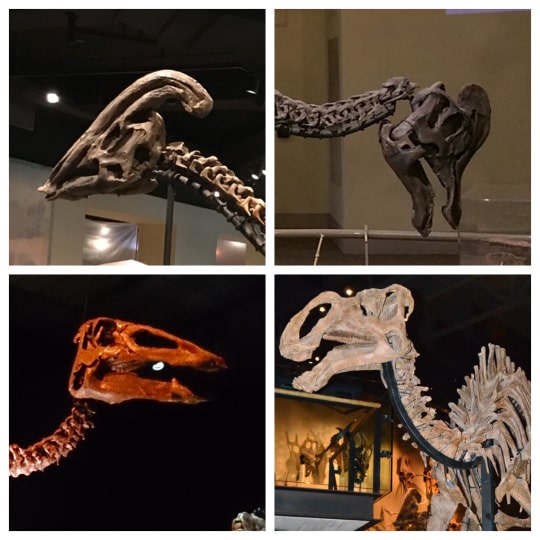
A gallery of hadrosaur heads. Top left: the lambeosaurine Parasaurolophus at the Field Museum of Natural History in Chicago (photo by the author). Top right: the lambeosaurine Corythosaurus at Carnegie Museum of Natural History (photo from Wikimedia Commons). Bottom left: the saurolophine Edmontosaurus at the Houston Museum of Natural Science (photo from Wikimedia Commons). Bottom right: the saurolophine Gryposaurus at the Natural History Museum of Utah in Salt Lake City (photo from Wikimedia Commons).

As a crestless hadrosaur, Gryposaurus was a saurolophine. Despite its lack of crest, its skull still had pizzazz: its nasal bone arched dramatically, giving the impression of a ‘Roman nose’ (which is very noticeable if you compare the skulls of Edmontosaurus and Gryposaurus in the image above). The name Gryposaurus notabilis means “notable hooked-nose lizard” in homage to this feature. G. notabilis is the type species of Gryposaurus; type species are typically the first ones to be named in a genus, and therefore become the reference to which all new specimens that may belong to that genus are compared. The other species (such as G. monumentensis, shown in the photo montage above) are similar enough to the type species that they can be referred to the genus Gryposaurus, but they differ in too many ways to be assigned to G. notabilis itself.

Occasionally, paleontologists will revisit a fossil species or genus and decide that it is either too similar to another to justify its own name or that certain specimens are too different to be grouped under the same name. Kritosaurus, another saurolophine with a ‘Roman nose,’ has fallen victim to both of these circumstances. It was originally considered its own genus, but was subsequently revisited by paleontologists who decided that it was so similar to Gryposaurus that the two genera were lumped together under the name Gryposaurus (when combining taxonomic groups, the first name that was published is the one that gets used). However, later paleontologists reviewed the evidence again and split a single species of Kritosaurus back out of Gryposaurus. The famous sauropod (giant long-necked herbivorous dinosaur) Brontosaurus underwent a similar series of changes over the years: originally, it and Apatosaurus were considered different animals, but after a review they were lumped together under Apatosaurus. Recently, the two were split apart again and the name Brontosaurus was revived (to the delight of fans of that name around the world).

It is not uncommon in paleontology for species to be lumped or split based on new or revisited evidence. When you consider that the decision to name new fossil species is often based on fragmentary, highly incomplete skeletons, you can see why it might be difficult to get things right the first time! These changes sometimes give people the impression that paleontologists “can’t make up their minds” or “contradict themselves,” but we must remember two things. First, that science is meant to change based on new evidence. Second, there have been thousands of paleontologists over the course of history, and every one of them is an individual person who can draw their own conclusions based on the same evidence. Although the resulting changes can disappoint fans of a specific animal or hypothesis, revision is normal and beneficial for the field as a whole. Scientists are supposed to be nebby – it’s how we make new discoveries!

Lindsay Kastroll is a volunteer and paleontology student working in the Section of Vertebrate Paleontology at Carnegie Museum of Natural History. Museum staff, volunteers, and interns are encouraged to blog about their unique experiences and knowledge gained from working at the museum.

Related Content

Mesozoic Monthly: Aspidorhynchus

Ah, Snap! Dino Named for Marvel’s Thanos

Jurassic Days: Specimen Scavenger Hunt

Filed Under: Blog Tagged With: dinosaurs in their time, Educator Resources, Lindsay Kastroll, Mesozoic Monthly, Museum from Home, Science News, Section of Vertebrate Paleontology

July 31, 2020 by wpengine

Mesozoic Monthly: Aspidorhynchus

As we all seek out responsible ways to enjoy our summer months while the world continues to respond to COVID-19, many of us are embracing the therapeutic effects of the great outdoors. One popular activity, especially in and around the Three Rivers, is fishing. Some modern fishes look positively primeval, as if they were hooked straight out of the Age of Dinosaurs and reeled into the present day. For July’s edition of Mesozoic Monthly, our star is Aspidorhynchus, one of the weird and wonderful fishes that inhabited the oceans of the Mesozoic Era.

Let’s start with a quick lesson on fish, for context. There are two main groups of bony fishes. One group, the class Sarcopterygii, are called the lobe-finned fishes because they have fleshy, limb-like fins that they use to paddle through the water like oars. The first vertebrates to go on land were sarcopterygians, and the descendants of these adventurous fish eventually evolved into amphibians, reptiles, and mammals – including us! Despite their prolific limbed descendants, sarcopterygians make up only a small fraction of fishes today. The vast majority of fish belong to the other class: Actinopterygii, or the ray-finned fishes. These fishes have delicate ray-like bones supporting thinly webbed fins instead of the meaty fins of the sarcopterygians. Actinopterygians are so successful that they dominate both freshwater and saltwater ecosystems, thrive in a variety of habitats, and fill various ecological niches. Such diverse lifestyles mean that actinopterygians come in many shapes and sizes. Nemo (a clownfish) is an actinopterygian. So is the barracuda that ate his mother, the catfish in the Monongahela River, and the unfortunate goldfish you won at the carnival as a kid. Most fossil fishes, like Aspidorhynchus for example, are also actinopterygians.

Aspidorhynchus is an extinct member of the order Holostei, nested, in diagrams of relatedness, within the class Actinopterygii. The only members of the Holostei today are gars and bowfins. Superficially, Aspidorhynchus looks like a gar, but it is more closely related to bowfins. Its name means “shield snout,” in reference to its pointy, swordfish-like upper jaw. Unlike swordfish, which lack teeth as adults, this snout was filled with many sharp teeth. The limited flexibility of its skull restricted its diet to tiny fish, two inches (5 centimeters) in diameter at the largest. Aspidorhynchus was not very large itself, its slender body only growing to approximately two feet (60 centimeters) in length. It was covered with ganoid scales, which are hard, diamond-shaped scales made with a shiny compound called ganoin. Only a few types of modern fishes have ganoid scales, including gar, sturgeon, and paddlefish.

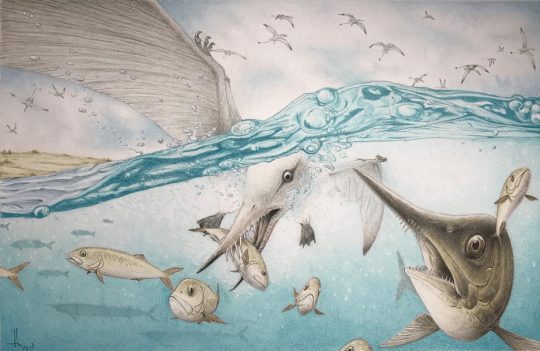
Jurassic feeding frenzy: the pterosaur (flying reptile) Rhamphorhynchus and the predatory fish Aspidorhynchus attack a school of smaller fish. Usually, the baitfish were the only casualties here, but once in a while, everybody lost (see below!). Art by RavePaleoArt on DeviantArt, reproduced with permission.

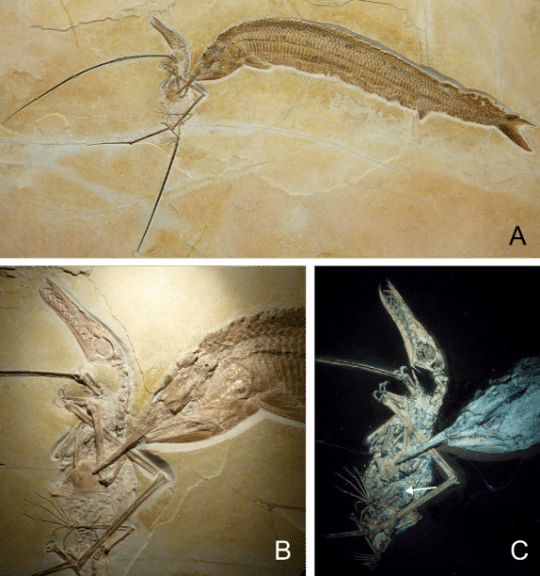
Although species of Aspidorhynchus lived in the Jurassic and Cretaceous periods, we know that it encountered the same struggles as some modern fish due to several remarkable fossils. Just like swordfish, the pointy snout of Aspidorhynchus frequently got it into trouble by impaling other animals! The abundance of fossil evidence for this was provided by the unique conditions of the habitat preserved in the famous Solnhofen Limestone of Germany. In the Late Jurassic, this area was an isolated series of lagoons that accumulated a bottom layer of anoxic brine, which is extra-salty, low-oxygen water where oxygen-dependent (aerobic) life cannot survive. Despite this, the surface still teemed with life: fishes and marine reptiles dominated the water, small non-avian dinosaurs scurried along the shore, and pterosaurs (flying reptiles) and archaic birds flew overhead. The fish-eating pterosaur Rhamphorhynchus seems to have been a fairly frequent victim of the snout of Aspidorhynchus, with multiple fossils documenting unfortunate collisions in which the fish’s snout pierced and became entangled in the wing membrane of the pterosaur. (For a summary of pterosaur wings, check out the March edition of Mesozoic Monthly, on Nemicolopterus.) It’s obvious from the size of the animals that neither was trying to eat the other, but somehow, they became stuck together. As the two animals struggled to survive, they slowly drifted downward into the anoxic brine, where they suffocated and settled onto the bottom of the lagoon. If any other animals had tried to eat or otherwise disturb the corpses, they would have died in the brine as well, so the fossils of the Solnhofen Limestone are typically pristine and undisturbed by scavengers.

Three views of the most famous (and probably the most beautiful) Aspidorhynchus vs. Rhamphorhynchus fossil from the Upper Jurassic Solnhofen Limestone of southern Germany. Avid fisherman Matt Lamanna, the head of Vertebrate Paleontology at Carnegie Museum of Natural History (CMNH), jokes that the Aspidorhynchus looks angry, as if it’s mad about getting its snout stuck in the Rhamphorhynchus and dooming them both. Sorry Matt, this is just a quirk of preservation – the compression of the Aspidorhynchus skull during fossilization gave it the appearance of having grouchy eyebrows that weren’t there in life. You can learn more about this specimen in a paper by Frey and Tischlinger (2012).And if you want to see real fossils of both of these animals in person (albeit preserved separately), come visit the Solnhofen case in CMNH’s Dinosaurs in Their Time exhibition.

Because Aspidorhynchus lived only during the Mesozoic, there’s no chance that a modern-day angler will ever hook one. But should you find yourself fishing in one of Pennsylvania’s rivers or lakes this summer, and manage to land a gar or bowfin, pause for a moment and reflect on the ancient legacy of these fishes – a heritage that dates to the Age of Dinosaurs.

Lindsay Kastroll is a volunteer and paleontology student working in the Section of Vertebrate Paleontology at Carnegie Museum of Natural History. Museum staff, volunteers, and interns are encouraged to blog about their unique experiences and knowledge gained from working at the museum.

Related Content

Preserving Fossil Treasures: Eocene Fishes from Monte Bolca, Italy

Science Chats: Herpetologist Talks About Dinosaurs with Paleontologist

The Bromacker Fossil Project Part VIII: Martensius bromackerensis Honoring a Colleague

Filed Under: Blog Tagged With: dinosaurs in their time, Lindsay Kastroll, Mesozoic Monthly, Museum from Home, Science News, Vertebrate Paleontology

May 27, 2020 by wpengine

Mesozoic Monthly: Citipati

The month of May that we’re living in is very different from the one we all anticipated at the start of the year. However, society somehow manages to march on. College students are still graduating, moms are still being celebrated, and Mesozoic Monthly continues! Our honoree for the month of May is known to have been a dedicated parent due to several specimens that show adults guarding eggs. Say hello to Citipati osmolskae!

illustration of Citipati, a dinosaur that looks similar to a bird, on a nest of blue eggs

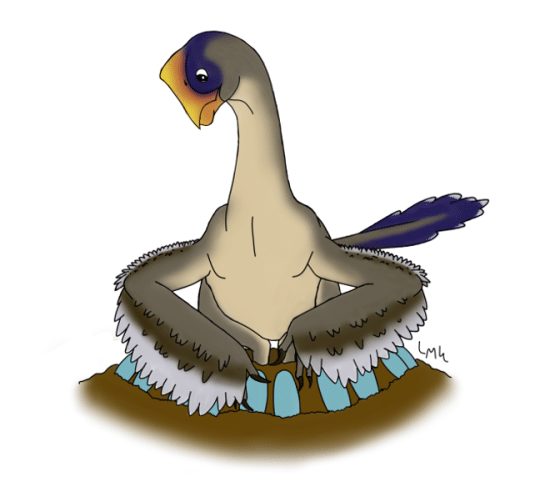
A devoted Citipati parent guarding its nest. Some evidence suggests that the Citipati skeletons found atop nests may have been males (rather than females as was originally thought). Also, recent research indicates that—believe it or not—oviraptorid eggs were blue! Art by ginjaraptor on DeviantArt.

It might not look like it, but Citipati is a theropod, like the more famous dinosaurs Tyrannosaurus, Allosaurus, and Velociraptor. Most theropods were carnivores, sporting skulls with big toothy grins, but not all theropods were ravenous predators! There are several groups of theropods that evolved toothless beaks for specialized diets. One of the stars of Jurassic Park, Gallimimus, was part of a predominantly herbivorous group of beaked theropods called Ornithomimidae. Citipati belongs to another group of beaked theropods called Oviraptoridae. “Oviraptor” means “egg thief,” in reference to an old hypothesis that oviraptorids stole and ate eggs from other dinosaurs’ nests. The discovery of a Citipati skeleton perched in a brooding position atop a nest of eggs was pivotal in changing this idea. We now know that instead of stealing others’ eggs to eat, fossilized oviraptorids preserved near eggs were actually protecting their own eggs! The eggs in an oviraptorid’s nest were arranged in circles with a space in the center for the parent to sit and spread their feathered arms over their incubating young.

photograph of Anzu dinosaur fossil

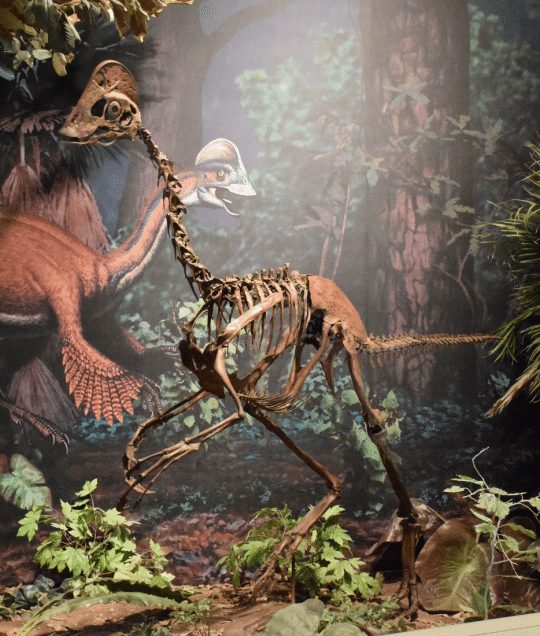
Citipati and other oviraptorids are closely related to one of Carnegie Museum of Natural History’s most bizarre dinosaurs, the ‘Chicken from Hell’ Anzu wyliei, shown here on display in the museum’s Dinosaurs in Their Time exhibition.

So, instead of eggs, what would the toothless beak of Citipati have been used to eat? Because most oviraptorid beaks are very deep, like those of modern parrots, most paleontologists infer that these dinosaurs ate mostly plants. However, this doesn’t necessarily mean that meat was off the menu; it would still have been possible for oviraptorids to have eaten small animals, making them omnivores. On top of its thick skull, Citipati possessed a tall, triangular crest that gave its small head a square-shaped profile. This crest was not as impressive as those on some other dinosaurs, but since Citipati grew to ten feet (three meters) long, the animal would still have been quite imposing. I certainly wouldn’t want to get between a Citipati parent and its eggs!

Citipati fossils are found in the modern Gobi Desert of Mongolia, in rocks known as the Djadokhta Formation. The Djadokhta rocks are made of sediments that were deposited late in the Cretaceous Period, preserving details of the ecosystem that existed there roughly 80–75 million years ago. The name Citipati means “funeral pyre lord,” which is fitting due to the hot environment in which this oviraptorid lived. Also, Citipati shares its name with a Buddhist deity that is believed to protect cemeteries from thieves, which is an appropriate parallel considering how the skeleton of this dinosaur was found guarding its fossilized nest.

Although the habitat Citipati lived in was a desert, like the Gobi Desert that is there today, this prehistoric desert was probably not as dry. In the event of rain, water gathered in temporary streams that drained the water to basins and oases. Since desert rain events are by definition few and far between, any animals that did not live near these oases would have needed to have adaptations for going without water for a long period of time. Some of the animals that lived in this unwelcoming environment alongside Citipati included everyone’s favorite small theropod Velociraptor, the hornless ceratopsian Protoceratops, and the tail-club wielding ankylosaur Pinacosaurus.

Lindsay Kastroll is a volunteer and paleontology student working in the Section of Vertebrate Paleontology at Carnegie Museum of Natural History. Museum staff, volunteers, and interns are encouraged to blog about their unique experiences and knowledge gained from working at the museum.

Filed Under: Blog Tagged With: dinosaurs in their time, Lindsay Kastroll, Mesozoic Monthly, Museum from Home, Science News, Vertebrate Paleontology

  • Page 1
  • Page 2
  • Go to Next Page »

sidebar

About

  • Mission & Commitments
  • Directors Team
  • Museum History

Get Involved

  • Volunteer
  • Membership
  • Carnegie Discoverers
  • Donate
  • Employment
  • Events

Bring a Group

  • Groups of 10 or More
  • Birthday Parties at the Museum
  • Field Trips

Powdermill

  • Powdermill Nature Reserve
  • Powdermill Field Trips
  • Powdermill Staff
  • Research at Powdermill

More Information

  • Image Permission Requests
  • Science Stories
  • Accessibility
  • Shopping Cart
  • Contact
  • Visitor Policies
One of the Four Carnegie Museums | © Carnegie Institute | Privacy Policy | Terms of Use | Accessibility
Rad works here logo