• Skip to primary navigation
  • Skip to main content
  • Skip to primary sidebar

Carnegie Museum of Natural History

One of the Four Carnegie Museums of Pittsburgh

  • Visit
    • Buy Tickets
    • Visitor Information
    • Exhibitions
    • Events
    • Dining at the Museum
    • Celebrate at the Museum
    • Powdermill Nature Reserve
    • Event Venue Rental
    • Gift Cards
  • Learn
    • Field Trips
    • Educator Information
    • Programs at the Museum
    • Bring the Museum to You
    • Guided Programs FAQ
    • Programs Online
    • Climate and Rural Systems Partnership
  • Research
    • Scientific Sections
    • Science Stories
    • Science Videos
    • Senior Science & Research Staff
    • Museum Library
    • Science Seminars
    • Scientific Publications
    • Specimen and Artifact Identification
  • About
    • Mission & Commitments
    • Directors Team
    • Museum History
  • Tickets
  • Give
  • Shop

Pat McShea

June 18, 2020 by wpengine

Eastern Garter Snake Encounter

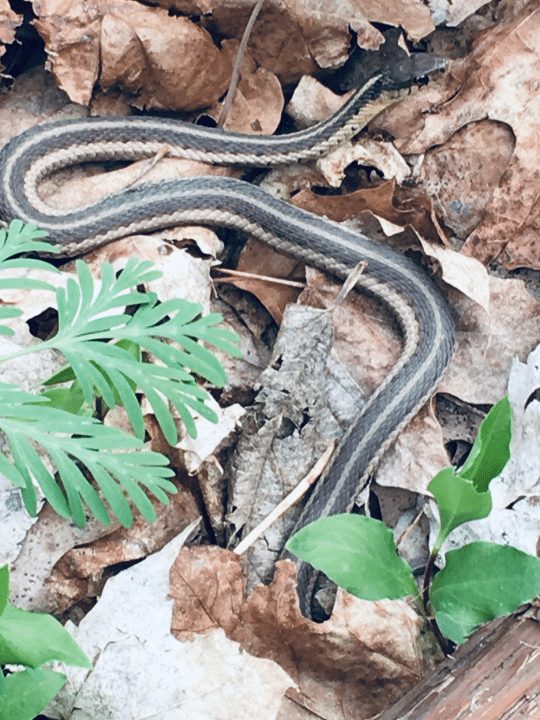
photo of garter snake in leaves

The eastern garter snake never moved. I only noticed the harmless reptile because my hands were within inches of its sleek body as I crouched to photograph a large-flowered trillium. The image above is a result of an abrupt subject change, but rushing wasn’t necessary. I was later able to photograph the intended wildflower without disturbing its striped neighbor.

After perhaps 90 seconds of sharing space with the snake, I backed carefully away from the blooming patch of forest understory within the Allegheny Land Trust’s Barking Slopes Natural Area. Later that day, in the pages of a trusted reference book, I found an explanation for what seemed an unusually passive predator.

Amphibians and Reptiles of Pennsylvania and the Northeast, is a Cornell University Press publication from 2001 by three authors with deep ties to CMNH, Arthur C. Hulse, long a Research Associate for the Museum’s Section of Herpetology, the late C. J. McCoy, a curator within the Section between 1964 and 1993, and Ellen J. Censky, a curator within the Section between 1994 and 1998.

The 5 pages of the 400-page volume devoted to garter snakes includes a description of the snake’s wide range of reactions to close encounters with our species.

“At one extreme, some remain fairly quiescent and allow themselves to be picked up and will not attempt any defensive behavior. At the other extreme, individuals flatten the head and body, flare the lips to expose teeth, and strike violently.”

The authors cite research indicating that young garter snakes are more aggressive after eating a large meal, a behavior that might occur because recently ingested food reduces their mobility, and therefore their chances for successful escape.

By this line of reasoning, the docile creature I encountered might simply have been hungry.

Patrick McShea works in the Education and Visitor Experience department of Carnegie Museum of Natural History. Museum employees are encouraged to blog about their unique experiences and knowledge gained from working at the museum.
Related Content

Northern Ribbon Snake

Lost and Found

Flying Snakes? Unique Reptile Adaptations

Filed Under: Blog Tagged With: Education, Educators, herpetology, Museum from Home, Pat McShea, Patrick McShea

May 29, 2020 by wpengine

Educator Spotlight: Christian Shane

In mid-March, like every teacher who suddenly found work and home life disrupted by Covid-19 related school closings, Christian Shane was concerned about his students. During the earliest days of sheltering restrictions, however, the science teacher from North Allegheny School District’s Ingomar Middle School was also worried about fish.

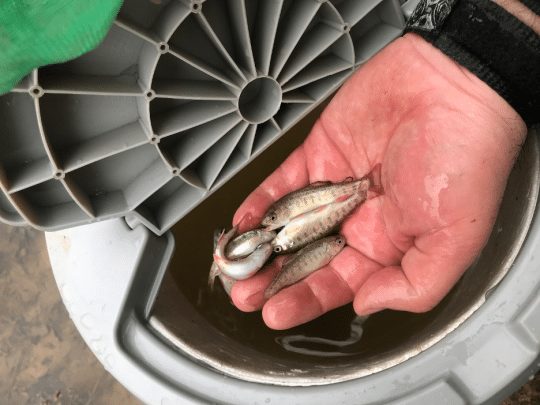
Christian and his seventh-grade students participate in Trout in the Classroom, an inter-disciplinary program made possible by a unique partnership between the Pennsylvania Council of Trout Unlimited and the Pennsylvania Fish and Boat Commission. A 55-gallon tank in Christian’s classroom held some 200 fingerling rainbow trout, fish raised from eggs since November, and destined for eventual release in designated stocked trout waters.

The release occurred far earlier than planned, and without any student participation. “When the school closed, teachers were instructed not to enter the building,” Christian explained, “but a custodian called that very first Saturday and said I’d better come get the fish.”

Fingerling trout on the early release date. A video of the release was shared with students.

I learned of the rescue and release weeks afterward when I called Christian to ask if his home-based lessons involved any of the mammal skulls he borrowed from the Museum’s loan program in early March. The skulls were secure in his classroom, Christian reported, but the first-hand learning experiences the specimens provided for students before the school closure proved to be vitally important during later home bound instruction. “I’ve been trying to get the students outside. Whatever the size of their yard, I want them to notice things where they live that relate to what we’re covering in our remote lessons.”

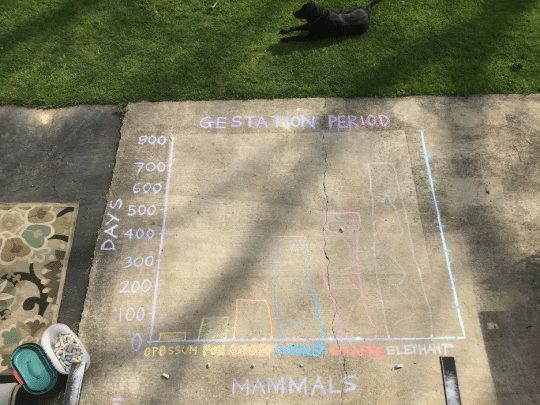
A teach-from-home innovation: Christian Shane created a driveway graph of mammal gestation periods.

According Christian, in a semester where teaching goals progressed from understanding the structures and processes of organisms to fuller comprehension of the roles of organisms in ecosystems, being able to make detailed observations of something as common as fern or a blooming violet was vitally important. “Students took two weeks to acclimate to the new conditions, but I’m confident they’ve learned a lot this spring.”

No doubt an innovative teacher had something to do with that progress.

Patrick McShea works in the Education and Visitor Experience department of Carnegie Museum of Natural History. Museum employees are encouraged to blog about their unique experiences and knowledge gained from working at the museum.
Filed Under: Blog Tagged With: Education, Educator Loan Program, Pat McShea, Patrick McShea

May 26, 2020 by wpengine

South American Hippo Habitat

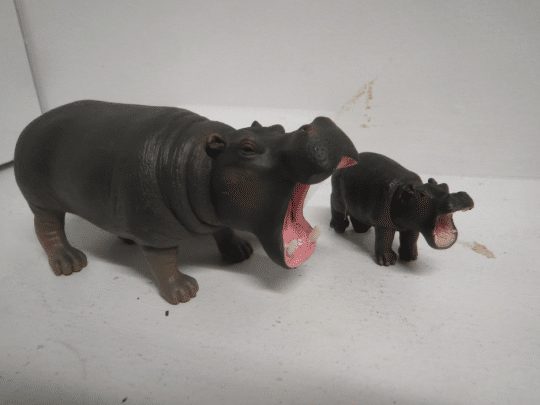
two South American hippo toys

In the wake the groundbreaking exhibition, We Are Nature, museum educators increasingly recognize opportunities for existing exhibits to foster discussions of profound human impacts. Because of a recent research study published in Proceedings of the National Academy of Science, even these sturdy plastic components of the African Wildlife Play Table (above) can spark wide ranging discussions about the impacts of large animal relocations.

The research paper Introduced herbivores restore Late Pleistocene ecological functions, by ecologist Erick Lundgren (University of Technology, Sydney, Australia) and ten co-authors, documents the establishment and growth of a hippo population along a section of Columbia’s Magdalena River over the past three decades. The founding members of a population now estimated to include as many as 80 individuals were four hippos, three females and one male, acquired during the 1980s by notorious drug lord Pablo Escobar for a private zoo on his estate.

According to researchers, the population of Magdalena River hippos could grow to between 800 and 5,000 animals by the year 2050.

For a summary of the research and its implications by The New York Times science writer Asher Elbein, please visit “Pablo Escobar’s Hippos Fill a Hole Left Since Ice Age Extinctions.”

Patrick McShea works in the Education and Visitor Experience department of Carnegie Museum of Natural History. Museum employees are encouraged to blog about their unique experiences and knowledge gained from working at the museum.
Filed Under: Blog Tagged With: Anthropocene Living Room, Anthropocene Studies, Education, Educators, mammals, Museum from Home, Pat McShea, Patrick McShea

October 22, 2019 by wpengine

Bright Flying Mammal

museum display of mammals found in Pennsylvania
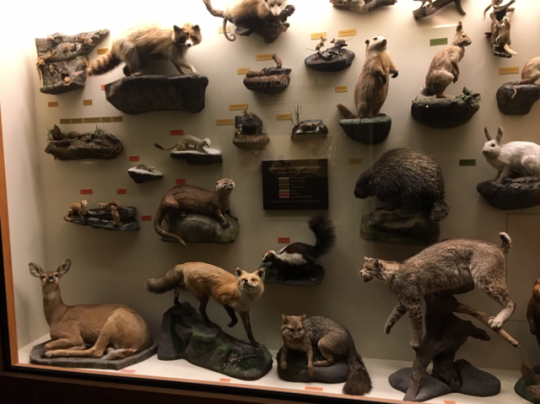
Mammals of Pennsylvania within the Hall of North American Wildlife

Can you name our region’s most colorful mammal? If the question was asked in front of the museum’s Mammals of Pennsylvania display, many people would choose the red fox near the center of the exhibit’s floor-level row.

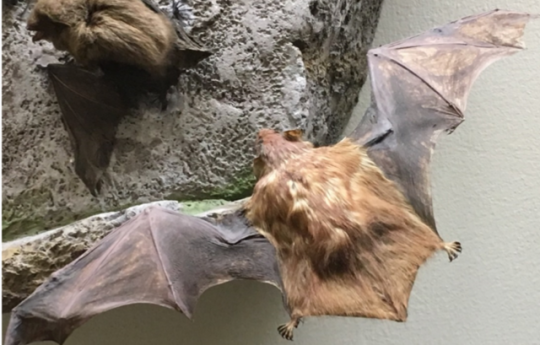
Five feet above fox, and just inches from the tip of a raccoon’s tail, a far smaller, but equally bright alternate exists in the form of a gliding eastern red bat.

Eastern red bat
Eastern Red Bat, known to science as Lasiurus borealis

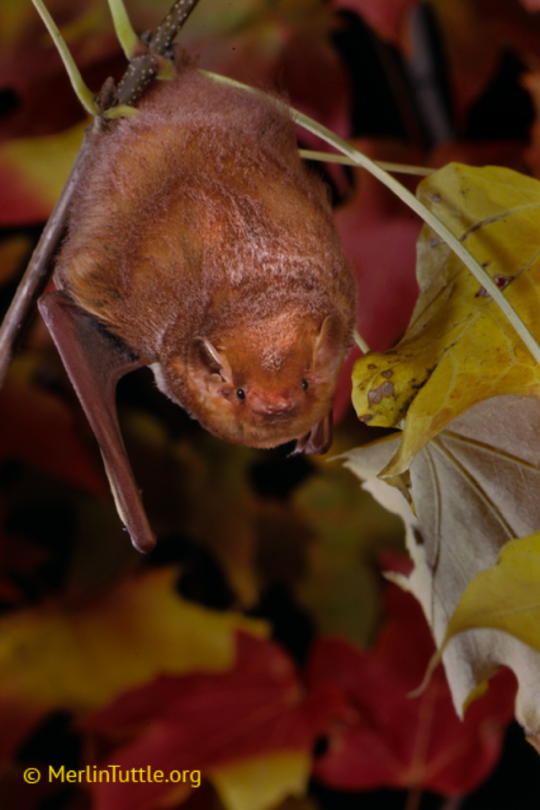
In color, red bat fur ranges from golden brown to bright rusty orange, with males typically sporting brighter shades than females. The bright fur coats of this widespread insect-eating species provide surprisingly effective camouflage when the bats are at rest. Red bats are tree bats, a term that indicates the species’ preference for spending daylight hours roosting within the foliage of deciduous and sometimes evergreen trees.

Eastern red bat
Eastern Red Bat

With wings folded, they hang upside-down from the grip of a single foot, looking, to casual observers, like dead leaves or pine cones.

Red Bats have so far escaped the devastating effects of white-nose syndrome, a fungal disease that since 2007 has caused mortality rates as high as 90% at hibernation sites of many other bat species. Remarkably, on fall migration flights to southern portions of their North American range, red bats have been known to cross long stretches of territory with flocks of migrating birds.

For more information about eastern red bats, please check the species account prepared by Bat Conservation International.

For information about the vital ecosystem contributions of the world’s 1,300 bat species please visit Merlin Tuttle’s Bat Conservation.

Patrick McShea works in the Education and Visitor Experience department of Carnegie Museum of Natural History. Museum employees are encouraged to blog about their unique experiences and knowledge gained from working at the museum.
Filed Under: Blog Tagged With: Education, Hall of North American Wildlife, mammals, Pat McShea, Patrick McShea

September 9, 2019 by wpengine

Don’t Overlook the Lichens

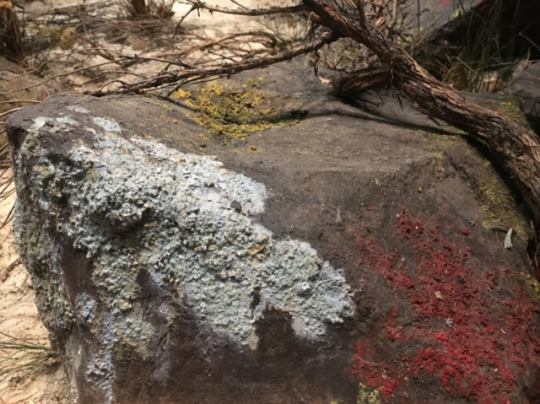
various lichen on rock

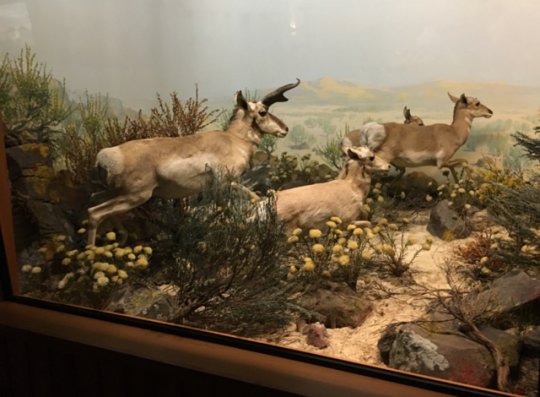
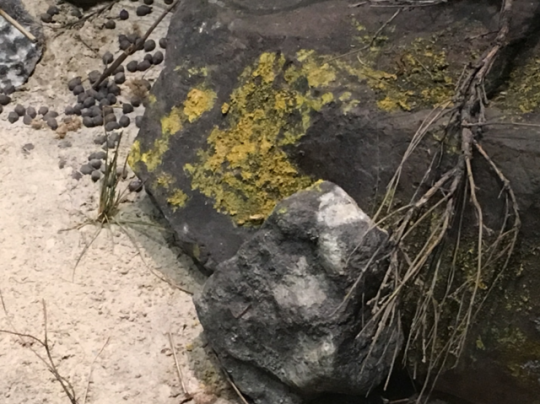
Lichens are scenery elements in many museum dioramas. Within the Pronghorn Antelope diorama in the Hall of North American Wildlife, for example, these frequently overlooked organisms coat a foreground boulder with irregular patches of gray, red, and gold.

pronghorn antelope diorama

If you approach this artfully recreated western scene with a little background information about lichens, you might find the colorful cluster of immobile organisms in the bottom right corner just as interesting as the four galloping centerpieces.

Lichens are found on every continent and estimates of their global diversity range from 13,000 to more than 17,000 species. Every lichen is a partnership of two different organisms, a fungus whose tissue provides the physical structure to support a second organism capable of photosynthesis. For most lichens the partner with the solar energy power is some form of green algae.  The fungus/algae partnership is a living arrangement in which separate identities fade while combined abilities allow for survival in locations where neither organism could live alone.

Crustose or curst-like lichen and pronghorn antelope scat.

Three distinctive growth forms provide a means for categorizing lichen. The colorful trio sharing the pronghorn antelope diorama are termed “crustose” or crust-like lichens. Lichens with a leaf-like appearance and structure are termed “foliose,” and those with shrubby upright or dangling strands are termed “fruticose.”

Because lichens absorb so much of their nourishment from the air and rainfall, they serve as living air quality indicators. By monitoring a region’s changing balance of pollution sensitive species and pollution tolerant species, a researcher can visually chart the build-up or decrease of pollutants such as sulfur dioxide and nitrogen dioxide.

For more detailed information about lichen ecology, including information about local research efforts, please visit the site maintained by Point Park University Professor Matthew Opdyke.

Patrick McShea works in the Education and Visitor Experience department of Carnegie Museum of Natural History. Museum employees are encouraged to blog about their unique experiences and knowledge gained from working at the museum.
Filed Under: Blog Tagged With: Botany, Hall of North American Wildlife, Pat McShea, Patrick McShea, plants

August 14, 2019 by wpengine

Frontier History Wizards

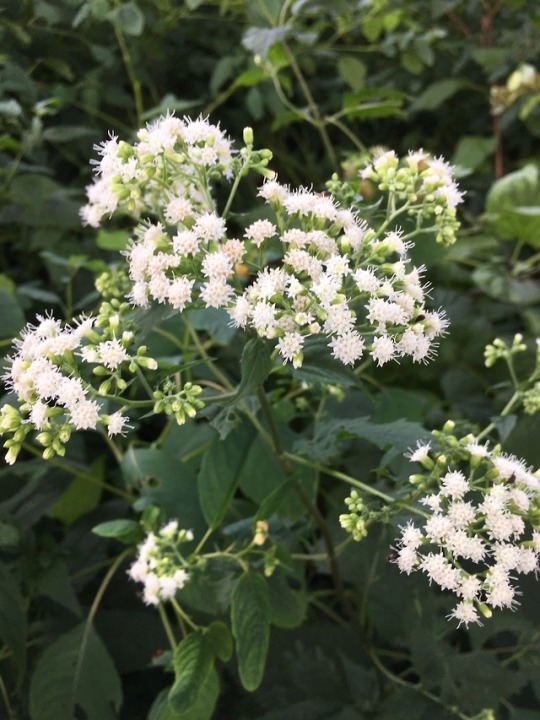
white snakeroot plant
White snakeroot blooming along the Allegheny River shoreline in early August.

Written descriptions for Carnegie Museum of Natural History summer camp, Wizard Academy, invite 8 – 10-year-old participants to experience a collision between “magic and science.” Based upon my recent experience with campers in the popular Harry Potter-themed program, the advertised subject could also include “history.”

During a discussion of poisonous plants with two dozen want-to-be wizards in the Hall of Botany, I drew the group’s attention to a display labeled “LOCAL SPECIES TO AVOID.”

The focus for my remarks was white snakeroot (Ageratina altissima) a straight-stemmed and flower-topped species in the display’s front row. I explained how the plant’s common name is an historic reference to its alleged value in treating snake bites, and that its designation as a plant to avoid was based upon on its connection to an often-fatal illness know as milk sickness.

The disease, which occurred when people drank milk from cows that had fed upon white snakeroot, was a scourge of pioneer life during the early nineteenth century, the decades-long period when settlement across what was then the American frontier dramatically altered vast forests west of the Appalachians.

One of the campers assisted my narration by reading from a handout about how Abraham Lincoln’s mother, Nancy Hanks Lincoln, died from milk sickness. When another camper asked how the plant-to-cow connection was “figured-out,” I confessed ignorance but promised to find out.

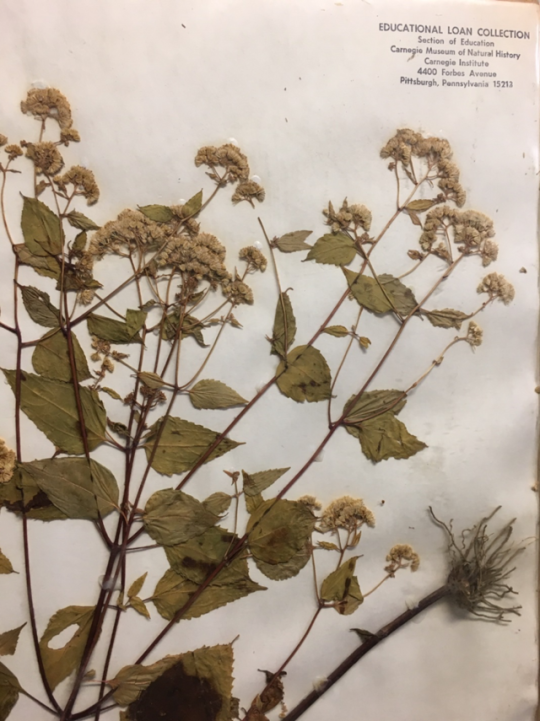
herbarium sheet of white snakeroot
White snakeroot herbarium sheet, part of the Educator Loan Collection’s “Poisonous Plants of Pennsylvania” box.

Much of the life-saving credit, I learned, belongs to a pair of women whose friendship crossed conflicting cultures of 1820’s Illinois; a frontier doctor, and an elderly fugitive of the federal government’s forced relocation of the Shawnee to territory further west. The doctor, Anna Pierce, lost family members to milk sickness and, based upon observations of disease occurrence, promoted the avoidance of milk drinking between June and the plant-killing frosts of autumn. The relocation resister, known to settlers as Aunt Shawnee, took Dr. Pierce into the woods to show her white snakeroot and explain the plant’s lethal properties. Pierce then conducted experiments to confirm the plant’s toxicity and shared her findings with other doctors.

More than 70 years later carefully controlled scientific studies documented year-to-year and geographic variations in the toxicity levels of white snakeroot, but it wasn’t until 1928 that the plant’s toxic chemical, an alcohol termed tremetol was isolated in a laboratory. Today, largely because of better pasture management, milk sickness is not a concern in commercial dairy operations.

The takeaway lesson, kindled when a ten-year-old camper’s question illuminated a nearly 200-year-old ethnobotany story, is to more fully value the indigenous knowledge of the vibrant Native cultures that continue to exist across our country.

(Information source: Natural History, July 1990, “Land of Milk and Honey” by David Duffy Cameron)

Patrick McShea works in the Education and Visitor Experience department of Carnegie Museum of Natural History. Museum employees are encouraged to blog about their unique experiences and knowledge gained from working at the museum.
Filed Under: Blog Tagged With: Education, Educator Loan Program, Educator Loans, Educator Resources, Pat McShea, Patrick McShea

  • « Go to Previous Page
  • Page 1
  • Interim pages omitted …
  • Page 10
  • Page 11
  • Page 12
  • Page 13
  • Page 14
  • Page 15
  • Go to Next Page »

sidebar

About

  • Mission & Commitments
  • Directors Team
  • Museum History

Get Involved

  • Volunteer
  • Membership
  • Carnegie Discoverers
  • Donate
  • Employment
  • Events

Bring a Group

  • Groups of 10 or More
  • Birthday Parties at the Museum
  • Field Trips

Powdermill

  • Powdermill Nature Reserve
  • Powdermill Field Trips
  • Powdermill Staff
  • Research at Powdermill

More Information

  • Image Permission Requests
  • Science Stories
  • Accessibility
  • Shopping Cart
  • Contact
  • Visitor Policies
Stay in the loop! Sign up for our newsletter(s).
One of the Four Carnegie Museums | © Carnegie Institute | Privacy Policy | Terms of Use | Accessibility
Rad works here logo