• Skip to primary navigation
  • Skip to main content
  • Skip to primary sidebar

Carnegie Museum of Natural History

One of the Four Carnegie Museums of Pittsburgh

  • Visit
    • Buy Tickets
    • Visitor Information
    • Exhibitions
    • Events
    • Dining at the Museum
    • Celebrate at the Museum
    • Powdermill Nature Reserve
    • Event Venue Rental
    • Gift Cards
  • Learn
    • Field Trips
    • Educator Information
    • Programs at the Museum
    • Bring the Museum to You
    • Guided Programs FAQ
    • Programs Online
    • Climate and Rural Systems Partnership
  • Research
    • Scientific Sections
    • Science Stories
    • Science Videos
    • Senior Science & Research Staff
    • Museum Library
    • Science Seminars
    • Scientific Publications
    • Specimen and Artifact Identification
  • About
    • Mission & Commitments
    • Directors Team
    • Museum History
  • Tickets
  • Give
  • Shop

Pat McShea

December 29, 2020 by wpengine

Milkweed Observations

Opportunities to capture dramatically different seasonal pictures of the same subject come with the territory of our temperate region. Next year, consider challenging yourself to document how a flower bed or prominent deciduous tree transforms seasonally in response to changing light, temperature, and moisture.
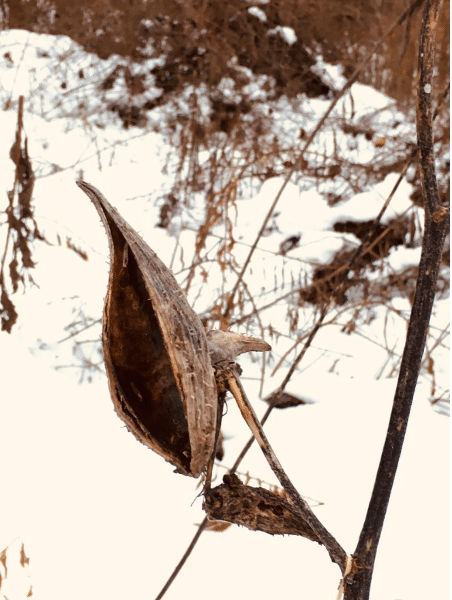
milkweed in winter with snow

The picture above, taken on the first day of winter, records the deteriorated condition of the common milkweed plant (Asclepias syriaca) I began observing during the first week of summer. The image might easily be termed an end point, but for documentation images that preceded it.
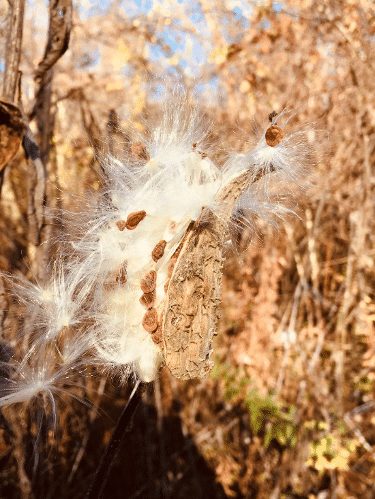
milkweed in autumn

Here, on a bright early November day, the burst seed pod offered dozens of matchhead-sized brown seeds, each attached to sparkling down-like filaments to the wind. With this picture as reference, the empty winter solstice pod implies continuance as much as conclusion.
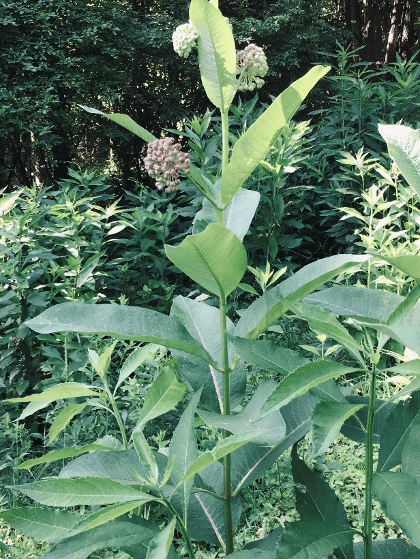
milkweed plant in summer

My observations began in late June, several days after the summer solstice, and just before the milkweed plant bloomed. My resolution for future observations is to begin them far earlier in the growing season, and to learn more about the insect fauna associated with the plant.
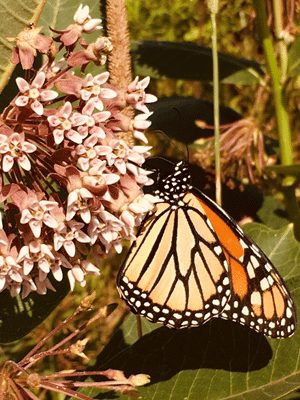
monarch butterfly on milkweed

Monarch butterflies (Danaus plexippus), a species currently experiencing alarming population declines, are the most well-known insects associated with milkweed. This one pictured above visited the plant’s lavender blossoms on July 25.
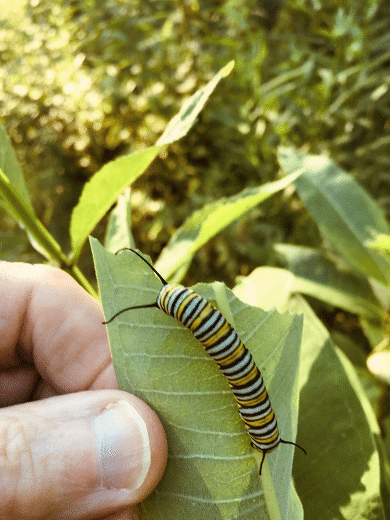
monarch caterpillar on milkweed leaf

Monarch butterfly caterpillars, such as the one photographed eating this leaf on August 19, are dependent on milkweed for nourishment and the predator protection they gain from the plant’s toxins.
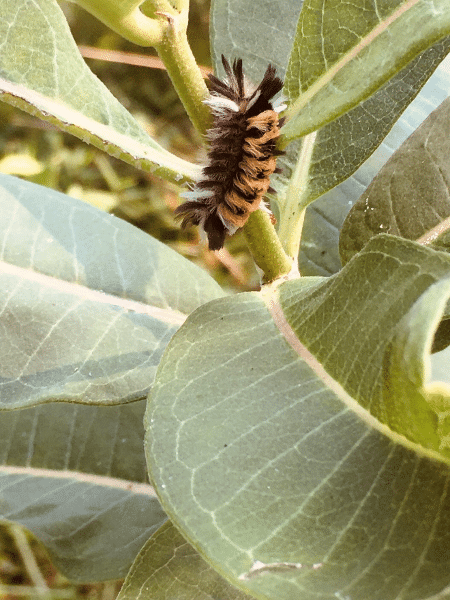
milkweed tussock moth caterpillar on milkweed

A lesser known milkweed dependent insect is the milkweed tussock moth (Euchaetes egle). A caterpillar of the species was photographed on the plant in mid-August.
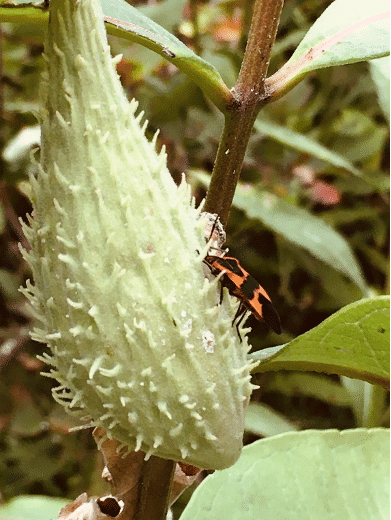
large milkweed bug on milkweed plant

The diet of the large milkweed bug (Oncopeltus fasciatus) includes seeds, so the presence of seed pods does not necessarily guarantee a bountiful crop the next growing season. The insect pictured above visited the plant on August 21.

Patrick McShea works in the Education and Visitor Experience department of Carnegie Museum of Natural History. Museum employees are encouraged to blog about their unique experiences and knowledge gained from working at the museum.

Related Content

Collected on This Day in 1934: European larch
Ask a Scientist: How do you find rare plants?

A Steeler Prayer

Filed Under: Blog Tagged With: Botany, Education, Museum from Home, Pat McShea

December 16, 2020 by wpengine

A Steeler Prayer

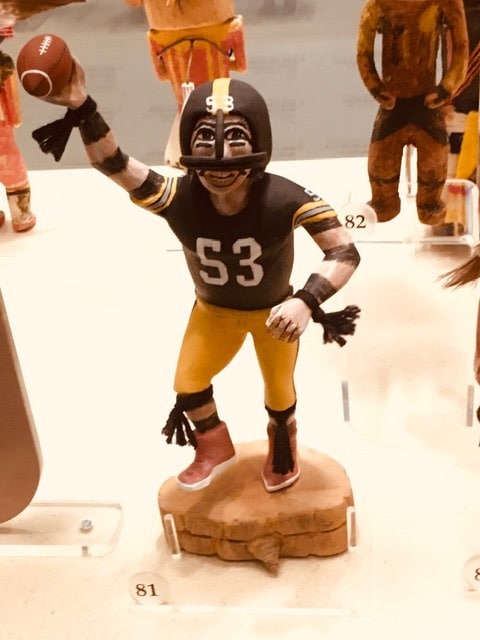
carved figure of a Pittsburgh Steelers football player holding a football

A celebratory touchdown dance in carved cottonwood has been quietly occurring at Carnegie Museum of Natural History for more than 22 years. Within the Alcoa Foundation Hall of American Indians, in the quadrant of the exhibition devoted to conveying information about the Hopi and their culture, a nine-inch high figure of a Pittsburgh Steelers player wearing number 53 holds a football aloft in his right hand. The wide-eyed grinning figure is displayed with plenty of colorful company, and its significance is best understood in terms of this carefully assembled cast.

The carved figures, which are properly called tihus, and more frequently referred to as katsinas, represent the benevolent spirit beings who live among the Hopi on three high mesas of northern Arizona for approximately a six-month period each year. An important role for the carvings is the imparting of knowledge and understanding of these beings or katsinam, and the target audiences for these life lessons are the Hopi themselves.

This aspect of limited cultural sharing was explained to museum educators in the months before the exhibition hall opened in 1998 when Hartman Lomawaima, a Hopi consultant, conducted a training session about the carvings. After a 90-minute presentation that included information about how the katsinas displayed in the hall had not been used in sacred ceremonies, he fielded a particularly pertinent question. “When we take students through the hall we won’t have the time you’ve just shared with us,” explained an experienced interpreter. “What can we tell students about these figures in a minute or two?” “That’s easy,’’ replied Hartman, “just tell them they’re three-dimensional prayers.”

A little more information about the black and gold figure can be gleaned from exhibit text. Here the carving is described as PITTSBURGH STEELER CLOWN KOYAALA, the carver identified as Regina Naha, and the creation date listed as 1992. A reputable reference on katsinas describes the word “Koyaala” as referring to clown figures of the village of Hano on First Mesa, and an internet search under the artist’s name reveals that she is from Hano.

For Steeler fans, and perhaps even for the team’s players, coaches, and administrators, there might be small comfort in knowing a “three-dimensional” prayer clad in their team’s uniform resides under the same roof as Tyrannosaurus rex. For fans of the city itself, the story of how the carving came to be on display offers another example of Pittsburgh Pride. In a font smaller than the rest of the display’s text, the figure is noted to be a “gift of Les and Joan Becker.” Deborah Harding, Collection Manager in the museum’s Section of Anthropology, was able to share some information about the couple. “Les and Joan were long-time and valuable volunteers in this section. During a visit to Arizona they spotted the Steeler carving in the shop at The Heard Museum in Phoenix, and bought it for the museum with the approval of the curator directing the hall’s development. According to the story I heard, Les was able to barter for a lower price by arguing that the figure would be displayed where it belonged, in Pittsburgh.”

Patrick McShea works in the Education and Visitor Experience department of Carnegie Museum of Natural History. Museum employees are encouraged to blog about their unique experiences and knowledge gained from working at the museum.

Related Content

Deeper Dig: Ancient Egypt Through Its Pottery

Carved Wooden Gope Board

Ice and Snow: The effects of temperature

Filed Under: Blog Tagged With: anthropology, Museum from Home, Pat McShea, Science News

December 7, 2020 by wpengine

Teaching About Teeth

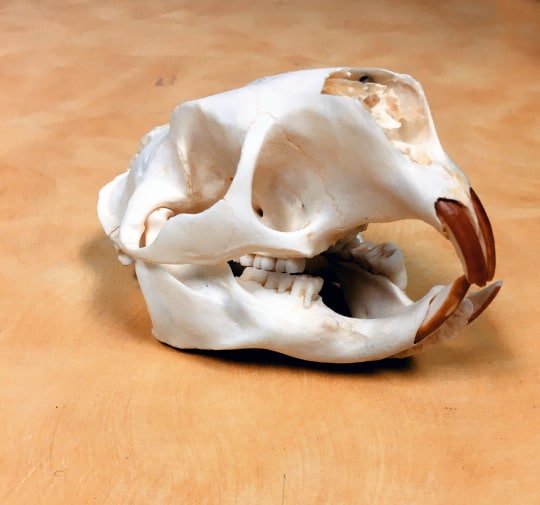
Porcupine skull from the Educator Loan Collection

The term “teachable moment” doesn’t accurately capture the opportunity first grade teachers have to guide their students in making observations about dental structure and function. “First graders are all about teeth,” explains Carolyn Mericle of the University of Pittsburgh’s Falk Laboratory School. The 29-year teaching veteran has long noted how the shared experience of tooth loss and replacement among these young students creates a high level of interest in all things dental that lasts for months, not moments.

Carolyn shared these observations during a recent phone conversation about how the mammal skulls she recently borrowed from the museum’s Educator Loan Collection would enhance student learning. Ideally, she explained, the students’ observations of the diversity of dental arrangements represented in the dozen skulls (a set which included black bear, white-tailed deer, striped skunk, and porcupine), would help them make connections to each creature’s diet. This experience would in turn lead to a better understanding of related classification terms such as, carnivore, herbivore, and omnivore.

Like every educator who is teaching through the COVID-19 pandemic, however, Carolyn is facing the necessity of modifying and adapting established plans. “Everything is hard this year.” she summarized, citing a school year that began with some of her students in her classroom and others at home, before a recent transformation to all remote instruction.

In the past, her students encountered the skulls firsthand by circulating among classroom tables where the objects were displayed. Each table included enough adjacent elbow room for students to make tooth-focused observational drawings. This week Carolyn plans to photograph the skulls and share the resulting images electronically to create a similar observational opportunity. “You have to re-think everything,” she adds, “because we’re working with a different set of tools.”

When the conversation concluded with a question about hope, Carolyn’s answer came without any hesitation. “The resilience of children gives me hope. They make the best of it. They’re powered by curiosity.”

Patrick McShea works in the Education and Visitor Experience department of Carnegie Museum of Natural History. Museum employees are encouraged to blog about their unique experiences and knowledge gained from working at the museum.

Related Content

A Gorilla for Our Imagination

Holiday Stowaway: Northern Saw-whet Owl 

Ask a Scientist: What is one of the more unique mammals of western PA?

Filed Under: Blog Tagged With: Educator Loan Program, Educators, Museum from Home, Pat McShea

November 30, 2020 by wpengine

A Gorilla for Our Imagination

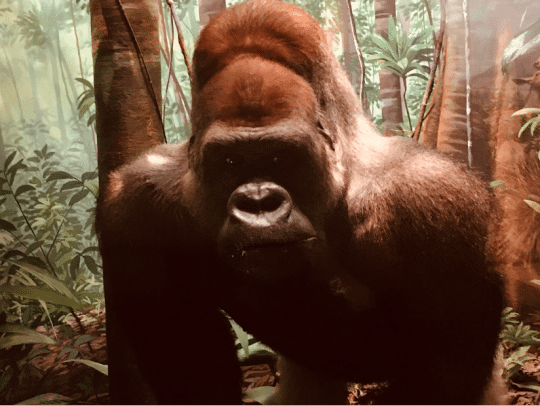
gorilla taxidermy mount

The lowland gorilla within the Hall of African Wildlife has a far different back-story than other large mammals in the exhibition’s dozen dioramas. All of the hall’s mammal taxidermy mounts are the preserved remains of creatures that once lived in the wilds of the African Continent. Most were collected between 1909 and 1912, during the course of two hunting safaris led by Childs Frick, son of Pittsburgh industrialist Henry Clay Frick. The gorilla was a far later addition to the stuffed menagerie, and its arrival occurred under entirely different circumstances.

The animal that grew to be a magnificent 350-pound silverback, was captured at a young age in Gabon, West Africa, sometime in the early 1960s. The gorilla lived in zoos afterward, initially in Copenhagen, Denmark, and later in Pittsburgh, where it died unexpectedly of natural causes in 1979.

Zoo staff offered the gorilla remains to museum curators, and through the efforts of a skilled team of taxidermists, an animal long known to zoo visitors as “George” came back into public view in an alert, but frozen stance.

Today it’s not unusual to occasionally hear museum visitors recalling the gorilla’s crowd-pleasing antics as a zoo attraction. The taxidermy mount’s far more important role, however, is as an educational tool capable of holding eye contact, and thereby encouraging contemplation. In staring contests that the glass-eyed mount never loses, the gorilla represents all of its wild living kind, the entire population of our planet’s largest primates, close relatives of modern humans, and a group whose continued existence is increasingly threatened by illegal hunting, habitat loss, and disease.

Scientists who study these great apes recognize two species of gorillas, each of which contain two sub-species, and all of which are considered critically endangered. The museum specimen, owing to its origin in Gabon, bears the echoing scientific name Gorilla gorilla gorilla to note its genus, species, and subspecies designation.

For anyone at a loss about what to contemplate while holding the gaze of this hall’s famous resident, consider some of what Terry Tempest Williams has to say in her 2019 work, Erosion: Essays of Undoing. The author begins an essay about a guided visit to observe mountain gorillas (Gorilla beringei beringei) in the Virunga Mountains of Rwanda with an appeal to senses that don’t come into play in museum exhibit halls. “We smelled them before we heard them. We heard them before we saw them.”

Later, amidst information about how members of the observed gorilla clan were refugees from an adjacent national park in war-torn Congo, and how their continued sanctuary in Rwanda is tenuous due to that nation’s rapidly growing population, relatively small size, and the discovery of oil deposits in the Virunga Mountains, Williams offers this thought:

“I wish there was a gorilla in every corner of our imagination to remind us what we are choosing to harm and ignore. I wish we could smell them, hear them, see them for who they are in place, and know them by name: the most gentle of creatures, with strength and power.”

For more information about gorillas, please visit this Wildlife Conservation Society site.

Patrick McShea works in the Education and Visitor Experience department of Carnegie Museum of Natural History. Museum employees are encouraged to blog about their unique experiences and knowledge gained from working at the museum.

Related Content

D is for Dugong

Scientist Takeover: Mammals! 

Ask a Scientist: Can you tell us the story of Harvey, the big rabbit? 

Filed Under: Blog Tagged With: Hall of African Wildlife, mammals, Museum from Home, Pat McShea

November 24, 2020 by wpengine

Holiday Stowaway: Northern Saw-whet Owl

Northern Saw-whet Owls have a reputation for showing-up in surprising places. The late November news that one of these small predators accompanied a 75-foot Norway spruce on a 200 mile journey from Oneonta, New York, where the 11-ton tree was cut, to Mid-town Manhattan, where the massive evergreen was installed in a place of honor at Rockefeller Center, fits the species’ profile.

The 8-inch high birds, whose common name reflects the resemblance of one of their calls to the sound of a saw being sharpened with a whet stone, are the smallest owl found in the mid-Appalachian region. As recently as 30 years ago infrequent sightings of the owls were interpreted as evidence of the species’ decline. That assumption began to change in the 1990s with the establishment of Project Owlnet, an ongoing multi-state field study that now consists of more than 100 owl migration banding sites where on late nights every fall researchers rely on recordings of the reclusive bird’s too-too-too breeding call to lure and temporarily capture owls in mist nets. These nocturnal labors have documented healthy populations of the owls in suitable habitats, although this good news is leavened with cautions that the species’ association with higher elevation forests could make it susceptible to the effects of climate change in the coming decades.

The individual owl getting attention as a holiday tree stow-away was driven back upstate to a wildlife rehabilitation facility in the town of Saugerties, where caregivers reported the bird seemed unharmed by its odyssey. The owl, according to reports, was quickly approaching condition for release back into the wild. Back in New York City, however, a counter explanation has developed for how and when the owl arrived in the Rockefeller Center Tree. According to some interested parties, the owl could have been in the city ahead of the tree’s arrival, and sought refuge in the big spruce before it was unloaded.

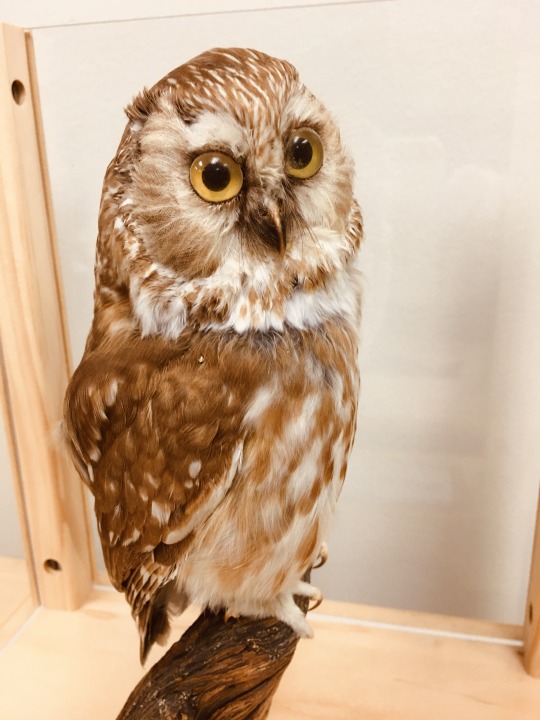
A taxidermy mount of a Northern Saw-whet Owl is a popular attraction in Discovery Basecamp.

A relatively recent experience leads me to view this explanation as within the realm of possibility. One fall day four years ago, while I was rolling a cart bearing owl taxidermy mounts into a basement classroom, a visitor stopped me by pointing directly at the smallest bird in the set. “Might I have seen this bird last week?” he asked excitedly. “At a bus stop??  On the Northside???” He then explained how the owl had been perched motionless at eye-level within leafy bushes beside a bus shelter, and that, “The owl was still there when I got on my bus.”

The museum basement, I later learned, has a direct claim to an even more remarkable sighting of species now being widely celebrated for cuteness and resilience on social media. In Birds of Western Pennsylvania, the encyclopedic 1940 volume written by the museum’s then Curator of Ornithology, W.E. Clyde Todd, the account for Northern Saw-whet Owl includes this note:

“A curious instance of a young bird found alive in one of the basement storerooms of the Carnegie Museum in June, 1927, was duplicated in July, 1932. There must have been a nesting pair in the immediate vicinity, although one would scarcely expect this owl within the city limits.”

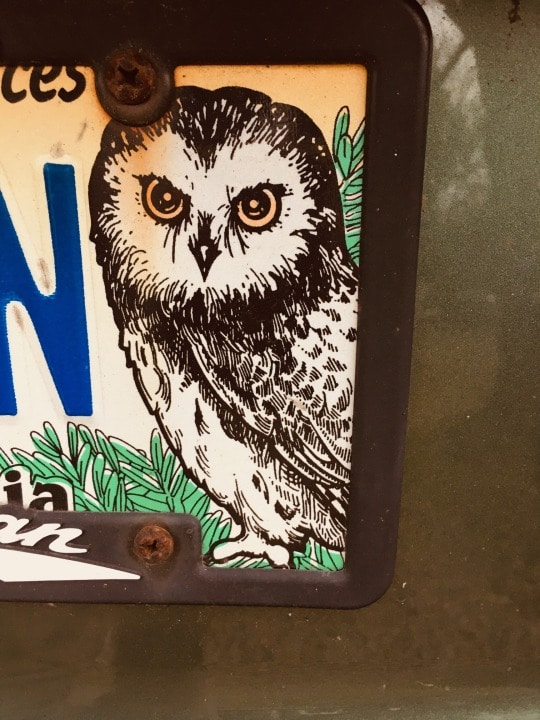
Because the Saw-whet was the original mascot of PA’s Wild Resources Conservation Program, some vehicles still carry license plates bearing ¾ size images of the owl.

For the past seven years, proof of the owl’s seasonal movements through the Pittsburgh area has been found in Sewickley Heights Borough Park where Bob Mulvihill, ornithologist at the National Aviary, has operated a Project Owlnet banding station during the late fall. Information about this important local research can be found on the National Aviary website.

To see a video of a Northern Saw-whet Owl recently banded at Powdermill Nature Reserve, please visit the museum’s TikTok.

Patrick McShea works in the Education and Visitor Experience department of Carnegie Museum of Natural History. Museum employees are encouraged to blog about their unique experiences and knowledge gained from working at the museum.

Related Content

Fraser Fir

Extinct Ornaments

Weighing She-Ra the American Kestrel

Filed Under: Blog Tagged With: Birds, Educators, Museum from Home, Pat McShea

November 11, 2020 by wpengine

Veterans Day

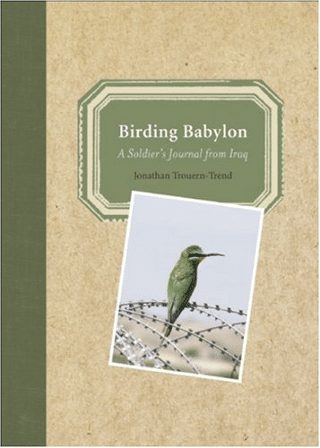
cover of the book Birding Babylon: A Soldier's Journal from Iraq by Jonathan Trouern-Trend

Every November, Veterans Day reminds us to acknowledge the sacrifice of fellow workers who have served in our Nation’s military. In recent years, I’ve found books can sometimes create enough common ground for such recognitions to go beyond the simple statement, “Thank you for your service.”

Birding Babylon, a pocket-sized Sierra Club book published in 2006, enabled me to learn more about CMNH Finance Manager Brian Nusida’s service as a Marine Squad Leader during two combat tours in Iraq. The book is a simple compilation of bird sighting blog posts by Sergeant First Class Jonathan Trouern-Trend, of the Connecticut National Guard, during his year-long deployment to Iraq. After reading the book, I left the copy on Brian’s desk while dropping off a routine expense report. “I didn’t know the names,” Brian reported the next time we passed in a museum hallway, “but I recognized some of the birds.” The exchange was the first of an ongoing series of conversations that have allowed me to begin understanding both the risks he faced and the responsibilities he shouldered as an American soldier.

In our most recent exchange Brian updated me on the fate of the Birding Babylon copy. “The book you left for me is currently in Afghanistan although I cannot say with who or their branch of service. I believe 3 Marines and a soldier have had that book with them over there. Some even signed the first flap before returning it. It’s a well-traveled book.”

A book I borrowed from Carnegie Library sparked a conversation with Security Guard David Lanier about his Air Force service decades ago in Vietnam. In the spring of 2018 when the Pittsburgh Arts and Lectures series brought author and University of Southern California professor Viet Thanh Nguyen to speak at Carnegie Music Hall, I prepared for the event by reading one of his recent books titled, Nothing Ever Dies: Vietnam and the Memory of War. Within that scholarly work, as part of a discussion of Zippo Lighters as icons of American military involvement in Vietnam, Nguyen refers to a 2007 publication titled Vietnam Zippos: American Soldiers’ Engravings and Stories (Sherry Buchanan, University of Chicago Press). The library had a copy of the book, and one morning when I set the copy on the counter of the Security Console to sign-out some keys, Dave took note of the cover and immediately reached for it saying, “Hey! I had one of those.” Once again, the book served as an ice breaker for later conversations about risk and responsibility of military service.

More than twenty-four years ago, Carnegie Magazine set a standard for broad sharing of information about the past service of museum employees in an article by freelance writer Mike Sajna, titled, From the Sands of Iwo Jima to Carnegie Museums: Our Guards in World War II. You can read the article here.

Patrick McShea works in the Education and Visitor Experience department of Carnegie Museum of Natural History. Museum employees are encouraged to blog about their unique experiences and knowledge gained from working at the museum.

Related Content

What Does Climate Change Mean for Western PA Farmers?

Teaching in a Pandemic

Filed Under: Blog Tagged With: Museum from Home, Pat McShea

  • « Go to Previous Page
  • Page 1
  • Interim pages omitted …
  • Page 8
  • Page 9
  • Page 10
  • Page 11
  • Page 12
  • Interim pages omitted …
  • Page 15
  • Go to Next Page »

sidebar

About

  • Mission & Commitments
  • Directors Team
  • Museum History

Get Involved

  • Volunteer
  • Membership
  • Carnegie Discoverers
  • Donate
  • Employment
  • Events

Bring a Group

  • Groups of 10 or More
  • Birthday Parties at the Museum
  • Field Trips

Powdermill

  • Powdermill Nature Reserve
  • Powdermill Field Trips
  • Powdermill Staff
  • Research at Powdermill

More Information

  • Image Permission Requests
  • Science Stories
  • Accessibility
  • Shopping Cart
  • Contact
  • Visitor Policies
Stay in the loop! Sign up for our newsletter(s).
One of the Four Carnegie Museums | © Carnegie Institute | Privacy Policy | Terms of Use | Accessibility
Rad works here logo