• Skip to primary navigation
  • Skip to main content
  • Skip to primary sidebar

Carnegie Museum of Natural History

One of the Four Carnegie Museums of Pittsburgh

  • Visit
    • Buy Tickets
    • Visitor Information
    • Exhibitions
    • Events
    • Dining at the Museum
    • Celebrate at the Museum
    • Powdermill Nature Reserve
    • Event Venue Rental
  • Learn
    • Field Trips
    • Educator Information
    • Programs at the Museum
    • Bring the Museum to You
    • Guided Programs FAQ
    • Programs Online
    • Climate and Rural Systems Partnership
  • Research
    • Scientific Sections
    • Science Stories
    • Science Videos
    • Senior Science & Research Staff
    • Museum Library
    • Science Seminars
    • Scientific Publications
    • Specimen and Artifact Identification
  • About
    • Mission & Commitments
    • Directors Team
    • Museum History
  • Tickets
  • Give
  • Shop

Patrick McShea

October 21, 2016 by wpengine

Discovery with Museum Loan Kits

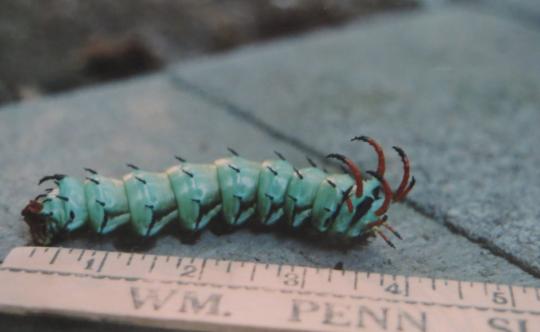
model of a caterpillar

by Patrick McShea

The first grade teacher who provided this picture didn’t realize how much it revealed about her skill in conveying scientific principles. She was more concerned about finding answers for her students’ pressing questions.

The photo and an attached note accompanied a box of preserved insect materials returned to the museum’s loan program one early November day. “A little girl found the ‘creature’ in this picture! She put it in a container and in three days it spun a hard black cocoon, also about four inches long. WHAT IS IT??? And what will
come out of the cocoon???”

Answers were quickly supplied. The mysterious creature was a caterpillar known as a hickory horned devil, the larval stage of the moth bearing the scientific name Citheronia regalis, and the common names regal moth and royal walnut moth. The caterpillars are harmless to touch, but as noted in the USDA Forest Service
publication, Caterpillars of Eastern Forests, hickory horned devils are the “largest and most formidable appearing eastern forest insect.”
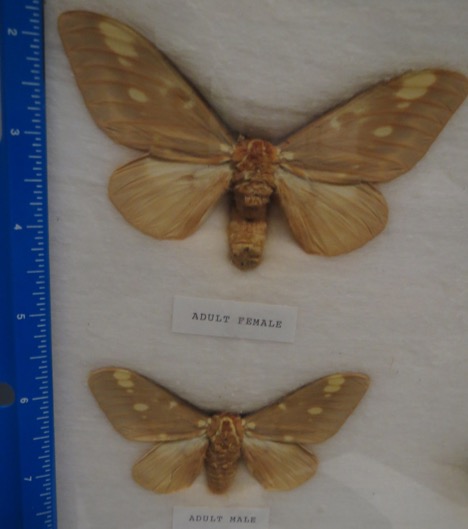
regal moths

The teacher’s next loan of museum materials included preserved specimens of regal moths (above), and a note praising the use of a ruler as a scale bar in the caterpillar photo. First grade is not too early to learn the importance of making objective measurements when sharing first hand observations, even when the subject is a frightening looking caterpillar.

Pittsburgh teachers looking to learn more about our loan program can visit our website. Schools can have unlimited access to the museum’s loan collection for $200 a year.

Patrick McShea works in the Education and Visitor Experience department of Carnegie Museum of Natural History. Museum employees are encouraged to blog about their unique experiences and knowledge gained from working at the museum.
Filed Under: Blog Tagged With: museums, Patrick McShea, Pittsburgh

October 18, 2016 by wpengine

Deforestation Damages

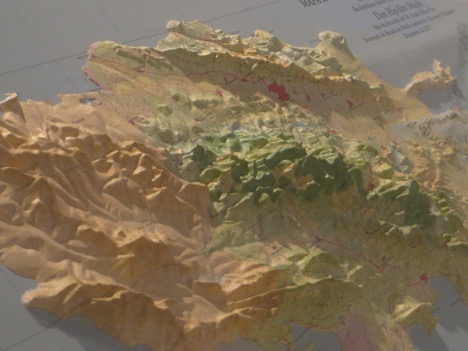
3D map of deforestation

by Patrick McShea

Museum exhibits frequently provide information to help us better understand current headlines. In the case of the devastation Hurricane Matthew recently caused in Haiti, a three dimensional map in the exhibition Population Impact (pictured above) indicates pervasive deforestation across that impoverished Caribbean nation.

The map the depicts the island of Hispaniola. The Dominican Republic encompasses the eastern portion of this mountainous island, and Haiti makes-up the western portion. Shades of deep green, which denote forest cover, crown the highest peaks on the Dominican side of the island. On the Haitian side, the pale brown shades that indicate crop land and pasture stretch from ocean edge to the crests of the highest and steepest ridges.

On the portion of Hispaniola directly in the hurricane ’s path, deforested slopes compounded the destructive power of torrential rain.  According to USA Today, less than 2% of Haiti’s land is still forested, making it one of the most deforested countries in the world. The countries steep terrain, clearly seen in our exhibit, also make the country more vulnerable to landslides and mudslides.

Read more about how deforestation left Haiti especially vulnerable to Hurricane
Matthew, and about the hurricane’s devastating effects on the people who live there.

Patrick McShea works in the Education and Visitor Experience department of Carnegie Museum of Natural History. Museum employees are encouraged to blog about their unique experiences and knowledge gained from working at the museum.

Filed Under: Blog Tagged With: Patrick McShea

September 2, 2016 by wpengine

Selected for Speed

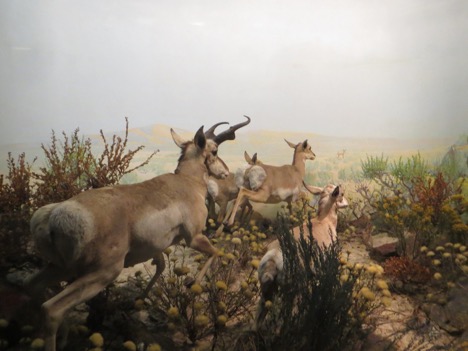
Pronghorn Antelopes in a diorama by Patrick McShea

At first it seems absurd to discuss speed in front of adiorama in which nothing moves. With appropriate prompts, however, this threedimensional snapshot of galloping pronghorn antelopes can generate an astonishing level of mind’s eye animation.

When viewed from dusty Wyoming roadsides, distant pronghorns appear to gallop without sound, even when their pace suddenly changes and their speed doubles for 100-yard stretches.

At the close vantage point offered by the diorama, such antelope maneuvers would undoubtedly produce a sensory mix of blurred furred forms, the staccato clatter of hooves against rock, and the powerful scent of crushed sage.

The species’ blazing speed invites speculation about its evolutionary history. Could pronghorn antelopes be adapted to elude a predator no longer found on western landscapes? A large extinct cat termed an American cheetah is sometimes cited as the missing participant in this natural selection process.

Fossil evidence examined during the past 25 years complicates this narrative. Paleontologists point to expansive ranges for these big cats that include mountainous areas and sea coasts, and the absence, to date, of sites containing both cat and antelope fossils.

With the identity of the pronghorn’s prehistoric predator unsettled, a viewing position in front of the diorama is a place to ponder possibilities.


Patrick McShea works in the Education and Visitor Experience department of Carnegie Museum of Natural History. Museum employees are encouraged to blog about their unique experiences of working at the museum.

Filed Under: Blog Tagged With: diorama, fossils, museums, Patrick McShea, Pittsburgh

August 25, 2016 by wpengine

Salamander Forests in Pa.

red eft salamander

by Patrick McShea

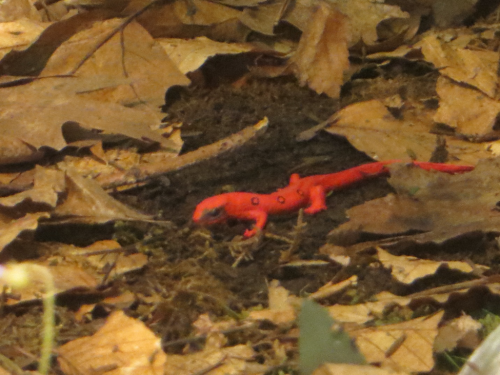
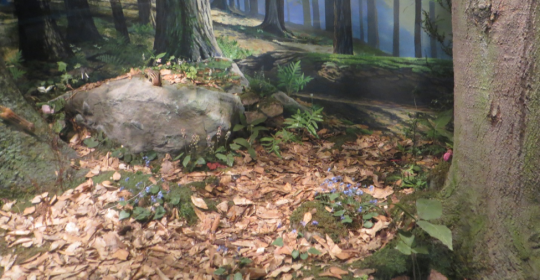
Within a Hall of Botany diorama depicting old growth Pennsylvania forest, a ferocious predator lurks amid dried oak, maple, and beech leaves. No snail, worm, or ground-dwelling insect is safe in the damp realm where this bright amphibian prowls.

The three-inch-long salamander is a red eft, the name given the land-dwelling middle life stage of the otherwise aquatic red-spotted newt. The creature’s solitary presence in the exhibit accurately reflects what you might hope
to see during a visit to a real old growth glen. At such a place, however, plenty of the eft’s near and distant salamander kin would almost certainly be lurking just out of sight.

salamander forest display

Pennsylvania supports 22 species of salamanders, the majority of which spend at least part of their lives foraging in habitat where trees, deep shade, damp leaf litter, loose soil, rotting logs, and mossy rocks occur. If the results of a 2014 University of Missouri study of salamander abundance in Ozark forests can be extrapolated to our region, the total biomass of salamanders inhabiting many wooded tracts rivals that of white-tailed deer.

Because these salamanders eat invertebrates that eat leaf litter, the abundance of the tiny predators helps forests to be places where a portion of the carbon pulled from the atmosphere by trees is stored in leaf litter.


Patrick McShea works in the Education and Visitor Experience department of Carnegie Museum of Natural History. Museum employees are encouraged to blog about their unique experiences of working at the museum.

Filed Under: Blog Tagged With: botany hall, forests, Patrick McShea, pennsylvania

August 15, 2016 by wpengine

An Immersive Alaskan Scene

Bears in a diorama in the Hall of North American Wildlife
by Patrick McShea

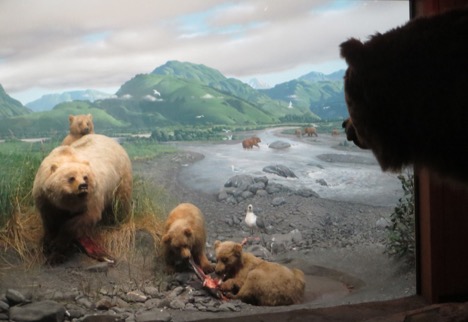
Well planned dioramas support multiple levels of interpretation. At the Alaskan Brown Bear diorama, however, it’s initially difficult to consider any narrative not focused upon these powerful creatures.

The Kodiak Island scene features nine brown bears – four distant bears are painted into the backdrop landscape and taxidermy mounts of an adult female and three cubs fill the diorama’s left foreground. Facing them from a four-foot high rock ledge outside the exhibit glass, a large male bear adds tension to the display.

The noses of the two adult two adult bears are less than 13 feet apart, a narrow zone that is routinely occupied by museum visitors when they read an adjacent label that highlights the potential for a violent encounter. “Male bears routinely prey on cubs. Fiercely protective, mother bears are known to attack and may even kill larger males that come too close.”

This immersive aspect was created during a 1995 renovation that extensively upgraded an exhibit originally dedicated in 1918.

The upgrade also involved the replacement of king salmon with red or sockeye salmon to accurately represent the species whose summer spawning runs draw bears to the stream. The diorama’s immersive zone is the perfect place to consider how the pair of cubs eating a single fish can represent an enormous transfer of nutrients between ocean and forest ecosystems.

When spawning red salmon return to the stream in which they were born, they do so after spending as long as four years at sea. If they manage to avoid bears and other predators, they still die, often far inland, within a few weeks of spawning. Research studies into the ecological impact of salmon runs have charted the movement of stable nitrogen isotopes from salmon tissue to the stems and leaves of streamside vegetation. The bears, in such cycles, are just intermediary processors.

Patrick McShea works in the Education and Visitor Experience department of Carnegie Museum of Natural History. Museum employees are encouraged to blog about their unique experiences of working at the museum.

Filed Under: Blog Tagged With: diorama, Hall of North American Wildlife, Patrick McShea, Pittsburgh

August 4, 2016 by wpengine

Photo Traps in Conservation

Photo Trap Display

by  Patrick McShea

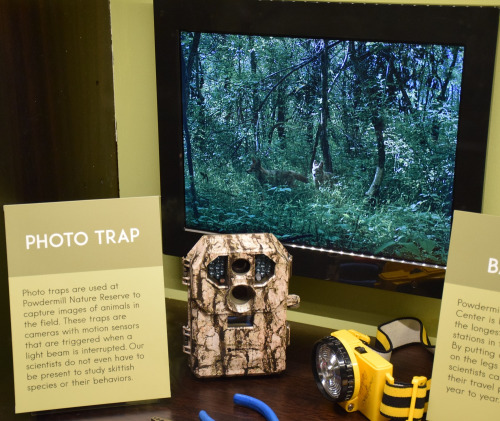
In the Hall of North American Wildlife at Carnegie Museum of Natural History, there’s a display of field
research tools that includes a 14-inch screen that continually shows still images of  bobcats, black bears, and
other seldom seen residents of Powdermill Nature Reserve, the museum’s environmental research center. The images were collected in photo traps, sturdy programmable cameras with shutters triggered by motion or heat sensors.

A photo trap unit rests adjacent to the screen with its lights, lens, and sensors facing outward. The compactness
of the camouflage-patterned device contrasts with enormous contributions such cameras are currently making in wildlife conservation studies. Single cameras can collect photographic evidence of rarely seen species at a low financial cost and with minimal disturbance of the targeted creatures. Arrays of strategically placed cameras can be used to calculate population densities and chart individual territories.

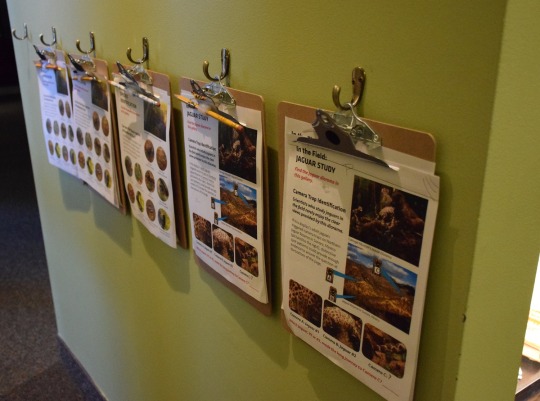
Around the corner from the display a clipboard-mounted activity sheet invites visitors to try their skill at interpreting photo trap evidence at the nearby Jaguar diorama.

clipboards hanging on the wall with activity sheets

For anyone interested in how photo traps are documenting the
continued presence jaguars and ocelots in the American southwest, the US Fish
and Wildlife Service maintains a site of spotted cat images.

Patrick McShea works in the Education and Visitor Experience department of Carnegie Museum of Natural History. Museum employees are encouraged to blog about their unique experiences of working at the museum.

Filed Under: Blog Tagged With: conservation, fieldwork, Hall of North American Wildlife, Patrick McShea

  • « Go to Previous Page
  • Page 1
  • Interim pages omitted …
  • Page 5
  • Page 6
  • Page 7
  • Page 8
  • Page 9
  • Go to Next Page »

sidebar

About

  • Mission & Commitments
  • Directors Team
  • Museum History

Get Involved

  • Volunteer
  • Membership
  • Carnegie Discoverers
  • Donate
  • Employment
  • Events

Bring a Group

  • Groups of 10 or More
  • Birthday Parties at the Museum
  • Field Trips

Powdermill

  • Powdermill Nature Reserve
  • Powdermill Field Trips
  • Powdermill Staff
  • Research at Powdermill

More Information

  • Image Permission Requests
  • Science Stories
  • Accessibility
  • Shopping Cart
  • Contact
  • Visitor Policies
One of the Four Carnegie Museums | © Carnegie Institute | Privacy Policy | Terms of Use | Accessibility
Rad works here logo